Questions · Page 3 of 6

M.C.Q

Question 1011 Mark
Write the correct answer in the following:
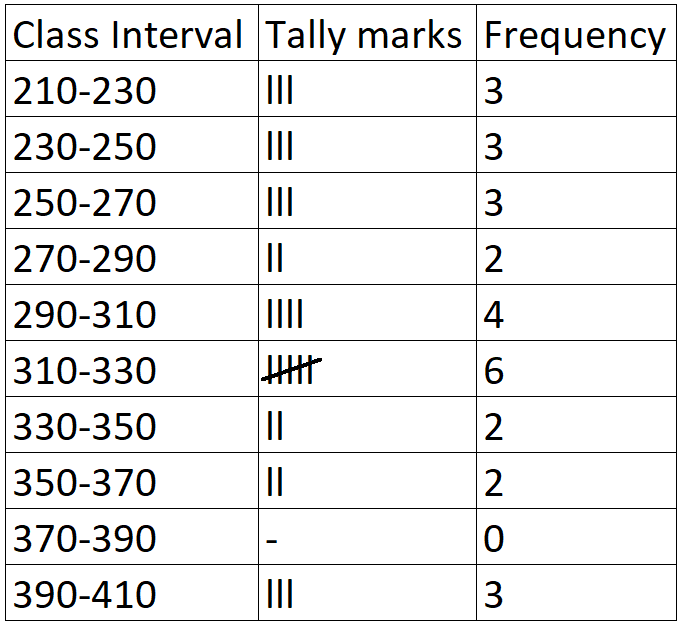
A grouped frequency table with class intervals of equal sizes using 250-270 (270 not included in this interval) as one of the class interval is constructed for the following data:
268, 220, 368, 258, 242, 310, 272, 342, 310, 290, 300, 320, 319, 304, 402, 318, 406, 292, 354, 278, 210, 240, 330, 316, 406, 215, 258, 236.
The frequency of the class 310-330 is:
Answer
  1. 6
Solution:
The observation corresponding to class 310–330 (330 not included in this interval) are 310, 310, 320, 319, 318, 316, i.e., 6 observations.
View full question & answer
Question 1021 Mark
The number of times a particular item occurs in a given data is called its:
Answer
  1. Frequency.
Solution:
The number of times a particular item occurs in a given data is called the frequency of the item. Hence, the correct choice is (b).
View full question & answer
Question 1031 Mark
The class-mark of the class 130-150 is:
Answer
  1. 140
Solution:
Class mark $=\frac{130+150}{2}=\frac{280}{2}=140$
View full question & answer
Question 1041 Mark
The smallest of three consecutive even integers is 32. Then, the mean of the three integers is:
Answer
  1. 34
Solution:
32 is the smallest even integer.
So three consecutive even integers are 32, 34 and 36
The mean is equal to the sum of all the values in the data set divided by the number of values in the data set.
$\frac{32+34+36}{3}=34$
View full question & answer
Question 1051 Mark
The following marks were obtained by the students in a test:
81, 72, 90, 90, 86, 85, 92, 70, 71, 83, 89, 95, 85, 79, 62
The range of the marks is:
Answer
  1. 33
Solution:
The marks obtained by the students are 81, 72, 90, 90, 86, 85, 92, 70, 71, 83, 89, 95, 85, 79 and 62.
The highest and lowest marks are 95 and 62 respectively. Therefore, the range of marks is
95 - 62
= 33
Hence, the correct option is (d).
View full question & answer
Question 1061 Mark
Median of the following observations, arranged in an ascending order is 22. If the numbers are 8, 11, 13, 15, x + 1, x + 3, 30, 35, 40, 43. Then, the value of x is:
Answer
  1. 20
Solution:
The median is the middle score for a set of data that has been arranged in ascending or descending order of magnitude.
For even number of observations, median is calculated as average of two middle number
$22=\frac{(\text{x}+1)+(\text{x}+3)}{2}$
$44=2\text{x}+4$
$40=2\text{x}$
$\text{x}=20$
View full question & answer
Question 1071 Mark
Write the correct answer in the following:
The range of the data: 25, 18, 20, 22, 16, 6, 17, 15, 12, 30, 32, 10, 19, 8, 11, 20 is:
Answer
  1. 26
Solution:
Maximum value of the variate = 32
And the minimum value of the variate = 6
Range = Maximum value of the variate-Minimum value of the variate = 32 - 6 = 26
View full question & answer
Question 1081 Mark
The mean of the marks scored by 50 students was found to be 39. Later on it was discovered that a score of 43 was misread as 23. The correct mean is:
Answer
  1. 39.4
Solution:
Calculted mean of 50 students = 39
$\therefore\ $Calculated sum of these numbers = 39 × 50 = 1950
Correct sum of these numbers = 1950 - (wrong term) + (correct term)
= 1950 - 23 + 43
= 1970
$\therefore\ $the corrected mean $=\frac{1970}{50}$
$=39.4$
View full question & answer
Question 1091 Mark
If the less than ogive and the more than ogive intersect at (32, 48), then the median of the data is:
Answer
  1. 32
Solution:
If the less than ogive and the more than ogive intersect at (32, 48), then the median of the data is 32. Because on the graph, the point of the x-axis, where less than ogive and more than ogive intersects, is the median. Therefore, the Median of the data is 32.
View full question & answer
Question 1101 Mark
A frequency polygon is constructed by plotting frequency of the class interval and the:
Answer
  1. Mid value of the class.
Solution:
Frequency polygon is the plot of frequencies vs. the mid values of the classes.
View full question & answer
Question 1111 Mark
There are 50 numbers. Each number is subtracted from 53 and the difference between the mean of the numbers so obtained is found to be -3.5. The mean of the given number is:
Answer
  1. 56.5
Solution:
Let the mean of the initial sequence is x.
Given that, after subtracting 53 from each number, the difference between the means is 3.5
So, x - 53 = 3.5
Mean of the number is x = 53 + 3.5 = 56.5
View full question & answer
Question 1121 Mark
For a given data, the difference between the maximum and minimum observation is known as its.
Answer
  1. Range
Solution:
Difference between maximum and minimum value of observation is called as range.
View full question & answer
Question 1131 Mark
The mean of 50 observations is 39. If one of the observations which was 23 was replaced by 43, the resulting mean will be:
Answer
  1. 39.4
Solution:
The mean of 50 observations is 39.
So sum of these 50 observations is 50 × 39 = 1950
After replacing the observation value 23 by 43,
Sum becomes 1970
So the mean is $\frac{1970}{50}=39.4$
View full question & answer
Question 1141 Mark
$\text{Mode}+\frac{2}{3}(\text{Mean - Mode})=$
Answer
  1. Median
Solution:
Since, 3 Median = Mode + 2 Mean
$\Rightarrow\text{Median}=\frac{\text{Mode}}{3}+\frac{2}{3}\text{Mean}$
$=\frac{\text{Mode}}{3}+\frac{2}{3}\text{Mean}-\frac{2}{3}\text{Mode}+\frac{2}{3}\text{Mode}$
$\text{Median}=\text{Mode}+\frac{2}{3}(\text{Mean - Mode})$
View full question & answer
Question 1151 Mark
Which one of the following is not a measure of central tendency?
Answer
  1. Variance
Solution:
Median and Mode are the most common measures of central tendency.
These may be considered depending on the type of data and data distribution
Variance measures how far the data set is spread out and is not a measure of central tendency.
View full question & answer
Question 1161 Mark
In a histogram, which of the following is proportional to the frequency of the corresponding class?
Answer
  1. Area of the rectangle.
Solution:
In, Histogram each rectangle is drawn, where width equivalent to class interval and height equivalent to the frequency of the class.
Since class interval are same across the distribution table, area of the rectangle is corresponding to frequency or height of the rectangle.
View full question & answer
Question 1171 Mark
The width of each of five continuous classes in a frequency distribution is 5 and the lower-class limit of the lowest class is 10. The upper-class limit of the highest class is:
Answer
  1. 35
Solution:
The classes are 10-15, 15-20, 20-25, 25-30, 30-35 so that upper limit of the highest class is 35.
View full question & answer
Question 1181 Mark
A data is such that its maximum value is 75 and range is 20, then the minimum value is:
Answer
  1. 55
Solution:
Difference between the maximum and minimum value of the observations is called as range.
Let, minimum value be 'x'
75 - x = 20
So, x = 55
View full question & answer
Question 1191 Mark
Write the correct answer in the following:
The class marks of a frequency distribution are given as follows: 15, 20, 25, .... The class corresponding to the class mark 20 is:
Answer
  1. 17.5 - 22.5
Solution:
The class mark are 15, 20, 25, ….
The size of each class interval is 25 - 20 = 20 - 15 = 5
Hence, the class interval corresponding to the class mark 20 is,
(20 - 2.5) - (20 + 2.5) i.e., 17.5 - 22.5.
So, (b) is the correct answer.
View full question & answer
Question 1201 Mark
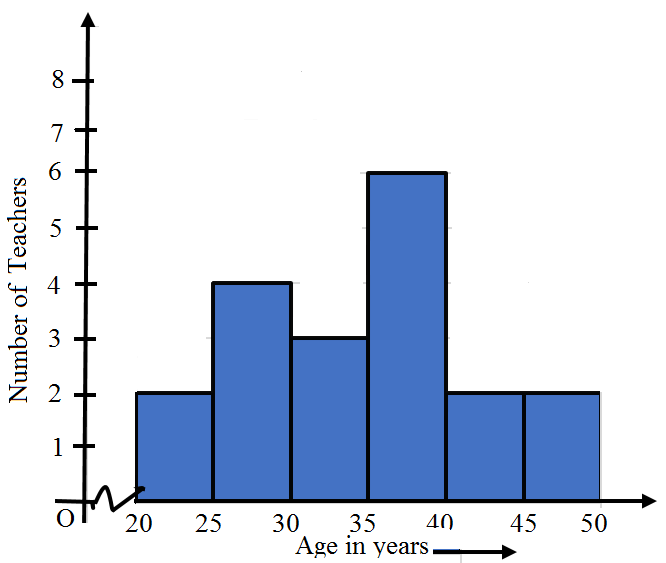
The graph given below shows the frequency distribution of the age of 22 teachers in a school. The number of teachers whose age is less than 40 years is:
Answer
  1. 15
Solution:
Add the values corresponding to the height of the bar before 40.
6 + 3 + 4 + 2 = 15.
View full question & answer
Question 1211 Mark
The mean of prime numbers between 30 and 40 is:
Answer
  1. 34
Solution:
Prime numbers between 30 and 40 are 31 and 37.
Mean $=\frac{31+37}{2}$
Mean $=34$
View full question & answer
Question 1221 Mark
Mean – Mode =
Answer
  1. 3(Mean – Median)
Solution:
Since, Mean – Mode + Mean + 2 Mode = 3 Median
⇒ Mean – Mode = 3 Median – Mean – 2 Mode
= 3 Median – Mean – 2 (3 Median – 2 Mean)
= 3 Median – Mean – 6 Median + 4 Mean
= 3 Mean – 3 Median
= 3 (Mean – Median)
View full question & answer
Question 1231 Mark
To analyse the election results, the data is collected from a newspaper. The data thus collected is known as:
Answer
  1. Secondary data.
Solution:
Secondary data is the readily available data collected by someone else & published in newspapers or journals etc.
View full question & answer
Question 1241 Mark
Median of the following numbers: 4, 4, 5, 7, 6, 7, 7, 12, 3 is:
Answer
  1. 6
Solution:
The observations in ascending order can be written as:
3, 4, 4, 5, 6, 7, 7, 7, 12
Median $=\Big(\frac{9+1}{2}\Big)\text{th}$ term = 5th term = 6
View full question & answer
Question 1251 Mark
The following marks were obtained by the students in a test:
81, 72, 90, 90, 86, 85, 92, 70, 71, 83, 89, 95, 85, 79, 62
The range of the marks is.
Answer
  1. 33
Solution:
Range of observations = Highest observation - Lowest observation
= 95 - 62 = 33
View full question & answer
Question 1261 Mark
Mode of the data 15, 14, 19, 20, 14, 15, 16, 14, 15, 18, 14, 19, 15, 17, 15 is:
Answer
  1. 15
Solution:
We first arrange the given data in ascending order as follows 14, 14, 14, 14, 15, 15, 15, 15, 15, 16, 17, 18, 19, 19, 20
From above, we see that 15 occurs most frequently i.e., 5 times.
Hence, the mode of the given data is 15.
View full question & answer
Question 1271 Mark
 What is class size of interval 10, 12, 14, 16, 18?
Answer
  1. 2
Solution:
Difference between the successive values of the class is called the class size.
View full question & answer
Question 1281 Mark
In a frequency distribution, the mid-value of a class is 10 and width of each class is 6. The lower limit of the class is:
Answer
  1. 7
Solution:
Given,
Mid value of the class = 10
Width of each class = 6
Now,
Let the lower limit be x.
We know,
Upper limit = Lower limit + class size
 = x + 6
Also,
Mid value $=\frac{\text{x}+\text{x}+6}{2}$
$=\frac{2\text{x}+6}{2}=\text{x}+3$
$\Rightarrow\text{x}+3=10$
$\Rightarrow\text{x}=7$
Thus, the lower limit is 7.
View full question & answer
Question 1291 Mark
If x is the mean of $x_1, x_2, ..... x_n, y$ is the mean of $y_1, y_2, ... x_n,....y_n,$ then $z$ the mean of $x_1, x_2, ....x_{n,} y_1, y_2, ....yn$ is equal to:
Answer
Since $x¯$ and $y¯$ are two numbers, though being means, their arithmetic mean is given by: $\text{z}=\frac{\text{x and y}}{2}$
View full question & answer
Question 1301 Mark
The median and mode of distribution are 20 and 18, then the mean is:
Answer
  1. 21
Solution:
3 Median = 2 × Mean + Mode
⇒ 3 × 20 = 2 × Mean + 18
⇒ 2 × Mean = 60 - 18 = 42
⇒ Mean = 21
View full question & answer
Question 1311 Mark
More than’ cumulative frequency table for a given data is as follows: Then, the frequency of the class interval 70-80 is:
Marks
More than 89
More than 79
More than 69
More than 59
Cumulative frequency
8
18
30
65
Answer
  1. 12
Solution:
A cumulative frequency distribution is the sum of the class and all classes below it in a frequency distribution.
Subtract cumulative frequency of class more than 70 from the next cummulative Frequency of class more than 69.
30 − 18 = 12
View full question & answer
Question 1321 Mark
Write the correct answer in the following:
Median of the following numbers, 4, 4, 5, 7, 6, 7, 7, 12, 3 is:
Answer
  1. 6
Solution:
First, we arrange the given numbers in ascending order is,
3, 4, 4, 5, 6, 7, 7, 7 and 12
Here, n = 9
Since, n is odd, so we use the formula for median,
Now, Median $=\Big(\frac{\text{n}+1}{2}\Big)^{\text{th}}\text{observation}$
$=\Big(\frac{9+1}{2}\Big)^{\text{th}}\text{observation}$ [Put n = 9]
$=\Big(\frac{10}{2}\Big)^{\text{th}}\text{observation}$
$=5^{\text{th}}\text{observation}=6$ 
View full question & answer
Question 1331 Mark
The marks obtained by 17 students in a mathematics test (out of 100) are given below:
91, 82, 100, 100, 96, 65, 82, 76, 79, 90, 46, 64, 72, 68, 66, 48, 49.
Find the range of the data.
Answer
  1. 54
Solution:
Highest Marks = 100
Lowest Marks = 46
Range of data = 100 - 46 = 54
View full question & answer
Question 1341 Mark
In a frequency distribution, the mid-value of a class is 60.5 and the width of the class is 10. The lower limit of the class is:
Answer
  1. 55.5
Solution:
upper limit - lower limit = class width
upper limit - lower limit = 10
$\frac{\text{(upper limit + lower limit)}}{2}=\text{mid}-\text{value}$
upper limit + lower limit = 2 × 60.5
upper limit + lower limit = 121
By solving the above two equations, we get
upper limit = 65.5
Lower limit = 55.5
View full question & answer
Question 1351 Mark
The range of the data
12, 25, 15, 18, 17, 20, 22, 6, 16, 11, 8, 19, 10, 30, 20, 32 is:
Answer
  1. 26
Solution:
We have:
Maximum value = 32
Minimum value = 6
We know:
Range = Maximum value - minimum value
= 32 - 6
= 26
View full question & answer
Question 1361 Mark
Find the median of the given data: 7, 8, 7, 7, 9, 10, 13.
Answer
  1. 8
Solution:
Arrange the given data in ascending order.
7, 7, 7, 8, 9, 10, 13
For odd number (n) of observation median $=\Big[\frac{(\text{n+1)}}{2}\Big]\text{th}$ term,
Here n = 7 so median $=\Big[\frac{{(7+1)}}{2}\Big]\text{th}$ term = 4th term that is 8,
Hence median = 8
View full question & answer
Question 1371 Mark
The median of the numbers $4, 4, 5, 7, 6, 7, 7, 12, 3$ is:
Answer
Arranging the points in an ascending order,
We have:
$3, 4, 4, 5, 6, 7, 7, 7, 12$
Here$, n = 9,$ Which is odd
$\therefore\ $median score = value of $\frac{1}{2}(9+1)^\text{th}$ terms
$=$ value of $\Big(\frac{1}{2}\times10\Big)^\text{th}$ term
$=$ value of $5^{th}$ term
$= 6$
View full question & answer
Question 1381 Mark
If $x$ is the mean of $x_1, x_2, ..., X_n$ then for $\text{a}\neq0,$ the mean of $\text{ax}_1,\ \text{ax}_2,\ ...,\ \text{ax}_\text{n},\ \frac{\text{x}_1}{\text{a}},\ \frac{\text{x}_2}{\text{a}},\ ...,\ \frac{\text{x}_\text{n}}{\text{a}}$ is:
Answer
Mean of $ax_1, ax_2, ..., ax_n$, is $\text{a}\bar{\text{x}}$
Mean of $\frac{\text{x}_1}{\text{a}},\ \frac{\text{x}_2}{\text{a}},\ ...,\ \frac{\text{x}_\text{n}}{\text{a}}$ is $\frac{1}{\text{a}}\bar{\text{x}}$
so the their mean is $\Big(\text{a}+\frac{1}{\text{a}}\Big)\frac{\bar{\text{x}}}{2}.$
View full question & answer
Question 1391 Mark
In the class intervals 10-20, 20-30, the number 20 is included in:
Answer
  1. 20-30
Solution:
This is the continuous from of frequency distribution. Here, the upper limit of each class is excluded, while the lower limit is included. So, the number 20 is included in the class interval 20-30.
View full question & answer
Question 1401 Mark
A grouped frequency table with class intervals of equal sizes using 250-270 (270 not included in this interval) as one of the class interval is constructed for the following data :
268, 220, 368, 258, 242, 310, 272, 342, 310, 290, 300, 320, 319, 304, 402, 318, 406, 292, 354, 278, 210, 240, 330, 316, 406, 215, 258, 236. The frequency of the class 310-330 is:
Answer
  1. 6
Solution:
The class interval is 250 - 270, 270 not included.
It means that the class is continuous.
Also, the data can be tabulated as follows:

Thus, frequency of the class 310 - 330 is 6 as can be seen from the table.
View full question & answer
Question 1411 Mark
A, B, C are three sets of values of x:
A: 2, 3, 7, 1, 3, 2, 3
B: 7, 5, 9, 12, 5, 3, 8
C: 4, 4, 11, 7, 2, 3, 4
Which one of the following statements is correct?
Answer
  1. Mean, Median and Mode of A are equal.
Solution:
A: 1, 2, 2, 3, 3, 3, 7
B: 3, 5, 5, 7, 8, 9, 12
C: 2, 3, 4, 4, 4, 7, 11
$\text{Mean of A}=\frac{1+2+2+3+3+3+7}{7}$
$=\frac{21}{7}=3$
$\text{Mean of B}=\frac{3+5+5+7+8+9+12}{7}$
$=\frac{49}{7}=7$
$\text{Mean of C}=\frac{2+3+4+4+4+7+11}{7}$
$=\frac{35}{7}=5$
Mode of A = 3; Median of A = 3
Mode of B = 5; Median of B = 7
Mode of C = 4; Median of C = 4
(Mean of A = 3) $\neq$ (Mode of C = 4)
(Mean of C = 5) $\neq$ (Median of B = 4)
(Median of B = 7) $\neq$ (Mode of A = 3)
Mean of A = 3, Mode of A = 3, Median of A = 3
View full question & answer
Question 1421 Mark
The mean of $n$ observations is $x$ If the first item is increased by $1,$ second by $2,$ third by $3$ and so on, then the new mean is:
Answer
If the first item is increased by $1, $second by $2,$ third by $3$ and so on,
So the new sequence thus formed is $ x_1 + 1, x_2 + 2, x_3 + 3 ...... x_n + n$
So the new mean is increased by $\frac{\text{n}+1}{2}$
So the new mean is $\text{x}+\frac{\text{n}+1}{2}$
Where $x$ is the mean of first $n$ numbers.
View full question & answer
Question 1431 Mark
The given data is 3, 5, 6, 7, 5, 4, 7, 5, 6, x, 8 and 7. Then the value of x for which the mode of the above data will be 7, is:
Answer
  1. 7
Solution:
The mode in a list of numbers refers to the integers that occur most number of times.
In the given list 5 occur three times and 7 occurs three times.
For 7 to be mode of the list it should occur more number of times than any other number
So x should be 7.
Mode = 7
View full question & answer
Question 1441 Mark
Write the correct answer in the following:
There are 50 numbers. Each number is subtracted from 53 and the mean of the numbers so obtained is found to be -3.5. The mean of the given numbers is:
Answer
  1. 56.5
Solution:
Given, n = 50, then mean $\bar{\text{x}}=\frac{\sum\limits^{\text{n}}_{\text{i}=1}\text{x}_\text{i}}{\text{n}}$
Then, $\bar{\text{x}}=\frac{1}{50}\times\sum\limits^{50}_{\text{i}=1}\text{x}_\text{i}$
$\Rightarrow\sum\limits^{50}_{\text{i}=1}\text{x}_\text{i}=50\bar{\text{x}}$
Now, subtract each observation from 53, we get a new mean say $\bar{\text{x}}_\text{new}$
$\therefore\ \bar{\text{x}}_\text{new}=\frac{(-\text{x}_1+53)+(-\text{x}_2+53)\ +\ .....\ +(-\text{x}_{50}+53)}{50}$
$\Rightarrow-3.5=\frac{-(\text{x}_1+\text{x}_2\ +\ .....\ +\text{x}_{50})+(53+53\ +\ ....\ +50\text{times})}{50}$
$\Rightarrow-3.5\times50=(-\text{x}_1+\text{x}_2+\ ....\ +\text{x}_{50})+53\times50$
$\therefore$ Mean of 50 observation $=\frac{1}{50}\sum\limits^{50}_{\text{i}=1}\text{x}_{\text{i}}$
$=\frac{1}{50}\times2852=56.5$ $\Bigg[\because\text{ mean}=\frac{\sum\limits^{\text{n}}_{\text{i}=1}\text{x}_\text{i}}{\text{n}}\Bigg]$
Hence, the mean of given number is 56.5
View full question & answer
Question 1451 Mark
If the mean of x, x + 3, x + 5, x + 7, x + 10 is 9, the mean of the last three observation is:
Answer
  1. $11\frac{1}{3}$
Solution:
Mean of 5 observations = 9
$\text{Mean}=\frac{\text{Sum of all observations}}{\text{Total number of observation}}$
$\Rightarrow9=\frac{\text{x}+\text{x}+3+\text{x}+5+\text{x}+7+\text{x}+10}{5}$
$\Rightarrow9=\frac{5\text{x}+18}{5}$
$\Rightarrow45=5\text{x}+18$
$\Rightarrow5\text{x}=20$
$\Rightarrow\text{x}=4$
So, the mean of the last three observations
$=\frac{\text{x}+5+\text{x}+7+\text{x}+10}{3}$
$=\frac{4+5+4+7+4+10}{3}$
$=\frac{34}{3}$
$=11\frac{1}{3}$
View full question & answer
Question 1461 Mark
Which one of the following is not a measure of central value?
Answer
  1. Range.
Solution:
The difference between the highest value and the lowest value in the data set is called Range.
View full question & answer
Question 1471 Mark
Write the correct answer in the following:
Let m be the mid-point and l be the upper class limit of a class in a continuous frequency distribution. The lower class limit of the class is:
Answer
  1. 2m - l
Solution:
Let x and y be the lower and upper class limit of a continuous frequency distribution.
Now, mid-point of a class $=\frac{(\text{x}+\text{y})}{2}=\text{m}$ [given]
⇒ x + y = 2m = x + l = 2m
$\big[\therefore$ y = l = upper class limit (given)$\big]$
⇒ x = 2m - l
Hence, the lower class limit of the class is 2m - l.
View full question & answer
Question 1481 Mark
The width of each of nine classes in a frequency distribution is $2.5$ and the lower class boundary of the lowest class $10.6$. Then the upper class boundary of the highest class is:
Answer
Number of classes $= 9$
Lower limit of the lowest class $= 10.6$
Width of each class $= 2.5$
So, Upper limit of the lowest class $= 10.6 + 2.5 = 13.1$
Now, Upper limit of the lowest class $+$ Width of each class $=$ Upper limit of the next class
Thus, we have
Upper limit of the lowest class $ +\  8\  \times$ width of each class $=$ Upper limit of the highest $(9^{th})$ class
Upper limit of the highest $(9^{th})$ class $= 13.1 + 8 \times 2.5 = 33.1$
View full question & answer
Question 1491 Mark
Let $\bar{\text{x}}$ be the mean of $x_1, x_2, ..., x_n$ and $\bar{\text{y}}$ be the mean of $y_1, y_2, ..., y_n$. If $\bar{\text{z}}$ is the mean of $x_1, x_2, ..., x_n, y_1, y_2, ..., y_n$ then $\bar{\text{z}}=$ ?
Answer
Since $\bar{\text{z}}$ is the mean of $x_1, x_2, ..., x_n, y_1, y_2, ..., y_n,$
$\bar{\text{z}}=\frac{(\text{x}_1+\text{x}_2+_{\dots}+\text{x}_\text{n})+(\text{y}_1+\text{y}_2+{\dots}\text{y}_\text{n})}{2\text{n}}$
Since $\bar{\text{x}}$ is the mean of $x_1, x_2, ..., x_n,$
$\bar{\text{x}}=\frac{\text{x}_1+\text{x}_2+_{\dots}+\text{x}_\text{n}}{\text{n}}$
$\Rightarrow\text{x}_1+\text{x}_2+_{\dots}+\text{x}_\text{n}=\text{n}\bar{\text{x}}$
Since $\bar{\text{y}}$ is the mean of $y_1, y_2, ..., y_n,$
$\bar{\text{y}}=\frac{\text{y}_1+\text{y}_2+_{\dots}+\text{y}_\text{n}}{\text{n}}$
$\Rightarrow\text{y}_1+\text{y}_2+_{\dots}+\text{y}_\text{n}=\text{n}\bar{\text{y}}$
so,
$\bar{\text{z}}=\frac{\text{n}\bar{\text{x}}}{2\text{n}}+\frac{\text{n}\bar{\text{y}}}{2\text{n}}=\frac{\text{n}\bar{\text{x}}+\text{n}\bar{\text{y}}}{2\text{n}}$
$=\frac{\bar{\text{x}}+\bar{\text{y}}}{2}$
View full question & answer
Question 1501 Mark
Let $\bar{\text{x}}$ be thae mean of $x_1, x_2, ......, x_n,$ and $\bar{\text{y}}$ the mean of $y_1 , y_2 , ... , y_n$ . If $\bar{\text{z}}$ is the mean of $x_1 , x_2 , ... , x_n , y_1 , y_2, ... , yn,$ then $\bar{\text{z}}$ is equal to:
Answer
We have $\bar{\text{x}}$ is the mean of $x_1, x_2, ......, x_n,$ and $\bar{\text{y}}$ is the mean of $y_1 , y_2 , ... , y_n$
So, $\bar{\text{x}}=\frac{(\text{x}_1+\text{x}_2+\text{x}_3+\ ....\ +\text{x}_\text{n})}{\text{n}}$
$\Rightarrow\text{x}_1+\text{x}_2+\text{x}_3+\ .....\ +\text{x}_\text{n}=\text{n}\bar{\text{x}}$
And $\bar{\text{y}}=\frac{(\text{y}_1+\text{y}_2+\text{y}_3+\ ....\ +\text{y}_\text{n})}{\text{n}}$
$\Rightarrow\text{y}_1+\text{y}_2+\text{y}_3+\ ....\ +\text{y}_\text{n}=\text{n}\bar{\text{y}}$
If $\bar{\text{z}}$ is the mean of $x_1, x_2, ...., y_1 , y_2 , ... , y_n$ then$,$
_{$\bar{\text{z}}=\frac{\text{n}\bar{\text{x}}+\text{n}\bar{\text{y}}}{\text{n}+\text{n}}=\frac{\text{n}(\bar{\text{x}}+\bar{\text{y}})}{2\text{n}}=\frac{\bar{\text{x}}+\bar{\text{y}}}{2}$}
View full question & answer