Questions

2 Marks Questions

🎯

Test yourself on this topic

13 questions · timed · auto-graded

Question 12 Marks
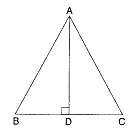
ABC is an isosceles triangle with AB = AC. Draw AP $\perp$ BC to show that $\angle$B = $\angle$C.
Answer
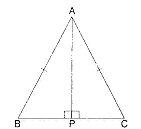

Given: ABC is an isosceles triangle with AB = AC.
To Prove : $\angle$B = $\angle$C
Construction: Draw AP $\perp$ BC
Proof: In right triangle APB and right triangle APC.
AB = AC . . . . [given]
AP = AP . . . .[Common]
$\therefore$ $\triangle$APB $\cong$ $\triangle$APC . . . [RHS rule]
$\therefore$ $\angle$ABP = $\angle$ACP . . .[c.p.c.t.]
$\therefore$ $\angle$B = $\angle$C
View full question & answer
Question 22 Marks
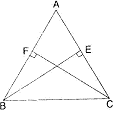
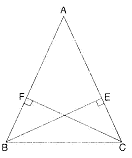
BE and CF are two equal altitudes of a triangle ABC. Using RHS congruence rule, prove that a triangle ABC is isosceles.
Answer


Given: BE and CF are two equal altitudes of a triangle ABC.
To Prove: $\triangle$ABC is isosceles.
Proof : In right $\triangle$BEC and right $\triangle$CFB
side BE = side CF ...[Given]
BC = CB ...[Common]
$\triangle$BEC = $\triangle$CFB ...[By RHS rule]
$\therefore$ ∠BCE = ∠CBF ...[c.p.c.t.]
$\therefore$ AB = AC ...[Sides opposite to equal angles of a triangle are equal]
$\therefore$ $\triangle$ABC is isosceles.
View full question & answer
Question 32 Marks
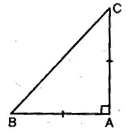
ABC is a right-angled triangle in which $\angle $A = ${90^ \circ }$ and AB = AC. Find $\angle $B and $\angle $C.
Answer
ABC is a right triangle in which,

AB = AC
$ \Rightarrow $ $\angle$C =$\angle$ B  [ opposite angles of equal side are equal]   .....(i)
We know that, in ABC, $\angle$A + $\angle $B + $\angle $C =$180^\circ $ [ Angle sum property of triangle]
$ \Rightarrow $ ${90^ \circ }$+$\angle $B + $\angle $B = $180^\circ $ [$\angle $ A = ${90^ \circ }$(given) and $\angle $B = C (from eq. (i)]
$ \Rightarrow $  2$\angle $B = $180^\circ $- ${90^ \circ }$ 
$ \Rightarrow $ 2$\angle $B =  ${90^ \circ }$
$ \Rightarrow$ $\angle$B = ${45^ \circ }$
Also $\angle $C = ${45^ \circ }$     [As $\angle $B = $\angle $C]
View full question & answer
Question 42 Marks
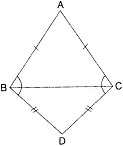
ABC and DBC are two isosceles triangles on the same base BC. Show that ∠ABD = ∠ACD.

Answer
Given : ABC and DBC are two isosceles triangles on the same base BC.
To Prove : ∠ABD = ∠ACD.
Proof : As ABC is an isosceles triangle on the base BC
$\therefore$ ∠ABC = ∠ACB . . . .(1)
As ABC is an isosceles triangle on the base BC
$\therefore$ ∠DBC = ∠DCB . . . (2)
Adding the corresponding sides of (1) and (2)
∠ABC + ∠DBC = ∠ACB + ∠DCB
$\Rightarrow$ ∠ABD = ∠ACD
View full question & answer
Question 52 Marks
$\text{ABC}$ is a triangle in which altitudes $BE$ and $CF$ to sides $AC$ and $AB$ are equal. Show that $\triangle \mathrm { ABE } \cong \triangle \mathrm { ACF }, AB = AC$ i.e. $\triangle ABC$ is an isosceles triangle.
Answer
Given : $\text{ABC}$ is a triangle in which altitude $BE$ and $CF$ to side $AC$ and $AB$ are equal.
To Prove : $\triangle \mathrm { ABE } \cong \triangle \mathrm { ACF }$
  1. $AB = AC i.e. \triangle ABC$ is an isosceles triangle.
    Proof $: BE = CF ...... [$Given$]$
    $\angle BAE = \angle CAF ...... [$Common$]$
    $\angle AFB = \angle AFC ....... [$Each $90^\circ]$
    $\therefore \triangle \mathrm { ABE } \cong \triangle \mathrm { ACF } ........ [$By $\text{AAS}$ property$]$
  2. $\triangle A B E \cong \triangle A C F ....... [$As proved$]$
    $\therefore AB = AC . . .[$c.p.c.t.$]$
    $\therefore \triangle ABC$ is an isosceles triangle.
View full question & answer
Question 62 Marks
$\triangle \text{ABC, AD} $is perpendicular bisector of $BC$. Show that $\triangle \text{ABC}$ is an isosceles triangle in which $AB = AC$.
Answer
Given : $AD \perp BC.$
To prove $: \text{ABC}$ is an isosceles triangle in which $AB = AC.$
Proof : In $\triangle ADB$ and $\triangle ADC,$
$DB = DC . . . [$As $AD \perp$ bisector of $BC]$
$\angle ADB = \angle ADC . . . [$Each $90^\circ]$
$AD = AD . . .[$Common$]$
$\therefore \triangle \mathrm { ADB } \cong \triangle \mathrm { ADC } . . .[$By $\text{SAS}$ property$]$
$\therefore AB = AC . . .[$c.p.c.t$]$
$\therefore \triangle ABC$ is an isosceles triangle in which $AB = AC.$
View full question & answer
Question 72 Marks
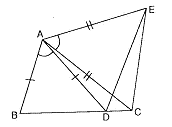
In figure, AC = AE, AB = AD and $\angle$BAD = $\angle$EAC. Show that BC = DE.

Answer
Given : AC = AE, AB = AD and $\angle$BAD = $\angle$EAC.
To prove ; BC = DE
Proof : In DABC and DADE
AC = AE, AB = AD and ∠BAD = ∠EAC ...[Given]
$\therefore$ $\angle$BAD + $\angle$DAC = $\angle$DAC + $\angle$EAC ...[Adding $\angle$DAC to both sides]
$\therefore$ $\angle$BAC = $\angle$DAE ...(1)
AC = AE ...[Given]
$\angle$BAC = $\angle$DAE ...[From (1)]
AB = AD ...[Given]
$\therefore$ DABC $\cong$ DADE ...[By SAS property]
$\therefore$ BC = DE ...[c.p.c.t.]
View full question & answer
Question 82 Marks
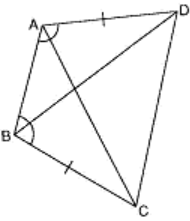
ABCD is a quadrilateral in which AD = BC and $\angle$DAB = $\angle$CBA : Prove that: 

  1. $\triangle$ ABD $\cong$ $\triangle$ BAC
  2. BD = AC
  3. $\angle$ ABD= $\angle$ BAC

Answer
In quadrilateral ACBD, we have AD = BC and ∠ DAB = ∠ CBA
  1. In ∆ ABC and ∆ BAC,
    AD = BC (Given)
    ∠DAB = ∠CBA (Given)
    AB = AB (Common)
    $\triangle$ABD $\cong$ $\triangle$BAC ...[By SAS Congruence]
  2. Since ∆ABD ≅ ∆BAC
    ⇒ BD = AC [By C.P.C.T.]
  3. Since ∆ABD ≅ ∆BAC
    ⇒ ∠ABD = ∠BAC [By C.P.C.T.]
View full question & answer
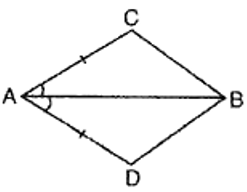
Question 92 Marks
Answer
Given: In quadrilateral ABCD, AC = AD and AB bisects $\angle $A.
To prove: $\angle $ABC $ \cong$ $\triangle$ABD
Proof: In $\triangle$ABC and $\triangle$ABD,
AC = AD [Given]
$\angle $BAC = $\angle $BAD [$\because $ AB bisects $\angle $A]
AB = AB [Common]
$\therefore $ $\triangle$ABC $ \cong$ $\triangle$ABD [By SAS congruency]
Thus BC = BD [By C.P.C.T.]
View full question & answer
Question 102 Marks
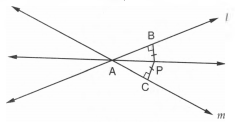
$P$ is a point equidistant from two lines $l$ and $m$ intersecting at a point $A \ ($see figure$)$. Show that $AP$ bisects the angle between them.
Answer

Given: $P$ is a point equidistant from two lines $l$ and $m$ intersect at a point $A.$
To Prove: $AP$ bisects the angle between them. $i.e. \angle PAB$ = $\angle PAC$
Proof: Let $PB$ and $PC$ be perpendiculars from $P$ on lines $l$ and $m$ respectively. Since $P$ is equidistant from lines $l$ and $m.$
Therefore$,PB = PC$
In $\Delta PAB$ and $\Delta PAC$, we have
$PB = PC [$Given$]$
$\angle PBA = \angle PCA [$Each equal to $90^\circ]$
and$, PA = PA [$Common$]$
$\triangle PAB \cong \triangle PAC [$By $\text{RHS}$ congruence criterion$]$
$\Rightarrow \angle PAB = \angle PAC$
Hence Proved
View full question & answer
Question 112 Marks
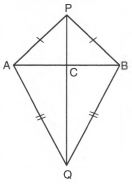
$AB$ is a line segment. $P$ and $Q$ are points on opposite sides of $AB$ such that each of them is equidistant from the points $A$ and $B ($See Figure$).$ Show that the line $PQ$ is the perpendicular bisector of $AB$.
 
Answer
In $\triangle PAQ$ and $\triangle PBQ,$
$AP = BP \ ($Given$)$
$AQ = BQ \ ($Given$)$
$PQ = PQ \ ($Common$)$
So, $\triangle PAQ \cong \triangle PBQ \ (\text{SSS}$ rule$)$
Therefore, $\angle APQ = \angle BPQ \text{ (CPCT)}.$
Now let us consider $\triangle PAC$ and $\triangle PBC$.
You have:$ AP = BP ($Given$)$
$\angle APC = \angle BPC (\angle APQ = \angle BPQ$ proved above$)$
$PC = PC ($Common$)$
So, $\triangle PAC \cong \triangle PBC (\text{SAS}$ rule$)$
Therefore$, \text{AC = BC (CPCT)}.......(i)$
$\angle ACP = \angle BCP \text{(CPCT)}$
and $\angle ACP + \angle BCP = 180^\circ ($Linear pair$)$
So, $2\angle \mathrm{ACP}= 180^\circ$
Or, $\angle ACP = 90^\circ ......(ii)$
From $(i)$ and $(ii),$ we can easily conclude that $PQ$ is the perpendicular bisector of $AB.$
View full question & answer
Question 122 Marks
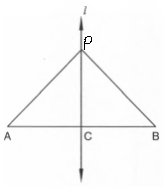
$AB$ is a line segment and line $l$ is its perpendicular bisector. If a point $P$ lies on $l,$ show that $P$ is equidistant from $A$ and $B$.
Answer
Let $C$ be the mid$-$point of $AB$.
Clearly, line l passes through $C$ is perpendicular to $AB.$
In $\triangle PCA$ and $\triangle PCB$, we have

$AC = BC\  [\because C$ is the mid$-$point of $AB]$
$PC = PC\  [$common side$]$
$\angle P C A=\angle P C B \ [$Each equal to $90^\circ$ as $l \perp AB]$
So, by $\text{SAS}$ congruence rule, we obtain
$\triangle P C A \cong \triangle P C B$
$\Rightarrow PA = PB$
View full question & answer
Question 132 Marks
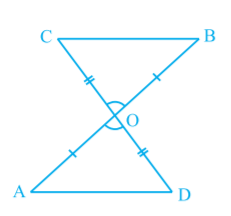
In Fig., OA = OB and OD = OC. Show that

  1. $\triangle$ AOD $\cong$ $\triangle$ BOC
  2. AD || BC

Answer
  1. You may observe that in $\triangle$ AOD and $\triangle$ BOC,
    OA = OB (Given)
    OD = OC
    Also, since $\angle$ AOD and $\angle$ BOC form a pair of vertically opposite angles,
    we have $\angle$ AOD = $\angle$ BOC
    So, $\triangle$ AOD $\cong$ $\triangle$ BOC (by the SAS congruence rule)
  2. In congruent triangles AOD and BOC, the other corresponding parts are also equal.
    So, $\angle$ OAD = $\angle$ OBC and these form a pair of alternate angles for line segments AD and BC.
    Therefore, AD || BC
View full question & answer
2 Marks Questions - MATHS STD 9 Questions - Vidyadip