The slope of a speed-time graph gives:
Question types
Motion question types
418 questions across 9 question groups — pick any mix to generate a Science paper with step-by-step answer keys.
418
Questions
9
Question groups
5
Question types
01
M.C.Q. [1 M]
173 Q→02Assertion (A) & Reason (B) MCQ
6 Q→03true or false
5 Q→04Fill in the blank
16 Q→05Very short answer type question [1 M ]
63 Q→06Que-Ans (Each of 2 Mark )
86 Q→07Que-Ans (Each of 3 Mark )
44 Q→08Que-Ans (Each of 4 Mark )
24 Q→09Case study ( 4 Marks )
1 Q→Sample Questions
Motion questions
One sample from each question group in this chapter. Select any group above to see the full set with answer keys.
View full solution →
A freely falling object travels 4.9m in 1st second, 14.7m in 2nd second, 24.5m in 3rd second, and so on. This data shows that the motion of a freely falling object is a case of:
Suppose a boy is enjoying a ride on a merry$-$go$-$round which is moving with a constant speed of $10 \ ms^{-1}.$ It implies that the boy is:
View full solution →The numerical ratio of displacement to distance for a moving object is:
In a free fall the velocity of a stone is increasing equally ion equal intervals of time under the effect of gravitational force of the earth. Then what can you say about the motion of this stone? Whether the stone is having:
In the following Questions, the Assertion and Reason have been put forward. Read the statements carefully and choose the correct alternative from the following:
Reason: The slope of a $v-t$ graph with $60^\circ$ inclination is greater than $30^\circ$ inclination.
View full solution →- Both the Assertion and the Reason are correct and the Reason is the correct explanation of the Assertion.
- The Assertion and the Reason are correct but the Reason is not the correct explanation of the Assertion.
- Assertion is true but the Reason is false.
- The statement of the Assertion is false but the Reason is true.
Reason: The slope of a $v-t$ graph with $60^\circ$ inclination is greater than $30^\circ$ inclination.
In the following questions, a statement of Assertion is given by the corresponding statement of Reason. Of the statements, mark the correct answer as:
Reason: When speed of a body remains constant, then its acceleration is always zero.
- If both Assertion and Reason are true and Reason is the correct explanation of Assertion.
- If both Assertion and Reason are true, but Reason is not the correct explanation of Assertion.
- If Assertion is true, but Reason is false.
- If Assertion is false, but Reason is true.
- If Assertion and Reason both are false.
Reason: When speed of a body remains constant, then its acceleration is always zero.
In the following questions, a statement of Assertion is given by the corresponding statement of Reason. Of the statements, mark the correct answer as:
Reason: Area of velocity-time graph gives distance travelled by the body.
- If both Assertion and Reason are true and Reason is the correct explanation of Assertion.
- If both Assertion and Reason are true, but Reason is not the correct explanation of Assertion.
- If Assertion is true, but Reason is false.
- If Assertion is false, but Reason is true.
- If Assertion and Reason both are false.
Reason: Area of velocity-time graph gives distance travelled by the body.
In the following questions, a statement of Assertion is given by the corresponding statement of Reason. Of the statements, mark the correct answer as:
Reason: Shortest distance travelled by the body between two points is called distance.
- If both Assertion and Reason are true and Reason is the correct explanation of Assertion.
- If both Assertion and Reason are true, but Reason is not the correct explanation of Assertion.
- If Assertion is true, but Reason is false.
- If Assertion is false, but Reason is true.
- If Assertion and Reason both are false.
Reason: Shortest distance travelled by the body between two points is called distance.
In the following Questions, the Assertion and Reason have been put forward. Read the statements carefully and choose the correct alternative from the following:
Reason: The equations of motion do not apply to freely falling body as its motion is not uniformly accelerated.
- Both the Assertion and the Reason are correct and the Reason is the correct explanation of the Assertion.
- The Assertion and the Reason are correct but the Reason is not the correct explanation of the Assertion.
- Assertion is true but the Reason is false.
- The statement of the Assertion is false but the Reason is true.
Reason: The equations of motion do not apply to freely falling body as its motion is not uniformly accelerated.
Velocity of a body cannot be greater in magnitude than its speed. [True/ False]
On a straight line path, speed of a body is equal to its velocity. [True/ False]
There is no situation in the universe when velocity is zero but acceleration is non-zero. [True/ False]
We calculate average speed when the body is in non-uniform motion. [True/ False]
Displacement can be equal to, less than or greater than distance travelled. [True/ False]
Fill in the following blanks with suitable words:
The slope of a speed-time graph of a moving body gives its ________.
The slope of a speed-time graph of a moving body gives its ________.
Acceleration is calculated from v - t graph while is area under v - t graph.
Fill in the blanks with suitable words:
The physical quantity which gives both, the speed and direction of motion of a body is called its __________.
The physical quantity which gives both, the speed and direction of motion of a body is called its __________.
Fill in the blanks with suitable words:
Acceleration is the rate of change of $...............$ It is measured in $...............$
View full solution →Acceleration is the rate of change of $...............$ It is measured in $...............$
Fill in the blanks.
_____ is the term used for negative acceleration.
_____ is the term used for negative acceleration.
What does the slope of a distance-time graph indicate?
What do the following measure in a car?
- Speedometer.
- Odometer.
Write the formula for acceleration. Give the meaning of each symbol which occurs in it.
If the velocity-time graph of an object is parallel to X-axis, then what does it mean? Can it be parallel to Y-axis?
Change the speed of 6m/s into km/h.
An object is moving along a straight line with uniform acceleration. The following table gives the velocity of the object at various instants of time:
Plot the graph.
From the graph,
|
Time (in sec.):
|
0
|
1
|
2
|
3
|
4
|
5
|
6
|
|
Velocity (in m/s):
|
2
|
4
|
6
|
8
|
10
|
12
|
14
|
From the graph,
- Find the velocity of the object at the end of 2.5 seconds.
- Calculate the acceleration.
- Calculate the distance covered in the last 4 seconds.
What is meant by:
- Average speed
- Uniform speed?
Study the velocity-time graph and calculate.
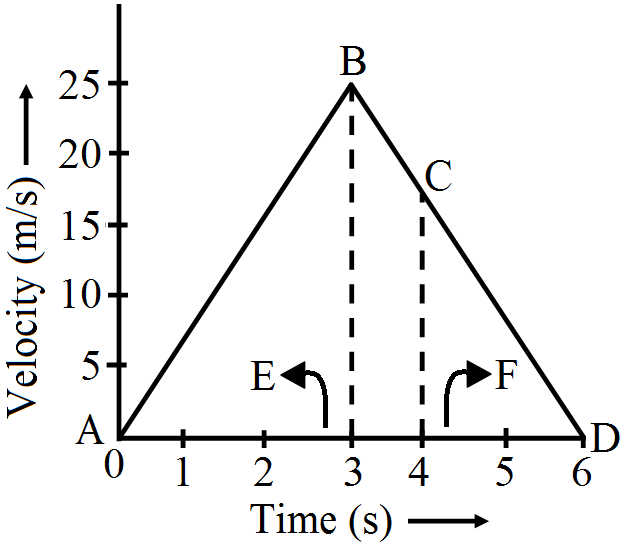
- The acceleration from A to B.
- The acceleration from B to C.
- The distance covered in the region ABE.
- The average velocity from C to D.
- The distance covered in the region BCFE.
After studying the motion of a ball rolling on a straight line as shown in the figure.
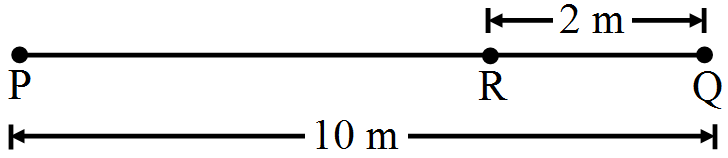
Find its distance and displacement covered.
Find its distance and displacement covered.
- When it rolls from P to Q.
- Finally comes back to P (i.e., P to P)(take, P as reference point).
Plot the v-t graph for the following data and state the nature of motion the body:
|
v(m/s):
|
0
|
5
|
8
|
12
|
18
|
25
|
30
|
35
|
40
|
45
|
|
t(s):
|
2
|
4
|
6
|
8
|
10
|
12
|
14
|
16
|
18
|
20
|
What is meant by the term ‘acceleration’ State the $SI$ unit of acceleration.
View full solution →A body travels a distance of 3km towards East, then 4km towards North and finally 9km towards East.
- What is the total distance travelled?
- What is the resultant displacement?
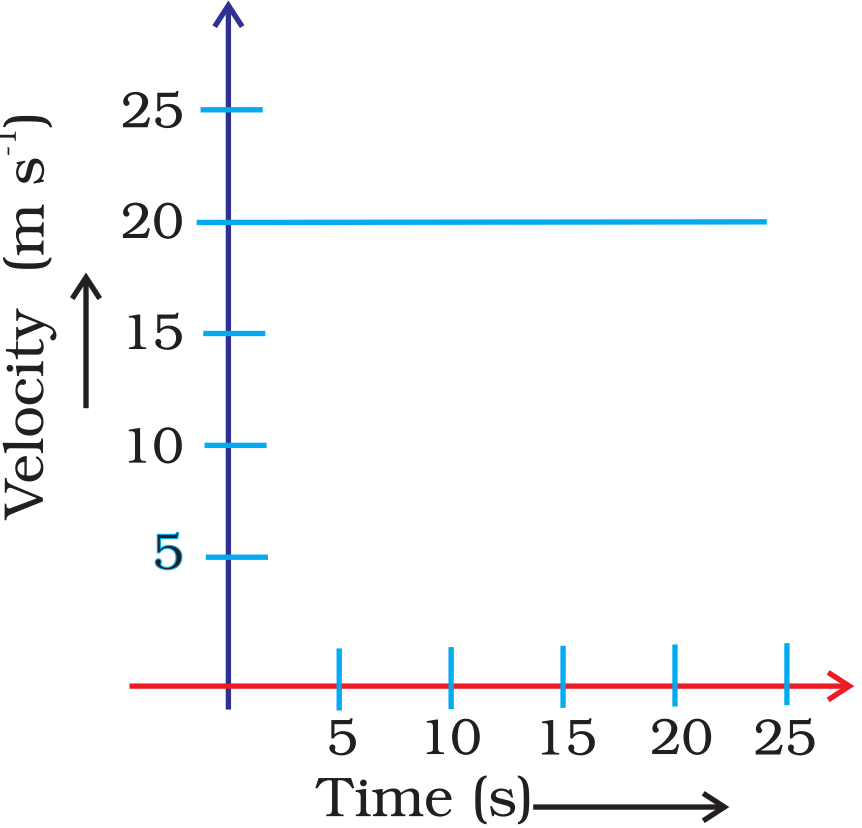
Given below is the velocity-time graph for the motion of the car. What does the nature of the graph show? Also, find the acceleration of the car.
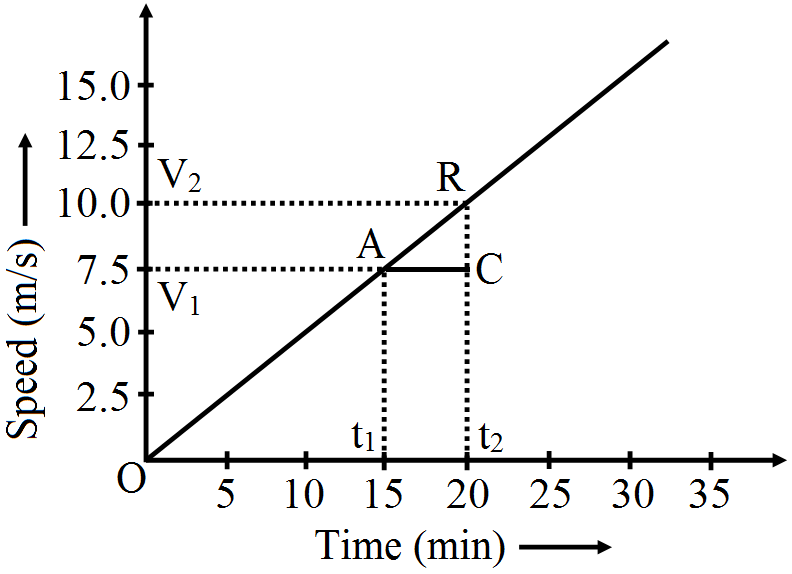
The velocity$-$time graph shows the motion of a cyclist. Find
$i.$ Its acceleration
$ii.$ Its velocity and
$iii.$ The distance covered by the cyclist in $15$ seconds.
View full solution →$i.$ Its acceleration
$ii.$ Its velocity and
$iii.$ The distance covered by the cyclist in $15$ seconds.
What is the difference between speed and velocity?
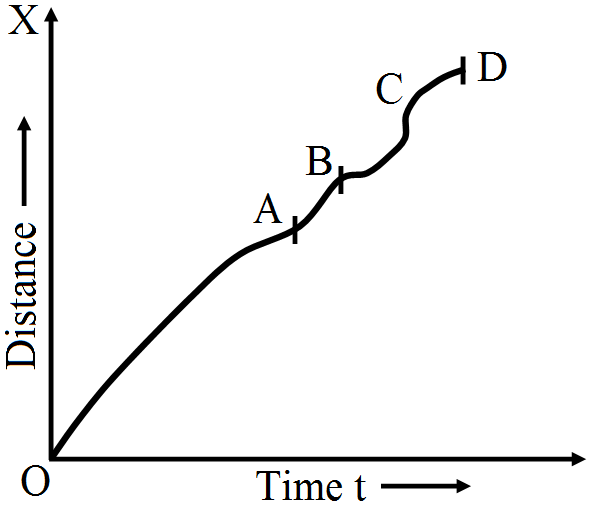
The figure shows an x-t graph of a particle moving along a straight line. What is the sign of the acceleration during the intervals OA, AB, BC, and CD?

A girl walks along a straight path to drop a letter in the letterbox and comes back to her initial position. Her displacement–time graph is shown in Plot a velocity–time graph for the same.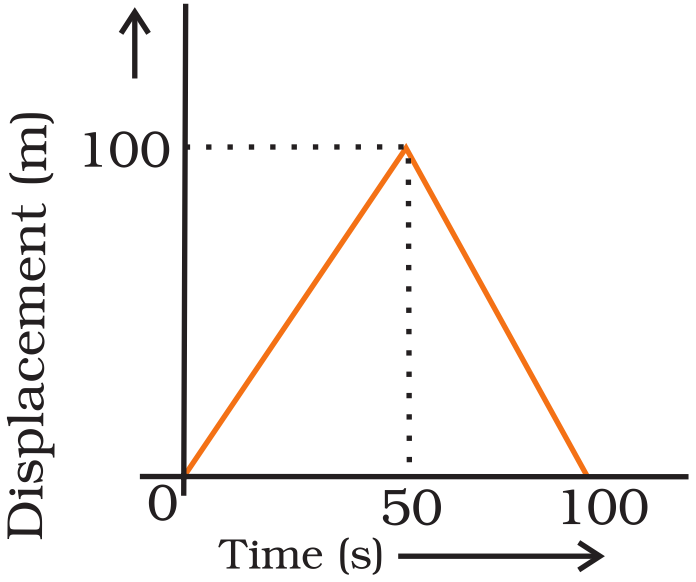
A boy walks from his classroom to the bookshop along a straight corridor towards North. He covers a distance of 20m in 25 seconds to reach the bookshop. After buying a book, he travels the same distance in the same time to reach back in the classroom. Find (a) average speed, and (b) average velocity, of the boy.
The graph given alongside shows how the speed of a car changes with time: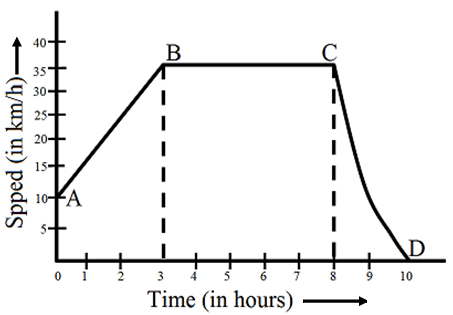
- What is the initial speed of the car?
- What is the maximum speed attained by the car?
- Which part of the graph shows zero acceleration
- Which part of the graph shows varying retardation?
- Find the distance travelled in first 8 hours.
Describe an experiment to show that sound cannot pass through vacuum.
Instruction: The table given below shows distance (in cm) travelled by the bodies A, B and C. Read this data carefully and answer the questions which follow.
Distance (in cm) covered by different bodies:
Distance (in cm) covered by different bodies:
|
Time
|
Body A
|
Body B
|
Body C
|
|
1st second
|
20
|
20
|
20
|
|
2nd second
|
20
|
36
|
60
|
|
3rd second
|
20
|
24
|
100
|
|
4th second
|
20
|
30
|
140
|
|
5th second
|
20
|
48
|
180
|
- Which of the bodies is moving with:
- Constant speed?
- Constant acceleration?
- Which of the bodies covers:
- Maximum distance in 3rd second?
- Minimum distance in 3rd second?
- Which of the bodies is moving with non-uniform acceleration?
Generate a Motion paper free
Pick question groups from the list above, set marks and difficulty, and export a branded PDF with step-by-step answer keys. First 3 chapters free — no signup.