Questions

[2 Mark Questions]

🎯

Test yourself on this topic

35 questions · timed · auto-graded

Question 12 Marks
Find the equation of a straight line passing through the point P(−5, 2) and parallel to the line joining the points Q(3, −2) and R(−5, 4)
Answer
Slope of the line $=\frac{y_2-y_1}{x_2-x_1}$
Slope of the line $Q R=\frac{4+2}{-5-3}=\frac{6}{-8}=\frac{3}{-4}$
$
\Rightarrow-\frac{3}{4}
$
Slope of its parallel $=-\frac{3}{4}$
The given point is $p(-5,2)$

Equation of the line is $y-y_1=m\left(x-x_1\right)$
$
\begin{aligned}
& y-2=-\frac{3}{4}(x+5) \\
& 4 y-8=-3 x-15 \\
& 3 x+4 y-8+15=0 \\
& 3 x+4 y+7=0
\end{aligned}
$
The equation of the line is $3 x+4 y+7=0$
View full question & answer
Question 22 Marks
If the straight lines 12y = − (p + 3)x + 12, 12x – 7y = 16 are perpendicular then find ‘p’
Answer
Slope of the first line $12 y=-(p+3) x+12$ $y =\frac{-( p +3) x}{12}+1 \quad \ldots($ Comparing with $y = mx + c )$

Slope of the second line $\left( m _1\right)=\frac{-( p +3)}{12}$
Slope of the second line $12 x-7 y=16$
$
\left(m_2\right)=\frac{-a}{b}=\frac{-12}{-7}=\frac{12}{7}
$

Since the two lines are perpendicular
$
\begin{aligned}
& m_1 \times m_2=-1 \\
& \frac{-(p+3)}{12} \times \frac{12}{7}=-1 \\
& \Rightarrow \frac{-(p+3)}{7}=-1 \\
& -(p+3)=-7 \\
& -p-3=-7
\end{aligned}
$

$
\begin{aligned}
& \Rightarrow-p=-7+3 \\
& -p=-4 \\
& \Rightarrow p=4
\end{aligned}
$
The value of $p=4$
View full question & answer
Question 32 Marks
Check whether the given lines are parallel or perpendicular $\frac{x}{3}+\frac{y}{4}+\frac{1}{7}=0$ and $\frac{2 x}{3}+\frac{y}{2}+\frac{1}{10}=0$
Answer
$
\frac{x}{3}+\frac{y}{4}+\frac{1}{7}=0, \frac{2 x}{3}+\frac{y}{2}+\frac{1}{10}=0
$

Slope of the line $\left(m_1\right)=\frac{-a}{b}$
$
\begin{aligned}
& =-\frac{1}{3} \div \frac{1}{4} \\
& =-\frac{1}{3} \times \frac{4}{1} \\
& =-\frac{4}{3}
\end{aligned}
$

Slope of the line $\left(m_2\right)=-\frac{2}{3} \div \frac{1}{2}$
$
\begin{aligned}
& =-\frac{2}{3} \times \frac{2}{1} \\
& =-\frac{4}{3} \\
& m_1=m_2=-\frac{4}{3}
\end{aligned}
$
$\therefore$ The two lines are parallel.
View full question & answer
Question 42 Marks
Check whether the given lines are parallel or perpendicular
5x + 23y + 14 = 0 and 23x – 5x + 9 = 0
Answer
$
5 x+23 y+14=0 \text { and } 23 x-5 x+9=0
$
Slope of the line $\left(m_1\right)=\frac{-5}{23}$
Slope of the line $\left( m _2\right)=\frac{-23}{-5}=\frac{23}{5}$
$
m_1 \times m_2=\frac{-5}{23} \times \frac{23}{5}=-1
$
$\therefore$ The two lines are perpendicular
View full question & answer
Question 52 Marks
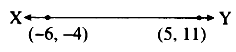
A cat is located at the point(– 6, – 4) in xy plane. A bottle of milk is kept at (5, 11). The cat wish to consume the milk travelling through shortest possible distance. Find the equation of the path it needs to take its milk.
Answer

Equation of the line joining the point is
$
\begin{aligned}
& \frac{y-y_1}{y_2-y_1}=\frac{x-x_1}{x_2-x_1} \\
& \frac{y+4}{11+4}=\frac{x+6}{5+6} \\
& \frac{y+4}{15}=\frac{x+6}{11} \\
& 15(x+6)=11(y+4) \\
& 15 x+90=11 y+44 \\
& 15 x-11 y+90-44=0 \\
& 15 x-11 y+46=0
\end{aligned}
$
The equation of the path is $15 x-11 y+46=0$
View full question & answer
Question 62 Marks
Find the equation of a line through the given pair of point $\left(2, \frac{2}{3}\right)$ and $\left(\frac{-1}{2},-2\right)$
Answer
Equation of the line passing through the point $\left(2, \frac{2}{3}\right)$ and $\left(\frac{-1}{2},-2\right)$
$
\begin{aligned}
& \frac{y-y_1}{y_2-y_1}=\frac{x-x_1}{x_2-x_1} \\
& \frac{y-\frac{2}{3}}{-2-\frac{2}{3}}=\frac{x-2}{-\frac{1}{2}-2} \\
& \Rightarrow \frac{\frac{3 y-2}{3}}{\frac{-6-2}{3}}=\frac{\frac{x-2}{-1-4}}{2} \\
& \frac{3 y-2}{3} \times \frac{3}{-8}=\frac{x-2}{\frac{-5}{2}} \\
& \Rightarrow \frac{3 y-2}{-8}=\frac{2(x-2)}{-5} \\
& -5(3 y-2)=-8 \times 2(x-2) \\
& -15 y+10=-16(x-2) \\
& -15 y+10=-16 x+32 \\
& 16 x-15 y+10-32=0
\end{aligned}
$
$
16 x-15 y-22=0
$
The required equation is $16 x-15 y-22=0$
View full question & answer
Question 72 Marks
Find the equation of a line through the given pair of point (2, 3) and (– 7, – 1)
Answer
Equation of the line joining the point $(2,3)$ and $(-7,-1)$ is
$
\begin{aligned}
& \frac{y-y_1}{y_2-y_1}=\frac{x-x_1}{x_2-x_1} \\
& \frac{y-3}{-1-3}=\frac{x-2}{-7-2} \\
& \Rightarrow \frac{y-3}{-4}=\frac{x-2}{-9} \\
& -9(y-3)=-4(x-2) \\
& -9 y+27=-4 x+8 \\
& 4 x-9 y+27-8=0 \\
& 4 x-9 y+19=0
\end{aligned}
$
The required equation is $4 x-9 y+19=0$
View full question & answer
Question 82 Marks
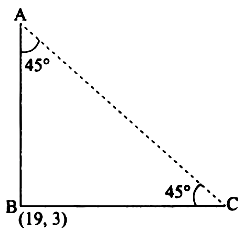
The hill in the form of a right triangle has its foot at (19, 3). The inclination of the hill to the ground is $45^o$. Find the equation of the hill joining the foot and top.
Answer
Slope of AB (m) = tan $45^o$
= 1
Equation of the hill joining the foot and the top is
$y-y_1=m\left(x-x_1\right)$
$y-3=1(x-19)$

y – 3 = x – 19
– x + y – 3 + 19 = 0
– x + y + 16 = 0
x – y – 16 = 0
The required equation is x – y – 16 = 0
View full question & answer
Question 92 Marks
Find the value of ‘a’, if the line through (– 2, 3) and (8, 5) is perpendicular to y = ax + 2
Answer
Given points are $(-2,3)$ and $(8,5)$
Slope of a line $=\frac{y_2-y_1}{x_2-x_1}$
$
\begin{aligned}
& =\frac{5-3}{8+2} \\
& =\frac{2}{10} \\
& =\frac{1}{5}
\end{aligned}
$Slope of a line $y=a x+2$ is " $a$ "
Since two lines are $\perp^r$
$
\begin{aligned}
& m_1 \times m_2=-1 \\
& \frac{1}{5} \times a=-1 \\
& \Rightarrow \frac{a}{5}=-1 \\
& \Rightarrow a=-5
\end{aligned}
$
∴ The value of a = – 5
View full question & answer
Question 102 Marks
Find the slope and $y$ intercept of $\sqrt{3 x}+(1-\sqrt{3}) y=3$
Answer
The equation of a line is $\sqrt{3 x}+(1-\sqrt{3}) y=3$
$
\begin{aligned}
& (1-\sqrt{3}) y=\sqrt{3} x+3 \\
& y=\frac{-\sqrt{3} x}{1-\sqrt{3}}+\frac{3}{1-\sqrt{3}}
\end{aligned}
$

Slope $(m)=\frac{-\sqrt{3}}{1-\sqrt{3}}$
$
\begin{aligned}
& =\frac{-\sqrt{3}(1+\sqrt{3})}{(1-\sqrt{3})(1+\sqrt{3})} \\
& =\frac{-\sqrt{3}-3}{1-3} \\
& =\frac{-(\sqrt{3}+3)}{-2} \\
& =\frac{\sqrt{3}+3}{2}
\end{aligned}
$
$y$ intercept $=\frac{3}{1-\sqrt{3}}$
$\begin{aligned} & =\frac{3(1+\sqrt{3})}{(1-\sqrt{3})(1+\sqrt{3})} \\ & =\frac{3+3 \sqrt{3}}{1-3} \\ & =\frac{3+3 \sqrt{3}}{-2} \\ & =-\frac{3(1+\sqrt{3})}{2}\end{aligned}$
View full question & answer
Question 112 Marks
Find the equation of a line whose inclination is 30˚ and making an intercept – 3 on the Y-axis.
Answer
Angle of inclination $=30^{\circ}$
Slope of a line $=\tan 30^{\circ}$
$
(m)=\frac{1}{\sqrt{3}}
$
$y$ intercept $(c)=-3$

Equation of a line is $y=m x+c$
$
\begin{aligned}
& y =\frac{1}{\sqrt{3}} x-3 \\
& \sqrt{3} y=x-3 \sqrt{3} \\
& \therefore x-\sqrt{3}-3 \sqrt{3}=0
\end{aligned}
$
View full question & answer
Question 122 Marks
The equation of a straight line is 2(x – y) + 5 = 0. Find its slope, inclination and intercept on the Y-axis
Answer
Equation of a line is $2(x-y)+5=0$
$
\begin{aligned}
& 2 x-2 y+5=0 \\
& -2 y=-2 x-5 \\
& 2 y=2 x+5 \\
& y=\frac{2 x}{2}+\frac{5}{2} \\
& y=x+\frac{5}{2}
\end{aligned}
$
Slope of line $=1$
$
\begin{aligned}
& \text { Y intercept }=\frac{5}{2} \\
& \tan \theta=1 \\
& \tan \theta=\tan 45^{\circ}
\end{aligned}
$
$\therefore$ angle of inclination $=45^{\circ}$
View full question & answer
Question 132 Marks
Find the equation of a straight line passing through the mid-point of a line segment joining the points (1, – 5), (4, 2) and parallel to X-axis
Answer
Mid point of the line joining to points $(1,-5),(4,2)$
Mid point of the line $=\left(\frac{x_1+x_2}{2}, \frac{y_1+y_2}{2}\right)$
$
\begin{aligned}
& =\left(\frac{1+4}{2}, \frac{-5+2}{2}\right) \\
& =\left(\frac{5}{2}, \frac{-3}{2}\right)
\end{aligned}
$

Any line parallel to $X$-axis. Slope of a line is 0 .

Equation of a line is $y-y_1=m\left(x-x_1\right)$
$
\begin{aligned}
& y+\frac{3}{2}=0\left(x-\frac{5}{2}\right) \\
& y+\frac{3}{2}=0 \\
& \Rightarrow \frac{2 y+3}{2}=0 \\
& 2 y+3=0
\end{aligned}
$
View full question & answer
Question 142 Marks
Find the equation of a straight line passing through the mid-point of a line segment joining the points (1, – 5), (4, 2) and parallel to Y-axis
Answer
Mid point of the line joining to points $(1,-5),(4,2)$
$
\begin{aligned}
& \text { Mid point of the line }=\left(\frac{x_1+x_2}{2}, \frac{y_1+y_2}{2}\right) \\
& =\left(\frac{1+4}{2}, \frac{-5+2}{2}\right) \\
& =\left(\frac{5}{2}, \frac{-3}{2}\right)
\end{aligned}
$
Equation of a line parallel to $Y$-axis is $x=\frac{5}{2}$
$
\begin{aligned}
& \Rightarrow 2 x=5 \\
& 2 x-5=0
\end{aligned}
$
View full question & answer
Question 152 Marks
Find the equation of a straight line passing through (– 8, 4) and making equal intercepts on the coordinate axes
Answer
Let the $x$-intercept andy intercept " $a$ "

The equation of a line is
$
\frac{x}{ a }+\frac{y}{ a }=1
$

The line passes through the point $(-8,4)$
$
\begin{aligned}
& \frac{-8}{a}+\frac{4}{a}=1 \\
& \frac{-8+4}{a}=1 \\
& -4=a
\end{aligned}
$

The equation of a line is
$
\frac{x}{-4}+\frac{y}{-4}=1
$

Multiply by -4
$
\begin{aligned}
& x+y=-4 \\
& x+y+4=0
\end{aligned}
$
The equation of the line is x + y + 4 = 0
View full question & answer
Question 162 Marks
Find the intercepts made by the following line on the coordinate axes
3x – 2y – 6 = 0
Answer
3x – 2y – 6 = 0.
x intercept when y = 0
⇒ 3x – 6 = 0
⇒ x = 2
y intercept when x = 0
⇒ 0 – 2y – 6 = 0
⇒ y = – 3
View full question & answer
Question 172 Marks
Find the intercepts made by the following line on the coordinate axes
4x + 3y + 12 = 0
Answer
4x + 3y + 12 = 0.
x intercept when y = 0
⇒ 4x + 0 + 12 = 0
⇒ x = – 3
y intercept when x = 0
⇒ 0 + 3y + 12 = 0
⇒ y = – 4
View full question & answer
Question 182 Marks
Find the equation of a line whose intercepts on the x and y axes are given below
4, – 6
Answer
$
x \text { intercept }(a)=4, y \text { intercept }(b)=-6
$

Equation of a line is $\frac{x}{ a }+\frac{y}{ b }=1$
$
\begin{aligned}
& \frac{x}{4}+\frac{y}{-6}=1 \\
& \Rightarrow \frac{x}{4}-\frac{y}{6}=1 \quad \ldots(\text { L.C.M. of } 4 \text { and } 6 \text { is } 12) \\
& 3 x-2 y=12 \\
& 3 x-2 y-12=0
\end{aligned}
$

The equation of a line is $3 x-2 y-12=0$
View full question & answer
Question 192 Marks
Find the equation of a line whose intercepts on the $x$ and $y$ axes are given below
$
-5, \frac{3}{4}
$
Answer
$
x \text { intercept }(a)=-5, y \text { intercept }(b)=\frac{3}{4}
$
Equation of a line is $\frac{x}{ a }+\frac{y}{ b }=1$
$
\begin{aligned}
& \Rightarrow \frac{x}{-5}+\frac{y}{\frac{3}{4}}=1 \\
& \left.\frac{x}{-5}+\frac{4 y}{3}=1 \quad \ldots \text { (L.C.M. of } 5 \text { and } 3 \text { is } 15\right) \\
& -3 x+20 y=15 \\
& -3 x+20 y-15=0 \\
& 3 x-20 y+15=0
\end{aligned}
$
$\therefore$ Equation of a line is $3 x-20 y+15=0$
View full question & answer
Question 202 Marks
You are downloading a song. The percent y (in decimal form) of megabytes remaining to get downloaded in x seconds is given by y = – 0.1x + 1 after how many seconds will 75% of the song gets downloaded?
Answer
When $75 \%$ of a song gets downloaded $25 \%$ remains.

In other words $y=25 \%$
$
y=0.25
$

By using the equation we get
$
\begin{aligned}
& 0.25=-0.1 x+1 \\
& 0.1 x=0.75 \\
& x=\frac{0.75}{0.1}=7.5 \text { seconds }
\end{aligned}
$
View full question & answer
Question 212 Marks
You are downloading a song. The percent y (in decimal form) of megabytes remaining to get downloaded in x seconds is given by y = – 0.1x + 1 after how many seconds the song will be downloaded completely?
Answer
When a song is downloaded completely the remaining percent is zero.
i.e $y=0$
$
0=-0.1 x+1
$
$0.1 x=1$ second
$
\begin{aligned}
& x=\frac{1}{0.1}=\frac{1}{1} \times 10 \\
& x=10 \text { seconds }
\end{aligned}
$
View full question & answer
Question 222 Marks
Find the equation of a straight line which has slope $\frac{-5}{4}$ and passing through the point $(-1,2)$.
Answer
Slope of a line $(m)=\frac{-5}{4}$

The given point $\left( x _1, y _1\right)=(-1,2)$
Equation of a line is $y-y_1=m\left(x-x_1\right)$
$
\begin{aligned}
& y-2=\frac{-5}{4}(x+1) \\
& 5(x+1)=-4(y-2) \\
& 5 x+5=-4 y+8 \\
& 5 x+4 y+5-8=0 \\
& 5 x+4 y-3=0
\end{aligned}
$
The equation of a line is $5 x+4 y-3=0$
View full question & answer
Question 232 Marks
The line through the points (– 2, 6) and (4, 8) is perpendicular to the line through the points (8, 12) and (x, 24). Find the value of x.
Answer
Find the slope of the line joining the point $(-2,6)$ and $(4,8)$
Slope of line $\left( m _1\right)=\frac{y_2-y_1}{x_2-x_1}$
$
=\frac{8-6}{4+2}=\frac{2}{6}=\frac{1}{3}
$

Find the slope of the line joining the points $(8,12)$ and $(x, 24)$
Slope of a line $\left( m _2\right)=\frac{24-12}{x-8}=\frac{12}{x-8}$

Since the two lines are perpendicular.
$
\begin{aligned}
& m _1 \times m _2=-1 \\
& \frac{1}{3} \times \frac{12}{x-8}=-1 \\
& \Rightarrow \frac{12}{3(x-8)}=-1 \\
& -1 \times 3(x-8)=12 \\
& -3 x+24=12
\end{aligned}
$
$
\begin{aligned}
& \Rightarrow-3 x=12-24 \\
& -3 x=-12 \\
& \Rightarrow x=\frac{12}{3}=4
\end{aligned}
$
$\therefore$ The value of $x =4$
View full question & answer
Question 242 Marks
The line through the points $(-2, a)$ and $(9,3)$ has slope $-\frac{1}{2}$ Find the value of a
Answer
The given points are $(-2, a)$ and $(9,3)$
$
\begin{aligned}
& \text { Slope of a line }=\frac{y_2-y_1}{x_2-x_1} \\
& -\frac{1}{2}=\frac{3- a }{9+2} \\
& \Rightarrow-\frac{1}{2}=\frac{3- a }{11} \\
& 2(3- a )=-11 \\
& \Rightarrow 6-2 a =-11 \\
& -2 a =-11-6 \\
& \Rightarrow-2 a =-17 \\
& \Rightarrow a =\frac{-17}{-2}
\end{aligned}
$
$\therefore$ The value of $a=\frac{17}{2}$
View full question & answer
Question 252 Marks
If the three points (3, – 1), (a, 3) and (1, – 3) are collinear, find the value of a
Answer
The vertices are $A(3,-1), B(a, 3)$ and $C(1,-3)$
Slope of a line $=\frac{y_2-y_1}{x_2-x_1}$
Slope of $A B=\frac{3+1}{a-3}=\frac{4}{a-3}$
Slope of $B C=\frac{3+3}{a-1}=\frac{6}{a-1}$
Since the three points are collinear.

Slope of $A B=$ Slope $B C$
$
\begin{aligned}
& \frac{4}{a-3}=\frac{6}{a-1} \\
& 6(a-3)=4(a-1) \\
& 6 a-18=4 a-4 \\
& 6 a-4 a=-4+18 \\
& 2 a=14
\end{aligned}
$

$
\Rightarrow a =\frac{14}{2}=7
$
The value of $a=7$
View full question & answer
Question 262 Marks
Show that the given points are collinear: (– 3, – 4), (7, 2) and (12, 5)
Answer
The vertices are $A(-3,-4), B(7,2)$ and $C(12,5)$

Slope of a line $=\frac{y_2-y_1}{x_2-x_1}$
Slope of $A B=\frac{2+4}{7+3}=\frac{6}{10}=\frac{3}{5}$

Slope of $B C=\frac{5-2}{12-7}=\frac{3}{5}$
Slope of $A B=$ Slope of $B C=\frac{3}{5}$
$\therefore$ The three points $A, B, C$ are collinear.
View full question & answer
Question 272 Marks
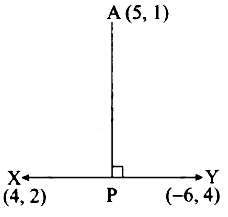
What is the slope of a line perpendicular to the line joining A(5, 1) and P where P is the mid-point of the segment joining (4, 2) and (– 6, 4)
Answer
$\begin{aligned} & \text { Mid-point of } X Y=\left(\frac{x_1+x_2}{2}, \frac{y_1+y_2}{2}\right) \\ & =\left(\frac{4-6}{2}, \frac{2+4}{2}\right) \\ & =\left(\frac{-2}{2}, \frac{6}{2}\right) \\ & =(-1,3)\end{aligned}$

$\begin{aligned} & \text { Slope of a line }=\frac{y_2-y_1}{x_2-x_1} \\ & =\frac{3-1}{-1-5} \\ & =\frac{2}{-6} \\ & =-\frac{1}{3}\end{aligned}$
View full question & answer
Question 282 Marks
In the following, find the value of ‘a’ for which the given points are collinear
(2, 3), (4, a) and (6, – 3)
Answer
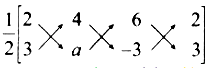
Let the points be $A(2,3), B(4, a)$ and $C(6,-3)$.
Since the given points are collinear.
$
\begin{aligned}
& \text { Area of a triangle }=0 \\
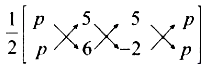
& \frac{1}{2}\left[\left(x_1 y_2+x_2 y_3+x_3 y_1\right)-\left(x_2 y_1+x_3 y_2+x_1 y_3\right)\right]=0
\end{aligned}
$

$
\begin{aligned}
& \frac{1}{2}[(2 a-12+18)-(12+6 a-6)]=0 \\
& 2 a+6-(6+6 a)=0 \\
& 2 a+6-6-6 a=0 \\
& -4 a=0 \\
& \Rightarrow a=\frac{0}{4} \\
& =0
\end{aligned}
$
The value of $a=0$
View full question & answer
Question 292 Marks
Vertices of given triangles are taken in order and their areas are provided aside. Find the value of ‘p’.
Vertices Area (sq.units)
(0, 0), (p, 8), (6, 2) 20
Answer
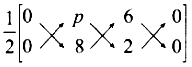
Let the vertices be $A(0,0) B(p, 8), c(6,2)$
Area of a triangle $=20$ sq.units
$
\frac{1}{2}\left[\left(x_1 y_2+x_2 y_3+x_3 y_1\right)-\left(x_2 y_1+x_3 y_2+x_1 y_3\right)\right]=20
$

$
\begin{aligned}
& \frac{1}{2}[(0+2 p+0)-(0+48+0)]=20 \\
& \frac{1}{2}[2 p-48]=20 \\
& 2 p-48=40 \\
& \Rightarrow 2 p=40+48 \\
& p=\frac{88}{2}=44
\end{aligned}
$
The value of $p=44$
View full question & answer
Question 302 Marks
Vertices of given triangles are taken in order and their areas are provided aside. Find the value of ‘p’.
Vertices Area (sq.units)
(p, p), (5, 6), (5, –2) 32
Answer
xLet the vertices be $A(p, p), B(5,6)$ and $C(5,-2)$
Area of a triangle $=32$ sq. units
$
\frac{1}{2}\left[\left(x_1 y_2+x_2 y_3+x_3 y_1\right)-\left(x_2 y_1+x_3 y_2+x_1 y_3\right)\right]=32
$

$
\begin{aligned}
& \frac{1}{2}[(6 p-10+5 p)-(5 p+30-2 p)]=32 \\
& \frac{1}{2}[11 p-10-3 p-30]=32 \\
& 11 p-10-3 p-30=64 \\
& 8 p-40=64 \\
& 8 p=64+40 \\
& \Rightarrow 8 p=104 \\
& p=\frac{104}{8} \\
& =13
\end{aligned}
$
The value of $p=13$
View full question & answer
Question 312 Marks
Determine whether the sets of points are collinear?
(a, b + c), (b, c + a) and (c, a + b)
Answer
Let the points be $A(a, b+c), B(b, c+a)$ and $C(c, a+b)$
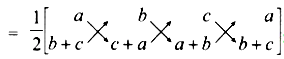
Area of the triangle $=\frac{1}{2}\left[\left(x_1 y_2+x_2 y_3+x_3 y_1\right)-\left(x_2 y_1+x_3 y_2+x_1 y_3\right)\right]$

$
\begin{aligned}
& =\frac{1}{2}[a(c+a)+b(a+b)+c(b+c)-b(b+c)+c(c+a)+a(a+b)] \\
& =\frac{1}{2}\left[a c+a^2+a b+b^2+b c+c^2-\left(b^2+b c+c^2+a c+a^2+a b\right)\right] \\
& =\frac{1}{2} \times 0 \\
& =0
\end{aligned}
$
Since the area of a triangle is 0 .
$\therefore$ The given points are collinear.
View full question & answer
Question 322 Marks
Determine whether the sets of points are collinear?
$
\left(-\frac{1}{2}, 3\right),(-5,6) \text { and }(-8,8)
$
Answer
Let the points be $A \left(-\frac{1}{2}, 3\right), B (-5,6)$ and $C (-8,8)$
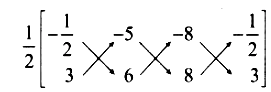
Area of $\triangle ABC =\frac{1}{2}\left[\left(x_1 y_2+x_2 y_3+x_3 y_1\right)-\left(x_2 y_1+x_3 y_3+x_1 y_3\right)\right]$
$
=\frac{1}{2}[(-3-40-24)-(-15-48-4)]
$

$
\begin{aligned}
& =\frac{1}{2}[-67+67] \\
& =\frac{1}{2} \times 0 \\
& =0
\end{aligned}
$
Area of a $\Delta$ is 0 .
$\therefore$ The three points are collinear.
View full question & answer
Question 332 Marks
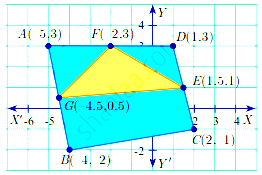
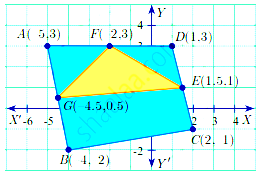
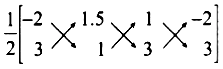
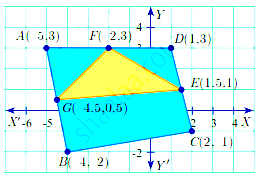
Find the area of triangle AGF
Answer
$\begin{aligned} & \text { Area of a triangle }=\frac{1}{2}\left[\left(x_1 y_2+x_2 y_3+x_3 y_1\right)-\left(x_2 y_1+x_3 y_2+x_1 y_3\right)\right] \\ & \text { Area of } \triangle AGF =\frac{1}{2}[(-2.5-13.5-6)-(-13.5-1-15)] \\ & =\frac{1}{2}[-22-(-29.5)]\end{aligned}$

$\begin{aligned} & =\frac{1}{2}[-22+29.5] \\ & =\frac{1}{2} \times 7.5 \\ & =3.75 \text { sq.units }\end{aligned}$
View full question & answer
Question 342 Marks
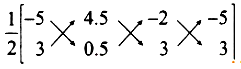
Find the area of triangle FED
Answer
Area of a triangle $=\frac{1}{2}\left[\left(x_1 y_2+x_2 y_3+x_3 y_1\right)-\left(x_2 y_1+x_3 y_2+x_1 y_3\right)\right]$
Area of $\triangle FED =\frac{1}{2}[(-2+4.5+3)-(4.5+1-6)]$
$
=\frac{1}{2}[5.5-(-0.5)]
$

$\begin{aligned} & =\frac{1}{2}[5.5+0.5] \\ & =\frac{1}{2} \times 6 \\ & =3 \text { sq.units }\end{aligned}$
View full question & answer
Question 352 Marks
Find the area of quadrilateral BCEG
Answer
Area of the Quadrilateral BCEG $=$
$
\frac{1}{2}\left[\left(x_1 y_2+x_2 y_3+x_3 y_4+x_4 y_1\right)-\left(x_2 y_1+x_3 y_2+x_4 y_3+x_1 y_4\right)\right]
$

$\begin{aligned} & =\frac{1}{2}[(4+2+0.75+9)-(-4-1.5-4.5-2)] \\ & =\frac{1}{2}[15.75+12] \\ & =\frac{1}{2}[27.75] \\ & =13.875 \\ & =13.88 \text { sq. units }\end{aligned}$
View full question & answer
[2 Mark Questions] - MATHS STD 10 Questions - Vidyadip