Questions

[2 Mark Questions]

🎯

Test yourself on this topic

20 questions · timed · auto-graded

Question 12 Marks
$D$ is the mid point of side $B C$ and $A E \perp B C$. If $B C=a, A C=b, A B=c, E D=x, A D=p$ and $A E=$ $h$, prove that $c^2=p^2-a x+\frac{a^2}{4}$
Answer
From the figure, D is the midpoint of BC.
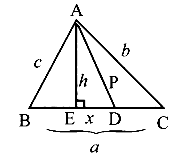
We have $\angle A E D=90^{\circ}$
$\therefore \angle ADE<90^{\circ} \text { and } \angle ADC>90^{\circ}$
i.e. $\angle A D E$ is acute and $\angle A D C$ is obtuse, In $\triangle ABD , \angle ADE$ is an acute angle.
$A B^2=A D^2+B D^2-2 B D \cdot D E$
$\Rightarrow A B^2=A D^2+(12 B C) 2-2 \times 12 B C \cdot D E$
$\Rightarrow A B^2=A D^2+14 B C^2-B C \cdot D E$
$\Rightarrow A B^2=A D^2-B C \cdot D E+14 B C^2$
$\Rightarrow c^2=p^2-a x+14 a^2$
Hence proved.
View full question & answer
Question 22 Marks
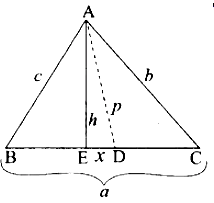
$D$ is the mid point of side $B C$ and $A E \perp B C$. If $B C=a, A C=b, A B=c, E D=x, A D=p$ and $A E=$ $h$, prove that $b^2+c^2=2 p^2+\frac{a^2}{2}$
Answer
Given $\angle A E D=90^{\circ}$

$E D=x, D C=\frac{a}{2} \quad \ldots(D$ is the mid point of $B C)$
$\therefore EC =x+\frac{ a }{2}, BE =\frac{ a }{2}-x$
$\therefore$ In the right $\triangle AED$
$
\begin{aligned}
& A D^2=A E^2+E D^2 \\
& p^2=h^2+x^2
\end{aligned}
$
In the right $\triangle AEC$,
$
\begin{aligned}
& A C^2=A E^2+E C^2 \\
& b ^2= h ^2+\left(x+\frac{ a }{2}\right)^2 \\
& = h ^2+x^2+\frac{ a ^2}{4}+2 \times x \times \frac{ a }{2}
\end{aligned}
$

$
\begin{aligned}
& b ^2= p ^2+\frac{ a ^2}{4}+ a x \cdots(1)\\
& b ^2= p ^2+ a x+\frac{1}{4} a ^2 \cdots(2)
\end{aligned}
$

In the right triangle $A B E$,
$
\begin{aligned}
& A B^2=A E^2+B E^2 \\
& c^2=h^2+(a 2-x)^2 \\
& c^2=h^2+a 24+x^2-a x \\
& c^2=h^2+x^2+14 a^2-a x \\
& c^2=p^2-a x+\frac{a^2}{4} \ldots . . .(3)
\end{aligned}
$

By adding (2) and (3)
$
\begin{aligned}
& b ^2+ c ^2= p ^2+ a x+\frac{ a ^2}{4}+ p ^2- a x+\frac{ a ^2}{4} \\
& =2 p ^2+\frac{2 a ^2}{4}
\end{aligned}
$
$=2 p ^2+\frac{ a ^2}{2}$
View full question & answer
Question 32 Marks
ABC is a triangle in which AB = AC. Points D and E are points on the side AB and AC respectively such that AD = AE. Show that the points B, C, E and D lie on a same circle
Answer
∠B = ∠C ...(Given AB = AC)
AD + DB = AE + EC
BD = EC ...(Given AD = AE)
DE parallel BC Since AEC is a straight line.
∠AED + ∠CED = 180°
∠CBD + ∠CED = 180°
Similarly of the opposite angles = 180°
∴ BCED is a cyclic quadrilateral
View full question & answer
Question 42 Marks
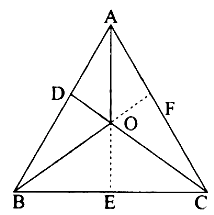
O is any point inside a triangle ABC. The bisector of ∠AOB, ∠BOC and ∠COA meet the sides AB, BC and CA in point D, E and F respectively. Show that AD × BE × CF = DB × EC × FA
Answer
In ∆ABC the bisector meets AB at D, BC at E and AC at F.


The angle bisector $A O, B O$ and $C O$ intersect at " $O$ ".
By Cevas Theorem
$
\begin{aligned}
& \frac{ AD }{ DB } \times \frac{ BF }{ EC } \times \frac{ CF }{ AF }=1 \\
& AD \times BE \times CF = DB \times EC \times AF
\end{aligned}
$
Hence it is proved.
View full question & answer
Question 52 Marks
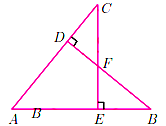
If BD ⊥ AC and CE ⊥ AB, prove that ∆AEC ~ ∆ADB
Answer
∠AEC = ∠ADB = 90°
∠A is common By AA – Similarity.
∴ ∆AEC ~ ∆ADB
Since the two triangles are similar.
View full question & answer
Question 62 Marks
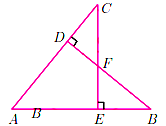
If $B D \perp A C$ and $C E \perp A B$, prove that $\frac{C A}{A B}=\frac{C E}{D B}$
Answer
$\begin{aligned} & \frac{ AE }{ AD }=\frac{ AC }{ AB }=\frac{ EC }{ DB } \\ & \frac{ AC }{ AB }=\frac{ CE }{ DB }\end{aligned}$
View full question & answer
Question 72 Marks
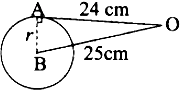
The length of the tangent to a circle from a point P, which is 25 cm away from the centre is 24 cm. What is the radius of the circle?
Answer
Let the radius AB be r.
In the right ∆ABO,
$O B^2=O A^2+A B^2$
$25^2=24^2+r^2$

$
\begin{aligned}
& 25^2-24^2=r^2 \\
& (25+24)(25-24)=r^2 \\
& r=\sqrt{49}=7
\end{aligned}
$

Radius of the circle $=7 cm$
View full question & answer
Question 82 Marks
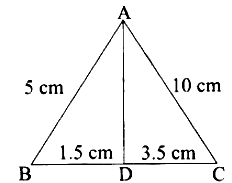
Check whether AD is bisector of ∠A of ∆ABC of the following
AB = 5 cm, AC = 10 cm, BD = 1.5 cm and CD = 3.5 cm
Answer
$\begin{aligned} & \text { In } \triangle ABC , AB =5 cm , AC =10 cm , BD =1.5 cm , CD =3.5 cm \\ & \frac{ BD }{ DC }=\frac{1.5}{3.5}=\frac{15}{35}=\frac{3}{7} \\ & \frac{ AB }{ AC }=\frac{5}{10}=\frac{1}{2} \\ & \frac{ BD }{ DC } \neq \frac{ AB }{ AC } \\ & \therefore AD \text { is not a bisector of } \angle A .\end{aligned}$
View full question & answer
Question 92 Marks
Check whether AD is bisector of ∠A of ∆ABC of the following
AB = 4 cm, AC = 6 cm, BD = 1.6 cm and CD = 2.4 cm.
View full question & answer
Question 102 Marks
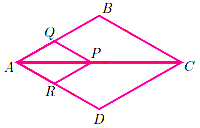
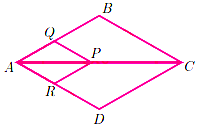
If $PQ \| BC$ and $PR \| CD$ prove that $\frac{ AR }{ AD }=\frac{ AQ }{ AB }$
Answer
In $\triangle A B C$, We have PQ || BC
By basic proportionality theorem

$
\frac{ AQ }{ AB }=\frac{ AP }{ AC } \cdots(1)
$
In $\triangle A C D$, We have PR || CD
Basic proportionality theorem
$
\frac{ AP }{ AC }=\frac{ AR }{ AD } \cdots(2)
$
From (1) and (2) we get
$
\frac{ AQ }{ AB }=\frac{ AR }{ AD }
$
or
$
\frac{ AR }{ AD }=\frac{ AQ }{ AB }
$
View full question & answer
Question 112 Marks
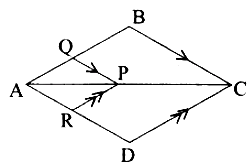
If $P Q \| B C$ and $P R \| C D$ prove that $\frac{Q B}{A Q}=\frac{D R}{A R}$
Answer
In $\triangle A B C, P Q \| B C$...(Given)

By basic proportionality theorem
$
\frac{ AP }{ PC }=\frac{ AQ }{ QB }
$

By basic proportionality theorem
$
\frac{ AP }{ PC }=\frac{ AR }{ RD }
$

From (1) and (2) we get
$
\frac{ AQ }{ QB }=\frac{ AP }{ RD }
$
or
$
\frac{ QB }{ AQ }=\frac{ DR }{ AR }
$
View full question & answer
Question 122 Marks
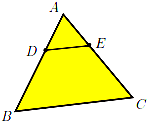
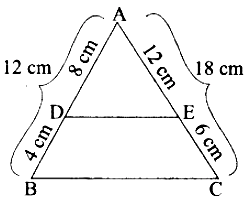
In ΔABC, D and E are points on the sides AB and AC respectively. For the following case show that DE || BC
AB = 12 cm, AD = 8 cm, AE = 12 cm and AC = 18 cm
Answer
Here AB = 12 cm, BD =12 – 8 = 4 cm, AE =12 cm, EC = 18 – 12 = 6 cm

$
\begin{aligned}
& \therefore \frac{ AD }{ DB }=\frac{8}{4}=2 \\
& \frac{ AE }{ EC }=\frac{12}{6}=2 \\
& \frac{ AD }{ DB }=\frac{ AE }{ EC }
\end{aligned}
$
By converse of basic proportionality theorem $D E \| B C$
View full question & answer
Question 132 Marks
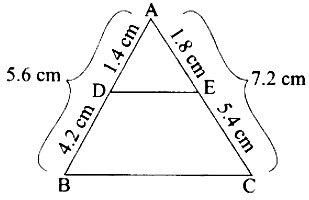
In ΔABC, D and E are points on the sides AB and AC respectively. For the following case show that DE || BC
AB = 5.6 cm, AD = 1.4 cm, AC = 7.2 cm and AE = 1.8 cm.
Answer
Here AB = 5.6 cm, AD = 1.4 cm, BD = AB – AD
= 5.6 – 1.4
= 4.2

AC = 7.2 cm, AE = 1.8 cm, EC = AC – AE
= 7.2 – 1.8
EC = 5.4 cm

$
\begin{aligned}
& \frac{ AD }{ DB }=\frac{1.4}{4.2}=\frac{1}{3} \\
& \frac{ AE }{ EC }=\frac{1.8}{5.4}=\frac{1}{3} \\
& \frac{ AE }{ EC }=\frac{ AD }{ DE }
\end{aligned}
$

By converse of basic proportionality theorem DE \|| $B C$
View full question & answer
Question 142 Marks
If $\triangle A B C \sim \triangle D E F$ such that area of $\triangle A B C$ is $9 cm^2$ and the area of $\triangle D E F$ is $16 cm^2$ and $B C=2.1 cm$. Find the length of $E F$.
Answer
Given $\triangle ABC \sim \triangle DEF$
$
\begin{aligned}
& \therefore \frac{\text { Area of } \Delta ABC }{\text { Area of } \Delta DEF }=\frac{ BC ^2}{ EF ^2} \ldots \text { (Square of their corresponding sides) } \\
& \frac{9}{16}=\frac{(2.1)^2}{ EF ^2} \\
& \left(\frac{3}{4}\right)^2=\left(\frac{2.1}{ EF }\right)^2 \\
& \frac{3}{4}=\frac{2.1}{ EF } \\
& EF =\frac{4 \times 2.1}{3}=2.8 cm
\end{aligned}
$

Length of $E F=2.8 cm$
View full question & answer
Question 152 Marks
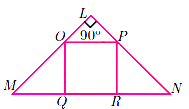
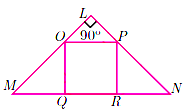
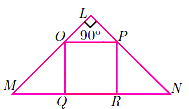
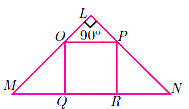
If figure $O P R Q$ is a square and $\angle M L N=90^{\circ}$. Prove that $Q R^2=M Q \times R N$
Answer
We have $\triangle QMO \sim \triangle RPN$
$
\begin{aligned}
& \frac{ MQ }{ PR }=\frac{ QO }{ RN } \\
& \frac{ MQ }{ QR }=\frac{ QR }{ RN } \\
& QR ^2= MQ \times RN
\end{aligned}
$

Hence it is proved.
View full question & answer
Question 162 Marks
If figure OPRQ is a square and ∠MLN = 90°. Prove that ∆LOP ~ ∆QMO
Answer
In ∆LOP and ∆QMO
∠OLP = ∠OQM = 90°
∠LOP = ∠OMQ ...(Since OQRP is a square OP || MN)
∴ ∆LOP~ ∆QMO ...(By AA similarity)
View full question & answer
Question 172 Marks
If figure OPRQ is a square and ∠MLN = 90°. Prove that ∆LOP ~ ∆RPN
Answer
In ∆LOP and ∆RPN
∠OLP = ∠PRN = 90°
∠LPO = ∠PNR ...(OP || MN)
∴ ∆LOP ~ ∆RPN ...(By AA similarity)
View full question & answer
Question 182 Marks
If figure OPRQ is a square and ∠MLN = 90°. Prove that ∆QMO ~ ∆RPN
Answer
In ∆QMO and ∆RPN
∠MQO = ∠NRP = 90°
∠RPN = ∠QOM ...(OP || MN)
∴ ∆QMO ~ ∆RPN ...(By AA similarity)
View full question & answer
Question 192 Marks
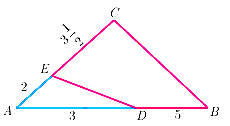
Check whether the triangles are similar and find the value of $x$
Answer
In $\triangle A B C$ and $\triangle A E D$
$
\begin{aligned}
& \frac{ AB }{ AD }=\frac{ AE }{ AE } \\
& \frac{8}{3}=\frac{11}{\frac{2}{2}} \\
& \frac{8}{3}=\frac{11}{4} \Rightarrow 32 \neq 33
\end{aligned}
$
$\therefore$ The two triangles are not similar.
View full question & answer
Question 202 Marks
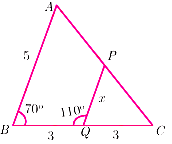
Check whether the triangles are similar and find the value of x
Answer
$
\begin{aligned}
& \text { In } \triangle ABC \text { and } \triangle PQC \\
& \angle PQC =70^{\circ} \\
& \angle ABC =\angle PQC =70^{\circ} \\
& \angle ACB =\angle PCQ \ldots \text {..(common) } \\
& \triangle ABC \sim \triangle PQC \\
& \frac{5}{x}=\frac{6}{3} \\
& 6 x =15 \\
& x =\frac{15}{6}=\frac{5}{2} \\
& \therefore x =2.5
\end{aligned}
$
$\triangle A B C$ and $\triangle P Q C$ are similar.

The value of $x=2.5$
View full question & answer
[2 Mark Questions] - MATHS STD 10 Questions - Vidyadip