Questions

[2 Mark Questions]

🎯

Test yourself on this topic

8 questions · timed · auto-graded

Question 12 Marks
Metal A belongs to period 4 and group 8. A in red hot condition reacts with steam to form B. A reacts with dilute HNO3 to give C. A again reacts with conc. H2SO4 to give D. Find A, B, C and D with suitable reaction.
Answer
(i) Metal (A) belongs to period 4 and group 8 is iron (Fe).
(ii) Iron (A) reacts with steam to form magnetic oxide (B)
$
3 Fe +4 H _2 O \text { (steam) } \longrightarrow Fe _3 O _4+4 H _2 \uparrow
$
(A)
(B)
(iii) Iron (A) reacts with dilute $HNO _3$ in cold condition to give ferrous nitrat
$
4 Fe +10 HNO _3 \longrightarrow 4 Fe \left( NO _3\right)_2+ NH _4 NO _3+3 H _2 O
$
(A)
(C)
(iv) Iron (A) reacts with conc. $H _2 SO _4$ to form Ferric Sulphate (D).
$
\underset{\text { (A) }}{2 Fe }+6 H _2 SO _4 \longrightarrow Fe _2\left( SO _4\right)_3+3 SO _2+6 H _2 O
$

cellpadding="0">

AIronFe
BMagnetic OxideFe_(3)O_(4)
CFerrous NitrateFe(NO_(3))_(2)
DFerric SulphateFe_(2)(SO_(4))_(3)
View full question & answer
Question 22 Marks
A silvery - white metal on treatment with NaOH and HCl liberates H 2 gas to form B and C respectively. The metal A will not react with acid D due to the formation of a passive film on the surface. Hence it is used for transporting acid D. Identify A, B, C, D and support your answer with balanced equations.
Answer
(i) A silvery - white metal (A) is Aluminium (Al).
(ii) Aluminium reacts with NaOH to form B which is known as sodium meta aluminate with the liberation of $H _2$ gas.
$2 A1+2 NaOH+2 H_2 O \longrightarrow 2 NaAlO_2+3 H_2 \uparrow$
Sodium meta aluminate (B)
(iii) Aluminium reacts with HCl to form Aluminium chloride which is known as C with the liberation of $H _2$ gas.
(iv) Aluminium does not react with conc. nitric acid $\left( HNO _3\right)$ which is known as D , due to the formation of a passive film on the surface.
A Aluminium Al
B Sodium meta aluminate $NaAlO_2$
C Aluminium chloride $AlCl_3$
D Nitric acid $HNO_3$
View full question & answer
Question 32 Marks
A reddish – brown metal A, when exposed to moist air, forms a green layer B. When A is heated at different temperatures in the presence of O2, it forms two types of oxides – C (black) and D (red). Identify A, B, C, D and write the balanced equation.
Answer
(i) A reddish - brown metal A is a copper $( Cu )$.
(ii) When copper (A) is exposed to moist air it forms a green layer (B) is copper carbonate.
$2 Cu + O _2+ CO _2+ H _2 O \longrightarrow CuCO _3 \cdot Cu ( OH )_2$
Copper carbonate (B)
(iii) When copper is heated at different temperature in the presence of oxygen, it forms two types of oxides $CuO$ and $Cu _2 O$. ( $C$ and $\left.D \right)$
$2 Cu + O _2 \frac{\text { below } 1370 K }{\Delta} 2 CuO$
$\text { SamacheerKalvi.Guru }$
$\text { Copper (II) oxide (C) }$
$\text { (Black) }$
$4 Cu + O _2 \frac{\text { above } 1370 K }{\Delta} \quad 2 Cu _2 O$
Copper (I) oxide (D) (Red)cellpadding="0">
A Copper Cu
B Copper carbonate CuCO_(3)*Cu(OH)_(2)
C Copper (II) oxide-black CuO
D Copper (I) oxide-red Cu_(2)O
View full question & answer
Question 42 Marks
Anionic radius Is higher than the corresponding neutral atom. Give reason.
Answer
When an atom gains one or more electrons it forms an anion. During the formation of anion, the number of orbital electrons becomes greater than the nuclear charge. Hence, the electrons are not strongly attracted by the lesser number of nuclear charges. Hence anionic radius is higher than the corresponding neutral atom.
View full question & answer
Question 52 Marks
Why the graphite rods acting as anode in the Hall’s process should be replaced periodically?
Answer
During Hall’s Process, the carbon electrodes get consumed, so they have to be replaced periodically.
View full question & answer
Question 62 Marks
All ores are minerals, but ait minerals are not ores. Why?
Answer
  • The elements or compounds of the metals which occur in nature in the earth’s crust are called minerals whereas ore is a mineral from which the metal is profitably extracted.
  • For example, aluminium exists in the two mineral forms, that is clay and bauxite. But aluminium is mainly extracted from bauxite which contains 70 % aluminium oxide. So, bauxite is an ore of aluminium whereas clay is not ore.
  • So, all ores are minerals but all minerals need not be ores.
View full question & answer
Question 72 Marks
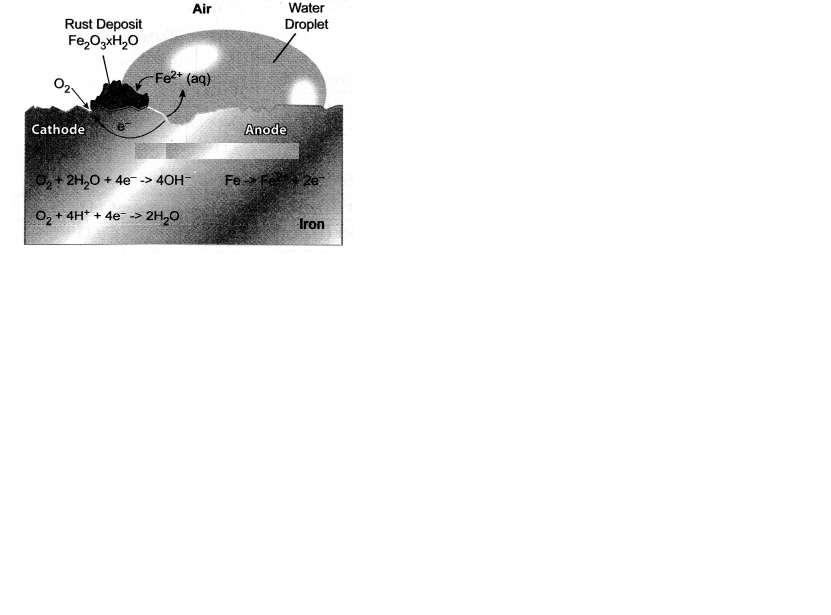
Explain the mechanism of rusting?
Answer
Rust is chemically known as hydrated ferric oxide (it is formulated as $Fe _2 O _3 \cdot xH _2 O$ ).
Rusting results in the formation of scaling reddish – brown hydrated ferric oxide on the surface of iron and iron-containing materials.

Image
View full question & answer
Question 82 Marks
What would be the atomic number of the next
  1. alkali metal
  2. alkaline earth metal
  3. Halogens
  4. inert gas, if discovered in future.
Answer
  1. Alkali metal: 118 + 1 = 119
  2. Alkaline earth metal: 120
  3. Halogens: 117
  4. Inert gas: 118
View full question & answer
[2 Mark Questions] - Science STD 10 Questions - Vidyadip