Questions

[5 Mark each]

🎯

Test yourself on this topic

15 questions · timed · auto-graded

Question 35 Marks
List out the economic importance of plants & their uses of Fabaceae.
Answer
Economic ImportanceBinomialUseful PartUses
PulsesCajanus cajan (Pigeon Pea) Phaseolus vulgaris (French bean) Cicer arietinum (Chick pea/Channa) Vigna mungo (black gram) Vigna radiata (green gram) Vigna unguiculata (cow pea) Glycine max (soya bean) Macrotylama uniflorum (Horse gramSeedsSources of protein and starch of our food
Food plantsLablab purpureus (field bean) Sesbania grandflora (agathi, vegetable huming bird)
Cyamopsis tetragonoloba
(cluster bean)
Tender fruits Leaves
 
 
Tender fruits
Vegetable
Greens
 
 
Vegetable
Oil plantsArachis hypogea (Ground nut)
 
Pongamia pinnata (Pungam)
Seeds
 
 
Seeds
Oil extracted from the seeds is edible and used for cooking.
Pongam oil has medicinal value and is used in the preparation of soap.
Timber PlantsDalbergia latifolia (rose wood) Pterocarpus santalinus (red sandalwood) P. dalbergioides (Padauk) P. MarsupiumTimberTimber is used for making furniture, cabinet articles and as building materials.
Medicinal PlantsCrotalaria albida
Psoralea corylifolia
 
Glycirrhiza glabra (Licorice root)
Mucuna Pruriens
Roots
Seeds
Roots
Seeds
Used as purgative
Used in leprosy and leucoderma
Immuno modulator
Neurological remedy
Fibre PlantsCrotalaria juncea (sunhemp) Sesbania aegyptiaca (sesbanStem fibres (Bast)Used for making ropes
Pith PlantAeschynomene asperaStem pithUsed for packing, handicraft and fishing floats
Dye PlantsIndigofera tinctoria (Avuri)
 
Clitoria ternatea
 
Butea monosperma
Leaves
 
Flowers and seeds
Flowers
Indigo dye obtained from leaves is used in colour printing and paints. Blue dye is obtained
Natural dye
Green ManuringIndigofera tinctoria Tephrosea purpurea Glirricidia sepiumEntire plantUsed as green manure because of the presence of nitrogen fixing bacteria in the lateral roots
Ornamental PlantsButea frondosa (Flame of the forest) Clitoria ternatea, Lathyrus odoratus (Sweet pea) and Lupinus hirsutus (LupinEntire PlantGrown as ornamental plants
View full question & answer
Question 45 Marks
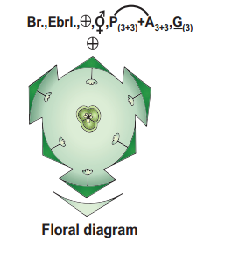
Explain Allium cepa in botanical terms. Draw floral diagram.
Answer
Botanical description of Allium cepa:
  1. Habit: Perennial herb with bulb.
  2. Root: Fibrous adventitious root system
  3. Stem: Underground bulb
  4. Leaf: A cluster of radical leaves emerges from the underground bulb, cylindrical and fleshy having sheathy leaf bases with parallel venation.
  5. Inflorescence: Scapigerous i.e. the inflorescence axis (peduncle) arising from the ground bearing a cluster of flowers at its apex. Pedicels are of equal length, arising from the apex of the peduncle which brings all flowers at the same level.
  6. Flower: Small, white, bracteate, bracteolate, pedicellate, complete, trimerous, actinomorphic and hypogynous. Flowers are protandrous.
  7. Perianth: Tepals 6, white, arranged in two whorls of three each, syntepalous showing valvate aestivation.
  8. Androecium: Stamens 6, arranged in two whorls of three each, epitepalous, apostamenous / free and opposite to tepals. Anthers dithecous. basifixed, introse and dehiscing longitudinally.
  9. Gynoecium: Tricarpellary and syncarpous. Ovary superior, trilocular with two ovules in each locule on axile placentation. Style simple, slender with simple stigma.
  10. Fruit: A loculicidal capsule.
  11. Seed: Endospermous
  12. Floral Formula:
  13. Image
View full question & answer
Question 55 Marks
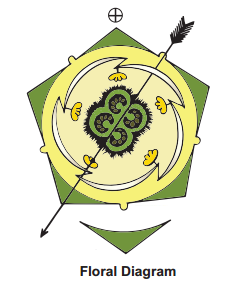
Explain Datura metal in botanical terms. Draw floral diagram.
Answer

Image
  1. Habit: Large, erect and stout herb.
  2. Root: Branched tap root system.
  3. Stem: Stem is hollow, green and herbaceous with strong odour.
  4. Leaf: Simple, alternate, petiolate, entire or deeply lobed, glabrous exstipulate showing unicostate reticulate venation.
  5. Inflorescence: Solitary and axillary cyme.
  6. Flower: Flowers are large, greenish white, bracteate, ebracteolate, pedicellate, complete, heterochlamydeous, pentamerous, regular, actinomorphic, bisexual and hypogynous.
  7. Calyx: Sepals 5, green synsepalous showing valvate aestivation. Calyx is mostly persistant, odd sepal is posterior in position.
  8. Corolla: Petals 5, greenish white, sympetalous, plicate (folded like a fan) showing twisted aestivation, funnel shaped with wide mouth and 10 lobed.
  9. Androecium: Stamens 5, free from one another, epipetalous, altemipetalous and are inserted in the middle of the corolla tube. Anthers are basifixed, dithecous, with long filament, introse and longitudinally dehiscent.
  10. Gynoecium: Ovary bicarpellary, syncarpous superior ovary, basically bilocular but tetralocular due to the formation of false septum. Carpels are obliquely placed and ovules on swollen axile placentation. Style simple long and filiform, stigma two lobed.
  11. Fruit: Spinescent capsule opening by four special valves with persistent calyx.
  12. Seed: Endospermous
  13. Floral Formula
Image
View full question & answer
Question 65 Marks
Explain Clitoria ternatea in botanical terms. Draw floral diagram.
Answer

Image
  1. Habit: Twining climber
  2. Root: Branched tap root system having nodules.
  3. Stem: Aerial, weak stem and a twiner.
  4. Leaf: Imparipinnately compound, alternate, stipulate showing reticulate venation. Leaflets are stipellate.
    Petiolate and stipels are pulvinated.
  5. Inflorescence: Solitary and axillary
  6. Flower: Bracteate, bracteolate, bracteoles usually large, pedicellate, heterochlamydeous, complete, bisexual, pentamerous, zygomorphic and hypogynous.
  7. Calyx: Sepals 5, synsepalous, green showing valvate aestivation. Odd repel is anterior in position.
  8. Corolla: Petals 5, white or blue apopetalous, irregular papilionaceous corolla showing, descendingly imbricate aestivation.
  9. Androecium: Stamens 10, diadelphous (9) + 1 nine stamens fused to form a bundle and the tenth stamen is free. Anthers are dithecous, basifixed, introse and dechising by longitudinal slits.
  10. Gynoecium: Monocarpellary, uni – locular, with many ovules on marginal placentation, ovary superior, style simple and incurved with feathery stigma.
  11. Fruit: Legume
  12. Seed: Non – endospermous, reniform.
  13. Floral Formula
Image
View full question & answer
Question 75 Marks
List out the significance of Molecular Taxonomy.
Answer
The significance of Molecular Taxonomy:
  1. It helps to identify a very large number of species of plants and animals by the use of conserved molecular sequences.
  2. Using DNA data evolutionary patterns of biodiversity are now investigated.
  3. DNA taxonomy plays a vital role in phytogeography, which ultimately helps in genome mapping and biodiversity conservation.
  4. DNA – based molecular markers used for designing DNA based molecular probes, have also been developed under the branch of molecular systematics.
View full question & answer
Question 85 Marks
Distinguish between classical taxonomy & modern taxonomy.
Answer
Classical Taxonomy:
  1. It is called old systematics or Alpha (α) – taxonomy or Taxonomy
  2. It is pre – Darwinean
  3. Species is considered as basic unit and is static
  4. Classification is mainly based on morphological characters
  5. This system is based on the observation of a few samples / individuals
Modern Taxonomy:
  1. It is called Neosystematics or Biosystematics or Omega (Ω) taxonomy
  2. It is post – Darwinean
  3. Species is considered as dynamic entity and ever changing
  4. Classification is based on morphological, reproductive characters and phylogenetic (evolutionary) relationship of the organism
  5. This system is based on the observation of large number of samples / individuals
View full question & answer
Question 95 Marks
Define biosystematics & list out the aim of biosystematics.
Answer
1. Biosystematics: Biosystematics is an “Experimental, ecological and cytotaxonomy” through which life forms are studied and their relationships are defined.
2. Aims of Biosystematics: The aims of biosystematics are as follows:
  • To delimit the naturally occurring biotic community of plant species.
  • To establish the evolution of a group of taxa by understanding the evolutionary and phylogenetic trends.
  • To involve any type of data gathering based on modem concepts and not only on morphology and anatomy.
  • To recognize the various groups as separate biosystematics categories such as ecotypes, ecospecies, cenospecies and comparium.
View full question & answer
Question 115 Marks
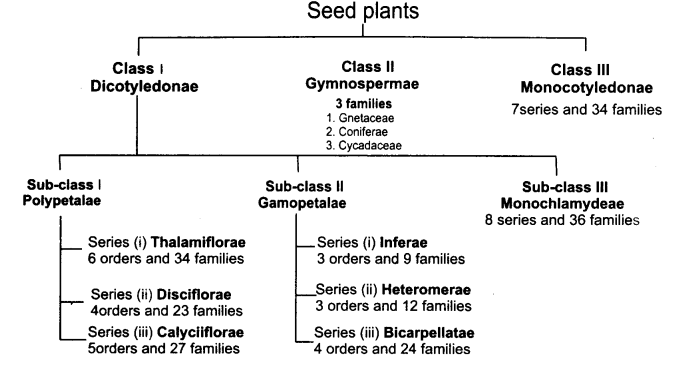
Draw a flow chart depicting the Bentham and Hooker Classification.
Answer
Bentham and Hooker system of classification

Image
View full question & answer
Question 125 Marks
Point out the characters of Early angiosperm according to APG Classification.
Answer
The characters of Early angiosperm according to APG Classification:
  1. Seeds always with two cotyledons.
  2. Presence of ethereal oils.
  3. Leaves are always simple net – veined
  4. Each floral whorls with many parts
  5. Perianth usually spirally arranged or parts in threes
  6. Stamens with broad filaments
  7. Anthers tetrasporangiate
  8. Pollen monosulcate
  9. Nectaries are rare
  10. Carpels usually free and
  11. Embryo very small
View full question & answer
Question 135 Marks
Enumerate the uses of Herbarium.
Answer
The uses of Herbarium:
  1. Herbarium provides resource material for systematic research and studies.
  2. It is a place for orderly arrangement of voucher specimens.
  3. Voucher specimen serves as a reference for comparing doubtful newly collected fresh specimens.
  4. Voucher specimens play a role in studies like floristic diversity, environmental assessment, ecological mechanisms and survey of unexplored areas.
  5. Herbarium provides opportunity for documenting biodiversity and studies related to the field of ecology and conservation biology.
View full question & answer
Question 145 Marks
Explain the role of Botanical garden in taxonomy.
Answer
Botanical gardens play the following important roles.
  1. Gardens with aesthetic value which attract a large number of visitors. For example, the Great Banyan Tree (Ficus benghalensis) in the Indian Botanical Garden at Kolkata.
  2. Gardens have a wide range of species and supply taxonomic material for botanical research.
  3. Garden is used for self-instruction or demonstration purposes.
  4. It can integrate information of diverse fields like Anatomy, Embryology, Phytochemistry, Cytology, Physiology and Ecology.
  5. Act as a conservation centre for diversity, rare and endangered species.
  6. It offers annual list of available species and a free exchange of seeds.
  7. Botanical garden gives information about method of propagation, sale of plant material to the general public.
View full question & answer
Question 155 Marks
List out the principles of ICN.
Answer
International Code of Nomenclature is based on the following six principles.
  1. Botanical nomenclature is independent of zoological and bacteriological nomenclature.
  2. Application of names of taxonomic group is determined by means of nomenclatural types.
  3. Nomenclature of a taxonomic group is based on priority of publication.
  4. Each taxonomic group with a particular circumscription, position and rank can bear only one correct name, the earliest that is in accordance with the rules except in specified cases.
  5. Scientific names of taxonomic groups are treated as Latin regardless of their derivation.
  6. The rules of nomenclature are retroactive unless expressly limited.
View full question & answer
[5 Mark each] - BIO BOTANY STD 11 Questions - Vidyadip