Questions · Page 1 of 2

[ 2 Marks Questions ]

🎯

Test yourself on this topic

50 questions · timed · auto-graded

Question 12 Marks
Is the acceleration of a particle in circular motion not always towards the center. Explain.
Answer
No acceleration is towards the center only in case of uniform circular motion.
View full question & answer
Question 22 Marks
A gunman always keep his gun slightly tilted above the line of sight while shooting. Why?
Answer
Because bullet follow Parabolic trajectory under constant downward acceleration.
View full question & answer
Question 32 Marks
A person sitting in a train moving at constant velocity throws a ball vertically upwards. How will the ball appear to move to an observer.
  • Sitting inside the train
  • Standing outside the train
Answer
  • Vertical straight line motion
  • Parabolic path.
View full question & answer
Question 42 Marks
The greatest height to which a man can throw a stone is h. What will be the greatest distance upto which he can throw the stone?
Answer
Maximum height:
$H =\frac{u^2 \sin ^2 \theta}{g} \Rightarrow H _{\max }=\frac{u^2}{2 g}= h (\text { at } \theta=90) $
$\text { Maximum range } R _{\max }=\frac{u^2}{g}=2 h$
View full question & answer
Question 52 Marks
What will be the effect on horizontal range of a projectile when its initial velocity is doubled keeping angle of projection same?
Answer
$
\frac{u^2 \sin 2 \theta}{g} \Rightarrow R \ \\ \alpha \ \\ u^2
$
Range comes four times.
View full question & answer
Question 62 Marks
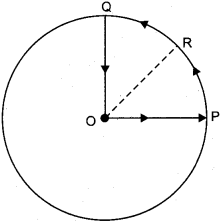
A cyclist starts from centre O of a circular park of radius 1 km and moves along the path OPRQO as shown. If he maintains constant speed of 10 ms-1. What is his acceleration at point R in magnitude & direction?Image
Answer
Centripetal acceleration, $a _{ c }=\frac{v^2}{r}=\frac{10^2}{1000}=0.1 m / s ^2$ along RO.
View full question & answer
Question 72 Marks
An object is in uniform motion along a straight line, what will be position time graph for the motion of object, if (i) $x_0=$ positive, $v=$ negative is constant.
(i) $x _0=$ positive, $v =$ negative is $|\vec{v}|$ constant.
(ii) both $x _0$ and $v$ are negative $|\vec{v}|$ is constant.
(iii) $x _0=$ negative, $v =$ positive $|\vec{v}|$ is constant.
(iv) both $x _0$ and $v$ are positive $|\vec{v}|$ is constant where $x _0$ is position at $t =0$.
View full question & answer
Question 82 Marks
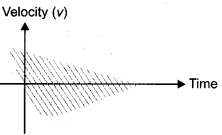
Suggest a suitable physical situation for the following graph.
Image
Answer
A ball thrown up with some initial velocity rebounding from the floor with reduced speed after each hit.
View full question & answer
Question 92 Marks
The displacement of a body is proportional to $t^3$, where $t$ is time elapsed. What is the nature of acceleration - time graph of the body?
Answer
As a $\alpha t^3 \Rightarrow s=k t^3$
Velocity, $V =\frac{d s}{d t}=3 kt ^3$
Acceleration, $a =\frac{d v}{d t}=3 kt ^3$
i.e., $a\ \\ \alpha\ \\ t$
$\Rightarrow$ motion is uniform, acceleration motion, a - $t$ graph is straight-line.
View full question & answer
Question 102 Marks
Can a body have zero velocity and still be accelerating? If yes gives any situation.
Answer
Yes, at the highest point of vertical upward motion under gravity.
View full question & answer
Question 112 Marks
What are positive and negative acceleration in straight line motion?
Answer
If speed of an object increases with time, its acceleration is positive. (Acceleration is in the direction of motion) and if speed of an object decreases with time its acceleration is negative (Acceleration is opposite to the direction of motion).
View full question & answer
Question 122 Marks
What is the angle between $(\overrightarrow{ A }+\overrightarrow{ A })$ and $(\overrightarrow{ A }-\overrightarrow{ A })$ ?
Answer
90°
View full question & answer
Question 132 Marks
What is the source of centripetal acceleration for earth to go round the sun?
Answer
Gravitation force of sun.
View full question & answer
Question 142 Marks
What is the angular velocity of the hour hand of a clock?
Answer
$\omega=\frac{2 \pi}{12}=\frac{\pi}{6} rad\ \\h ^{-1}$
View full question & answer
Question 162 Marks
What is the average value of acceleration vector in uniform circular motion over one cycle?
Answer
Null vector.
View full question & answer
Question 172 Marks
A train is moving on a straight track with acceleration a. A passenger drops a stone. What is the acceleration of stone with respect to passenger?
Answer
$\sqrt{a^2+g^2}$ where $g =$ acceleration due to gravity.
View full question & answer
Question 182 Marks
A particle is in clockwise uniform circular motion the direction of its acceleration is radially inward. If sense of rotation or particle is anticlockwise then what is the direction of its acceleration?
Answer
Radial in ward.
View full question & answer
Question 192 Marks
What is the angle between velocity vector and acceleration vector in uniform circular motion?
Answer
90°
View full question & answer
Question 202 Marks
When does
  • height attained by a projectile maximum?
  • horizontal range is maximum?
Answer
  • Height is maximum at θ = 90
  • Range is maximum at θ = 45.
View full question & answer
Question 212 Marks
What is the angle between velocity and acceleration at the highest point of a projectile motion?
Answer
90°
View full question & answer
Question 222 Marks
A body projected horizontally moves with the same horizontal velocity although it moves under gravity Why?
Answer
Because horizontal component of gravity is zero along horizontal direction.
View full question & answer
Question 242 Marks
When is the magnitude of $(\overline{ A }+\overline{ B })$ equal to the magnitude of $(\overline{ A }-\overline{ B })$ ?
Answer
When $\overline{ A }$ is perpendicular to $\overline{ B }$.
View full question & answer
Question 252 Marks
State the essential condition for the addition of vectors.
Answer
They must represent the physical quantities of same native.
View full question & answer
Question 272 Marks
A projectile is fired with Kinetic energy 1 KJ. If the range is maximum, what is its Kinetic energy, at the highest point?
Answer
Here $\frac{1}{2} m v^2=1 kJ =1000 J , \theta=45^{\circ}$
At the highest point, K.E. $=\frac{1}{2} m(v \cos 0)^2=\frac{1}{2} \frac{m v^2}{2}=\frac{1000}{2}=500 J$.
View full question & answer
Question 282 Marks
If the instantaneous velocity of a particle is zero, will its instantaneous acceleration be necessarily zero?
Answer
No. (highest point of vertical upward motion under gravity).
View full question & answer
Question 292 Marks
Will the displacement of a particle change on changing the position of origin of the coordinate system?
Answer
Will not change.
View full question & answer
Question 302 Marks
Which of the two – linear velocity or the linear acceleration gives the direction of motion of a body?
Answer
Linear velocity.
View full question & answer
Question 312 Marks
A car moving with velocity of 50 kmh-1 on a straight road is ahead of a jeep moving with velocity 75 kmh-1 would the relative velocity be altered if jeep is ahead of car?
Answer
No change.
View full question & answer
Question 322 Marks
Two balls of different masses are thrown vertically upward with same initial velocity. Maximum heights attained by them are $h_1$ and $h _2$ respectively what is $h _1 / h _2$ ?
Answer
Same height,
$\therefore h _1 / h _2=1$
View full question & answer
Question 332 Marks
Suggest a situation in which an object is accelerated and have constant speed.
Answer
Uniform Circular Motion.
View full question & answer
Question 342 Marks
Draw Position time graph of two objects, A & B moving along a straight line, when their relative velocity is zero.
View full question & answer
Question 352 Marks
Under what condition is the average velocity equal the instantaneous velocity?
Answer
When the body is moving with uniform velocity.
View full question & answer
Question 362 Marks
What is time of flight?
Answer
The time taken for the projectile to complete its trajectory or time taken by the projectile to hit the ground is called time of flight.
View full question & answer
Question 372 Marks
Explain projectile motion.
Answer
A projectile moves under the combined effect of two velocities.
  • A uniform velocity in the horizontal direction, which will not change provided there is no air resistance.
  • A uniformly changing velocity (i.e., increasing or decreasing) in the vertical direction.
There are two types of projectile motion:
  • Projectile given an initial velocity in the horizontal direction (horizontal projection)
  • Projectile given an initial velocity at an angle to the horizontal (angular projection)
To study the motion of a projectile, let us assume that,
  • Air resistance is neglected.
  • The effect due to rotation of Earth and curvature of Earth is negligible.
  • The acceleration due to gravity is constant in magnitude and direction at all points of the motion of the projectile.
View full question & answer
Question 382 Marks
What are the examples of projectile motion?
Answer
1. An object dropped from window of a moving train.
2. A bullet fired from a rifle.
3. A ball thrown in any direction.
4. A javelin or shot put thrown by an athlete.
5. A jet of water issuing from a hole near the bottom of a water tank.
View full question & answer
Question 392 Marks
Write an acceleration in terms of its component?###Show that the acceleration is the second derivative of position vector with respect to time.
Answer
in terms of components, we can write,
$\vec{a}=\frac{d v_x}{d t} \hat{i}+\frac{d v_y}{d t} \hat{j}+\frac{d v_z}{d t} \hat{k}=\frac{d \vec{v}}{d t}$
$a_x=\frac{d^2 x}{d t^2}, a_y=\frac{d^2 y}{d t^2}, a_z=\frac{d^2 z}{d t^2}$
are the components of instantaneous acceleration. Since each component of velocity is the derivative of the corresponding coordinate, we can express the components $a _{ x ^{\prime}} a _{ y ^{\prime}}$ and $a _{ z }$ as $a_x=\frac{d v_x}{d t}, a_y=\frac{d v_y}{d t}, a_z=\frac{d v_z}{d t}$
Then the acceleration vector $\vec{a}$ it self is
$\vec{a}=\frac{d^2 x}{d t^2} \hat{i}+\frac{d^2 y}{d t^2} \hat{j}+\frac{d^2 z}{d t^2} \hat{k}=\frac{d^2 \vec{r}}{d t^2}$
Thus acceleration is the second derivative of position vector with respect to time.
View full question & answer
Question 402 Marks
Write a note an instantaneous acceleration.
Answer
Instantaneous acceleration or acceleration of a particle at time ' $t$ ' is given by the ratio of change in velocity over $\Delta t$, as $\Delta t$ approaches zero.
Acceleration $\vec{a}=\lim _{\Delta t \rightarrow 0} \frac{\Delta \vec{v}}{\Delta t}=\frac{d \vec{v}}{d t}$
In other words, the acceleration of the particle at an instant $t$ is equal to rate of change of velocity
(1) Acceleration is a vector quantity. Its SI unit is $ms ^{-2}$ and its dimensional formula is $\left[ M ^{\circ} L ^1 T ^{-2}\right]$
(2) Acceleration is positive if its velocity is increasing, and is negative if the velocity is decreasing. The negative acceleration is called retardation or deceleration.
View full question & answer
Question 412 Marks
What is average acceleration?
Answer
The average acceleration is defined as the ratio of change in velocity over the time interval $a _{ avg }=\frac{\Delta \overrightarrow{ v }}{\Delta t}$ It is a vector quantity.
View full question & answer
Question 422 Marks
What is relative velocity?
Answer
When two objects are moving with different velocities, then the velocity of one object with respect to another object is called relative velocity of an object with respect to another.
View full question & answer
Question 432 Marks
Is it possible for body to have variable velocity but constant speed? Give example.
Answer
Yes, it is possible. In horizontal circular motion the speed of a particle is always constant but due to the variation in direction continuously, the velocity of a particle varies.
View full question & answer
Question 442 Marks
Why does rubber ball bounce greater heights on hills than in plains?
Answer
The maximum height attained by the projectile is inversely proportional to acceleration due to gravity. At greater height, acceleration due to gravity will be lesser than plains. So ball can bounce higher in hills than in plains.
View full question & answer
Question 462 Marks
Will two dimensional motion with an acceleration only in one dimension?
Answer
Yes. In oblique projection, the acceleration is acting vertically downward but the object follows a parabolic path.
View full question & answer
Question 472 Marks
“Displacement vector is basically a position vector”. Comment on it.
Answer
This statement is almost correct only. Because the displacement vector also gives the position of a point just like a position vector. The difference between these two vectors is p. The displacement vector gives the position of a point with respect to a point other than origin but position vector gives the position of a point with respect to origin.
View full question & answer
Question 482 Marks
Write a note an momentum.
Answer
Momentum of a particle is defined as product of mass with velocity. It is denoted as $\vec{p}$
Momentum is also a vector quantity
$
\overrightarrow{ r }= m \overrightarrow{ v }
$
The direction of momentum is also in the direction of velocity, and the magnitude of momentum is equal to product of mass and speed of the particle.
$p = mv$
In component form the momentum can be written as
$
p _{ x } \hat{i}+ p _{ y } \hat{j}+ p _{ z } \hat{k}= mv _{ x } \hat{i}+ mv _{ y } \hat{j}+ mv _{ z } \hat{k}
$
Here,
$p _{ x }= x$ component of momentum and is equal to $mv _{ x }$
$P_x=y$ component of momentum and is equal to $mv _{ y }$
$P_x=z$ component of momentum and is equal to $mv _{ z }$
View full question & answer
Question 492 Marks
What is position vector?
Answer
It is vector which denotes the position of a particle at any instant of time, with respect to some reference frame or coordinate system.
The position $\vec{r}$ vector of the particle at a point $P$ is given by
$
\overrightarrow{ r }= x \hat{i}+ y \hat{j}+ z \hat{k}
$
where $x , y$ and $z$ are components of $\overrightarrow{ r }$.
View full question & answer
Question 502 Marks
Give any three example for vector product of two vectors.
Answer
1. Torque $\overrightarrow{ t }=\overrightarrow{ r } \times \overrightarrow{ F }$. Where $i$ is force and $\overrightarrow{ F }$ is force and $\overrightarrow{ r }$ position vector of a particle.
2. Angular momentum $\overrightarrow{ L }=\overrightarrow{ r } \times \overrightarrow{ P }$ where $\overrightarrow{ P }$ is the linear momentum.
3. Linear velocity $\overrightarrow{ v }=\vec{\omega} \times \overrightarrow{ r }$ where $\vec{\omega}$ is angular velocity.
View full question & answer
[ 2 Marks Questions ] - Physics STD 11 Questions - Vidyadip