Question 13 Marks
Derive the expression for resultant spring constant when two springs having constant $k_1$ and $k_2$ are connected in parallel.
Answer
View full question & answer→$k_1$ and $k_2$ attached to a mass $m$ as shown in figure. The results can be generalized to any number of springs in parallel.
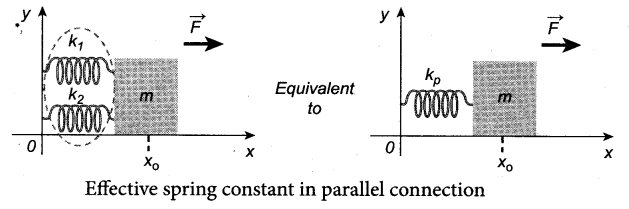
Let the force F be applied towards right as shown in figure. In this case, both the springs elongate or compress by the same amount of displacement. Therefore, net force for the displacement of mass m is
$F=-k_p X \ldots(1)$
where $k_p$ is called effective spring constant.
Let the first spring be elongated by a displacement $x$ due to force $F_1$ and second spring be elongated by the same displacement x due to force $F _2$, then the net force
$F=-k_1 x-k_2 x$
Equating equations (2) and (1), we get
$k_p=k_1+k_2 \ldots . .(2)$
Generalizing, for $n$ springs connected in parallel,
$k_P=\sum_{i=1}^n k_i$
If all spring constants are identical i.e., $k_1=k_2=\ldots=k_n=k$ then
$k_P=n k$
This implies that the effective spring constant increases by a factor $n$. Hence, for the springs in parallel connection, the effective spring constant is greater than individual spring constant.
Let the force F be applied towards right as shown in figure. In this case, both the springs elongate or compress by the same amount of displacement. Therefore, net force for the displacement of mass m is
$F=-k_p X \ldots(1)$
where $k_p$ is called effective spring constant.
Let the first spring be elongated by a displacement $x$ due to force $F_1$ and second spring be elongated by the same displacement x due to force $F _2$, then the net force
$F=-k_1 x-k_2 x$
Equating equations (2) and (1), we get
$k_p=k_1+k_2 \ldots . .(2)$
Generalizing, for $n$ springs connected in parallel,
$k_P=\sum_{i=1}^n k_i$
If all spring constants are identical i.e., $k_1=k_2=\ldots=k_n=k$ then
$k_P=n k$
This implies that the effective spring constant increases by a factor $n$. Hence, for the springs in parallel connection, the effective spring constant is greater than individual spring constant.