Question
Derive the expression for resultant spring constant when two springs having constant $k_1$ and $k_2$ are connected in parallel.
Answer

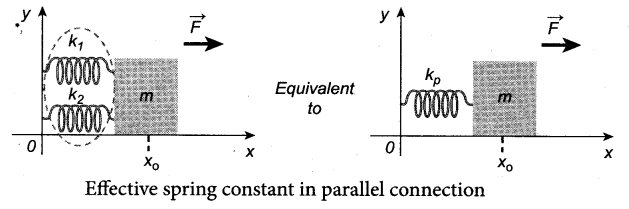
$k_1$ and $k_2$ attached to a mass $m$ as shown in figure. The results can be generalized to any number of springs in parallel.
Image
Let the force F be applied towards right as shown in figure. In this case, both the springs elongate or compress by the same amount of displacement. Therefore, net force for the displacement of mass m is
$F=-k_p X \ldots(1)$
where $k_p$ is called effective spring constant.
Let the first spring be elongated by a displacement $x$ due to force $F_1$ and second spring be elongated by the same displacement x due to force $F _2$, then the net force
$F=-k_1 x-k_2 x$
Equating equations (2) and (1), we get
$k_p=k_1+k_2 \ldots . .(2)$
Generalizing, for $n$ springs connected in parallel,
$k_P=\sum_{i=1}^n k_i$
If all spring constants are identical i.e., $k_1=k_2=\ldots=k_n=k$ then
$k_P=n k$
This implies that the effective spring constant increases by a factor $n$. Hence, for the springs in parallel connection, the effective spring constant is greater than individual spring constant. 

Need a full question paper?

Generate a complete, print-ready paper with questions like this in minutes — across 16+ boards, with answer keys.
Start Generating Free

Similar questions

The temperature at the bottom of a $40 m$ deap lake is $12^{\circ} C$ and that at the surface is $35^{\circ} C$. An air bubble of volume $1.0 cm 3$ rises from the bottom to the surface. Find its volume, (atmospheric pressure $=10 m$ of water)
Derive the expression for resultant spring constant when two springs having constant $k _1$ and $k _2$ are connected in series.
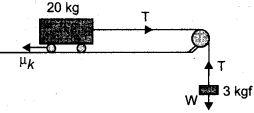
What is the acceleration of the block and trolley system as the figure, if the coefficient of kinetic friction between the trolley and the surface is 0.04 ? Also Calculate friction in the string: Take $g=$ $10 m / s ^2$, mass of the string is negligible.
Image
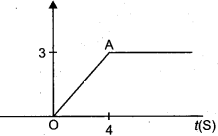
Figure shows the position-time graph of a particle of mass 4 kg. What is the
Image
(a) Force on the particle for t < 0, t > 4s, 0 < t < 4s?
(b) Impulse at t = 0 and t = 4s?
(Consider one dimensional motion only)
The acceleration of a particle in $m s^2$ is given by $a=3 t^2+2 t+2$, where time $t$ is in second. If the particle starts with a velocity $v =2 ms ^{-1}$ at $t =0$, then find the velocity at the end of $2 s$.
A mass of ideal gas at pressure P is expanded isothermally to four times the original volume and then slowly compressed adiabatically to its original volume. Assuming γ(= CP/CV) to be 1.5, find the new pressure of the gas.
Draw
(a) acceleration – time
(b) velocity – time
(c) Position – time graphs representing motion of an object under free fall. Neglect air resistance.
Two particles mass $100 g$ and $300 g$ at a given time have velocities $10 \hat{j}-7 \hat{j}-3 \hat{j}$ and $7 \hat{i}-9 \hat{j}+$ $6 \hat{k} ms ^{-1}$ respectively. Determine velocity of center of mass.
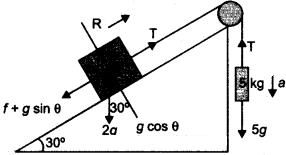
Two blocks of mass 2 kg and 5 kg are connected by an ideal string passing over a pulley. The block of mass 2 kg is free to slide on a surface inclined at an angle of 30° with the horizontal whereas 5 kg block hangs freely. Find the acceleration of the system and the tension in the string.
Image
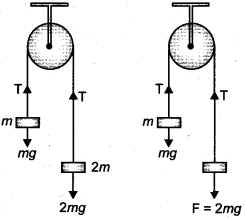
The pulley arrangement of figure are identical. The mass of the rope is negligible. In (a) mass m is lifted up by attaching a mass (2m) to the other end of the rope. In (b), m is lifted up by pulling the other end of the rope with a constant downward force F = 2 mg. In which case, the acceleration of m is more?
Image