Questions · Page 1 of 2

MCQ

🎯

Test yourself on this topic

50 questions · timed · auto-graded

MCQ 11 Mark
The fundamental frequency of a closes organ pipe of length 20 cm is equal to the second overtone of an organ pipe open at both the ends. The length of the organ pipe open at both the ends is ……
  • A
    80 cm
  • B
    100 cm
  •  120 cm
  • D
    140 cm
Answer
Correct option: C.
 120 cm
120 cm
Hint :
$\frac{v}{4 L _{\text {closed }}}=\frac{3 v}{2 L _{\text {open }}} \Rightarrow L _{\text {open }}=6 L _{\text {closed }}=120 cm$
View full question & answer
MCQ 21 Mark
If we study the vibration of a pipe open at both ends, then which of the following statement is not true?
  • A
    open end will be antinode
  • B
     odd harmonics of the fundamental frequency will be generated
  • C
     all harmonics of the fundamental
  • pressure change will be maximum at both ends.
Answer
Correct option: D.
pressure change will be maximum at both ends.
Hint :
Pressure change at open ends is zero.
View full question & answer
MCQ 31 Mark
In a resonance tube, the first resonance is obtained at $40 cm$ length, using a tuning fork of frequency $450 Hz$. Ignoring end correction, the velocity of sound in air is
  • A
    $ 620 m/s$
  • $720 m/s$
  • C
    $820 m/s$
  • D
    $1020 m/s$
Answer
Correct option: B.
$720 m/s$
$720 m/s$
{ Hint: }
$\frac{\lambda}{4}=40 cm =0.4 m$
$\Rightarrow \quad \therefore \lambda=4 \times 0.4=1.6 m ; f=450 Hz$
$ \text { Velocity of sound } \quad v=f \lambda=450 \times 1.6=720 m / s$
View full question & answer
MCQ 41 Mark
A closes organ pipe of length 20 cm is sounded with a tuning fork in resonance. What is the frequency of the tuning fork? (v = 332 m/s)
  • A
     300 Hz
  • B
     350 Hz
  • C
    375 Hz
  •  415 Hz
Answer
Correct option: D.
 415 Hz
415 Hz
Hint :
In resonance, the frequency of the fork is equal to the frequency of the organ pipe, $ f=\frac{v}{4 L }=\frac{332}{4 \times 0.2}=415 Hz $
View full question & answer
MCQ 51 Mark
The ratio of intensities of two waves is 16 : 9. If they produce interference, then the ratio of maximum and minium intensities will be ……..
  • A
    $4: 3$
  • $49: 1$
  • C
    $64: 27$
  • D
    $81: 49$
Answer
Correct option: B.
$49: 1$
$49: 1$
Hint :
Amplitude ratio $r=\sqrt{\frac{ I _1}{ I _2}}=\sqrt{\frac{16}{9}}=\frac{4}{3}$ $_{\text {Sat. }}$$\frac{I_{\max }}{I_{\max }}=\left(\frac{r+1}{r-1}\right)^2=\left(\frac{4+3}{4-3}\right)^2=\frac{49}{1}$
View full question & answer
MCQ 61 Mark
Two vibrating tuning forks produce progressive waves given be y1 =4 sin 500 πt and y2 = 2 sin 506 πt where t is in seconds number of beats produced per minute is ……..
  • A
    60
  • B
    3
  • C
    369
  • 180
Answer
Correct option: D.
180
180
Hint :
$v_1=\frac{500 \pi}{2 \pi}=250 Hz ; v_2=\frac{506 \pi}{2 \pi}=253 Hz$
View full question & answer
MCQ 71 Mark
Two sound waves with wavelengths 5.0 cm and 5.5 cm, respectively each propagate in a gas with velocity 330 m/s. The number of beats per second will be ……..
  • A
    $0$
  • B
     1
  • 6
  • D
    12
Answer
Correct option: C.
6
6
Hint :
$\text { Number of beats } / s \text { is }=330\left[\frac{1}{5}-\frac{1}{5.5}\right]=6$
View full question & answer
MCQ 81 Mark
An air column in a pipe, which is closed at one end, will be in resonance with a vibrating tuning fork of frequency 256 Hz, if the length of the column in centimeter is (velocity of sound in air = 340 m/s)
  • A
    21.25
  • B
    125
  • C
    62.50
  • 33.2
Answer
Correct option: D.
33.2
33.2
Hint :
$f=\frac{v}{4 L } \Rightarrow L =\frac{v}{4 f}=\frac{34000}{4 \times 256}=33.2 cm$
View full question & answer
MCQ 91 Mark
If the ratio of the amplitudes of two waves is 4 : 3, then the ratio of maximum and minimum intensities is …….
  • A
    $16: 9$
  • B
    $49: 16$
  • C
    $7: 1$
  • $49: 1$
Answer
Correct option: D.
$49: 1$
$49: 1$
View full question & answer
MCQ 101 Mark
Two open organ pipes of lengths 50 cm and 50.5 cm produce 3 beats/s. Then the velocity of sound is …….
  • A
    300 m/s
  • B
    30 m/s
  • 303 m/s
  • D
    30.3 m/s
Answer
Correct option: C.
303 m/s
303 m/s
Hint :
$\frac{v}{2 \times 50}-\frac{v}{2 \times 50.5}=3$ (or) $(101-100) v=100 \times 101 \times 3$ (or) $v=30300 cm / s =303 cm / s$
View full question & answer
MCQ 111 Mark
Two waves of the same frequency and intensity superimpose with each other in opposite phases. Then after superposition the ……
  • A
    intensity increases to four times
  • B
     intensity increase to two times
  • C
     frequency increases to four times
  • none of the above
Answer
Correct option: D.
none of the above
none of the above
Hint :
Since the waves are in opposite phases, the resultant intensity will be zero. The frequency remains the same. So, the correct choice is (d).
View full question & answer
MCQ 121 Mark
A standing wave is represented by y = A sin (100t) cos (0.01x) where y and A are in millimetres, t in seconds and x in metres. The velocity of the wave is ………
  • $10^4 m / s$
  • B
    $1 m / s$
  • C
    $10^{-4} m / s$
  • D
    not derivable from the above information
Answer
Correct option: A.
$10^4 m / s$
$10^4 m / s$
Hint :
$v=\frac{\omega}{k}=\frac{100}{0.10}=10^4 m / s$
View full question & answer
MCQ 131 Mark
A wave of frequency 100 Hz is sent along a string towards a fixed end when this wave travels back after reflection, a node is formed at a distance of 10 cm from the fixed end of the string. The speed of the incident wave is ……
  • A
     40 m/s
  • 20 m/s
  • C
     10 m/s
  • D
     5 m/s
Answer
Correct option: B.
20 m/s
20 m/s
Hint :
The fixed end is also a node distance between two nodes $=\frac{\lambda}{2}=10 cm$ or $\lambda=20 cm =0.2 cm$ Speed $v=f \lambda=100 \times 0.2=20 m / s$
View full question & answer
MCQ 141 Mark
If a resonance tube is sounded with a tuning fork of frequency 256 Hz, resonance occurs at 35 cm and 105 cm. The velocity of sound is about ……
  • 358 m/s
  • B
    512 m/s
  • C
     524 m/s
  • D
    none of these
Answer
Correct option: A.
358 m/s
358 m/s
Hint :
$v=2 f\left( L _2- L _1\right)=2 \times 256 \times(105-35) \times 10^{-2}=358.4 m / s$
View full question & answer
MCQ 151 Mark
A sonometer wire is vibrating in the second overtone. In the wire there are ……
  • A
     two nodes and two antinodes
  • B
     one node and two antinodes
  • four nodes and three antinodes
  • D
    three nodes and three antinodes
Answer
Correct option: C.
four nodes and three antinodes
View full question & answer
MCQ 161 Mark
Two waves of the same frequency and amplitude super impose to produce a resultant disturbance of the same amplitude. The phase difference between the waves is ……
  • A
    zero
  • B
     π/3
  • C
    π/4
  • 2π/3
Answer
Correct option: D.
2π/3
2π/3
Hint :
Let the amplitude of each wave be A and phase difference between them be $\varphi$. Then, $A=\sqrt{A^2+A^2+2 A^2 \cos \phi} \Rightarrow \cos \phi=-\frac{1}{2} \text { or } \phi=\frac{2 \pi}{3}$
View full question & answer
MCQ 171 Mark
With the increase in temperature, the frequency of the found from an organ pipe
  • A
    decrease
  • increase
  • C
    remains unchanged
  • D
    changes erractically
Answer
Correct option: B.
increase
increase
Hint :
Frequency ∝ v/L. Now v and L both increase with temperature but increase of v is much more than the increase of L which is negligible. Thus frequency increases with temperature.
View full question & answer
MCQ 181 Mark
A cylindrical tube, open at both ends has a fundamental frequency f in air. The tube is dipped vertically in water so that half of it is in water. The fundamental frequency of the air column is now …….
  • A
     f/2
  • f
  • C
    3f/4
  • D
    2f
Answer
Correct option: B.
f
f
Hint :
When the tube is dipped in water, it become a closed pipe of length $L / 2$. Its fundamental frequency is$f^{\prime}=\frac{v}{4( L / 2)}=f$
View full question & answer
MCQ 191 Mark
A vibrating stretched string resonates with a tuning fork of frequency 512 Hz when the length of the string is 0.5 m. The length of the string required to vibrate resonantly with a tuning fork of frequency 256 Hz would be ……
  • A
     0.25 m
  • B
    0.75 m
  •  1.0 m
  • D
     2.0 m
Answer
Correct option: C.
 1.0 m
1.0 m
Hint :
$v \propto \frac{1}{ L } \Rightarrow \frac{ L _2}{ L _1}=\frac{v_1}{v_2}$ or $L _2=\frac{v_1}{v_2} L _1=\frac{512 \times 0.5}{256 .}=1.0 m$
View full question & answer
MCQ 201 Mark
Beats occur because of
  • interference
  • B
    reflection
  • C
    refraction
  • D
    Doppler effect
Answer
Correct option: A.
interference
 interference
View full question & answer
MCQ 211 Mark
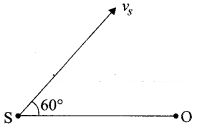
A source of sounds emitting waves of frequency $100 Hz$ and an observer $O$ are located at same distance from each other The source is moving with a speed of $19.4 ms ^{-1}$ at an angle of $60^{\circ}$ with the source-observer line as shown in the figure. The observer is at rest. The apparent frequency observed by the observer (velocity of sound in air $330 ms ^{-1}$ ) is ......
Image
  • A
     97 Hz
  • B
     100 Hz
  • 103 Hz
  • D
     106 Hz
Answer
Correct option: C.
103 Hz
103 Hz
Hint :
$f^{\prime}=\frac{v}{v-v_s \cos \theta}=\frac{330}{330-19.4 \cos 60^{\circ}} \times 100=103 Hz$
View full question & answer
MCQ 221 Mark
A train moving at a speed of 220 m/s towards a stationary object, emits a sound of frequency 1000 Hz. Some of the sound reaching the object gets reflected back to the train as echo. The frequency of the echo as detected by the driver of the train is
  • A
    3000 Hz
  • B
    3500 Hz
  • C
    4000 Hz
  • 5000 Hz
Answer
Correct option: D.
5000 Hz
5000 Hz
Hint :
$f^{\prime}=\left(\frac{330+220}{330+220}\right) \times 1000=5000 Hz$
View full question & answer
MCQ 231 Mark
Sound waves travel at 350 m/s through warm air and at 3500 m/s through brass. The wavelength of a 700 Hz acoustic wave as it enters brass from warm air
  • A
    increases by a factor 20
  •  increases by a factor 10
  • C
    decreases by a factor 20
  • D
     decreases by a factor 10
Answer
Correct option: B.
 increases by a factor 10
increase by a factor 10
Hint :
Since the frequency remains the same, we have$\frac{\lambda_{\text {brass }}}{\lambda_{\text {air }}}=\frac{v_{\text {brass }}}{v_{\text {air }}} \Rightarrow \lambda_{\text {brass }}=\frac{3500}{350} \lambda_{\text {air }}=10\lambda_{\text {air }}$
View full question & answer
MCQ 241 Mark
The velocity of sound in air at NTP is 330m/s. What will be its value when temperature is doubled and pressure is halved?
  • A
    165 m/s
  • B
    330 m/s
  • $330 / \sqrt{2}$
  • D
    $300 / \sqrt{2} m / s$
Answer
Correct option: C.
$330 / \sqrt{2}$
$330 / \sqrt{2}$
Hint :
There is no effect of change of pressure on the velocity of sound in air. Further, $v \propto \sqrt{T}$
View full question & answer
MCQ 251 Mark
Doppler effect in sound is due to ………
  • A
    motion of source
  • B
     motion of observer
  • relative motion of source and observer
  • D
    none of the above
Answer
Correct option: C.
relative motion of source and observer
 relative motion of source and observer
View full question & answer
MCQ 261 Mark
The waves produced by a motor boat sailing in water are ……..
  • A
     transverse
  • B
    longitudinal
  •  longitudinal and transverse
  • D
     stationary
Answer
Correct option: C.
 longitudinal and transverse
 longitudinal and transverse
View full question & answer
MCQ 271 Mark
A point source emits sound equally in all direction is a non-absorbing medium. Two points P and Q are at distances of 2m and 3m, respectively, from the source. The ratio of the intensities of the waves at P and Q is …….
  • A
    $3: 2$
  • B
    $4: 9$
  • C
    $2: 3$
  • $9: 4$
Answer
Correct option: D.
$9: 4$
$9: 4$
Hint :
$I \alpha \frac{1}{r^2} \Rightarrow \frac{ I _{ P }}{ I _{ Q }}=\left(\frac{r_{ Q }}{r_{ P }}\right)^2=\left(\frac{3}{2}\right)^2=\frac{9}{4}$
View full question & answer
MCQ 281 Mark
Two waves represented by the following equation are travelling in the same medium: y1 = 5 sin 2π (75t – 0.25 x) and y2 = 10 sin 2π (150 – 0.25x) The intensity ratio of the two waves is ……..
  • A
     1 : 2
  •  1 : 4
  • C
    $1: 8$
  • D
    $1: 16$
Answer
Correct option: B.
 1 : 4
$1: 4$
Hint :
$I \propto A^2 \Rightarrow \frac{I_1}{I_2}=\left(\frac{A_1}{A_2}\right)^2=\left(\frac{5}{10}\right)^2=\frac{1}{4}$
View full question & answer
MCQ 291 Mark
A transverse wave propagating along $x$-axis is represented by$y(x, t)=8.0 \sin \left(0.5 \pi x-4 \pi t-\frac{\pi}{4}\right)$where $x$ is in metres and $t$ is in seconds. The speed of the wave is ..........
  • A
    $0.5 \pi m / s$
  • B
    $\frac{\pi}{4} m / s$
  • $8 m / s$
  • D
    $4 \pi m / s$
Answer
Correct option: C.
$8 m / s$
$8 m / s$
Hint :
Comparing with the standard equation $y= A \sin (k x-\omega t+\phi)$ We have
$\omega=4 \pi, k=0.5 \pi$
$\nu=\frac{\omega}{k}=\frac{4 \pi}{0.5 \pi}=8 m / s$
View full question & answer
MCQ 301 Mark
A transverse wave propagating on a stretched string of linear density $3 \times 10^{-4} kg m ^{-1}$ is represented by the equation, $y=0.2 \sin (1.5 x+60 t)$ Where $x$ is in metres and $t$ is in seconds. The tension in the string (in newtons) is:
  • A
    0.24
  • 0.48
  • C
    1.2
  • D
     1.80
Answer
Correct option: B.
0.48
0.48
Hint :
$v=\sqrt{\frac{ T }{m}}=\frac{\omega}{k} \Rightarrow T =\left(\frac{\omega}{k}\right)^2 m=\left(\frac{60}{1.5}\right)^2 \times 3 \times 10^{-4}=0.48 N$
View full question & answer
MCQ 311 Mark
The equation of a wave is y = 0.1 sin (100πt – kx) where x, y are in metres and t in seconds. If – the velocity of the wave is 100 m/s, then the value of k is
  • A
    $1 m ^{-1}$
  • B
    $2 m ^{-1}$
  • $\pi m ^{-1}$
  • D
    $2 \pi m ^{-1}$
Answer
Correct option: C.
$\pi m ^{-1}$
$\pi m^{-1}$
View full question & answer
MCQ 321 Mark
When a stone is dropped on the surface of still water, the waves produced are …….
  • A
     transverse
  • B
    longitudinal
  • C
    Stationary
  • partly longitudinal and partly transverse.
Answer
Correct option: D.
partly longitudinal and partly transverse.
View full question & answer
MCQ 331 Mark
Which of the following statement is untrue? The velocity of sound in a gas …….
  • A
    is independent of pressure
  • B
     increases with increase in temperature
  • C
     is dependent on molecular weight
  • is greater in dry air than in moist air
Answer
Correct option: D.
is greater in dry air than in moist air
View full question & answer
MCQ 341 Mark
The frequency of a sound wave is/and its velocity is v. If the frequency is increased to 4 f the velocity of the wave will be:
  • v
  • B
     2v
  • C
     4 v
  • D
     v/4
Answer
Correct option: A.
v
v
Hint :
The velocity is a characteristic of the medium and, therefore, it remains constant.
View full question & answer
MCQ 351 Mark
Sound waves of wavelength greater than that of audible sound are called ……
  •  infrasonic waves
  • B
    ultrasonic waves
  • C
    sonic waves
  • D
    seismic waves
Answer
Correct option: A.
 infrasonic waves
 infrasonic waves
View full question & answer
MCQ 361 Mark
A source of sound and a listener are approaching each other with a speed of $40 ms ^{-1}$.The apparent frequency of a note produced by the source is $400 Hz$. Then its true frequency is (velocity of sound in air $=360 ms ^{-1}$ )
  •  320 Hz
  • B
    400 Hz
  • C
    360 Hz
  • D
    420 Hz
Answer
Correct option: A.
 320 Hz
320 Hz
Hint :
$f^{\prime}=\left(\frac{v+v_0}{v-v_s}\right) f \Rightarrow 400=\left[\frac{360+40}{360-40}\right] f \Rightarrow f=320 Hz$
View full question & answer
MCQ 371 Mark
Asa spherical wave propagates, …….
  • A
     the wave intensity remains constant
  • B
    the wave intensity decrease as the inverse of the distance from the source
  •  the wave intensity decreases as the inverse square of the distance from the source.
  • D
    The wave intensity decreases as the inverse cube of the distance from the source.
Answer
Correct option: C.
 the wave intensity decreases as the inverse square of the distance from the source.
 The wave intensity decreases as the inverse square of the distance from the source.
View full question & answer
MCQ 381 Mark
If a sound wave travels from air to water, the quantity that remain unchanged is …….
  • A
     velocity
  • B
    wavelength
  •  frequency
  • D
    amplitude
Answer
Correct option: C.
 frequency

Frequency is the property of the source which does not alter with a change in medium. Thus, frequency remains unchanged when a sound wave travels from air to water.
View full question & answer
MCQ 391 Mark
The speed of a wave in a medium is 760 m/s. If 3600 waves are passing through a point in the medium in 2 minutes, then its wavelength is ……
  • A
    13.8 m
  • 25.3 m
  • C
     41.5 m
  • D
     57.2 m
Answer
Correct option: B.
25.3 m
25.3 m
Hint :
Frequency $n=\frac{3600}{120}=30 Hz$; Wavelength $\lambda=\frac{v}{n}=\frac{760}{30}=25.3 m$
View full question & answer
MCQ 401 Mark
The Doppler effect is applicable for ……..
  • A
     light waves
  • B
    sound waves
  • C
     space waves
  • both (a) and (b)
Answer
Correct option: D.
both (a) and (b)
both (a) and (b)
View full question & answer
MCQ 411 Mark
A vehicle with a horn of frequency n is moving with a velocity of 30m/s in a direction perpendicular to the straight line joining the observer and the vehicle. The observer perceives the sound to have a frequency n + n1. Then (if the sound velocity in air is 300 m/s)
  • A
    $n _1=10 n$
  • $n _1=0$
  • C
    $n _1=-0.1 n$
  • D
    $n _1=0.1 n$
Answer
Correct option: B.
$n _1=0$
$n _1=0$
Hint :
No Doppler effect is observed if the source moves perpendicular to the line joining the source and the observer. Therefore, the correct choice is (b).
View full question & answer
MCQ 421 Mark
A source of sounds is travelling with a velocity of 40 km/hr towards an observer and emits sound of frequency 2000 Hz. If the velocity of sound is 1220 km/hr, then what is the apparent frequency heard by the observer?
  •  2068 Hz
  • B
    2180 Hz
  • C
    2000 Hz
  • D
    1980 Hz
Answer
Correct option: A.
 2068 Hz
2068 Hz
Hint :
$f^{\prime}=\left(\frac{v}{v-v_s}\right) \times f=\frac{1220}{1220-40} \times 2000=2068 Hz$
View full question & answer
MCQ 431 Mark
Asa transverse wave strikes against a fixed end …….
  • its phase changes by 180°, but velocity does not change.
  • B
     its phase does not change, but velocity changes
  • C
     its velocity changes and phase too changes by 180°
  • D
    nothing can be predicted about changes in its velocity and phase.
Answer
Correct option: A.
its phase changes by 180°, but velocity does not change.
 its phase changes by 180°, but velocity does not change
View full question & answer
MCQ 441 Mark
If the velocity of sound in air is $340 ms ^{-1}$, a person singing a note of frequency $250 cps$ is producing sound waves with a wavelength of ........
  • A
     0.7
  • B
    1.36 cm
  • 1.36 m
  • D
     85 km
Answer
Correct option: C.
1.36 m
1.36
Hint :
$f^{\prime}=\frac{340}{250}=1.36 m$
View full question & answer
MCQ 451 Mark
The equation of a wave moving on string is y = 8 sin{π(0.002 x – 4t)} where x, y are in centimeter and t in seconds. The velocity of the wave is ……
  • A
    100 cm/s
  • B
    0.2π cm/s
  • C
     4π cm/s
  • 200 cm/s
Answer
Correct option: D.
200 cm/s
200 cm/s
Hint :
$v=\frac{\omega}{k}=\frac{4}{0.02}=200 cm / s$
View full question & answer
MCQ 461 Mark
A wave travels in a medium according to the equation of displacement given by y(x, t) = 0.03 sin{π(2t – 0.01 x)} where y and x are in metres and t in seconds. The wave length of the wave is …..
  •  200 m
  • B
     100 m
  • C
    20 m
  • D
     10 m
Answer
Correct option: A.
 200 m
200 m
Hint :
$\lambda=\frac{2 \pi}{k}=\frac{2 \pi}{0.01 \pi}=200 m$
View full question & answer
MCQ 471 Mark
Which of the following equations represents a wave?
  • A
     y = A(ωt – kx)
  • B
     y = A sin ωt
  • C
     y = A cos kx
  • y = A sin (at – bx + c)
Answer
Correct option: D.
y = A sin (at – bx + c)
 y = A sin (at -bx + c)
View full question & answer
MCQ 481 Mark
The path difference between the two waves $y_1=a_1 \sin \left(\omega t-\frac{2 \pi x}{\lambda}\right)$ and $y_2=a_2 \cos \left(\omega t-\frac{2 \pi x}{\lambda}+\phi\right)$ is ...........
  • A
    $\frac{\lambda}{2 \pi} \phi$
  • $\frac{\lambda}{2 \pi}\left(\phi+\frac{\pi}{2}\right)$
  • C
    $\frac{2 \pi}{\lambda}\left(\phi+\frac{\pi}{2}\right)$
  • D
    $\frac{2 \pi}{\lambda} \phi$
Answer
Correct option: B.
$\frac{\lambda}{2 \pi}\left(\phi+\frac{\pi}{2}\right)$
$\frac{\lambda}{2 \pi}\left(\phi+\frac{\pi}{2}\right)$ Hint: Phase difference $=\phi+\frac{\pi}{2} ;$ Path difference $=\frac{\lambda}{2 \pi}\left(\phi+\frac{\pi}{2}\right)$
View full question & answer
MCQ 491 Mark
Pitch of sound depends on ……
  •  frequency
  • B
    wavelength
  • C
    amplitude
  • D
    speed
Answer
Correct option: A.
 frequency
 frequency
View full question & answer
MCQ 501 Mark
If the density of oxygen is 16 times that of hydrogen, what will be the ratio of the velocities of sound in them?
  • A
     1 : 4
  • B
     4 : 1
  • C
     2 : 1
  •  1 : 16
Answer
Correct option: D.
 1 : 16
1 : 16
Hint :
Using eq. $\frac{v_1}{v_2}=\sqrt{\frac{\rho_2}{\rho_1}} \frac{v_{ O _2}}{v_{ H _2}}=\sqrt{\frac{\rho_{ H _2}}{\rho_{ O _2}}}=\sqrt{\frac{1}{16}}=\frac{1}{4}$
View full question & answer
MCQ - Physics STD 11 Questions - Vidyadip