Questions

[ 3 Marks Questions ]

🎯

Test yourself on this topic

11 questions · timed · auto-graded

Question 13 Marks
To simulate car accidents, auto manufacturers study the collisions of moving cars with mounted springs of different spring constants. Consider a typical simulation with a car of mass $1000 kg$ moving with a speed $18.0 kmh ^{-1}$ on a smooth road and colliding with a horizontally mounted spring of spring constant $6.25 \times 10^{-3} Nm ^{-1}$. What is the maximum compression of the spring?
Answer
At maximum compression $x_m$, the K.E. of the car is converted entirely into the P.E. of the spring.
$
\therefore \quad \frac{1}{2} k x_m^2=\frac{1}{2} m v^2 \text { or } x_m=2 m .
$
View full question & answer
Question 23 Marks
An elevator which can carry a maximum load of 1800 kg (elevator + passengers) is moving up with a constant speed of 2 ms-1. The frictional force opposing the motion is 4000 N. Determine the minimum power delivered by the motor to the elevator in watts as well as in horse power.
Answer
$
F=m g+f=22000 N
$
$\therefore$ Power supplied by motor to balance this force is :
$
P = F v=44000 W =\frac{44000}{746}=59 hp .
$
View full question & answer
Question 33 Marks
A truck of mass 1000 kg accelerates uniformly from rest to a velocity of 15 ms-1 in 5 seconds. Calculate
(i) its acceleration,
(ii) its gain in K.E.,
(iii) average power of the engine during this period, neglect friction.
Answer
(i) $a=\frac{v-u}{t}=3 m / s ^2$
(ii) Gain in K.E. $=\frac{1}{2} m\left(v^2-u^2\right)=1.125 \times 10^5 J$
(iii) $P =\frac{ W }{t}=22500 W$.
View full question & answer
Question 43 Marks
Two identical 5 kg blocks are moving with same speed of $2 ms^{-1}$ towards each other along a frictionless horizontal surface. The two blocks collide, stick together and come to rest. Consider the two blocks as a system. Calculate work done by
(i) external forces and
(ii) Internal forces.
Answer
Here no external forces are acting on the system so:
$\overrightarrow{ F }_{\text {ext }}=0 \Rightarrow W _{\text {ext }}=0$
According to work-energy theorem :
Total W.D. = Change in K.E.
or $W _{\text {ext }}+$ = Final K.E. - Initial K.E.
$0+ W _{\text {int. }}=0-\left(\frac{1}{2} m u^2+\frac{1}{2} m u^2\right)$
or
$W _{\text {int. }}=-m u^2=-20 J$
View full question & answer
Question 53 Marks
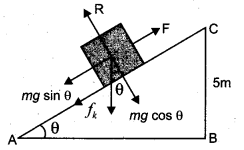
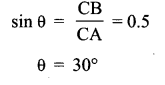
A body of mass 0.3 kg is taken up an inclined plane to length 10 m and height 5 m and then allowed to slide down to the bottom again. The coefficient of friction between the body and the plane is 0.15. What is the
(i) work done by the gravitational force over the round trip?
(ii) work done by the applied force over the upward journey?
(iii) work done by frictional force over the round trip?
(iv) kinetic energy of the body at the end of the trip?
How is the answer to (iv) related to the first three answers?
Answer
Image
Image
(i) $W = FS =- mg \sin \theta \times h =-14.7 J$ is the W.D. by gravitational force in moving plane.
$W ^{\prime}= FS =+ mg \sin \theta \times h =14.7 J$ is the W.D. by gravitational force in moving the body down the inclined plane.
$\therefore$ Total W.D. round the trip, $W_1=W+W^{\prime}=0$
(ii) Force needed to move the body up the inclined plane,
$F=m g \sin \theta+f_k=m g \sin \theta+\mu_k R=m g \sin \theta+\mu_k m g \cos \theta$
$\therefore$ W.D. by force over the upward journey is
$W_2=F \times I=m g\left(\sin \theta+\mu_k \cos \theta\right) I=18.5 J$
(iii) W.D. by frictional force over the round trip,
$W_3=-f k(I+I)=-2 f k I=-2 \mu_k \cos \theta I=-7.6 J$
$\text { (iv) K.E. of the body at the end of round trip }$
$=\text { W.D. by net force in moving the body down the inclined plane }$
$=\left(mg \sin \theta-\mu_{K} \cos \theta\right) I$
$=10.9 J$
$\Rightarrow \text { K.E. of body = net W.D. on the body. }$
View full question & answer
Question 63 Marks
A man pulls a lawn roller through a distance of 20 m with a force of 20 kg weight. If he applies the force at an angle of 60° with the ground, calculate the power developed if he takes 1 min in doing so.
Answer
$P =\frac{ W }{t}=\frac{ F s \cos \theta}{t}=32.66 W$.
View full question & answer
Question 73 Marks
A bullet of mass 0.02 kg is moving with a speed of 10 ms-1. It can penetrate 10 cm of a wooden block, and comes to rest. If the thickness of the target would be 6 cm only, find the K.E. of the bullet when it comes out.
Answer
For $x=10 cm =0 \cdot 1 m , F x=\frac{1}{2} m v_1^2=1 J$
$
\therefore \quad F =10 N \text { SamacheerKalvi.Guru }
$
For $x=6 cm =0.06 m , F x=\frac{1}{2} m v_1^2-\frac{1}{2} m v_2^2$ or
$
F x=\frac{1}{2} m v_1^2-\text { Final K.E. }
$
or
$
\text { Final K.E. }=\frac{1}{2} m v_1^2- F x=1-10 \times 0.06=1-0.6=0.4 J
$
View full question & answer
Question 83 Marks
In lifting a $10\ kg$ weight to a height of $2\ m, 230\ J$ energy is spent. Calculate the acceleration with which it was raised.
Answer
$W=m g h+m a h=m(g+a) h$
$\therefore a=1.5 m / s ^2 .$
View full question & answer
Question 93 Marks
A railway carriage of mass 9000 kg moving with a speed of 36 kmph collides with a stationary carriage of same mass. After the collision, the carriages get coupled and move together. What is their common speed after collision? What type of collision is this?
Answer
$m_1=9000 kg , u_1=36 km / h =10 m / s$
$m _2=9000 kg , u_2=0, v=v_1=v_2=?$
By conservation of momentum:
$m _1 u _1+ m _2 u _2=\left( m _1+ m _2\right) v$
$\therefore v =5 m / s$
Total K.E. before collision $=\frac{1}{2} m_1 u_1^2+\frac{1}{2} m_2 u_2^2=45000 J$ Total K.E. after collision $=\frac{1}{2}\left(m_1+m_2\right) v^2=225000 J$ As total K.E. after collision < Total K.E. before collision $\therefore$ collision is inelastic
View full question & answer
Question 103 Marks
Water is pumped out of a well 10 m deep by means of a pump rated 10 KW. Find the efficiency of the motor if 4200 kg of water is pumped out every minute. Take g = 10 m/s2.
Answer
Input power $=10 KW$
Output power $=\frac{ W }{t}=\frac{m g h}{t}=7 KW$
$\therefore$ Efficiency $=\frac{\text { Output power }}{\text { Input power }} \times 100=70 \%$
View full question & answer
Question 113 Marks
A body is moving along z-axis of a coordinate system under the effect of a constant force F = Find the work done by the force in moving the body a distance of $2$ m along z-axis.
Answer
$\overrightarrow{ F }=(2 \hat{i}+3 \hat{j}+\hat{k}) N , \overrightarrow{ S }=2 \hat{k}$
$W =\overrightarrow{ F } \cdot \overrightarrow{ S }=2 J $
View full question & answer
[ 3 Marks Questions ] - Physics STD 11 Questions - Vidyadip