Question types

Work, Energy and Power question types

129 questions across 4 question groups — pick any mix to generate a Physics paper with step-by-step answer keys.

129
Questions
4
Question groups
5
Question types
Sample Questions

Work, Energy and Power questions

One sample from each question group in this chapter. Select any group above to see the full set with answer keys.

Q 1MCQ1 Mark
A boy “A” of mass 50 kg climbs up a staircase in 10 s. Another boy “B” of mass 60 kg climbs up a Same staircase in 15s. The ratio of the power developed by the boys “A” and “B” is
  • $\frac{5}{4}$
  • B
    $\frac{3}{2}$
  • C
    $\frac{4}{5}$
  • D
    $\frac{2}{3}$

Answer: A.

View full solution
Q 2MCQ1 Mark
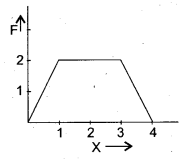
If the force F acting on a body as a function of x then the work done in moving a body from x = 1 m to x = 3m is
Image
  • A
    6 J
  • 4 J
  • C
    2.5 J
  • D
    1 J

Answer: B.

View full solution
Q 3MCQ1 Mark
A spring of negligible mass having a force constant of $10 Nm ^{-1}$ is compressed by a force to a distance of $4 cm$. A block of mass $900 g$ is free to leave the top of the spring. If the spring is released, the speed of the block is
  • A
    $11.3 ms ^{-1}$
  • B
    $13.3 \times 101 ms ^{-1}$
  • $13.3 \times 10^{-2} ms ^{-1}$
  • D
    $13.3 \times 10^{-3} ms^{-1}$

Answer: C.

View full solution
Q 4MCQ1 Mark
Two balls of equal masses moving with velocities 10 m/s and -7 m/s respectively collide elastically. Their velocities after collision will be
  • A
    $3 ms ^{-1}$ and $17 ms ^{-1}$
  • $-7 ms ^{-1}$ and $10 ms ^{-1}$
  • C
    $10 ms ^{-1}$ and $-7 ms ^{-1}$
  • D
    $3 ms ^{-1}$ and $-70 ms ^{-1}$

Answer: B.

View full solution
Q 5MCQ1 Mark
A bullet hits and gets embedded in a wooden block resting on a horizontal friction less surface. Which of the following is conserved?
  • momentum alone
  • B
    kinetic energy alone
  • C
    kinetic energy alone
  • D
    both momentum and kinetic energy

Answer: A.

View full solution
To simulate car accidents, auto manufacturers study the collisions of moving cars with mounted springs of different spring constants. Consider a typical simulation with a car of mass $1000 kg$ moving with a speed $18.0 kmh ^{-1}$ on a smooth road and colliding with a horizontally mounted spring of spring constant $6.25 \times 10^{-3} Nm ^{-1}$. What is the maximum compression of the spring?
View full solution
An elevator which can carry a maximum load of 1800 kg (elevator + passengers) is moving up with a constant speed of 2 ms-1. The frictional force opposing the motion is 4000 N. Determine the minimum power delivered by the motor to the elevator in watts as well as in horse power.
View full solution
A truck of mass 1000 kg accelerates uniformly from rest to a velocity of 15 ms-1 in 5 seconds. Calculate
(i) its acceleration,
(ii) its gain in K.E.,
(iii) average power of the engine during this period, neglect friction.
View full solution
Two identical 5 kg blocks are moving with same speed of $2 ms^{-1}$ towards each other along a frictionless horizontal surface. The two blocks collide, stick together and come to rest. Consider the two blocks as a system. Calculate work done by
(i) external forces and
(ii) Internal forces.
View full solution
A body of mass 0.3 kg is taken up an inclined plane to length 10 m and height 5 m and then allowed to slide down to the bottom again. The coefficient of friction between the body and the plane is 0.15. What is the
(i) work done by the gravitational force over the round trip?
(ii) work done by the applied force over the upward journey?
(iii) work done by frictional force over the round trip?
(iv) kinetic energy of the body at the end of the trip?
How is the answer to (iv) related to the first three answers?
View full solution

Generate a Work, Energy and Power paper free

Pick question groups from the list above, set marks and difficulty, and export a branded PDF with step-by-step answer keys. First 3 chapters free — no signup.

Download App