Questions · Page 1 of 2

MCQ

🎯

Test yourself on this topic

50 questions · timed · auto-graded

MCQ 11 Mark
A boy “A” of mass 50 kg climbs up a staircase in 10 s. Another boy “B” of mass 60 kg climbs up a Same staircase in 15s. The ratio of the power developed by the boys “A” and “B” is
  • $\frac{5}{4}$
  • B
    $\frac{3}{2}$
  • C
    $\frac{4}{5}$
  • D
    $\frac{2}{3}$
Answer
Correct option: A.
$\frac{5}{4}$
$\frac{5}{4}$
Solution:Work done by the boy 'A' $\left( W _1\right)=m_1 g h=50 g h$Work done by the boy 'B' $\left( W _2\right)=m_2 g h=60 g h$Power developed by$A = P _1=\frac{w_1}{t_1}=\frac{50 g h}{10}$ Power developed by $B =$ is $\quad P _2=60 gh / 15$. then, $p_1 / p_2=\frac{50 gh / 10}{60 gh / 15}=\frac{5}{4}$
View full question & answer
MCQ 21 Mark
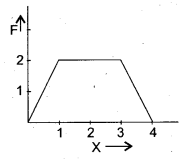
If the force F acting on a body as a function of x then the work done in moving a body from x = 1 m to x = 3m is
Image
  • A
    6 J
  • 4 J
  • C
    2.5 J
  • D
    1 J
Answer
Correct option: B.
4 J
4 J
View full question & answer
MCQ 31 Mark
A spring of negligible mass having a force constant of $10 Nm ^{-1}$ is compressed by a force to a distance of $4 cm$. A block of mass $900 g$ is free to leave the top of the spring. If the spring is released, the speed of the block is
  • A
    $11.3 ms ^{-1}$
  • B
    $13.3 \times 101 ms ^{-1}$
  • $13.3 \times 10^{-2} ms ^{-1}$
  • D
    $13.3 \times 10^{-3} ms^{-1}$
Answer
Correct option: C.
$13.3 \times 10^{-2} ms ^{-1}$
Solution:
We know that, the potential energy of the spring $=\frac{1}{2} kx ^2$. Here the potential energy of the spring is converted into kinetic energy of the block.
$
\begin{aligned}
\therefore \quad \frac{1}{2} k x^2 & =\frac{1}{2} m v^2 \\
v^2 & =\frac{k}{m} x^2 \Rightarrow v=\sqrt{\frac{k}{m}} x \quad \text { SamacheerKalvi.Guru } \\
v & =\sqrt{\frac{20}{90}} \times 4 \times 10^{-2}=\sqrt{\frac{100}{9}} \times 4 \times 10^{-2}=13.3 \times 10^{-2} ms ^{-1} .
\end{aligned}
$
View full question & answer
MCQ 41 Mark
Two balls of equal masses moving with velocities 10 m/s and -7 m/s respectively collide elastically. Their velocities after collision will be
  • A
    $3 ms ^{-1}$ and $17 ms ^{-1}$
  • $-7 ms ^{-1}$ and $10 ms ^{-1}$
  • C
    $10 ms ^{-1}$ and $-7 ms ^{-1}$
  • D
    $3 ms ^{-1}$ and $-70 ms ^{-1}$
Answer
Correct option: B.
$-7 ms ^{-1}$ and $10 ms ^{-1}$
View full question & answer
MCQ 51 Mark
A bullet hits and gets embedded in a wooden block resting on a horizontal friction less surface. Which of the following is conserved?
  • momentum alone
  • B
    kinetic energy alone
  • C
    kinetic energy alone
  • D
    both momentum and kinetic energy
Answer
Correct option: A.
momentum alone
momentum alone
View full question & answer
MCQ 61 Mark
A missile fired from a launcher explodes in mid air, its total
  • kinetic energy increases
  • B
    momentum increases
  • C
    kinetic energy decreases
  • D
    momentum decreases
Answer
Correct option: A.
kinetic energy increases
View full question & answer
MCQ 71 Mark
If momentum of a body increases by 25% its kinetic energy will increase by
  • A
    $25 \%$
  • B
    $50 \%$
  • C
    $125 \%$
  • $56.25 \%$
Answer
Correct option: D.
$56.25 \%$
$56.25 \%$
Solution:
Let momentum of $p _1=100 \%$ momentum of $p _2=125 \%$.
$
\therefore
$
$
\begin{aligned}
\frac{p_2}{p_1} & =\frac{5}{4} \Rightarrow p_2=\frac{5}{4} p_1 \quad \therefore \quad v_2=\frac{5}{4} v_1 \\
\text { Kinetic energy } & =\frac{1}{2} m v^2 \text { SamacheerKalvi.Guru }
\end{aligned}
$
$
E \propto v^2 \quad E _2=\frac{25}{16} E _1
$
$
\begin{aligned}
\text { Increase in } K . E & =\frac{ E _2- E _1}{ E _1} \times 100=\frac{\frac{25}{16} E _1- E _1}{ E _1} \times 100 \\
& =\frac{\frac{25-16}{16} E _1}{ E _1} \times 100=\frac{9}{16} \times 100=56.25 \%
\end{aligned}
$
View full question & answer
MCQ 81 Mark
A 9 kg mass and 4 kg mass are moving with equal kinetic energies. The ratio of their momentum is
  • A
    $1: 1$
  • $3: 2$
  • C
    $2: 3$
  • D
    $9: 4$.
Answer
Correct option: B.
$3: 2$
$3: 2$ Given that K.E are equal
$
\therefore \quad \frac{ P _1^2}{2 m_1}=\frac{ P _2^2}{2 m_2} \quad \therefore \quad \frac{ P _1}{\dot{ P }_2}=\sqrt{\frac{m_1}{m_2}}=\sqrt{\frac{9}{4}}=\frac{3}{2}
$
View full question & answer
MCQ 91 Mark
A force of $(10 \hat{i}-3 \hat{j}+6 \hat{k}) N$ acts on a body of $5 kg$ and displaces it from $(6 \hat{i}+5 \hat{j}-3 \hat{k})$ to ( $10 \hat{i}-2 \hat{j}+7 k) m$. The work done is
  • A
    100 J
  • B
    $0$
  • 121 J
  • D
    none of these
Answer
Correct option: C.
121 J
Here
$
\mathrm{F}=(10 \hat{i}-3 \hat{j}+6 \hat{k}) \mathrm{N}
$
$
\begin{aligned}
\text { Displacement vector } & =\bar{x}=\left(x_2-x_1\right) \hat{i}+\left(y_2-y_1\right) \hat{j}+\left(z_2-z_1\right) \hat{k} \\
\bar{x} & =(10-6) \hat{i}+(-2-5) \hat{j}+(7+3) \hat{k}=4 \hat{i}-7 \hat{j}+10 \hat{k}
\end{aligned}
$
$
\begin{aligned}
\text { We know that work done } & =w=\overline{\mathrm{F}} \cdot \bar{s}=(10 \hat{i}-3 \hat{j}+6 \hat{k}) \cdot(4 \hat{i}-7 \hat{j}+10 k) \\
& =40+21+60=121 \mathrm{~J} . \text {}
\end{aligned}
$
View full question & answer
MCQ 101 Mark
A particle of mass $“m”$ moving with velocity $v$ strikes a particle of mass $“2m”$ at rest and sticks to it. The speed of the combined mass is
  • A
    $\frac{v}{2}$
  • B
    $2 v$
  • $\frac{v}{3}$
  • D
    $\frac{v}{4}$
Answer
Correct option: C.
$\frac{v}{3}$
$\frac{v}{3}$
According to conservation of linear momentum
$m v=(m+2 m) v_1$
$v_1=\frac{m v}{3 m}=\frac{v}{3}$
View full question & answer
MCQ 111 Mark
In gravitational field, the work done in moving a body from one point into another depends on
  • initial and final positions
  • B
    distance between them
  • C
    actual distance covered
  • D
    velocity of motion
Answer
Correct option: A.
initial and final positions
View full question & answer
MCQ 121 Mark
A position dependent force $F =\left(7-2 x +3 x ^2\right) N$ acts on a small body of mass $2 kg$ and displaces it from $x=0$ to $x=5 m$. Work done is
  • A
    35 J
  • B
    70 J
  • 135 J
  • D
    270 J
Answer
Correct option: C.
135 J
135 J $W =\int_{x_1}^{x_2} F \cdot d x=\int_0^5\left(7-2 x 3 x^2\right) d x=\left[7 x-x^2+x^3\right]_0^5=135 J$
View full question & answer
MCQ 131 Mark
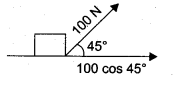
A box is dragged across a surface by a rope which makes an angle 45° with the horizontal. The tension in the rope is 100 N when the box is dragged 10 m. The work done is
  • 707.1 J
  • B
    607.1 J
  • C
    1414.2 J
  • D
    900 J
Answer
Correct option: A.
707.1 J
707.1 J The component of force acting along the surface is T cos θ
Image
∴ Work done = T cos θ × x
= 10o cos 45° × 10
= 707.1 J
View full question & answer
MCQ 141 Mark
A box is dragged across a surface by a rope which makes an angle 45° with the horizontal. The tension in the rope is 100 N when the box is dragged 10 m. The work done is
  • $\frac{1-e}{1+e}$
  • B
    $\frac{1+e}{e-1}$
  • C
    $(1+e)(1-e)$
  • D
    $\frac{e-1}{e+1}$
Answer
Correct option: A.
$\frac{1-e}{1+e}$
$\frac{1-e}{1+e}$
View full question & answer
MCQ 151 Mark
For perfectly inelastic collision, coefficient of restitution is
  • $0$
  • B
    1
  • C
    0 < e < 1
  • D
Answer
Correct option: A.
$0$
$0$
View full question & answer
MCQ 161 Mark
For inelastic collision co-efficient of restitution is
  • A
    $0$
  • B
    1
  •  0 < e < 1
  • D
Answer
Correct option: C.
 0 < e < 1
 0 < e < 1
View full question & answer
MCQ 181 Mark
If the velocity of separation is equal to the velocity of approach, then the collision is
  • conservative force
  • B
    non conservative force
  • C
    gravitational force
  • D
    electrostatic force
Answer
Correct option: A.
conservative force
conservative force
View full question & answer
MCQ 191 Mark
Inelastic collision is due to
  • A
    conservative force
  • non conservative force
  • C
    gravitational force
  • D
    electrostatic force
Answer
Correct option: B.
non conservative force
View full question & answer
MCQ 201 Mark
Elastic collision is due to
  • A
    conservative force
  • non conservative force
  • C
    gravitational force
  • D
    electrostatic force
Answer
Correct option: B.
non conservative force
View full question & answer
MCQ 211 Mark
When bubblegum is thrown on a moving vehicle, it sticks is an example for
  • A
    elastic collision
  • B
    inelastic collision
  • perfectly inelastic collision
  • D
    none
Answer
Correct option: C.
perfectly inelastic collision
View full question & answer
MCQ 221 Mark
If the two colliding bodies stick together after collision such collisions are
  • A
    elastic collision
  • B
    inelastic collision
  • perfectly inelastic collision
  • D
    head on collision
Answer
Correct option: C.
perfectly inelastic collision
View full question & answer
MCQ 231 Mark
In inelastic collision, which is conserved
  • A
    linear momentum
  • B
    total energy
  • both (a) and (b)
  • D
    none
Answer
Correct option: C.
both (a) and (b)
both (a) and (b)
View full question & answer
MCQ 241 Mark
The kinetic energy is not conserved in
  • A
    Elastic collision
  • In elastic collision
  • C
    both (a) and (b)
  • D
    none
Answer
Correct option: B.
In elastic collision
View full question & answer
MCQ 251 Mark
The kinetic energy is conserved in
  • elastic collision
  • B
    inelastic collision
  • C
    both (a) and (b)
  • D
    none
Answer
Correct option: A.
elastic collision
Elastic collision
View full question & answer
MCQ 261 Mark
Which of the following quantity is conserved in all collision process?
  • A
    kinetic energy
  • linear momentum
  • C
    both (a) and (b)
  • D
    none.
Answer
Correct option: B.
linear momentum
linear momentum
View full question & answer
MCQ 271 Mark
A bullet is fired normally on an immovable wooden plank of thickness 2 m. It loses 20% of its kinetic energy in penetrating a thickness 0.2 m of the plank. The distance penetrated by the bullet inside the wooden plank is
  • A
    0.2 m
  • B
    0.8 m
  • 1 m
  • D
    1.5 m
Answer
Correct option: C.
1 m
1 m
The wood offers a constant retardation. If the bullet loses 20% of its kinetic energy by penetrating 0.2m. it can penetrate further into 4 × 0.2 = 0.8 m with the remaining kinetic energy. So the total distance penetrated by the bullet is 0.2 + 0.8 = 1 m.
View full question & answer
MCQ 281 Mark
A body of mass 5 kg is initially at rest. By applying a force of 20 N at an angle of 60° with horizontal the body is moved to a distance of 4 m. The kinetic energy acquired by the body is
  • A
    80 J
  • B
    60 J
  • 40 J
  • D
    17.2 J
Answer
Correct option: C.
40 J
40 J The work done is equal to its kinetic energy ∴ K.E gained = Fs cos θ = 20 × 4 cos 60° = 40 J.
View full question & answer
MCQ 291 Mark
A body of mass m is thrown vertically upward with a velocity v. The height at which the kinetic energy of the body is one third of its initial value is given by
  • A
    $\frac{v^2}{2}$
  • B
    $\frac{v^2}{4}$
  • $\frac{v^2}{6 g}$
  • D
    $\frac{v^2}{3}$
Answer
Correct option: C.
$\frac{v^2}{6 g}$
$\frac{v^2}{6 g}$ Initial K.E $=\frac{1}{2} m v^2$. The loss in K.E will be the gain in potential energy
$
\begin{aligned}
\therefore m g h=\frac{1}{3}\left(\frac{1}{2} m v^2\right) \Rightarrow m g h & =\frac{1}{6} m v^2 \\
h & =\frac{v^2}{6 g} .
\end{aligned}
$
View full question & answer
MCQ 301 Mark
If a force F is applied on a body and the body moves with velocity v, the power will be
  • F.V
  • B
    F/V
  • C
    $FV ^2$
  • D
    $FW ^2$
Answer
Correct option: A.
F.V
F.V
View full question & answer
MCQ 321 Mark
The dimension of power is
  • A
    $ML ^2 T ^{-2}$
  • $ML ^2 T ^{-3}$
  • C
    $ML ^{-2} T ^2$
  • D
    $ML ^{-2} T ^3$
Answer
Correct option: B.
$ML ^2 T ^{-3}$
$ML ^2 T ^{-3}$
View full question & answer
MCQ 341 Mark
The unit of power is
  • A
    J
  • B
    W
  • C
    $J s ^{-1}$
  • both (b) and (c)
Answer
Correct option: D.
both (b) and (c)
both (b) and (c)
View full question & answer
MCQ 361 Mark
The body must have a minimum speed of lowermost point in vertical circular motion to complete the circle
  • A
    $\geq \sqrt{g r}$
  • B
    $\geq \sqrt{2 g r}$
  • $\geq \sqrt{5 g r}$
  • D
    $\geq 5 g r$
Answer
Correct option: C.
$\geq \sqrt{5 g r}$
$\geq \sqrt{5 g r}$
View full question & answer
MCQ 371 Mark
The body must have a speed at highest point in vertical circular motion to stay in the circular path
  • $\geq \sqrt{g r}$
  • B
    $\geq \sqrt{2 g r}$
  • C
    $\geq \sqrt{5 g r}$
  • D
    $\geq 5 g r$
Answer
Correct option: A.
$\geq \sqrt{g r}$
$\geq \sqrt{ g r }$
View full question & answer
MCQ 381 Mark
Which of the following is zero at the highest point in vertical circular motion?
  • velocity of the particle
  • B
    tension of the spring
  • C
    potential energy
  • D
    none
Answer
Correct option: A.
velocity of the particle
View full question & answer
MCQ 391 Mark
When a particle moving in a vertical circle, the variable is/are
  • A
    velocity of the particle
  • B
    tension of the string
  • both (a) and (b)
  • D
    mass of the particle
Answer
Correct option: C.
both (a) and (b)
View full question & answer
MCQ 401 Mark
Negative gradient of potential energy gives
  • conservative force
  • B
    non conservative force
  • C
    kinetic energy
  • D
    frictional force
Answer
Correct option: A.
conservative force
conservative force
View full question & answer
MCQ 411 Mark
The work done by the conservative forces in a cycle is
  • zero
  • B
    one
  • C
    infinity
  • D
    having negative value
Answer
Correct option: A.
zero
zero
View full question & answer
MCQ 421 Mark
If the work done is completely recoverable, then the force is
  • A
    conservative
  • non-conservative
  • C
    both (a) and (b)
  • D
    frictional in nature
Answer
Correct option: B.
non-conservative
non-conservative
View full question & answer
MCQ 431 Mark
Non conservative force is
  • A
    frictional force
  • B
    viscous force
  • C
    air resistance
  • all the above
Answer
Correct option: D.
all the above
all the above
View full question & answer
MCQ 441 Mark
Conservative force is
  • A
    electrostatic force
  • B
    magnetic force
  • C
    gravitational force
  • all the above
Answer
Correct option: D.
all the above
all the above
View full question & answer
MCQ 451 Mark
Two springs of spring constants k1 and k2 (k1 > k2). If they are stretched by the same force then (u1, u2 are potential energy of the springs) is
  • A
    $\mathrm{u}_1>\mathrm{u}_2 $
  • $ \mathrm{u}_2>\mathrm{u}_1 $
  • C
    $ \mathrm{u}_1=\mathrm{u}_2 $
  • D
    $ \mathrm{u}_1 \geq \mathrm{u}_2 $
Answer
Correct option: B.
$ \mathrm{u}_2>\mathrm{u}_1 $
View full question & answer
MCQ 461 Mark
Potential energy stored in the spring depends on
  • A
    spring constant
  • mass
  • C
    gravity
  • D
    length
Answer
Correct option: B.
mass
mass
View full question & answer
MCQ 471 Mark
Elastic potential energy possessed by a spring is
  • A
    $\frac{1}{2} m v^2$
  • B
    $m g h$
  • $\frac{1}{2} k x^2$
  • D
    $k x^2$
Answer
Correct option: C.
$\frac{1}{2} k x^2$
$\frac{1}{2} k x^2$
View full question & answer
MCQ 481 Mark
For a given momentum, the kinetic energy is proportional to
  • A
    $m$
  • $\frac{1}{m}$
  • C
    $m^2$
  • D
    $\sqrt{m}$
Answer
Correct option: B.
$\frac{1}{m}$
$\frac{1}{m}$
View full question & answer
MCQ 491 Mark
If two objects of masses m1 and m2 (m1 > m2) are moving with the same momentum then the kinetic energy will be greater for
  • A
    $m_1$ 
  •  $m_2$
  • C
    $m_1$ or $m_2$
  • D
    both will have equal kinetic energy
Answer
Correct option: B.
 $m_2$
 $m_2$
View full question & answer
MCQ 501 Mark
If p is the momentum of the particle then its kinetic energy is
  • A
    $\sqrt{2 Mp }$
  • B
    $\frac{p}{2 M }$
  • $\frac{p^2}{2 m}$.
  • D
    $\frac{2 m}{p}$
Answer
Correct option: C.
$\frac{p^2}{2 m}$.
$\frac{p^2}{2 m}$.
View full question & answer
MCQ - Physics STD 11 Questions - Vidyadip