Question types

Electricity. question types

115 questions across 9 question groups — pick any mix to generate a Science paper with step-by-step answer keys.

115
Questions
9
Question groups
5
Question types
Sample Questions

Electricity. questions

One sample from each question group in this chapter. Select any group above to see the full set with answer keys.

Q 1M C Q1 Mark
……………….. wire is used in the filament of the bulbs.
  • A
    Nichrome
  • B
    Copper
  • Tungsten
  • D
    None

Answer: C.

View full solution
Q 2M C Q1 Mark
A tiny particle which rotates around the nucleus of an atom is ………………..
  • A
    proton
  • electron
  • C
    neutron
  • D
    both a and b

Answer: B.

View full solution
Q 3M C Q1 Mark
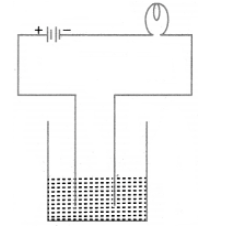
Liquids that conduct electricity are the solutions of ………………..
  • A
    acids
  • B
    bases
  • C
    salts
  • all of these

Answer: D.

View full solution
Q 4M C Q1 Mark
Flow of per unit time is called current ………………..
  • charge
  • B
    proton
  • C
    neutron
  • D
    all of these

Answer: A.

View full solution
Q 5M C Q1 Mark
The terminal which is connected to a positive terminal of a battery is called ……………….
  • anode
  • B
    cathode
  • C
    neutral
  • D
    none

Answer: A.

View full solution
Assertion : When both the strips of electroscope is charged with similar charge, they repel each other and become wide open.
Reason : Like charges always repel each other.
  • Both assertion and reason are true and the reason is the correct explanation of the assertion.
  • B
    Both assertion and reason are true, but the reason is not the correct explanation of the assertion.
  • C
    The assertion is true, but the reason is false.
  • D
    The assertion is false, but the reason is true.

Answer: A.

View full solution
Assertion : A current carrying wire should be charged.
Reason : The current in a wire is due to flow of free electrons in a definite direction.
  • A
    Both assertion and reason are true and the reason is the correct explanation of the assertion.
  • B
    Both assertion and reason are true, but the reason is not the correct explanation of the assertion.
  • C
    The assertion is true, but the reason is false.
  • The assertion is false, but the reason is true.

Answer: D.

View full solution
Assertion : Insulators do not allow flow of current through them.
Reason : Insulators have no free charge carrier
  • Both assertion and reason are true and the reason is the correct explanation of the assertion.
  • B
    Both assertion and reason are true, but the reason is not the correct explanation of the assertion.
  • C
    The assertion is true, but the reason is false.
  • D
    The assertion is false, but the reason is true.

Answer: A.

View full solution
Assertion : Parts of car and bicycle are made iron with chromium coating.
Reason : Chromium does not corrode and resist scratches.
  • Both assertion and reason are true and the reason is the correct explanation of the assertion.
  • B
    Both assertion and reason are true, but the reason is not the correct explanation of the assertion.
  • C
    The assertion is true, but the reason is false.
  • D
    The assertion is false, but the reason is true.

Answer: A.

View full solution
Assertion : Charges flow from higher potential to the lower potential.
Reason : Current flows mainly due to flow of electrons.
  • A
    Both assertion and reason are true and the reason is the correct explanation of the assertion.
  • Both assertion and reason are true, but the reason is not the correct explanation of the assertion.
  • C
    The assertion is true, but the reason is false.
  • D
    The assertion is false, but the reason is true.

Answer: B.

View full solution
Match the following.
Two similar charges acquires a positive charge
Two dissimilar charges prevents a circuit from overheating
When glass rod is rubbed with silk repel each other
When ebonite rod is rubbed with fur attract each other
Fuse acquires a negative charge
View full solution
Crossword puzzle :
Clue:
Across :
1. Ions having a positive charge formed by the loss of electrons.
2. Chemical compound which conducts electricity when in aqueous state.
5. Atoms that have an electric charge.
7. A piece of metal through which an electric current enters or leaves in a liquid or gas.

Down :
3. A process in which a thin film of metal is deposited on another metal with the help of electricity.
4. A process in which a chemical change especially decomposition of a chemical compound is brought about by passing an electric current through a solution.
6. Ions having a negative charge formed by the gain of electrons.
8. The negative electrode is an electrolytic cell, toward which positively charged particles are attracted.
View full solution

Generate a Electricity. paper free

Pick question groups from the list above, set marks and difficulty, and export a branded PDF with step-by-step answer keys. First 3 chapters free — no signup.

Download App