Question
Explain series and parallel circuit.
Answer

  • Series Circuit:
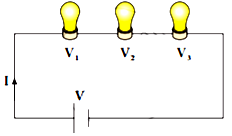
1. A series circuit is one that has more than one resistor (bulb) but only one path through which the electrons can travel.
2. From one end of the battery, the electrons move along one path with no branches through the resistors (bulbs) to the other end of the cell.
3. All the components in a series circuit are connected end to end.
4. So, the current through the circuit remains the same throughout the circuit.
5. But, the voltage gets divided across the bulbs in the circuit.
6. In the following series circuit, two bulbs are used as resistors.
7. Let I will be the current through the circuit and $V_1 V_2, V_3$ be the voltage across each bulb.
8. The supply voltage $V$ is the total of the individual voltage drops across the resistances. $V=V_1+$ $V _2+ V _3$
- Parallel Circuit:

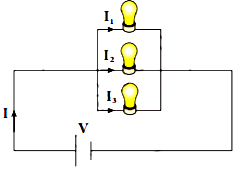
1. In a parallel circuit, there is more than one resistor (bulb) and they are arranged on many paths.
2. This means charges (electrons) can travel from one end of the cell through many branches to the other end of the cell.
3. Here, the voltage across the resistors (bulbs) remains the same but the current flowing through the circuit gets divided across each resistor.
4. Let us consider three bulbs connected in series.
5. Let $V$ be the voltage across the bulbs and $I _1, l _2, l _3$ be the current across each bulb.
6. The current I from the battery is the total of the individual current flowing through the resistances. $l=I_1+l_2+I_3$

Need a full question paper?

Generate a complete, print-ready paper with questions like this in minutes — across 16+ boards, with answer keys.

Start Generating Free

Similar questions

State the law of conservation of mass.
What are the properties of sound?
How is water purified at a water purification plant?
Crossword puzzle :
Across:
1. The acid found in apples.
3. The ion formed when an acid is dissolved in water.
5. An indicator that remains colourless in an acid.
7. The gas liberated when dilute hydrochloric acid reacts with limestone.
9. A gas that dissolved in water to form ammonium hydroxide.

Down:
2. An acid used for cooking.
4. An acid that has three hydrogen atoms in its moelcule.
6. A reaction in which an acid reacts w’ith a base to form salt and water only.
8. A base that is soluble in water.
10. The chemical name of this compound is calcium hydroxide.
What is electroplating? Explain how it is done.
Crossword puzzle :
Across:
1. The particles that build up an atom.
3. The arrangement of electrons in a succession of energy levels or shells.
5. An electrically neutral sub atomic particle that is part of the nucleus of an atom.
6. A whole number that represents the ability of an atom or a group of atoms to combine with other atoms or group of atoms.
7. The number of protons in the nucleus of an atom.
8. The smallest unit of an element that maintains the properties of an element.
A sub – atomic particle that has a positive electric charge.
Down:
2. A substance that cannot be broken down into simpler substance by chemical means.
4. The total number of protons and neutrons present in the nucleus of an atom.
9. An ion that has a negative charge.
11 A sub – atomic particle with a negative electric charge.
12. Positively charged ions.
Explain the neutralization reactions in our daily life.
Explain the different types of coal.
Crossword puzzle :
Across:
1. A gas that supports combustion.
4. The compound that turns lime water milky.
5. The Gaseous jacket that surrounds the Earth.
6. It is used as a refrigerant.
7. Solid form of carbon dioxide.
Down:
2. The process by which atmospheri&oitrogen is converted into nitrates.
3. The common name of the compound formed when nails are exposed to moist air.
8. It changes the fertility of the soil, destroys plants and aquatic life.
Explain the arrangement of arm bones.