Question types

Heat. question types

111 questions across 9 question groups — pick any mix to generate a Science paper with step-by-step answer keys.

111
Questions
9
Question groups
5
Question types
Sample Questions

Heat. questions

One sample from each question group in this chapter. Select any group above to see the full set with answer keys.

Q 1M C Q1 Mark
When two objects are in thermal contact, the heat is transferred by ………………
  • A
    convection
  • B
    radiation
  • conduction
  • D
    none

Answer: C.

View full solution
Q 2M C Q1 Mark
Substances which allow heat to pass through them are called …………….
  • conductors
  • B
    insulators
  • C
    moderators
  • D
    none

Answer: A.

View full solution
Q 3M C Q1 Mark
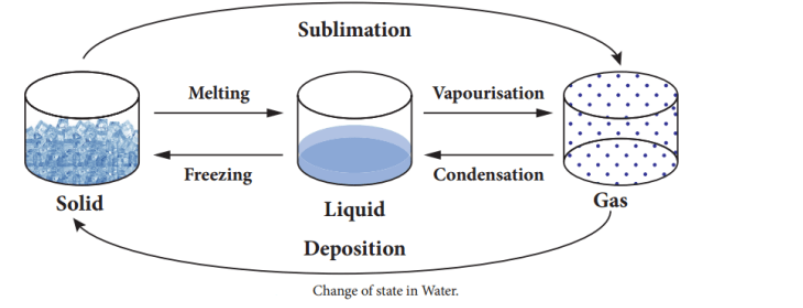
Process of change of state from gaseous state to liquid state is called …………….
  • A
    freezing
  • condensation
  • C
    sublimation
  • D
    boiling

Answer: B.

View full solution
Q 4M C Q1 Mark
Mud houses are cooler in summer and warmer in winter because –
  • A
    mud is a bad conductor of heat
  • B
    mud is a good conductor of heat
  • mud is a super conductor of heat
  • D
    none

Answer: C.

View full solution
Q 5M C Q1 Mark
In conduction, heat flows from ………………
  • A
    hotter to hotter region
  • B
    colder to hotter region
  • hotter to colder region
  • D
    colder to colder region

Answer: C.

View full solution
Assertion : Small gaps left between railway lines.
Reason : It allows for contraction of rails during summer.
  • A
    Both assertion and reason are true and the reason is the correct explanation of the assertion.
  • B
    Both assertion and reason are true, but reason is not the correct explanation of the assertion.
  • The assertion is true, but the reason is false.
  • D
    The assertion is false, but the reason is true.

Answer: C.

View full solution
Assertion : Temperature is the measure of the heat energy.
Reason : Energy is the capacity to do work.
  • A
    Both assertion and reason are true and the reason is the correct explanation of the assertion.
  • B
    Both assertion and reason are true, but reason is not the correct explanation of the assertion.
  • C
    The assertion is true, but the reason is false.
  • The assertion is false, but the reason is true.

Answer: D.

View full solution
Assertion : Radiation is a process of transfer of heat in which a material medium is not necessary.
Reason : The heat from the sun reaches us through millions of miles of empty space by convection.
  • A
    Both assertion and reason are true and the reason is the correct explanation of the assertion.
  • B
    Both assertion and reason are true, but reason is not the correct explanation of the assertion.
  • The assertion is true, but the reason is false.
  • D
    The assertion is false, but the reason is true.

Answer: C.

View full solution
Assertion : When a very hot liquid is poured into a thick glass tumbler it cracks.
Reason : Unequal expansion of the inner and outer glass walls causes the glass to crack.
  • Both assertion and reason are true and the reason is the correct explanation of the assertion.
  • B
    Both assertion and reason are true, but reason is not the correct explanation of the assertion.
  • C
    The assertion is true, but the reason is false.
  • D
    The assertion is false, but the reason is true.

Answer: A.

View full solution
Consider the statement given below and choose the correct option.
Assertion: A system can be converted from one state to another state.
Reason: It takes place when the temperature of the system is constant.
  • Both assertion and reason are true and reason is the correct explanation of assertion.
  • B
    Both assertion and reason are true, but reason is not the correct explanation of assertion.
  • C
    Assertion is true, but the reason is false.
  • D
    Assertion is false, but the reason is true.

Answer: A.

View full solution
What is the rise in temperature of 5 kg of water if it is given $84,000 J$ heat energy? Specific heat capacity of water $4200 J Kg ^{-1}{ }^{\circ} C ^{-1}$.
View full solution
1. Specific heat capacity (a) Dewar bottle
2. Calorimeter (b) Lavoisier and simon
3. Vacuum flask (c) $JKg ^{-1} K^{-1}$
4. Ice – calorimeter (d) Heat capacity
View full solution

Generate a Heat. paper free

Pick question groups from the list above, set marks and difficulty, and export a branded PDF with step-by-step answer keys. First 3 chapters free — no signup.

Download App