Questions

[4 Mark Questions]

🎯

Test yourself on this topic

6 questions · timed · auto-graded

Question 14 Marks
Distinguish between heat and temperature.
Answer
HeatTemperature
1. It is a form of energy.1. It is a thermal condition of body.
2. It flows from one object to other object when there is a difference in temperature2. It is a quantity that indicates whether or not and in which direction heat will flow.
3. It is the total amount of internal energy of a body3. It is proportional to average kinetic energy of the molecules of a body.
4. In the transmission of heat, total amount of heat remains unchanged.4. In the transmission of heat, temperature does not remain same.
5. Its SI unit is joule (J)5. Its SI unit is kelvin (K).
View full question & answer
Question 24 Marks
Write the difference between conduction, convection, and radiation.
Answer
ConductionConvectionRadiation
Heat is transferred without the actual movement of the moleculesHeat transfer takes place due to the movement of the molecules themselves.Heat is transferred without a medium.
Conduction is possible only in solids with the exception of mercury which is a liquidConvection takes place in liquids and gases only.Radiation requires no medium. It takes place even in vacuum.
Transfer is slowTransfer is fasterTransfer is the fastest
Heat transfer can be in any direction.Heat transfer is mainly upwards.Heat transfer takes place in all direction.
View full question & answer
Question 34 Marks
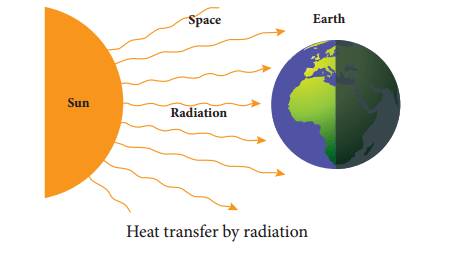
Write a note on radiation.
Answer
Image
  1. Radiation is the third form of heat transfer.
  2. By conduction, heat is transferred through solids, by convection heat is transferred through liquids and gases, but by radiation heat can be transferred through empty space even through vacuum.
  3. Heat energy from the Sun reaches the Earth by this form of heat transfer.
  4. Radiation is defined as the way of heat transfer from one place to another in the form of electromagnetic waves.
View full question & answer
Question 44 Marks
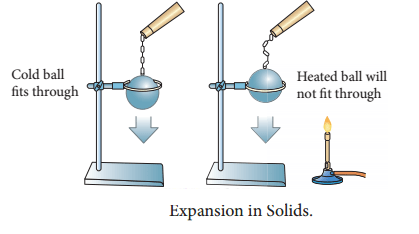
Describe an experiment to prove that solids expands on heating and contract on cooling.
Answer
Image
  1. Take a metal ball and a metal ring of suitable diameter.
  2. Pass the metal ball through the ring.
  3. You can observe that the metal ball can easily go through it.
  4. Now heat the metal ball and then try to pass it fits through through the ring.
  5. It will not pass through the ring.
  6. Keep the metal ball on the ring for some time.
  7. In few minutes, it will fall through the ring. Expansion in Solids
  8. When the ball is heated the atoms in the ball gain heat energy.
  9. They start vibrating and force each other apart.
  10. As a result an expansion takes place. That’s why the ball did not go through the ring.
  11. After some time, as the ball lost the heat energy to the surrounding it came back to its original size and it went through the ring.
  12. This shows that heat energy causes expansion in solids.
View full question & answer
Question 54 Marks
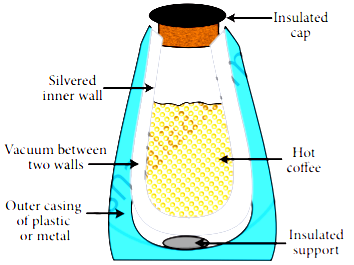
Explain the working of thermos flask.
Answer

Thermos flask
  1. A thermos flask has double walls, which are evacuated.
  2. It is silvered on the inside.
  3. The vacuum between the two walls prevents heat from being transferred from the inside to the outside by conduction and convection.
  4. With very little air between the walls, there is almost no transfer of heat from the inner wall to the outer wall or vice versa.
  5. Conduction can only occur at the points where the two walls meet, at the top of the bottle and through insulated support at the bottom.
  6. The silvered walls reflect radiated heat back to the liquid in the bottle.
View full question & answer
Question 64 Marks
Write a note on thermostat.
Answer
  1. A thermostat is a device which maintains the temperature of a place or an object constant.
  2. The word thermostat is derived from two Greek words, ‘thermo’ meaning heat and ‘static’ meaning staying the same.
  3. Thermostats are used in any device or system that gets heated or cools down – to a preset temperature. It turns an appliance or a circuit on or off when a particular temperature is reached.
  4. Devices that use a thermostat include a building heater, a central heater in a room, an air conditioner, a water heater, as well as kitchen equipment including an oven and refrigerators.
  5. Sometimes, a thermostat functions both as the sensor and the controller of a thermal 6 system.
View full question & answer
[4 Mark Questions] - Science STD 8 Questions - Vidyadip