Questions

[7 marks Questions]

🎯

Test yourself on this topic

3 questions · timed · auto-graded

Question 17 Marks
Explain the different ways by which water gets polluted.
Answer
  1. Domestic Sewage.
    Untreated sewage contains impurities such as organic matter from food waste, toxic chemicals from household products and it may also contain disease-causing microbes.
  2. Domestic waste and plastics.
    Plastics block drains spreading vector-borne diseases such as malaria and dengue. Waste in water bodies negatively impact aquatic life.
  3. Agricultural activities
    a. Fertilizers, pesticides, and insecticides used in agriculture can dissolve in rainwater and flow into water bodies such as rivers and lakes.
    b. This causes an excess of nutrients such as nitrates and phosphates as well as toxic chemicals into the water bodies and they can be harmful to aquatic life.
  4. Industrial waste
    a. Many industries release toxic waste such as lead, mercury, cyanides, cadmium, etc.
    b. If this waste is unregulated and is released into water bodies, it negatively impacts humans, plants, animals, and aquatic life.
  5. Oil spills.
    Oil spills cause water pollution which is harmful to aquatic life.
  6. Thermal pollution.
    Water used for cooling purposes is discharged back to a river or to the original water source at a raised temperature and sometimes with chemicals. This rise in temperature decreases the amount of oxygen dissolved in water which adversely affects aquatic life.
View full question & answer
Question 27 Marks
What is Electrolysis? Explain the electrolysis of water.
Answer
The process of breaking down water molecules by the passage of electric current is known as the electrolysis of water.
Electrolysis of Water:
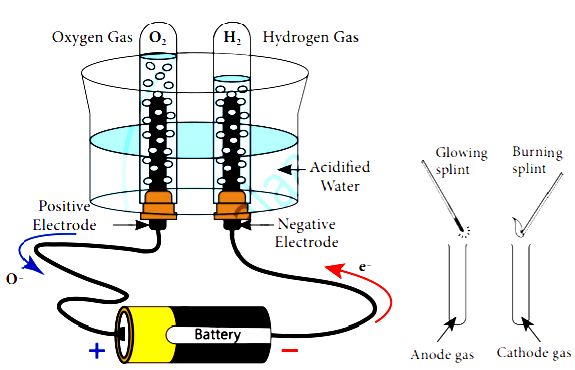
  1. A glass beaker is fixed with two carbon electrodes and it is filled with water up to one-third of its volume.
  2. The positive carbon electrode acts as an anode and the negative carbon electrode acts as a cathode.
  3. Two test tubes are placed on the electrodes.
  4. The electrodes are connected to a battery and the current is passed until the test tubes are filled with a particular gas.
  5. If the gas collected is tested using a burning splint we can notice that the gas in cathode side bums with a popping sound when the burning splint is brought near the mouth of the test tube.
  6. This property is usually shown by hydrogen gas and so it is confirmed that the gas inside the test tube is hydrogen.
  7. The burning splint placed near the anode side bums more brightly confirming that it is oxygen gas. This experiment shows that water is made up of hydrogen and oxygen.
  8. The ratio of hydrogen and oxygen is 2:1. Hence, for every two volumes of hydrogen collected at the cathode, there is one volume of oxygen collected at the anode.
Electrolysis of Water
View full question & answer
Question 37 Marks
How is water purified at a water purification plant?
Answer
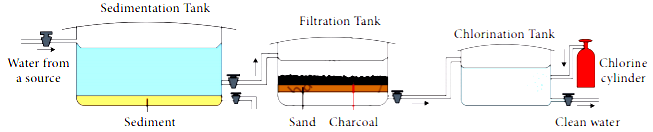
In a conventional water treatment plant, water is subjected to a different process. They are:
  • Sedimentation:
  1. Water from lakes or rivers is collected in large sedimentation tanks.
  2. There, it is allowed to stand undisturbed so that suspended impurities settle down at the bottom of the tank.
  3. Sometimes, a chemical substance such as potash alum is added to water to speed up the process of sedimentation, this is called loading.
  4. The particles of potash alum combine with the suspended impurities and make them settle down at a faster rate.
  • Filtration:
  1. Water from the sedimentation tanks is then pumped to the filtration tanks.
  2. Filtration tanks contain filter beds made up of gravel, sand, pebbles, activated charcoal, and concrete.
  3. Water passes through these layers and becomes free from any remaining dissolved or suspended impurities completely.
Water treatment
  • sterilisation:
  1. The filtered water is treated chemically to remove the remaining germs or bacteria, this process is called sterilisation.
  2. The chemicals that are used in this process are chlorine and ozone.
  3. The process of adding chlorine in adequate amounts to water is called chlorination.
  4. The water from filtration tanks is pumped into chlorination tanks, where chlorine is added to remove harmful bacteria and other germs.
  5. Ozonisation is a process in which water is treated with ozone gas to kill the germs present in it.
  6. The sterilisation of water can also be done by exposing it to air and sunlight.
  7. Oxygen from the air and sunlight destroys the germs present in water.
  8. Aeration is the process in which air under pressure is blown into filtered water, this also helps to kill the germs.
View full question & answer
[7 marks Questions] - Science STD 8 Questions - Vidyadip