Question
How is water purified at a water purification plant?

Answer

In a conventional water treatment plant, water is subjected to a different process. They are:
  • Sedimentation:
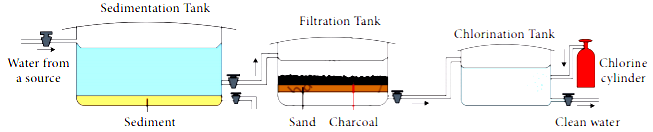
  1. Water from lakes or rivers is collected in large sedimentation tanks.
  2. There, it is allowed to stand undisturbed so that suspended impurities settle down at the bottom of the tank.
  3. Sometimes, a chemical substance such as potash alum is added to water to speed up the process of sedimentation, this is called loading.
  4. The particles of potash alum combine with the suspended impurities and make them settle down at a faster rate.
  • Filtration:
  1. Water from the sedimentation tanks is then pumped to the filtration tanks.
  2. Filtration tanks contain filter beds made up of gravel, sand, pebbles, activated charcoal, and concrete.
  3. Water passes through these layers and becomes free from any remaining dissolved or suspended impurities completely.
Water treatment
  • sterilisation:
  1. The filtered water is treated chemically to remove the remaining germs or bacteria, this process is called sterilisation.
  2. The chemicals that are used in this process are chlorine and ozone.
  3. The process of adding chlorine in adequate amounts to water is called chlorination.
  4. The water from filtration tanks is pumped into chlorination tanks, where chlorine is added to remove harmful bacteria and other germs.
  5. Ozonisation is a process in which water is treated with ozone gas to kill the germs present in it.
  6. The sterilisation of water can also be done by exposing it to air and sunlight.
  7. Oxygen from the air and sunlight destroys the germs present in water.
  8. Aeration is the process in which air under pressure is blown into filtered water, this also helps to kill the germs.

Need a full question paper?

Generate a complete, print-ready paper with questions like this in minutes — across 16+ boards, with answer keys.
Start Generating Free

Similar questions

In this crossword puzzle, names of 10 elements are hidden. Symbols of these are given below. Complete the puzzle.
Write a short note on different types of clocks.
What are the effects of acid rain? How can we prevent them?
How lightning takes place?
Explain the different ways by which water gets polluted.
Crossword puzzle :
Across:
1. A gas that supports combustion.
4. The compound that turns lime water milky.
5. The Gaseous jacket that surrounds the Earth.
6. It is used as a refrigerant.
7. Solid form of carbon dioxide.
Down:
2. The process by which atmospheri&oitrogen is converted into nitrates.
3. The common name of the compound formed when nails are exposed to moist air.
8. It changes the fertility of the soil, destroys plants and aquatic life.
Describe an experiment to prove that the pressure in a liquid increase with depth.
Cross - word puzzle :
Clues :
Across :
2. The bouncing back of sound wave when it strikes a hard surface.
4. Form of matter of fixed shape other than liquid or gas.
6. Maximum distance moved by a vibrating body form its position of rest.
8.Waves which need a material medium for its propagation.
10. A kind of raepid to and fro motion of an object.

Down:
1. A unit used to measure the loudness or intensity of sound.
3. Sound wave whose frequency is too high to be heard by humans.
5. Sound wave whose frequency is too low to be heard by humans.
7. A reflection of sound.
9. The branch of science deals with the study of seismic waves.
Crossword puzzle :
Across:
1. The acid found in apples.
3. The ion formed when an acid is dissolved in water.
5. An indicator that remains colourless in an acid.
7. The gas liberated when dilute hydrochloric acid reacts with limestone.
9. A gas that dissolved in water to form ammonium hydroxide.

Down:
2. An acid used for cooking.
4. An acid that has three hydrogen atoms in its moelcule.
6. A reaction in which an acid reacts w’ith a base to form salt and water only.
8. A base that is soluble in water.
10. The chemical name of this compound is calcium hydroxide.
Explain the working of a periscope.