Questions · Page 1 of 2

MCQ

🎯

Test yourself on this topic

50 questions · timed · auto-graded

MCQ 11 Mark
The centrifugal force is ______.
  • A
    a real force.
  • B
    the force of reaction of centripetal force.
  • C
    a virtual force.
  • D
    directed towards the centre of the circular path.
View full question & answer
MCQ 31 Mark
Which one of the following is most likely not a case of uniform circular motion?
  • A
    Motion of the Earth around the Sun.
  • B
    Motion of a toy train on a circular track.
  • C
    Motion of a racing car on a circular track.
  • D
    Motion of hours’ hand on the dial of the clock.
View full question & answer
MCQ 41 Mark
The area under velocity – time graph represents the

  • velocity of the moving object.

  • displacement covered by the moving object.

  • speed of the moving object.

  • acceleration of the moving object

  • A
    velocity of the moving object.
  • B
    displacement covered by the moving object.
  • C
    speed of the moving object.
  • D
    acceleration of the moving object
View full question & answer
MCQ 51 Mark
The force responsible for drying clothes in a washing machine is …………….
  • A
    Centripetal force
  • B
    Centrifugal force
  • C
    Gravitational force
  • D
    Electro static force
View full question & answer
MCQ 71 Mark
A car is being driven at a speed of 20ms-1 when brakes are applied to bring it to rest in 5 s. The deceleration produced in this case will be
  • A
    (+4 ms ^{-2}$
  • B
    (-4 ms ^{-2}$
  • C
    (-0.25 ms ^{-2}$
  • D
    (+0.25 ms ^{-2}$
View full question & answer
MCQ 81 Mark
The area under the velocity-time graph represents
  • A
    the velocity of the moving object
  • C
    speed of the moving object.
  • D
    acceleration of the moving object
View full question & answer
MCQ 91 Mark
In a 100m race, the winner takes 10s to reach the finishing point. The average speed of the winner is
  • A
    (5 ms ^{-1}$
  • B
    (20 ms ^{-1}$
  • C
    (40 ms ^{-1}$
View full question & answer
MCQ 101 Mark
A body moving with an initial velocity 5ms-1 and accelerates at 2ms -2. Its velocity after 10s is
  • A
    (20 ms ^{-1}$
  • B
    (25 ms ^{-1}$
  • C
    (5 ms ^{-1}$
  • D
    (22.55 ms ^{-1}$
View full question & answer
MCQ 111 Mark
The magnitude of the centripetal force is given by (F= ….)
  • A
    (\frac{m v^2}{r_{s a}}$
  • B
    (\frac{v^2}{r}$
  • C
    (\frac{2 \pi}{ T }$
  • D
    (ma$
View full question & answer
MCQ 121 Mark
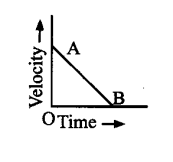
In the velocity-time graph, AB shows that the body has Image
  • A
    uniform acceleration
  • B
    non-uniform retardation
  • C
    uniform speed
  • D
    initial velocity OA & is moving with uniform retardation.
View full question & answer
MCQ 131 Mark
If the displacement-time graph of a particle is parallel to the time axis, then velocity of the particle is.
  • A
    infinity
  • B
    unity
  • C
    equal to acceleration
  • D
    zero
View full question & answer
MCQ 141 Mark
Distance travelled by a freely falling body is proportional to
  • A
    mass of the body
  • B
    square of the acceleration due to gravity
  • C
    square of the time of fall
  • D
    time of fall
View full question & answer
MCQ 151 Mark
When a body moves uniformly along the circle then
  • B
    its speed changes but velocity remains the same
  • C
    both speed and velocity changes
  • D
    both speed and velocity remains same
View full question & answer
MCQ 161 Mark
If a body starts from rest, what can be said about the acceleration of the body?
  • A
    positively accelerated
  • B
    negative accelerated
  • C
    uniform accelerated
  • D
    none of the above
View full question & answer
MCQ 171 Mark
What is the slope of the body when it moves with uniform velocity?
  • A
    positive
  • B
    negative
  • C
    zero
  • D
    may be positive or negative
View full question & answer
MCQ 181 Mark
Which of the following can determine the acceleration of a moving object.
  • A
    area of the velocity-time graph
  • B
    the slope of the velocity-time graph
  • C
    area of a distance-time graph
  • D
    the slope of a distance-time graph
View full question & answer
MCQ 191 Mark
The equation v = u + at gives information as
  • A
    velocity is a function of time
  • B
    velocity is a function of position
  • C
    position is a function of time
  • D
    position is a function of time and velocity
View full question & answer
MCQ 201 Mark
When an object undergoes acceleration
  • A
    there is always an increase in its velocity ‘
  • B
    there is always an increase in its speed
  • C
    a force always acting on it.
  • D
    all the above
View full question & answer
MCQ 221 Mark
If the velocity of a body changes uniformly from u to v in time t, the sum of average velocity and acceleration is
  • A
    (\frac{(u+v)}{t_{\text {SamacheerKalvi.Guide }}} \quad$
  • B
    (\frac{(v-u)}{t}$
  • C
    (\frac{2 u}{t}$
  • D
    (\frac{2 v}{t}$
View full question & answer
MCQ 231 Mark
If a moving body comes to rest, then its acceleration is
  • A
    positive
  • B
    negative
  • C
    zero
  • D
    all of these depending upon initial velocity.
View full question & answer
MCQ 241 Mark
Choose the correct option.
  • B
    distance is a vector, velocity is a scalar, acceleration is a vector
  • C
    distance is a vector, velocity is a vector, acceleration is a vector
  • D
    distance is a scalar, velocity is a vector, acceleration is scalar
View full question & answer
MCQ 251 Mark
A boy throws a ball up and catches it when the ball falls back. In which part of the motion the ball is accelerating?
  • B
    when the ball comes to rest
  • C
    during upward motion
  • D
    when the boy catches the ball.
View full question & answer
MCQ 261 Mark
A quantity has a value of 16ms-2. It is the
  • A
    acceleration of an object
  • B
    velocity of an object
  • C
    retardation of an object
View full question & answer
MCQ 271 Mark
A bus accelerating with 4ms-2 changes its speed from 60ms_1 to a certain value in 5s. The final speed is
  • A
    40 m/s
  • B
    (25 ms ^{-1}$
  • C
    (60 ms ^{-1}$
  • D
    (30 ms ^{-1}$
View full question & answer
MCQ 291 Mark
A body is said to be in non uniform motion if it travels
  • A
    equal distance in unequal interval of time
  • B
    equal distance in equal interval of time
  • C
    unequal distance in unequal interval of time
  • D
    unequal distance in equal interval of time.
View full question & answer
MCQ 301 Mark
A man leaves his house at 6.30 a.m. for a morning walk and returns back at 7.30 a.m. after covering 4 km. Displacement covered by him is …………….
  • A
    2 km
  • C
    8 km
  • D
    4 km
View full question & answer
MCQ 321 Mark
An ant moves from one corner of a room diagonally to the opposite corner. If the dimensions of the hall are 8m x 6m, the displacement of the ant is
  • A
    10m
  • B
    14m
  • C
    28m
  • D
    2m
View full question & answer
MCQ 341 Mark
Which of the quantities have the same SI unit?
  • A
    speed, velocity
  • B
    acceleration, time
  • C
    velocity, time
  • D
    velocity, acceleration
View full question & answer
MCQ 351 Mark
Which of the following is correct about uniform circular motion
(i) direction of motion is continuously changed
(ii) direction of motion is not changed
(iii) speed and direction both remain constant
(iv) speed is constant but direction is changing
  • A
    ii & iii are correct
  • B
    i, ii & iii are correct
  • C
    i & iv are correct
  • D
    all of these
View full question & answer
MCQ 361 Mark
Statement A: Uniform circular motion is a case of accelerated motion
Statement B: In third equation of motion we do not have the term time
  • A
    Statement B is true, A is false
  • B
    Statement A is true, B is false
  • C
    neither statement A nor B is true
  • D
    both are true
View full question & answer
MCQ 381 Mark
A body moves in a uniform circular motion
  • A
    It is moving with constant velocity
  • B
    its acceleration is zero
  • C
    the body has an acceleration y
  • D
    none of the above
View full question & answer
MCQ 411 Mark
When an object undergoes acceleration
  • A
    there is always an increase in its velocity
  • B
    there is always an increase in its speed
  • C
    a force always acting on it.
  • D
    all of the above
View full question & answer
MCQ 431 Mark
A car accelerates at 1.5m/s2in a straight road. How much is the increase in velocity in 4s.
  • 6 m/s
  • B
    4 m/s
  • C
    3 m/s
  • D
    2.66m/s
Answer
Correct option: A.
6 m/s
6 m/s
View full question & answer
MCQ 441 Mark
A body is projected up with an initial velocity u m/s. It goes up to a height, ‘h’ metres in seconds time. Then it comes back at the point of projection. Considering negligible air resistance, which of the following statement is true?
  • A
    the acceleration is zero
  • the displacement is zero
  • C
    the average velocity is 2hit
  • D
    the final velocity is 2u when body reaches projection point
Answer
Correct option: B.
the displacement is zero
View full question & answer
MCQ 451 Mark
A scalar quantity has T
  • magnitude only
  • B
    direction only
  • C
    both
  • D
    none
Answer
Correct option: A.
magnitude only
magnitude only
View full question & answer
MCQ 461 Mark
The rate of change of displacement
  • A
    speed
  • velocity
  • C
    acceleration
  • D
    retardation
Answer
Correct option: B.
velocity
velocity
View full question & answer
MCQ 471 Mark
$m / s ^2$ is the unit of
  • A
    distance
  • B
    displacement
  • C
    velocity
  • acceleration
Answer
Correct option: D.
acceleration
acceleration
View full question & answer
MCQ 481 Mark
The area under v-t graph represents a physical quantity which has the unit.
  • A
    (m ^2$
  • (m$
  • C
    (m ^3$
  • D
    (ms ^{-1}$
Answer
Correct option: B.
(m$
(m$
View full question & answer
MCQ 491 Mark
From the given v-t graph, u can be inferred that the object is
  • in uniform motion
  • B
    at rest
  • C
    in non-uniform motion
  • D
    moving with uniform acceleration
Answer
Correct option: A.
in uniform motion
in uniform motion
View full question & answer
MCQ 501 Mark
If the displacement of an object is proportional to square of time, then the object moves with
  • A
    uniform velocity
  • uniform acceleration
  • C
    increasing acceleration
  • D
    decreasing acceleration
Answer
Correct option: B.
uniform acceleration
View full question & answer
MCQ - Science STD 9 Questions - Vidyadip