Question types

PHYSICS CH 2 Motion question types

151 questions across 9 question groups — pick any mix to generate a Science paper with step-by-step answer keys.

151
Questions
9
Question groups
5
Question types
Sample Questions

PHYSICS CH 2 Motion questions

One sample from each question group in this chapter. Select any group above to see the full set with answer keys.
Q 1MCQ1 Mark
The centrifugal force is ______.
  • A
    a real force.
  • B
    the force of reaction of centripetal force.
  • C
    a virtual force.
  • D
    directed towards the centre of the circular path.
View full solution
Q 3MCQ1 Mark
Which one of the following is most likely not a case of uniform circular motion?
  • A
    Motion of the Earth around the Sun.
  • B
    Motion of a toy train on a circular track.
  • C
    Motion of a racing car on a circular track.
  • D
    Motion of hours’ hand on the dial of the clock.
View full solution
Q 4MCQ1 Mark
The area under velocity – time graph represents the

  • velocity of the moving object.

  • displacement covered by the moving object.

  • speed of the moving object.

  • acceleration of the moving object

  • A
    velocity of the moving object.
  • B
    displacement covered by the moving object.
  • C
    speed of the moving object.
  • D
    acceleration of the moving object
View full solution
Q 5MCQ1 Mark
The force responsible for drying clothes in a washing machine is …………….
  • A
    Centripetal force
  • B
    Centrifugal force
  • C
    Gravitational force
  • D
    Electro static force
View full solution
Assertion: Displacement of a body may be zero when distance travelled by it is not zero.
Reason: The displacement is the shortest distance between initial and final position.
  • A
    If both assertion and reason are true and reason is the correct explanation of assertion.
  • B
    If both assertion and reason are true but reason is not the correct explanation of assertion.
  • C
    If assertion is true but reason is false.
  • D
    If assertion is false but reason is true.
View full solution
Assertion: The Speedometer of a car or a motor-cycle measures its average speed.
Reason: Average velocity is equal to total displacement divided by total time taken.
  • A
    If both assertion and reason are true and reason is the correct explanation of assertion.
  • B
    If both assertion and reason are true but reason is not the correct explanation of assertion.
  • C
    If assertion is true but reason is false.
  • D
    If assertion is false but reason is true.
View full solution
Assertion: The accelerated motion of an object may be due to change in magnitude of velocity or direction or both of them.
Reason: Acceleration can be produced only by change in magnitude of the velocity. It does not depend the direction.
  • A
    If both assertion and reason are true and reason is the correct explanation of assertion.
  • B
    If both assertion and reason are true but reason is not the correct explanation of assertion.
  • C
    If assertion is true but reason is false.
  • D
    If assertion is false but reason is true.
View full solution
Assertion : The slope of distance-time graph of a body moving with high speed is steeper than slope of distance-time graph of a body with low velocity.
(a) If both assertion & reason are true and the reason is the correct explanation of the assertion.
(b) If both assertion & reason are true but the reason is not correct explanation of the assertion.
(c) If the assertion is true but the reason is false.
(d) If assertion & reason both are false.
(e) If assertion is false but reason is true.
View full solution
Assertion : Position-time graph of a stationary object is a straight line parallel to time axis. ’
Reason : For a stationary object, position does not change with time.
(a) If both assertion & reason are true and the reason is the correct explanation of the assertion.
(b) If both assertion & reason are true but the reason is not correct explanation of the assertion.
(c) If the assertion is true but the reason is false.
(d) If assertion & reason both are false.
(e) If assertion is false but reason is true.
View full solution
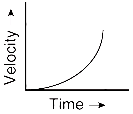
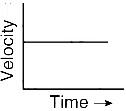
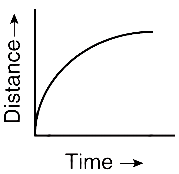
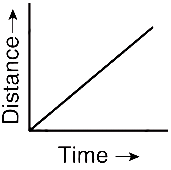
Match the Following.
Sr. No.List I List II
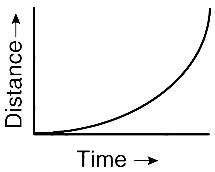
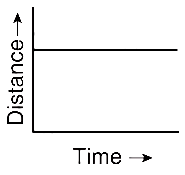
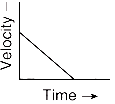
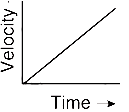
1.Motion of a body covering equal distances in equal interval of timeA.
2.Motion with non uniform accelerationB.
3.Constant retardationC.
4.Uniform accelerationD.
View full solution
Exercise Problems.

An athlete completes one round of a circular track of diameter 200 m in 40 s. What will be the distance covered and the displacement at the end of 2 m and 20 s?

View full solution
Sr. No.List I List II
1.Motion of a body covering equal distances in equal interval of timeD.
2.Motion with non uniform accelerationC.
3.Constant retardationA.
4.Uniform accelerationB.
View full solution
State whether true or false. If false, correct the statement.

If the velocity – time graph of a particle is a straight line inclined to X-axis then its displacement – time graph will be a straight line.

  • True

  • False

View full solution
State whether true or false. If false, correct the statement.

The velocity – time graph of a particle falling freely under gravity would be a straight line parallel to the x axis.

  • True

  • False

View full solution

Generate a PHYSICS CH 2 Motion paper free

Pick question groups from the list above, set marks and difficulty, and export a branded PDF with step-by-step answer keys. First 3 chapters free — no signup.

Download App