Question 15 Marks
How many terms are there in the A.P.?
$-1,\frac{5}{6},\frac{2}{3},\frac{1}{2}, .....\frac{10}{3}.$
AnswerHere, A.P. is $-1,\frac{5}{6},\frac{2}{3},\frac{1}{2}, .....\frac{10}{3}.$
The first term (a) = -1
The last term $(\text{a}_\text{n})=\frac{10}{3}$
Now,
Common difference $(d) = a_1 - a$
$=-\frac{5}{6}-(-1)$
$=-\frac{5}{6}+1$
$=\frac{-5+6}{6}$
$=\frac{1}{6}$
Thus, using the above mentioned formula, we get,
$\frac{10}{3}=-1+(\text{n}-1)\frac{1}{6}$
$\frac{10}{3}+1=\frac{1}{6}\text{n}-\frac{1}{6}$
$\frac{13}{3}+\frac{1}{6}=\frac{1}{6}\text{n}$
Further solving for n, we get
$\frac{26+1}{6}=\frac{1}{6}\text{n}$
$\text{n}=\frac{27}{6}(6)$
$\text{n}=27$
Thus, n = 27
Therefore, the number of terms present in the given A.P. is 27.
View full question & answer→Question 25 Marks
The $24^{\text {th }}$ term of an A.P. is twice its $10^{\text {th }}$ term. Show that its $72^{\text {nd }}$ term is 4 times its $15^{\text {th }}$ term.
AnswerLet a be the first term and d be the common difference.
We know that, $n^{th}$ term $= a_n = a + (n - 1)d$
According to the question,
$a_{24} = 2a_{10}$
$\Rightarrow a + (24 - 1)d = 2(a + (10 - 1)d)$
$\Rightarrow a + 23d = 2a + 18d$
$\Rightarrow 23d - 18d = 2a - a$
$\Rightarrow 5d = a$
$\Rightarrow a = 5d .....(i)$
Also,
$a_{72} = a + (72 - 1)d$
$a_{72} = 5d = 71d [a = 5d From (i)]$
$= 76d .....(ii)$
$and a_{15} = a + (15- 1)d$
= 5d + 14d [from (i)]
= 19d .....(iii)
On comparing (ii) and (iii), we get
$76d = 4 \times 19d$
$\Rightarrow a_{72} = 4 \times a_{15}$
Thus, $72^{\text {nd }}$ term of the given A.P. is 4 times its $15^{\text {th }}$ term.
View full question & answer→Question 35 Marks
All integers from 1 to 500 which are multiplies of 2 or 5.
AnswerSince, multiples of 2 ot 5 = Multiple of 2 + Multiples of 5 - Multiples of LCM (2, 5) i.e., 10.
$\therefore$ MUltiples of 2 or 5 from 1 to 500
= List of multiples of 2 from 1 to 500 + list of multiple of 5 from 1 to 500 - list of multiple of 10 from 1 to 500
$= (2, 4, 6, ....., 500) + (5, 10, 15, ....., 500) - (10, 20, ....., 500)$
All of these list from an A.P.
Now, number of terms in first list,
$500 = 2 + (n_1 - 1)2$
$\Rightarrow 498 = (n_1 - 1)2$
$\Rightarrow n_1 - 1 = 249$
$\Rightarrow n_1 = 250$
Number of terms in second list,
$500 = 5 + (n_2 - 1)5$
$\Rightarrow 495 = (n_2 - 1)5$
$\Rightarrow 99 = (n_2 - 1)$
$\Rightarrow n_2 = 100$
and number of terms in third list,
$500 = 10 + (n_3 - 1)10$
$\Rightarrow 490 = (n_3 - 1)10$
$\Rightarrow n_3 - 1 = 49$
$\Rightarrow n_3 = 50$
From Eq. (i), Sum of multiples of 2 or 5 from 1 to 500
= Sum of (2, 4, 6, ....., 500) + Sum of (5, 10, ....., 500) - Sum of (10, 20, ...., 500)
$=\frac{\text{n}_1}{2}[2+500]+\frac{\text{n}_2}{2}[5+500]-\frac{\text{n}_3}{2}[10+500]$
$\Big[\because\ \text{S}_\text{n}=\frac{\text{n}}{2}(\text{a}+\text{l})\Big]$
$=\frac{250}{2}\times502=\frac{100}{2}\times505-\frac{50}{2}\times510$
$= 250 × 251 + 505 × 50 - 25 × 510$
$= 62750 + 25250 - 12750$
$= 88000 - 12750$
$= 75250$
View full question & answer→Question 45 Marks
The $26^{th}, 11^{th}$ and last term of an A.P. are 0, 3 and $-\frac{1}{5},$ respectively. Find the common difference and the number of terms.
AnswerLet the first term, common difference and number of terms of an A.P. are a, d and n, respectively.
We know that, if last term of an A.P. is known,
then l = a + (n – 1) d ……(i) and $n^{th}$ term of an
A.P is $T_n = a + (n - 1)d .....(ii)$
Given that, $26^{th}$ term of an A.P. = 0
$\Rightarrow T_{26} = a + (26 - 1)d = 0$ [From eq. (i)]
$\Rightarrow a + 25d = 0 .....(iii) 11^{th}$ term of an A.P. = 3
$\Rightarrow T_{11} = a + (11 - 1)d = 3$ [From eq. (ii)]
$\Rightarrow a + 10d = 3 .....(iv)$ and last term of an A.P. $=-\frac{1}{5}$
$\Rightarrow l = a + (n - 1)d$ [From eq. (i)]
$\Rightarrow\ -\frac{1}{5}=\text{a}+(\text{n}-1)\text{d}$
Now, subtracting Eq. (iv) from Eq. (iii),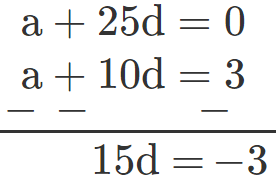
$\Rightarrow\ \text{d}=-\frac{1}{5}$ Put the value of d in Eq. (iii),
we get $\text{a}+25\Big(-\frac{1}{5}\Big)=0$
$\Rightarrow a - 5 = 0$
$\Rightarrow a = 5$
Now, put the value of a, d in Eq. (v), we get
$-\frac{1}{5}=5+(\text{n}-1)\Big(-\frac{1}{5}\Big)$
$\Rightarrow -1 = 25 - (n - 1)$
$\Rightarrow -1 = 25 - n + 1$
$\Rightarrow n = 25 + 2 = 27$
Hencem the common difference and number of terms are $-\frac{1}{5}$ and 27, respectively. View full question & answer→Question 55 Marks
Find the sum of the following arithmetic progressions:$\frac{\text{x}-\text{y}}{\text{x}+\text{y}}\frac{3\text{x}-2\text{y}}{\text{x}+\text{y}}\frac{5\text{x}-3\text{y}}{\text{x}+\text{y}}, .....\text{ to n terms.}$
AnswerIn an A.P. let first term = a, common difference = d, and there are n terms. Then, sum of n terms is,
$\text{S}_\text{n}=\frac{\text{n}}{2}\{2\text{a} + (\text{n} - 1)\text{d}\}$
Given, $\frac{\text{x}-\text{y}}{\text{x}+\text{y}}\frac{3\text{x}-2\text{y}}{\text{x}+\text{y}}\frac{5\text{x}-3\text{y}}{\text{x}+\text{y}}, .....$
Here,
First term $\text{a}=\frac{\text{x}-\text{y}}{\text{x}+\text{y}}$
Difference $\text{d}=\frac{3\text{x}-2\text{y}}{\text{x}+\text{y}}-\frac{\text{x}-\text{y}}{\text{x}+\text{y}}$
$\Rightarrow\ \text{d}=\frac{3\text{x}-2\text{y}-(\text{x}-\text{y})}{\text{x}+\text{y}}$
$\Rightarrow\ \text{d}=\frac{3\text{x}-2\text{y}-\text{x}+\text{y}}{\text{x}+\text{y}}$
$\Rightarrow\ \text{d}=\frac{2\text{x}-\text{y}}{\text{x}+\text{y}}$
No of terms n = n
We know, $\text{S}_\text{n}=\frac{\text{n}}{2}\{2\text{a} + (\text{n} - 1)\text{d}\}$
$\Rightarrow\ \text{S}_\text{n}=\frac{\text{n}}{2}\bigg[2\Big(\frac{\text{x}-\text{y}}{\text{x}+\text{y}}+(\text{n}-1)\frac{(2\text{x}-\text{y})}{(\text{x}+\text{y})}\bigg]$
$\Rightarrow\ \text{S}_\text{n}=\frac{\text{n}}{2}\bigg[\frac{2\text{x}-2\text{y}}{\text{x}+\text{y}}+\frac{\text{n}(2\text{x}-\text{y})-1(2\text{x}-\text{y})}{\text{x}+\text{y}}\bigg]$
$\Rightarrow\ \text{S}_\text{n}=\frac{\text{n}}{2}\bigg[\frac{2\text{x}-2\text{y}+\text{n}(2\text{x}-\text{y})-2\text{x}+\text{y}}{\text{x}+\text{y}}\bigg]$
$\Rightarrow\ \text{S}_\text{n}=\frac{\text{n}}{2}\bigg[\frac{\text{n}(2\text{x}-\text{y})-\text{y}}{\text{x}+\text{y}}\bigg]$
$\Rightarrow\ \text{S}_\text{n}=\frac{\text{n}}{2(\text{x}+\text{y})}[\text{n}(2\text{x}-\text{y})-\text{y}]$
Hence, sum of n terms is $\frac{\text{n}}{2(\text{x}+\text{y})}[\text{n}(2\text{x}-\text{y})-\text{y}]$.
View full question & answer→Question 65 Marks
The sum of first $n$ terms of an A.P is $5 n^2+3 n$. If its $m^{\text {th }}$ terms is 168 , find the value of $m$. Also, find the $20^{\text {th }}$ term of this A.P.
Answer$S_n = 5n^2 + 3n, T_m = 168$
$S_1 = 5(1)^2 + 3 \times 1 = 5 + 3 = 8$
$S_2 = 5(2)^2 + 3 \times 2 = 20 + 6 = 26$
$\therefore$ $T_2 = 26 - 8 = 18$
{$\because$ $T_2 = (S_2 - S_1)}$
$d = T_2 - T_1$
$d = 18 - 8 = 10, a = 8$
$\therefore$ $T_m = a + (m - 1)d$
$168 = 8 + (m - 1) \times 10$
$\Rightarrow 168 - 8 = (m - 1) \times 10$
$160 = 10(m - 1)$
$\frac{160}{10}=\text{m}-1$
$\Rightarrow m - 1 = 16$
$m = 16 + 1 = 17$
$\therefore$ m = 17
Now,$T_{20} = a + (20 - 1)d$
$= 8 + 19 \times 10 = 8 + 190 = 198.$
View full question & answer→Question 75 Marks
Write the first five terms of the following sequences whose $n^{th}$ terms are:
$a_n = n^2 - n + 1.$
Answer$a_n = n^2 - n + 1$.Here, the $n^{th}$ term is givne by the above expression. So, to find the first term we use n = 1, we get,
$a_1 = (1)^2 - (1) + 1$
$= 1 - 1 + 1
= 1
$ Similarly, we find the other four terms,
Second term $(n = 2),$
$a_2 = (2)^3 - (2) + 1$
$= 4 - 2 + 1$
$= 3$
Third term $(n = 3),$
$a_3 = (3)^2 - (3) + 1$
$= 9 - 3 + 1$
$= 7$
Fourth term $(n = 4),$
$a_4 = (4)^2 - (4) + 1$
$= 16 - 4 + 1$
$= 13$
Fifth term $(n = 5),$
$a_5 = (5)^2 - (5) + 1$
$= 25 - 5 + 1$
$= 21$
Therefore, the first terms for the given sequence are $a_1 = 1, a_2 = 3, a_3 = 7, a_4 = 13, a_5 = 21.$ View full question & answer→Question 85 Marks
Let there be an A.P. with first term ' $a$ ', common difference ' $d$ '. If $a_n$ denotes in $n^{\text {th }}$ term and $S_n$ the sum of first $n$ terms, find. n and d , if $a =8, a _{ n }=62$ and $S _{ n }=210$.
AnswerHere, we have an A.P. Whose $n^{\text {th }}$ term $\left(a_n\right)$, Sum of first $n$ terms $\left(S_n\right)$ and first term $(a)$ are given. We need to find the number of terms ( n ) and the common difference (d).
Here,
First term $(a) = 8$
Last term $(a_n) = 62$
Sum of n terms $(S_n) = 210$
Now, here the sum of the n terms is given by the formula,
$\text{S}_\text{n}=\Big(\frac{\text{n}}{2}\Big)(\text{a}+\text{l})$
Where, a = the first term
l = the last term
So, for the given A.P. on substituting the values in the formula for the sum of n terms of an A.P., we get,
$210=\Big(\frac{\text{n}}{2}\Big)[8+62]$
$210(2)=\text{n}(70)$
$\text{n}=\frac{420}{70}$
$\text{n}=6$
Also, here we will find the value of d using the formula.
$a_n = a + (n - 1)d$
So, Substituting the values in the above mentioned formula
$62 = 8 + (6 - 1)d$
$62 - 8 = (5)d$
$\frac{54}{5}=\text{d}$
$\text{d}=\frac{54}{5}$
Therefore, for the given A.P. n = 6 and $\text{d}=\frac{54}{5}$.
View full question & answer→Question 95 Marks
The first term of an A.P. is 5 and its $100^{\text {th }}$ term is -292 . Find the $50^{\text {th }}$ term of this A.P.
AnswerGiven
First term a = 5
and $100^{th}$ term $a_{100} = -292$
We know $n^{th}$ term of A.P.
$a_n = a + (n - 1)d$
then,
$\Rightarrow a_{100} = 5 + (100 - 1)d$
$\Rightarrow -292 = 5 + 99d$
$\Rightarrow 99d = -297$
$\Rightarrow\ \text{d}=\frac{-297}{99}=\frac{-27}{9}$
⇒ d = -3
Now, we have to find $50^{th}$ term, then
$\Rightarrow a_{50} = a + (50 - 1)d$
$\Rightarrow a_{50} = 5 + 49 \times (-3)$
$\Rightarrow a_{50} = 5 - 147$
$\Rightarrow a_{50} = 142$
Hence, $50^{th}$ term of given A.P. is -142.
View full question & answer→Question 105 Marks
The first term of an A.P. is 2 and the last term is 50. The sum of all these terms is 442. Find the common difference.
AnswerIn the given problem, we have the first and the last term of an A.P. along with the sum of all the terms of A.P. Here, we need to find the common difference of the A.P.
Here,
The first term of the A.P (a) = 2
The last term of the A.P (l) = 50
Sum of all the terms $S_n = 442$
Let the common difference of the A.P. be d.
So, let us first find the number of the terms (n) using the formula,
$442=\Big(\frac{\text{n}}{2}\Big)(2+50)$
$442=\Big(\frac{\text{n}}{2}\Big)(52)$
$442=({\text{n}})(26)$
$\text{n}=\frac{442}{26}$
$\text{n}=17$
Now, to find the common difference of the A.P. we use the following formula,
l = a + (n - 1)d
We get,
$50 = 2 + (17 - 1)d$
$50 = 2 + 17d - d$
$50 = 2 + 16d$
$\frac{50-2}{16}=\text{d}$
Further, solving For d,
$\text{d}=\frac{48}{16}$
$\text{d}=3$
Therefore the common difference of the A.P. d = 3.
View full question & answer→Question 115 Marks
Three numbers are in A.P. If the sum of these numbers be 27 and the product 648, find the numbers.
AnswerLet,
Three numbers are (a - d), a, (a + d)
Sum of three numbers,
$\Rightarrow (a - d) + a + (a + d) = 27$
$\Rightarrow a - d + a + a + d = 27$
$\Rightarrow 3a = 27$
$\Rightarrow a = 9$
Product of three numbers,
$\Rightarrow (a - d) a(a + d) = 648$
$\Rightarrow (a^2 - d^2)a = 648$
$\Rightarrow [(9)^2 - d^2]9 = 648$
$\Rightarrow\ 81-\text{d}^2=\frac{648}{9}$
$\Rightarrow 81 - d^2 = 72$
$\Rightarrow 81 - 72 = d^2$
$\Rightarrow 9 = d^2$
$\Rightarrow\ \text{d}=\sqrt{9}$
$\Rightarrow d = 3$
Now, the numbers are,
$(a - d), a, (a + d)$
$\Rightarrow (9 - 3), 9, (9 + 3)$
$\Rightarrow 6, 9, 12$
Hence, numbers are 6, 9, 12.
View full question & answer→Question 125 Marks
Find the four numbers in A.P., whose sum is 50 and in which the greatest number is 4 times the least.
AnswerHere, we are given that four number are in A.P., such that there sum is 50 and the greater number is 4 times the smallest.
So let us take the four terms as a - d, a, a + d, a + 2d.
Now, we are given that sum of these numbers is 50, so we get,
(a - d) + (a) + (a + d) + (a + 2d) = 50
a - d + a + a + d + a + 2d = 50
4a + 2d = 50
2a + d = 25 .....(i)
Also, the greater numbets is 4 times the smallest, so we get,
a + 2d = 4(a - d)
a + 2d = 4a - 4d
4d + 2d = 4a - a
6d = 3a
$\text{d}=\frac{3}{6}\text{a}\ .....\text{(ii)}$
Now using (ii) in (i), we get,
$2\text{a}+\frac{3}{6}\text{a}=25$
$\frac{12\text{a}+3\text{a}}{6}=25$
$15\text{a}=150$
$\text{a}=\frac{150}{15}$
$\text{a}=10$
Now, using the value of a in (ii), we get
$\text{d}=\frac{3}{6}(10)$
$\text{d}=\frac{10}{2}$
$\text{d}=5$
So, first term is given by,
a - d = 10 - 5
= 5
Second term is given by,
a = 10
Third term is given by,
a + d = 10 + 5
= 15
Fourth term is given by,
a + 2d = 10 + (2)(5)
= 10 + 10
= 20
Therefore, the four terms are 5, 10, 15, 20.
View full question & answer→Question 135 Marks
A man saved Rs. 16500 in ten years. In each year after the first he saved Rs. 100 more than he did in the preceding year. How much did he save in the first year?
AnswerHere,
We are given that the total saving of a man is Rs. 16500 and every year he saved Rs. 100 more than the previous year.
So, let us take the first installment as a.
Second installment = a + 100
Third installment = a + 100 + 100
So, there installment will from an A.P. with the common difference (d) = 100
The sum of his savings every year $S_n = 16500$
Number of years (n) = 10
So, to find the first installment, we use the following formula for the sum of n terms of an A.P.,
$\text{S}_\text{n}=\frac{\text{n}}{2}[2\text{a}+(\text{n}-1)\text{d}]$
Where; a = first term for the given A.P.
d = common difference of the given A.P.
n = number of terms
So, using the formula for n = 10, we get,
$\text{S}_{10}=\frac{10}{2}[2(\text{a})+(10-1)(100)]$
$16500 = 5[2a + (9)(100)]$
$16500 = 10a + 4500$
$16500 - 4500 = 10a$
Further solving for a,
10a = 12000
a = Rs. 1200
Therefore, man saved Rs. 1200 in the first year.
View full question & answer→Question 145 Marks
Write the expression $a_n - a_k$ for the $A.P. a, a + d, a + 2d, ...$
Hence, find the common difference of the A.P. for which,
$20^{th}$ term is 10 more than the $18^{th}$ term.
AnswerWe know,
$a_n = a + (n - 1)d$
Let,
$n^{th} term a_n = a + (n - 1)d$
$\Rightarrow a_n = a + nd - d$
$k^{th} term, a_k = a + (k - 1)d$
$\Rightarrow a_k = a + kd - d$
Now,
$\Rightarrow a_n - a_k = (a + nd - d) - (a + kd - d)$
$\Rightarrow = a + nd - d - a - kd + d$
$\Rightarrow = nd - kd$
$\Rightarrow = d(n - k)$
Given,
$a_{20} = 10 + a_{18} .....(i)$
We know, $a_n = a+ (n - 1)d$
Then, $20^{th}$ term, $a_{20} = a + (20 - 1)d$
$\Rightarrow a_{20} = a + 19d$
$18^{th}$ term, $a_{18} = a + (18 - 1)d$
$\Rightarrow a_{18} = a + 17d$
By putting value of a20 and a18
$\Rightarrow a + 19d = 10 + a + 17d$
$\Rightarrow 19d = 17d + 10 + a - a$
$\Rightarrow 19d - 17d = 10$
$\Rightarrow 2d = 10$
$\Rightarrow d = 5$
Hence, Common differecne is 5.
View full question & answer→Question 155 Marks
A man saved Rs. 32 during the first year, Rs. 36 in the second year and in this way he increases his saving by Rs. 4 every year. Find in what time his saving will be Rs. 200.
AnswerSavings for the first year = Rs. 32
For the second year = Rs. 36
$\therefore$ a = 32 and d = 36 - 32 = 4
$S_n = 200$
$\Rightarrow\ 200=\frac{\text{n}}{2}[2\text{a}+(\text{n}-1)\text{d}]$
$\Rightarrow 400 = n[2 \times 32 + (n - 1)4]$
$\Rightarrow 400 = n[64 + 4n - 4]$
$\Rightarrow 400 = n(60 + 4n) = 60n + 4n^2$
$\Rightarrow 4n^2 + 60n - 400 = 0 (Dividing by 4)$
$\Rightarrow 4(n^2 + 15n - 100 = 0$
$\Rightarrow n^2 + 15n - 100 = 0$
$\Rightarrow n^2 + 20n - 5n - 100 = 0$
$\Rightarrow n(n + 20) - 5(n + 20) = 0$
$\Rightarrow n = -20, n = 5.$
View full question & answer→Question 165 Marks
Find the sum of all odd numbers between:
100 and 200.
AnswerIn this problem, we need to find the sum of all odd numbers lying between 100 and 200.
So, we know that the first odd number after 0 is 101 and the last odd number before 200 is 199.
Also, all these terms will from an A.P. with the common difference of 2.
So here,
First term (a) = 101
Last term (l) = 199
Common difference (d) = 2
So, here the first step is to find the total number of terms. Let us take the number of terms as n.
Now, as we know,
$a_n = a + (n - 1)d$
So, for the last term,
$199 = 101 + (n - 1)2$
$199 = 101 + 2n - 2$
$199 = 99 + 2n$
$199 - 99 = 2n$
Further simplifying,
100 = 2n
$\text{n}=\frac{100}{2}$
n = 50
Now, using the formula for the sum of n terms.
$\text{S}_\text{n}=\frac{\text{n}}{2}[2\text{a}+(\text{n}-1)\text{d}]$
$\text{S}_\text{n}=\frac{50}{2}[2(101)+(50-1)2]$
= 25[202 + (49)2]
= 25(202 + 98)
= 25(300)
= 7500
therefore, the sum of all the odd numbers lying between 100 and 200 is $S_n = 7500.$
View full question & answer→Question 175 Marks
Find the sum of all odd numbers between:
0 and 50
AnswerIn this problem, we need to find the sum of all odd numbers lying between 0 and 50.
So, we know that the first odd number after 0 is 1 and the last odd number before 50 is 49.
Also. all these terms will form an A.P. with the common difference of 2.
So here,
First term (a) = 1
Last term (l) = 49
Common difference (d) = 2
So, here the first step is to find the total number of terms. Let us take the number of terms as n.
Now, as we know,
$a_n = a + (n - 1)d$
So, for the last term,
$49 = 1 + (n - 1)2$
$49 = 1 + 2n - 2$
$49 = 2n - 1$
$49 + 1 = 2n$
Further simplifying,
50 = 2n
$\text{n}=\frac{50}{2}$
n = 25
Now, using the formula for the sum of n terms,
$\text{S}_\text{n}=\frac{\text{n}}{2}[2\text{a}+(\text{n}-1)\text{d}]$
For n = 25, we get
$\text{S}_{25}=\frac{25}{2}\Big[2\times1+(25-1)2\Big]$
$=\frac{25}{2}[2+48]$
$=\frac{25}{2}(50)=25\times25$
$=625$
Therefore, the sum of all the odd numberes lying between 0 and 50 is $S_n = 625.$
View full question & answer→Question 185 Marks
If the sum of the first $n$ terms of an A.P is $4 n-n^2$, what is the first term? What is the sum of first two terms? What is the second term? Similarly, find the third, the tenth and the $n ^{\text {th }}$ terms.
View full question & answer→Question 195 Marks
Find the sum of all even integers between 101 and 999.
AnswerIn this problem, we need to find the sum of all the even numbers lying between 101 and 999.
So, we know that the first even number after 101 is 102 and the last even number before 999 is 998.
Also, all these terms will form an A.P. with the common difference of 2.
So here,
First term (a) = 102
Last term (l) = 998
Common difference (d) = 2
So, here the first step is to find the total number of terms. Let us take the number of terms as n.
Now, as we know,
$a_n = a + (n - 1)d$
So, for the last term,
998 = 102 + (n - 1)2
998 = 102 + 2n - 2
998 = 100 + 2n
998 - 100 = 2n
Further Simplifying,
898 = 2n
$\text{n}=\frac{898}{2}$
n = 449
Now, using the formula for the sum of n terms,
$\text{S}_\text{n}=\frac{\text{n}}{2}[2\text{a}+(\text{n}-1)\text{d}]$
For n = 449, we get,
$\text{S}_\text{449}=\frac{449}{2}[2(102)+(449-1)2]$
$=\frac{449}{2}[204+(448)2]$
$=\frac{449}{2}(204+896)$
$=\frac{449}{2}(1100)$
On further simplification, we get,
$s_n = 449(550)$
= 246950
Therefore, the sum of all the even numbers lying between 101 and 999 is $s_n$ = 246950.
View full question & answer→Question 205 Marks
The sum of the first 7 terms of an A.P. is 63 and the sum of its next 7 terms is 161. Find the $28^{th}$ term of this A.P.
AnswerSum of first 7 terms $(S_7) = 63$ Sum of next 7 terms = 161
$\therefore$ $S_{14} = 63 + 161 = 224$ Let a be first term and d be the common difference, then
$\therefore\ \text{S}_\text{n}=\frac{\text{n}}{2}[2\text{a}+(\text{n}-1)\text{d}]$
$\text{S}_7=\frac{7}{2}[2\text{a}+(7-1)\text{d]}$
$=\frac{7}{2}[2\text{a}+6\text{d}]$
$\Rightarrow\ 63=7\text{a}+21\text{d}$
$\therefore\ \text{a}+3\text{d}=9\ .....(\text{i})$ and
$\text{S}_{14}=\frac{14}{2}[2\text{a}+(14-1)\text{d}]$
$224=7[2\text{a}+13\text{d}]$ $32=2\text{a}+13\text{d}$
$\Rightarrow\ 2\text{a}+13\text{d}=32$ Multiply (i) by 2 and (ii) by 1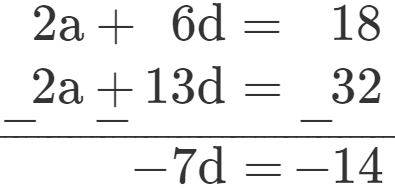
$\therefore\ \text{a}=9-3\text{d}=9-3\times2=9-6=3$
$\therefore\ \text{a}=3,\text{d}=2$
Now $\text{T}_{28}=\text{a}+(\text{n}-1)\text{d}=3+(28-1)\times2$
$=3+27\times2=3+54=57$ View full question & answer→Question 215 Marks
Find the common difference and write the next four terms of the following arithmetic progressions:
$-1,\frac{5}{6},\frac{2}{3},\ .....$
AnswerHere, first term$ (a_1) = -1$
Common difference $(d) = a_2 - a_1$
$=-\frac{5}{6}-(-1)$
$=\frac{-5+6}{6}$
$=\frac{1}{6}$
Now, we need to find the next four terms of the given A.P
That is we need to find $a_4, a_5, a_6, a_7.$
So, using the formula $a_n = a + (n - 1)d$
Substituting n = 4, 5, 6, 7 in the above formula
Substituting n = 4, we get
$\text{a}_4=-1+(4-1)\Big(\frac{1}{6}\Big)$
$\text{a}_4=-1+\Big(\frac{1}{2}\Big)$
$\text{a}_4=\frac{-2+1}{2}=\frac{-1}{2}$
Substituting n = 5, we get
$\text{a}_5=-1+(5-1)\Big(\frac{1}{6}\Big)$
$\text{a}_5=-1+\frac{2}{3}$
$\text{a}_5=\frac{-3+2}{3}$
$\text{a}_5=-\frac{1}{3}$
Substituting n = 6, we get
$\text{a}_6=-1+(6-1)\Big(\frac{1}{6}\Big)$
$\text{a}_6=-1+\frac{5}{6}$
$\text{a}_6=\frac{-6+5}{6}$
$\text{a}_6=-\frac{1}{6}$
Substituting n = 7, we get
$\text{a}_7=-1+(7-1)\Big(\frac{1}{6}\Big)$
$\text{a}_7=-1+1$
$\text{a}_7=0$
Therefore, the common difference is $\text{d}=\frac{1}{6}$ and the next four terms are $-\frac{1}{2},-\frac{1}{3},-\frac{1}{6},0$.
View full question & answer→Question 225 Marks
Find the middle term of the A.P. 213, 205, 197, ...., 37.
AnswerLet a be the first term and d be the common difference.
We know that, $n^{\text {th }}$ term $=a_n=a+(n-1) d$
It is given that $a=213, d=-8$ and $a_n=37$
According to the question,
$\Rightarrow 37 = 213 + (n - 1)(-8)$
$\Rightarrow 37 = 213 - 8n + 8$
$\Rightarrow 8n = 221 - 37$
$\Rightarrow 8n = 184$
$\Rightarrow n = 23 .....(i)$
Therefore, Total number of terms is 23.
Since, there are odd number of terms.
So, Middle term will be $\Big(\frac{23 + 1}{2}\Big)^{\text{th}}$ term, i.e., the $12^{th} term.$
$\therefore$ $a_{12} = 213 + (12 - 1)(-8)$
= 213 - 88
= 125
Thus, the middle term of the A.P. 213, 205, 197, ....., 37 is 125.
View full question & answer→Question 235 Marks
Find the next five terms of the following sequences given:
$a_1 = 4, a_n = 4a_{n-1} + 3, n > 1.$
AnswerGiven,
First term $(a_1) = 4$
$n^{th} term (a_n) = 4a_{n-1} + 3, n > 1$
To find next fice terms i.e., $a_2, a_3, a_4, a_5, a_6$ we put n = 2, 3, 4, 5, 6 is $a_n$
Then, we get
$a_2 = 4a_{2-1} + 3 = 4.a_1 + 3 = 4(4) + 3 = 19 ($\therefore$ a_1 = 4)$
$a_3 = 4a_{3-1} + 3 = 4.a_2 + 3 = 4(19) + 3 = 79$
$a_4 = 4a_{4-1} + 3 = 4.a_3 + 3 = 4(79) + 3 = 319$
$a_5 = 4a_{5-1} + 3 = 4.a_4 + 3 = 4(319) + 3 = 1279$
$a_6 = 4a_{6-1} + 3 = 4.a_5 + 3 = 4(1279) + 3 = 5119.$
$\therefore$ The required next five terms are,
$a_2 = 19, a_3 = 79, a_4 = 319, a_5 = 1279, a_6 = 5119.$
View full question & answer→Question 245 Marks
Find the next five terms of the following sequences given:
$a_1 = a_2 = 2, a_n = a_{n-1} - 3, n > 2.$
Answer$a_1 = a_2 = 2$
$a_n = a_{n-1} - 3$
$Let n = 3, 4, 5, 6, 7$
$a_3 = a_{3-1} - 3 = a_2 - 3$
$= 2 - 3 = -1$
$a_4 = a_{4-1} - 3 = a_3 - 3$
$= -1 - 3 = -4$
$a_5 = a_{5-1} - 3 = a_4 - 3$
$= -4 - 3 = -7$
$a_6 = a_{6-1} - 3 = a_5 - 3$
$= -7 - 3 = -10$
$a_7 = a_{7-1} - 3 = a_6 - 3$
$= -10 - 3 = -13.$
View full question & answer→Question 255 Marks
If the $n^{\text {th }}$ term of the A.P. $9,7,5, \ldots$ is same as the $n ^{\text {th }}$ term of the A.P. $15,12,9, \ldots$ find $n$.
AnswerGiven,
$AP_1=9,7,5, \ldots . . n_1$
$AP_2=15,12,9, \ldots . . n_2$
$n ^{\text {th }}$ term of both AP is equal then
$n_1=n_2=n$
we know, $n ^{\text {th }}$ term of A.P.
$a_n=a+(n-1) d$
$\text { For } AP_1, a_{n_1}=n$
$a=9$
$\text { and } d=(7-9)=-2$
$\text { then, } n=9+(n-1)-2$
$\Rightarrow n=9-2 n+2$
$\Rightarrow n=11-2 n . \ldots . \text {.(i) }$
$\text { For } AP_2, a_{n_2}=n$
$a=15$
$\text { and } d=(12-15)=-3$
$\text { then, } n=15+(n-1)-3$
$\Rightarrow n=15-3 n+3$
$\Rightarrow n=18-3 n \ldots . . \text { (ii) }$
From eq. (i) and (ii), we get
$\Rightarrow 11-2 n=18-3 n$
$\Rightarrow-2 n+3 n=18-11$
$\Rightarrow n=7$
View full question & answer→Question 265 Marks
In an A.P., if the $5^{\text {th }}$ and $12^{\text {th }}$ terms are 30 and 65 respectively, what is the sum of first 20 terms?
AnswerGiven,
$5^{\text {th }}$ term $a _5=30$
$12^{\text {th }}$ term $a _{12}=65$
We know $a_n=a+(n-1) d$
$\Rightarrow 30= a +4 d$.....(i)
$12^{\text {th }}$ term $a_{12}=a+(12-1) d$
$\Rightarrow 65=a+11 d . . . . .(ii)$
Subtracting eq. (i) from Eq. (ii)
$\Rightarrow 65 - 30 = a + 11d - (a + 4d)$
$\Rightarrow 35 =a + 11d - a - 4d$
$\Rightarrow 35 = 7d$
$\Rightarrow\ \text{d}=\frac{35}{7}$
⇒ d = 5
From eq. (i) 30 = a + 4 × 5
⇒ 30 = a + 20
⇒ a = 30 - 20
⇒ a = 10
We know, Sum of n terms
$\text{S}_\text{n}=\frac{\text{n}}{2}[2\text{a}+(\text{n}-1)\text{d}]$
$\Rightarrow\ \text{S}_{20}=\frac{20}{2}[2\times10+(20-1)5]$
$\Rightarrow S_{20} = 10[20 + 19 \times 5]$
$\Rightarrow S_{20} = 10[20 + 95]$
$\Rightarrow S_{20} = 10 \times 115$
$\Rightarrow S_{20} = 1150$
Hence, Sum of first 20 terms is 1150.
View full question & answer→Question 275 Marks
In an A.P. the first term is $8, n ^{\text {th }}$ term is 33 and the sum to first n terms is 123 . Find n and d , the common differences.
AnswerIn an A.P,
First term (a) = 8
$n^{th} term (a_n) = 33$
$S_n = 123$
Let d the common difference an n be the number of terms
$\therefore$ $a_n = a + (n - 1)d$
⇒ 33 = 8 + (n - 1)d
⇒ (n - 1)d = 33 - 8 = 25 .....(i)
and $\text{S}_\text{n}=\frac{\text{n}}{2}[2\text{a}+(\text{n}-1)\text{d}]$
$\Rightarrow\ 123=\frac{\text{n}}{2}[2\times8+25]\ [\text{ from (i)}]$
$123\times2=\text{n}(16+25)=41\text{n}$
$\Rightarrow\ \text{n}=\frac{123\times2}{41}=6$
From (i) (n - 1)d = 25
$\Rightarrow\ (6-1)\text{d}=25\Rightarrow\ 5\text{d}=25$
$\Rightarrow\ \text{d}=\frac{25}{5}=5$
Hence n = 6, d = 5.
View full question & answer→Question 285 Marks
Find the sum:1 + 3 + 5 + 7 + ..... + 199.
AnswerGiven,
A.P. 1 + 3 + 5 + 7 + ..... + 199.
Here,
First term, a = 1
Difference, d = 3 - 1 = 2
and Last term $a_n = 199$
$We know, a_n = a + (n - 1)d$
$\Rightarrow 199 = 1 + (n - 1)2$
$\Rightarrow 199 = 1 + 2n - 2$
$\Rightarrow 200 = 2n$
$\Rightarrow n = 100$
We know, Sum of n terms,
$\text{S}_\text{n}=\frac{\text{n}}{2}[2\text{a}+(\text{n}-1)\text{d}]$
$\Rightarrow\ \text{S}_{100}=\frac{100}{2}[2(1)+(100-1)2]$
$\Rightarrow S_{100} = 50[2 + 99 \times 2]$
$\Rightarrow S_{100} = 50[2 + 198]$
$\Rightarrow S_{100} = 50[200]$
$\Rightarrow S_{100} = 10000.$
Hecne, Sum of given A.P. is 10000.
View full question & answer→Question 295 Marks
The first and the last terms of an A.P. are 5 and 45 respectively. If the sum of all its terms is 400, find its common difference.
AnswerLet a be the first term and d be the common difference.
We know that, Sum of first n terms $=\text{S}_\text{n}=\frac{\text{n}}{2}[2\text{a}+(\text{n}-1)\text{d}]$
Also, $n^{th}$ term $a_n = a + (n - 1)d$
According to the question,
$a = 5, a_n = 45$ and $S_n = 400$
Now,
$a_n = a (n - 1)d$
$\Rightarrow 45 = 5 + (n - 1)d$
$\Rightarrow 40 = nd - d$
$\Rightarrow nd - d = 40 .....(1)$
Also,
$\text{S}_\text{n}=\frac{\text{n}}{2}[2\times5+(\text{n}-1)\text{d}]$
$\Rightarrow\ 400=\frac{\text{n}}{2}[10+\text{nd}-\text{d}]$
⇒ 800 = n[10 + 40] [From (i)]
⇒ 50n = 800
⇒ n = 16 .....(ii)
On substituting (ii) in (i), we get
nd - d = 40
⇒ (16 - 1)d = 40
⇒ 15d = 40
$\Rightarrow\ \text{d}=\frac{8}{3}$
Thus, common difference of the given A.P. is $\frac{8}{3}$.
View full question & answer→Question 305 Marks
Write the expression $a_n - a_k$ for the $A.P. a, a + d, a + 2d, ...$
Hence, find the common difference of the A.P. for which,
$11^{th}$ term is 5 and $13^{th}$ term is 79.
AnswerWe know,
$a_n = a + (n - 1)d$
Let,
$n^{th}$ term $a_n = a + (n - 1)d$
$\Rightarrow a_n = a + nd - d$
$k^{th}$ term, $a_k = a + (k - 1)d$
$\Rightarrow a_k = a + kd - d$
Now,
$\Rightarrow a_n - a_k = (a + nd - d) - (a + kd - d)$
$\Rightarrow = a + nd - d - a - kd + d$
$\Rightarrow = nd - kd$
$\Rightarrow = d(n - k)$
Given , $11^{th}$ term, $a_{11} = 5$
and $13^{th}$ term, $a_{13} = 79$
We know, an = a + (n - 1)d
then,
$11^{th}$ term, $a_{11} = a + (11 - 1)d$
$\Rightarrow 5 = a + 10d .....(i)$
$13^{th}$ term, $a_{13} = a + (13 - 1)d$
$\Rightarrow 79 = a + 12d .....(ii)$
By subtituting eq. (i) from eq. (ii)
$\Rightarrow 79 - 5 = a + 12d - (a + 10d)$
$\Rightarrow 74 = a + 12d - a - 10d$
$\Rightarrow 74 = 2d$
$\Rightarrow d = 37.$
View full question & answer→Question 315 Marks
If 10 times the $10^{\text {th }}$ term of an A.P. is equal to 15 times the $15^{\text {th }}$ term, show that $25^{\text {th }}$ term of the A.P. is zero.
AnswerHere, let us take the first term of the A.P. as a and the common difference as d.
We are given that 10 times the $10^{th}$ term is equal to 15 times the $15^{th}$ term. We need to show that $25^{th}$ term is zero.
So, let us first find the two terms.
So, as we know,
$a_n=a+(n-1) d$
For $10^{\text {th }}$ term $( n =10)$
$a_{10}=a+(10-1) d$
$=a+9 d$
For $15^{\text {th }}$ term $( n =15)$,
$a_{15}=a+(15-1) d$
$=a+14 d$
Now, we are given
$10(a+9 d)=15(a+14 d)$
Solving this, we get,
$10a + 90d = 15a + 210d$
$90d - 210d = 15a - 10a$
$-120d = 5a$
$-24d = a .....(i)$
Next, we need to prove that the $25^{th}$ term of the A.P. is zero. For that, let us find the $25^{th}$ term using n = 25,
$a_{25} = a + (25 - 1)d$
$= -24d + 24d$ (using 1)
$= 0$
Thus, the $25^{th}$ term of the given A.P. is zero.
Hence proved.
View full question & answer→Question 325 Marks
The sum of first 9 terms of an A.P. is 162 . The ratio of its $6^{\text {th }}$ term to its $13^{\text {th }}$ term is $1: 2$. Find the first and $15^{\text {th }}$ term of the A.P?
AnswerSum of first 9 terms = 162
Ratio of its $6^{th}$ term and $13^{th}$ term = 1 : 2
$\text{S}_9=\frac{9}{2}[2\text{a}+(9-1)\text{d}]=162\ .....(\text{i})$
$\text{T}_6=[\text{a}+(6-1)\text{d}]=(\text{a}+5\text{d})$
$=\text{a}+5\text{d}$
and $\text{T}_{13}=[\text{a}+(13-1)\text{d}]=(\text{a}+12\text{d})$
But $\text{T}_6:\text{T}_{13}=1:2\Rightarrow\ \frac{\text{T}_6}{\text{T}_{13}}=\frac{1}{2}$
$\Rightarrow\ \frac{\text{a}+5\text{d}}{\text{a}+12\text{d}}=\frac{1}{2}\Rightarrow\ 2\text{a}+10\text{d}=\text{a}+12\text{d}$
$\Rightarrow\ 2\text{a}-\text{a}=12\text{d}-10\text{d}\Rightarrow\ \text{a}=2\text{d}$
From (i),
$\because\ \frac{9}{2}[2\text{a}+(9-1)\text{d}]=162$
$\Rightarrow\ \frac{9}{2}(2\text{a}+8\text{d})=162$
$\Rightarrow\ \frac{9}{2}(4\text{d}+8\text{d})=162\ (\because\ \text{a}=2\text{d})$
$\Rightarrow\ \frac{9}{2}\times12\text{d}=162\Rightarrow\ 54\text{d}=162$
$\Rightarrow\ \text{d}=\frac{162}{54}=3$
$\text{a}=2\text{d}=2\times3=6$
Now $\text{T}_{15}=\text{a}+(15-1)\text{d}=\text{a}+14\text{d}$
$=6+14\times3=6+42=48$
Hence first term = 6 and $T_{15} = 48.$
View full question & answer→Question 335 Marks
If $12^{th}$ term of an A.P. is -13 and the sum of the first four terms is 24, what is the sum of first 10 terms?
AnswerGiven, $a_{12} = -13, a + a_2 + a_3 + a_4 = 24$
$\text{S}_4=\frac{4}{2}(2\text{a}+3\text{d})=24$ $2\text{a}+3\text{d}=\frac{24}{2}=12\ .....(\text{i})$
$\Rightarrow\ \text{a}+(12-1)\text{d}=-13$
$\text{a}+11\text{d}=-13\ .....(\text{ii})$
Subtract (i) from (ii) × 2
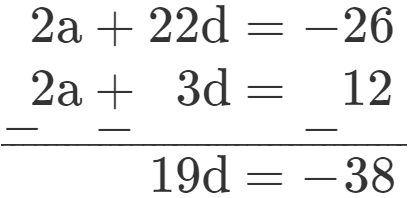
$\text{d}=\frac{-38}{19}=-2$
put $d = -2 in (ii) a + 11(-2) = -13 a = -13 + 22 a = 9$
Given to find sum of first 10 terms.
$\text{S}_{10}=\frac{10}{2}[2\text{a}+(10-1)\text{d}]$
$\text{S}_{10}=5\big[2\times9+9\times(-2)\big]$
$=5(18-18)$ $=0$ $\therefore\ \text{S}_{10}=0$ View full question & answer→Question 345 Marks
If the sum of 7 terms of an A.P. is 49 and that of 17 terms is 289, find the sum of n terms.
AnswerLet a be the first term and d be the common difference of an A.P.
Sum of 7 terms = 49
and sum of 17 terms = 289
$\text{S}_7=\frac{7}{2}[2\text{a}+(7-1)\text{d}]=49$
$\Rightarrow\ \frac{7}{2}[2\text{a}+6\text{d}]=49$
$7\text{a}+21\text{d}=49\Rightarrow\ \text{a}+3\text{d}=7\ (\text{Dividing by }7)$
$\therefore\ \text{a}+3\text{d}=7\ .....(\text{i})$
Similarly $\text{S}_{17}=\frac{17}{2}[2\text{a}+(17-1)\text{d}]=289$
$\Rightarrow\ \frac{17}{2}[2\text{a}+16\text{d}]=289$
$\Rightarrow\ 17\text{a}+136\text{d}=289\ (\text{Dividing by }17)$
$\Rightarrow\ \text{a}+8\text{d}=17\ .....(\text{ii})$
Subtracting (i) from (ii)
$5\text{d}=10\Rightarrow\ \text{d}=\frac{10}{5}=2$
and $\text{a}+3\text{d}=7\Rightarrow\ \text{a}+2\times3=7$
$\Rightarrow\ \text{a}+6=7\Rightarrow\ \text{a}=7-6=1$
$\therefore\ \text{a}=1,\text{d}=2$
$\therefore\ \text{S}_\text{n}=\frac{\text{n}}{2}[2\text{a}+(\text{n}-1)\text{d}]$
$=\frac{\text{n}}{2}[2\times1+(\text{n}-1)2]$
$=\frac{\text{n}}{2}[2+2\text{n}-2]=\frac{\text{n}}{2}\times2\text{n}=\text{n}^2$
View full question & answer→Question 355 Marks
If $S_n$ denotes the sum of first n terms of an A.P., prove that $S_{12} = 3(S_8 - S_4).$
AnswerLet a be the first term and d be the common difference
We know that, Sum of first n terms $=\text{S}_\text{n}=\frac{\text{n}}{2}[2\text{a}+(\text{n}-1)\text{d}]$
Now,
$\text{S}_4=\frac{4}{2}[2\text{a}+(4-1)\text{d}]$
$=2(2\text{a}+3\text{d})$
$=4\text{a}+6\text{d} \ .....\text{(i)}$
$\text{S}_8=\frac{8}{2}[2\text{a}+(8-1)\text{d}]$
$=4(2\text{a}+7\text{d})$
$=8\text{a}+28\text{d}\ .....(\text{ii})$
$\text{S}_{12}=\frac{12}{2}[2\text{a}+(12-1)\text{d}]$
$=6(2\text{a}+11\text{d})$
$=12\text{a}+66\text{d}\ .....(\text{iii})$
On Subtracting (i) from (ii), we get
$S_8 - S_4 = 8a + 28d - (4a + 6d)$
$= 4a + 22d$
Multiplying both sides by 3, we get
$3(S_8 - S_4) = 3(4a + 22d)$
$= 12a + 66d$
$= S_{12} [from (iii)]$
Thus, $S_{12} = 3(S_8 - S_4).$
View full question & answer→Question 365 Marks
Find the $12^{th}$ term from the end of the following arithmetic progressions:
$1, 4, 7, 10, ....., 88.$
Answer$1, 4, 7, 10, ....., 88.$
Here, to find the $12^{th}$ term from the end let us first find the total number of terms. Let us take the total number of terms as n.
So,
First term (a) = 1
Last term ($a_n$) = 88
Common difference, $d = 4 - 1 = 3$
Now, as we know
$a_n = a + (n - 1)d$
So, for the last term,
$88 = 1 + (n - 1)3$
$88 = 1 + 3n - 3$
$88 = -2 + 3n$
$88 + 2 = 3n$
Further simplifying,
90 = 3n
$\text{n}=\frac{90}{3}$
n = 30
So, the $12^{th}$ term from the end means the $19^{th}$ term from the beginning.
So, for the $19^{th}$ term $(n = 19)$
$a_{19} = 1 + (19 - 1)3$
$= 1 + (18)3$
$= 1 + 54$
$= 55$
Therefore, the $12^{th}$ term the end of the given A.P. is 55.
View full question & answer→Question 375 Marks
Find the next five terms of the following sequences given:
$\text{a}_1=-1,\text{a}_\text{n}=\frac{\text{a}_\text{n}-1}{\text{n}},\text{n}\geq2$
AnswerGiven, first term ($a_1$) = -1
$n^{th}$ term ($a_n$) $=\frac{\text{a}_\text{n}-1}{\text{n}},\text{n}\geq2$
To find next five terms i.e., $a_2, a_3, a_4, a_5, a_6$
we put n = 2, 3, 4, 5, 6 is an
$\text{a}_2=\frac{\text{a}_{2-1}}{2}=\frac{\text{a}_1}{2}=\frac{-1}{2}$
$\text{a}_3=\frac{\text{a}_{3-1}}{3}=\frac{\text{a}_2}{3}=\frac{-\frac{1}{2}}{3}=\frac{-1}{6}$
$\text{a}_4=\frac{\text{a}_{4-1}}{4}=\frac{\text{a}_3}{4}=\frac{\frac{-1}{6}}{4}=\frac{-1}{24}$
$\text{a}_5=\frac{\text{a}_{5-1}}{5}=\frac{\text{a}_4}{5}=\frac{\frac{-1}{24}}{5}=\frac{-1}{120}$
$\therefore$ The next five terms are,
$\text{a}_2=\frac{-1}{2},\text{a}_3=\frac{-1}{6},\text{a}_4=\frac{-1}{24},\text{a}_5=\frac{-1}{120},\text{a}_6=\frac{-1}{720}$
View full question & answer→Question 385 Marks
Find the sum of all integers between 84 and 719, which are multiples of 5.
AnswerIn this problem, we need to find the sum of all the multiples of 5 lying between 84 and 719.
So, we know that the first multiple of 5 after 84 is 85 and the last multiple of 5 before 719 is 715.
Also, all these terms will form an A.P. with the common difference of 5.
So here,
First term (a) = 85
Last term (l) = 715
Common difference (d) = 5
So, here the first step is to find the total number of terms. Let us take the number of terms as n.
Now, as we know,
$a_n = a + (n - 1)d$
So, for the last term,
$715 = 85 + (n - 1)5$
$715 = 85 + 5n - 5$
$715 = 80 + 5n$
$715 - 80 = 5n$
Further simplifying,
635 = 5n
$\text{n}=\frac{635}{5}$
n = 127
Now, using the formula for the sum of n terms,
$\text{S}_\text{n}=\frac{\text{n}}{2}[2\text{a}+(\text{n}-1)\text{d}]$
We get,
$\text{S}_\text{n}=\frac{127}{2}[2(85)+(127-1)5]$
$=\frac{127}{2}[170+(126)5]$
$=\frac{127}{2}(170+630)$
$=\frac{127(800)}{2}$
On further simplification, we get,
$S_n = 127(400)$
$= 50800$
Therefore, the sum of all the multiples of 5 lying between 84 and 719 is $S_n = 50800.$
View full question & answer→Question 395 Marks
Find the sum of n terms of an A.P. whose nth terms is given by an = 5 - 6n.
AnswerGiven, $a_n = 5 - 6n$
By putting $n = 1, 2, 3, .....$
$a_1 = 5 - 6(1) = 5 - 6 = -1$
$a_2 = 5 - 6(2) = 5 - 12 = -7$
and $a_3 = 5 - 6(3) = 5 - 18 = -13$
So, A.P. is -1, -7, -13, .....
Here,
First term a = -1
and Difference d = -7 - (-1) = -7 + 1 = -6
we know, sum of n terms
$\text{S}_\text{n}=\frac{\text{n}}{2}[2\text{a}+(\text{n}-1)\text{d}]$
$\Rightarrow\ \text{S}_\text{n}=\frac{\text{n}}{2}[2(-1)+(\text{n}-1)-6]$
$\Rightarrow\ \text{S}_\text{n}=\frac{\text{n}}{2}[-2+6\text{n}+6]$
$\Rightarrow\ \text{S}_\text{n}=\frac{\text{n}}{2}[4-6\text{n}]$
$\Rightarrow\ \text{S}_\text{n}=\frac{\text{n}}{2}\times2[2-3\text{n}]$
$\Rightarrow\ \text{S}_\text{n}=\text{n}[2-3\text{n}]$
Hence, Sum of n terms is n[2 - 3n].
View full question & answer→Question 405 Marks
The $4^{\text {th }}$ term of an A.P. is three times the first and the $7^{\text {th }}$ term exceeds twice the third term by 1 . Find the first term and the common difference.
AnswerGiven,
$4^{th}$ term of an A.P. is three times the times the first term
$a_4 = 3.a$
$n^{th}$ term of a sequence
$a_n = a + (n - 1).d$
$a + (4 - 1)d = 3a$
$a + 3d = 3a$
$3d = 2a$
$\text{a}=\frac{3}{2}\text{d}\ .....(\text{i})$
Seventh term exceeds twice the third term by 1.
$a_7 + 1 = 2.a3$
$\text{a}+(7-1)\text{d}+1=2(\text{a}+(3-1)\text{d})$
$a + 6d + 1 = 2a + 4d$
$a = 2d + 1 .....(ii)$
By equating (1), (2)
$\frac{3}{2}\text{d}=2\text{d}+1$
$\frac{3}{2}\text{d}-2\text{d}=1$
$-d = 2$
$d = -2$
Put $\text{d}=-2\text{ in a}=\frac{3}{2}\text{d}$
$=\frac{3}{2}.\text{x}$
$=-3$
$\therefore$ First term a = -3, common difference d = -2.
View full question & answer→Question 415 Marks
Which of the following sequences are arithmetic progressions. For those which are arithmetic progressions, find out the common difference.
$12, 2, -8, -18, .....$
AnswerIn the given problem, we are given various sequences.
We need to find out that the given sequences are an A.P. of not and then find its common difference (d).
$12, 2, -8, -18, .....$
Let $a_1 = 12, a_2 = 2, a_3 = -8, a_4 = -18$
Now $a_2 - a_1 = 2 - 12 = -10$
$a_3 - a_2 = -8 - 2 = -10$
$a_4 - a_3 = -18 - (-8) = -18 + 8 = -10$
$\therefore$ We see that common difference is -10
$\therefore$ It is an A.P.
View full question & answer→Question 425 Marks
The $10^{\text {th }}$ and $18^{\text {th }}$ terms of an A.P. are 41 and 73 respectively. Find $26^{\text {th }}$ term.
AnswerIn the given problem, we are given $10^{\text {th }}$ and $18^{\text {th }}$ term of an A.P.
We need to find the $26^{\text {th }}$ term
Here,
$a_{10} = 41$
$a_{18} = 73$
Now, we will find $a_{10}$ and $a_{18}$ using the formula $a_n = a + (n - 1)d$
So,
$a_{10} = a + (10 - 1)d$
$41 = a + 9d .....(i)$
Also,
$a_{18} = a + (18 - 1)d$
$73 = a + 17d .....(ii)$
So, to solve for a and d
On susbtracting (1) from (2), we get
8d = 32
$\text{d}=\frac{32}{8}$
d = 4
Substituting d = 4 in (1), we get
$41 = a + 9(4)$
$41 - 36 = a$
$a = 5$
Thus,
$a = 5$
$d = 4$
$n = 26$
Substituting the above values in the formula,
$a_n = a + (n - 1)d$
$a_{26} = 5 + (26 - 1)4$
$a_{26} = 5 + 100$
$a_{26} = 105$
Therefore,$a_{26} = 105$
View full question & answer→Question 435 Marks
A sum of Rs. 700 is to be used to give seven cash prizes to students of a school for their overall academic performance. If each prize is Rs. 20 less than its preceding prize, find the value of each prize.
AnswerIn the given problem,
Total amount of money ($S_n$) = Rs 700
There are a total of 7 prizes and each prize is Rs 20 less than the previous prize. So let us take the first prize as Rs a.
So, the second prize will be Rs a - 20, third prize will be Rs a - 20 - 20.
Therefore, the prize money will form an A.P. with first term a and common difference -20.
So, using the formula for the sum of n terms,
$\text{S}_\text{n}=\frac{\text{n}}{2}[2\text{a}+(\text{n}-1)\text{d}]$
We get,
$700=\frac{7}{2}\Big[2\text{a}+(7-1)(-20)\Big]$
$700=\frac{7}{2}[2\text{a}+(6)(-20)]$
$700=\frac{7}{2}(2\text{a}-120)$
$700=7(\text{a}-60)$
On Further simplification, we get,
$\frac{700}{7}=\text{a}-60$
$100+60=\text{a}$
$\text{a}=160$
Therefore, the value of first prize is Rs. 160.
Second prize = Rs. 140
Third prize = Rs. 120
Fourth prize = Rs. 100
Fifth prize = Rs. 80
Sixth prize = Rs. 60
Seventh prize = Rs. 40
So the values of prizes are Rs. 160, Rs. 140, Rs. 120, Rs. 100, Rs. 80, Rs. 60, Rs. 40.
View full question & answer→Question 445 Marks
Let there be an A.P. with first term ' $a$ ', common difference ' $d$ '. If $a_n$ denotes in $n^{\text {th }}$ term and $S_n$ the sum of first $n$ terms, find. d , if $a =3, n =8$ and $S _{ n }=192$.
AnswerHere, we have an A.P. whose first term (a), Sum of first n terms ($S_n$) and the number of terms (n) are given. We need to find common difference (d).
Here,
First term (a) = 3
Sum of n terms ($S_n$) = 192
Number of terms (n) = 8
So here we will find the value of n using the formula, $a_n = a + (n - 1)d$
So. to find the common difference of this A.P., we use the following formula for the sum of n terms of an A.P.
$\text{S}_\text{n}=\frac{\text{n}}{2}[2\text{a}+(\text{n}-1)\text{d}]$
Where; a = first term for the given A.P.
d = common difference of the given A.P.
n = number of terms
So, using the formula for n = 8, we get,
$\text{S}_8=\frac{8}{2}[2(3)+(8-1)(\text{d})]$
$192 = 4[6 + (7)(d)]$
$192 = 24 + 28d$
$28d = 192 - 24$
Furhter solving for d,
$\text{d}=\frac{168}{28}$
$d = 6$
Therefore, the common difference of the given A.P. is d = 6.
View full question & answer→Question 455 Marks
Find the sum:$\text{7}+10\frac{1}{2}+14+\ .....\ + 84$
AnswerGiven,
$\text{A.P., }7+10\frac{1}{2}+14+\ .....\ + 84$
Here,
First term, a = 7
Difference, $\text{d}=\frac{21}{2}-7=\frac{7}{2}$
and Last term, $a_n = 84$
We know, $a_n = a + (n - 1)d$
$\Rightarrow\ 84= 7 + (\text{n}-1)\frac{7}{2}$
$\Rightarrow\ 84=7+\frac{7\text{n}}{2}-\frac{7}{2}$
$\Rightarrow\ 84=\frac{14+7\text{n}-7}{2}$
$\Rightarrow\ 84\times2=7+7\text{n}$
$\Rightarrow\ 168=7+7\text{n}$
$\Rightarrow\ 7\text{n}=168-7$
$\Rightarrow\ \text{n}=\frac{161}{7}=23$
We know, Sum of n terms,
$\text{S}_\text{n}=\frac{\text{n}}{2}[2\text{a}+(\text{n}-1)\text{d}]$
$\Rightarrow\ \text{S}_{23}=\frac{23}{2}\Big[2(7)+(23-1)\frac{7}{2}\Big]$
$\Rightarrow\ \text{S}_{23}=\frac{23}{2}\Big[14+22\times\frac{7}{2}\Big]$
$\Rightarrow\ \text{S}_{23}=\frac{23}{2}[14+77]$
$\Rightarrow\ \text{S}_{23}=\frac{23}{2}\times91=\frac{2093}{2}$
Hecne, Sum of given A.P. is $\frac{2093}{2}$.
View full question & answer→Question 465 Marks
Find:
Which term in the $A.P. 121, 117, 113, ..... $ is its first negative term?
AnswerIn the given problem, we are given an A.P. and the value of one of its term. We need to find which term it is (n).
So here we will find the value of n using the formula, $a_n = a + (n - 1)d.$
Given,
$A.P. 121, 117, 113, .....$
Here,
First term $= 121$
Difference $= 117 - 121 = -4$
We have to find which term of A.P. is its first negative term is then,
$a_n < 0$
We know, $n^{th}$ term of A.P.
$a + (n - 1)d < 0$
$\Rightarrow 121 + (n - 1) -4 < 0$
$\Rightarrow 121 + (-4n + 4) < 0$
$\Rightarrow 121 - 4n + 4 < 0$
$\Rightarrow 125 - 4n < 0$
$\Rightarrow 4n > 125$
$\Rightarrow\ \text{n}>31\frac{1}{4}$
$\because\ \text{n}>31\frac{1}{4}$
⇒ n = 32
Hence, $32^{th}$ term of the given A.P. for getting first negative term.
View full question & answer→Question 475 Marks
Let there be an A.P. with first term ' $a$ ', common difference ' $d$ '. If $a_n$ denotes in $n ^{\text {th }}$ term and $S_n$ the sum of first $n$ terms, find. n and a , if $a _{ n }=4, d=2$ and $S _{ n }=-14$.
Answer$a_n = 4, d = 2, S_n = -14$
$\therefore$ $a + (n - 1)2 = 4$
$\Rightarrow a + (n - 1)^2 = 4$
$\Rightarrow a + 2n - 2 = 4$
$ \Rightarrow a + 2n = 4 + 2$
$a + 2n = 6 .....(i)$
$\text{S}_\text{n}=\frac{\text{n}}{2}[\text{a}+\text{l}]\Rightarrow\ -14=\frac{\text{n}}{2}[\text{a}+4]$
$n (a + 4) = -28 .....(ii)$
From (i) a = 6 - 2n
$\therefore$ in (ii)
$n (6 - 2n + 4) = -28$
$\Rightarrow n(10 - 2n) = -28$
$\Rightarrow 10n - 2n^2 = - 28$
$ \Rightarrow 2n^2 - 10n - 28 = 0$
$\Rightarrow n^2 - 5n - 14 = 0$ (Divisible by 2)
$\Rightarrow n^2 - 7n + 2n - 14 = 0$
$\begin{Bmatrix} \therefore\ -14=-7\times2\\ -5=-7=2 \end{Bmatrix}$
$\Rightarrow n(n - 7) + 2(n - 7) = 0$
$\Rightarrow (n - 7)(n + 2) = 0$
Either n - 7 = 0, then n = 7
of n + 2 = 0, then n = -2 but it is not possible being negative
$\therefore\ \text{n}=7$
Now a = 6 - 2n = 6 - 2 × 7 = 6 - 14 = -8
Hence a = -8, n = 7
View full question & answer→Question 485 Marks
Find the second term and $n ^{\text {th }}$ term of an A.P. whose $6^{\text {th }}$ term is 12 and $8^{\text {th }}$ term is 22.
AnswerIn the given problem, we are given $6^{\text {th }}$ and $8^{\text {th }}$ term of an A.P.
We need to find the $2^{\text {nd }}$ and $n ^{\text {th }}$ term,
Here, let us take the first term as a and the common difference as $d$, We are given,
$a_6 = 12$
$a_8 = 22$
Now, we will find $a_6$ and $a_8$ using the formula $a_n = a + (n - 1)d$
So,
$a_6 = a+ (6 - 1)d$
$12 = a + 5d .....(i)$
Also,
$a_8 = a + (8 - 1)d$
$22 = a + 7d .....(ii)$
So, to solve for a and d
On subtracting (1) from (2), we get
$22 - 12 = (a + 7d) - (a + 5d)$
$10 = a + 7d - a - 5d$
$10 = 2d$
$\text{d}=\frac{10}{2}$
$d = 5 .....(iii)$
Susbtituting (iii) in (i), we get
$12 = a + 5(5)$
$a = 12 - 25$
$a = -13$
Thus,
$a = -13$
$d = 5$
So, for the $2^{nd}$ term (n = 2),
$a_2 = -13 + (2 - 1)5$
$= -13 + (1)5$
$= -13 + 5$
$= -8$
For the $n^{th}$ term,
$a_n = -13 + (n - 1)5$
$= -13 + 5n - 5$
$= -18 + 5n$
Therefore, $a_2 = -8, a_n = 5n - 18.$
View full question & answer→Question 495 Marks
Show that the sequence defined by $a_n = 5n - 7$ is an A.P, find its common difference.
AnswerIn the given problem, we need to show that the given sequence is an A.P. and then find its common difference.
Here,
$a_n = 5n - 7$
Now, to show that it is an A.P, Will find its few terms by substituting $n = 1, 2, 3, 4, 5$
So,
Substituting n = 1, we get
$a_1 = 5(1) - 7$
$a_1 = -2$
Subsituting n = 2, we get
$a_2 = 5(2) - 7$
$a_2 = 3$
Subsituting n = 3, we get
$a_3 = 5(3) - 7$
$a_3 = 8$
Subsituting n = 4, we get
$a_4 = 5(4) - 7$
$a_4 = 13$
Subsituting n = 5, we get
$a_5 = 5(5) - 7$
$a_5 = 18$
Further, for the given sequence to be an A.P,
We find the common difference (d)
$a = a_2 - a_1 = a_3 - a_2$
thus,
$a_2 - a_1 = 3 - (-2) = 5$
Since $a_2 - a_1 = a_3 - a_2$
Hence, the given sequence is an A.P, and its common difference is d = 5.
View full question & answer→Question 505 Marks
Find the sum:
$(-5) + (-8) + (-11) + ..... + (-230).$
AnswerGiven,
$A.P. (-5) + (-8) + ..... (-230)$
Here,
First term a = -5
Difference d = -8 - (-5) = -8 + 5 = -3
and Last term $a_n = -230$
We know $a_n = a + (n - 1)d$
$\Rightarrow -230 = -5 + (n - 1)(-3)$
$\Rightarrow -230 = -5 - 3n + 3$
$\Rightarrow -230 = -2 - 3n$
$\Rightarrow -228 = -3n$
$\Rightarrow\ \text{n}=\frac{-228}{-3}=76$
We know, sum of n terms,
$\text{S}_\text{n}=\frac{\text{n}}{2}[2\text{a}+(\text{n}-1)\text{d}]$
$\Rightarrow\ \text{S}_{76}=\frac{76}{2}[2(-5)+(76-1)(-3)]$
$\Rightarrow S_{76} = 38[-10 + 75 \times -3]$
$\Rightarrow S_{76} = 38[-10 - 225]$
$\Rightarrow S_{76} = 38[-235]$
$\Rightarrow S_{76} = -8930$
Hence, Sum of given A.P. is -8930.
View full question & answer→