Question
Write the first five terms of the following sequences whose $n^{th}$​​​​​​​ terms are:
$a_n = n^2 - n + 1.$

Answer

$a_n = n^2 - n + 1$.Here, the $n^{th}$​​​​​​​ term is givne by the above expression. So, to find the first term we use n = 1, we get,
$a_1 = (1)^2 - (1) + 1$
$= 1 - 1 + 1
= 1
$ Similarly, we find the other four terms,
Second term $(n = 2),$
$a_2 = (2)^3 - (2) + 1$
$= 4 - 2 + 1$
$= 3$
Third term $(n = 3),$
$a_3 = (3)^2 - (3) + 1$
$= 9 - 3 + 1$
$= 7$
 Fourth term $(n = 4),$
$a_4 = (4)^2 - (4) + 1$
$= 16 - 4 + 1$
$= 13$
Fifth term $(n = 5),$
$a_5 = (5)^2 - (5) + 1$
$= 25 - 5 + 1$
$= 21$
Therefore, the first terms for the given sequence are $a_1 = 1, a_2 = 3, a_3 = 7, a_4 = 13, a_5 = 21.$

Need a full question paper?

Generate a complete, print-ready paper with questions like this in minutes — across 16+ boards, with answer keys.
Start Generating Free

Similar questions

Find the solution of the pair of equations $\frac{\text{x}}{10}+\frac{\text{y}}{5}-1=0$ and $\frac{\text{x}}{8}+\frac{\text{y}}{6}=15.$ Hence, find $\lambda,$ if $\text{y}=\lambda\text{x}+5.$
By the graphical method, find whether the following pair of equations are consistent or not. If consistent, solve them:
$3x + y + 4 = 0, 6x - 2y + 4 = 0.$
A box contains cards numbered 3, 5, 7, 9, ..., 35, 37. A card is drawn at random from the box. Find the probability that the number on the card is a prime number.
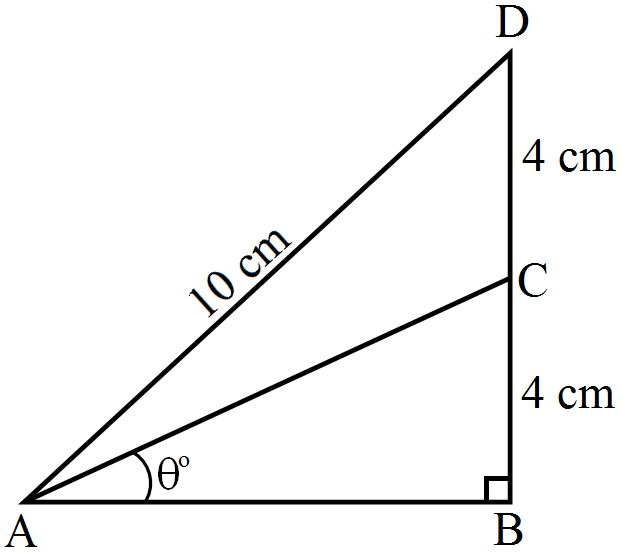
In the adjoining figure, $\angle\text{B}=90^\circ,\angle\text{BAC}=\theta,\text{BC}=\text{CD}=4\text{cm}$ and AD = 10cm. Find
  1. $\sin\theta$
  2. $\cos\theta.$
Hint: $\text{AB}^2=\big(\text{AD}^2-\text{BD}^2\big)=36\text{cm}^2$ $\therefore\text{AB}=6\text{cm}.$ $\text{AC}^2=\big(\text{AB}^2+\text{BC}^2\big)=52\text{cm}^2$ $\therefore\text{AC}=2\sqrt{13}\text{cm}.$ Thus, AB = 6cm and $\text{AC}=2\sqrt{13}\text{cm}.$
Determine a point which divides a line segment of length 12cm internally in the ratio 2 : 3. Also justify your construction.
Given below is a cumulative frequency distribution showing the marks secured by 50 students of a class:
Marks
Below 20
Below 40
Below 60
Below 80
Below 100
Number of students
17
22
29
37
50
Form the frequency distribution table for the data.
The central angles of two sectors of circles of radii $7\ cm$ and $21\ cm$ are respectively $120^\circ$ and $40^\circ $. Find the areas of the two sectors as well as the lengths of the corresponding arcs. What do you observe?
Side of a triangular field are 15m, 16m and 17m. With the three corners of the field a cow, a buffalo and tied separately with ropes of length 7m each to graze in field. Find the area of the field which cannot be grazed by three animals.
Find the roots of the following equation, if they exist, by applying the quadratic formula:
$4x^2 + 4bx - (a^2 - b^2) = 0$
The larger of the two supplementary angles exceeds the smaller by 18°. Find them.