MCQ 11 Mark
In a right triangle $\text{ABC},$ right $-$ angled at $B, BC = 12\ cm$ and $AB = 5 \ cm.$ The radius of the circle inscribed in the triangle $($in $\ cm)$ is :
AnswerLet $r$ is the radius of the circle.
From the figure,
$OP = OQ = OR = r$
In triangle $\text{ABC},$
From Pythagoras Theorem,
$\Rightarrow A C^2=A B^2+B C^2 $
$ \Rightarrow A C^2=5^2+(12)^2 $
$ \Rightarrow A C^2=25+144 $
$ \Rightarrow A C^2=169 $
$\Rightarrow AC = 13$
Now,
$\text{area}(\triangle\text{AOB})+\text{area}(\triangle\text{BOC})+\text{area}(\triangle\text{AOC})=\text{area}(\text{AOB})$
Now,
$\text{s}=\frac{(5+12+13)}{2}=\frac{30}{2}=15$
So, $\text{area}(\triangle\text{AOB})+\text{area}(\triangle\text{BOC})+\text{area}(\triangle\text{AOC})=\text{area}(\text{AOB})$
$\Rightarrow\frac{(\text{OP}\times\text{AB})}{2}+\frac{(\text{OP}\times\text{AB})}{2}+\frac{(\text{OP}\times\text{AB})}{2}=\sqrt{\{\text{s}\times(\text{s}-\text{a})\times(\text{s}-\text{b})\times(\text{s}-\text{c})\}}$
$\Rightarrow\frac{\{(\text{OP}\times\text{AB})+(\text{OP}\times\text{AB})+(\text{OP}\times\text{AB})\}}{2}=\sqrt{\{15\times(15-5)\times(15-13)\times(15-13)\}}$
$\Rightarrow\frac{\{15+12\text{r}+13\text{r}\}}{2}=\sqrt{\{15\times10\times3\times2\}}$
$\Rightarrow\frac{30\text{r}}{2}=\sqrt{900}$
$\Rightarrow15\text{r}=30$
$\Rightarrow\text{r}=\frac{30}{15}$
$\Rightarrow\text{r}=2$
So, the radius of the circle is $2\ cm.$
View full question & answer→MCQ 21 Mark
Two circles touch each other externally at $P. AB$ is a common tangent to the circles touching them at $A$ and $B$. The value of $\angle\text{APB}$ is :
- A
$30^{\circ}$
- B
$45^{\circ}$
- C
$60^{\circ}$
- ✓
$90^{\circ}$
AnswerCorrect option: D. $90^{\circ}$
Given $X$ and $Y$ are two circles touch each other externally at $P. $
$AB$ is the common tangent to the circles $X$ and $Y$ at point $A$ and $B$ respectively.
To find : $\angle\text{APB}$
Proof : Let $\angle\text{CAP}=\alpha$ and $\angle\text{CPB}=\beta$
$CA = CP \ [$Length of the tangents from an external point $C]$
In a triangle $\text{PAC},$
$\angle\text{CAP}=\angle\text{APC}=\alpha$
Similarly $CB = CP$ and $\angle\text{CPB}=\angle\text{PBC}=\beta$
Now in the triangle $\text{APB},$
$\angle\text{PAB}+\angle\text{PBA}+\angle\text{APB}=180^\circ \ [$Sum of the interior angles in a triangle$]$
$\alpha+\beta+(\alpha+\beta)=180^\circ$
$2\alpha+2\beta=180^\circ$
$\alpha+\beta=90^\circ$
$\therefore\ \angle\text{APB}=\alpha+\beta=90^\circ$
View full question & answer→MCQ 31 Mark
In a right triangle $\text{ABC},$ right $-$ angled at $B, BC = 12\ cm$ and $AB = 5\ cm.$ The radius of the circle inscribed in the triangle $($in $\ cm)$ is :
AnswerLet $r$ is the radius of the circle.
From the figure,
$OP = OQ = OR = r$
In triangle $\text{ABC},$
From Pythagoras Theorem,
$\Rightarrow A C^2=A B^2+B C^2 $
$ \Rightarrow A C^2=5^2+(12)^2 $
$ \Rightarrow A C^2=25+144 $
$ \Rightarrow A C^2=169 $
$\Rightarrow AC = 13$
Now,
$\text{area}(\triangle\text{AOB})+\text{area}(\triangle\text{BOC})+\text{area}(\triangle\text{AOC})=\text{area}(\text{AOB})$
Now,
$\text{s}=\frac{(5+12+13)}{2}=\frac{30}{2}=15$
So, $\text{area}(\triangle\text{AOB})+\text{area}(\triangle\text{BOC})+\text{area}(\triangle\text{AOC})=\text{area}(\text{AOB})$
$\Rightarrow\frac{(\text{OP}\times\text{AB})}{2}+\frac{(\text{OP}\times\text{AB})}{2}+\frac{(\text{OP}\times\text{AB})}{2}=\sqrt{\{\text{s}\times(\text{s}-\text{a})\times(\text{s}-\text{b})\times(\text{s}-\text{c})\}}$
$\Rightarrow\frac{\{(\text{OP}\times\text{AB})+(\text{OP}\times\text{AB})+(\text{OP}\times\text{AB})\}}{2}=\sqrt{\{15\times(15-5)\times(15-13)\times(15-13)\}}$
$\Rightarrow\frac{\{15+12\text{r}+13\text{r}\}}{2}=\sqrt{\{15\times10\times3\times2\}}$
$\Rightarrow\frac{30\text{r}}{2}=\sqrt{900}$
$\Rightarrow15\text{r}=30$
$\Rightarrow\text{r}=\frac{30}{15}$
$\Rightarrow\text{r}=2$
So, the radius of the circle is $2\ cm.$
View full question & answer→MCQ 41 Mark
From a point $Q, 13\ cm$ away from the centre of a circle, the length of tangent $PQ$ to the circle is $12\ cm$. The radius of the circle $($in $\ cm)$ is :
- A
$25$
- B
$\sqrt{313}$
- ✓
$5$
- D
$1$
AnswerAccording to questions,
$PQ\ ($tangent$)\ = 12\ cm$
$OQ = 13\ cm$
$OP \ ($radius$) = ?$
By Pythagoras theorem
$ P Q^2=P O^2+O Q^2 $
$ 144=P Q^2+169 $
$ P O^2=169-144 $
$\text{PO}=\sqrt{25}$
$PO = 5\ cm$
View full question & answer→MCQ 51 Mark
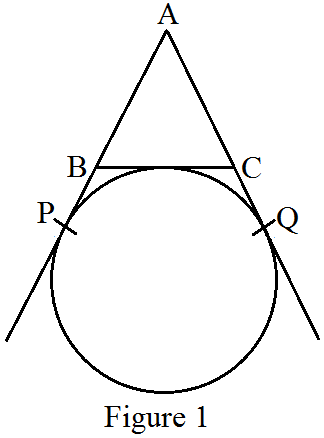
In Figure $1, AP, AQ$ and $BC$ are tangents to the circle. If $AB = 5\ cm, AC = 6\ cm$ and $BC = 4\ cm,$ then the length of $AP\ ($in $\ cm)$ is :
Answer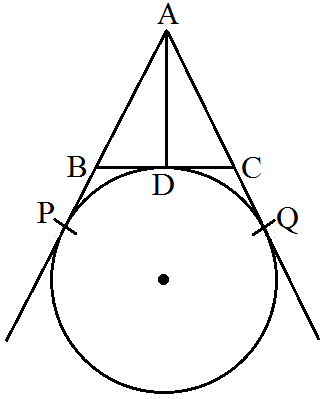
We know that tangent segments to a circle from the same external point are congruent
Therefore, we have
$AP = AQ$
$BP = BD$
$CQ = CD$
Now,
$AB + BC + AC = 5 + 4 + 6$
$\Rightarrow AB + BD + DC + AC = 15\ cm$
$\Rightarrow AB + BP + CQ + AC = 15\ cm$
$\Rightarrow AP + AQ = 15\ cm$
$\Rightarrow 2AP = 15\ cm$
$\Rightarrow AP = 7.5\ cm$ View full question & answer→MCQ 61 Mark
The perimeter $($in $\ cm)$ of a square circumscribing a circle of radius a $cm,$ is
AnswerSide of a square $= a + a = 2a \ cm$
perimeter of square $= 4 \ \times$ side
$= 4 \times 2a$
$= 8a$
View full question & answer→MCQ 71 Mark
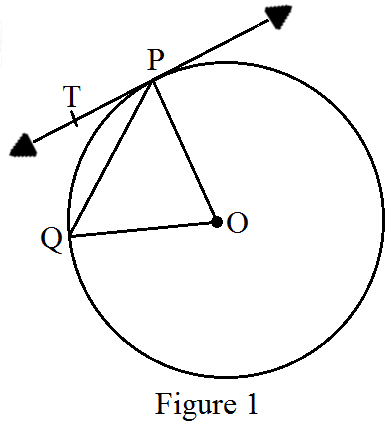
In Figure $1, O$ is the centre of a circle $,PQ$ is a chord and $PT$ is the tangent at $P$. If $\angle\text{POQ}=70^\circ,$ then $\angle\text{TPQ}$ is equal to :
- A
$55^{\circ}$
- B
$70^{\circ}$
- C
$45^{\circ}$
- ✓
$35^{\circ}$
AnswerCorrect option: D. $35^{\circ}$
We know that the radius and tangent are perpendicular at their point of contact.
Since $,OP = OQ$
$\text{POQ}$ is a isosceles right triangle
Now, in isosceles right triangle $\text{POQ},$
$\angle\text{POQ}+\angle\text{OPQ}+\angle\text{OQP}=180^\circ$
$\Rightarrow70^\circ+2\angle\text{OPQ}=180^\circ$
$\Rightarrow\angle\text{OPQ}=55^\circ$
Now, $\angle\text{TPQ}+\angle\text{OPQ}=90^\circ$
$\Rightarrow\angle\text{TPQ}=35^\circ$
View full question & answer→MCQ 81 Mark
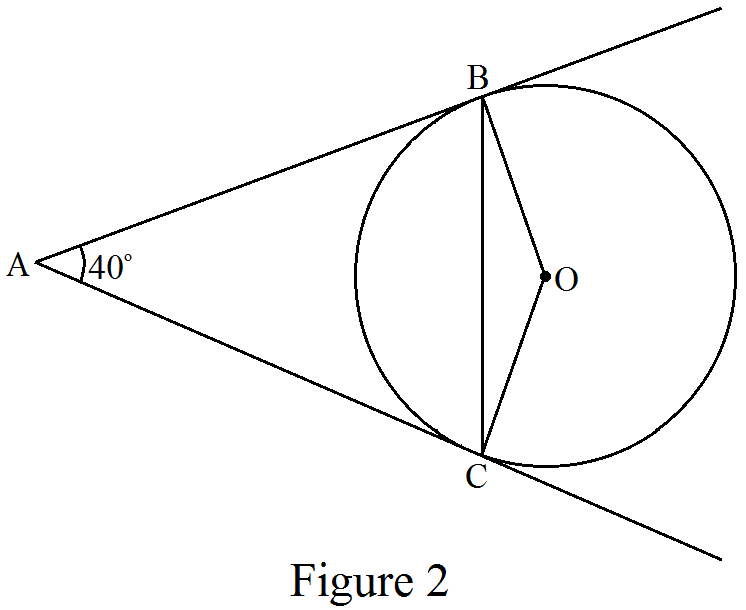
In Figure $2, AB$ and $AC$ are tangents to the circle with centre $O$ such that$\angle\text{BAC}=40^\circ.$ Then $\angle\text{BOC}$ is equal to :
- A
$40^{\circ}$
- B
$50^{\circ}$
- ✓
$140^{\circ}$
- D
$150^{\circ}$
AnswerCorrect option: C. $140^{\circ}$
$AB$ and $AC$ are tangents
$\therefore \text{ABO} = \text{ACO} = 90^\circ $
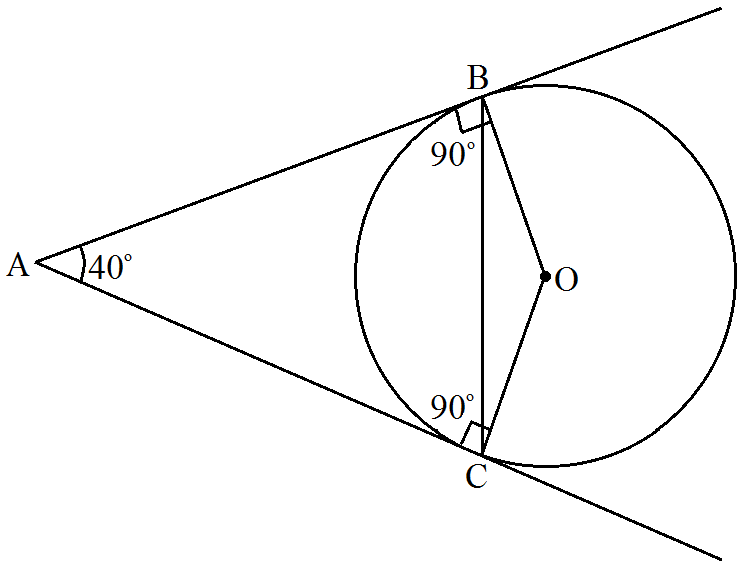
In $\text{ABOC}$
$\angle\text{ABO}+\angle\text{ACO}+\angle\text{BAC}+\angle\text{BOC}=360^\circ$
$90^\circ+90^\circ+40^\circ+\angle\text{BOC}=360^\circ$
$\angle\text{BOC}=360^\circ-220^\circ=140^\circ$ View full question & answer→MCQ 91 Mark
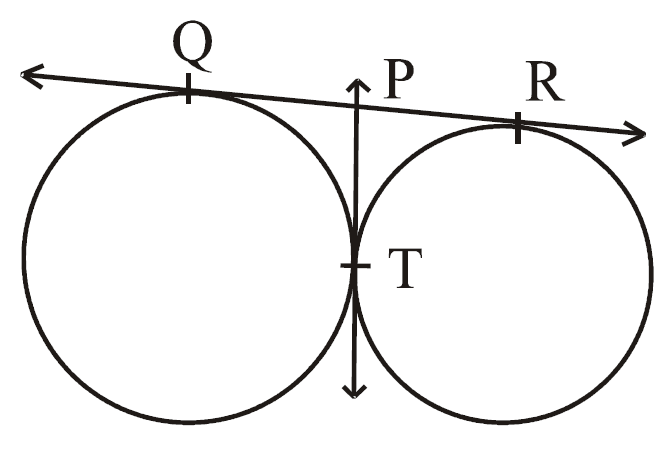
In Fig. $1, QR$ is a common tangent to the given circles, touching externally at the point $T$. The tangent at $T$ meets $QR$ at $P$. If $PT = 3.8\ cm,$ then the length of $QR\ ($in $\ cm)$ is :
Answer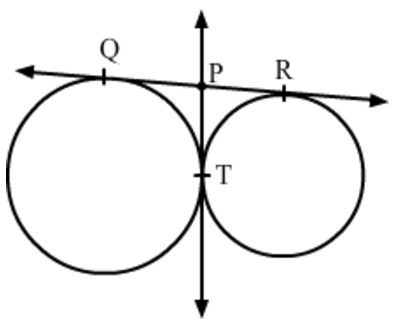
It is known that the length of the tangents drawn from an external point to a circle are equal.
$\therefore QP = PT = 3.8\ cm ....(1)$
$PR = PT = 3.8\ cm ....(2)$
From equations $(1)$ and $(2),$ we get:
$QP = PR = 3.8\ cm$
Now $, QR = QP + PR$
$= 3.8\ cm + 3.8\ cm$
$= 7.6\ cm$
Hence, the correct option is $B$. View full question & answer→MCQ 101 Mark
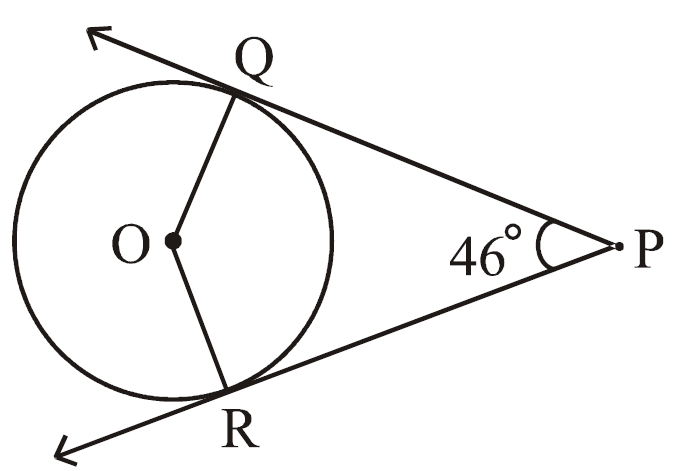
In Fig. $2, PQ$ and $PR$ are two tangents to a circle with centre $O$. If $\angle\text{QPR}=46^\circ,$ then $\angle\text{QOR}$ equals :
- A
$67^\circ$
- ✓
$134^\circ$
- C
$44^\circ$
- D
$46^\circ$
AnswerCorrect option: B. $134^\circ$
Given : $\angle\text{QPR}=46^\circ,$
$PQ$ and $PR$ are tangents.
Therefore, the radius drawn to these tangents will be perpendicular to the tangents.
So, we have $OQ \perp PQ$ and $OR \perp RP.$
$\Rightarrow\angle\text{OQP} = \angle\text{PRO} = 90^{o}$
So, in quadrilateral $\text{PQOR},$ we have
$\angle \text{OQP} + \angle \text{QPR} + \angle\text{PRO} + \angle\text{ROQ} =360^\circ$
$\Rightarrow90^\circ + 46^\circ + 90^\circ + \angle\text{ROQ}= 360^\circ$
$\Rightarrow\angle\text{ROQ} = 360^\circ -226^\circ = 134^\circ$
Hence, the correct option is $B$.
View full question & answer→MCQ 111 Mark
In Fig.$2,$ a circle with centre $O$ is inscribed in a quadrilateral $\text{ABCD}$ such that, it touches the sides $BC, AB, AD$ and $CD$ at points $P, Q, R$ and $S$ respectively, If $AB = 29\ cm, AD = 23\ cm,$ $\angle\text{B}=90^\circ$ and $DS = 5\ cm,$ then the radius of the circle $($in $\ cm.)$ is :
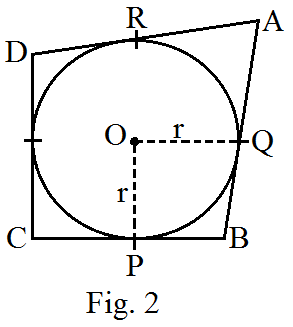
AnswerGiven that $DS = 5\ cm,$
Since $DS$ and $DR$ are tangents from the same external point to the circle, $DS = DR = 5\ cm$
Since $AD = 23\ cm, AR = AD - DR = 23 - 5 = 18\ cm.$
Similarly, $AR$ and $AQ$ are the tangents from the same external point to the circle and hence $AR = AQ = 18\ cm.$
Since $AB = 29\ cm, BQ = AB - AQ = 29 - 18 = 11\ cm.$
Since $CB$ and $AB$ are the tangents to the circle, angle $\text{OPB}$ and angle $\text{OQB}$ is equal to $900.$
Given that angle $B$ is $900$ and hence angle $\text{POQ}$ is also equal to $900$ and hence $\text{OQBP}$ is a square.
Since $BQ$ is $11\ cm,$ the side of the square $\text{OQBP}$ is $11\ cm$
From the figure it is clear that the side of the square is the radius of the circle and hence radius of the circle is $11\ cm.$
View full question & answer→MCQ 121 Mark
In fig. $1, PA$ and $PB$ are two tangents drawn from an external point $P$ to a circle with centre $C$ and radius $4\ cm$. If $\text{PA}\bot\text{PB},$ then the length of each tangent is :
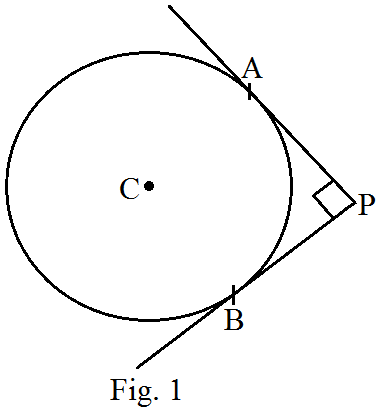
- A
$3\ cm$
- ✓
$4\ cm$
- C
$5\ cm$
- D
$6\ cm$
AnswerCorrect option: B. $4\ cm$
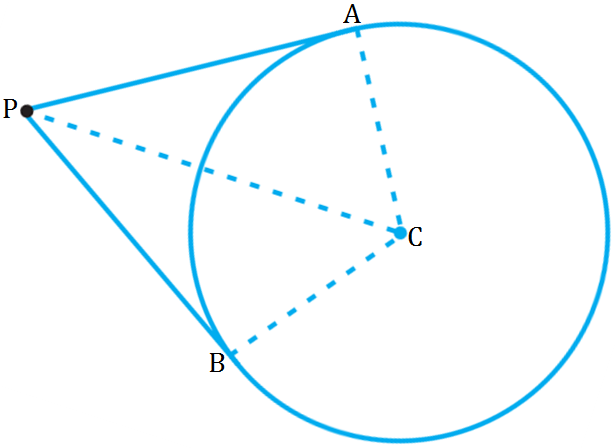
Given $PA$ and $PB$ are two tangents. $PA$ is perpendicular to $PB$. In triangles $\text{PAC}$ and $\text{PBC},$
$PA = PB \ [$tangents drawn from external point are equal in length$]$
$CP$ is common.
$CA = CB =$ radius
Therefore by $\text{SSS}$ triangles are congruent.
$\angle\text{APC}=\angle\text{BPC}=\frac{90}{2}=45^\circ$
In right angled triangle $\text{CAP},$
$\angle\text{APC}=\angle\text{ACP}=\frac{(180-90)}{2}=45$
$PA = CA = 4\ cm$
Therefore the length of the tangent is $4\ cm.$ View full question & answer→MCQ 131 Mark
In Fig. $1,$ the sides $AB, BC$ and $CA$ of a triangle $\text{ABC},$ touch a circle at $P, Q$ and $R$ respectively. If $PA = 4\ cm, BP = 3\ cm$ and $AC = 11\ cm,$ then the length of $BC\ ($in $\ cm)$ is :
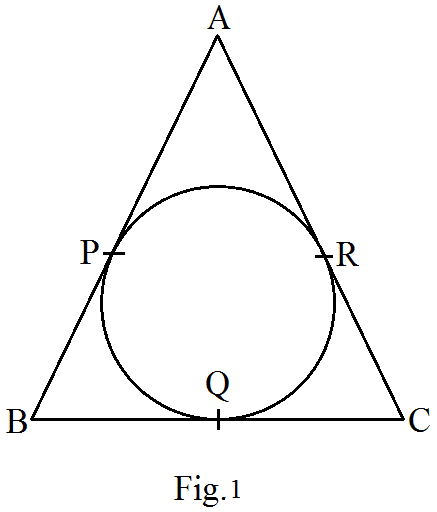
AnswerTriangle $\text{ABC},$ we have
$BP= BQ = 3\ cm$
$AP= AR = 4\ cm$
$($Tangents drawn from an external point to the circle are equal.$)$
So, $RC = AC - AR$
$= 11 - 4 = 7\ cm$
Hence $RC = CQ = 7 \ cm$
Then $,BC = BQ + QC$
$7 + 3 = 10\ cm$
View full question & answer→MCQ 141 Mark
In Fig $2,$ a circle touches the side $DF$ of $\angle\text{EDF}$ at hand touches $ED$ and $EF$ produced at $K$ and $M$ respectively. If $EK = 9\ cm,$ then the perimeter of $\triangle\text{EDF}\ ($in $\ cm)$ is :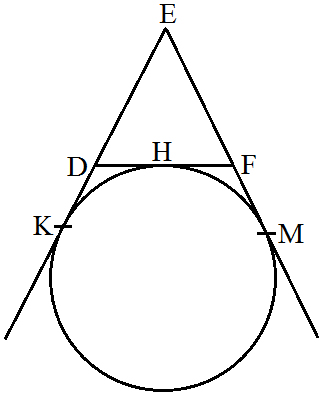
AnswerWe know that tangent segments to a circle from the same external point are congruent.
Therefore, we have $EK = EM = 9\ cm$
Now, $EK + EM = 18\ cm$
$\Rightarrow ED + DK + EF + FM = 18\ cm$
$\Rightarrow ED + DH + EF + HF = 18\ cm$
$\Rightarrow ED + DF + EF = 18\ cm$
$\Rightarrow$ Perimeter of $\triangle\text{EDF}=18\text{ cm}$
View full question & answer→MCQ 151 Mark
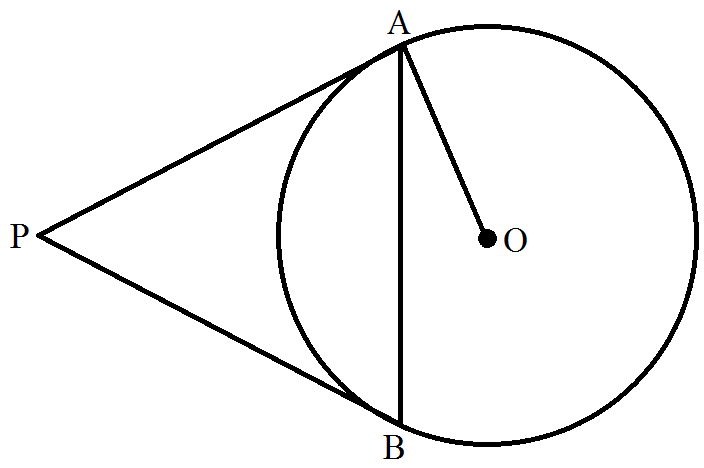
In Fig. $2, PA$ and $PB$ are tangents to the circle with centre $O$. If $\angle\text{APB}=60^\circ$ then $\angle\text{OAB}$ is :
- ✓
$30^\circ$
- B
$60^\circ$
- C
$90^\circ$
- D
$15^\circ$
AnswerCorrect option: A. $30^\circ$
Construction : Join $OB.$
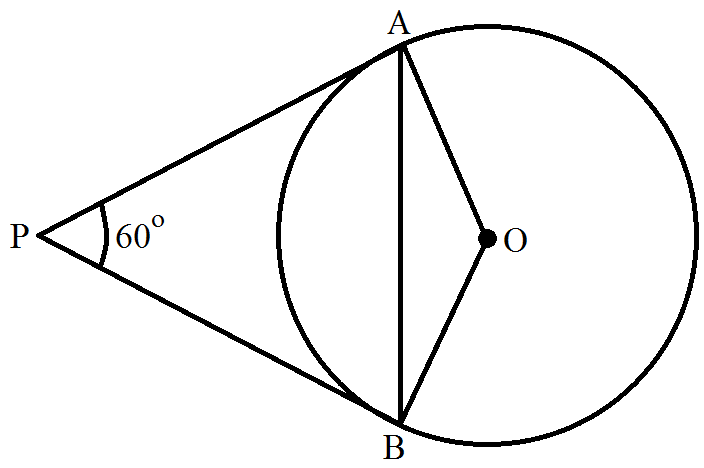
We know that the radius and tangent are perpendicular at their point of contact
$\because\ \angle\text{OBP}=\angle\text{OAP}=90^\circ$
Now, in quadrilateral $\text{AOBP}$
$\angle\text{AOB}+\angle\text{OBP}+\angle\text{APB}+\angle\text{OAP}=360^\circ$
$\Rightarrow\angle\text{AOB}+90^\circ+60^\circ+90^\circ=360^\circ$
$\Rightarrow240^\circ+\angle\text{AOB}=360^\circ$
$\Rightarrow\angle\text{AOB}=120^\circ$
Now, in isosceles triangle $\text{AOB}$
$\angle\text{AOB}+\angle\text{OAB}+\angle\text{OBA}=180^\circ$
$\Rightarrow120^\circ+2\angle\text{OAB}=180^\circ$
$\Rightarrow\angle\text{OAB}=30^\circ$ View full question & answer→MCQ 161 Mark
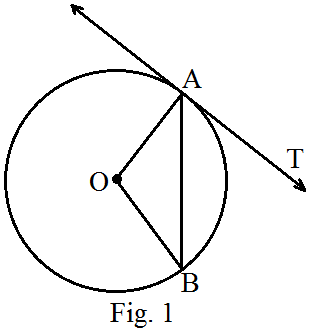
In Fig. $1, O$ is the centre of a circle, $AB$ is a chord and $AT$ is the tangent at. If $\angle\text{AOB}=100^\circ$ then $\angle\text{BAT}$ is equal to :
- A
$100^\circ$
- B
$40^\circ$
- ✓
$50^\circ$
- D
$90^\circ$
AnswerCorrect option: C. $50^\circ$
In $\angle\text{OAB},$
$OA = OB \ ($radii$)$
$\Rightarrow\angle\text{OAB}=\angle\text{OBA}$
But, $\angle\text{OBA}+\angle\text{OBA}+\angle\text{AOB}=180^\circ$
$\angle\text{AOB}=180^\circ-100^\circ$
$\angle\text{OAB}=40^\circ$
$\angle\text{OAB}+\angle\text{BAT}=90^\circ \ ($Radius is perpendicular to tangent$)$
$40^\circ+\angle\text{BAT}=90^\circ$
$\angle\text{BAT}=50^\circ$
View full question & answer→MCQ 171 Mark
In Figure, from an external point $P,$ two tangents $PQ$ and $PR$ are drawn to a circle of radius $4\ cm$ with centre $O$. If $\angle\text{QPR} = 90^\circ,$ then length of $PQ$ is :
- A
$3\text{ cm}$
- ✓
$4\text{ cm}$
- C
$2\text{ cm}$
- D
$2\sqrt{2}\text{ cm}$
AnswerCorrect option: B. $4\text{ cm}$
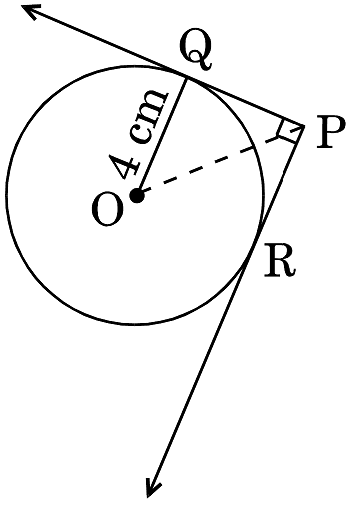
Tangents make $90^\circ$ at the point of intersection.
Thus $\text{PQO}$ and $\text{PRO}$ are $90^\circ$
$\text{QPR}$ is given $90^\circ$
Therefore,
$\text{QOR = 360 $-$ (PQR + PRO + QPR)}$
$= 360 - (90 + 90 + 90)$
$= 90$
Thus $,\text{PQOR}$ is a square.
with each side equal to $4\ cm \ ($radius of circle $- QO)$ View full question & answer→MCQ 181 Mark
In Figure, $PQ$ is tangent to the circle with centre at $O,$ at the point $B$. If $\angle\text{AOB} = 100^\circ,$ then $\angle\text{ABP}$ is equal to :
- ✓
$50^\circ$
- B
$40^\circ$
- C
$60^\circ$
- D
$80^\circ$
AnswerCorrect option: A. $50^\circ$
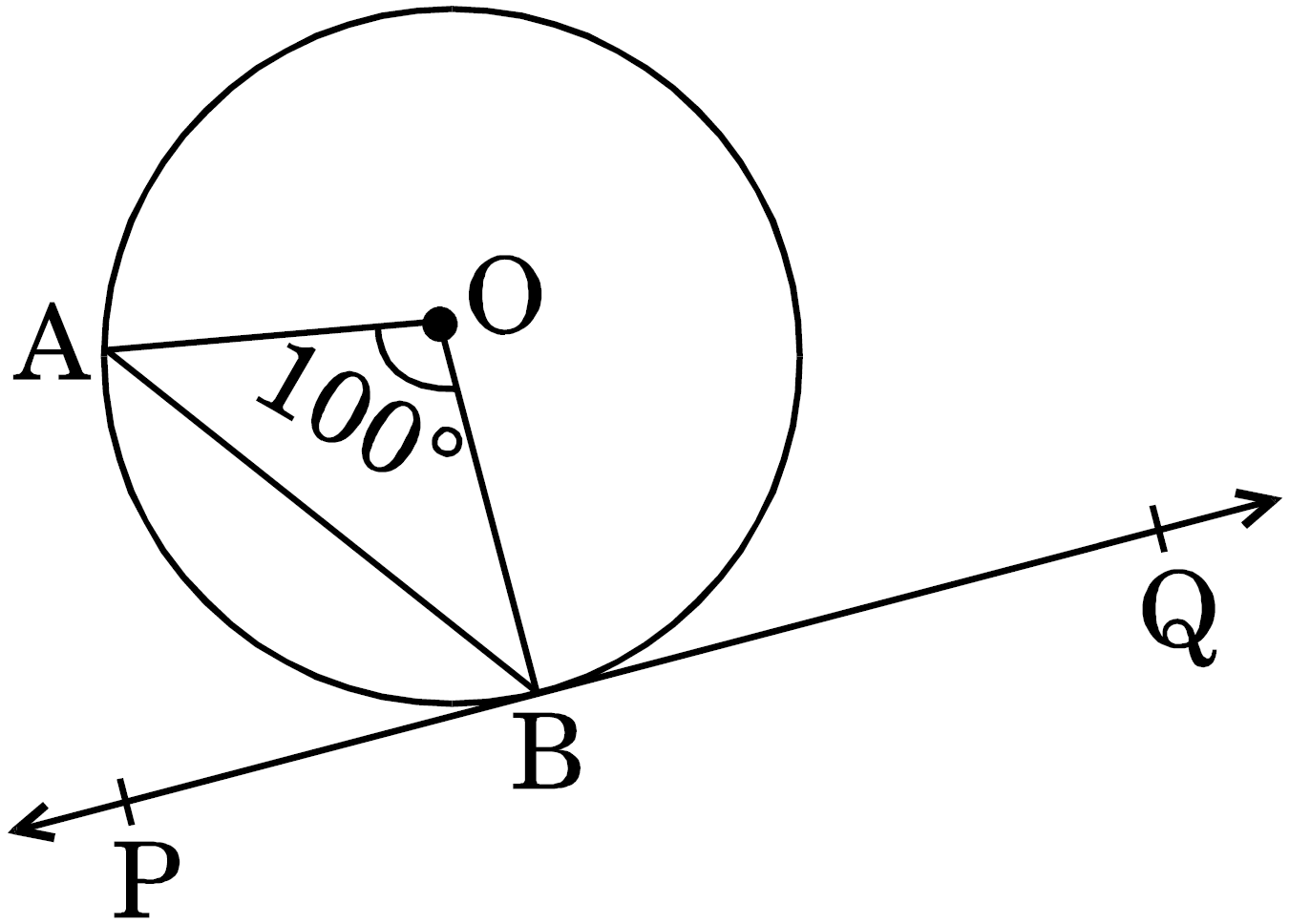
Circle,
$\text{OA = OB} \ ($radius of circle isosceles triangle$)$
$\triangle\text{OAB}$
$\angle\text{OAB}=\angle\text{OBA}$
$PQ$ is a tangent touches circle at $b$
$\text{OB}\bot\text{PQ}$
$\angle\text{OBP}=90^\circ$
$\angle\text{OBP}=\angle\text{OBA}+\angle\text{ABP}\ \dots(1)$
$\triangle\text{OAB}$
$\text{DA = OB}$
$\angle\text{OAB}=\angle\text{OBA}=\text{x}\ ($let's say$)$
Angle sum proportional,
$100+\text{x}+\text{x}=180^\circ$
$100+2\text{x}=180^\circ$
$\text{x}=\frac{80}{2} = 40$
Put the value in eq. $1^{st}$
$9 = 40 + \angle\text{ABP}$
$\angle\text{ABP} = 50^{\circ}$ View full question & answer→MCQ 191 Mark
The value of $\theta$ for which $\cos(10^\circ+\theta)=\sin30^\circ,$ is :
- ✓
$50^\circ$
- B
$40^\circ$
- C
$80^\circ$
- D
$20^\circ$
AnswerCorrect option: A. $50^\circ$
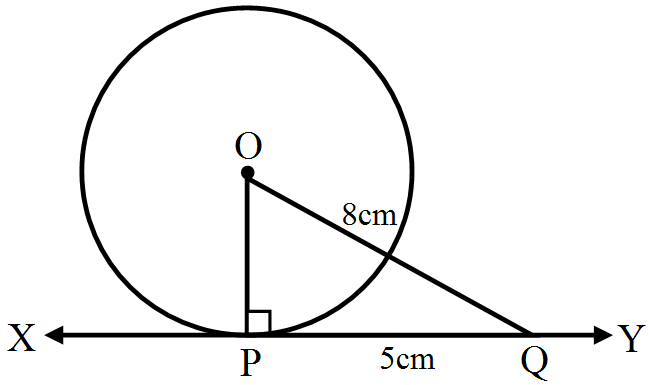
To find the value of $\theta$ in $\cos(10^\circ+\theta)=\sin30^\circ$
Now as we know
$\sin\theta=\cos(90^\circ-\theta)$
therefore; we have,
$\cos(10^\circ+\theta)=\sin30^\circ$
$\Rightarrow\cos(10^\circ+\theta)=\cos(90^\circ-30^\circ)\ \dots(1)$
Now if $\sin\text{A}=\sin\text{B}$ then $A = B$
$10+\theta=90^\circ-30^\circ$
$\Rightarrow10+\theta=60^\circ$
$\Rightarrow\theta=60^\circ-10$
$\Rightarrow\theta=50^\circ$
Hence the value of $\theta$ is $50^\circ$ View full question & answer→MCQ 201 Mark
In the given figure $,QR$ is a common tangent to the given circles touching externally at the point $T$. The tangent at $T$ meets $QR$ at $P$. If $PT = 3.8\ cm,$ then the length of $QR\ ($in $\ cm)$ is :
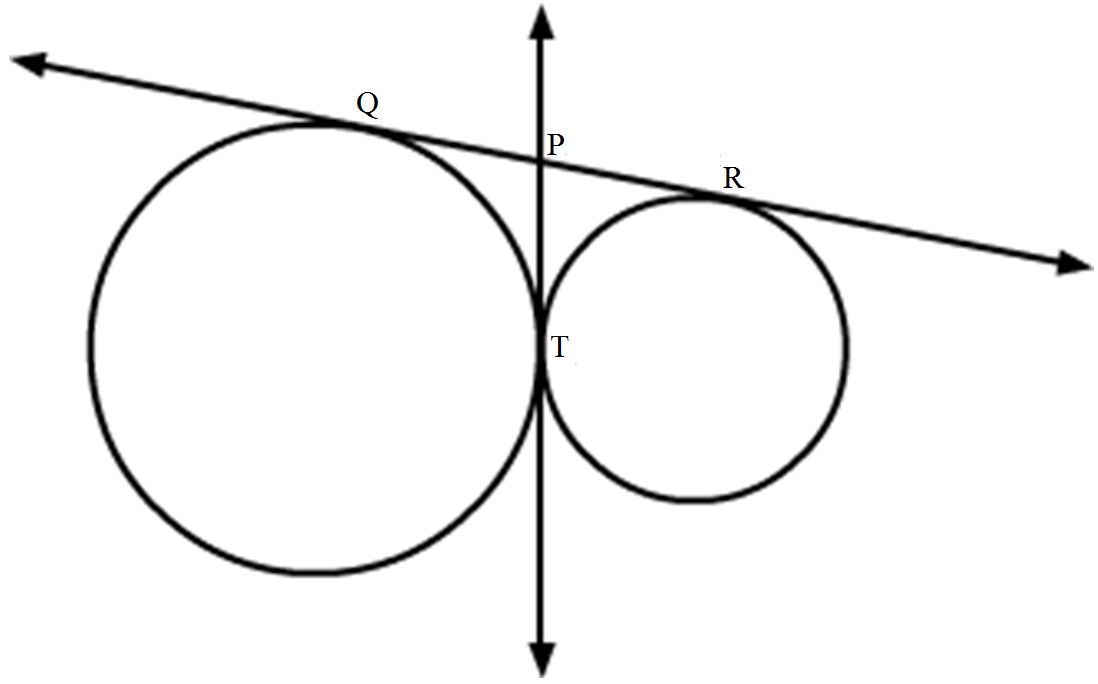
AnswerIt is given that $QR$ is a common tangent to the given circles touching externally at the point $T$.
Also, the tangent at $T$ meets $QR$ at $P$ such that $PT = 3.8\ cm.$
Now, $PQ$ and $PT$ are tangents drawn to the same circle from an external point.
$\therefore PQ = PT = 3.8\ cm\ ($Lengths of tangents drawn from an external point to a circle are equal$)$
$PR$ and $PT$ are tangents drawn to the same circle from an external point $T$.
$\therefore PR = PT = 3.8\ cm \ ($Lengths of tangents drawn from an external point to a circle are equal$)$
Now,
$QR = PQ + PR $
$= 3.8\ cm + 3.8\ cm = 7.6\ cm$
Thus, the length of $QR$ is $7.6\ cm.$
View full question & answer→MCQ 211 Mark
In the figure, a quadrilateral $\text{ABCD}$ is drawn to circumscribe a circle such that its sides $AB, BC, CD$ and $AD$ touch the circle at $P, Q, R$ and $S$ respectively. If $AB = x \ cm, BC= 7\ cm, CR = 3\ cm$ and $AS = 5\ cm,$ then $x =$
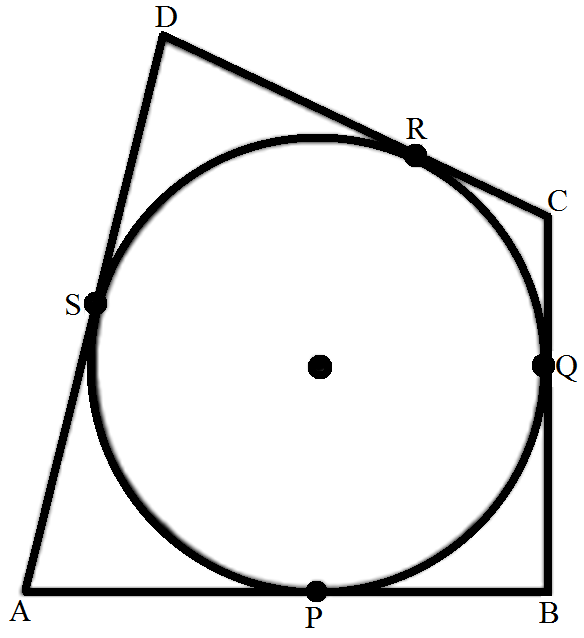
AnswerIn the given figure,
$\text{ABCD}$ is a quadrilateral circumscribe a circle and its sides $AB, BC, CD$ and $DA$ touch the circle at $P, Q, R$ and $S$ respectively.
$AB = x \ cm, BC = 7\ cm, CR = 3\ cm, AS = 5\ cm$
$CR$ and $CQ$ are tangents to the circle from $C$
$CR = CQ = 3\ cm$
$BQ = BC – CQ = 7 – 3 = 4\ cm$
$BQ =$ and $BP$ are tangents from $B$
$BP = BQ = 4\ cm$
$AS$ and $AP$ are tangents from $A$
$AP = AS = 5\ cm$
$AB = AP + BP $
$= 5 + 4 = 9\ cm$
$x = 9\ cm$
View full question & answer→MCQ 221 Mark
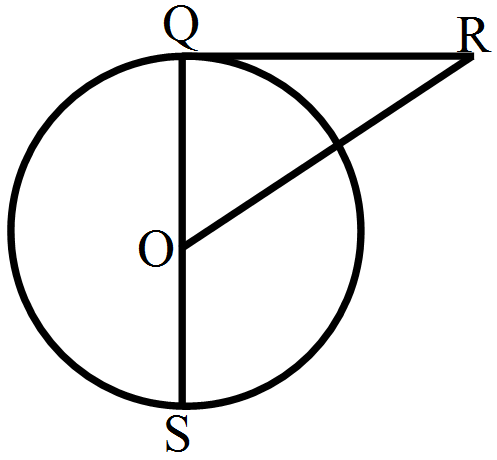
In the given figure $,RQ$ is a tangent to the circle with centre $O$. If $SQ = 6\ cm$ and $QR = 4\ cm,$ then $OR$ is equal to :
- A
$2.5\ cm$
- B
$3\ cm$
- ✓
$5\ cm$
- D
$8\ cm$
AnswerCorrect option: C. $5\ cm$
$SQ = 6\ cm $
$\Rightarrow OQ = 3\ cm$
$QR = 4\ cm$
Since $RQ$ is a tangent to the circle at $Q$.
$\angle\text{RQO}=90^\circ ....($tangent is perpendicular to the radius of a circle$)$
In $\triangle\text{RQO},$
By using Pythagoras theorem,
$O R^2=R Q^2+O Q^2 $
$ =4^2+3^2 $
$ =16+9 $
$ =25 $
$ \therefore O R^2=25 $
$\Rightarrow OR = 5\ cm$
View full question & answer→MCQ 231 Mark
Choose the correct option and give justification. If tangents PA and PB from a point P to a circle with centre O are inclined to each other at angle of 80°, then $\angle$POA is equal to:
Answera. 50°
$\because\angle$OAP = 90°
[The tangent at any point of a circle is $\perp$ to the radius through the point of contact]
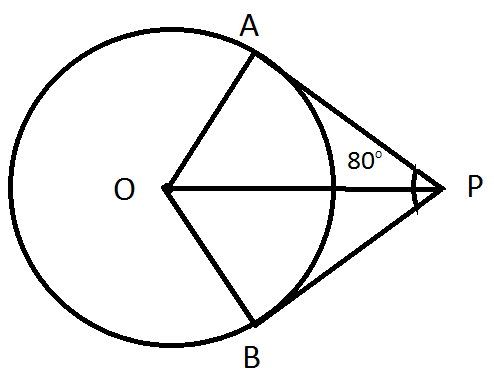
$\angle$OPA = $\frac{1}{2}\angle$BPA = $\frac{1}{2}\times$ 80° = 40°
[Centre lies on the bisector of the angle between the two tangents]
In $\triangle$OPA,
$\angle$OAP + $\angle$OPA + $\angle$POA = 180°
[Angle sum property of a triangle]
$\Rightarrow$ 90° + 40° + $\angle$POA = 180°
$\Rightarrow$ 130° + $\angle$POA = 180°
$\Rightarrow$ $\angle$POA = 50° View full question & answer→MCQ 241 Mark
Each question consists of two statements, namely, Assertion $(A)$ and Reason $(R)$. for selecting the correct answer, use the following code:
|
Assertion $(A)$
|
Reason $(R)$
|
|
At a point $P$ of a circle with centre $O$ and radius $12\ cm,$ a tangent $PQ$ of length $16\ cm$ is drawn. Then, the point of contact. $OQ = 20\ cm.$
|
The tangent at any point of a circle is perpendicular to the radius through the point of contact.
|
- ✓
Both Assertion $(A)$ and Reason $(R)$ are true and Reason $(R)$ is a correct explanation of Assertion $(A)$.
- B
Both Assertion $(A)$ and Reason $(R)$ are true but Reason $(R)$ is not a correct explanation of Assertion $(A).$
- C
Assertion $(A)$ is true and Reason $(R)$ is false.
- D
Assertion $(A)$ is false and Reason $(R)$ is true.
AnswerCorrect option: A. Both Assertion $(A)$ and Reason $(R)$ are true and Reason $(R)$ is a correct explanation of Assertion $(A)$.
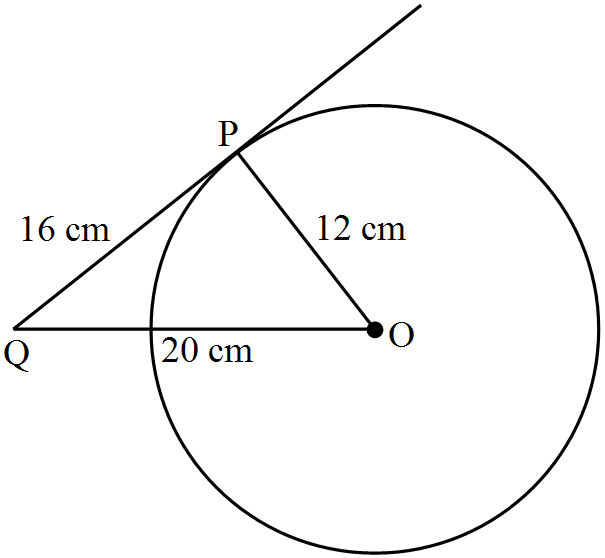
We know that the tangent is perpendicular to the radius of a circle.
In $\triangle\text{OPQ},$
By Pythagoras theorem,
$ \mathrm{OQ}^2=\mathrm{QP}^2+\mathrm{OP}^2 $
$ \Rightarrow \mathrm{OP}^2=16^2+12^2 $
$ \Rightarrow O P^2=256+144 $
$ \Rightarrow O P^2=400 $
$\Rightarrow OP = 20\ cm$
So, the Assertion $(A)$ is true.
The Reason $(R)$ is true and is the correct explanation for the Assertion $(A).$ View full question & answer→MCQ 251 Mark
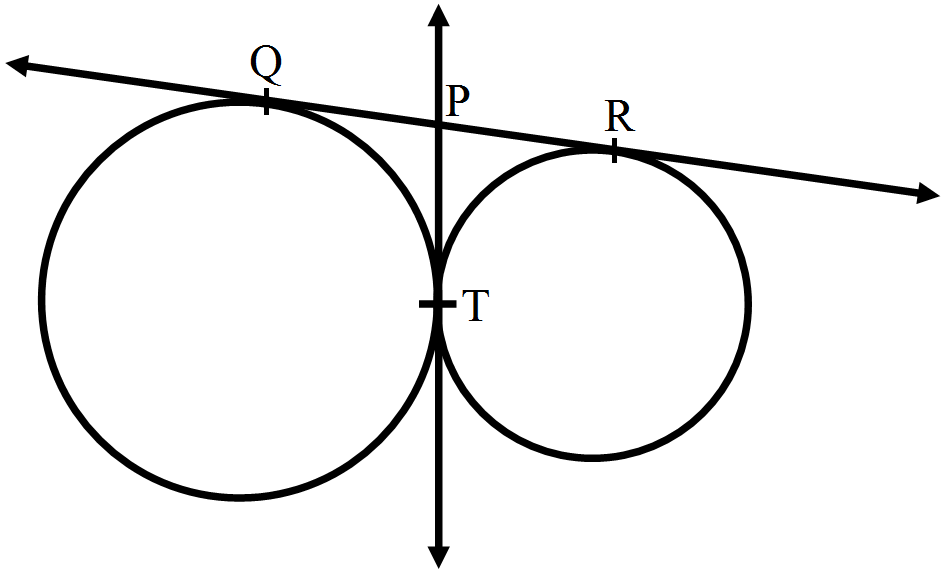
In the given figure, $QR$ is a common tangent to the given circle, touching externally at the point $T$. The tangent at $T$ meets $QR$ at $P$. If $PT = 3.8\ cm$ then the length of $QR$ is :
- A
$1.9\ cm$
- B
$3.8\ cm$
- C
$5.7\ cm$
- ✓
$7.6\ cm$
AnswerCorrect option: D. $7.6\ cm$
We know that tangent from an external point to the circle are equal.
$PQ = PT = 3.8\ cm$
$PR = PT = 3.8\ cm$
$QR = PQ + PR$
$= 3.8 +3.8$
$=7.6\ cm$
View full question & answer→MCQ 261 Mark
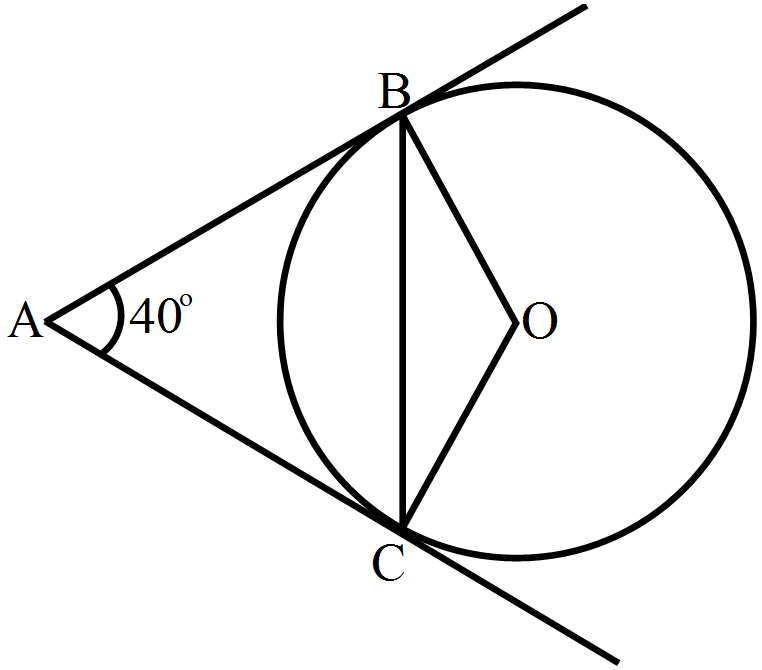
In the given figure, $AB$ and $AC$ are tangent to the circle with centre $O$ such that $\angle\text{BAC}=40^\circ.$ Then, $\angle\text{BOC}$ is equal to :
- A
$80^\circ$
- B
$100^\circ$
- C
$120^\circ$
- ✓
$140^\circ$
AnswerCorrect option: D. $140^\circ$
Since $AB$ and $AC$ are the tangent to the circle.
$\angle\text{OBA}=\angle\text{BAC}=90^\circ....($tangent is perpendicular to the radius of a circle$)$
In $\text{ABOC}$
$\angle\text{OBA}+\angle\text{BAC}+\angle\text{OCA}+\angle\text{BOC}=360^\circ$
$\Rightarrow90^\circ+40^\circ+90^\circ+\angle\text{BOC}=360^\circ$
$\Rightarrow\angle\text{BOC}=140^\circ$
View full question & answer→MCQ 271 Mark
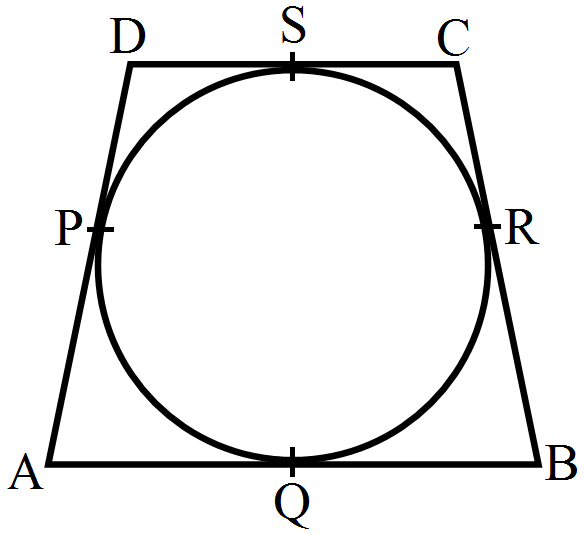
In the given figure, quadrilateral $\text{ABCD}$ is circumscribed, touching the circle at $P, Q, R$ and $S$. If $AP = 5\ cm, BC = 7\ cm$ and $CS = 3\ cm, AB =?$
- ✓
$9\ cm$
- B
$10\ cm$
- C
$12\ cm$
- D
$8\ cm$
AnswerCorrect option: A. $9\ cm$
We know that tangent from an external point to the circle are equal.
$AP = AQ = 5\ cm$
$CS = CR = 3\ cm$
$RB = BC - CR$
$= 7 +3$
$=4\ cm$
So $,BQ = RB = 4\ cm$
Thus $, AB = AQ + RB$
$ = 5 + 4 = 9\ cm$
View full question & answer→MCQ 281 Mark
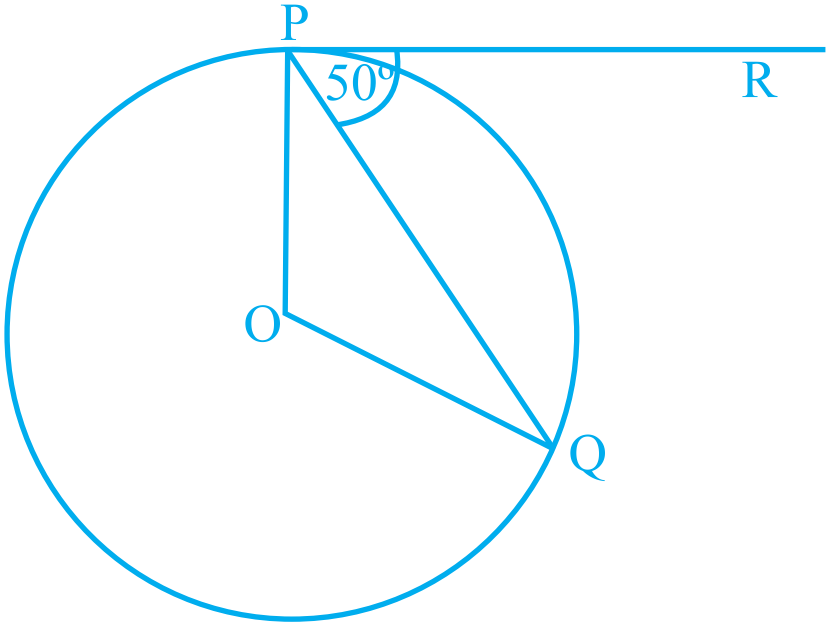
In Figure, if $O$ is the centre of a circle $,PQ$ is a chord and the tangent $PR$ at $P$ makes an angle of $50^\circ$ with $PQ,$ then $\angle\text{POQ}$ is equal to :
- ✓
$100^\circ$
- B
$80^\circ$
- C
$90^\circ$
- D
$75^\circ$
AnswerCorrect option: A. $100^\circ$
Given, $\angle\text{QPR}=50^\circ$
We know that, the tangent at any point of a circle is perpendicular to the radius through the point of contact.
$\therefore\ \angle\text{OPR}=90^\circ$
$\Rightarrow\ \angle\text{OPQ}+\angle\text{QPR}=90^\circ\ \ [$from figure$]$
$\Rightarrow\ \angle\text{OPQ}=90^\circ-50^\circ=40^\circ\ \ [\because\angle\text{QPR}=50^\circ]$
Now $,OP = OQ =$ Radius of circle
$\therefore\ \angle\text{OQP}=\angle\text{OPQ}=40^\circ$
$[$since, angles opposite to equal sides are equal$]$
In $\triangle\text{OPQ},\ \ \angle\text{O}+\angle\text{P}+\angle\text{Q}=180^\circ$
$[$since, sum of angles of a triangle $= 180^\circ ]$
$\Rightarrow\ \angle\text{O}=180^\circ-(40^\circ+40^\circ)\ \ [\because\angle\text{P}=40^\circ=\angle\text{Q}]$
$= 180^\circ - 80^\circ = 100^\circ$
View full question & answer→MCQ 291 Mark
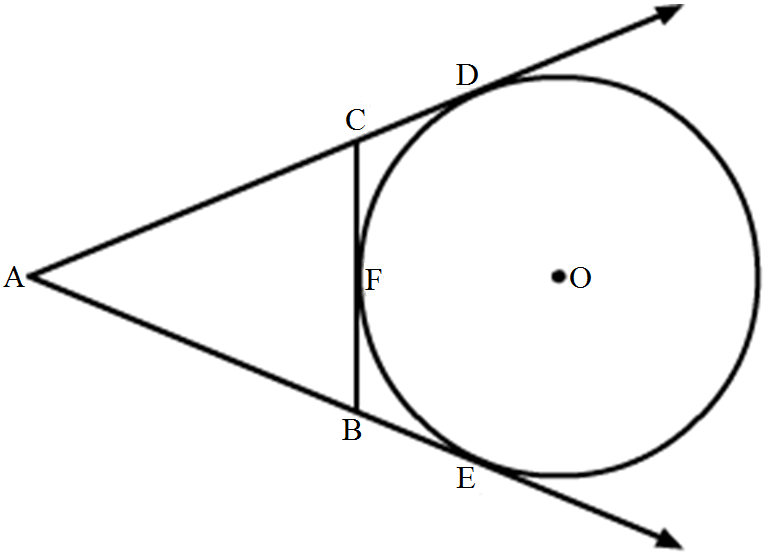
In the given figure, if $AD, AE$ and $BC$ are tangents to the circle at $D, E$ and $F$ respectively, Then :
- A
$AD = AB + BC + CA$
- ✓
$2AD = AB + BC + CA$
- C
$3AD = AB + BC + CA$
- D
$4AD = AB + BC + CA$
AnswerCorrect option: B. $2AD = AB + BC + CA$
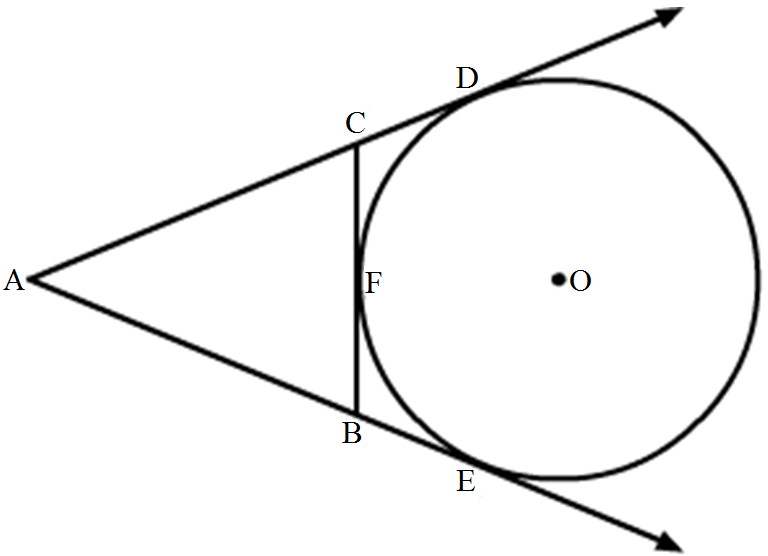
By the property of tangent
$AC = AB \ ($tangent from $A)...(i)$
$CD = CF \ ($tangent from $C)...(ii)$
$BF = BE \ ($tangent from $B)...(iii)$
Now taking $\text{RHS},$
$AB + BC + CA = AB + BF + FC + CA$
$AB + BC + CA = AB + BE + CD + CA \ [$from $(ii) $ and $ (iii) ]$
$AB + BC + CA = AE + AD$
$AB + BC + CA = 2AD$ View full question & answer→MCQ 301 Mark
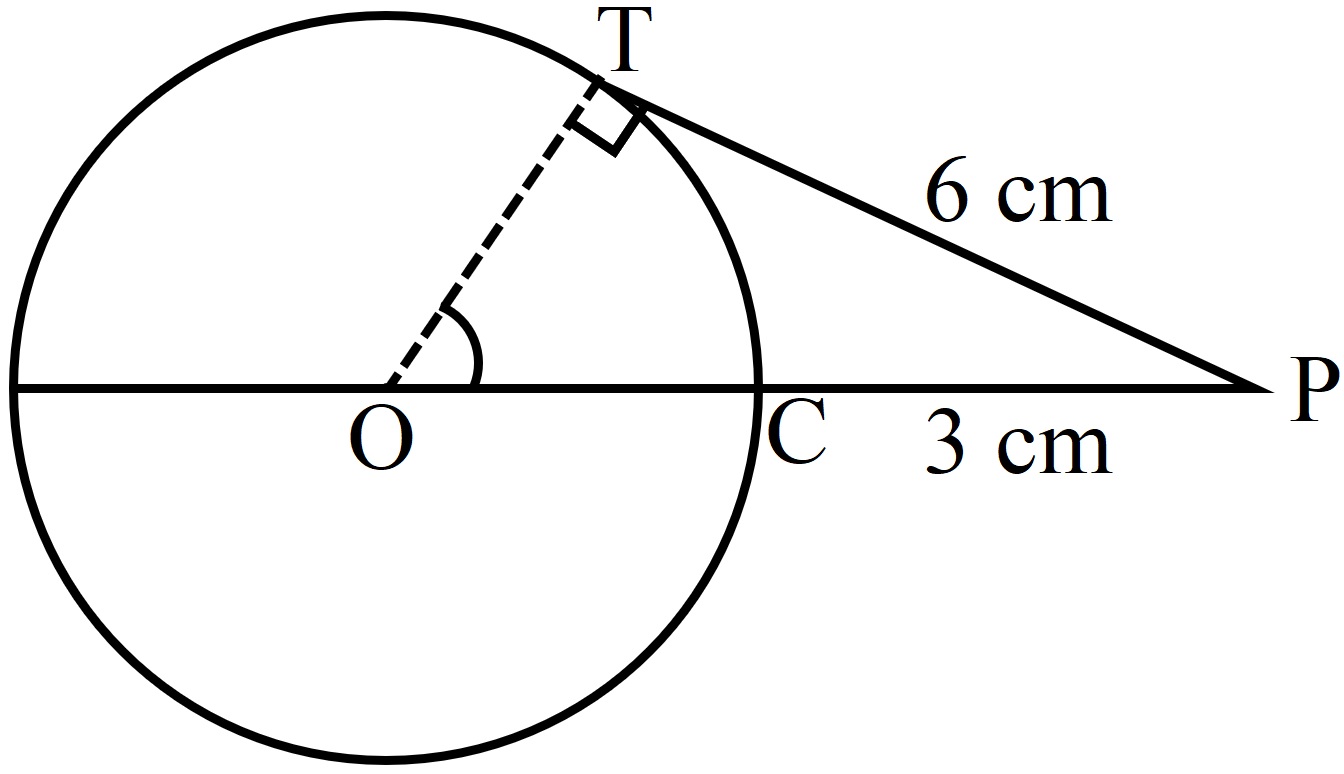
In the given figure $,O$ is the centre of the circle and $PT$ is a tangent at $T$. If $PC = 3\ cm$ and $PT = 6\ cm,$ then the radius of the circle is equal to :
- A
$6\ cm$
- B
$5\ cm$
- C
$7\ cm$
- ✓
$4.5\ cm$
AnswerCorrect option: D. $4.5\ cm$
In right angled triangle $\text{OTP},$
Let the radius of the circle be $r \ cm,$ then $OT = OC = r$
$OP^2= OT^2+ PT^2$
$\Rightarrow (r + 3)^2= r^2+ 6^2$
$\Rightarrow r^2+ 6r + 9 = r^2+ 36$
$\Rightarrow 6r = 27$
$ \Rightarrow r = 4.5\ cm$
View full question & answer→MCQ 311 Mark
The length of the tangent from a point $A$ at a circle, of radius $3 \ cm,$ is $4 \ cm$. The distance of $A$ from the centre of the circle is :
- A
$\sqrt{7}\text{ cm}$
- B
$7\ cm$
- ✓
$5\ cm$
- D
$25\ cm$
AnswerCorrect option: C. $5\ cm$
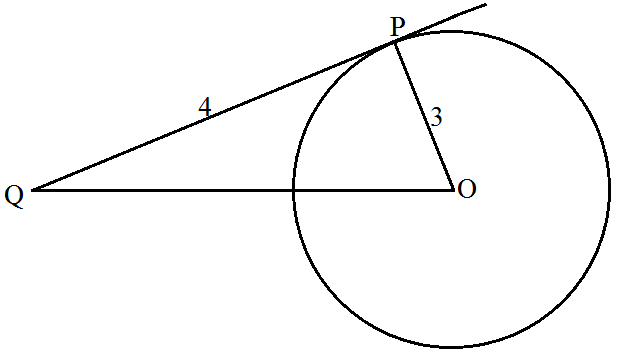
We know, radius always perpendicular to tangent so we say $\triangle\text{OPA}$ is right angle triangle then $\angle\text{OPA}=90^{\circ}$
Now, we have to find $OA$
$ \Rightarrow O A^2=A P^2+O P^2 $
$ \Rightarrow O A^2=4^2+3^2 $
$ \Rightarrow O A^2=16+9 $
$\Rightarrow OA = \sqrt{25}$
$\Rightarrow OA = 5$
Hence, correct choice is $(c)$ View full question & answer→MCQ 321 Mark
If $PT$ is tahgent drawn froth a point $P$ to a circle touching it at $T$ and $O$ is the centre of the circle, then $\angle OPT + \angle POT =$
- A
$30^\circ$
- B
$60^\circ$
- ✓
$90^\circ$
- D
$180^\circ$
AnswerCorrect option: C. $90^\circ$
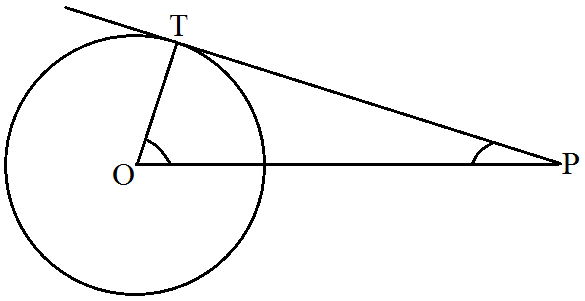
In the figure, $PT$ is the tangent to the circle with centre $O$.
$OP$ and $OT$ are joined
$PT$ is tangent and $OT$ is the radius
$OT \perp PT$
Now in right $\triangle\text{OTP}$
$\angle\text{OTP}=90^{\circ}$
$\angle\text{OPT}+\angle\text{POT}$
$=180^{\circ}-90^{\circ}=90^{\circ}$ View full question & answer→MCQ 331 Mark
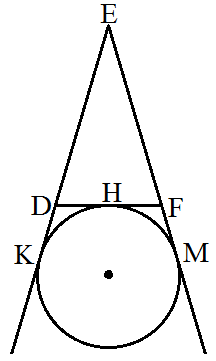
In the figure, a circle touches the side $DF$ of $\triangle\text{EDF}$ at $H$ and touches $ED$ and $EF$ produced at $K$ and $M$ respectively. If $EK = 9\ cm,$ then the perimeter $\triangle\text{EDF}$ of is :
- ✓
$18\ cm$
- B
$13.5\ cm$
- C
$12\ cm$
- D
$9\ cm$
AnswerCorrect option: A. $18\ cm$
In $\triangle\text{DEF}\ \ DF$ touches the circle at $H$ and circle touches $ED$ and $EF$ Produced at $K$ and $M$ respectively.
$EK = 9\ cm$
$EK$ and $EM$ are the tangents to the circle.
$EM = EK = 9\ cm$
Similarly $DH$ and $DK$ are the tangent.
$DH = DK$ and $FH$ and $FM$ are tangents.
$FH = FM$
Now, perimeter of $\triangle\text{DEF}$
$= ED + DF + EF$
$= ED + DH + FH + EF$
$= ED + DK + EM + EF$
$= EK + EM$
$= 9 + 9$
$= 18\ cm.$
View full question & answer→MCQ 341 Mark
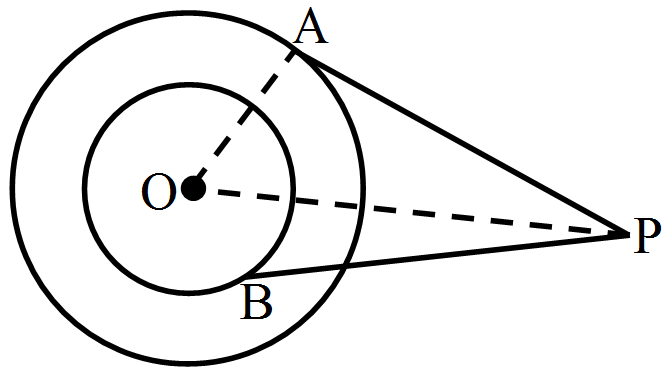
In the given figure, $O$ is the centre of two concentric circles of radii $5\ cm$ and $3\ cm$. From an external point $P$ tangents $PA$ and $PB$ are drawn to these circles. If $PA = 12\ cm$ then $PB$ is equal to :
- A
$5\sqrt{2}\text{ cm}$
- B
$3\sqrt{5}\text{ cm}$
- ✓
$4\sqrt{10}\text{ cm}$
- D
$5\sqrt{10}\text{ cm}$
AnswerCorrect option: C. $4\sqrt{10}\text{ cm}$
Construction : Join $OB.$
We know that tangent is perpendicular to the radius of a circle.
In $\triangle\text{OPA},$
By Pythagoras theorem,
$OP^2= OA^2+ AP^2$
$\Rightarrow OP^2= 5^2+ 12^2$
$\Rightarrow OP^2= 169$
$\Rightarrow OP = 13\ cm$
In $\triangle\text{OPB},$
By Pythagoras theorem,
$OP^2= OB^2+ PB^2$
$\Rightarrow PB^2= OP^2- OB^2$
$\Rightarrow PB^2= 13^2- 3^2$
$\Rightarrow PB^2= 160$
$\Rightarrow \text{PB} =4\sqrt{10}\text{ cm} $
View full question & answer→MCQ 351 Mark
In the given figure, there are two concentric circles with centre $O. PR$ and $\text{PQS}$ are tangents to the inner circle from point plying on the outer circle. If $PR = 7.5\ cm,$ then $PS$ is equal to :
- A
$10\ cm$
- B
$12\ cm$
- ✓
$15\ cm$
- D
$18\ cm$
AnswerCorrect option: C. $15\ cm$
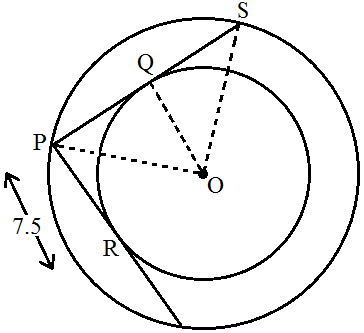
Here$, PO = OS\ ($radius$)$
then $\triangle\text{POS}$ called isosceles triangle.
We know, In isosceles triangle line drawn from vertex to base, then line bisects the base in equal parts.
so we say,
$PQ = QS ...(i)$
From the property of tangent
$PR = PQ = 7.5\ cm\ [$tangent from point $P] ...(ii)$
Now we have to find $PS,$
$PS = PQ + QS$
$\Rightarrow PS = PQ + PQ \ [$from eq $.(i)]$
$\Rightarrow PS = 7.5 + 7.5\ [$fromeq $.(ii)]$
$\Rightarrow PS =15\ cm$ View full question & answer→MCQ 361 Mark
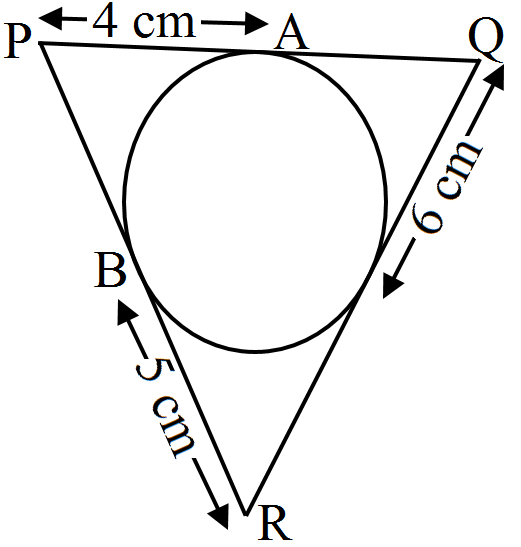
The perimeter of $\triangle\text{PQR}$ in the given figure is :
- A
$15\ cm$
- B
$60\ cm$
- C
$45\ cm$
- ✓
$30\ cm$
AnswerCorrect option: D. $30\ cm$
Since Tangents from an external point to a circle are equal.
$\therefore\text{PA}=\text{PB}=4\text{ cm,}$
$\text{BR} = \text{CR} = 5\text{ cm}$
$\text{CQ} = \text{AQ }= 6 \text{ cm}$
Perimeter of $ \angle\text{PQR} = \text{PQ} + \text{QR} + \text{RP}$
$= PA + AQ + QC + CR + BR + PB$
$= 4 + 6 + 6 + 5 + 5 + 4 = 30\ cm$
View full question & answer→MCQ 371 Mark
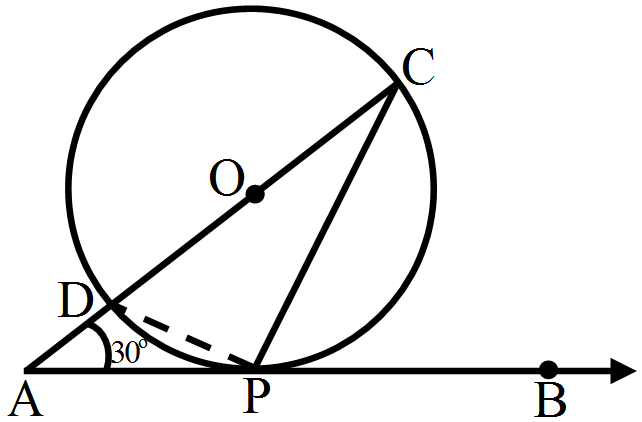
In the given figure $,O$ is the centre of the circle. $AB$ is the tangent to the circle at the point $P$. If $\angle\text{PAO} = 30^\circ$ then $\angle\text{CPB} + \angle\text{ACP}$ is equal to :
- A
$60^\circ$
- ✓
$90^\circ$
- C
$120^\circ$
- D
$150^\circ$
AnswerCorrect option: B. $90^\circ$
Since $\text{APB}$ is a straight line,
$\angle\text{APD}+\angle\text{DPC}+\angle\text{CPB}=180^\circ $
We know that angles that subtend the same arc are equal.
$\Rightarrow\angle\text{APD}=\angle\text{ACP}$
$\Rightarrow\angle\text{ACP}+90^\circ+\angle\text{CPB}=180^\circ ....($Since $\angle\text{DPC}$ is inscribed in a semicircle$)$
$\Rightarrow\angle\text{CPB}+\angle\text{ACP}=90^\circ$
View full question & answer→MCQ 381 Mark
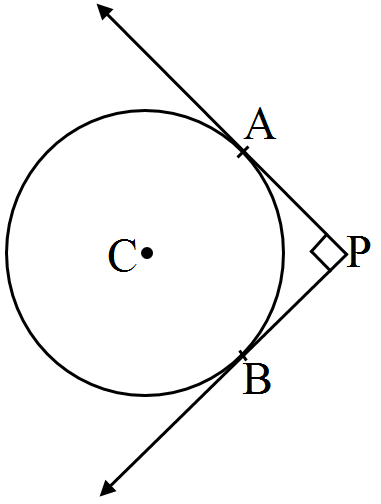
In figure $,PA$ and $PB$ are two tangents drawn from an external point $P$ to a circle with centre $C$ and radius $4 \ cm$. If $\text{PA} \bot\text{PB} ,$ then the length of each tangent is :
- A
$5\ cm$
- B
$3\ cm$
- ✓
$4\ cm$
- D
$8\ cm$
AnswerCorrect option: C. $4\ cm$
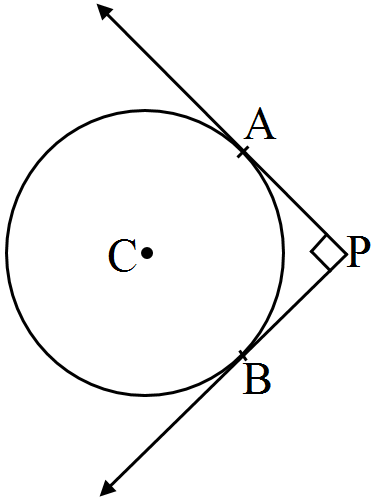
Construction: Joined $AC$ and $BC$.
Here $\text{CA}\bot\text{AP}$ and $\text{CB} \bot \text{BP}$ and $\text{PA} \bot\text{PB} $ Also $AP = PB$
Therefore $,\text{BPAC}$ is a square.
$\Rightarrow AP = PB = BC = 4\ cm$ View full question & answer→MCQ 391 Mark
Each question consists of two statements, namely, Assertion $(A)$ and Reason $(R)$. for selecting the correct answer, use the following code :
|
Assertion $(A)$
|
Reason $(R)$
|
| If two tangent are drawn to a circle from an external point then they subtend equal angles at the centre. |
A parallelogram circumscribing a circle is a rhombus. |
- A
Both Assertion $(A)$ and Reason $(R)$ are true and Reason $(R)$ is a correct explanation of Assertion $(A)$.
- ✓
Both Assertion $(A)$ and Reason $(R)$ are true but Reason $(R)$ is not a correct explanation of Assertion $(A).$
- C
Assertion $(A)$ is true and Reason $(R)$ is false.
- D
Assertion $(A)$ is false and Reason $(R)$ is true.
AnswerCorrect option: B. Both Assertion $(A)$ and Reason $(R)$ are true but Reason $(R)$ is not a correct explanation of Assertion $(A).$
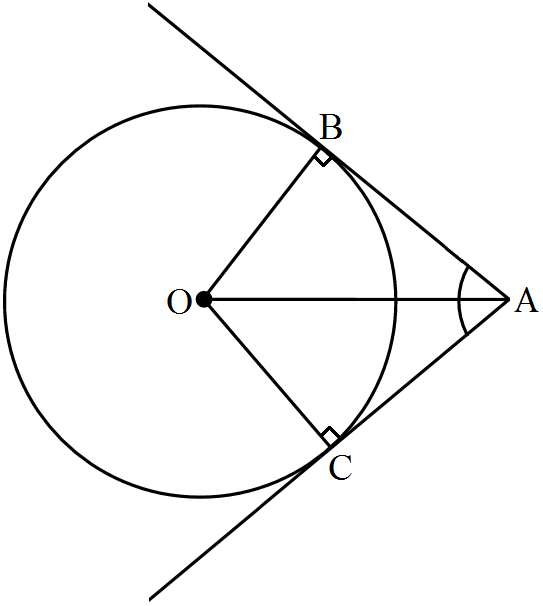
Consider tangent $AB$ and $AC$ drawn to the circle with centre $O$.
In $\triangle\text{OBA}$ and $\triangle\text{OCA},$
$\text{AO}=\text{AO} ....($common side$)$
$\text{OB}=\text{OC} .....($radii of the same circle$)$
$\angle\text{B}=\angle\text{C}=90^\circ$
$\Rightarrow\triangle\text{OBA}\cong\triangle\text{OCA} ....(\text{RHS}$ congruence criterion$)$
So, $\angle\text{OBA}=\angle\text{COA} ....(\text{cpct})$
Thus, the $(R)$ is also true and can be proved using the property, 'tangent from an external point to a circle are equal'
But, the Reason $(R)$ is not the correct explanation for the Assertion $(A).$ View full question & answer→MCQ 401 Mark
In figure, $ AB$ is a chord of a circle and $AT$ is a tangent at $A$ such that $\angle\text{BAT}=60^\circ,$ measure of $\angle\text{ACB}$ is :
- A
$110^\circ$
- B
$90^\circ$
- C
$150^\circ$
- ✓
$120^\circ$
AnswerCorrect option: D. $120^\circ$
Since $OA$ is perpendicular to $AT,$ then $\angle\text{OAT}=90^\circ$
$\Rightarrow\angle \text{OAB}+\angle\text{BAT}=90^\circ$
$\angle \text{OAB}+60^\circ=90^\circ$
$\Rightarrow\angle\text{OAB}=30^\circ$
$\therefore\angle\text{OAB}=\angle\text{OAB}=30^\circ\ [$Angles opposite to radii$]$
$\therefore\angle\text{OBA}=180^\circ-(30^\circ+30^\circ)=120^\circ\ [$Angles sum property of a triangle$]$
$\therefore \text{Reflex}\ \angle\text{AOB}=360^\circ-120^\circ=240^\circ$
Now, since the arc $AB$ of a circle makes an angle which is equal to twice the angle $\text{ACB}$ subtended by it at the circumference.
$\therefore \text{Reflex}\ \angle\text{AOB}=\angle\text{ACB}$
$\Rightarrow240^\circ=2\angle\text{ABC}$
$\therefore\angle \text{ABC}=120^\circ$
View full question & answer→MCQ 411 Mark
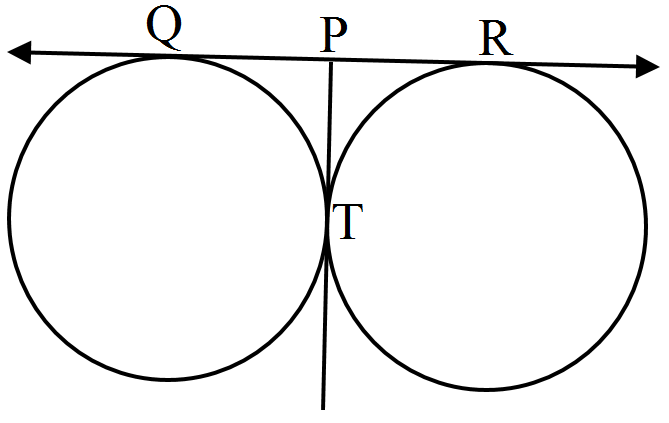
In the given figure if $QP = 4.5\ cm,$ then the measure of $QR$ is equal to :
- A
$15\ cm$
- ✓
$9\ cm$
- C
$18\ cm$
- D
$13.5\ cm$
AnswerCorrect option: B. $9\ cm$
Here $QP = PT = 4.5\ cm \ [$Tangents to a circle from an external point $P]$
Also $PT = PR = 4.5\ cm \ [$Tangents to a circle from an external point $P]$
$\therefore QR = QP + PQ $
$= 4.5 + 4.5 = 9\ cm$
View full question & answer→MCQ 421 Mark
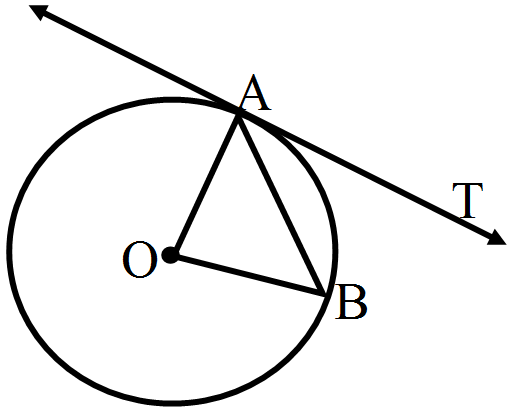
In the given figure, $O$ is the centre of the circle $AB$ is a chord and $AT$ is the tangent at $A$. If $\angle\text{AOB} = 100^\circ$ then $\angle\text{BAT} $ is equal to :
- A
$40^\circ$
- ✓
$50^\circ$
- C
$90^\circ$
- D
$100^\circ$
AnswerCorrect option: B. $50^\circ$
In $\triangle\text{OAB},$
$\text{OA}=\text{OB} ....($radii of the same circle$)$
$\Rightarrow\angle\text{OAB}=\angle\text{OAB} ....($angles opposite equal sides are equal$)$
$\angle\text{AOB}+\angle\text{OAB}+\angle\text{OBA}=180^\circ\ ($Angle Sum Property$)$
$\Rightarrow\angle\text{AOB}+\angle\text{OAB}+\angle\text{OAB}=180^\circ$
$\Rightarrow100^\circ+2\angle\text{OAB}=180^\circ$
$\Rightarrow2\angle\text{OAB}=80^\circ$
$\Rightarrow\angle\text{OAB}=40^\circ$
Since $AT$ is the tangent,
$\angle\text{OAT}=90^\circ$
$\Rightarrow\angle\text{OAB}+\angle\text{BAT}=90^\circ$
$\Rightarrow40^\circ+\angle\text{BAT}=90^\circ$
$\Rightarrow\angle\text{BAT}=50^\circ$
View full question & answer→MCQ 431 Mark
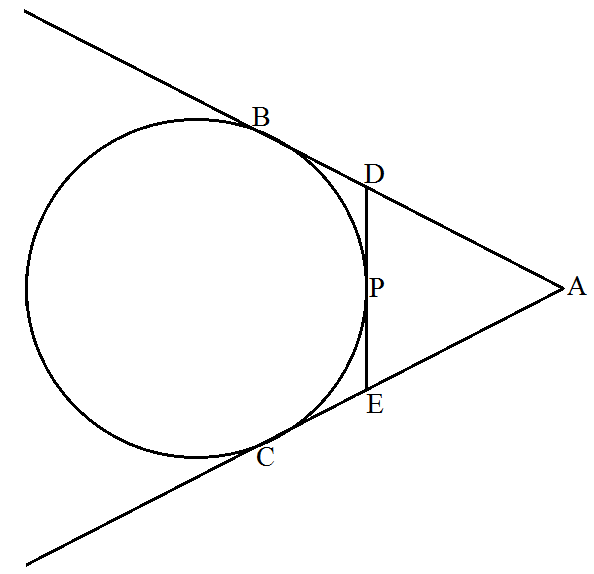
In the given figure, if $AB = 8\ cm$ and $PE = 3\ cm,$ then $AE =$
- A
$11\ cm$
- B
$7\ cm$
- ✓
$5\ cm$
- D
$3\ cm$
AnswerCorrect option: C. $5\ cm$
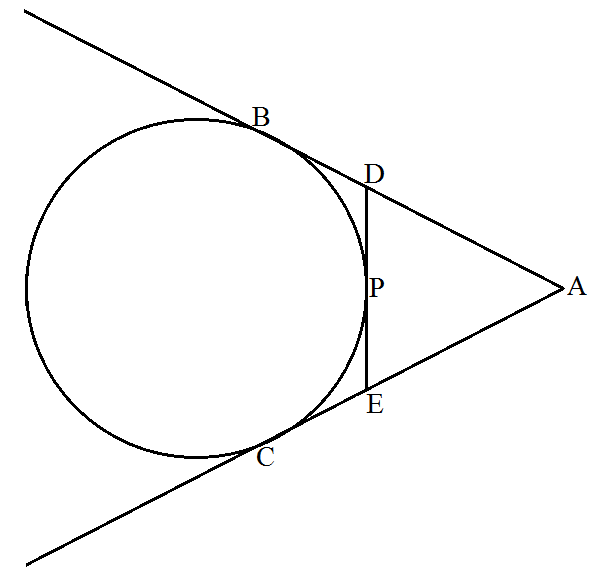
We know that tangents drawn from the same external point will be equal in length.
Therefore,
$AB = AC$
It is given that,
$AB = 8\ cm$
Hence,
$AC = 8\ cm …… (1)$
Similarly,
$PE = CE$
It is given that,
$PE = 3\ cm$
Therefore,
$CE = 3\ cm …… (2)$
Subtracting equations $(1)$ and $(2),$ we get,
$AC − CE = 8 − 3$
From the figure we can see that,
$AC − CE = AE$
Therefore,
$AE = 8 − 3$
$AE = 5\ cm$ View full question & answer→MCQ 441 Mark
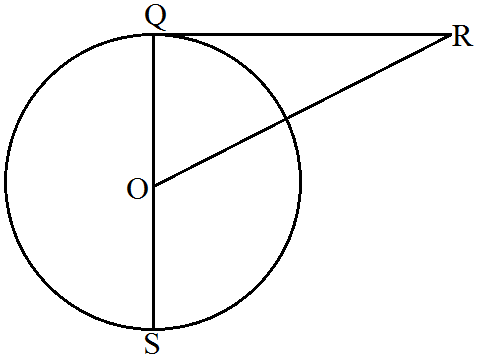
In the given figure $,RQ$ is a tangent to the circle with centre $O$. If $SQ = 6\ cm$ and $QR = 4\ cm,$ then $OR =$
- A
$8\ cm$
- B
$3\ cm$
- C
$2.5\ cm$
- ✓
$5\ cm$
AnswerCorrect option: D. $5\ cm$
In the figure $, O$ is the centre of the circle $QR$ is tangent to the circle and $\text{QOS}$ is a diameter $SQ = 6\ cm, QR = 4\ cm$
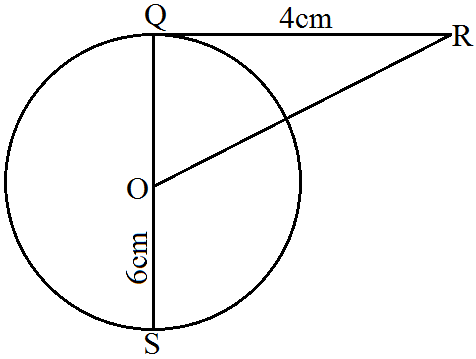
$\text{OQ}=\ \frac{1}{2}\ \text{QS}=\frac{1}{2}\times6=3\text{ cm}$
$OQ$ is radius
$OQ \perp QR$
Now in right $\triangle\text{OQR}$
$\mathrm{OR}^2=\mathrm{QR}^2+\mathrm{QO}^2$
$=(3)^2+(4)^2$
$=9+16=25=(5)^2$
$OR = 5\ cm$
View full question & answer→MCQ 451 Mark
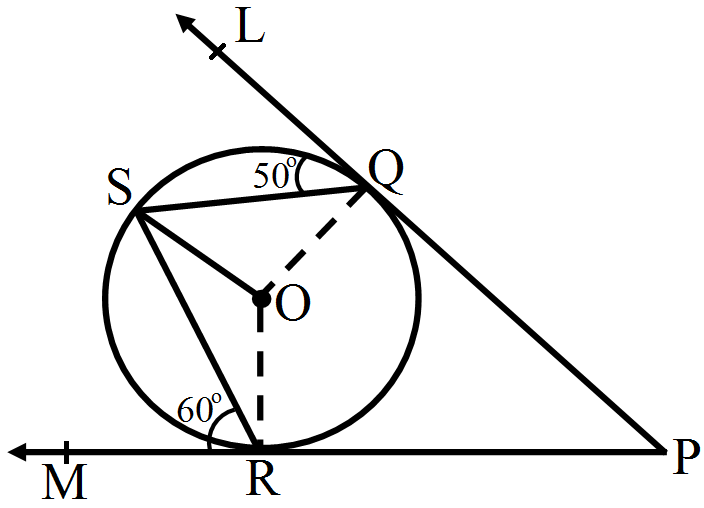
In the given figure $,O$ is the centre of a circle; $\text{PQL}$ and $\text{PRM}$ are the tangents at the points $Q$ and $R$ respectively, and $S$ is a point on the circle, such that $\angle\text{SQL} = 50^\circ.$ and $\angle\text{SRM} = 60^\circ.$ Find $ \angle\text{QSR}=?$
- A
$40^\circ$
- B
$50^\circ$
- C
$60^\circ$
- ✓
$70^\circ$
AnswerCorrect option: D. $70^\circ$
Since $PL$ and $PM$ are the tangent to the circle.
$\angle\text{OQL}=\angle\text{ORM}=90^\circ \ ($tangent is perpendicular to the radius of a circle$)$
So,
$\angle\text{OQL}+\angle\text{SQL}+\angle\text{OQS}$
$\Rightarrow90^\circ=50^\circ+\angle\text{OQS}$
$\Rightarrow\angle\text{OQC}=40^\circ$
Similarly, we can find $\angle\text{ORS}=30^\circ.$
In $\triangle\text{OQS},$
$\text{OQ}=\text{OS}$
$\angle\text{OQS}=\angle\text{OSQ}=40^\circ ...($angles opposite equal sides are equal$)$
In $\triangle\text{ORS},$
$\text{OR}=\text{OS}$
$\angle\text{ORS}=\angle\text{OSR}=30^\circ$
So, $\angle\text{QSR}=\angle\text{OSQ}+\angle\text{OSR}$
$=40^\circ+30^\circ=70^\circ.$
View full question & answer→MCQ 461 Mark
If two tangents inclined at a angle of $60^\circ$ are drawn to a circle of radius $3\ cm,$ then length of each tangent is equal to :
AnswerCorrect option: D. $3\sqrt{3}\text{ cm}$
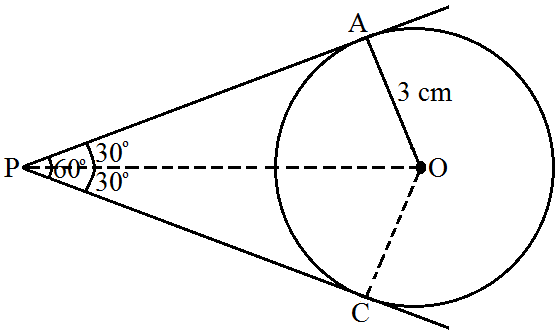
Let $P$ be an external point and a pair of tangents is drawn from point $P$ and angle between these two tangents is $60^\circ $. Join $OA$ and $OP.$
Also, $OP$ is a bisector of line.
$\angle\text{APO}=\angle\text{CPO}=30^\circ$
Also $, OA \perp AP$
Tangent at any point of a circle is perpendicular to the radius through the point of contact.
In right angled $\triangle\text{OAP},\tan30^\circ=\frac{\text{OA}}{\text{AP}}=\frac{3}{\text{AP}}$
$\Rightarrow\frac{1}{\sqrt{3}}=\frac{3}{\text{AP}}$
$\Rightarrow\text{AP}=3\sqrt{3}\text{ cm}$
Hence, the length of each tangent is $3\sqrt{3}\text{ cm}$ View full question & answer→MCQ 471 Mark
If angle between two radii of a circle is $130^\circ,$ the angle between the tangent at the ends of radii is :
- A
$90^\circ$
- ✓
$50^\circ$
- C
$70^\circ$
- D
$40^\circ$
AnswerCorrect option: B. $50^\circ$
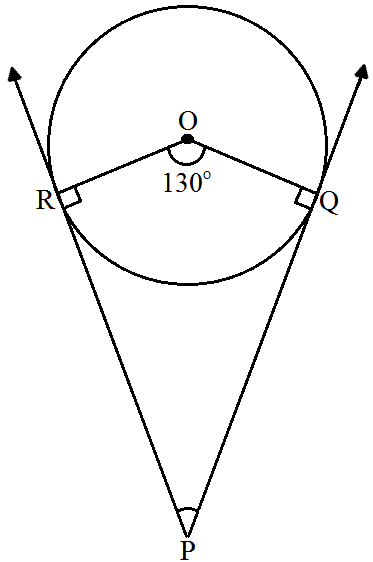
Let $PQ$ and $RP$ be the radii of the circle with the centre $O$.
$\angle\text{ROQ}=130^\circ$
$\text{RP}\bot\text{OR}$ and $ \text{PQ}\bot\text{OQ} \ ($Radii are perpendicular to the tangent$)$
In quadilateral $\text{ROQP},$
$\angle\text{ORP}+\angle\text{RPQ}+\angle\text{PQO}+\angle\text{QOR}=360^\circ$
$\Rightarrow90^\circ+\angle\text{RPQ}+90^\circ+130^\circ=360^\circ$
$\Rightarrow\angle\text{RPQ}=50^\circ$
View full question & answer→MCQ 481 Mark
In the figure, if $PR$ is tangent to the circle at $P$ and $Q$ is the centre of the circle, then $\angle POQ =$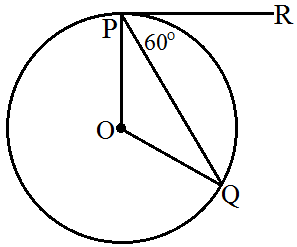
- A
$110^\circ$
- B
$100^\circ$
- ✓
$120^\circ$
- D
$90^\circ$
AnswerCorrect option: C. $120^\circ$
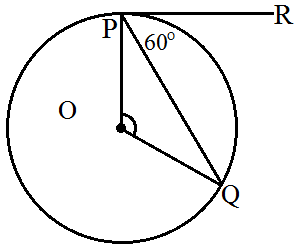
We know, radius $OP\bot $ to tangent $PR$ then $\angle\text{OPR}=90^{\circ}$
Now,
$\angle\text{OPQ}=\angle\text{OPR}-\angle\text{QPR}$
$\angle\text{OPQ}=90^{\circ}-60^{\circ}$
$\angle\text{OPQ}=30^{\circ}$
In $\triangle\text{OPQ},$
$OP = OQ\ ($radius of circle$)$
$\angle\text{OPQ}=\angle\text{OQP}=30^{\circ}\ ($opposite angle of same side$)$
we also know that sum of all angle of triangle is $180^\circ ,$ then
$\angle\text{OPQ}+\angle\text{OQP}+\angle\text{POQ}=180^{\circ}$
$\Rightarrow30^{\circ}+30^{\circ}+\angle\text{POQ}=180^{\circ}$
$\Rightarrow\angle\text{POQ}=120^{\circ}$ View full question & answer→MCQ 491 Mark
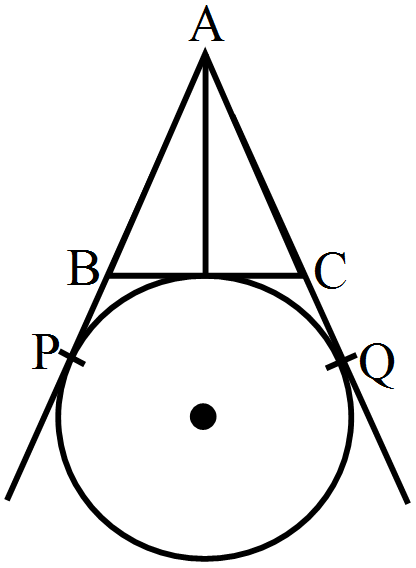
In the given figure, $AP, AQ$ and $BC$ are tangents to the circle. If $AB = 5\ cm, AC = 6\ cm$ and $BC = 4\ cm$ then the length of $AP$ is :
- A
$15\ cm$
- B
$10\ cm$
- C
$9\ cm$
- ✓
$7.5\ cm$
AnswerCorrect option: D. $7.5\ cm$
Let $BC$ intersect the circle at $D$.
We know that tangent from an external point to the circle are equal.
$BP = BD$
$CD = CQ$
$AP = AQ$
perimeter of $\triangle\text{ABC}$
$= AB + BC + AC$
$= AB + (BD + CD) + AC$
$= AB + (BP + CQ) + AC$
$= (AB + BP) + (AC + CQ)$
$= AP + AQ$
Since perimeter of $\triangle\text{ABC} = AB + BC + AC $
$= 5 + 6 + 4 = 15\ cm$
$\Rightarrow AP + AQ = 15$
$\Rightarrow 2AP = 15$
$\Rightarrow AP = 7.5\ cm$
View full question & answer→MCQ 501 Mark
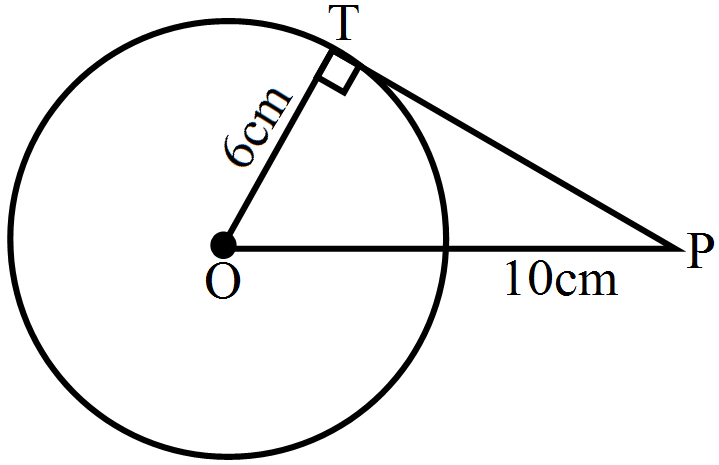
In the given figure $,PT$ is a tangent to a circle with centre $O$. If $OT = 6\ cm$ and $OP = 10\ cm,$ then the length of tangent $PT$ is :
- ✓
$8\ cm$
- B
$10\ cm$
- C
$12\ cm$
- D
$16\ cm$
AnswerCorrect option: A. $8\ cm$
$OT = 6\ cm$
$OP = 10\ cm$
Since $PT$ is a tangent to the circle at $T$.
$\angle\text{PTO}=90^\circ....($tangent is perpendicular to the radius of a circle$)$
In $\triangle\text{PTO},$
By Pythagoras theorem,
$ \mathrm{OP} 2=\mathrm{PT}^2+\mathrm{OT}^2 $
$ \Rightarrow \mathrm{PT}^2=\mathrm{OP}^2-\mathrm{OT}^2 $
$ \Rightarrow \mathrm{PT}^2=10^2-6^2 $
$ \Rightarrow \mathrm{PT}^2=100-36 $
$\Rightarrow PT = 8\ cm$
View full question & answer→