MCQ
Each question consists of two statements, namely, Assertion $(A)$ and Reason $(R)$. for selecting the correct answer, use the following code :
Assertion $(A)$
Reason $(R)$
If two tangent are drawn to a circle from an external point then they subtend equal angles at the centre. A parallelogram circumscribing a circle is a rhombus.
  • A
    Both Assertion $(A)$ and Reason $(R)$ are true and Reason $(R)$ is a correct explanation of Assertion $(A)$.
  • Both Assertion $(A)$ and Reason $(R)$ are true but Reason $(R)$ is not a correct explanation of Assertion $(A).$
  • C
    Assertion $(A)$ is true and Reason $(R)$ is false.
  • D
    Assertion $(A)$ is false and Reason $(R)$ is true.
Answer

Correct option: B.
Both Assertion $(A)$ and Reason $(R)$ are true but Reason $(R)$ is not a correct explanation of Assertion $(A).$

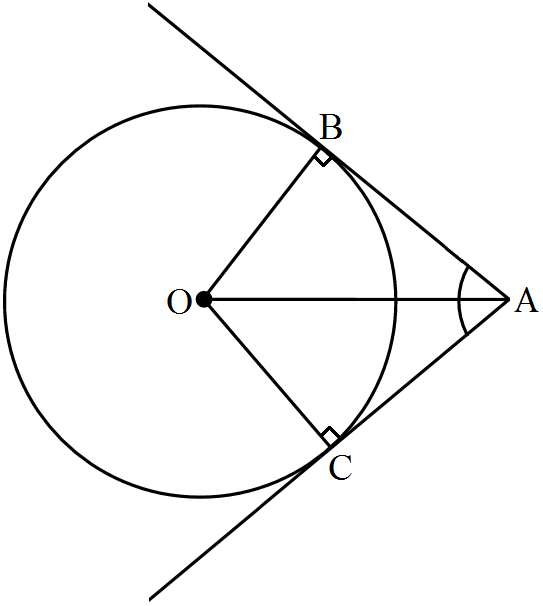
Consider tangent $AB$ and $AC$ drawn to the circle with centre $O$.
In $​​\triangle\text{OBA}$ and $​​\triangle\text{OCA},$
$\text{AO}=\text{AO} ....($common side$)$
$\text{OB}=\text{OC} .....($radii of the same circle$)$
$\angle\text{B}=\angle\text{C}=90^\circ$
$\Rightarrow\triangle\text{OBA}\cong\triangle\text{OCA} ....(\text{RHS}$ congruence criterion$)$
So, $\angle\text{OBA}=\angle\text{COA} ....(\text{cpct})$
Thus, the $(R)$ is also true and can be proved using the property, 'tangent from an external point to a circle are equal'
But, the Reason $(R)$ is not the correct explanation for the Assertion $(A).$

Need a full question paper?

Generate a complete, print-ready paper with questions like this in minutes — across 16+ boards, with answer keys.

Start Generating Free

Similar questions

A number is selected at random from the numbers 1 to 30. The probability that it is a prime number is
A card is drawn from a well shuffled deck of playing cards. The probability of getting red face card is
$\frac{2 \tan 30^{\circ}}{1-\tan ^{2} 30^{\circ}}$ =
A system of linear equations is said to be inconsistent if it has
Image
An $AP 5, 12, 19, ...$ has $50$ terms. Its last term is
The calculation for mode for the following distribution is given below:
Here, the maximum frequency is 32 and the corresponding modal class is $30-40$.
$\therefore \quad l=30, h=10, f_0=12, f_1=32, f_2=20($ Step 1$)$
$\therefore \quad$ Mode $=l+\left(\frac{f_1-f_0}{2 f_1-f_0-f_2}\right) \times h \quad$ (Step 2)
$=30+\left(\frac{32-12}{64-12-20}\right) \times 10=30+\frac{25}{4}=36.25$ (Step 3$)$
In which step is there an error in solving?
MarksNumber of students
0-106
10-2010
20-3012
30-4032
40-5020
If $x = 3$ is a solution of the equation $3x^2+ (k - 1)x + 9 = 0$ then $k = ?$
Choose the correct answer from the given four options: Its is given that $\triangle\text{ABC}\sim\triangle\text{PQR},$ with $\frac{\text{BC}}{\text{QR}}=\frac{1}{3}.$ Then $,\frac{\text{ar}(\text{PQR})}{\text{ar}(\text{BCA})}$ is equal to :
A vertical pole $6m$ long casts a shadow of lenghth $3.6m$ on the ground. What is the height of a tower which casts a shadow of lenght $18m$ at the same time ?
A solid sphere is cut into two hemispheres. The ratio of the surface areas of sphere to that of two hemispheres taken together, is :