Question 15 Marks
The three vertices of a parallelogram are (3, 4) (3, 8) and (9, 8). Find the fourth vertex.
Answer
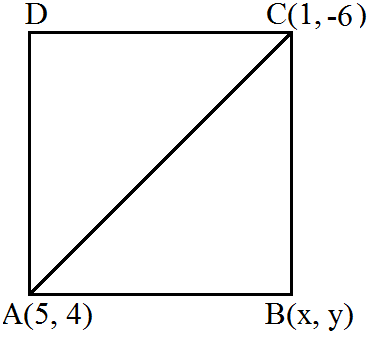
View full question & answer→Let A(3, 4), B(3, 8) and C(9, 8) be the three given vertex then fourth vertex be D(x, y)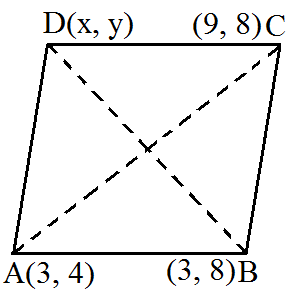
Since, ABCD is parallelogram, the diagonals bisect each other.
Therefore, the mid-point of the diagonals of the parallelogram coincide.
Let P(x, y) be the mid-point of diagonal AC then,
$\text{P}(\text{x},\text{y})=\Big(\frac{3+9}{2},\frac{4+8}{2}\Big)$ P(x, y) = (6, 6)Let Q(x, y) be the mid-point of diagonal BD then,
$\text{Q}(\text{x},\text{y})=\Big(\frac{3+\text{x}}{2},\frac{8+\text{y}}{2}\Big)$ Coordinates of mid-point AC = Coordinates of mid-point BD P(x, y) = Q(x, y) $\Rightarrow\ (6,6)=\Big(\frac{3+\text{x}}{2},\frac{8+\text{y}}{2}\Big)$ Now, equating individual components, $\Rightarrow\ 6=\frac{3+\text{x}}{2}$ and $6=\frac{8+\text{y}}{2}$ ⇒ 3 + x = 12 and 8 + y = 12 ⇒ x = 9 and y = 4Hence, coordinates of fourth point are (9, 4).
Since, ABCD is parallelogram, the diagonals bisect each other.
Therefore, the mid-point of the diagonals of the parallelogram coincide.
Let P(x, y) be the mid-point of diagonal AC then,
$\text{P}(\text{x},\text{y})=\Big(\frac{3+9}{2},\frac{4+8}{2}\Big)$ P(x, y) = (6, 6)Let Q(x, y) be the mid-point of diagonal BD then,
$\text{Q}(\text{x},\text{y})=\Big(\frac{3+\text{x}}{2},\frac{8+\text{y}}{2}\Big)$ Coordinates of mid-point AC = Coordinates of mid-point BD P(x, y) = Q(x, y) $\Rightarrow\ (6,6)=\Big(\frac{3+\text{x}}{2},\frac{8+\text{y}}{2}\Big)$ Now, equating individual components, $\Rightarrow\ 6=\frac{3+\text{x}}{2}$ and $6=\frac{8+\text{y}}{2}$ ⇒ 3 + x = 12 and 8 + y = 12 ⇒ x = 9 and y = 4Hence, coordinates of fourth point are (9, 4).
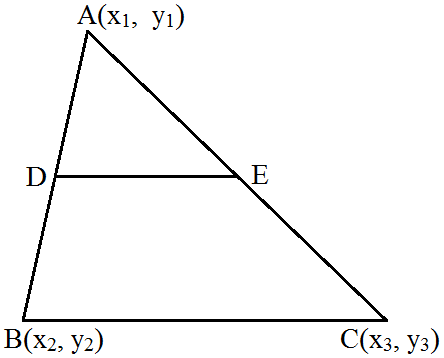
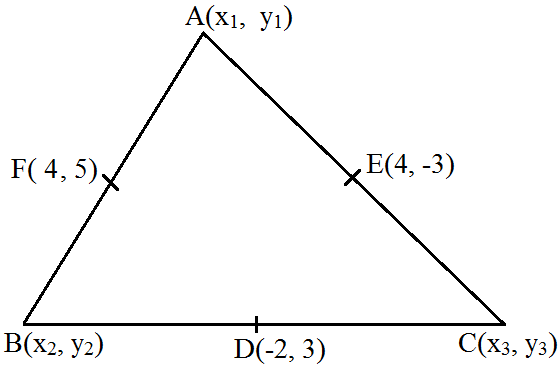
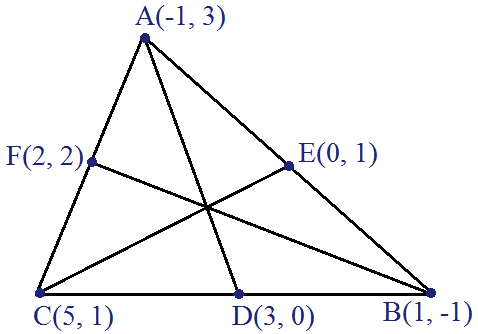 Let AD, BF and CE be the medians of $\triangle\text{ABCD}$
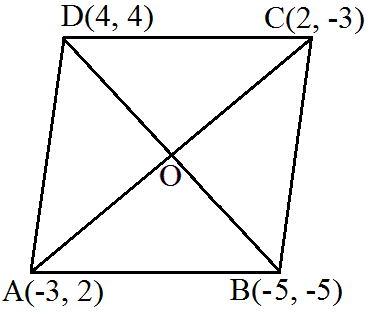
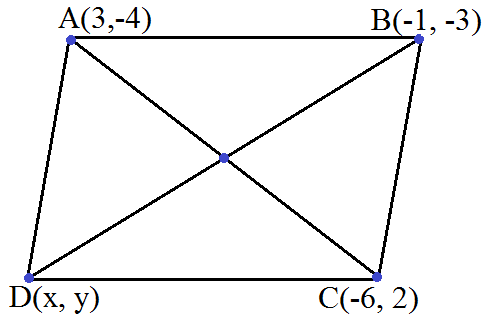 Let A(3, -4) and C(-6, -2) be the extremities of diagonal AC and B(-1, -3), D(x, y) be the extremities of diagonal BD.
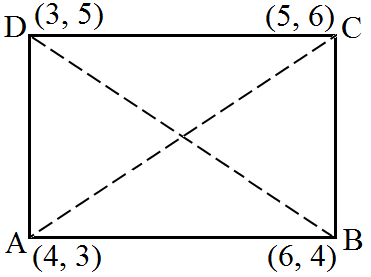 Now, $\text{AB}=\sqrt{(6-4)^2+(4-3)^2}$ $=\sqrt{4+1}$ $=\sqrt{5}\ \text{units}$ and $\text{BC}=\sqrt{(5-6)^2+(6-4)^2}$$=\sqrt{1+4}$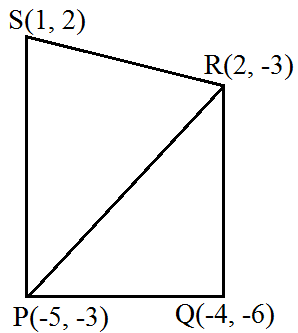
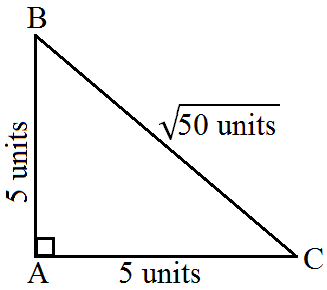
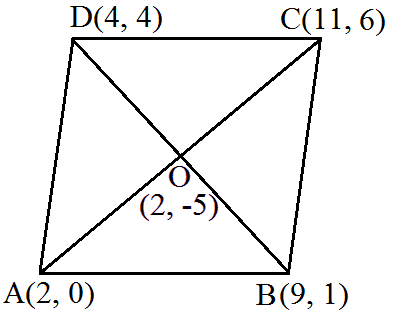 Let O is the mid-point of AC then co-ordinates of O will be $\Big(\frac{2+11}{2},\frac{0+6}{2}\Big)$ or $\Big(\frac{13}{2},\frac{6}{2}\Big)$ or $\Big(\frac{13}{2},3\Big)$ Let O is the mid-point of BD, then co-ordinates of O will be $\Big(\frac{9+4}{2},\frac{1+4}{2}\Big)$ or $\Big(\frac{13}{2},\frac{5}{2}\Big)$The co-ordinates of O in both cases are not same.
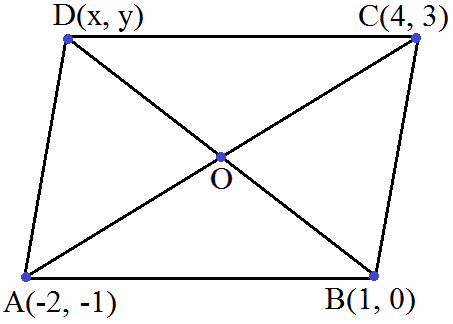 $\because$ O is the mid-point of AC. $\therefore$ Vertices of O will be$\Big(\frac{\text{x}_1+\text{x}_2}{2},\frac{\text{y}_1+\text{y}_2}{2}\Big)$ or $\Big(\frac{-2+4}{2},\frac{-1+3}{2}\Big)$
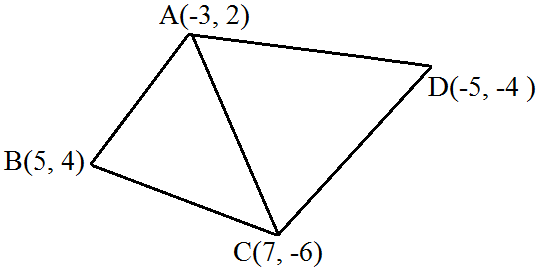
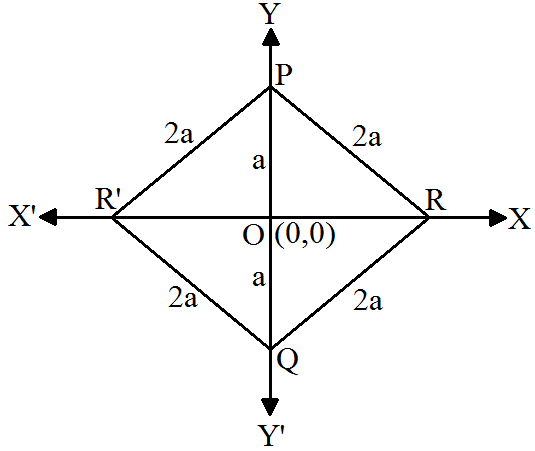
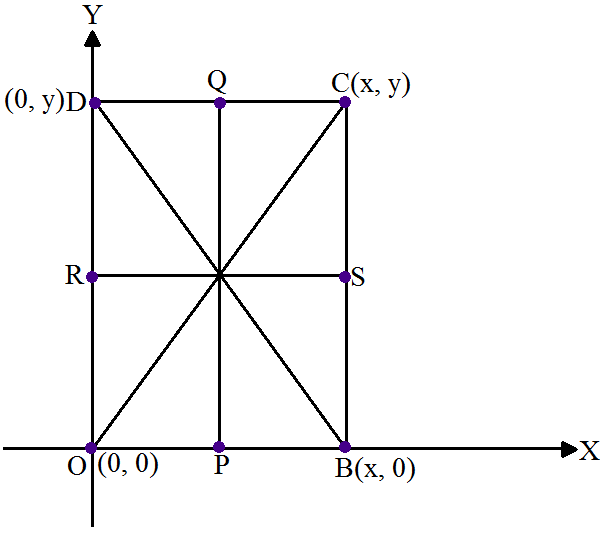 Let OBCD be the quadrilateral P, Q, R, S be the midpoint off OB, CD, OD and BC.
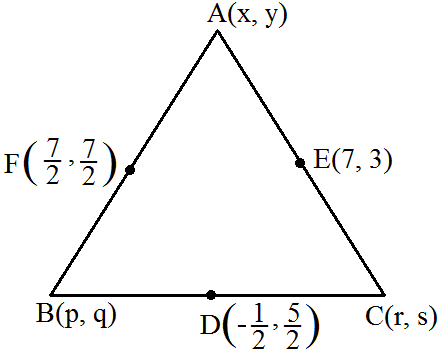 The midpoint of BC is $\text{D}\Big(\frac{-1}{2},\frac{5}{2}\Big)$