Questions · Page 4 of 5

5 Marks Questions

Question 1515 Marks
Draw the graphs of the pair of linear equations x - y + 2 = 0 and 4x - y - 4 = 0. Calculate the area of the triangle formed by the lines so drawn and the x-axis.
Answer
For drawing the graphs of the given equations, we find two solutions of each of the equations, which are given in table. Plot the points A(0, 2), B(-2, 0), P(0, -4) and Q(1, 0) on the graph paper, and join the points to form the lines AB and PQ as shown in the figure.
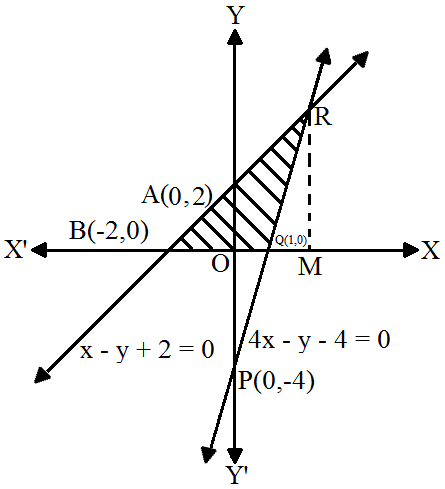
We observe that there is a point R(2,4) common to both the lines AB and PQ. The triangle formed by these lines and the x-axis is BQR. The vertices of this triangle are B(-2, 0), Q(1, 0) and R(2, 4). We know that; Area of triangle $=\frac{1}{2}$ × Base × Altitude Here, Base = BQ = BO + OQ = 2 + 1 = 3 units. Altitude = RM = Ordinate of R = 4 units. So, area of ABQR $=\frac{1}{2}\times3\times4$ $=6\text{ sq. units.}$
View full question & answer
Question 1525 Marks
Solve the following system of equations graphically.
2x - 3y + 6 = 0
2x + 3y - 18 = 0
Also, find the area of the region bounded by these two lines and y-axis.
Answer
The given system of equations is,
2x - 3y + 6 = 0
2x + 3y - 18 = 0
Now, 2x - 3y + 6 = 0
⇒ 2x + 6 = 3y
⇒ 3y = 2x + 6
$\Rightarrow\text{y}=\frac{2\text{x}+6}{3}$
When x = 0, we have
$\text{y}=\frac{2\times0+6}{3}=2$
When x = -3 we have
$\text{y}=\frac{2\times(-3)+6}{3}=0$
Thus, we have the following table.
x
0
-3
y
2
0
Graph of the given system of equations.

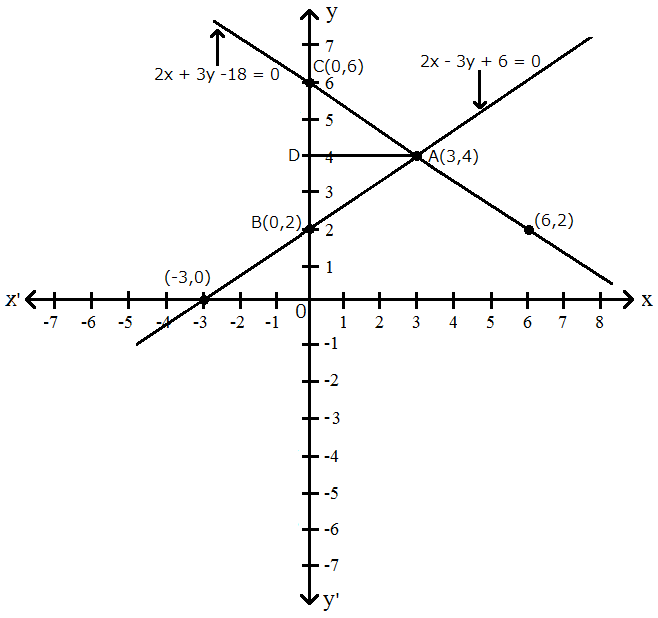
Clearly, the two lines intersect at A(3, 4).
Hence, x = 3, y = 4 is the solution of the given system of equations.
we also observe that the lines represented by the equations 2x - 3y + 6 = 0 and 2x + 3y - 18 = 0 meet y-axis at B(0, 2) and C(0. 6) respectively.
Thus, x = 3, y = 4 is the solution of the given system of equations. Draw AD perpendicular from A on Y-axis. Clearly,
We have, AD = x - Coordinate of point A(3, 4)
⇒ AD = 3 and BC = 6 - 2 = 4
Area of the shaded region = Area of $\triangle\text{ABC}$
Area of the shaded region $=\frac{1}{2}(\text{Base}\times\text{Height})$
$=\frac{1}{2}(\text{BC}\times\text{AD})$
$=\frac{1}{2}\times4\times3$
$=2\times3$
$=6\text{sq.units.}$
$\therefore$ Area of the region bounded by these two lines and y-axis is 6 sq. units.
View full question & answer
Question 1535 Marks
Solve the following systems of equations graphically:
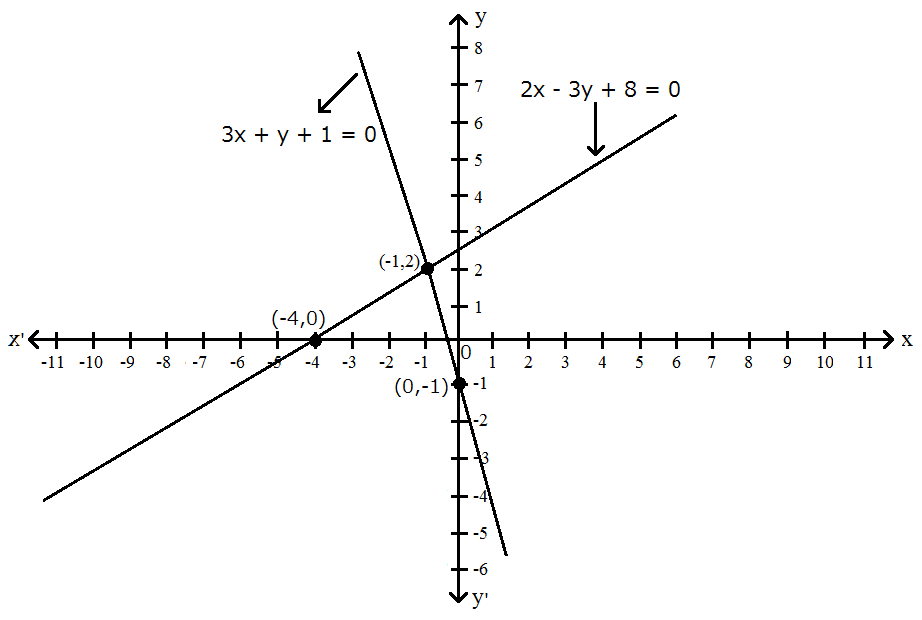
3x - y + 1 = 0
2x - 3y + 8 = 0
Answer
We have,
3x + y + 1 = 0
2x + 3y + 8 = 0
Now,
3x + y + 1 = 0
⇒ y = -1 - 3x
When x = 0, we have
y = -1
When x = -1, we have
y = -1 - 3 × (-1) = 2
Thus, we have the following table giving points on the line 3x + y + 1 = 0
x
-1
0
y
2
-1
Now,
2x - 3y + 8 = 0
⇒ 2x = 33y - 8
$\Rightarrow\text{x}=\frac{3\text{y}-8}{2}$
When y = 0, we have
$\text{x}=\frac{3\times0-8}{2}=-4$
When y = 2, we have
$\text{x}=\frac{3\times2-8}{2}=-1$
Thus, we have the following table giving points on the line 2x - 3y + 8 = 0
x
-4
-1
y
0
-2
Graph of the equation are:

Clearly, two lines intersect at (-1, 2)
Hence, x = -1, y = 2 is the solution of the given system of equations.
View full question & answer
Question 1545 Marks
Solve the following system of equations by the method of cross-multiplication:
$\frac{\text{b}}{\text{a}}\text{x}+\frac{\text{a}}{\text{b}}\text{y}=\text{a}^2+\text{b}^2$
$\text{x}+\text{y}=2\text{ab}$
Answer
The given equation are,
$\frac{\text{b}}{\text{a}}\text{x}+\frac{\text{a}}{\text{b}}\text{y}=\text{a}^2+\text{b}^2$
$​​$$\text{b}^2\text{x}+\text{a}^2\text{y}-(\text{a}^2+\text{b}^2)\text{ab}=0\ ...(\text{i})$
$\text{x}+\text{y}-2\text{ab}=0\ ....(\text{ii})$
By cross-multiplication method we get,
$\Rightarrow\frac{\text{x}}{\text{a}^2(-2\text{ab})-\big\{-(\text{a}^2+\text{b}^2)\text{ab}\big\}}=\frac{\text{y}}{-(\text{a}^2+\text{b}^2)\text{ab}-\text{b}^2(-2\text{ab})}\\=\frac{1}{\text{b}^2-\text{a}^2}$
$\Rightarrow \frac{\text{x}}{-2\text{a}^3\text{b}+\text{a}^3\text{b}+\text{ab}^3}=\frac{\text{y}}{-\text{a}^3\text{b}-\text{ab}^3+2\text{ab}^3}=\frac{1}{\text{b}^2-\text{a}^2}$
$\Rightarrow \frac{\text{x}}{\text{ab}^3-\text{a}^3\text{b}}=\frac{\text{y}}{\text{ab}^3-\text{a}^3\text{b}}=\frac{1}{\text{b}^2-\text{a}^2}$
$\Rightarrow\frac{\text{x}}{\text{ab}(\text{b}^2-\text{a}^2)}=\frac{\text{y}}{\text{ab}(\text{b}^2-\text{a}^2)}=\frac{1}{\text{b}^2-\text{a}^2}$
$\Rightarrow \text{x}=\frac{\text{ab}(\text{b}^2-\text{a}^2)}{(\text{b}^2-\text{a}^2)}=\text{ab}$
$\Rightarrow\text{y}=\frac{\text{ab}(\text{b}^2-\text{a}^2)}{(\text{b}^2-\text{a}^2)}=\text{ab}$
Thus, x = y = ab
View full question & answer
Question 1555 Marks
The sum of a two digit number and the number obtained by reversing the order of its digits is 99. If the digits differ by 3, find the number.
Answer
Let the digit at unit place and tens olace be x and y respectively.
number = 10y + x
The number obtaines after reversing the order of digits = 10x + y
According to question
10y + x + 10x + y = 99
11x + 11y = 99
x + y = 9 .....(i)
and, x - y = 3 ....(ii)
Adding (i) and (ii) we get
⇒ 2x = 12
⇒ x = 6
Putting x = 6 in (i) we get
⇒ 6 + y = 9
⇒ y = 3
Thus, number will be (3 × 10 + 6) = 36
When adding (i) and (ii) we get
⇒ 2y = 12
⇒ y = 6
Putting y = 6 in (i) we get
⇒ 6 + x = 9
⇒ x = 3
Thus, the number will be (6 × 10 + 3) = 63
View full question & answer
Question 1565 Marks
Show graphically that the following systems of equations is in-consistent (i.e. has no solution):
$3\text{x}-4\text{y}-1=0$
$2\text{x}-\frac{8}{3}\text{y}+5=0$
Answer
We have,
$3\text{x}-4\text{y}-1=0$
$2\text{x}-\frac{8}{3}\text{y}+5=0$
Now,
$3\text{x}-4\text{y}-1=0$
$\Rightarrow3\text{x}=1+4\text{y}$
$\Rightarrow\text{x}=\frac{1+4\text{y}}{3}$
When y = 2, we have
$\text{x}=\frac{1+4\times2}{3}=3$
When y = -1, we have
$\text{x}=\frac{1+4\times(-1)}{3}=-1$
Thus, we have the following table giving points on the line 3x - 4y - 1 = 0.
x
-1
3
y
-1
2
$2\text{x}-\frac{8}{3}\text{y}+5=0$
$\Rightarrow\frac{6\text{x}-8\text{y}+15}{3}=0$
$\Rightarrow6\text{x}-8\text{y}+15=0$
$\Rightarrow6\text{x}=8\text{y}-15$
$\Rightarrow\text{x}=\frac{8\text{y}-15}{6}$
When y = 0, we have,
$\text{x}=\frac{8\times0-15}{6}=-2.5$
When y = 3, we have,
$\text{x}=\frac{8\times3-15}{6}=1.5$
Thus, we have the following table giving points on the line $2\text{x}-\frac{8}{3}\text{y}+5=0.$
x
-2.5
1.5
y
0
3
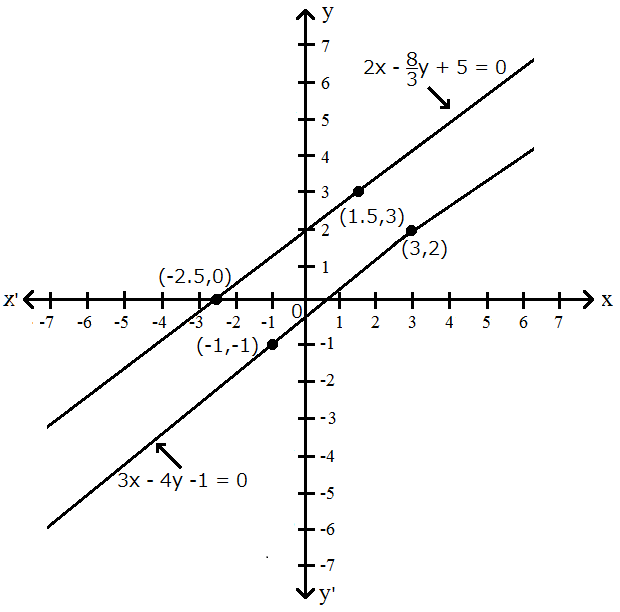
Graph of the given equations.

We find the lines represented by equations 3x - 4y - 1 = 0 and $2\text{x}-\frac{8}{3}\text{y}+5=0$ are parallel. So, the two lines have no common point.
Hence, the given system of equations is in-consistent.
View full question & answer
Question 1575 Marks
Draw the graphs of the lines x = -2, and y = 3. Write the vertices of the figure formed by these lines, the x-axis and the y-axis. Also, find the area of the figure.
Answer
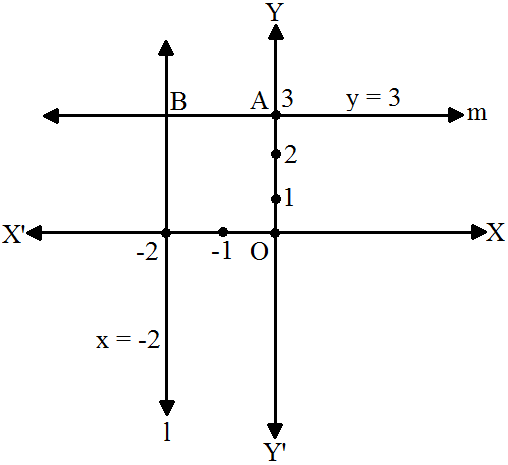
We know that the graph of x = -2 is a line parallel to y-axis at a distance of 2 units to the left of it. So, the line l is the graph of x = -2
The graph of y = 3 is a line parallel to the x-axis at a distance of 3 units above it. So, the line m is the graph of y = 3. The figure enclosed by the line x = -2, y = 3, the x-axis and the y-axis is OABC, which is a rectangle. A is a point on the y-axis at a distance of 3 units above the x-axis. So, the coordinates of A are (0, 3). C is a point on the x-axis at a distance of 2 units to the left of y-axis. So, the coordinates of C are (-2, 0). B is the solution of the pair of equations x = -2 and y = 3. So, the coordinates of B are (-2, 3). So, the vertices of the rectangle OABC are O(0, 0), A(0, 3), B(-2, 3), C(-2, 0). The length and breadth of this rectangle are 2 units and 3 units, respectively. As the area of a rectangle = length x breadth, The area of rectangle OABC = 2 x 3 = 6 sq. units.
View full question & answer
Question 1585 Marks
Solve the following system of equations by the method of cross-multiplication:
$\frac{5}{\text{x}+\text{y}}-\frac{2}{\text{x}-\text{y}}=-1,$
$\frac{15}{\text{x}+\text{y}}+\frac{7}{\text{x}-\text{y}}=-10,$ where $\text{x}\neq0$ and $\text{y}\neq0.$
Answer
Let $\frac{1}{\text{x}+\text{y}}=\text{u}$ and $\frac{1}{\text{x}-\text{y}}=\text{v}.$ Then, the given system of equations becomes.
5u - 2v = -1
15u + 7v = 10
Here, $a_1 = 5, b_1 = -2, c_1 = 1$
$a_2 = 15, b_2 = 7$ and $c_2 = -10$
By cross-multiplication, we get,
$\Rightarrow\frac{\text{u}}{(-2)\times(-10)-1\times7}=\frac{-\text{v}}{(5)\times(-10)-1\times15}\\=\frac{1}{5\times7-(-2)\times15}$
$\Rightarrow\frac{\text{u}}{20-7}=\frac{-\text{v}}{-50-15}=\frac{1}{35+30}$
$\Rightarrow\frac{\text{u}}{13}=\frac{-\text{v}}{-65}=\frac{1}{65}$
Now, $\frac{\text{u}}{13}=\frac{1}{65}$
And, $\frac{\text{v}}{65}=\frac{1}{65}$
$\Rightarrow\text{v}=\frac{65}{65}=1$
Now, $\text{u}=\frac{1}{\text{x}+\text{y}}$
$\Rightarrow\frac{1}{\text{x}+\text{y}}=\frac{1}{5}$
$\text{x}+\text{y}=5\ ...(\text{i})$
And, $\text{v}=\frac{1}{\text{x}-\text{y}}$
$ \Rightarrow\frac{1}{\text{x}-\text{y}}=1$
$\Rightarrow\text{x}-\text{y}=1\ ....(\text{ii})$
Adding equation (i) and (ii) we get,
$2\text{x}=5+1$
$\Rightarrow2\text{x}=6$
$\Rightarrow\text{x}=\frac{6}{2}=3$
View full question & answer
Question 1595 Marks
Find the values of a and b for which the following system of equations has infinitely many solutions:
2x + 3y = 7
2ax + ay = 28 - by
Answer
Given
$2x + 3y = 7$
$2ax + ay = 28 - by$
⇒ 2ax + (a + b)y = 28
We know that the system of equations
$a_1x + b_1y = c_1$
$a_2x + b_2y = c_2$​​​​​​​
has infinitely many solutions if
$\frac{\text{a}_1}{\text{a}_2}=\frac{\text{b}_1}{\text{b}_2}=\frac{\text{c}_1}{\text{c}_2}$
$\therefore\frac{2}{2\text{a}}=\frac{3}{\text{a}+\text{b}}=\frac{7}{28}$
$\Rightarrow\frac{1}{\text{a}}=\frac{3}{\text{a}+\text{b}}=\frac{1}{4}$
$\Rightarrow\frac{1}{\text{a}}=\frac{3}{\text{a}+\text{b}}$ and $\frac{3}{\text{a}+\text{b}}=\frac{1}{4}$
Now,
$\frac{1}{\text{a}}=\frac{3}{\text{a}+\text{b}}$
$\Rightarrow\text{a}+\text{b}=3\text{a}$
$\Rightarrow\text{b}=2\text{a}\ ....(\text{i})$
Also,
$\frac{3}{\text{a}+\text{b}}=\frac{1}{4}$
$\Rightarrow\text{a}+\text{b}=12\ .....(\text{ii})$
Solving (i) and (ii) we get
a = 4 and b = 8
View full question & answer
Question 1605 Marks
Susan invested certain amount of money in two schemes A and B, which offer interest at the rate of 8% per annum and 9% per annum, respectively. She received ₹ 1860 as annual interest. However, had she interchanged the amount of investment in the two schemes, she would have received 720 more as annual interest. How much money did she invest in each scheme?
Answer
Let the amount of investments in schemes A and B be ₹ x and ₹ y, respectively. Case I: Interest at the rate of 8% per annum on scheme A + Interest at the rate of 9% per annum on scheme B = Total amount received $\Rightarrow\frac{\text{x}\times8\times1}{100}+\frac{\text{y}\times9\times1}{100}$ $=₹1860$ $\Big[\because\text{Simple interest}=\frac{\text{principal}\times\text{rate}\times\text{time}}{100}\Big]$ $\Rightarrow8\text{x}+9\text{y}=186000\ .....(\text{i})$Case II:
Interest at the rate of 9% per annum on scheme A + Interest at the rate of 8% per annum on scheme B = ₹ 20 more as annual interest. $\Rightarrow\frac{\text{x}\times9\times1}{100}+\frac{\text{y}\times8\times1}{100}$ $=₹20+₹1860$ $\Rightarrow\frac{9\text{x}}{100}+\frac{8\text{y}}{100}=1880$ $\Rightarrow9\text{x}+8\text{y}=188000\ .....(\text{ii})$ On multiplying eq. (i) by 9 and eq. (ii) by 8 and then subtracting them, we get (image) $\big[(9\times186) - (8\times188)\big]$ $=1000(1674-1504)$ $=1000\times170$ $17\text{y}=170000$ $\Rightarrow\text{y}=10000$ On putting the value of y in eq. (i) we get $=8\text{x}+9\times10000=186000$ $\Rightarrow8\text{x}=186000-90000$ $\Rightarrow8\text{x}=96000$ $\Rightarrow\text{x}=12000$ Hence, she invested ₹ 12000 and ₹ 10000 in two schemes A and B, respectively.
View full question & answer
Question 1615 Marks
A two-digit number is 4 times the sum of its digits. If 18 is added to the number, the digits are reversed. Find the number.
Answer
Let the digit in the unit's place be x and the digit at the ten's place be y. Then,
Number = 10y + x
The number obtained by reversing the order of the digit is 10x + y
According to the given conditions we have
10y + x = 4(x + y)
⇒ 10y + x = 4x + 4y
⇒ 0 = 4x - x + 4y - 10y
⇒ 0 = 3x - 6y
⇒ 3x - 6y = 0
⇒ 3(x - 2y) = 0
⇒ x - 2y = 0 ......(i)
and, 10y + x + 18 = 10x + y
⇒ 18 = 10x - x + y - 10y
⇒ 18 = 9x - 9y
⇒ 9x - 9y = 18
⇒ 9(x - y) = 18
⇒ x - y = 2 .....(ii)
Subtracting equation (ii) from equation (i) we get
-2y - (-y) = 0 - 2
⇒ -2y + y = -2
⇒ -y = -2
⇒ y = 2
Putting y = 2 in equation (ii) we get
x - 2 = 2
⇒ x = 4
Hence the required number is 10y + x = 10 × 2 + 4 = 24
View full question & answer
Question 1625 Marks
Find the values of a and b for which the following system of equations has infinitely many solutions:
$2x - (2a + 5)y = 5$
$(2b + 1)x - 9y = 15$
Answer
The given system of equations is
$2x - (2a + 5)y = 5$
$(2b + 1)x - 9y = 15$
It is of the form
$a_1x + b_1y + c_1 = 0$
$a_2x + b_2y + c_2 = 0$
Where $a_1 = 2, b_1 = -(2a + 5), c_1 = -5$
And $a_2 = (2b + 1), b_2 = -9, c_2 = -15$
The given system of equations will be have infinite number of solution, if
$\frac{\text{a}_1}{\text{a}_2}=\frac{\text{b}_1}{\text{b}_2}=\frac{\text{c}_1}{\text{c}_2}$
$\Rightarrow\frac{2}{2\text{b}+1}=\frac{-(2\text{a}+5)}{-9}=\frac{-5}{-15}$
$\Rightarrow\frac{2}{2\text{b}+1}=\frac{2\text{a}+5}{9}=\frac{1}{3}$
$\Rightarrow\frac{2}{2\text{b}+1}=\frac{1}{3}$ and $\frac{2\text{a}+5}{9}=\frac{1}{3}$
$\Rightarrow6=2\text{b}+1$ and $\frac{3(2\text{a}+5)}{9}=1$
$\Rightarrow6-1=2\text{b}$ and $2\text{a}=-2$
$\Rightarrow\frac{5}{2}=\text{b}$ and $\text{a}=\frac{-2}{2}=-1$
Hence, the given system of equations will have infinitely many solutions, if a = -1 and $\text{b}=\frac{5}{2}$
View full question & answer
Question 1635 Marks
Solve the following systems of equations:
$\frac{\text{x}}{7}+\frac{\text{y}}{3}=5,$
$\frac{\text{x}}{2}-\frac{\text{y}}{9}=6.$
Answer
The given system of equation is
$\frac{\text{x}}{7}+\frac{\text{y}}{3}=5\ .......(\text{i})$
$\frac{\text{x}}{2}-\frac{\text{y}}{9}=6\ .......(\text{ii})$
From (i), we get
$\frac{3\text{x}+7\text{y}}{21}=5$
$\Rightarrow3\text{x}+7\text{y}=105$
$\Rightarrow3\text{x}=105-7\text{y}$
$\Rightarrow\text{x}=\frac{105-7\text{y}}{3}$
From (ii), we get
$\frac{9\text{x}-2\text{y}}{18}=6$
$\Rightarrow9\text{x}-2\text{y}=108\ .....(\text{iii})$
Substituting $\text{x}=\frac{105-7\text{y}}{3}$ in (iii), we get
$9\Big(\frac{105-7\text{y}}{3}\Big)-2\text{y}=108$
$\Rightarrow\frac{948-63\text{y}}{3}-2\text{y}=108$
$\Rightarrow945-63\text{y}-6\text{y}=108\times3$
$\Rightarrow945-69\text{y}=324$
$\Rightarrow945-324=69\text{y}$
$\Rightarrow69\text{y}=621$
$\Rightarrow\text{y}=\frac{621}{69}$
$\Rightarrow\text{y}=9$
Putting y = 9 in $\text{x}=\frac{1105-7\text{y}}{3},$ we get
$\text{x}=\frac{105-7\times9}{3}$
$\text{x}=\frac{105-63}{3}$
$\Rightarrow\text{x}=\frac{42}{3}$
$\Rightarrow\text{x}=14$
Hence, the solution of the given system of equations is x = 14, y = 9.
View full question & answer
Question 1645 Marks
Find the values of p and q for which the following system of linear equations has infinite number of solutions:
$2x + 3y = 9$
$(p + q)x + (2p - q)y = 3(p + q + 1)$
Answer
The given system of equations is
$2x + 3y - 9 = 0$
$(p + q)x + (2q - q)y - 3(p + q + 1) = 0$
It is of the form
$a_1x + b_1y + c_1 = 0$
$a_2x + b_2y + c_2 = 0$
Where, $a_1 = 2, b_1 = 3, c_1 = -9$
And $a_2 = p + q, b_2 = 2p - q, c_2 = -3(p + q + 1)$
The given system of equations will have infinite number of solutions if
$\frac{\text{a}_1}{\text{a}_2}=\frac{\text{b}_1}{\text{b}_2}=\frac{\text{c}_1}{\text{c}_2}$
$\Rightarrow\frac{2}{\text{p}+\text{q}}=\frac{3}{2\text{a}-\text{q}}=\frac{3}{\text{p}+\text{q}+1}$
$\Rightarrow\frac{2}{\text{p}+\text{q}}=\frac{3}{2\text{a}-\text{q}}$ and $\frac{3}{2\text{a}-\text{q}}=\frac{3}{\text{p}+\text{q}+1}$
$\Rightarrow 2(2p - q) = 3 (p + q)$ and $p + q + 1 = 2p - q$
$\Rightarrow 4p - 2p = 3p + 3p$ and $-2p + p + q + q = -1$
$\Rightarrow p - 5q - p + 2p = -1$ [on adding]
$\Rightarrow - 3p = -1$
$\Rightarrow\text{q}=\frac{1}{3}$
Putting $\text{q}=\frac{1}{3}$ in p - 5q, we get
$\text{p}-5\Big(\frac{1}{3}\Big)=0$
$\Rightarrow\text{p}=\frac{5}{3}$
Hence the given system of equations will have infinitely many solutions, if $\text{p}=\frac{5}{3}$ and $\text{q}=\frac{1}{3}$
View full question & answer
Question 1655 Marks
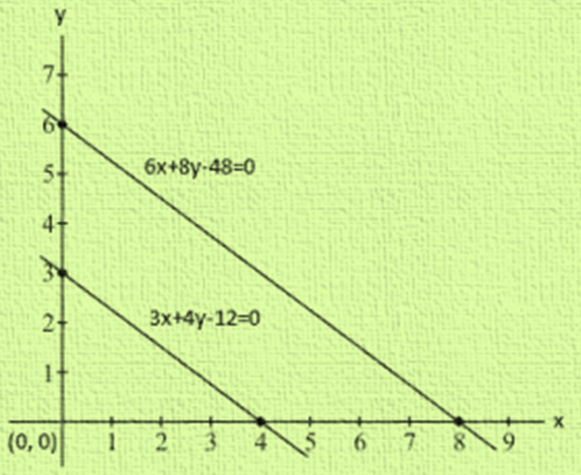
The path of a train a is given by the equation 3x + 4y - 12 = 0 and the path of another train B is given by the equation 6x + 8y - 48 = 0. Represent this situation graphically.
Answer
The paths of two trains are given by the following pair of linear equations.
3x + 4y - 12 = 0 ......(i)
6x + 8y - 48 = 0 .......(ii)
In order to represent the following sets of lines graphically we need two points for a single equation
We have, 3x + 4y - 12 = 0 Putting y = 0
⇒ 3x + 4(0) = 12 ⇒ 3x = 12 ⇒ x = 4
Hence the coordinate is (4, 0)
Putting x = 0
3(0) + 4y = 12 ⇒ 4y = 12 ⇒ y = 3
Hence the coordinate is (0, 3)
x
4
0
y
0
3
We have, 6x + 8y - 48 = 0, Putting x = 0
6(0) + 8y = 48 ⇒ 8y = 48 ⇒ y = 6
Hence the coordinate is (0, 6)
6x + 8y - 48 = 0, Putting y = 0
6x + 8(0) = 48 = 6x = 48 = x = 8
Hence the coordinate is (8, 0)
x
0
8
y
6
0

Hence the two lines intersect at point (-1, 2) Hence x = -1 and y = 2.
View full question & answer
Question 1665 Marks
Write the set of values of a and b for which the following system of equations has infinitely many solutions.
2x + 3y = 7
2ax + (a + b)y = 28
Answer
The given equations are
2x + 3y - 7 = 0
2ax + (a + b)y - 28 = 0
$\frac{\text{a}_1}{\text{a}_2}=\frac{2}{2\text{a}},\frac{\text{b}_1}{\text{b}_2}=\frac{3}{\text{a}+\text{b}},\frac{\text{c}_1}{\text{c}_2}=\frac{-7}{-28}$
For the equations to have infinite number of solutions,
$\frac{\text{a}_1}{\text{a}_2}=\frac{\text{b}_1}{\text{b}_2}=\frac{\text{c}_1}{\text{c}_2}$
Therefore
$\frac{2}{2\text{a}}=\frac{3}{\text{a}+\text{b}}=\frac{7}{28}$
Let us take
$\frac{2}{2\text{a}}=\frac{3}{\text{a}+\text{b}}$
2(a + b) = 2a × 3
2a + 2b = 6a
0 = 6a - 2a - 2b
0 = 4a - 2b
$\frac{3}{\text{a}+\text{b}}=\frac{7}{28}$
28 × 3 = 7(a + b)
84 = 7a + 7b
By dividing both the sides by 7 we get,
12 = a + b ....(ii)
By multiplying equations (ii) by 2 we get
24 = 2a + 2b .....(iii)
Substituting (iii) from (i) we get
$4\text{a}\ -\ 2\text{b}\ =\ 0\\2\text{a}\ +\ 2\text{b}\ =\ 24\over6\text{a}\ \ \ \ \ \ \ \ \ \ =\ 24$
$\text{a}=\frac{24}{6}$
a = 4
Subtracting a = 4 in equation (iii) we have
24 = 2a + 2b
24 = 2 × 4 + 2b
24 = 8 + 2b
24 - 8 = 2b
16 = 2b
$\frac{16}{2}=\text{b}$
8 = b
Hence, the value of a = 4, b = 8 when system of equations has infinity many solutions.
View full question & answer
Question 1675 Marks
4 tables and 3 chairs, together, cost Rs. 2250 and 3 tables and 4 chairs cost Rs. 1950. Find the cost of 2 chairs and 1 table.
Answer
Given,
Cost of 4 tables and 3 chairs = Rs. 2250
Cost of 3 tables and 4 chairs = Rs. 1950
To find: The cost of 2 chairs and 1 table.
Suppose, the cost of 1 table = Rs. x
The cost of 1 chair = Rs. y
According to the given conditions,
4x + 3y = 2250
4x + 3y - 2200 = 0 ....(i)
3x + 4y = 1950
3x + 4y - 1950 = 0 ........(ii)
Solving eq. (i) and eq. (ii) by cross multiplication
$\frac{\text{x}}{-5850+9000}=\frac{-\text{y}}{-7800+6750}=\frac{1}{16-9}$
$\frac{\text{x}}{3150}=\frac{-\text{y}}{-1050}=\frac{1}{7}$
$\text{x}=\frac{3150}{7}$
$\text{x}=450$
$\therefore$ Cost of 1 table = Rs. 450
Cost of 1 table = Rs. 450
$\text{y}=\frac{1050}{7}$
$\text{y}=150$
$\therefore$ Cost of 1 chairs = Rs. 150
Cost of 2 chairs = Rs. 300
Hence total Cost of 2 chairs and 1 table = Rs. 750
View full question & answer
Question 1685 Marks
Solve the following systems of equations:
$\sqrt{2}\text{x}-\sqrt{3}\text{y}=0,$
$\sqrt{3}\text{x}-\sqrt{8}\text{y}=0.$
Answer
The given equations are,
$\sqrt{2}\text{x}-\sqrt{3}\text{y}=0\ ......(\text{i})$
$\sqrt{3}\text{x}-\sqrt{8}\text{y}=0\ .....(\text{ii})$
Multiplying (i) by $\sqrt{3}$ and (ii) by $\sqrt{2}$ we get,
$\Rightarrow\sqrt{6}\text{x}-3\text{y}=0\ ......(\text{iii})$
$\Rightarrow\sqrt{6}\text{x}-4\text{y}=0\ ......(\text{iv})$
Subtracting (iii) from (iv) we get,
$​​\Rightarrow-\text{y}=0$
$​​\Rightarrow\text{y}=0$
Putting y = 0 in (i) we get,
$​​\Rightarrow\sqrt{2}\text{x}-\sqrt{3}\times0=0$
$​​\Rightarrow\sqrt{2}\text{x}-0=0$
$​​\Rightarrow\sqrt{2}\text{x}=0$
$​​\Rightarrow\text{x}=0$
Thus, the solution is x = 0 and y = 0.
View full question & answer
Question 1695 Marks
Solve the following system of equations by the method of cross-multiplication:
$2ax + 3by = a + 2b,$
$3ax + 2by = 2a + b.$
Answer
The given system of equations is,
$2ax + 3by = a + 2b .......(i)$
$3ax + 2by = 2a + b .........(ii)$
Here, $a_1 = 2a, b_1=3b, c_1 = -(a + 2b)$
$a_2 = 3a, b_2 = 2_b, c_2= -(2a + b)$
By cross-multiplication we have,
$\Rightarrow\frac{\text{x}}{-3\text{b}\times(2\text{a}+\text{b})-\big[-(\text{a}+2\text{b})\big]\times2\text{b}}\\=\frac{-\text{y}}{-2\text{a}\times(2\text{a}+\text{b})-\big[-(\text{a}+2\text{b})\big]\times3\text{a}}\\=\frac{1}{2\text{a}\times2\text{b}-3\text{b}\times3\text{a}}$
$\Rightarrow\frac{\text{x}}{-3\text{b}(2\text{a}+\text{b})+2\text{b}(\text{a}+2\text{b})}\\=\frac{-\text{y}}{-2\text{a}(2\text{a}+\text{b})+3\text{a}(\text{a}+2\text{b})}\\=\frac{1}{4\text{ab}-9\text{ab}}$
$\Rightarrow\frac{\text{x}}{-6\text{ab}-3\text{b}^2+2\text{ab}+4\text{b}^2}\\=\frac{-\text{y}}{-4\text{a}^2-2\text{ab}+3\text{a}^2+6\text{ab}}\\=\frac{1}{-5\text{ab}}$
$\Rightarrow\frac{\text{x}}{-4\text{ab}+\text{b}^2}=\frac{-\text{y}}{-\text{a}^2+4\text{ab}}\\=\frac{1}{-5\text{ab}}$
Now, $\frac{\text{x}}{-4\text{ab}+\text{b}^2}=\frac{1}{-5\text{ab}}$
$\Rightarrow\text{x}=\frac{-4\text{ab}+\text{b}^2}{-5\text{ab}}$
$\Rightarrow\text{x}=\frac{-\text{b}(4\text{a}-\text{b})}{-5\text{ab}}$
$\Rightarrow\text{x}=\frac{4\text{a}-\text{b}}{5\text{a}}$
and, $\frac{-\text{y}}{-\text{a}^2+4\text{ab}}=\frac{1}{-5\text{ab}}$
$\Rightarrow-\text{y}=\frac{-\text{a}^2+4\text{ab}}{-5\text{ab}}$
$ \Rightarrow-\text{y}=\frac{-\text{a}(\text{a}-4\text{b})}{-5\text{ab}}$
$\Rightarrow-\text{y}=\frac{\text{a}-4\text{b}}{5\text{b}}$
$\Rightarrow\text{y}=\frac{4\text{b}-\text{a}}{5\text{b}}$
Hence, $\text{x}=\frac{4\text{a}-\text{b}}{5\text{a}},\text{y}=\frac{4\text{b}-\text{a}}{5\text{b}}$ is the solution of the given system of equations.
View full question & answer
Question 1705 Marks
Solve the following system of equations by the method of cross-multiplication:
$\frac{\text{ax}}{\text{b}}-\frac{\text{by}}{\text{a}}=\text{a}+\text{b}$
$\text{ax}-\text{by}=2\text{ab}$
Answer
The given system of equations may be written as,
$\frac{\text{a}}{\text{b}}\times\text{x}-\frac{\text{b}}{\text{a}}\times\text{y}-(\text{a}+\text{b})=0$
$\text{ax}-\text{by}=2\text{ab}$
Here,
$\text{a}_1=\frac{\text{a}}{\text{b}},\text{b}_1=-\frac{\text{b}}{\text{a}},$ $\text{c}_1=-(\text{a}+\text{b})$
$\text{a}_2=\text{a},\text{b}_2=-\text{b}$ and $\text{c}_2=-2\text{ab}$
By cross-multiplication we get,
$\Rightarrow\frac{\text{x}}{\frac{\text{b}}{\text{a}}\times2\text{ab}-\text{b}(\text{a}+\text{b})}=\frac{-\text{y}}{\frac{\text{a}}{\text{b}}\times(-2\text{ab})+\text{a}(\text{a}+\text{b})}\\=\frac{1}{-\text{b}\times\frac{\text{a}}{\text{b}}+\frac{\text{b}}{\text{a}}\times\text{a}}$
$\Rightarrow\frac{\text{x}}{2\text{b}^2-\text{ab}-\text{b}^2}=\frac{-\text{y}}{-2\text{a}^2+\text{a}^2+\text{ab}}=\frac{1}{-\text{a}+\text{b}}$
$\Rightarrow\frac{\text{x}}{\text{b}^2-\text{ab}}=\frac{-\text{y}}{-\text{a}^2+\text{ab}}=\frac{1}{-\text{a}+\text{b}}$
$ \Rightarrow\frac{\text{x}}{\text{b}(\text{b - a})}=\frac{-\text{y}}{\text{a}(-\text{a + b})}=\frac{1}{\text{b}-\text{a}}$
Now, $ \frac{\text{x}}{\text{b}(\text{b - a})}=\frac{1}{(\text{b}-\text{a})}$
$\Rightarrow\text{x}=\frac{\text{b}(\text{b - a})}{(\text{b}-\text{a})}$
$\text{x}=\text{b}$
and, $ \frac{-\text{y}}{\text{a}(\text{b}-\text{a})}=\frac{1}{\text{b} - \text{a}}$
$\Rightarrow{-\text{y}}=\frac{\text{a}(\text{b}-\text{a})}{\text{b} - \text{a}}$
$\Rightarrow-\text{y}=\text{a}$
$\Rightarrow\text{y}=-\text{a}$
Hence, x = b, y = -a is the solution of the given system of equations.
View full question & answer
Question 1715 Marks
Find the values of a and b for which the following system of equations has infinitely many solutions:
$3x + 4y = 12$
$(a + b)x + 2(a - b)y = 5a - 1$
Answer
The given system of equations is
3x + 4y - 12 = 0
(a + b)x + 2(a - b)y - (5a - 1) = 0
It is of the form
$a_1x + b_1y + c_1 = 0$
$a_2x + b_2y + c_2 = 0$
Where, $a_1 = 3, b_1 = 4, c_1 = -12$
and, $a_2 = a + b, b_2 = 2(a - b), c_2 = -(5a - 1)$
The given system of equations will have infinite number of solution, if
$\frac{\text{a}_1}{\text{a}_2}=\frac{\text{b}_1}{\text{b}_2}=\frac{\text{c}_1}{\text{c}_2}$
$\Rightarrow\frac{3}{\text{a}+\text{b}}=\frac{4}{2(\text{a}-\text{b})}=\frac{-12}{-(5\text{a}-1)}$
$\Rightarrow\frac{3}{\text{a}+\text{b}}=\frac{2}{\text{a}-\text{b}}=\frac{12}{5\text{a}-1}$
$\Rightarrow\frac{3}{\text{a}+\text{b}}=\frac{2}{\text{a}-\text{b}}$ and $\frac{2}{\text{a}-\text{b}}=\frac{12}{5\text{a}-1}$
⇒ 3(a - b) = 2(a + b) and 2(5a - 1) = 12(a - b)
⇒ 3a - 3b = 2a + 2b and 10a - 2 = 12a - 12b
⇒ 3a - 2b = 2a + 3b and 10a - 12a = -12b + 2
⇒ a = 5b and -2a = -12b + 2
Substituting a = 5b in - 2a = -12b + 2, we get
-2(5b) = -12b + 2
⇒ -10b = -12b + 2
⇒ 12b - 10b = 2
⇒ 2b=2
⇒ b = 1
Putting b = 1 in a = 5b we get
a = 5 × 1 = 5
Hence, the given system of equations will have infinitely many solutions, if a = 5 and b = 1
View full question & answer
Question 1725 Marks
Find the values of a and b for which the following system of equations has infinitely many solutions:
$x + 2y = 1$
$(a - b)x + (a + b)y = a + b - 2$
Answer
The given system of equations is
x + 2y = 1
(a - b)x + (a + b)y = a + b - 2
We know that the system of equations
$a_1x + b_1y = c_1$
$a_2x + b_2y = c_2$
$\frac{\text{a}_1}{\text{a}_2}=\frac{\text{b}_1}{\text{b}_2}=\frac{\text{c}_1}{\text{c}_2} $
So,$\frac{1}{\text{a}-\text{b}}=\frac{2}{\text{a}+\text{b}}=\frac{1}{\text{a}+\text{b}-2}$
$\Rightarrow\frac{1}{\text{a}-\text{b}}=\frac{2}{\text{a}+\text{b}}$ and $\frac{2}{\text{a}+\text{b}}=\frac{1}{\text{a}+\text{b}-2}$
⇒ a + b = 2a - 2b and 2a + 2b - 4 = a + b
⇒ a = 3b and a + b = 4
⇒ a - 3b = 0 and a + b = 4
Solving these two equations, we get
$-4b = -4$
$\Rightarrow b = 1$
Putting b = 1 in a + b = 4, we get
$a = 3$
View full question & answer
Question 1735 Marks
Solve the following systems of equations:
$\frac{1}{2\text{x}}+\frac{1}{3\text{y}}=2$
$\frac{1}{3\text{x}}+\frac{1}{2\text{y}}=\frac{13}{6}$
Answer
Let $\frac{1}{\text{x}}=\text{u}$ and $\frac{1}{\text{y}}=\text{v},$ the given equations become
$\frac{\text{u}}{2}+\frac{\text{v}}{3}=2$
$\Rightarrow\frac{3\text{u}+2\text{v}}{6}=2$
$\Rightarrow3\text{u}+2\text{v}=12\ ......(\text{i})$
And $\frac{\text{u}}{3}+\frac{\text{v}}{2}=\frac{13}{6}$
$\Rightarrow\frac{2\text{u}+3\text{v}}{6}=\frac{13}{6}$
$\Rightarrow2\text{u}+3\text{v}=13\ .....(\text{ii})$
Let us eliminate V from equations (i) and (ii) multiplying equation (i) by 3 and (ii) by 2, we get
$9\text{u}+6\text{v}=36\ .....(\text{iii})$
$4\text{v}+6\text{v}=26\ .....(\text{iv})$
Subtracting equation (iv) from equation (iii), we get
$9\text{u}-4\text{u}+6\text{v}-6\text{v}=36-26$
$\Rightarrow5\text{u}=10$
$\Rightarrow\text{u}=\frac{10}{5}=2$
Putting u = 2 in equationg (i), we get
$3\times2+2\text{v}=12$
$\Rightarrow6+2\text{v}=12$
$\Rightarrow2\text{v}=12-6$
$\Rightarrow\text{v}=\frac{6}{2}=3$
Hence, $\text{x}=\frac{1}{\text{u}}=\frac{1}{2}$ and $\text{y}=\frac{1}{\text{v}}=\frac{1}{3}$
So, the solution of the given system of equation is $\text{x}=\frac{1}{2},\text{y}=\frac{1}{3}.$
View full question & answer
Question 1745 Marks
Solve the following systems of equations:
$\frac{5}{\text{x}+1}-\frac{2}{\text{y}-1}=\frac{1}{2}$
$\frac{10}{\text{x}+1}+\frac{2}{\text{y}-1}=\frac{5}{2}$ Where $\text{x}\neq-1$ and $\text{y}\neq1.$
Answer
The given equation are
$\frac{5}{\text{x}+1}-\frac{2}{\text{y}-1}=\frac{1}{2}\ ......(\text{i})$
$\frac{10}{\text{x}+1}+\frac{2}{\text{y}-1}=\frac{5}{2}\ ......(\text{ii})$
$\frac{1}{\text{x}+1}=\text{u}$ and $\frac{1}{\text{y}-1}=\text{v}$
$5\text{u}-2\text{v}=\frac{1}{2}$
$10\text{u}-4\text{v}=1\ ...(\text{iii})$
$10\text{u}+2\text{v}=\frac{5}{2}$
$20\text{u}+4\text{v}=5\ ...(\text{iv})$
Adding (iii) and (iv)
$30\text{u}=6$
$\text{u}=\frac{1}{5}$
So, that $\text{v}=\frac{1}{4}$
Now, $\text{x}+1=5$ and $\text{y}-1=4$
$\text{x}=4$ and $\text{y}=5.$
View full question & answer
Question 1755 Marks
Solve the following systems of equations:
7(y + 3) - 2(x + 2) = 14,
4(y - 2) + 3(x - 3) = 2.
Answer
The given equations are,
7(y + 3) - 2(x + 2) = 14
7y - 2x = -3 .......(i)
4(y - 2) + 3 (x - 3) = 2
4y + 3x = 19 .......(ii)
Multiply equation (i) by 3 and equation (ii) by 2 and add both equations we get,
$21\text{y}-6\text{x}=-9\\\ \ 8\text{y}+6\text{x}=38\\ \overline{\ \ \ \ \ \ \ \ \ \ \ \ \ \ \ \ \ \ \ \ \ \ \ \ \ \ \ \ \ \ }\\29\text{y}\ \ \ \ \ \ \ \ \ = 29$
⇒ y = 1
Put the value of x in equation (i) we get,
7 × 1 - 2x = -3
⇒ -2x = -10
⇒ x = 5
Hence the value of x = 5 and y = 1.
View full question & answer
Question 1765 Marks
Solve the following system of equations by the method of cross multiplication:
$\frac{\text{x}}{\text{a}}+\frac{\text{y}}{\text{b}}=2,$
$\text{a}\text{x}-\text{by}=\text{a}^2-\text{b}^2.$
Answer
Given,
$\frac{\text{x}}{\text{a}}+\frac{\text{y}}{\text{b}}=2$
$\text{a}\text{x}-\text{by}=\text{a}^2-\text{b}^2$
To find, the solution of the systems of equation by the method of cross-multiplication:
Here we have the pair of simultaneous equation,
$\frac{\text{x}}{\text{a}}+\frac{\text{y}}{\text{b}}-2=0$
$\text{a}\text{x}-\text{by}-(\text{a}^2-\text{b}^2)=0$
By cross multiplication method we get,
$\Rightarrow\frac{\text{x}}{\Bigg(\Big(\frac{1}{\text{b}}\times-(\text{a}^2-\text{b}^2)\Big)\Bigg)-\big((-2)\times(-\text{b})\big)}\\=\frac{-\text{y}}{\Bigg(\Big(\frac{1}{\text{a}}\times(\text{a}^2-\text{b}^2)\Big)\Bigg)-\Big(-2\times(\text{a})\Big)}\\=\frac{1}{\Big(\frac{1}{\text{a}}\times(-\text{b})\Big)-\Big(\frac{1}{\text{b}}\times(\text{a})\Big)}$
$\Rightarrow\frac{\text{x}}{\frac{-(\text{a}^2-\text{b}^2)}{\text{b}}-2\text{b}}=\frac{-\text{y}}{\Big(\frac{-(\text{a}^2-\text{b}^2)}{\text{a}}\Big)+2\text{a}}\\=\frac{1}{\Big(\frac{(-\text{b})}{\text{a}}\Big)-\Big(\frac{(\text{a})}{\text{b}}\Big)}$
$\Rightarrow \frac{\text{x}}{\frac{-(\text{a}^2-\text{b}^2)-2\text{b}^2}{\text{b}}}=\frac{-\text{y}}{\Big(\frac{-(\text{a}^2-\text{b}^2)+2\text{a}^2}{\text{a}}\Big)}\\=\frac{1}{\Big(\frac{(-\text{b}^2)-(\text{a}^2)}{\text{ab}}\Big)}$
So for x we have,
$\Rightarrow \frac{\text{x}}{\frac{-(\text{a}^2-\text{b}^2)-2\text{b}^2}{\text{b}}}=\frac{1}{\Big(\frac{-(\text{a}^2+\text{b}^2)}{\text{ab}}\Big)}$
$\Rightarrow\frac{\text{x}}{\frac{-(\text{a}^2+\text{b}^2)}{\text{b}}}=\frac{1}{\Big(\frac{-(\text{a}^2+\text{b}^2)}{\text{ab}}\Big)}$
And $\text{x}=\text{a}$
$\Rightarrow\frac{-\text{y}}{\Big(\frac{-(\text{a}^2-\text{b}^2)+2\text{a}^2}{\text{a}}\Big)}=\frac{1}{\Big(\frac{-(\text{a}^2+\text{b}^2)}{\text{ab}}\Big)}$
$\Rightarrow\frac{-\text{y}}{\frac{(\text{a}^2+\text{b}^2)}{\text{a}}}=\frac{1}{\Big(\frac{-(\text{a}^2+\text{b}^2)}{\text{ab}}\Big)}$
$\Rightarrow\text{y}=\text{b}$
Hence we get the value of x = a and y = b.
View full question & answer
Question 1775 Marks
The incomes of X and Y are in the ratio of 8 : 7 and their expenditures are in the ratio 19 : 16. If each saves Rs. 1250, find their incomes.
Answer
Let the income of X be Rs. 8x and the income of y be Rs. 7x
Further, let the expenditures of X and Y be 19y and 16y respectively. Then,
Saving of x = 8x - 19y
Saving of y = 7x - 16y
$\therefore$ 8x - 19y = 1250 ......(i)
and, 7x - 16y = 1250 ......(ii)
Multiplying equation (i) by 7, and equation (ii) by 8, we get
56x - 133y = 8750 ......(iii)
56x - 128y = 10, 000 .....(iv)
Subtracting equation (iv) fron equation (iii) we get
-133y + 128y = 8750 - 10000
⇒ -133y + 128y = 8750 - 10000
⇒ -5y = -1250
$\Rightarrow\text{y}=\frac{-1250}{-5}=250$
Putting y = 250 in equation (i) we get
8x - 19 × 250 = 1250
⇒ 8x - 4750 = 1250
⇒ 8x = 1250 + 4750
$\Rightarrow\text{x}=\frac{6000}{8}=750$
Thus, X's income = 8x = 8 × 750 = Rs. 6000
Y's income = 7x = 7 × 750 = Rs. 5250
View full question & answer
Question 1785 Marks
A man walks a certain distance with certain speed. If he walks $\frac{1}{2}$km an hour faster, he takes 1 hour less. But, if he walks 1km an hour slower, he takes 3 more hours. Find the distance covered by the man and his original rate of walking.
Answer
Let the speed of Ajeet and amit be x km/ hr and y klm/ hr respectively. Then
time taken by Ajeet to cover 30km $=\frac{30}{\text{x}}\text{ hrs.}$
And, Time taken by Amit to cover 30km $=\frac{30}{\text{y}}\text{ hrs.}$
By the given conditions, we have
$\frac{30}{\text{x}}-\frac{30}{\text{y}}=2$
$\Rightarrow\frac{15}{\text{x}}-\frac{15}{\text{y}}=1\ ....(\text{i})$
If Ajeet doubles his place, then speed of Ajeet is 2xkm/ hr
$\therefore$ Times taken by Ajeet to cover 30 km $=\frac{30}{2\text{x}}\text{ hrs.}$
Times taken by Amit to cover 30 km $=\frac{30}{\text{y}}\text{ hrs.}$
According to the given conditions, we have
$\frac{30}{\text{y}}-\frac{30}{\text{2x}}=1$
$\Rightarrow\frac{30}{\text{y}}-\frac{15}{\text{x}}=1\ ....(\text{ii})$
Putting $\frac{1}{\text{x}}=\text{u}$ and $\frac{1}{\text{y}}=\text{v},$ in equations (i) and (ii) we get
$15\text{u}-15\text{v}=1\ ....(\text{iii})$
$30\text{v}-15\text{u}=1\ .....(\text{iv})$
Adding equation (iii) and equation (vi) we get
$30\text{v}-15\text{v}=1+1$
$\Rightarrow15\text{v}=2$
$\Rightarrow\text{v}=\frac{2}{15}$
Putting $\text{v}=\frac{2}{15}$ in equation (iii) we get
$15\text{u}-15\times\frac{2}{15}=1$
$\Rightarrow15\text{u}-2=1$
$\Rightarrow15\text{u}=1+2$
$\Rightarrow15\text{u}=3$
$\Rightarrow\text{u}=\frac{3}{15}=\frac{1}{5}$
Now, $\text{u}=\frac{1}{5}$
$\Rightarrow\frac{1}{\text{x}}=\frac{1}{5}$
$\Rightarrow\text{x}=5$
x = 5km/ h and y = 7.5km/ h.
View full question & answer
Question 1795 Marks
Solve the following system of equations by the method of cross-multiplication:
5ax + 6by = 28,
3ax + 4by = 18.
Answer
5ax + 6by = 28
3ax + 4by = 18
To find: The solution of the systems of equation by the method of cross-multiplication:
Here we have the pair of simultaneous equation.
5ax + 6by - 28 = 0
3ax + 4by - 18 = 0
By cross multiplication method we get,
$\Rightarrow\frac{\text{x}}{(-18\times6\text{b})-(4\text{b}\times(-28)}=\frac{-\text{y}}{(5\text{a})\times(-18)-\big((3\text{a})\times-(28)\big)}\\=\frac{1}{20\text{ab}-18\text{ab}}$
$\Rightarrow\frac{\text{x}}{(-108\text{b})-(-112\text{b})}=\frac{-\text{y}}{(-90\text{a})-(-84\text{a})}=\frac{1}{2\text{ab}}$
$\Rightarrow\frac{\text{x}}{4\text{b}}=\frac{-\text{y}}{-6\text{a}}=\frac{1}{2\text{ab}}$
$\Rightarrow\frac{\text{x}}{4\text{b}}=\frac{\text{y}}{6\text{a}}=\frac{1}{2\text{ab}}$
Consider the following to calculate x.
$\Rightarrow\frac{\text{x}}{4\text{b}}=\frac{1}{2\text{ab}}$
$\Rightarrow\text{x}=\frac{4\text{b}}{2\text{ab}}$
$\Rightarrow\text{x}=\frac{2}{\text{a}}$
And $\frac{\text{y}}{6\text{b}}=\frac{1}{2\text{ab}}$
$\Rightarrow\frac{\text{y}}{6\text{b}}=\frac{1}{2\text{ab}}$
$\Rightarrow\text{y}=\frac{6\text{a}}{2\text{ab}}=\frac{3}{\text{b}}$
Hence we get the value of $\text{x}=\frac{2}{\text{a}}$ and $\text{y}=\frac{3}{\text{b}}$
View full question & answer
Question 1805 Marks
Solve the following systems of equations:
$\frac{4}{\text{x}}+5\text{y}=7,$
$\frac{3}{\text{x}}+4\text{y}=5.$
Answer
The given equations are
$\frac{4}{\text{x}}+5\text{y}=7\ ......(\text{i})$
$\frac{3}{\text{x}}+4\text{y}=5\ ......(\text{ii})$
Let $\frac{1}{\text{x}}=\text{u}$ so,
$4\text{u}+5\text{y}=7\ ....(\text{iii})$
$3\text{u}+4\text{y}=5\ .....(\text{iv})$
Multiplying (iii) by 3 and (iv) by 4, we get
$\Rightarrow12\text{u}+15\text{y}=21\ ......(\text{v})$
$\Rightarrow12\text{u}+16\text{y}=20\ .......(\text{vi})$
Subtracting (v) from (vi), we get
$\Rightarrow1\text{y}=-1$
$\Rightarrow\text{y}=-1$
Putting y = -1 in (iv) we get
$\Rightarrow3\text{u}+4(-1)=5$
$\Rightarrow3\text{u}=9$
$\Rightarrow\text{u}=3$
$\therefore\frac{1}{\text{x}}=\text{u}$
$\Rightarrow\text{x}=\frac{1}{\text{u}}\Rightarrow\text{x}=\frac{1}{3}$
Thus, $\text{x}=\frac{1}{3}$ and y = -1.
View full question & answer
Question 1815 Marks
The coach of a cricket team buys 7 bats and 6 balls for Rs. 3800. Later, he buys 3 bats and 5 balls for Rs. 1750. Find the cost of each bat and each ball.
Answer
Given,
7 bats and 6 balls cost is Rs. 3800
3 bats and 5 balls cost is Rs. 1750
To find: cost of 1 bat and 1 ball
Let the cost of 1 bat = Rs. x
The cost of 1 ball = Rs y
According to the given conditions we have
7x + 6y = 3800 .....(i)
7x + 6y - 3800 = 0
3x + 5y = 1750
3x + 5y - 1750 = 0 .....(ii)
Thus, we get the following system of linear equation,
7x + 6y - 3800 = 0 ......(i)
3x + 5y - 1750 = 0 .......(ii)
By using cross multiplication, we have
$\Rightarrow\frac{\text{x}}{(-1750\times6)-(-3800\times5)}=\frac{-\text{y}}{(-1750\times7)-(-3800\times3)}\\=\frac{1}{35-18}$
$\Rightarrow\frac{\text{x}}{(8500)}=\frac{-\text{y}}{-850}=\frac{1}{17}$
$\Rightarrow\frac{\text{x}}{(8500)}=\frac{1}{17}$
$\text{x}=500$
$\Rightarrow \frac{-\text{y}}{(-850)}=\frac{1}{17}$
$\text{y}=50$
Hence cost of 1 bat = x = 500
Hence cost of 1 ball = y = 50
View full question & answer
Question 1825 Marks
A shopkeeper sells a saree at 8% profit and a sweater at 10% discount, thereby getting a sum of ₹ 1008. If she had sold the saree at 10% profit and the sweater at 8% discount, she would have got ₹ 1028. Find the cost price of the saree and the list price (price before discount) of the sweater.
Answer
Let the cost price of the saree and the list price of the sweater be ⇒ x and ₹ y, respectively.
Case I: Sells a saree at 8% profit + Sells a sweater at 10% discount = ₹ 1008
⇒ (100 + 8)% of x + (100 - 10)% of y = 1008
⇒ 108% of x + 90% of y = 1008
⇒ 1.08x + 0.9y = 1008 .....(i)
Case II: Sold the saree at 10% profit + Sold the sweater at 8% discount = ₹ 1028
⇒ (100 + 10)% of x + (100 - 8)% of y = 1028
⇒ 110% of x + 92% of y = 1028
⇒ 1.1x + 0.92y = 1028 .....(ii)
OnPutting the value of y from eq. (i) into eq. (ii) we get
$1.1\text{x}+0.92\Big(\frac{1008-1.08\text{x}}{0.9}\Big)=1028$
⇒ 1.1 × 0.9x + 927.36 - 0.99936x = 1028 × 0.9
⇒ 0.99x - 0.9936x = 925.2 - 927.36
⇒ -0.0036x = -2.16
$\therefore\text{x}=\frac{2.16}{0.0036}=600$
On putting the value of x in eq. (i) we get
1.08 × 600 + 0.9y = 1008
⇒ 108 × 6 + 0.9y = 1008
⇒ 0.9y = 1008 - 648
⇒ 0.9y = 360
$\Rightarrow\text{y}=\frac{360}{0.9}=400$
Hence, the price of the saree and the list price (price before discount) of the sweater are ₹ 600 and ₹ 400, respectively.
View full question & answer
Question 1835 Marks
ABCD is a cyclic quadrilateral such that $\angle\text{A}=(4\text{y}+20)^\circ,\angle\text{B}=(3\text{y}-5)^\circ$ $\angle\text{C}=(-4\text{x})^\circ$ and $\angle\text{D}=(7\text{x}+5)^\circ$ Find the four angles.
Answer
We know that the sum of the opposite angles of cyclic quadrilateral is 180° in the cyclic quadrilateral ABCD angle A and C angles B and D pairs of opposite angles
$\therefore\angle\text{A}+\angle\text{C}=180^\circ$ and $\angle\text{B}+\angle\text{D}=180^\circ$
$\angle\text{A}+\angle\text{C}=180^\circ$
By Substituting $\angle\text{A}=(4\text{y}+20)^\circ$ and $\angle\text{C}=(-4\text{x})^\circ$ we get
4y + 20° - 4x = 180°
-4x + 4y + 20° = 180°
-4x + 4y = 180° - 20°
-4x + 4y = 160°
4x - 4y = -160°
Divide both sides of equation by 4 we get
x - y = -40°
x - y + 40° = 0 .....(i)
$\angle\text{B}+\angle\text{D}=180^\circ$
BY substituting $\angle\text{B}=(3\text{y}-5)^\circ$ and $\angle\text{D}=(7\text{x}+5)^\circ$ we get
3y - 5° + 7x + 5° = 180°
7x + 3y = 180°
7x + 3y - 180° = 0 ......(ii)
By multiplying equation (i) by 3 we get
3x - 3y + 120° = 0 .....(iii)
By adding equation (iii) from (ii) we get
$3\text{x}\ -\ 3\text{y}\ +\ 120\ =\ 0\\7\text{x}\ +\ 3\text{y}\ -\ 180\ =\ 0\over10\text{x}\ \ \ \ \ \ \ \ \ \ \ \ \ \ \ \ \ \ \ \ =\ 60$
$\text{x}=\frac{60}{10}$
$\text{x}=6^\circ$
By substituting x = 6° in equation (i) we get
x - y + 40° = 0
6° - y + 40° = 0
-1y = -40° - 6°
-1y = -46°
$\text{y}=\frac{-46^\circ}{-1}$
$\text{y}=46^\circ$
The angles of a cyclic quadrilateral are
$\angle\text{A}=4\text{y}+20$
= (4 × 46)° + 20°
= 184 + 20
= 204°
$\angle\text{B}=3\text{y}-5$
= 3 × 46 - 5
= 138 - 5 = 133°
$\angle\text{C}=-4\text{x}^\circ$
= -[4(6)]°
= -24°
$\angle\text{D}=\big(7\text{x}+5\big)^\circ$
= (7 × 6)° + 5°
= (42 + 5)°
= 47°
Hence the angles of quadrilateral are $\angle\text{A}=204^\circ,\angle\text{B}=133^\circ\angle\text{C}=-24^\circ,\angle\text{D}=47^\circ$
View full question & answer
Question 1845 Marks
Solve the following systems of equations:
$\frac{2}{3\text{x}+2\text{y}}+\frac{3}{3\text{x}-2\text{y}}=\frac{17}{5},$
$\frac{5}{3\text{x}+2\text{y}}+\frac{1}{3\text{x}-2\text{y}}=2.$
Answer
The given equations are
$\frac{2}{3\text{x}+2\text{y}}+\frac{3}{3\text{x}-2\text{y}}=\frac{17}{5}$
$\frac{5}{3\text{x}+2\text{y}}+\frac{1}{3\text{x}-2\text{y}}=2$
Let $\frac{1}{3\text{x}-2\text{y}}=\text{u}$ and $\frac{1}{3\text{x}-2\text{y}}=\text{v}$ then equations are
$2\text{u}+3\text{v}=\frac{17}{5}\ ......(\text{i})$
$5\text{u}+\text{v}=2\ ......(\text{ii})$
Multiply equation (ii) by 3 and subtract (ii) from (i) we get
$2\text{u}\ \ +3\text{v}=\frac{17}{5}\\15\text{u}+3\text{v}=6\\\overline{\ \ \ \ \ \ \ \ \ \ \ \ \ \ \ \ \ \ \ \ \ \ \ \ }\\-13\text{u}=-\frac{13}{5}$
$\Rightarrow\text{u}=\frac{1}{5}$
Put the value of u in equation (i) we get
$2\times\frac{1}{5}+3\text{v}=\frac{17}{5}$
$\Rightarrow3\text{v}=3$
$\Rightarrow\text{v}=1$
Then
$\frac{1}{3\text{x}+2\text{y}}=\frac{1}{5}$
$\Rightarrow3\text{x}+2\text{y}=5\ ......(\text{iii})$
$\frac{1}{3\text{x}-2\text{y}}=1$
$\Rightarrow{3\text{x}-2\text{y}}=1\ ......(\text{iv})$
Add both equations we get
${3\text{x}\ +\ 2\text{y}}\ =\ 5\\{3\text{x}\ -\ 2\text{y}}\ =\ 1\over6\text{x}\ \ \ \ \ \ \ \ \ \ =\ 6$
$\Rightarrow\text{x}=1$
Put the value of x in equation (iii) we get
$3\times1+2\text{y}=5$
$\Rightarrow2\text{y}=2$
$\Rightarrow\text{y}=1$
Hence the value of x = 1 and y = 1.
View full question & answer
Question 1855 Marks
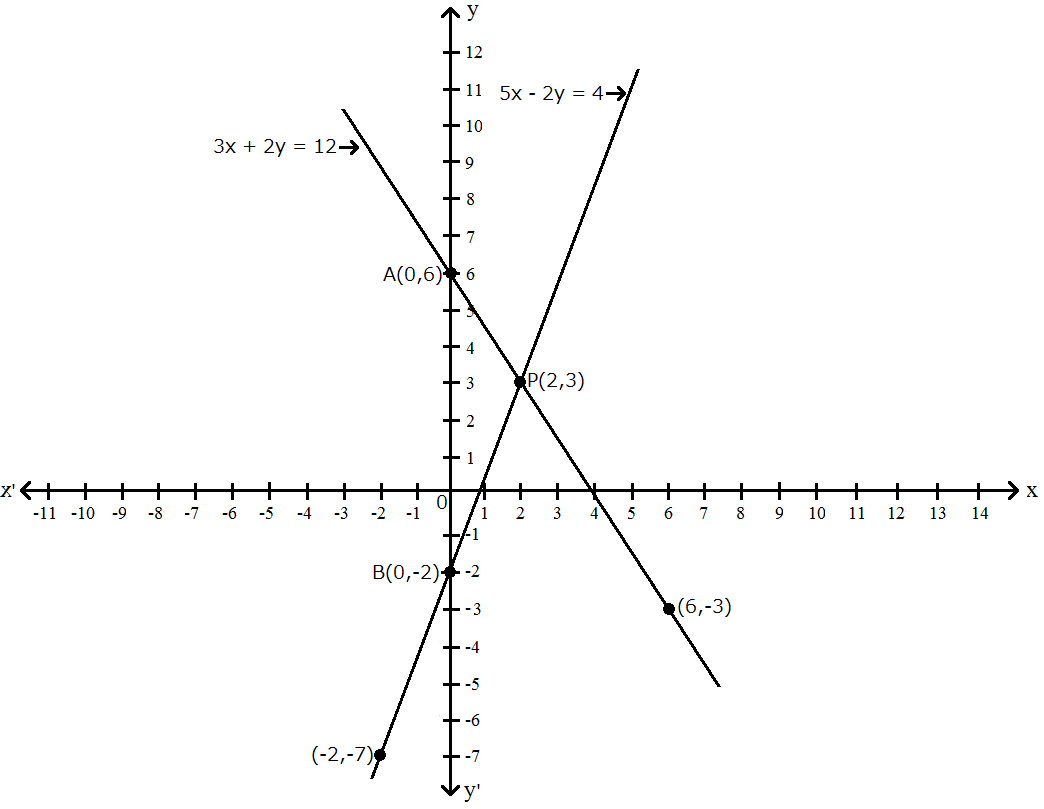
Solve graphically the following system of linear equation. Also find the coordinates of the points where the lines meet axis of y.
3x + 2y = 12
5x - 2y = 4
Answer
We have,
3x + 2y = 12
5x - 2y = 4
Now, 3x + 2y = 12
⇒ 3x = 12 - 2y
$\Rightarrow\text{x}=\frac{12-2\text{y}}{3}$
When y = 3, we have,
$\text{x}=\frac{12-2\times3}{3}=2$
When y = -3, we have,
$\text{x}=\frac{12-2\times(-3)}{3}=6$
Thus, we have the following table giving points on the line 3x + 2y = 12
x
2 6
y
3 -3
Now, 5x - 2y = 4
⇒ 5x = 4 + 2y
$\Rightarrow\text{x}=\frac{4+2\text{y}}{5}$
When y = 3, we have,
$\text{x}=\frac{4+2\times3}{5}=2$
When y = -7, we have,
$\text{x}=\frac{4+2\times(-7)}{5}=-2$
Thus, we have the following table points on the line 5x + 2y = 4
x
2
-2
y
3 -7
Graph of the given equations,

Clearly, two intersect at P(2, 3).
Hence, x = 2, y = 3 is the solution of the given system of equations.
We also observe that lines represented by 3x + 2y = 12 and 5x - 2y = 4 meet y-axis at A(0, 6) and B(0, -2) respectively.
View full question & answer
Question 1865 Marks
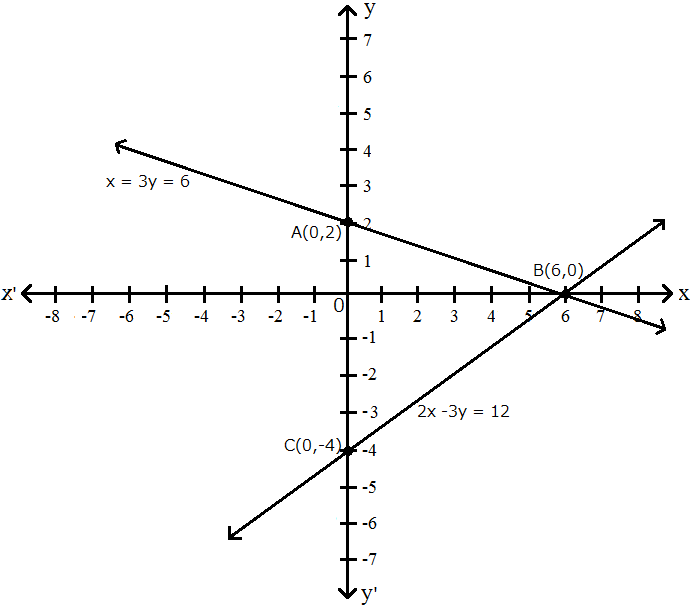
Represent the following pair of equations graphically and write the coordinates of points where the lines intersects y-axis.
x + 3y = 6,
2x - 3y = 12.
Answer
The given equations are
x + 3y = 6 ......(i)
2x - 3y = 12 ........(ii)
Putting x = 0 in equation (i) we get,
⇒ 0 + 3y = 6
⇒ y = 2
⇒ x = 0, y = 2
Putting y = 0 in equation (i) we get,
⇒ x + 3 × 0 = 6
⇒ x = 6
⇒ x = 6, y = 0
Use the following table to draw the graph.
x
0
6
y
2
0
The graph of (i) can be obtained by plotting the two points A(0, 2), B(6, 0).
2x - 3y = 12 ......(ii)
Putting x = 0 in equation (ii) we get,
⇒ 2 × 0 - 3y = 12
⇒ y = -4
⇒ x = 0, y = -4
Putting y = 0 in equation (ii) we get,
⇒ 2x - 3 × 0 = 12
⇒ x = 6
⇒ x = 6, y = 0
Use the following table to draw the graph.
x
0
6
y
-4
0
Draw the graph by plotting two points C(0, -4), D(6, 0) from table.

Graph of lines represented by the equations x + 3y = 6, 2x - 3y = 12 meet y-axis at A(0, 2), C(0, -4) respectively.
View full question & answer
Question 1875 Marks
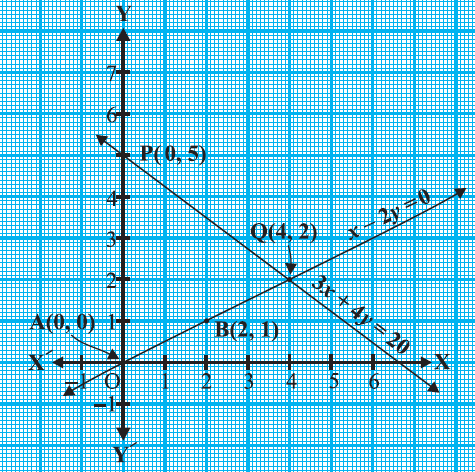
Akhila went to a fair in her village. She wanted to enjoy rides in the Giant Wheel and play Hoopla (a game in which you throw a rig on the items kept in the stall, and if the ring covers any object completely you get it). The number of times she played Hoopla is half the number of rides she had on the Giant Wheel. Each ride costs Rs. 3, and a game of Hoopla costs Rs. 4. If she spent Rs. 20 in the fair, represent this situation algebraically and graphically.
Answer
The pair of equations formed is: $\text{y}=\frac{1}{2}\text{x}$ i.e., x - 2y = 0 3x + 4y = 20 Let us represent these equations graphically. For this, we need at least two solutions for each equation. We give these solutions in Table:
x
0
2
$\text{y}-\frac{\text{x}}{2}$
0
1
x
0
2
4
$\text{y}=\frac{20-3\text{x}}{4}$
5
0
2
Recall from Class IX that there are infinitely many solutions of each linear equation. So each of you choose any two values, which may not be the ones we have chosen. Can you guess why we have chosen x = 0 in the first equation and in the second equation? When one of the variables is zero, the equation reduces to a linear equation is one variable, which can be solved easily. For instance, putting x = 0 in Equation (2), we get 4y = 20 i.e. y = 5 Similarly, putting y = 0 in equation (2), we get 3x = 20 i.e., $\text{x}=\frac{20}{3}.$ but as $\frac{20}{3}$ is not an integer, it will not be easy to plot exactly on the graph paper. So, we choose y = 2 Which gives x = 4, an integral value. Plot the points A(0, 0), B(2, 1) and P(0, 5), Q(4, 12), corresponding to the draw the lines AB and PQ, representing the equations x - 2y = 0 and 3x + 4y = 20, as shown. observe that the two lines representing the two equations are intersecting at the point (4, 2).
View full question & answer
Question 1885 Marks
Aftab tells his daughter, "Seven years ago, I was seven times as old as you were then. Also, three years from now, I shall be three times as old as you will be". Is not this interesting? Represent this situation algebraically and graphically.
Answer
Let present age of aftab be x years and his daughter be y years.
Seven years ago:
Age of aftab = (x - 7) years
Age of his daughter = (y - 7) years
According to question:
(x - 7) = 7(y - 7)
⇒ x - 7 = 7y - 49
⇒ x - 7y + 42 = 0 .......(i)
Three year from now:
Age of abtab = (x + 3) years
Age of his daughter = (y + 3) years
According to question:
(x + 3) = 3(y + 3)
⇒ (x + 3) = 3y + 9
⇒ x - 3y - 6 = 0 ........(ii)
Thus, equation (i) and (ii) show the situation algelraically.
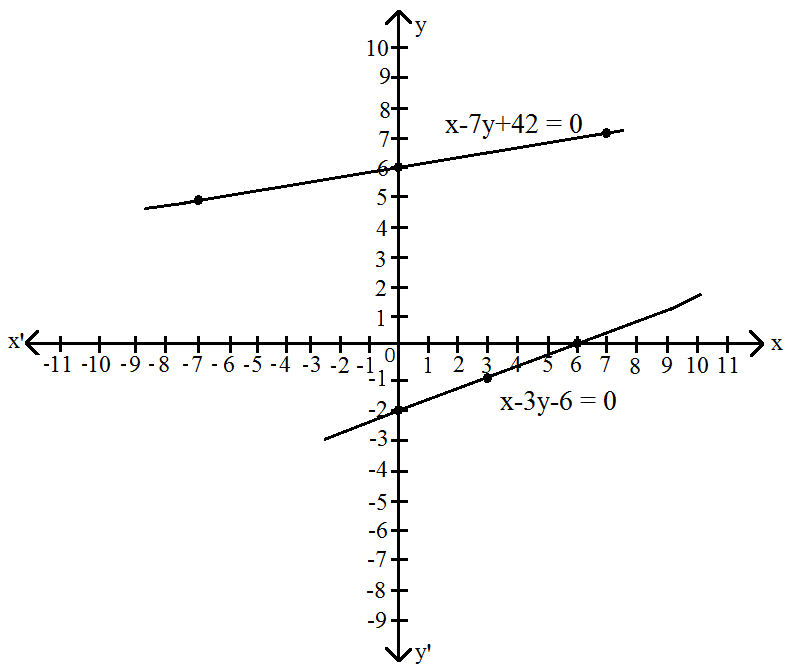
Graphically represention:
In equation (i), putting x = 0, we get y = 6
Putting x = 7, we get y = 7
Putting x = 7, we get y = 5
x
0
7
-7
y
6
7
5
In equation (ii), putting x = 0, we get y = -2
putting x = 3, we get y = -1
putting x = 6, we get y = 0
x
0
3
6
y
-2
-1
0
View full question & answer
Question 1895 Marks
Solve the following systems of equations:
$\frac{10}{\text{x}+\text{y}}+\frac{2}{\text{x}-\text{y}}=4,$
$\frac{15}{\text{x}+\text{y}}-\frac{5}{\text{x}-\text{y}}=-2.$
Answer
$\frac{10}{\text{x}+\text{y}}+\frac{2}{\text{x}-\text{y}}=4$
$\frac{15}{\text{x}+\text{y}}-\frac{5}{\text{x}-\text{y}}=-2$
Putting $\frac{1}{\text{x}+\text{y}}=\text{p} $ and $\frac{1}{\text{x}-\text{y}}=\text{q} $ in the given equations, we get:
10p + 2q = 4
⇒10p + 2q - 4 = 0 ......(i)
15p - 2q = -2
⇒15p - 5q + 2 = 0 ........(ii)
Using cross multiplication, we get
$\frac{\text{p}}{4-20}=\frac{\text{q}}{-60-(-20)}=\frac{1}{-50-30}$
$\frac{\text{p}}{-16}=\frac{\text{q}}{-80}=\frac{1}{-80}$
$\frac{\text{p}}{-16}=\frac{1}{-80}$ and $\frac{\text{q}}{-80}=\frac{1}{-80}$
$\text{p}=\frac{1}{5}$ and $\text{q}=1$
$\text{p}=\frac{1}{\text{x}+\text{y}}=\frac{1}{5}$ and $\text{q}=\frac{1}{\text{x}-\text{y}}=1$
x + y = 5 .....(iii)
and x - y = 1 .....(iv)
Adding equation (iii) and (iv), we get
2x = 6
x = 3 .... (v)
Putting value of x in equation (iii), we get
y = 2
Hence, x = 3 and y = 2.
View full question & answer
Question 1905 Marks
Solve graphically the system of linear equations:
4x - 3y + 4 = 0,
4x + 3y - 20 = 0.
Find the area bounded by these lines and x-axis.
Answer
The given equations are,
4x - 3y + 4 = 0 ......(i)
4x + 3y - 20 = 0 ........(ii)
From (i), $\text{y}=\frac{4\text{x}+4}{3}$
Putting x = 2, we get y = 4
Putting x = 5, we get y = 8
Putting x = -1, we get y = 0
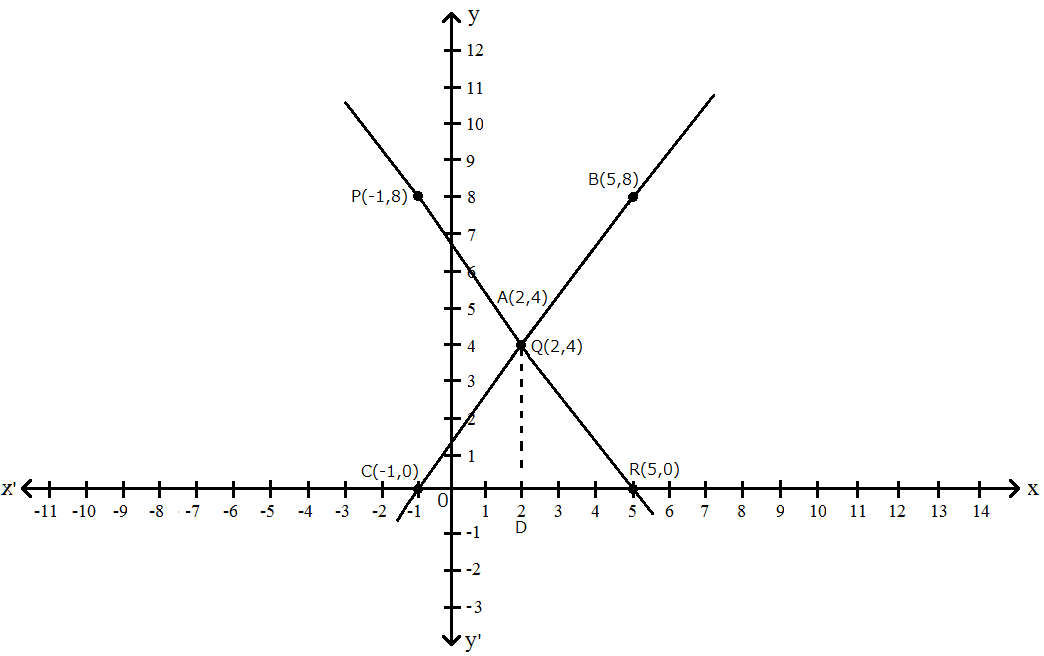
Thus, plot the points A(2, 4), B(5, 8) and C(-1, 0) On the graph paper.
From (ii), $\text{y}=\frac{20-4\text{x}}{3}$
Putting x = -1, we get y = 8
Putting x = 2, we get y = 4
Putting x = 5, we get y = 0
Thus Plot the points P(-1, 8), Q(2, 4) and R(5, 0) on the graph paper.

Thus, theb are boundad by these lines and x-axis in from of $\triangle\text{OQR}.$
Area of $\triangle\text{OQR} =\frac{1}{2}\times\text{OR}\times\text{QD}$
$=\frac{1}{2}\times6\times4$
= 3 × 4
= 12 sq. units.
When, we solve these equations we get x = 2 and y = 4.
View full question & answer
Question 1915 Marks
The boat goes 30km upstream and 44km downstream in 10 hours. In 13 hours, it can go 40km upstream and 55km downstream. Determine the speed of stream and that of the boat in still water.
Answer
Let the speed of the boat in still water be x km/hr and the speed of the stream be y km/hr
Speed upstream = (x - y) km/hr
Speed down stream = (x + y) km/hr
Now,
Time taken to cover 30km upstream $=\frac{30}{\text{x}-\text{y}}\text{hrs.}$
Time taken to cover 44km down stream $=\frac{44}{\text{x}+\text{y}}\text{hrs.}$
But total time of journey is 10 hours
$\frac{30}{\text{x}-\text{y}}+\frac{44}{\text{x}+\text{y}}=10\ ....(\text{i})$
Time taken to cover 40km upstream $=\frac{40}{\text{x}-\text{y}}\text{hrs.}$
Time taken to cover 55km down stream $=\frac{55}{\text{x}+\text{y}}\text{hrs.}$
In this case total time of journey is given to be 13 hours
$\therefore\frac{40}{\text{x}-\text{y}}+\frac{55}{\text{x}+\text{y}}=13\ ....(\text{ii})$
Putting $\frac{1}{\text{x}-\text{y}}=\text{u}$ and $\frac{1}{\text{x}-\text{y}}=\text{v}$ in equation (i) and (ii) we get
$30\text{u}+44\text{v}=10$
$40\text{u}+55\text{v}=10$
$30\text{u}+44\text{v}-10=0\ ....(\text{iii})$
$40\text{u}+55\text{v}-13=0\ .....(\text{iv})$
Solving these equations by cross multiplication we get
$\Rightarrow\frac{\text{u}}{44\times-13-55\times-10}=\frac{-\text{v}}{30\times-13-40\times-10}\\=\frac{1}{30\times55-40\times44}$
$\Rightarrow\frac{\text{u}}{-572+550}=\frac{-\text{v}}{-390+400}=\frac{1}{1650-1760}$
$\Rightarrow\frac{\text{u}}{-22}=\frac{-\text{v}}{10}=\frac{1}{-110}$
$\Rightarrow\text{u}=\frac{-22}{-110}$
$\Rightarrow\text{v}=\frac{-10}{-110}$
$\text{u}=\frac{1}{5}$ and $\text{v}=\frac{1}{11}$
Now, $\text{u}=\frac{2}{10}$
$\frac{1}{\text{x}-\text{y}}=\frac{2}{10}$
$1\times10=2(\text{x}-\text{y})$
$10=2\text{x}-2\text{y}\div2$
$5=\text{x}-\text{y}\ ....(\text{v})$
$\text{v}=\frac{1}{11}$
$\frac{1}{\text{x}+\text{y}}=\frac{1}{11}$
$1\times11=1(\text{x}+\text{y})$
$11=\text{x}+\text{y}\ ....(\text{vi})$
By solving equation (v) and (vi) we get
$\text{x}\ -\ \text{y}\ =\ 15\\\text{x}\ +\ \text{y}\ =\ 16\over2\text{x}\ \ \ \ \ \ =\ 16$
$\text{x}=\frac{16}{2}$
$\text{x}=8$
Substituting x = 8 in equation (vi) we get
$\text{x}+\text{y}=11$
$8+\text{y}=11$
$\text{y}=11-8$
$\text{y}=3$
Hence, speed of the boat in still water is 8 km/hr. Speed of the stream is 3km/hr.
View full question & answer
Question 1925 Marks
Ritu can row downstream 20km in 2 hours, and upstream 4km in 2 hours. Find her speed of rowing in still water and the speed of the current.
Answer
Let the speed of rowing in still water be x km/hr and the speed of the current be y km/hrLet the speed of rowing in still water be x km/ hr and the speed of the current be y km/ hr.
Speed upstream = (x - y) km/ hr
Speed downstream = (x + y) km/ hr
Now,
Time taken to cover 20km down steam $=\frac{20}{\text{x}+\text{y}}\text{ hrs.}$
Time taken to cover 4km upstream $=\frac{4}{\text{x}+\text{y}}\text{ hrs.}$
But, time taken to cover 20km downstream in 2 hours
$\frac{20}{\text{x}+{\text{y}}}=2$
$20=2(\text{x}+\text{y})$
$20=2\text{x}+2\text{y}\ ......(\text{i})$
Time taken to cover 4km upstream in 2 hours
$\frac{4}{\text{x}-\text{y}}=2$
$4=2(\text{x}-\text{y})$
$4=2\text{x}-2\text{y}\ .....(\text{ii})$
By solving these equation (i) and (ii) we get
$2\text{x}\ +\ 2\text{y}\ =\ 20\\2\text{x}\ -\ 2\text{y}\ =\ \ \ 4\over4\text{x}\ \ \ \ \ \ \ \ \ \ \ =\ 24$
$\text{x}=\frac{24}{4}$
$\text{x}=6$
Substitute x = 6 in equation (i) we get
$2\text{x}+2\text{y}=20$
$2+2\text{y}=20$
$2\text{y}=20-12$
$\text{y}=\frac{8}{2}$
$\text{y}=4$
Hence, the speed of rowing in still water is 6km/ hr.
The speed of current is 4km/ hr.
View full question & answer
Question 1935 Marks
Solve the following system of equations by the method of cross-multiplication:
$\text{bx}+\text{cy}=\text{a}+\text{b}$
$\text{ax}\Big(\frac{1}{\text{a}-\text{b}}-\frac{1}{\text{a}+\text{b}}\Big)+\text{cy}\Big(\frac{1}{\text{b}-\text{a}}-\frac{1}{\text{b}+\text{a}}\Big)=\frac{2\text{a}}{{\text{a}+\text{b}}}$
Answer
The given system of equation is,
$\text{bx}+\text{cy}=\text{a}+\text{b}\ ....(\text{i})$
$\text{a}\text{x}\Big(\frac{1}{\text{a}-\text{b}}-\frac{1}{\text{a}+\text{b}}\Big)+\text{cy}\Big(\frac{1}{\text{b}-\text{a}}-\frac{1}{\text{b}+\text{a}}\Big)=\frac{2\text{a}}{\text{a}+\text{b}}\ ...(\text{ii})$
From equation (i) we get
$\text{bx}+\text{cy}-(\text{a}+\text{b})=0\ ...(\text{iii})$
From equation (ii) we get
$\text{a}\text{x}\Big[\frac{\text{a}+\text{b}-(\text{a}-\text{b})}{(\text{a}-\text{b})(\text{a}+\text{b})}\Big]+\text{cy}\Big(\frac{\text{b}+\text{a}-(\text{b}-\text{a})}{(\text{b}-\text{a})(\text{b}+\text{a})}\Big)-\frac{2\text{a}}{\text{a}+\text{b}}=0$
$ \Rightarrow\text{a}\text{x}\Big[\frac{\text{a}+\text{b}-\text{a}+\text{b}}{(\text{a}-\text{b})(\text{a}+\text{b})}\Big]+\text{cy}\Big(\frac{\text{b}+\text{a}-\text{b}+\text{a}}{(\text{b}-\text{a})(\text{b}+\text{a})}\Big)-\frac{2\text{a}}{\text{a}+\text{b}}$
$\Rightarrow\text{a}\text{x}\Big[\frac{2\text{b}}{(\text{a}-\text{b})(\text{a}+\text{b})}\Big]+\text{cy}\Big(\frac{2\text{a}}{(\text{b}-\text{a})(\text{b}+\text{a})}\Big)-\frac{2\text{a}}{\text{a}+\text{b}}=0$
$ \Rightarrow\text{x}\Big[\frac{2\text{a}\text{b}}{(\text{a}-\text{b})(\text{a}+\text{b})}\Big]+\text{y}\Big(\frac{2\text{a}\text{c}}{-(\text{a}-\text{b})(\text{a}+\text{b})}\Big)-\frac{2\text{a}}{\text{a}+\text{b}}=0$
$ \Rightarrow\text{x}\Big[\frac{2\text{a}\text{b}}{(\text{a}-\text{b})(\text{a}+\text{b})}\Big]+\text{y}\Big(\frac{-2\text{a}\text{c}}{(\text{a}-\text{b})(\text{a}+\text{b})}\Big)-\frac{2\text{a}}{\text{a}+\text{b}}=0$
$\Rightarrow\frac{1}{\text{a}+\text{b}}\Big[\frac{2\text{abx}}{\text{a}-\text{b}}-\frac{2\text{acy}}{\text{a}-\text{b}}-2\text{a}\Big]=0$
$\Rightarrow\frac{2\text{abx}}{\text{a}-\text{b}}-\frac{2\text{acy}}{\text{a}-\text{b}}-2\text{a}=0$
$ \Rightarrow\frac{2\text{abx}-2\text{acy}-2\text{a}(\text{a}-\text{b})}{\text{a}-\text{b}}=0$
$\Rightarrow2\text{abx}-2\text{acy}-2\text{a}(\text{a}-\text{b})=0\ ...(\text{iv})$
From equation (i) and equation (ii) we get
$a_1 = b, b_1 = c, c_1 = -(a + b)$
$a_2 = 2ab, b2 = -2ac$ and $c_2 = -2a(a - b)$
By cross-multiplication we get,
$\Rightarrow\frac{\text{x}}{-2\text{ac}(\text{a}-\text{b})-\big[-(\text{a}+\text{b})\big][-2\text{ac}]}\\=\frac{-\text{y}}{-2\text{ab}(\text{a}-\text{b})-\big[-(\text{a}+\text{b})\big][2\text{ab}]}\\=\frac{1}{-2\text{abc}-2\text{abc}}$
$\Rightarrow\frac{\text{x}}{-2\text{a}^2\text{c}+2\text{ab}-\big[2\text{a}^2\text{c}+2\text{abc}\big]}\\=\frac{-\text{y}}{-2\text{a}^2\text{b}+2\text{ab}^2+\big[2\text{a}^2\text{b}+2\text{ab}^2\big]}\\=\frac{1}{-4\text{abc}}$
$\Rightarrow\frac{\text{x}}{-2\text{a}^2\text{c}+2\text{ab}-2\text{a}^2\text{c}-2\text{abc}}\\=\frac{-\text{y}}{-2\text{a}^2\text{b}+2\text{ab}^2+2\text{a}^2\text{b}+2\text{ab}^2}\\=\frac{1}{-4\text{abc}}$
$\Rightarrow\frac{\text{x}}{-4\text{a}^2\text{c}}=\frac{-\text{y}}{4\text{a}\text{b}^2}=\frac{-1}{4\text{abc}}$
Now,
$\frac{\text{x}}{-4\text{a}^2\text{c}}=\frac{-1}{4\text{abc}}$
$\Rightarrow\text{x}=\frac{4\text{a}^2\text{c}}{4\text{abc}}=\frac{\text{a}}{\text{b}}$
and,
$\Rightarrow\text{y}=\frac{4\text{a}^2\text{c}}{4\text{abc}}=\frac{\text{b}}{\text{c}}$
Hence, $\text{x}=\frac{\text{a}}{\text{b}},\text{y}=\frac{\text{b}}{\text{c}}$ is the solution of the given system of the equations.
View full question & answer
Question 1945 Marks
Solve the following systems of equations:
x - y + z = 4,
x - 2y - 2z = 9,
2x + y + 3z = 1.
Answer
We have,
x - y + z = 4 ........(i)
x - 2y - 2z = 9 .......(ii)
2x + y + 3z = 1 .........(iii)
From equation (i) we get
z = 4 - x + y
⇒ z = -x + y + 4
Substituting the value of z in equation (ii) we get
x - 2y - 2(-x + y + 4) = 9
⇒ x - 2y + 2x - 2y - 8 = 9
⇒ 3x - 4y = 9 + 8
⇒ 3x - 4y = 17 .......(iv)
Substituting the value of z in equation (iii) we get
2x + y + 3(-x + y + 4) = 1
⇒ 2x + y - 3x + 3y + 12 = 1
⇒ -x + 4y = 1 - 12
⇒ -x + 4y = -11 .......(v)
Adding equations (iv) and (v) we get
3x - x - 4y + 4y = 17 - 11
⇒ 2x = 6
$\Rightarrow\text{x}=\frac{6}{2}=3$
Puuting x = 3 in equation (iv) we get
3 × 3 - 4y = 17
⇒ 9 - 4y = 17
⇒ -4y = 17 - 9
⇒ -4y = 8
$\Rightarrow\text{y}=\frac{8}{-4}=-2$
Putting x = 3 and y = -2 in z = -x + y + 4 we get
z = -3 - 2 + 4
⇒ z = -5 + 4
⇒ z = -1
Hence solution of the giving system of equation is x = 3, y = -2, z = -1.
View full question & answer
Question 1955 Marks
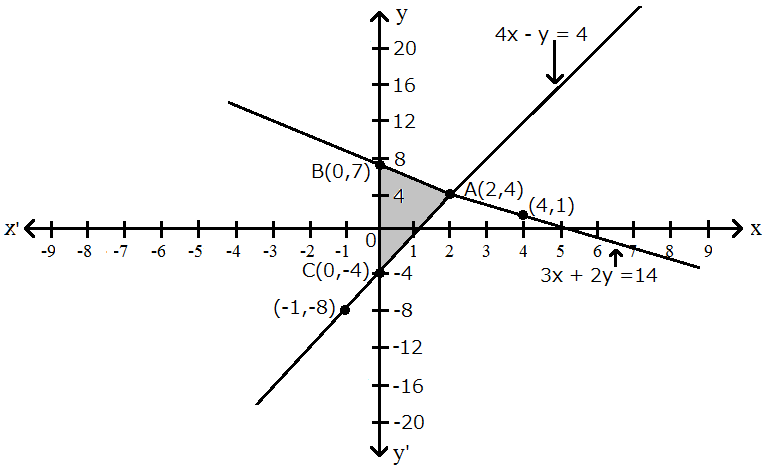
Solve the following system of equations graphically:
Shade the region between the lines and the y-axis.
4x - y = 4,
3x + 2y = 14.
Answer
The given system of equations is
4x - y = 4
3x + 2y = 14
Now, 4x - y = 4
⇒ 4x - 4 = y
⇒ y = 4x - 4
When x = 0, we have
y = 4 × 0 - 4 = -4
When x = -1, we have
y = 4 × (-1) - 4 = -8
Thus, we have the following table.
x
0
-1
y
-4
-8
We have,
3x + 2y = 14
⇒ 2y = 14 - 3x
$\Rightarrow\text{y}=\frac{14-3\text{x}}{2}$
When x = 0, we have
$\text{y}=\frac{14-3\times0}{2}=7$
When x = 4, we have
$\text{y}=\frac{14-3\times4}{2}=1$
Thus, we have the following table.
x
0
4
y
7
1
Graph of the given system of equations

Clearly, the two lines intersect at A(2, 4). Hence, x = 2, y = 4 is the solution of the given system of equations.
We also observe $\triangle\text{ABC}$ is the required shaded region.
View full question & answer
Question 1965 Marks
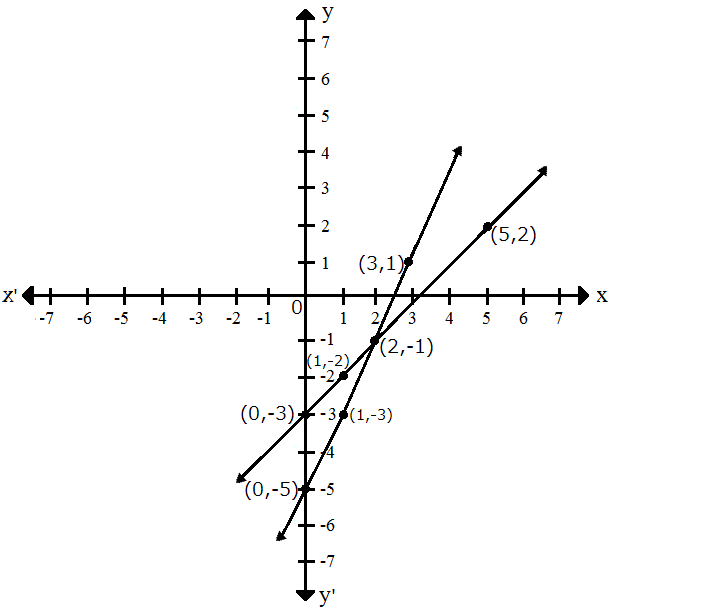
Solve graphically the following system of linear equation. Also find the coordinates of the points where the lines meet axis of y.
$2x - y - 5 = 0,$
$x - y - 3 = 0.$
Answer
$2x - y - 5 = 0 .....(i)$
$x - y - 3 = 0 ..........(ii)$
The two points satisfying (i) can be listed in a table as,
x
1
3
y
-3
1
The two points satisfying (ii) can be listed in a table as,
x
1
5
y
-2
2
Now, graph of equations (i) and (ii) can be drawn as,

It is seen that the solution of the given system of equations is given by x = 2, y = -1. Also, it is observed that the lines (i) and (ii) meet the y-axis at the points. (0, -3) and (0, -5) respectively.
View full question & answer
Question 1975 Marks
Solve the following system of linear equation graphically and shade the region between the two lines and x-axis:
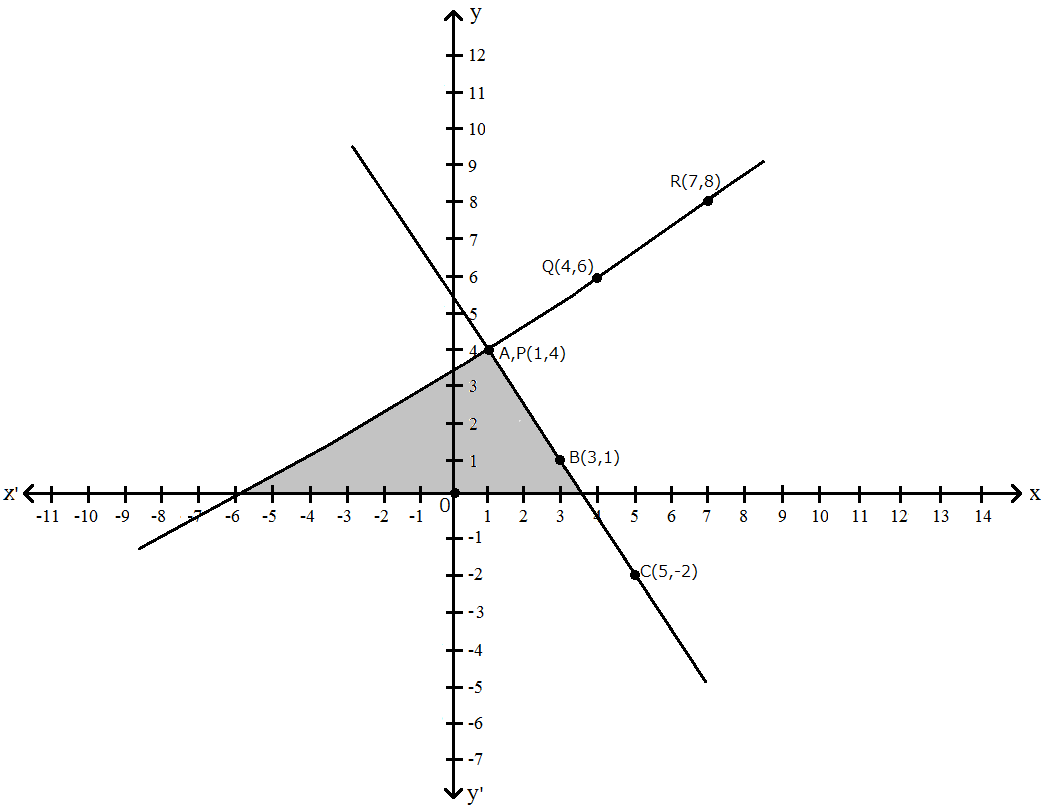
3x + 2y -11 = 0,
2x - 3y + 10 = 0.
Answer
The system of given equations are,
3x + 2y - 11 = 0 ......(i)
2x - 3y + 10 = 0 ........(ii)
From (i), $\text{y}=\frac{11-3\text{x}}{2}$
Putting x = 1, we get y = 4
Putting x = 3, we get y = 1
Putting x = 5, we get y = -2
Thus, plot A(1, 4), B(3, 1) and C(5, -2) on graph paper.
From (ii), $\text{y}=\frac{2\text{x}+10}{3}$
Putting x = 1, we get y = 4
Putting x = 4, we get y = 6
Putting x = 7, we get y = 8
Thus, plot P(1, 4), Q(4, 6) and R(7, 8) on graph paper.
View full question & answer
Question 1985 Marks
Solve the following system of linear equation graphically and shade the region between the two lines and x-axis:
2x + 3y = 12,
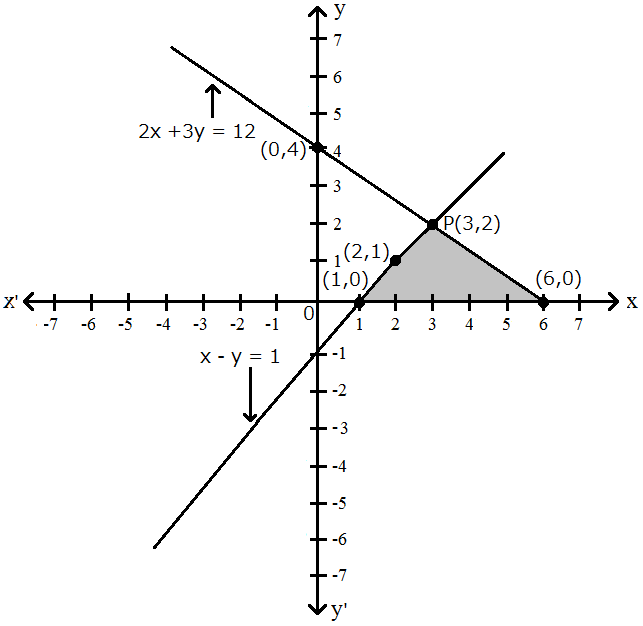
x - y = 1.
Answer
The system of given equations is,
2x + 3y = 12
x - y = 1
Now, 2x + 3y = 12
⇒ 2x = 12 - 3y
When y = 2, we have,
$\text{x}=\frac{12-3\times2}{2}=3$
When y = 4, we have,
$\text{x}=\frac{12-3\times4}{2}=0$
Thus, we have the following table,
x
0
3
y
4
2
We have, x - y = 1
⇒ x = 1 + y
When y = 0, we have,
x = 1
When y = 1, we have,
x = 1 + 1 = 2
Thus, we have the following table,
x
1
2
y
0
1
Graph of the given system of equations.

Clearly, the two lines intersect at P(3, 2).
Hence, x = 3, y = 2 is the solution of the given system of equations.
View full question & answer
Question 1995 Marks
Solve the following systems of equations graphically:
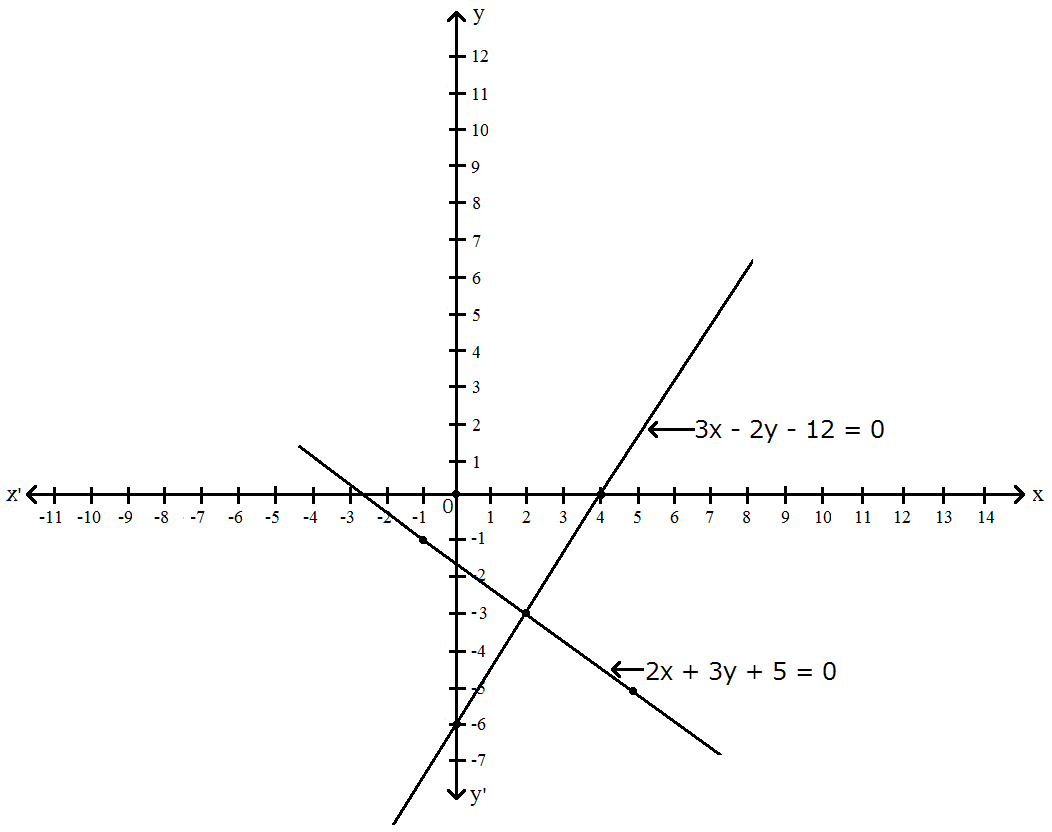
2x + 3y + 5 = 0
3x - 2y - 12 = 0
Answer
The given equations are,
2x + 3y + 5 = 0 .......(i)
3x - 2y - 12 = 0 ..........(ii)
From (i), $\text{y}=\frac{-5-2\text{x}}{3}\ .......(\text{iii})$
Putting x = -1 in (iii), we get y = -1
Putting x = 2 in (iii), we get y = -3
Putting x = 5 in (iii), we get y = -5
x
-1
2
5
y
-1
-3
-5
From (ii), $\text{y}=\frac{3\text{x}-12}{2}\ ......(\text{iv})$
Putting x = 0 in (iv), we get y = -6
Putting x = 2 in (iv), we get y = -3
Putting x = 4 in (iv), we get y = 0
x
0
2
4
y
-6
-3
0

Clearly, from the above graph solution of above system of equations is x = 2 and y = -3.
View full question & answer
Question 2005 Marks
A boat goes 12km upstream and 40km downstream in 8 hours. I can go 16km upstream and 32km downstream in the same time. Find the speed of the boat in still water and the speed of the stream.
Answer
Let the speed of boat in still water and speed of stream be x and y km/ hr. respectively.
Speed of upstream = (x - y) km/ hr.
Speed of downstream = (x + y) km/ hr.
Time taken to cover 12km. upstream $=\frac{12}{(\text{x}-\text{y})}\text{ hour.}$
Times taken to cover 40km. downstream $\frac{40}{(\text{x}+\text{y})}\text{ hour.}$
It takes 8 hours in journey so,
$\frac{12}{\text{x}-\text{y}}+\frac{40}{\text{x}+\text{y}}=8\ ....(\text{i})$
and, $\frac{16}{\text{x}-\text{y}}+\frac{32}{\text{x}+\text{y}}=8\ ....(\text{ii})$
let $\frac{1}{\text{x}-\text{y}}=\text{u}$ and $\frac{1}{\text{x}+\text{y}}=\text{v}$ then
12u + 40v = 8
⇒ 3u + 10v = 2 ....(iii)
⇒ 16u + 32v = 8
⇒ 2u + 4v = 1 .....(iv)
Multiplying (iii) by 2 and (iv) by 3, we get
⇒ 6u + 20v = 4 .....(v)
⇒ 6u + 12v = 3 .......(vi)
Subtracting (vi) from (v) we get
⇒ 8v = 1
$\Rightarrow\text{v}=\frac{1}{8}$
Putting $\text{v}=\frac{1}{8}$ in (iv) we get
$\Rightarrow2\text{u}+4\times\frac{1}{8}=1$
$\Rightarrow2\text{u}+\frac{1}{2}=1$
$\Rightarrow2\text{u}=\frac{1}{2}$
$\Rightarrow\text{u}=\frac{1}{4}$
$\because\frac{1}{\text{x}-\text{y}}=\text{u}$
$\text{x}-\text{y}=4\ ....(\text{vii})$
and $\frac{1}{\text{x}+\text{y}}=\text{v}$
$\text{x}+\text{y}=8\ .....(\text{viii})$
Adding (vii) and (viii) we get
⇒ 2x = 12
⇒ x = 6km/ hr.
Putting x = 6 in (viii) we get
⇒ 6 + y = 8
⇒ y = 2km/ hr.
Thus, speed of boat in still water = 6km/ hr. and speed of stream = 2km/ hr.
View full question & answer
5 Marks Questions - Page 4 - MATHS STD 10 Questions - Vidyadip