Questions · Page 3 of 5

5 Marks Questions

Question 1015 Marks
In the following system of equation determine whether the system has a unique solution, no solution or infinitely many solutions. In case there is a unique solution, find it:
3x - 5y = 20
6x - 10y = 40
Answer
3x - 5y = 20
6x - 10y = 40
Compareit with
$a_1x + b_1y + c_1 = 0$
$a_2x + b_2y + c_2 = 0$
we get
$a_1 = 3, b_1 = -5$, and$ c_1= -20$
$a_2 = 6, b_2 = -10$ and $c_2 = -40$
$\frac{\text{a}_1}{\text{a}_2}=\frac{3}{6},\frac{\text{b}_1}{\text{b}_2}=\frac{5}{10},$ and $\frac{\text{c}_1}{\text{c}_2}=\frac{1}{2}$
Simplifyingit we get
$\frac{\text{a}_1}{\text{a}_2}=\frac{1}{2},\frac{\text{b}_1}{\text{b}_2}=\frac{1}{2},$ and $\frac{\text{c}_1}{\text{c}_2}=\frac{1}{2}$
Hence, $\frac{\text{a}_1}{\text{a}_2}=\frac{\text{b}_1}{\text{b}_2}=\frac{\text{c}_1}{\text{c}_2}$
So both lines are coincident and overlap with each other, so it will have infinite or many solutions.
View full question & answer
Question 1025 Marks
Given the linear equation 2x + 3y - 8 = 0, write another linear equation in two variables such that the geometrical representation of the pair so formed is:
  1. Intersecting lines.
  2. Parallel lines.
  3. Coincident lines.
Answer
For the two lines $a_1x + b_1x + c_1 = 0$ and $a_2x + b_2x + c_2 = 0$, to be intersecting, we must have
$\frac{\text{a}_1}{\text{a}_2}\neq\frac{\text{b}_1}{\text{b}_2}$
So, the other linear equation can be 5x + 6y - 16 = 0
as $\frac{\text{a}_1}{\text{a}_2}=\frac{2}{5},$
$\frac{\text{b}_1}{\text{b}_2}=\frac{3}{6}=\frac{1}{2},$
$\frac{\text{c}_1}{\text{c}_2}=\frac{-8}{-16}=\frac{1}{2}$
For the two lines $a_1x + b_1x + c_1 = 0$ and $a_2x + b_2x + c_2 = 0$, to be parallel, we must have
$\frac{\text{a}_1}{\text{a}_2}=\frac{\text{b}_1}{\text{b}_2}\neq\frac{\text{c}_1}{\text{c}_2}$
So, the other linear equation can be 6x + 9y + 24 =0
as $\frac{\text{a}_1}{\text{a}_2}=\frac{2}{6}=\frac{1}{3},$
$\frac{\text{b}_1}{\text{b}_2}=\frac{3}{9}=\frac{1}{3},$
$\frac{\text{c}_1}{\text{c}_2}=\frac{-8}{24}=\frac{-1}{3}$
For the two lines $a_1x + b_1x + c_1 = 0$ and $a_2x + b_2x + c_2 = 0$, to be coincident, we must have
$\frac{\text{a}_1}{\text{a}_2}=\frac{\text{b}_1}{\text{b}_2}=\frac{\text{c}_1}{\text{c}_2}$
So, the other linear equation can be 8x + 12y - 32 =0
as $\frac{\text{a}_1}{\text{a}_2}=\frac{2}{8}=\frac{1}{4},$
$\frac{\text{b}_1}{\text{b}_2}=\frac{3}{12}=\frac{1}{4},$
$\frac{\text{c}_1}{\text{c}_2}=\frac{-8}{-32}=\frac{1}{4}$
View full question & answer
Question 1035 Marks
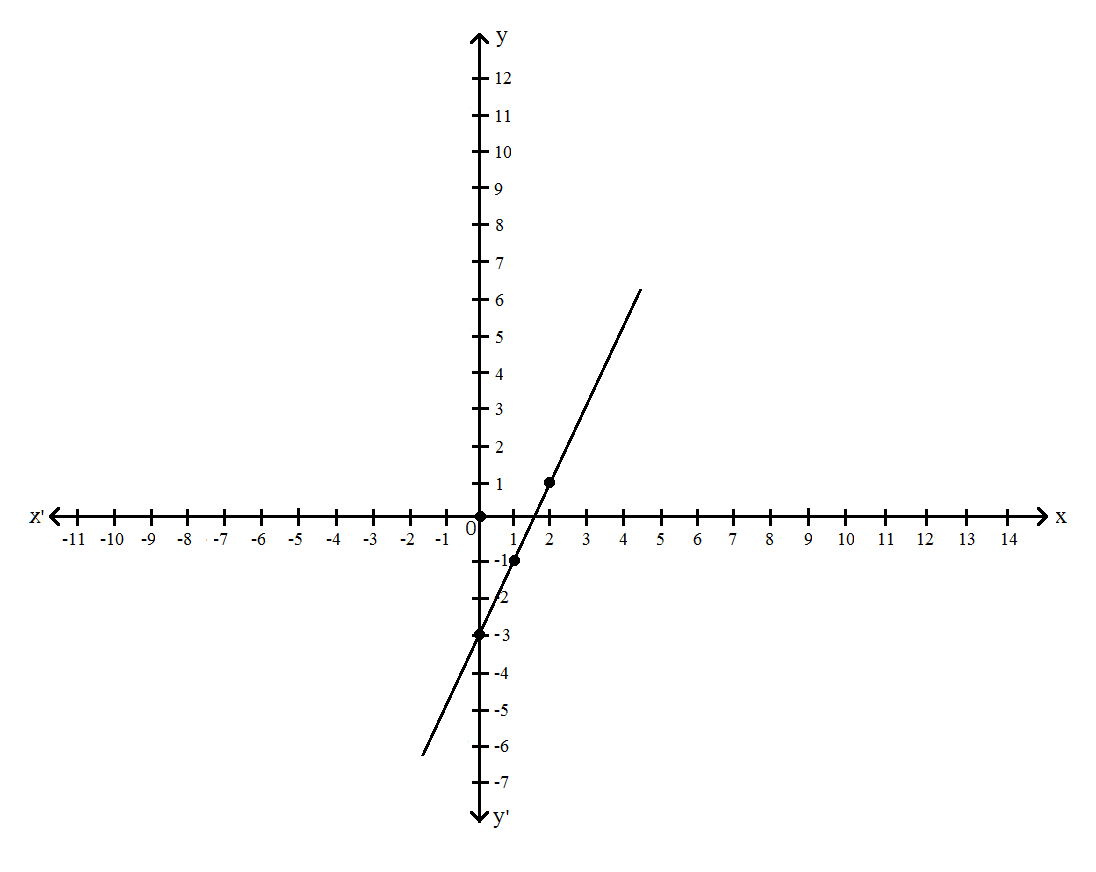
Determine, by drawing graphs, whether the following system of linear equations has a unique solution or not:
2y = 4x - 6, 2x = y + 3.
Answer
The given equations are,
2y = 4x - 6 ........(i)
2x = y + 3 ..........(ii)
From (i), $\text{y}=\frac{4\text{x}-6}{2}\ .....(\text{iii})$
When x = 0, y = -3
x = 1, y = -1
x = 2, y = 1
P lot these points A(0, -3), B(1, -1) and C(2, 1) on graph paper and join then,
From (ii), y = 2x - 3 ......(iv)
When x = 0, y = -3
x = 1, y = -1
x = 2, y = 1
P lot these points P(0, -3), Q(1, -1) and R(2, 1) on graph paper and join then.

We observe that points A, B, C and P, Q, R on same line so the syatem of equation has infinitaly many solutions.
View full question & answer
Question 1045 Marks
A two-digit number is 4 more than 6 times the sum of its digits. If 18 is subtracted from the number, the digits are reversed. Find the number.
Answer
Let the digit at unit and tens place be x and y respectively.
Number = 10y + x
Sum of digits = x + y
According to question,
10y + x = 6(x + y) + 4
⇒ 10y + x = 6x + 6y + 4
⇒ 5x - 4y + 4 = 0 ......(i)
and, 10y + x - 18 = 10x + y
⇒ 9x - 9y + 18 = 0
⇒ x - y + 2 = 0 .....(ii)
Multiplying (ii) by 4 we get
⇒ 4x - 4y + 8 = 0 ......(iii)
Subtracting (iii) from (i) we get
⇒ x - 4 = 0
⇒ x = 4
Putting x = 4 in (i) we get
⇒ 5 × 4 - 4y + 4 = 0
⇒ 20 - 4y + 4 = 0
⇒ 4y = 24
$\Rightarrow\text{y}=\frac{24}{4}$
⇒ y = 6
Thus, the number will be (6 × 10 + 4) = 64
View full question & answer
Question 1055 Marks
Solve the following systems of equations:$\frac{1}{3\text{x}+\text{y}}+\frac{1}{3\text{x}-\text{y}}=\frac{3}{4}$
$\frac{1}{2(3\text{x}-\text{y})}+\frac{1}{2(3\text{x}-\text{y})}=\frac{-1}{8}$
Answer
$\frac{1}{3\text{x}+\text{y}}+\frac{1}{3\text{x}-\text{y}}=\frac{3}{4}$$\frac{1}{2(3\text{x}+\text{y})}+\frac{1}{2(3\text{x}-\text{y})}=\frac{-1}{8}$
Putting $\frac{1}{3\text{x}+\text{y}}=\text{p} $ and $\frac{1}{3\text{x}-\text{y}}=\text{q} $ in the given equations.
we get
$\text{p}+\text{q}=\frac{3}{4}\dots(\text{i})$
$\frac{\text{p}}{2}-\frac{\text{q}}{2}=-\frac{1}{8}$
$\text{p}-\text{q}=-\frac{1}{4}\dots(\text{ii})$
Adding (i) and (ii), we get
$2\text{p}=\frac{3}{4}-\frac{1}{4}$
$2\text{p}=\frac{1}{2}$
$\text{p}=\frac{1}{4}$
Putting the value in equation (ii), we get
$\frac{1}{4}-\text{q}=-\frac{1}{4}$
$\text{q}=\frac{1}{4}+\frac{1}{4}=\frac{1}{2}$
$\text{p}=\frac{1}{3\text{x}+\text{y}}=\frac{1}{4}$
3x + y = 4 ...(iii)
$\text{q}=\frac{1}{3\text{x}-\text{y}}=\frac{1}{2}$
3x - y = 2 ...(iv)
Adding equations (iii) and (iv), we get
6x = 6
x = 1 ...(v)
Putting the value in equation (iii), we get
3(1) + y = 4
y = 1
Hence, x = 1 and y= 1.
View full question & answer
Question 1065 Marks
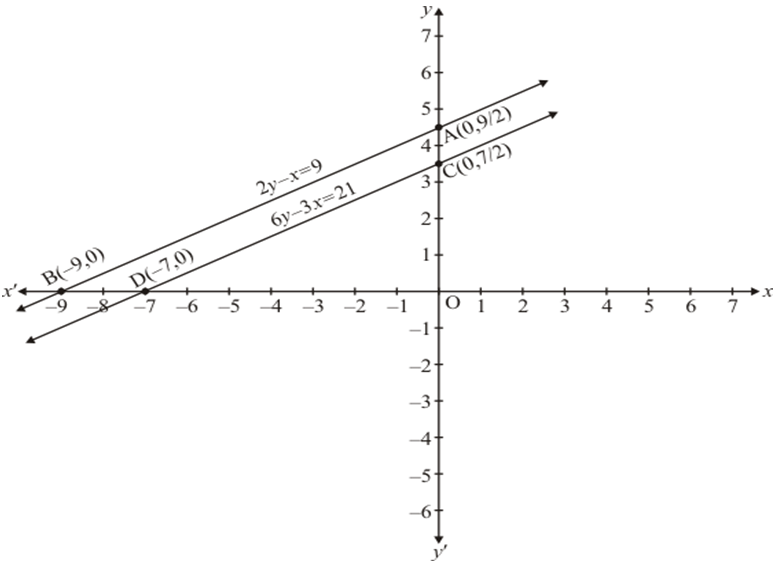
Show graphically that the following system of equation is in-consistent (i.e. has no solution):
2y − x = 9
6y − 3x = 21
Answer
The given equations are
2y − x = 9 ......(i)
6y − 3x = 21 .......(ii)
Putting x = 0 in equation (i), we get,
⇒ 2y - 0 = 9
$\Rightarrow\text{y}=\frac{9}{2}$
$\Rightarrow\text{x}=0,\ \text{y}=\frac{9}{2}$
Putting y = 0 in equation (i), we get,
⇒ 2 × 0 - x = 9
⇒ x = -9
⇒ x = -9, y = 0
Use the following table to draw the graph.
x
0
-9
y
$\frac{9}{2}$
0
Draw the graph by plotting the two points $\text{A}\Big(0,\frac{9}{2}\Big),$ B(-9, 0) from table.

6y - 3x = 21 ......(ii)
Putting x = 0 in equation (ii), we get,
⇒ 6y - 3 × 0 = 21
$\Rightarrow\text{y}=\frac{7}{2}$
$\Rightarrow\text{x}=0,\ \text{y}=\frac{7}{2}$
Putting y = 0 in equation (ii), we get,
⇒ 6 × 0 - 3x = 21
⇒ x = -7
$\therefore$ x = -7, y = 0
Use the following table to draw the graph.
x 0 -7
y $\frac{7}{2}$ 0
Draw the graph by plotting the two points $\text{C}\Big(0,\frac{7}{2}\Big),$ D(-7, 0) from table.
Here two lines are parallel and so don’t have common points. Hence the given system of equations has no solution.
View full question & answer
Question 1075 Marks
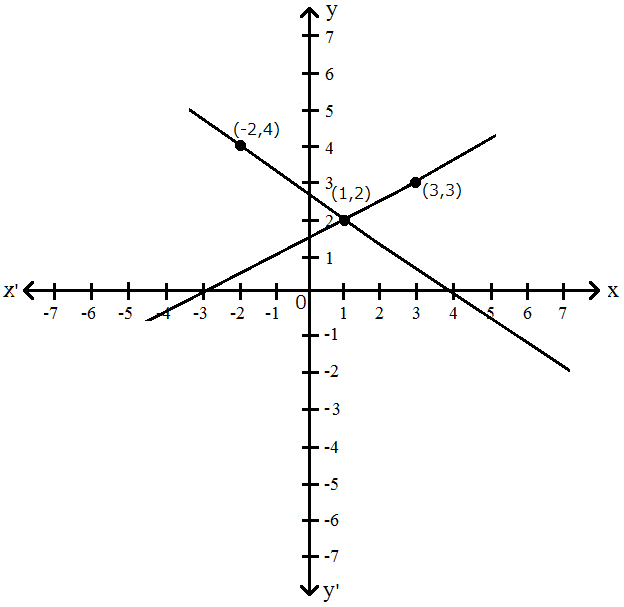
Solve graphically each of the following systems of linear equations. Also, find the coordinates of the points where the lines meet the axis of x in each system.
2x + 3y = 8,
x - 2y = -3.
Answer
The given equations are,
2x + 3y = 8 ......(i)
x - 2y = -3 .........(ii)
⇒ 2x = 8 - 3y
$\text{x}=\frac{8-3\text{y}}{2}$
Substituting some different values of y, we get their corresponding values of x as shown below.
x
4
1
-2
y
0
2
4
Plot these points on the graph and join them similarly in equation
x - 2y = -3
x = 2y - 3
x
-3
-1
1
y
0
1
2
Now plot these points and join them we see that these two lines intersect each other at (1, 2) x = 1, y = 2 and also these lines meet x-axis at (4, 0) and (-3, 0) respectively as shown in the,
View full question & answer
Question 1085 Marks
Solve the following systems of equations:
$\frac{5}{\text{x}+\text{y}}-\frac{2}{\text{x}-\text{y}}=-1,$
$\frac{15}{\text{x}+\text{y}}+\frac{7}{\text{x}-\text{y}}=10.$
Answer
Let $\frac{1}{\text{x}+\text{y}}=\text{u}$ and $\frac{1}{\text{x}-\text{y}}=\text{v}$ so
5u - 2v = -1 .....(i)
15u + 7v = 10 .....(ii)
Multiplying (i) by 3 we get
⇒ 15u - 6v = -3 .......(iii)
Subtracting (iii) from (ii) we get
⇒ 13v = 13
⇒ v = 1
Putting v = 1 in (iii) we get
⇒ 15u - 6 × 1 = -3
⇒ 15u = 3
$\Rightarrow\text{u}=\frac{1}{5}$
$\therefore\frac{1}{\text{x}+\text{y}}=\frac{1}{5}$
x + y = 5 .....(iv)
$\frac{1}{\text{x}-\text{y}}=1$
x - y = 1 .......(v)
Adding (iv) and (v) we get
⇒ 2x = 6
⇒ x = 3
Putting x = 3 in (iv) we get
⇒ 3 + y = 5
⇒ y = 2
Thus x = 3 and y = 2.
View full question & answer
Question 1095 Marks
Solve the following system of equations by the method of cross-multiplication:
$\frac{\text{x}}{\text{a}}+\frac{\text{y}}{\text{b}}=\text{a}+\text{b},$
$\frac{\text{x}}{\text{a}^2}+\frac{\text{y}}{\text{b}^2}=2.$
Answer
The given system of equation may be written as
$\frac{1}{\text{a}}\text{x}\times+\frac{1}{\text{b}}\times\text{y}-(\text{a}+\text{b})=0$
$\frac{1}{\text{a}^2}\text{x}\times+\frac{1}{\text{b}^2}\times\text{y}-2=0$
Here, $\text{a}_1=\frac{1}{\text{a}},\text{b}_2=\frac{1}{\text{b}},\text{c}_1=-(\text{a}+\text{b})$
$\text{a}_2=\frac{1}{\text{a}^2},\text{b}_2=\frac{1}{\text{b}^2},$ and $\text{c}_2=-2$
By cross multiplication, we get
$\Rightarrow\frac{\text{x}}{\frac{1}{\text{b}}(-2)+\frac{1}{\text{b}^2}(\text{a}+\text{b})}=\frac{-\text{y}}{\frac{1}{\text{a}}\times2+\frac{1}{\text{a}^2}(\text{a}+\text{b})}\\=\frac{1}{\frac{1}{\text{a}}\times\frac{1}{\text{b}^2}-\frac{1}{\text{a}^2}\times\frac{1}{\text{b}}}$
$ \Rightarrow\frac{\text{x}}{-\frac{2}{\text{b}}+\frac{\text{a}}{\text{b}^2}+\frac{1}{\text{b}}}=\frac{-\text{y}}{-\frac{2}{\text{a}}+\frac{1}{\text{a}}+\frac{\text{b}}{\text{a}^2}}=\frac{1}{-\frac{1}{\text{ab}^2}-\frac{1}{\text{a}^2\text{b}}}$
$\Rightarrow\frac{\text{x}}{\frac{\text{a}}{\text{b}^2}-\frac{1}{\text{b}}}=\frac{-\text{y}}{-\frac{1}{\text{a}}+\frac{\text{b}}{\text{a}^2}}=\frac{1}{\frac{1}{\text{ab}^2}-\frac{1}{\text{a}^2\text{b}}}$
$ \Rightarrow\frac{\text{x}}{\frac{\text{a}-\text{b}}{\text{b}^2}}=\frac{\text{y}}{\frac{\text{a}-\text{b}}{\text{a}^2}}=\frac{1}{\frac{\text{a}-\text{b}}{\text{a}^2\text{b}^2}}$
$\Rightarrow\text{x}=\frac{\text{a}-\text{b}}{\text{b}^2}\times\frac{1}{\frac{\text{a}-\text{b}}{\text{a}^2\text{b}^2}}=\text{a}^2$ and $\text{y}=\frac{\text{a}-\text{b}}{\text{a}^2}\times\frac{1}{\frac{\text{a}-\text{b}}{\text{a}^2\text{b}^2}}=\text{b}^2$
Hence, $\text{x}=\text{a}^2,\ \text{y}=\text{b}^2$ is the solution of the given system of the equtaions.
View full question & answer
Question 1105 Marks
The sum of the digits of a two-digit number is 9. Also, nine times this number is twice the number obtained by reversing the order of the digits. Find the number.
Answer
Let the units digit and tens digits of the number be x and y respectively.
Number = 10y + x
Number after reversing the digits = 10x + y
According to the question,
x + y = 9 ....(i)
9(10y + x) = 2(10x + y)
88y - 11x = 0 ......(ii)
Adding equations (i) and (ii) we obtain,
9y = 9
y = 1
Substituting the value of y in equation (i) we obtain,
x = 8
Thus, the number is 10y + x = 10 × 1 + 8 = 18
Concept insight: This problem talks about a two digit number. Here, remember that a two digit number xy can be expanded as 10x + y. Then, using the two given conditions, a pair of linear equations can be formed which can be solved by eliminating one of the variables.
View full question & answer
Question 1115 Marks
Solve the following system of equations by the method of cross-multiplication:
6(ax + by) = 3a + 2b
6(bx - ay) = 3b - 2a
Answer
The given system of equations is,
6(ax + by) = 3a + 2b ......(i)
6(bx - ay) = 3b - 2a ........(ii)
From equation (i) we get,
6ax + 6by - (3a + 2b) = 0 .....(iii)
From equation (ii) we get,
6bx - 6ay - (3b - 2a) = 0 .......(iv)
Here, $a_1 = 6a, b_1 = 6b, c_1 = -(3a + 2b)$
$a_2 = 6b, b_2 = -6a,$ and $c_2 = -(3b - 2a)$
By cross-multiplication we have,
$\Rightarrow\frac{\text{x}}{-6\text{b}(3\text{b}-2\text{a})-6\text{a}(\text{3a + 2b})}=\frac{-\text{y}}{-\text{6a}(\text{3b - 2a)}+\text{6b}(\text{3a +2b})}\\=\frac{1}{-\text{36a}^2-\text{36b}^2}$
$\Rightarrow \frac{\text{x}}{-\text{18b}^2+12\text{ab}-18\text{a}^2-12\text{ab}}=\frac{-\text{y}}{-18\text{ab}+\text{12a}^2+\text{18ab}+\text{12b}^2}\\=\frac{1}{-\text{36}(\text{a}^2+\text{b}^2)}$
$ \Rightarrow\frac{\text{x}}{-18\text{a}^2-18\text{b}^2}=\frac{-\text{y}}{12\text{a}^2+12\text{b}^2}=\frac{1}{-\text{36}(\text{a}^2+\text{b}^2)}$
$\Rightarrow\frac{\text{x}}{-18(\text{a}^2+\text{b}^2)}=\frac{-\text{y}}{12(\text{a}^2+\text{b}^2)}=\frac{-1}{\text{36}(\text{a}^2+\text{b}^2)}$
Now, $ \frac{\text{x}}{-18(\text{a}^2+\text{b}^2)}=\frac{-1}{\text{36}(\text{a}^2+\text{b}^2)}$
$\Rightarrow\text{x}=\frac{{18(\text{a}^2+\text{b}^2)}}{{\text{36}(\text{a}^2+\text{b}^2)}}$
$\Rightarrow\text{x}=\frac{1}{2}$
and, $\frac{-\text{y}}{12(\text{a}^2+\text{b}^2)}=\frac{-1}{36(\text{a}^2+\text{b}^2)}$
$\Rightarrow\text{y}=\frac{12(\text{a}^2+\text{b}^2)}{36(\text{a}^2+\text{b}^2)}$
$\Rightarrow\text{y}=\frac{1}{3}$
Hence, $\text{x}=\frac{1}{2}$ and $\text{y}=\frac{1}{3}$
View full question & answer
Question 1125 Marks
Solve the following systems of equations:
99x + 101y = 499,
101x + 99y = 501.
Answer
The given system of equation is
99x + 101y = 499 .......(i)
101x + 99y = 501 ........(ii)
Adding equation (i) and equation (ii) we get
99x + 101x + 101y + 99y = 499 + 501
⇒ 200x + 200y = 1000
⇒ 200 (x + y) = 1000
$\Rightarrow\text{x}+\text{y}=\frac{1000}{200}=5$
⇒ x + y = 5 ......(iii)
Subtracting equation (i) by equation (ii) we get
101x - 99x + 99y - 101y = 501 - 499
⇒ 2x + 2y = 2
⇒ 2(x - y) = 2
$\Rightarrow\text{x}-\text{y}=\frac{2}{2} $
$\Rightarrow\text{x}-\text{y}=1 \ .....(\text{iv})$
Adding equation (iii) and equation (iv) we get
2x = 5 + 1
$\Rightarrow\text{x}=\frac{6}{2} =3$
Putting x = 3 in equation (iii) we get
3 + y = 5
⇒ y = 5 - 3 = 2
Hence solution of the given system of equation is x = 3, y = 2.
View full question & answer
Question 1135 Marks
Solve the following systems of equations:
$2\text{x}-\frac{3}{\text{y}}=9,$
$\text{3}\text{x}+\frac{7}{\text{y}}=2,\text{y}\neq0.$
Answer
The given system of equation is
$2\text{x}-\frac{3}{\text{y}}=9\ .....(\text{iv})$
$\text{3}\text{x}+\frac{7}{\text{y}}=2,\text{y}\neq0\ .....(\text{ii})$
Taking $\frac{1}{\text{y}}=\text{u},$ the given equations becomes
$2\text{x}-3\text{u}=9\ ....(\text{iii})$
$3\text{x}+7\text{u}=2\ ....(\text{iv})$
From (iii), we get
$2\text{x}=9+3\text{u}$
$\Rightarrow\text{x}=\frac{9+3\text{u}}{2}$
Substituting $\text{x}=\frac{9+3\text{u}}{2}$ in (iv), we get
$3\Big(\frac{9+3\text{u}}{2}\Big)+7\text{u}=2$
$\Rightarrow\frac{27+9\text{u}+14\text{u}}{2} =2$
$\Rightarrow27+23\text{u}=2\times2$
$\Rightarrow23\text{u}=4-27$
$\Rightarrow\text{u}=\frac{-23}{23}=-1$
Hence, $\text{y}=\frac{1}{\text{u}}=\frac{1}{-1}=-1$
Putting u = -1 in $=\text{x}=\frac{9+3\text{u}}{2},$ we get
$\text{x}=\frac{9+3(-1)}{2}$
$=\frac{9-3}{2}=\frac{6}{2}=3$
$\Rightarrow\text{x}=3$
Hence, solution of the given system of equation is x = 3, y = -1.
View full question & answer
Question 1145 Marks
The sum of the numerator and denominator of a fraction is 3 less than twice the denominator. If the numerator and denominator are decreased by 1, the numerator becomes half the denominator. Determine the fraction.
Answer
Let the numerator and denominator of the fraction be x and y respectively. Then the fraction is $\frac{\text{x}}{\text{y}}$
The sum of the numerator and denominator of the fraction is 3 less than twice the denominator.
Thus, we have
x + y = 2y - 3
⇒ x + y - 2y + 3 = 0
⇒ x - y + 3 = 0
If the numerator and denominator are decreased by 1, the numerator becomes half the denominator.
Thus, we have
$\text{x}-1=\frac{1}{2}(\text{y}-1)$
$\Rightarrow\frac{\text{x}-1}{\text{y}-1}=\frac{1}{2}$
⇒ 2(x - 1) = y - 1
⇒ 2x - 2 = y - 1
⇒ 2x - y - 1 = 0
So, we have two equations
x - y + 3 = 0
2x - y - 1 = 0
Here x and y are unknowns. We have to solve the above equations for x and y.
By using cross-multiplication, we have
$ \Rightarrow\frac{\text{x}}{(-1)\times(-1)-(-1)\times3}=\frac{-\text{y}}{1\times(-1)-2\times3}\\=\frac{1}{1\times(-1)-2\times(-1)}$
$ \Rightarrow\frac{\text{x}}{1+3}=\frac{-\text{y}}{-1-6}=\frac{1}{-1+2}$
$\Rightarrow\frac{\text{x}}{4}=\frac{-\text{y}}{-7}=\frac{1}{1}$
$\Rightarrow\frac{\text{x}}{4}=\frac{-\text{y}}{-7}=1$
$\Rightarrow\text{x}=4,\ \text{y}=7 $
Hence, the fraction is $\frac{4}{7}$
View full question & answer
Question 1155 Marks
Solve the following systems of equations:
152x - 378y = −74,
-378x + 152y = -604.
Answer
$152\text{x}-378\text{y}=-74$
$-378\text{x}+152\text{y}=-604$
The given pair of linear equations is
$152\text{x}-378\text{y}=-74\dots(\text{i})$
$-378\text{x}+152\text{y}=-604\dots(\text{ii})$
Adding equation (i) and equation (ii), we get
$-226\text{x}-226\text{y}=-678$
$\Rightarrow\ \text{x}+\text{y}=3\dots(\text{iii})$
[Dividing throughout by -226]
Subtracting equation (ii) from equation (i), we get
$530\text{x}-530\text{y}=530$
$\Rightarrow\ \text{x}-\text{y}=1\dots(\text{iv})$
[Dividing throughout by 530]
Adding equation (iii) and equation (iv), we get
$2\text{x}=4 $
$\Rightarrow\ \text{x}=\frac{4}{2}=2$
Subtracting equation (iv) from equation (iii), we get
$2\text{y}=2$
$\Rightarrow\ \text{y}=\frac{2}{2}=1$
Hence, the solution of the given pair of linear equations is x = 2, y = 1.
View full question & answer
Question 1165 Marks
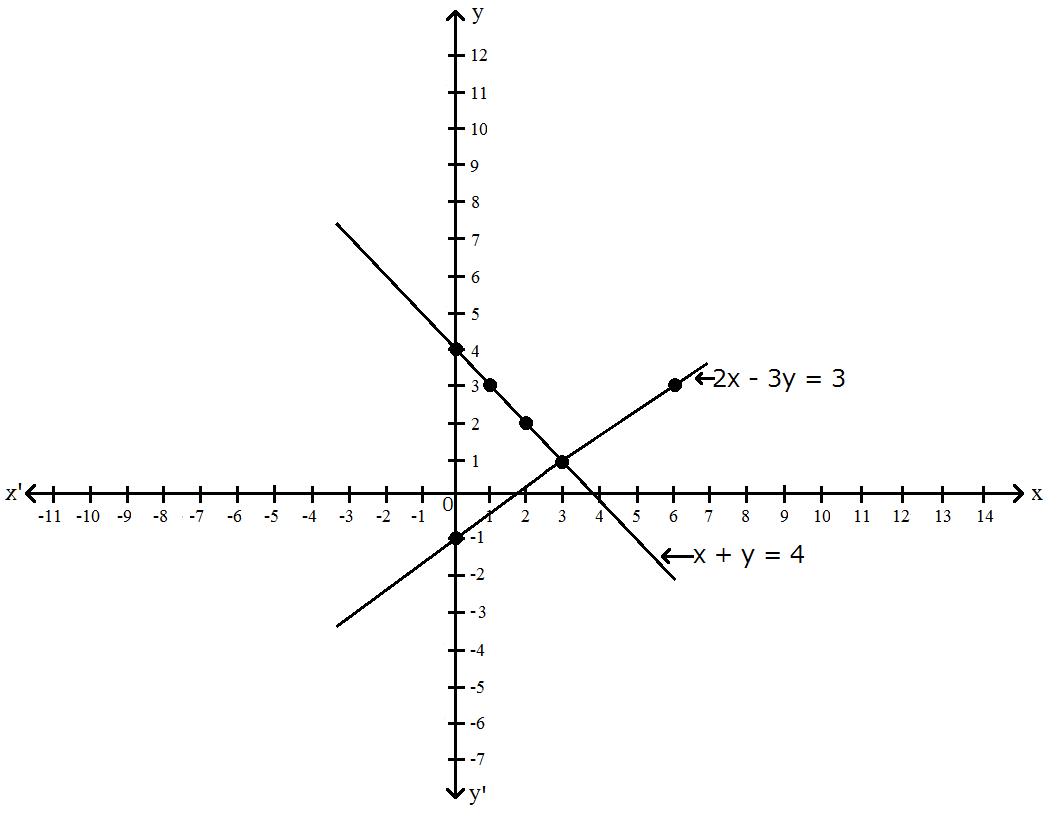
Solve the following systems of equations graphically:
x + y = 4
2x - 3y = 3
Answer
The given equations are,
x + y = 4 ......(i)
2x - 3y = 3 ........(ii)
From (i), y = 4 - x .......(iii)
Putting x = 0 in (iii), we get y = 4
Putting x = 1 in (iii), we get y = 3
Putting x = 2 in (iii), we get y = 2
x
0
1
2
y
4
3
2
From (ii), $\text{y}=\frac{2\text{x}-3}{3}\ ......(\text{iv})$
Putting x = 0 in (iv), we get y = -1
Putting x = 3 in (iv), we get y = 1
Putting x = 6 in (iv), we get y = 3
x
0
3
6
y
-1
1
3

Clearly, from the above graph solution of above syatam of equations is x = 3 and y = 1.
View full question & answer
Question 1175 Marks
2 men and 7 boys can do a piece of work in 4 days. The same work is done in 3 days by 4 men and 4 boys. How long would it take one man and one boy to do it?
Answer
Let one man alone can finish the work in x days and one boy alone can finish it in y days. Then,
One man's one day's work $=\frac{1}{\text{x}}$
One boy's alay's work $= \frac{1}{\text{y}}$
2 men one day work $= \frac{2}{\text{x}}$
7 boys one day work $= \frac{7}{\text{y}}$
Since 2 men and 7 days can finish the work in 4 days.
$\Rightarrow4\Big(\frac{2}{\text{x}}+\frac{7}{\text{y}}\Big)=1$
$\Rightarrow\frac{8}{\text{x}}+\frac{28}{\text{y}}=1\ ....(\text{i})$
Again 4 men and 4 boys can finish the work in 3 days.
$\Rightarrow3\Big(\frac{4}{\text{x}}+\frac{4}{\text{y}}\Big)=1$
$\Rightarrow\frac{12}{\text{x}}+\frac{12}{\text{y}}=1.....(\text{ii})$
Putting $\frac{1}{\text{x}}=\text{u}$ and $\frac{1}{\text{y}}=\text{v}$ in equation (i) and eq. (ii)
$\Rightarrow8\text{u}+28\text{v}-1=0\ ...(\text{iii})$
$\Rightarrow12\text{u}+12\text{v}-1=0\ ....(\text{iv})$
By using cross-multiplication we have
$\Rightarrow\frac{\text{u}}{28\times(-1)-12\times(-1)}=\frac{\text{-v}}{8\times(-1)-12\times(-1)}\\=\frac{1}{8\times12-12\times28}$
$\Rightarrow\frac{\text{u}}{-28+12}=\frac{\text{-v}}{-8+12}=\frac{1}{96-336}$
$\Rightarrow\frac{\text{u}}{-16}=\frac{\text{-v}}{4}=\frac{1}{-240}$
$\Rightarrow\frac{\text{u}}{-16}=\frac{1}{-240}$
$\Rightarrow\text{u}=\frac{-16}{-240}$
$\Rightarrow\text{u}=\frac{1}{15}$
$\Rightarrow\frac{\text{-v}}{4}=\frac{1}{-240}$
$\Rightarrow\text{v}=\frac{4}{240}$
$\Rightarrow\text{v}=60$
View full question & answer
Question 1185 Marks
Solve the following systems of equations:
$\frac{1}{2(\text{x}+2\text{y})}+\frac{5}{3(3\text{x}-2\text{y})}=\frac{-3}{2}$
$\frac{5}{4(\text{x}+2\text{y})}-\frac{3}{5(3\text{x}-2\text{y})}=\frac{61}{60}$
Answer
Let $\frac{1}{\text{x}+2\text{y}}=\text{u}$ and $\frac{1}{3\text{x}-2\text{y}}=\text{v}$
Then the given system of equation become
$\frac{\text{u}}{2}+\frac{5\text{v}}{3}=\frac{-3}{2}$
$\Rightarrow\frac{3\text{u}+10\text{v}}{6}=\frac{-3}{2}$
$\Rightarrow3\text{u}+10\text{v}=-9\ .....(\text{i})$
$\frac{5\text{u}}{4}-\frac{3\text{v}}{5}=\frac{61}{60}$
And
$\Rightarrow\frac{25\text{u}-12\text{v}}{20}=\frac{61}{60}$
$\Rightarrow25\text{u}-12\text{v}=\frac{61}{3}\ ......(\text{ii})$
Multiplying equation (i) by 12, and equation (ii) by 10, we get
$36\text{u}+120\text{v}=-108\ .....(\text{iii})$
$250\text{u}-120\text{v}=\frac{610}{3}\ .....(\text{iv})$
Adding equation (iii) and equation (iv) we get
$36\text{u}+250\text{u}=\frac{610}{3}-108$
$\Rightarrow286\text{u}=\frac{610-324}{3}$
$\Rightarrow286\text{u}=\frac{286}{3}$
$\Rightarrow\text{u}=\frac{1}{3}$
Putting $\text{u}=\frac{1}{3}$ in equation (i) we get
$3\times\frac{1}{3}+10\text{v}=-9$
$\Rightarrow1+10\text{v}=-9$
$\Rightarrow10\text{u}=-9-1$
$\Rightarrow\text{v}=\frac{-10}{10}=-1$
Now, $\text{u}=\frac{1}{\text{x}+2\text{y}}$
$\Rightarrow\frac{1}{\text{x}+\text{v}}=\frac{1}{3}$
$\Rightarrow\text{x}+2\text{y}=3\ ......(\text{v})$
And $\text{v}=\frac{1}{3\text{x}-2\text{y}}$
$\Rightarrow\frac{1}{3\text{x}-2\text{y}}=-1$
$\Rightarrow3\text{x}-2\text{y}=-1\ .....(\text{vi})$
Putting $\text{x}=\frac{1}{2}$ in equation (v), we get
$\frac{1}{2}+2\text{y}=3$
$\Rightarrow2\text{y}=3-\frac{1}{2}$
$\Rightarrow2\text{y}=\frac{6-1}{2}$
$\Rightarrow\text{y}=\frac{5}{4}$
Hence solution of the given system is $\text{x}=\frac{1}{2}, \text{y}=\frac{5}{4}.$
View full question & answer
Question 1195 Marks
In a cyclic quadrilateral ABCD $\angle\text{A}=(2\text{x}+4)^\circ,\angle\text{B}=(\text{y}+3)^\circ,$ $\angle\text{C}=(2\text{y}+10)^\circ,\angle\text{D}=(4\text{x}-5)^\circ.$ Find the four angles.
Answer
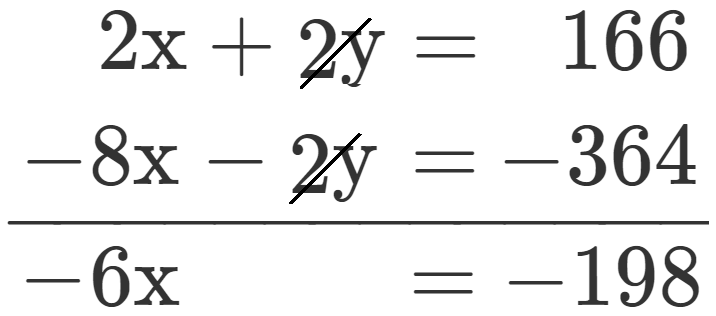
We know that the sum of the opposite angles of cyclic quadrilateral is 180°. in the cyclic quadrilateral ABCD, angles A and C and angles B and D pairs of opposite angles. Therefore $\angle\text{A}+\angle\text{C}=180^\circ$ By substituting $\angle\text{A}=(2\text{x}+4)^\circ$ and $\angle\text{C}=(2\text{y}+10)^\circ$ we get 2x + 4 + 2y + 10 = 180 2x + 2y + 14 = 180° 2x + 2y = 180° - 14° 2x + 2y = 166 .....(i) Taking $\angle\text{B}+\angle\text{D}=180^\circ$ By substituting $\angle\text{B}=(\text{y}+3)^\circ$ and $\angle\text{D}=(4\text{x}-5)^\circ$ we get y + 3 + 4x - 5 = 180° 4x + y - 5 + 3 = 180° 4x + y - 2 = 180° 4x + y = 180° + 2° 4x + y = 182° .....(ii) By multiplying equation (ii) by 2 we get 8x + 2y = 364 .....(iii) By subtracting equation (iii) from (i) we get
$\text{x}=\frac{-198}{-6}$ x = 33° By substituting x = 33° in equation (ii) we get 4x + y = 182 4 × 33 + y = 182 132 + y = 182 y = 182 - 132 y = 50 The angles of a cyclic quadrilateral are $\angle\text{A}=2\text{x}+4$ = 2 × 33 + 4 = 66 + 4 = 70° $\angle\text{B}=\text{y}+3$ = 50 + 3 = 53° $\angle\text{C}=2\text{y}+10^\circ$ = 2 × 50 + 10 = 100 + 10 = 110° $\angle\text{D}=4\text{x}-5$ = 4 × 33 - 5 = 132 - 5 = 127° Hence, the angles of cyclic quadrilateral ABCD are $\angle\text{A}=70^\circ,\angle\text{B}=53^\circ,\angle\text{C}=110^\circ,\angle\text{D}=127^\circ$
View full question & answer
Question 1205 Marks
Solve graphically each of the following systems of linear equations. Also, find the co-ordinates of the points where the lines meet the axis of x in each system.
2x - y = 2,
4x - 2y = 8.
Answer
2x - y = 2 .......(i)
4x - y = 8 ......(ii)
2x - y = 2 .....(i)
⇒ y = 2x - 2
Substituting some different values of x, we get corresponding values of y as shown below.
x
0
1
2
y
-2
0
2
Now plot the points on the graph and join them similarly in equation
4x - y = 8....(ii)
⇒ y = 4x - 8
x
1
2
3
y
-4
0
4
Now polt these points and join them we see that these two lines intersect each other at (3, 4) x = 3, y = 4. These two lines also meet x-axis at (1, 0) and (2, 0) respectively as shown in the,
View full question & answer
Question 1215 Marks
Solve the following systems of equations:
$\frac{4}{\text{x}}+3\text{y}=14,$
$\frac{1}{3\text{x}}-4\text{y}=23.$
Answer
$\frac{4}{\text{x}}+3\text{y}=14$
$\frac{3}{\text{x}}-4\text{y}=23$
Let $\frac{1}{\text{x}}=\text{p}$ in the equations changes we get
$4\text{p}+3\text{y}=14$
$\Rightarrow4\text{p}+3\text{y}-14=0\ ...(\text{i})$
$3\text{p}-4\text{y}=23$
$\Rightarrow3\text{p}-4\text{y}-23=0\ ...(\text{ii})$
By cross-multiplication. we get
$\frac{\text{p}}{-69-56}=\frac{\text{y}}{-42-(-92)}=\frac{1}{-16-9}$
$\Rightarrow-\frac{\text{p}}{125}=\frac{\text{y}}{50}=\frac{1}{-25}$
Now,
$-\frac{\text{p}}{125}=\frac{-1}{25}\ \text{and}\ \frac{\text{y}}{50}=\frac{1}{-25}$
$\Rightarrow\text{p}=5\ \text{and}\ \text{y}=-2$
Also, $\text{p}=\frac{1}{\text{x}}=5$
$\Rightarrow\text{x}=\frac{1}{5}$
So, $\text{x}=\frac{1}{5}$ and y = -2 is the solution.
View full question & answer
Question 1225 Marks
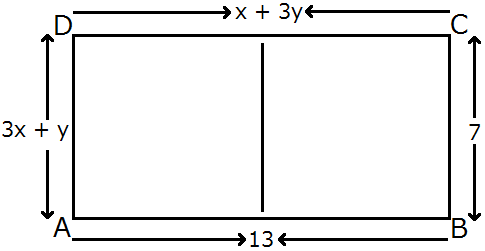
Find the values of x and y in the following rectangle.
Answer
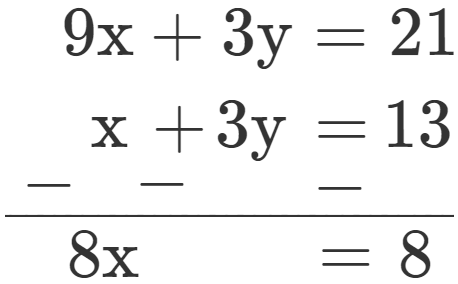
By Property of rectangle, Lengths are equal i.e., CD = AB ⇒ x + 3y = 13 .....(i) Breadth are equal i.e., AD = BC ⇒ 3x + y = 7 ......(ii) On multiplying eq. (ii) by 3 and then subtracting eq. (i) we get
x = 1 On Putting x = 1 in eq. we get 3y = 12 ⇒ y = 4 Hence the equired values of x and y are 1 and 4, respectively.
View full question & answer
Question 1235 Marks
Places A and B are 80km apart from each other on a highway. A car starts from A and other from B at the same time. If they move in the same direction, they meet in 8 hours and if they move in opposite directions, they meet in 1 hour and 20 minutes. Find the speeds of the cars.
Answer
Let x and y be two cars starting from points A and B respectively.
Let the speed of the car X be x km/hr and that of the car Y be y km/hr.
Case I: When two cars move in the same directions:
Suppose two cars meet at point Q, then,
Distance travelled by car X = AQ
Distance travelled by car Y = BQ
It is given that two cars meet in 8 hours.
Distance travelled by car X in 8 hours = 8x km AQ = 8x
Distance travelled by car Y in 8 hours = 8y km BQ = 8y
Clearly AQ - BQ = AB
8x - 8y = 80
Both sides divided by 8, we get
x - y = 10 .....(i)
Case II: When two cars move in opposite direction
Suppose two cars meet at point P, then,
Distance travelled by X car X = AP
Distance travelled by Y car Y = BP
In this case, two cars meet in 1 hour 20 minutes, we can write it as 1 hour $1\frac{1}{3}$ hours that is $\frac{4}{3}$ hours.
Therefore,
Distance travelled by car y in $\frac{4}{3}$ hours $=​​\frac{4}{3}\text{x}\text{ km}$
Distance travelled by car y in $\frac{4}{3}$ hours $=​​\frac{4}{3}\text{y}\text{ km}$
$\text{AP}+\text{BP}=\text{AB}$
$\frac{4}{3}\text{x}+\frac{4}{3}\text{y}=80$
$\frac{4}{3}(\text{x}+\text{y})=80$
$(\text{x}+\text{y})=80\times\frac{3}{4}$
$\text{x}+\text{y}=60\ ....(\text{ii})$
By solving (i) and (ii) we get,
$\text{x}\ -\ \text{y}\ =\ 10\\\text{x}\ +\ \text{y}\ =\ 60\over2\text{x}\ \ \ \ \ \ =\ 70$
$\text{x}=\frac{70}{2}$
$\text{x}=35$
By substituting x = 35 in equation (ii) we get
$\text{x}-\text{y}=60$
$35+\text{y}=60$
$\text{y}=60-35$
$\text{y}=25$
Hence, Speed of car X is 35km/hr. speed of car Y is 25km/hr.
View full question & answer
Question 1245 Marks
Solve the following systems of equations:
$\frac{22}{\text{x}+\text{y}}+\frac{15}{\text{x}-\text{y}}=5,$
$\frac{55}{\text{x}+\text{y}}+\frac{45}{\text{x}-\text{y}}=14.$
Answer
Let $\frac{1}{\text{x}+\text{y}}=\text{u}$ and $\frac{1}{\text{x}-\text{y}}=\text{v}.$ Then the given system of equation becomes
$22\text{u}+15\text{v}=5\ ......(\text{i})$
$55\text{u}+45\text{v}=14\ ......(\text{ii})$
Multiplying equation (i) by 3, and equation (ii) by 1, we get
$66\text{u}+45\text{v}=15\ ......(\text{iii})$
$55\text{u}+45\text{v}=14\ ......(\text{iv})$
Subtracting equation (iv) from equation (iii) we get
$66\text{u}-55\text{u}=15-4$
$\Rightarrow11\text{u}=1$
$\Rightarrow\text{u}=\frac{1}{11}$
Putting $\text{u}=\frac{1}{11}$ in equation (i) we get
$22\times\frac{1}{11}+15\text{v}=5$
$\Rightarrow2+15\text{v}=5$
$\Rightarrow15\text{v}=5-2$
$\Rightarrow15\text{v}=3$
$\Rightarrow\text{v}=\frac{3}{15}=\frac{1}{5}$
Now, $\text{u}=\frac{1}{\text{x}+\text{y}}$
$\Rightarrow\frac{1}{\text{x}+\text{y}}=\frac{1}{11}$
$\Rightarrow\text{x}+\text{y}=11\ .....(\text{v})$
And $\text{v}=\frac{1}{\text{x}-\text{y}}$
$\Rightarrow\frac{1}{\text{x}-\text{y}}=\frac{1}{5}$
$\Rightarrow\text{x}-\text{y}=5\ .....(\text{vi})$
Adding equation (v) and equation (vi) we get
$2\text{x}=11+5$
$\Rightarrow2\text{x}=16$
$\Rightarrow\text{x}=\frac{16}{2}=8$
Putting x = 8 in equation (v) we get
$8+\text{y}=11$
$\Rightarrow\text{y}=11-8=3$
Hence, solution of the given system of equation is x = 8, y = 3.
View full question & answer
Question 1255 Marks
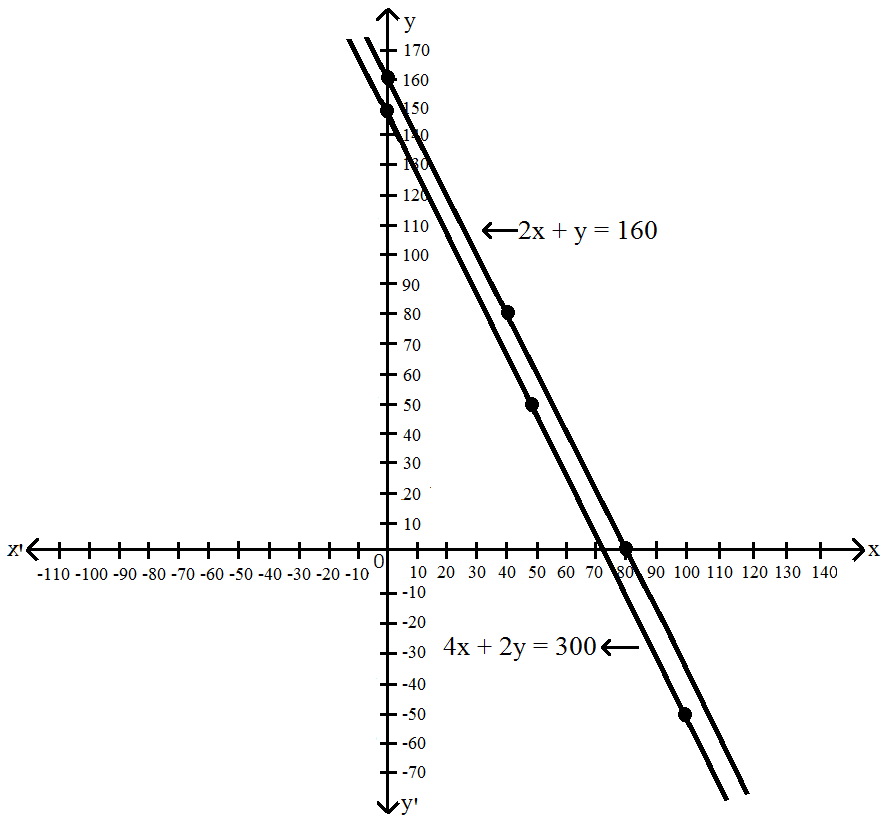
The cost of 2kg of apples and 1kg of grapes on a day was found to be Rs. 160. After a month, the cost of 4kg of apples and 2kg of grapes is Rs. 300 Represent the situation algebraically and geometrically.
Answer
Let the cost of apples and grapes be x and y represent
The cost of 2kg. appies and 1kg. grapes is Rs. 160
2x + y = 160 ........(i)
The cost of 4kg. apples and 2kg. grapes is Rs. 300
4x + 2y = 300 .......(ii)
equation (i) and (ii) show the algebraic situation.
graphical represent:
Using (i):
Putting x = 0, we get y = 160
Putting x = 40, we get y = 80
Putting x = 80, we get y = 0
x
0
40
80
y
160
80
0
Using (ii):
Putting x = 0, we get y = 150
Putting x = 50, we get y = 50
Putting x = 100, we get y = -50
x
0
50
100
y
150
50
-50
View full question & answer
Question 1265 Marks
The sum of a two-digit number and the number formed by reversing the order of digit is 66. If the two digits differ by 2, find the number. How many such numbers are there?
Answer
Let the ten's and the unit's in the first number be x and y, respectively, so, the first number may be written as 10x + y in the expanded form (for example, 56 = 10 (5) + 6)
When the digits are reversed, x becomes the unit's digit and y becomes the ten's digit. This number, in the expanded notation is 10y + x (For example, when 56 is reversed, we get 65 = 10(6) + 5).
According to the given condition,
(10x + y) + (10y + x) = 66
i.e., 11(x + y) = 66
i.e., x + y = 6 .....(i)
We are also given that the digits differ by 2, therefore, either
x - y = 2 .....(ii)
or y - x = 2 ......(iii)
If x - y = 2, then solving (i) and (2) by elimination we get x = 4 and y = 2
In this case we get the number 42
If y - x = 2, then solving (i) and (iii) by elimination we get x = 2 and y = 4. In this case, we get the number 24
Thus, there are two such numbers 42 and 24.
View full question & answer
Question 1275 Marks
Solve the following systems of equations:
$\frac{5}{\text{x}-1}+\frac{1}{\text{y}-2}=2,$
$\frac{6}{\text{x}-1}-\frac{3}{\text{y}-2}=1.$
Answer
Let $\frac{1}{\text{x} - 1 } = \text{u}$ and $ \frac{1}{\text{y} - 2} = \text{v}$
$\Rightarrow5\text{u} + \text{v} = 2$
and $6\text{u} - 3\text{v} = 1$
solving and getting $\text{u} = \frac{1}{3}$ and $\text{v} = \frac{1}{3}$
$\Rightarrow\text{x} - 1 = 3\Rightarrow\text{x} = 4 $
and, $\text{y} - 2 = 3 \Rightarrow\text{y} = 5$
$\Rightarrow\text{x} = 4 \text{ and } \text{y} = 5.$
View full question & answer
Question 1285 Marks
A fraction becomes $\frac{9}{11}$ if is added to both numerator and the denominator. If 3 is added to both the numerator and the denominator it becomes $\frac{5}{6}.$ Find the fraction.
Answer
Let the fraction be $\frac{\text{x}}{\text{y}}$
According to the given information,
$\frac{\text{x}+2}{\text{y}+2}=\frac{9}{11}$
$11\text{x}+22=9\text{y}+18$
$11\text{x}-9\text{y}=-4\ ....(\text{i})$
$\frac{\text{x}+3}{\text{y}+3}=\frac{5}{6}$
$6\text{x}+18=5\text{y}+15$
$6\text{x}-5\text{y}=-3\ ....(\text{ii})$
From equation (i) we obtain $\text{x}=\frac{-4+9\text{y}}{11}\ ....(\text{iii})$
Substituting this in equation (ii) we obtain
$ 6\Big(\frac{-4+9\text{y}}{11}\Big)-5\text{y}=-3$
$-24+54\text{y}-55\text{y}=-33$
$-\text{y}=-9$
$\text{y}=9\ ....(\text{iv})$
Substituting this in equation (iii) we obtain
$\text{x}=\frac{-4+81}{11}=7$
Hence, the fraction is $\frac{7}{9}$
View full question & answer
Question 1295 Marks
Solve the following systems of equations:
$\frac{\text{x}}{2}+\text{y}=0.8,$
$\frac{7}{\text{x}+\frac{\text{y}}{2}}=10.$
Answer
The given equations are
$\Rightarrow\frac{\text{x}}{2}+\text{y}=0.8$
⇒ x + 2y = 1.6 ......(i)
And, $\frac{7}{\text{x}+\frac{\text{y}}{2}}=10$
$\Rightarrow10\Big(\text{x}+\frac{\text{y}}{2}\Big)=7$
⇒ 20x + 10y = 14
⇒ 10x + 5y = 7 .......(ii)
Multiplying (i) by 10, we get
⇒ 10x + 20y = 16 ......(iii)
Subtracting (ii) from (iii), we get
⇒ 15y = 9
$\Rightarrow\text{y}=\frac{9}{15}=0.6$
Putting y = 0.6 in (iii), we get
⇒ 10x + 20 × 0.6 = 16
⇒ 10x = 16 - 12
$\Rightarrow\text{x}=\frac{4}{10}$
$\Rightarrow\text{x}=0.4$
Thus, x = 0.4 and y = 0.6
View full question & answer
Question 1305 Marks
Solve the following systems of equations:
${\text{x}}+\frac{\text{y}}{2}=4,$
$\frac{\text{x}}{3}+2\text{y}=5.$
Answer
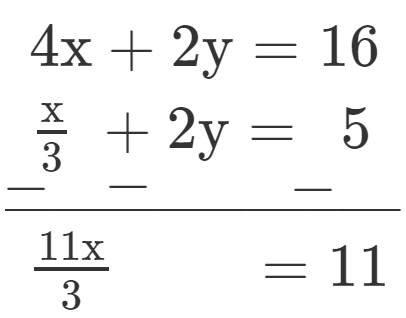
The given equations are, ${\text{x}}+\frac{\text{y}}{2}=4\ .....(\text{i})$ $\frac{\text{x}}{3}+2\text{y}=5\ ......(\text{ii})$ Multiply equation (i) by 4 and subtract equations (i) - (ii), we get 4x + 2y = 16
$\Rightarrow\text{x}=3$ Put the value of x in equation (i), we get $3+\frac{\text{y}}{2}=4$ $\Rightarrow\frac{\text{y}}{2}=1$ $\Rightarrow\text{y}=2$ Hence the value of x and y are x = 3 and y = 2.
View full question & answer
Question 1315 Marks
When 3 is added to the denominator and 2 is subtracted from the numerator a fraction becomes $\frac{1}{4}.$ And when 6 is added to numerator and the denominator is multiplied by 3, it becomes $\frac{2}{3}.$ Find the fraction.
Answer
Let the numerator and denominator of the fraction be x and y respectively. Then the fraction is $\frac{\text{x}}{\text{y}}$
If 3 is added to the denominator and 2 is subtracted from the numerator, the fraction becomes $\frac{1}{4}$
Thus, we have
$\frac{\text{x}-2}{\text{y}+3}=\frac{1}{4}$
⇒ 4(x - 2) = y + 3
⇒ 4x - 8 = y + 3
⇒ 4x - y - 11 = 0
If 6 is added to the numerator and the denominator is multiplied by 3, the fraction becomes $\frac{2}{3}$
$\frac{\text{x}+6}{3\text{y}}=\frac{2}{3}$
Thus we have
⇒ 3(x + 6) = 6y
⇒ 3x + 18 = 6y
⇒ 3x - 6y + 18 = 0
⇒ 3(x - 2y + 6) = 0
⇒ x - 2y + 6 = 0
So, we have two equations
4x - y - 11 =0
x - 2y + 6 =0
Here x and y are unknowns. We have to solve the above equations for x and y.
By using cross-multiplication, we have
$ \Rightarrow\frac{\text{x}}{(-1)\times6-(-2)\times(-11)}=\frac{-\text{y}}{4\times6-1\times(-11)}\\=\frac{1}{4\times(-2)-1\times(-1)}$
$\Rightarrow\frac{\text{x}}{-6-22}=\frac{-\text{y}}{24+11}=\frac{1}{-8+1}$
$\Rightarrow\frac{\text{x}}{-28}=\frac{-\text{y}}{35}=\frac{1}{-7}$
$\Rightarrow\frac{\text{x}}{28}=\frac{\text{y}}{35}=\frac{1}{7}$
$\Rightarrow\text{x}=\frac{28}{7},\ \text{y}=\frac{35}{7}$
$\Rightarrow\text{x}=4,\ \text{y}=5$
Hence, the fraction is $\frac{4}{5}$
View full question & answer
Question 1325 Marks
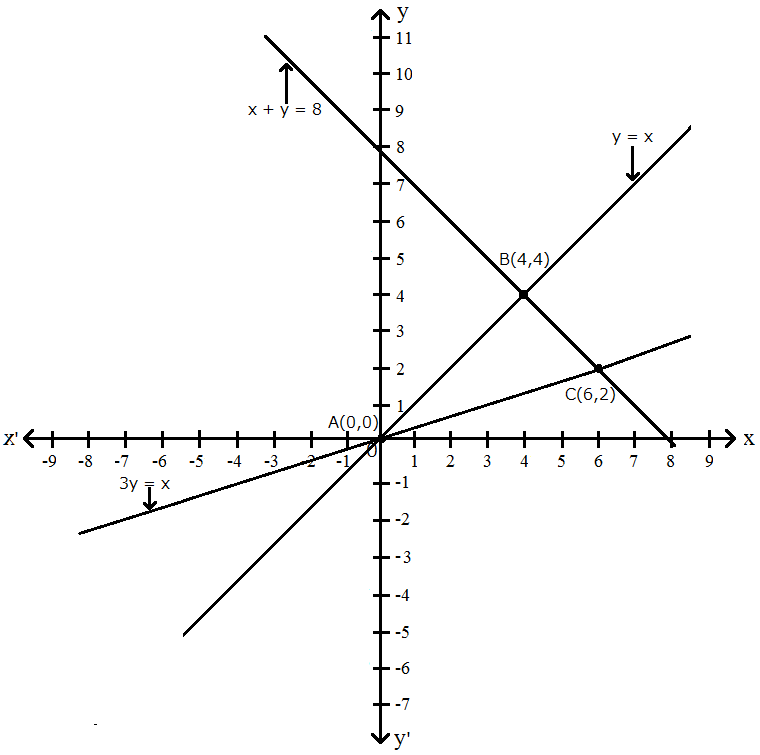
Determine graphically the coordinates of the vertices of a triangle, the equations of whose sides are:
y = x, 3y = x, x + y = 8.
Answer
The system of the given equations is,
y = x
3y = x
x + y = 8
Now, y = x
⇒ x = y
When y = 0, we have
x = 0
When y = -3, we have
x = -3
Thus, we have the following table.
x
0
-3
y
O
-3
We have, 3y = x
⇒ x = 3y
When y = 0, we have
x = 3 × 0 = 0
When y = -1, we have
y = 3 × (-1) = -3
Thus, we have the following table.
x
0
-3
y
O
-1
We have, x + y = 6
⇒ x = 8 - y
When y = 4, we have
y = 8 - 4 = 4
When y = 5, we have
y = 8 - 5 = 3
Thus, we have the following table.
x
4
5
y
4
3
Graph of the given system of equations.

From the graph of the three equations, we find that the three lines taken in pairs intersect each other at points A(0, 0), B(4, 4) and C(6, 2).
Hence, the vertices of the required triangle are (0, 0), (4, 4) and (6, 2).
View full question & answer
Question 1335 Marks
Solve the following systems of equations:
$\frac{2}{\sqrt{\text{x}}}+\frac{3}{\sqrt{\text{y}}}=2,$
$\frac{4}{\sqrt{\text{x}}}-\frac{9}{\sqrt{\text{y}}}=-1.$
Answer
$\frac{2}{\sqrt{\text{x}}}+\frac{3}{\sqrt{\text{y}}}=2$
$\frac{4}{\sqrt{\text{x}}}-\frac{9}{\sqrt{\text{y}}}=-1$
Let $\frac{1}{\sqrt{\text{x}}}=\text{p}$ and $\frac{1}{\sqrt{\text{y}}}=\text{q}$
The given equations reduse to
$2\text{p}+3\text{q}=2\ .....(\text{i})$
$4\text{p}-9\text{q}=-1\ .....(\text{ii})$
Multiplying equation (i) by 3, we obtain
$6\text{p}+9\text{q}=6\ .....(\text{iii})$
Adding equation (ii) and (iii), we obtain
$10\text{p}=5$
$\text{p}=\frac{1}{2}$
Putting the value of p in equation (i) we obtain
$2\times\frac{1}{2}+3\text{q}=2$
$3\text{q}=1$
$\text{q}=\frac{1}{3}$
$\therefore\text{p}=\frac{1}{\sqrt{\text{x}}}=\frac{1}{2}$
$\sqrt{\text{x}}=2$
$\text{x}=4$
$\text{q}=\frac{1}{\sqrt{\text{y}}}=\frac{1}{3}$
$\sqrt{\text{y}}=3$
$\text{y}=9$
$\therefore\text{x}=4,\text{y}=9$.
View full question & answer
Question 1345 Marks
A takes 3 hours more than B to walk a distance of 30km. But, if A doubles his pace (speed) he is ahead of B by $1\frac{1}{2}$ hours. Find the speeds of A and B.
Answer
Let the speed of A and B be x Km/hr and y Km/hr respectively. Then,
Time taken by A to cover $30\text{km}=\frac{30}{\text{x}}\text{hrs}$
And, Time taken by B to cover $30\text{km}=\frac{30}{\text{y}}\text{hrs}$
By the given conditions we have
$\frac{30}{\text{x}}-\frac{30}{\text{y}}=3$
$\frac{10}{\text{x}}-\frac{10}{\text{y}}=1\ ...(\text{i})$
If A doubles his pace, then speed of A is 2x km/hr
Time taken by A to cover $30\text{km}=\frac{30}{2\text{x}}\text{hrs}$
Time taken by B to cover $30\text{km}=\frac{30}{\text{y}}\text{hrs}$
According to the given condition, we have
$\frac{30}{\text{y}}-\frac{30}{2\text{x}}=1\frac{1}{2}$
$\frac{30}{\text{y}}-\frac{30}{2\text{x}}=\frac{3}{2}$
$\frac{30}{\text{y}}\times\frac{1}{3}-\frac{30}{2\text{x}}\times\frac{1}{3}=\frac{3}{2}\times\frac{1}{3}$
$\frac{10}{\text{y}}-\frac{5}{\text{x}}=\frac{1}{2}$
$-\frac{10}{\text{x}}+\frac{20}{\text{y}}=1\ ...(\text{ii})$
Putting $\frac{1}{\text{x}}={\text{u}}$ and $\frac{1}{\text{y}}={\text{v}}$ in equation (i) and (ii) we get
$10\text{u}-10\text{v}=1$
$10\text{u}-10\text{v}-1=0\ ....(\text{iii})$
$​​-10\text{u}+20\text{v}=1$
$-10\text{u}+20\text{v}-1=0\ ...(\text{iv})$
Adding equations (iii) and (iv), we get
$10\text{v}-2=0$
$10\text{v}=2$
$\text{v}=\frac{2}{10}$
$\text{v}=\frac{1}{5}$
Putting $\text{v}=\frac{1}{5}$ in equation (iii) we get
$10\text{u}-10\text{v}-1=0$
$10\text{u}-10\times\frac{1}{5}-1=0$
$10\text{u}-2-1=0$
$10\text{u}-3=0$
$10\text{u}=3$
$\text{u}=\frac{3}{10}$
Now, $\frac{1}{\text{x}}=\frac{3}{10}$
$\text{x}=\frac{10}{3}$
and, $\text{v}=\frac{1}{5}$
$\frac{1}{\text{y}}=\frac{1}{5}$
$\text{y}=5$
Hence the A's speed is $\frac{10}{3}\text{km/hr}$
The B's speed is 5 km/hr.
View full question & answer
Question 1355 Marks
Solve the following systems of equations:
$\frac{3}{\text{x}}-\frac{1}{\text{y}}=-9$
$\frac{2}{\text{x}}+\frac{3}{\text{y}}=5$
Answer
Let $\frac{1}{\text{x}}=\text{u}$ and $\frac{1}{\text{y}}=\text{v}$
$3\text{u}-\text{v}=-9\ .....(\text{i})$
$2\text{u}+3\text{v}=5\ .....(\text{ii})$
Multiplying (i) by 3, we get
$\Rightarrow9\text{u}-3\text{v}=-27\ .....(\text{iii})$
Adding (ii) and (iii) we get,
$\Rightarrow11\text{u}=-22$
$\Rightarrow\text{u}=\frac{-22}{11}=-2$
Putting u = -2 in (iii) we get,
$\Rightarrow9(-2)-3\text{v}=-27$
$\Rightarrow-3\text{v}=-27+18$
$\Rightarrow\text{v}=\frac{-9}{-3}=3$
$\therefore\text{u}=\frac{1}{\text{x}}\Rightarrow\text{x}=\frac{1}{\text{u}}$
$\text{x}=\frac{-1}{2}$
and $\text{v}=\frac{1}{\text{y}}\Rightarrow\text{y}=\frac{1}{\text{v}}$
$\text{y}=\frac{1}{3}$
Thus, $\text{x}=\frac{-1}{2}$ and $\text{y}=\frac{1}{3}$
View full question & answer
Question 1365 Marks
Solve the following system of equations by the method of cross-multiplication:$\frac{57}{\text{x}+\text{y}}+\frac{6}{\text{x}-\text{y}}=5,$
$\frac{38}{\text{x}+\text{y}}+\frac{21}{\text{x}-\text{y}}=9.$
Answer
$\frac{57}{\text{x}+\text{y}}+\frac{6}{\text{x}-\text{y}}=5$
$\frac{38}{\text{x}+\text{y}}+\frac{21}{\text{x}-\text{y}}=9$
Let x + y = p and x - y = q
$\therefore\frac{57}{\text{p}}+\frac{6}{\text{q}}=5$
$\Rightarrow\frac{57}{\text{p}}+\frac{6}{\text{q}}-5=0\ .....(\text{i})$
$\frac{38}{\text{p}}+\frac{21}{\text{q}}=9$
$\Rightarrow\frac{38}{\text{p}}+\frac{21}{\text{q}}-9=0$
Here $a_1 = 57, b_1 = 6, c_1 = -5$
$a_2 = 38, b_2 = 21, c_2 = -9$
$\therefore\frac{\frac{1}{\text{p}}}{-54+105}=\frac{\frac{1}{\text{q}}}{-190+513}=\frac{1}{1197-228}$
$\Rightarrow\frac{\frac{1}{\text{p}}}{51}=\frac{\frac{1}{\text{q}}}{323}=\frac{1}{969}$
$\therefore\frac{\frac{1}{\text{p}}}{51}=\frac{1}{969}$
$\frac{1}{\text{p}}=\frac{51}{969}=\frac{1}{19}$
$\therefore\text{p}=19$
and $\frac{\frac{1}{\text{q}}}{323}=\frac{1}{969}$
$\frac{1}{\text{q}}=\frac{323}{969}=\frac{1}{3}$
$\therefore\text{q}=3$
Now,
$\text{x}\ +\ \text{y}\ =\ 19\\\text{x}\ -\ \text{y}\ =\ \ \ 3\over2\text{x}\ \ \ \ \ \ =\ 22$
Adding, 2x = 22
⇒ x = 11
Subtracting, 2y = 16
⇒ y = 8
Hence x = 11, y = 8.
View full question & answer
Question 1375 Marks
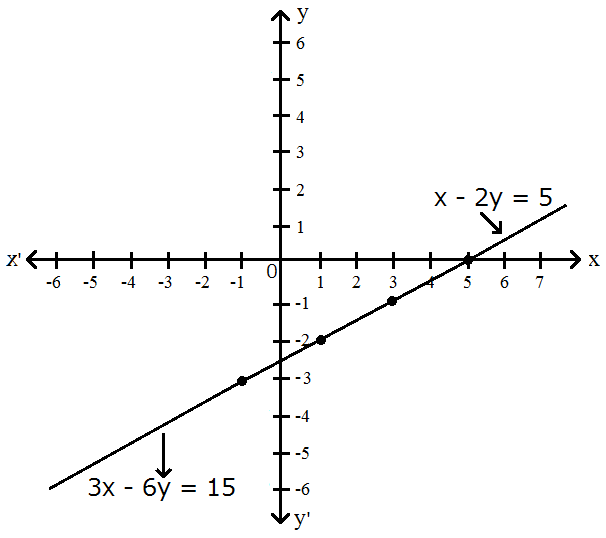
Solve graphically that the following system of equation has infinitely many solutions:
x - 2y = 5
3x - 6y = 15
Answer
We have,
x - 2y = 5
3x - 6y = 15
Now, x - 2y = 5
⇒ x = 2y + 5
When y = -1, we have,
x = 2(-1) + 5 = 3
When y= 0, we have,
x = 2 × 0 + 5 = 5
Thus, we have the following table giving points on the line x - 2y = 5
x
3
5
y
1
0
Now, 3x - 6y = 15
⇒ 3x = 15 + 6y
$\Rightarrow\text{x}=\frac{15+6\text{y}}{3}$
When y = -2, we have,
$\text{x}=\frac{15+6(-2)}{3}=1$
When y = -3, we havce,
$\text{x}=\frac{15+6(-3)}{3}=-1$
Thus, we have the following table giving points on the line 3x - 6y = 15
x
1
-1
y
-2
-3
Graph of the given equations,

After plot all points observe that all points on a line so that system of equation has infinite many solution.
View full question & answer
Question 1385 Marks
Solve the following systems of equations:
$\frac{44}{\text{x}+\text{y}}+\frac{30}{\text{x}-\text{y}}=10,$
$\frac{55}{\text{x}+\text{y}}+\frac{40}{\text{x}-\text{y}}=13.$
Answer
Let $\frac{1}{\text{x}+\text{y}}=\text{u}$ and $\frac{1}{\text{x}-\text{y}}=\text{v}.$
Then the system of the given equations becomes
44u + 30v = 10 ......(i)
55u + 40v = 13 .......(ii)
Multiplying equation (i) by 4 and equation (ii) by 3 we get
176u + 120v = 40 ......(iii)
165u + 120v = 39 ........(iv)
Subtracting equation (iv) by equation (iii) we get
176 - 165u = 40 - 39
⇒ 11u = 1
$\Rightarrow\text{u}=\frac{1}{11}$
Putting $\text{u}=\frac{1}{11}$ in equation (i) we get
$44\times\frac{1}{11}+30\text{v}=10$
4 + 30v = 10
⇒ 30v = 10 - 4
⇒ 30v = 6
$\Rightarrow\text{v}=\frac{6}{30}=\frac{1}{5}$
Now, $\text{u}=\frac{1}{\text{x}+\text{y}}$
$\Rightarrow\frac{1}{\text{x}+\text{y}}=\frac{1}{11}$
$\Rightarrow\text{x}+\text{y}=11\ .....(\text{v})$
Adding equation (v) and (vi) we get
2x = 11 + 5
⇒ 2x = 16
$\Rightarrow\text{x}=\frac{16}{2}=8$
Putting x = 8 in equation (v) we get
8 + y = 11
⇒ y = 11 - 8 - 3
Hence, solution of the given system of equation is x = 8, y = 3.
View full question & answer
Question 1395 Marks
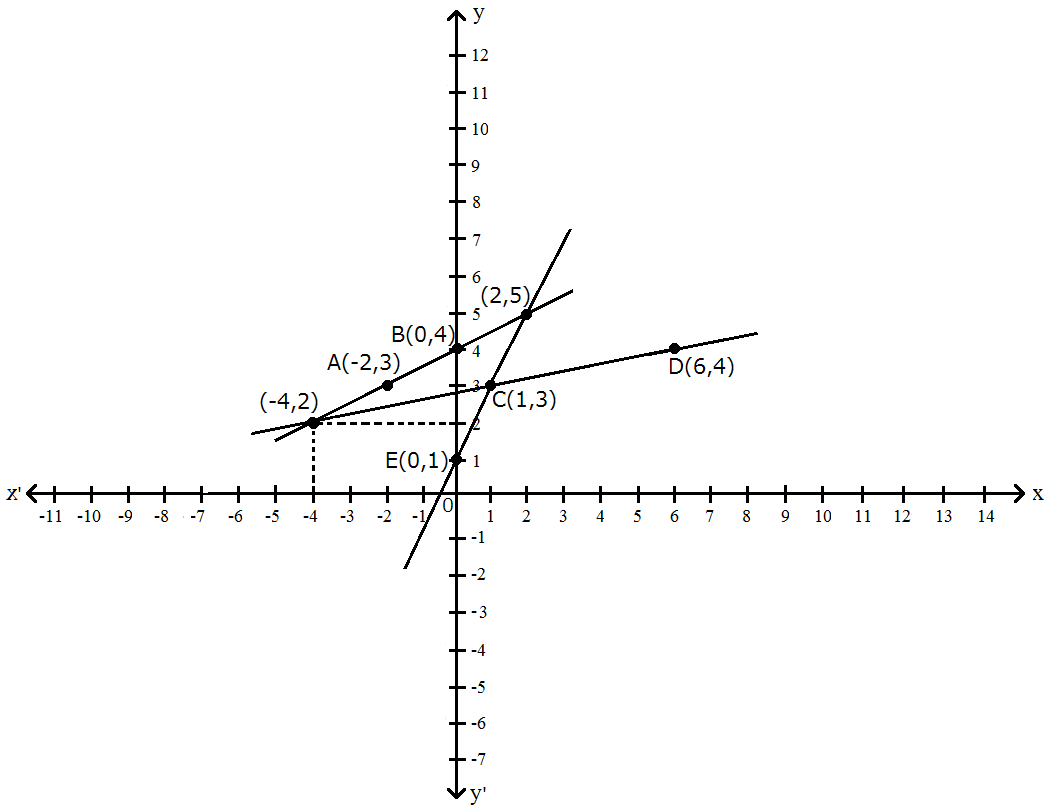
Determine graphically the vertices of the triangle, the equations of whose sides are given below:
  1. 2y - x = 8, 5y - x = 14 and y - 2x = 1
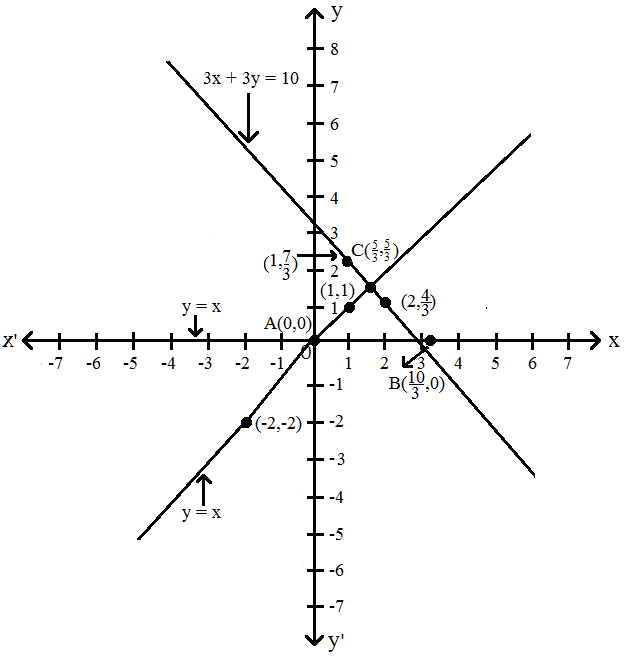
  2. y = x, y = 0 and 3x + 3y = 10
Answer
  1. First we take 2y - x = 8
$\Rightarrow\text{y}=\frac{\text{x}+8}{2}\ .....(\text{i})$

Putting x = -2 in (i), we get y = 3

Putting x = 0 in (i), we get y = 4

P lot points A(-2, 3) and B(0, 4) on graph paper and join them.

Now, 5y - x = 14

$\Rightarrow\text{y}=\frac{\text{x}+14}{5}\ ......(\text{ii})$

Putting x = 1 in (ii), we get y = 3

Putting x = 6 in (i), we get y = 4

P lot points C(1, 3) and D(6, 4) on graph paper and join then.

Now y - 2x = 1

⇒ y = 2x + 1

Putting x = 0 in (iii), we get y = 1

Putting x = 1 in (iii), we get y = 3

P lot points E(0, 1) and F(1, 3) on graph paper and join then.


Thus, the vertices of triangle are (-4, 2), (1, 3) and (2, 5)
  1. The given system of equations is,
y = x

y = 0

3x + 3y = 10

We have,

y = x

When x = 1, we have

y = 1

when x = -2, we have

y = -2

Thus, we have the following table giving points on the line y = x
x
1
-2
y
1
-2
We have,

3x + 3y = 10

⇒ 3y = 10 - 3x

$\Rightarrow\text{y}=\frac{10-3\text{x}}{3}$

When x = 1, we have,

$\Rightarrow\text{y}=\frac{10-3\times1}{3}=\frac{7}{3}$

When x = 2, we have,

$\Rightarrow\text{y}=\frac{10-3\times2}{3}=\frac{4}{3}$

Thus, we have the following table giving points on the line 3x + 3y = 10.
x
1
2
y
$\frac{7}{3}$
$\frac{4}{3}$
Graph of the given equations.


From the graph of the lines represented by the given equations, we observe that the lines taken in pairs intersect each other at points A(0, 0), $\text{B}\Big(\frac{10}{3},0\Big)$ and$\text{C}\Big(\frac{5}{3},\frac{5}{3}\Big).$

Hence, the required vertices of the triangle are A(0, 0), $\text{B}\Big(\frac{10}{3},0\Big)$ and $\text{C}\Big(\frac{5}{3},\frac{5}{3}\Big).$
View full question & answer
Question 1405 Marks
Determine, by drawing graphs, whether the following system of linear equations has a unique solution or not:
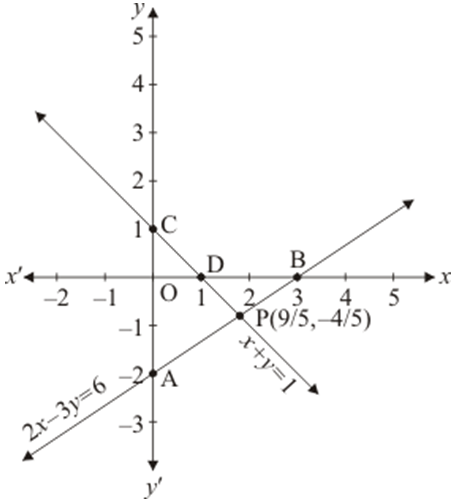
2x - 3y = 6, x + y = 1.
Answer
The given equations are
2x - 3y = 6 .......(i)
x + y = 1 ..........(ii)
Putting x = 0 in equation (i), we get,
⇒ 2 × 0 - 3y = 6
⇒ y = -2
⇒ x = 0, y = -2
Putting y = 0 in equation (i), we get,
⇒ 2x - 3 × 0 = 6
⇒ x = 3
⇒ x = 3, y = 0
Use the following table to draw the graph.
x
0
3
y
-2
0
Draw the graph by plotting the two points A(0, -2), B(3, 0) from table.

Graph of the equation.
x + y = 1 .......(ii)
Putting x = 0 in equation (ii), we get,
⇒ 0 + y = 1
⇒ y = 1
$\therefore$ x = 0, y = 1
Putting y = 0 in equation (ii), we get,
⇒ x + 0 =1
⇒ x = 1
⇒ x = 1, y = 0
Use the following table to draw the graph.
x
0
1
y
1
0
Draw the graph by plotting the two points C(0, 1), D(1, 0) from table. The two lines intersect at point $\text{P}\Big(\frac{9}{5},\frac{-4}{5}\Big).$
Hence the equations have unique solution.
View full question & answer
Question 1415 Marks
Solve graphically that the following system of equation has infinitely many solutions:
2x + 3y = 6
4x + 6y = 12
Answer
So we have 2x + 3y = 6 and 4x + 6y = 12.
Now, 2x + 3y = 5
$\text{x}=\frac{6-3\text{y}}{2}$
When y = 0 then, x = 3 when y = 2 then, x = 0
x
0
3
y
2
0
Now, 4x + 6y = 12
$\text{x}=\frac{12-6\text{y}}{4}$
When y = 0, then x = 3 When y = 2, then x = 0
Thus, we have the following table giving points on the line 4x + 6y = 12
x
0
3
y
2
0
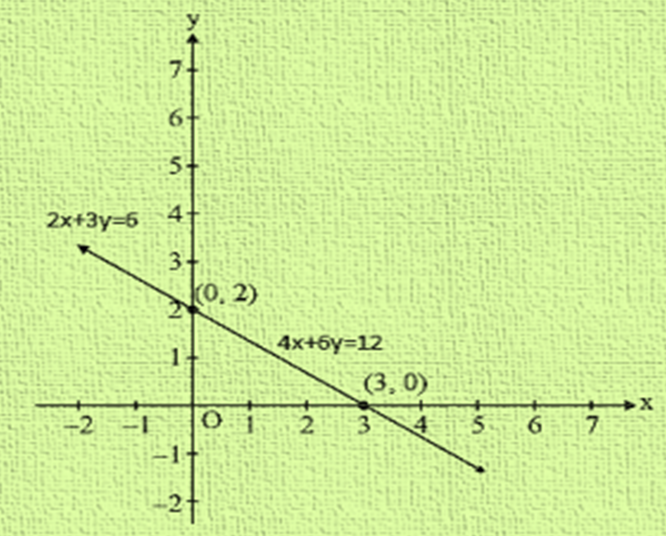
Graph of the equation 2x + 3y = 6 and 4x + 6y = 12

Thus the graphs of the two equations are coincident. Hence, the system of equations has infinitely many solutions.
View full question & answer
Question 1425 Marks
Yash scored 40 marks in a test, getting 3 marks for each right answer and losing 1 mark for each wrong answer. Had 4 marks been awanded for each correct answer and 2 marks been deducted for each incorrect answer, the Yash would have scored 50 marks. How many question were there in the test?
Answer
Let we taxe right answer be x then wrong answer will be y.
Therefore the total no. question = x + y ....(i)
It is given that if yash secord 40 marks in a test getting 3 marks for each right answer and losing 1 maks for each wrong answer then
⇒ 3x - y = 40
3x - y - 40 ....(ii)
It is also given that if 4 maks awarded for each right answer and 2 maks deducted for each wrong answer then he scored 50 marks.
4x - 2y = 50
4x - 2y - 50 ....(iii)
By multiplying eq. (ii) by 2 and we get
2(3x - y - 40)
= 6x - 2y - 80 = 0 .....(iv)
Now, subtracting eq. (iii) from eq. (iv)
6x - 2y - 80 - (4x - 2y - 50) = 0
6x - 2y - 80 - 4x + 2y + 50 = 0
2x - 30 = 0
2x = 30
x = 15
Now, Putting the value of x in eq. (ii) and we get
3 × 15 - y - 40 = 0
45 - y - 40 = 0
-y + 5 = 0
y = 5
Putting the value of x and y in eq. (i) and we get
x + y = 15 + 5 = 20
Hence, the total number of question is 20.
View full question & answer
Question 1435 Marks
Graphically, solve the following pair of equations:
$2x + y = 6$
$2x - y + 2 = 0$
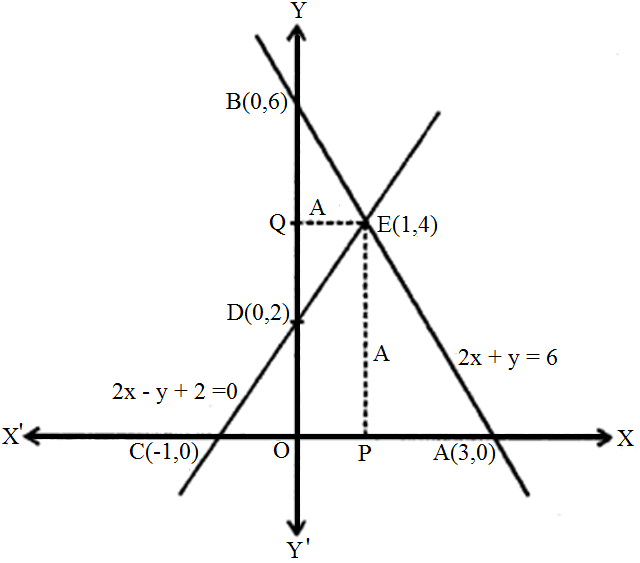
Find the ratio of the areas of the two triangles formed by the lines representing these equations with the x axis and the lines with the y-axis.
Answer
Given equations are $2x + y - 6$ and $2x - y + 2 = 0$ Table for equation $2x + y = 6$
x
0
3
y
6
0
Points
B
A
Table for equation $2x - y + 2 = 0$
x
0
-1
y
2
0
Points
D
C
Let $A_1$ and $A_2$​​​​​​​ represent the areas of $\triangle\text{ACE}$ and $\triangle\text{BDE},$respectively.
Now, $\text{A}_1=\text{Area of }\triangle\text{ACE}=\frac{1}{2}\times\text{AC}\times\text{PE}$
$=\frac{1}{2}\times4\times4=8$ and $\text{A}_2=\text{Area of }\triangle\text{BDE}=\frac{1}{2}\times\text{BD}\times\text{QE}$
$=\frac{1}{2}\times4\times1=2$
$\therefore\text{A}_1:\text{A}_2=8:2=4:1$
Hence, the pair of equations intersect graphically at point E(1, 4), i, e., x = 1 and y = 4.
View full question & answer
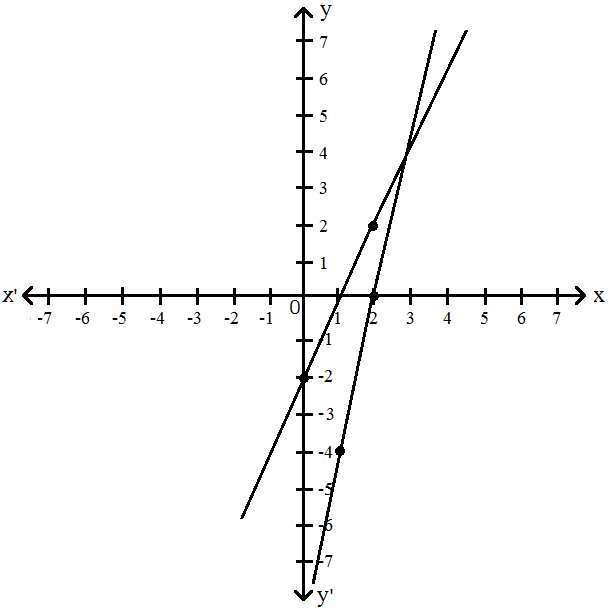
Question 1445 Marks
Form the pair of linear equations in the following problems, and find their solution graphically:
Champa went to a 'sale' to purchase some pants and skirts. When her friends asked her how many of each she had bought, she answered, "The number of skirts is two less than twice the number of pants purchased. Also the number of skirts is four less than four times the number of pants purchased." Help her friends to find how many pants and skirts Champa bought.
Answer
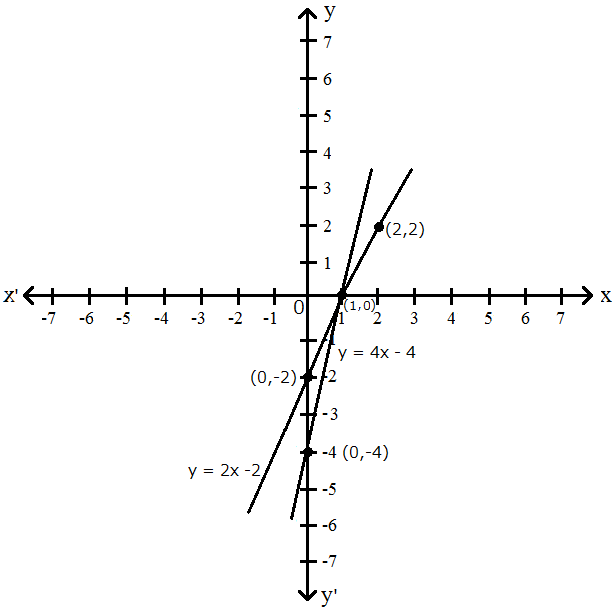
Let us denote the number of pants by x and the number of skirts by y. Then the equations formed are: y = 2x - 2 .....(i) y = 4x - 4 .......(ii) The graphs of the equations (i) and (ii) can be drawn by finding two solutions for each of the equations. They are given in the following table.
x
2
0
y = 2x - 2
2
-2
Hence, the graphic representation is as follows.
The two lines intersect at the point (1, 0). So, x = 1, y = 0 is the required solution of the pair of linear equations, i.e., the number of pants she purchased is 1 and she did not buy any skirt.
View full question & answer
Question 1455 Marks
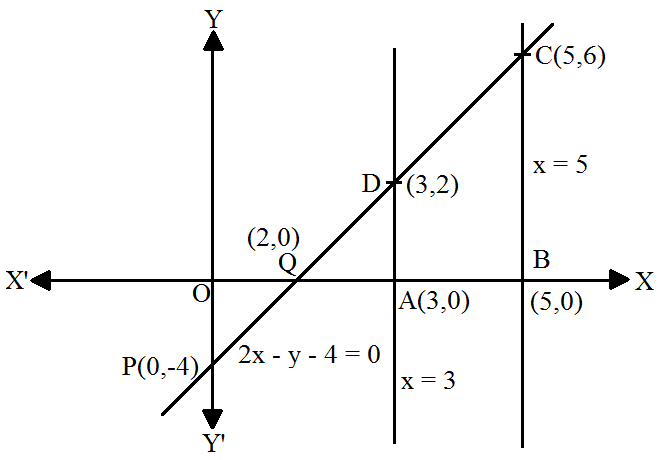
Draw the graph of the equations x = 3, x = 5 and 2x - y - 4 = 0. Also, find the area of the quadrilateral formed by the lines and the x-axis.
Answer
Given equation of lines 2x - y - 4 = 0, x = 3 and x = 5 Table for line 2x - y - 4 = 0,
x
0
2
y = 2x - 4
-4
0
Points
P
Q
Draw the points P (0, -4) and Q (2, 0) and join these points and form a line PQ also draw the lines x = 3 and x = 5. Area of quadrilateral ABCD $=\frac{1}{2}\times$ distance between parallel lines (AB) x (AD + BC) [since, quadrilateral ABCD is a trapezium] $=\frac{1}{2}\times2\times(6+2)$ $\big[\because$ AB = OB - OA = 5 - 3 = 2, AD = 2 and BC = 6 $\big]$ $=8\text{ sq. units.}$
Hence, the required area of the quadrilateral formed by the lines and the x-axis is 8 sq. units.
View full question & answer
Question 1465 Marks
Show graphically that the following system of equation is in-consistent (i.e. has no solution):
x - 2y = 6
3x - 6y = 0
Answer
The given equations are,
x - 2y = 6 .......(i)
3x - 6y = 0 ........(ii)
From (i), $\text{y}=\frac{\text{x}-6}{2}\ ......(\text{iii})$
Putting x = 0 in (iii), we get y = -3
Putting x = 2 in (iii), we get y = -2
Putting x = 4 in (iii), we get y = -1
x
0
2
4
y
-3
-2
-1
From (ii), $\text{y}=\frac{3\text{x}}{6}\ ......(\text{iv})$
Putting x = 0 in (iv), we get y = 0
Putting x = 2 in (iii), we get y = 1
Putting x = 4 in (iii), we get y = 2
x
0
2
4
y
0
1
2

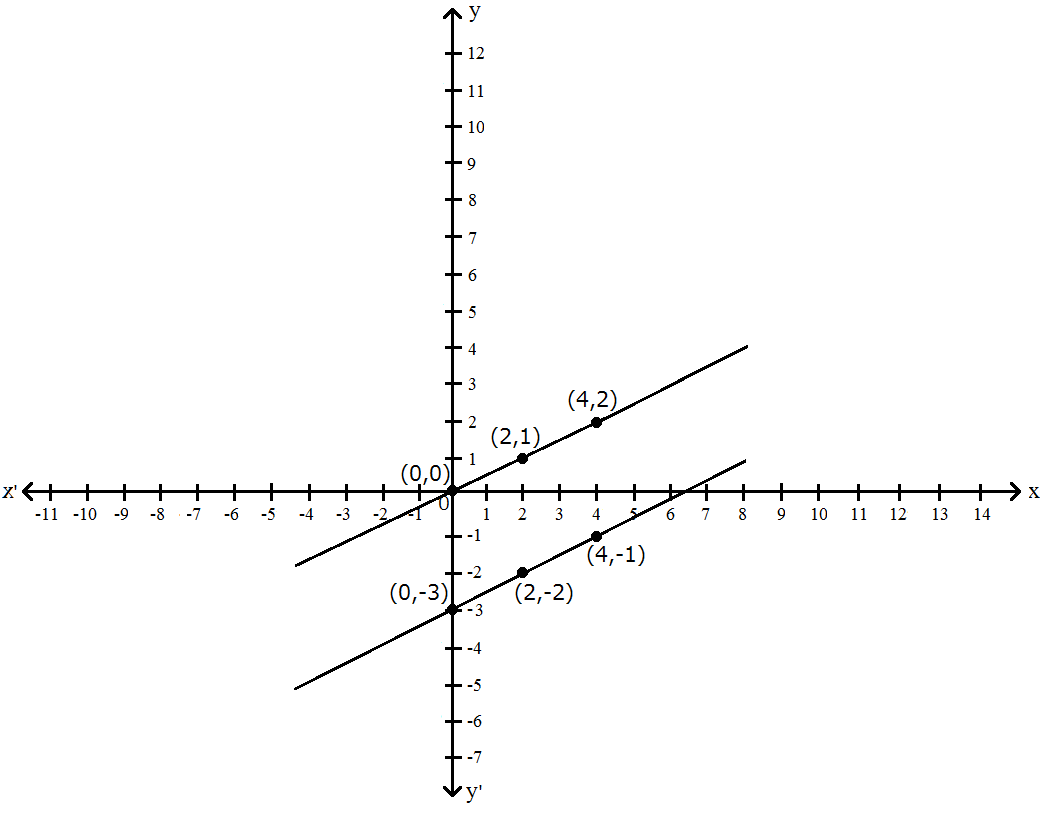
When we plot these points on graph paper we observe that both linesare parallel to each other means they have no solution so they are in-consistent.
View full question & answer
Question 1475 Marks
Find the values of a and b for which the following system of equations has infinitely many solutions:
2x + 3y = 7
(a - b)x + (a + b)y = 3a + b - 2
Answer
Given
2x + 3y = 7
(a - b)x + (a + b)y = 3a + b - 2
To find: To determine for what value of k the system of equation has infinitely many solutions,
We know that the system of equations,
$a_1x + b_1y = c_1$
$a_2x + b_2y = c_2$​​​​​​​
For infinitely many solution
$\frac{\text{a}_1}{\text{a}_2}=\frac{\text{b}_1}{\text{b}_2}=\frac{\text{c}_1}{\text{c}_2}$
Here,
$\frac{2}{(\text{a}-\text{b})}=\frac{3}{(\text{a}+\text{b})}=\frac{7}{3\text{a}+\text{b}-2}$
Consider the following
$\frac{3}{(\text{a}+\text{b})}=\frac{7}{3\text{a}+\text{b}-2}$
$9\text{a}+3\text{b}-6=7\text{a}+7\text{b}$
$2\text{a}-4\text{b}=6\ ....(\text{i})$
Again consider the following
$\frac{2}{(\text{a}-\text{b})}=\frac{7}{3\text{a}+\text{b}-2}$
6a + 2b - 4 = 7a - 7b
a - 9b = -4 .....(ii)
Multiplying eq. (ii) by 2 and subtracting eq. (i) from eq. (ii)
⇒ -14b = -14
⇒ b = 1
Substituting the value of b in eq. (ii) we get
⇒ a - 9 = -4
⇒ a = 5
Hence for a = 5 and b = 1 the system of equation has infinitely many solution.
View full question & answer
Question 1485 Marks
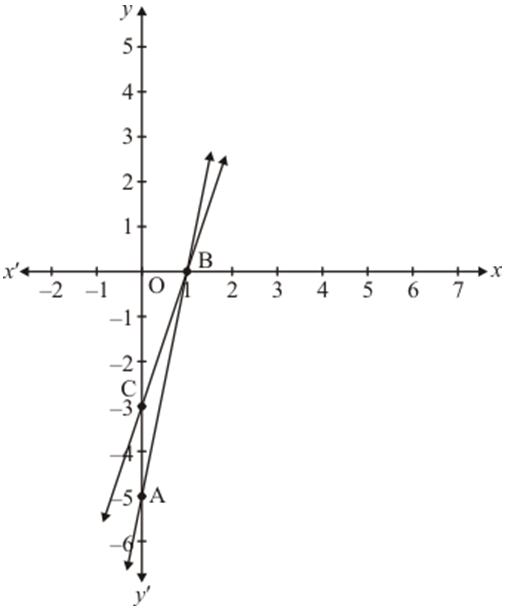
Draw the graphs of the equations 5x - y = 5 and 3x - y = 3. Determine the co-ordinates of the vertices of the triangle formed by these lines and y-axis. Calculate the area of the triangle so formed.
Answer
The given equations are,
5x - y = 5 ......(i)
3x - y = 3 ........(ii)
Putting x = 0 in equations (i), we get,
⇒ 5 × 0 - y = 5
⇒ y = -5
x = 0, y = -5
Putting y = 0 in equations (i), we get,
⇒ 5x - 0 = 5
⇒ x = 1, y = 0
Use the following table to draw the graph.
x
0
1
y
-5
0
Draw the graph by plotting the two points A(0, -5), B(1, 0) from table.

3x - y = 3 ......(ii)
Putting x = 0 in equations (ii), we get,
⇒ 3 × 0 - y = 3
⇒ y= - 3
⇒ x = 0, y = -3
Putting y = 0 in equations (ii), we get,
⇒ 3x - 0 = 3
⇒ x = 1
⇒ x = 1, y = 0
Use the following table to draw the graph.
x
0
1
y
-3
0
Draw the graph by plotting the two points C(0, -3), D(1, 0) from table. Hence the vertices of the required triangle are B(1, 0), C(0, -3) and A(0, -5). Now,
⇒ Required area = Area of PCA
⇒ Required area $=\frac{1}{2}(\text{Base}\times\text{Height}) $
⇒ Required area $=\frac{1}{2}(2\times1)\text{sq.units.}$
Hence the required area is 1 sq. units.
View full question & answer
Question 1495 Marks
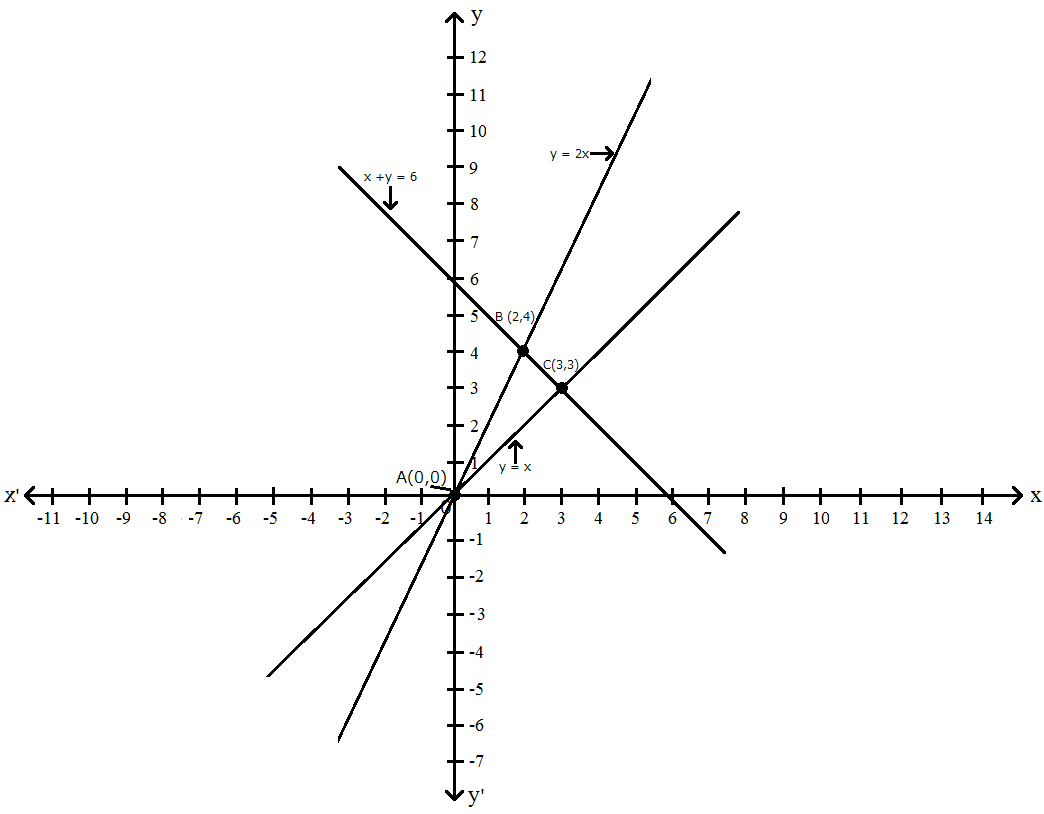
Determine graphically the coordinates of the vertices of a triangle, the equations of whose sides are:
y = x, y = 2x and y + x = 6.
Answer
The system of the given equations is,
y = x
y = 2x
y + x = 6
Now, y = x
When x = 0, we have
y = 0
When x = -1, we have
y = -1
Thus, we have the following table.
x
0
-1
y
0
-2
We have, y = 2x
When x = 0, we have
y = 2 × 0 = 0
When x = -1, we have
y = 2(-1) = -2
Thus, we have the following table.
x
0
-1
y
0
-2
We have, y + x = 6
⇒ y = 6 - x
When x = 2, we have
y = 6 - 2 = 4
When x = 4, we have
y = 6 - 4 = 2
Thus, we have the following table.
x
2
4
y
4
2
Graph of the given system of equations.

From the graph of the three equations, we find that the three lines taken in pairs intersect each other at points A(0, 0), B(2, 4) and C(3, 3).
Hence, the vertices of the required triangle are (0, 0), (2, 4) and (3, 3).
View full question & answer
Question 1505 Marks
In a $\triangle\text{ABC},$ $\angle\text{x}^\circ,\angle\text{B}=(3\text{x}-2)^\circ,\angle\text{C}=\text{y}^\circ$ Also $\angle\text{C}-\angle\text{B}=9^\circ.$ Find the three angles.
Answer
It is given that,
$\angle\text{A}=\text{x}^\circ ....(\text{i})$
$\angle\text{B}=(3\text{x}-2)^\circ\ ...(\text{ii})$
$\angle\text{C}=\text{y}^\circ\ ....(\text{iii})$
And, $\angle\text{C}-\angle\text{B}=9^\circ\ ....(\text{iv})$
Putting $\angle\text{C}=\text{y}^ \circ$ and $\angle\text{B}=(3\text{x}-2)^\circ$ in equation (iv), we get
y - (3x - 2) = 9
⇒ y - 3x + 2 = 9
⇒ y - 3x = 9 - 2
⇒ -3x + y = 7 .....(v)
We know that, the sum of angles of a triangle is 180°
$\therefore\angle\text{A}+\angle\text{B}+\angle\text{C}=180^\circ$
⇒ x + 3x - 2 + y = 180°
⇒ 4x - 2 + y = 180°
⇒ 4x + y = 180 + 2
⇒ 4x + y = 182 .......(vi)
Subtracting equation (v) from equatoin (vi) we get
4x + 3x = 182 - 7
⇒ 7x = 175
$\Rightarrow\text{x}=\frac{175}{7}$
⇒ x = 25
Putting x = 25 in equation (v) we get
-3 × 25 + y = 7
⇒ -75 + y = 7
⇒ y = 7 + 75
⇒ y = 82
$\therefore\angle\text{A}=\text{x}^\circ=25^\circ$
$\angle\text{B}=(3\text{x}-2)^\circ$
(3 × 25 - 2)°
= (75 - 2)
= 73°
And, $\angle\text{C}=\text{y}^\circ=82^\circ$
View full question & answer
5 Marks Questions - Page 3 - MATHS STD 10 Questions - Vidyadip