MCQ 511 Mark
A polynomial of degree $..........$ is called a linear polynomial :
AnswerA polynomial of degree $1$ is called a linear polynomial.
$4x + 3, \ 65y $ are linear polynomials.
View full question & answer→MCQ 521 Mark
If $\alpha$ and $\beta$ are the zero of $x^2+5 x+8,$ then the value of $(\alpha+\beta)$ is :
AnswerLet $\alpha$ and $\beta$ be the zeros of the $x^2+5 x+8$
Then, we have
$\alpha+\beta=-\frac{\text{b}}{\text{a}}$
$=-\frac{5}{1}=-5$
View full question & answer→MCQ 531 Mark
Which of the following is not a polynomial ?
- A
$\sqrt3\text{x}^2-2\sqrt3\text{x}+5$
- B
$\text{9x}^2-\text{4x}+\sqrt2$
- C
$\frac{3}{2}\text{x}^3+\text{6x}^2-\frac{1}{\sqrt2}\text{x}-8$
- ✓
$\text{x}+\frac{3}{\text{x}}$
AnswerCorrect option: D. $\text{x}+\frac{3}{\text{x}}$
An expression of the form $p(x)=a_0+a_1 x+a_2 x^2+\ldots+a_n x^n,$
where $a_n \neq 0$, is called a polynomial in $x$ of degree $n$.
Here, $a_0, a_1, a_2, \ldots, a_n$ are real numbers and each power of $x$ is a non $-$ negative integer.
Hence, $\text{x}+\frac{3}{\text{x}}$ is not a polynomial.
View full question & answer→MCQ 541 Mark
If $\alpha$ and $\beta$ are the zeroes of the polynomial $a x^2+b x+c$, then the values of $\frac{\alpha}{\beta}+\frac{\beta}{\alpha}$ is:
- A
$\frac{\text{b}^{2}}{\text{ac}}$
- B
$\frac{\text{c}^{2}}{\text{ab}}$
- C
$\frac{\text{b}^{2} - {\text{2ac}}}{\text{ac}}$
- ✓
$\frac{\text{a}^{2}}{\text{bc}}$
AnswerCorrect option: D. $\frac{\text{a}^{2}}{\text{bc}}$
$\frac{\text{a}^{2}}{\text{bc}}$
View full question & answer→MCQ 551 Mark
If $\alpha,\beta$ are the zeros of the polynomial $f(x)=x^2+x+1$, then $\frac{1}{\alpha}+\frac{1}{\beta}=$
AnswerSince $\alpha$ and $\beta$ are the zeros of the quadratic polynomial $f(x)=x^2+x+1$
$\alpha+\beta=-\frac{\text{coefficient of x}}{\text{coefficient of x}^2}$
$=\frac{-1}{1}=-1$
$\alpha\times\beta=\frac{\text{constant term}}{\text{coefficient of x}^2}$
$=\frac{1}{1}=1$
We have
$=\frac{1}{\alpha}+\frac{1}{\beta}$
$=\frac{\beta+\alpha}{\alpha\beta}$
$=\frac{-1}{1}$
$=-1$
The value of $\frac{1}{\alpha}+\frac{1}{\beta}$ is $-1$
Hence, the correct choice is $(b)$.
View full question & answer→MCQ 561 Mark
Choose the correct answer from the given four options in the following questions : A quadratic polynomial, whose zeroes are $–3$ and $4,$ is :
AnswerCorrect option: C. $\frac{\text{x}^2}{2}-\frac{\text{x}}{2}-6$
Then, sum of zeroes $= -3 + 4 = 1$
$\Big[\because\ \text{sum of zeroes}=\frac{\text{-b}}{\text{a}}\Big]$
$\Rightarrow\ \frac{-\text{b}}{\text{a}}=\frac{1}{1}\Rightarrow\ \frac{-\text{b}}{\text{c}}=-\frac{(-1)}{1}\ .....(\text{i})$
and product of zeroes $= -3 \times 4 = -12$
$\Big[\because\ \text{product of zeroes} = \frac{\text{c}}{\text{a}}\Big]$
$\Rightarrow\ \frac{\text{c}}{\text{a}}=\frac{-12}{1}\ .....\text{(ii)}$
From Eqs. $(i)$ and $(ii),$
$a = 1, b = -1$ and $c = -12$
$= ax^2+ bx + c$
$\therefore$ Required polynimial $= 1.x^2- 1.x - 12$
$= x^2- x - 12$
$=\frac{\text{x}^2}{2}-\frac{\text{x}}{2}-6$
We know that, if we multiply/divide and polynomial by any constant, then the zeroes of polynomial do not change.
Alternate Answer
Let the zeroes of a qaudratic polynomial are $\alpha = -3$ and $\beta = 4.$
Then, sum of zeroes $=\alpha + \beta = -3 + 4 = 1$ and product of zeroes $=\alpha\beta = (-3)(4) = -12.$
View full question & answer→MCQ 571 Mark
The zeros of the polynomial $7\text{x}^2-\frac{11\text{x}}{3}-\frac{2}{3}$ are :
- ✓
$\frac{2}{3},\ \frac{-1}{7}$
- B
$\frac{2}{7},\ \frac{-1}{3}$
- C
$\frac{-2}{3},\ \frac{1}{7}$
- D
AnswerCorrect option: A. $\frac{2}{3},\ \frac{-1}{7}$
$\text{f}(\text{x})=7\text{x}^2-\frac{11\text{x}}{3}-\frac{2}{3}$
Now $, f(x) = 0$
$\Rightarrow7\text{x}^2-\frac{11\text{x}}{3}-\frac{2}{3}=0$
$\Rightarrow 21x^2- 11x - 2 = 0$
$\Rightarrow 21x^2- 14x + 3x - 2 = 0$
$\Rightarrow 7x(3x - 2) + 1(3x - 2) = 0$
$\Rightarrow (3x - 2)(7x + 1) = 0$
$\Rightarrow 3x - 2 = 0$ or $7x + 1 = 0$
$\Rightarrow\text{x}=\frac{2}{3}$ or $\text{x}=-\frac{1}{7}$
So, the zeros of given polynomial are $\frac{2}{3}$ and $-\frac{1}{7}$
View full question & answer→MCQ 581 Mark
If two zeros $x^3+x^2-5 x-5$ are $\sqrt{5}$ and $-\sqrt{5},$ then its third zero is :
AnswerLet $\alpha=\sqrt{5}$ and $\beta=-\sqrt{5}$ be the given zeros and $\gamma$ be the third zero of $x^3+x^2-5 x-5=0$
By using $\alpha+\beta+\gamma=\frac{-\text{Coefficient of x}^2}{\text{Coefficient of x}^3}$
$\alpha+\beta+\gamma=-\frac{+(+1)}{1}$
$\alpha+\beta+\gamma=-1$
By substituting $\alpha=\sqrt{5}$ and $\beta=-\sqrt{5}$ in $\alpha+\beta+\gamma=-1$
$\sqrt{5}-\sqrt{5}+\gamma=-1$
$\gamma=-1$
Hence, the correct choice is $(b)$
View full question & answer→MCQ 591 Mark
Choose the correct answer from the given four options in the following questions : If one of the zeroes of the quadratic polynomial $(k-1) x^2+k x+1$ is $-3,$ then the value of $k$ is :
- ✓
$\frac{4}{3}$
- B
$\frac{-4}{3}$
- C
$\frac{2}{3}$
- D
$\frac{-2}{3}$
AnswerCorrect option: A. $\frac{4}{3}$
Given that, one of the zeroes of the quadratic polynpomial say $p(x) = (k - 1)x^2+ kx + 1$
is $-3,$ then $p(-3) = 0$
$\Rightarrow (k - 1)(-3)^2+ k(-3) + 1 = 0$
$\Rightarrow 9(k - 1) - 3k + 1 = 0$
$\Rightarrow 9k - 9 - 3k + 1 = 0Z$
$\Rightarrow 6k - 8 = 0$
$\therefore\ \text{k}=\frac{4}{3}$
View full question & answer→MCQ 601 Mark
if $\alpha$ and $\beta$ are the zeroes of the polynomial $3 x^2+11 x-4,$ then the value of $\frac{1}\alpha+\frac{1}\beta$ is :
- ✓
$\frac{11}{4}$
- B
$\frac{12}{4}$
- C
$\frac{13}{4}$
- D
$\frac{15}{4}$
AnswerCorrect option: A. $\frac{11}{4}$
Here $a = 3, b = 11, c = -4,$
Since $\frac{1}\alpha+\frac{1}\beta = \frac{\alpha+\beta}{\alpha\beta}$
$\alpha+\beta = \frac{-11}{3}, \alpha\beta= \frac{-4}{3}$
$\text{So } \frac{-11}{3}\frac{-4}{3} = \frac{11}{4}$
View full question & answer→MCQ 611 Mark
If the zeroes of a quadratic polynomial $ax^2+ bx + c$, $\text{C}\neq{0}$ are equal, then :
- ✓
$C$ and $a$ have the same sign
- B
$C$ and $a$ have opposite sign
- C
$B$ and $c$ have opposite sign
- D
$B$ and $c$ have the same sign
AnswerCorrect option: A. $C$ and $a$ have the same sign
If the zeroes of a quadratic polynomial $ax^2+ bx+ c$, $\text{C}\neq{0}$ are equal,
then $b^2 -4ac = 0 b^2- 4ac = 0.$
$\Rightarrow b^2= 4ac.$
Here $b^2$ is always positive
And this is possible only if $a$ and $c$ are both positive or both negative, both should have the same sign.
View full question & answer→MCQ 621 Mark
Choose the correct answer from the given four options in the following questions : If the zeroes of the quadratic polynomial $x^2+ (a + 1)x + b$ are $2$ and $-3,$ then :
- A
$a = -7, b = -1.$
- B
$a = 5, b = -1.$
- C
$a = 2, b = -1.$
- ✓
$a = 0, b = -6.$
AnswerCorrect option: D. $a = 0, b = -6.$
Let $p(x) = x^2+ (a + 1)x + b$
Given that, $2$ and $-3$ are the zeroes of the quadratic polynomial $p(x)$.
$\therefore p(2) = 0$ and $p(-3) = 0$
$\Rightarrow 2^2+ (a + 1)(2) + b = 0$
$\Rightarrow 4 + 2a + 2 + b = 0$
$\Rightarrow 2a + b = -6 .....(i)$
and $(-3)^2+ (a + 1)(-3) + b = 0$
$\Rightarrow 9 - 3a - 3 + b = 0$
$\Rightarrow 3a - b = 6 .....(ii)$
On adding Eqs. $(i)$ and $(ii),$ we get
$5a = 0 $
$\Rightarrow a = 0$
Put the value of a in Eq. $(i),$ we get
$2 \times 0 + b = -6 $
$\Rightarrow b = -6$
required values are $a = 0$ and $b = -6$.
View full question & answer→MCQ 631 Mark
The number of polynomials having zeroes as $-2$ and $5$ is :
- A
$1$
- B
$2$
- C
$3$
- ✓
more than $3$
AnswerCorrect option: D. more than $3$
more than $3$
View full question & answer→MCQ 641 Mark
The zeros of the polynomial $\text{x}^2-\sqrt2\text{x}-12$ are :
- A
$\sqrt2,\ -\sqrt2$
- ✓
$3\sqrt2,\ -2\sqrt2$
- C
$-3\sqrt2,\ 2\sqrt2$
- D
$3\sqrt2,\ 2\sqrt2$
AnswerCorrect option: B. $3\sqrt2,\ -2\sqrt2$
$\text{f}(\text{x})=\text{x}^2-\sqrt2\text{x}-12$
$=\text{x}^2-3\sqrt2\text{x}+2\sqrt2\text{x}-12$
$=\text{x}\big(\text{x}-3\sqrt2\big)+2\sqrt2\big(\text{x}-3\sqrt2\big)$
$=\big(\text{x}-3\sqrt2\big)\big(\text{x}+2\sqrt2\big)$
$\therefore\text{f}(\text{x})=0$
$\Rightarrow\big(\text{x}-3\sqrt2\big)\big(\text{x}+2\sqrt2\big)=0$
$\Rightarrow\text{x}-3\sqrt2=0$ or $\text{x}+2\sqrt2=0$
$\Rightarrow\text{x}=3\sqrt2$ or $\text{x}=-2\sqrt2$
So, the zeros of given polynomial are $3\sqrt2$ and $-2\sqrt2$
View full question & answer→MCQ 651 Mark
If $\alpha$ and $\beta$ are the zeroes of the polynomial $a x^2+b x+c$, then the value of $\frac{1}\alpha+\frac{1}\beta$ is :
- ✓
$\frac{-\text{b}}{\text{c}}$
- B
$\frac{\text{c}}{\text{a}}$
- C
$\frac{\text{b}}{\text{a}}$
- D
$\frac{\text{b}}{\text{c}}$
AnswerCorrect option: A. $\frac{-\text{b}}{\text{c}}$
Here, $\frac{1}\alpha+\frac{1}{\beta}$
$= \frac{\alpha +\beta}{\alpha\beta}$
$=\frac{\frac{-\text{b}}{\text{a}}}{\frac{\text{c}}{\text{a}}} =\frac{-\text{b}}{\text{c}}$
View full question & answer→MCQ 661 Mark
Choose the correct answer from the given four options in the following questions : Given that one of the zeroes of the cubic polynomial $a x^3+b x^2+c x+d$ is zero, the product of the other two zeroes is :
- A
$-\frac{\text{c}}{\text{a}}$
- ✓
$\frac{\text{c}}{\text{a}}$
- C
$0 $
- D
$-\frac{\text{b}}{\text{a}}$
AnswerCorrect option: B. $\frac{\text{c}}{\text{a}}$
Let $p(x)=a x^3+b x^2+c x+d$
Given that, one of the zeroes of the cubic polynomial $p(x)$ is zero,
Let $\alpha,$
$\beta$ and $\gamma$ are the zeroes of cubic polynomial $p(x),$ where $a = 0.$
We know that,
Sum of product of two zeroes at a time $=\frac{\text{c}}{\text{a}}$
$\Rightarrow\ \alpha\beta + \beta\gamma + \gamma\alpha =\frac{\text{c}}{\text{a}}$
$\Rightarrow\ 0\times\beta+\beta\gamma +\gamma\times0=\frac{\text{c}}{\text{a}}\ \big[\because\ \beta = 0,$ given $\big]$
$\Rightarrow\ 0+\beta\gamma + 0 =\frac{\text{c}}{\text{a}}$
$\Rightarrow\ \beta\gamma=\frac{\text{c}}{\text{a}}$
Hence, Product of other two zeroes $=\frac{\text{c}}{\text{a}}.$
View full question & answer→MCQ 671 Mark
If the product of zeros of the polynomial $f(x) a x^3-6 x^2+11 x-6$ is $4,$ then $a =$
- ✓
$\frac{3}{2}$
- B
$-\frac{3}{2}$
- C
$\frac{2}{3} $
- D
$ -\frac{2}{3}$
AnswerCorrect option: A. $\frac{3}{2}$
Since $\alpha$ and $\beta$ are the zeros of quadratic polynomial $f(x)=a x^2-6 x^2+11 x-6$
$\alpha\beta=\frac{-\text{Constant term}}{\text{Coefficient of x}^2}$
So we have
$4=-\Big(\frac{-6}{\text{a}}\Big) $
$4=\frac{6}{\text{a}}$
$4\text{a}=6$
$ \text{a}=\frac{6}{4}$
$ \text{a}=\frac{3\times2}{2\times2}$
$\text{a}=\frac{3}{2}$
The value of $\alpha$ is $\frac{3}{2}$
Hence, the correct alternative is $(a)$
View full question & answer→MCQ 681 Mark
If $-2$ and $3$ are the zeros of the quadratic polynomial $x^2+(a+1) x+b$, then :
- A
$a = -2, b = 6$
- B
$a = 2, b = -6$
- ✓
$a = -2, b = -6$
- D
$a = 2, b = 6$
AnswerCorrect option: C. $a = -2, b = -6$
Since $-2$ and $3$ are zeros of $x^2+(a+1) x+b,$ we have
Sum of roots $= -2 + 3 = 1$
$\Rightarrow\frac{-(\text{a}+1)}{1}=1$
$\Rightarrow a + 1 = -1$
$\Rightarrow a = -2$
Product of roots $= -2 \times 3 = -6$
$\Rightarrow\frac{{\text{b}}}{1}=-6$
$\Rightarrow\text{b}=-6$
View full question & answer→MCQ 691 Mark
If the product of two zeros of the polynomial $f(x)=2 x^3+6 x^2-4 x+9$ is $3,$ then its third zero is :
- A
$\frac{3}{2}$
- ✓
$\frac{-3}{2}$
- C
$\frac{9}{2}$
- D
$\frac{-9}{2}$
AnswerCorrect option: B. $\frac{-3}{2}$
Let $\alpha,\beta,\gamma$ be the zeros of polynomial $f(x)=2 x^3+6 x^2-4 x+9$ such that $\alpha\beta=3$
We have,
$\alpha\beta\gamma=\frac{\text{Constant term}}{\text{Coefficient of x}^2}$
$=\frac{-9}{2}$
Putting $\alpha\beta=3\text{ in }\alpha\beta\gamma=\frac{-9}{2},$ we get
$\alpha\beta\gamma=\frac{-9}{2}$
$3\gamma=\frac{-9}{2}$
$\gamma=\frac{-9}{2}\times\frac{1}{3}$
$\gamma=\frac{-3}{2}$
Therefore, the value of third zero is $\frac{-3}{2}$
Hence, the correct alternative is $(b)$
View full question & answer→MCQ 701 Mark
If $\alpha$ and $\beta$ are the zeroes of a quadratic polynomial $a x^2+b x+c,$ then $\alpha\beta=$
- A
$\frac{-\text{b}}{\text{a}}$
- B
$\frac{-\text{c}}{\text{a}}$
- ✓
$\frac{\text{c}}{\text{a}}$
- D
$\frac{\text{b}}{\text{a}}$
AnswerCorrect option: C. $\frac{\text{c}}{\text{a}}$
If $\alpha$ and $\beta$ are the zeroes of a quadratic polynomial $a x^2+b x+c$,
$\because$ Product of the zeroes of a quadratic polynomial $a x^2+b x+c$=
$=\frac{\text{Constant term}}{\text{Coefficient of x}^{2}}, $ then $\alpha\beta = \frac{\text{c}}{\text{a}}$
View full question & answer→MCQ 711 Mark
If the sum of the zeros of the quadratic polynomial $k x^2+2 x+3 k$ is equal to the product of its zeros, then $k =$ ?
- A
$\frac{1}{3}$
- B
$\frac{-1}{3}$
- C
$\frac{2}{3}$
- ✓
$\frac{-2}{3}$
AnswerCorrect option: D. $\frac{-2}{3}$
Let $\alpha$ and $\beta$ be the roots of $k x^2+2 x+3 k$.
Then, we have
$\alpha+\beta=\alpha\beta$
$\Rightarrow-\frac{2}{\text{k}}=\frac{\text{3k}}{\text{k}}$
$\Rightarrow-\frac{2}{\text{k}}=3$
$\Rightarrow\text{k}=-\frac{2}{3}$
View full question & answer→MCQ 721 Mark
A quadratic polynomial with zeroes $\frac{1}{4}$ and $-1$ is :
- A
$ 4 x^2+3 x+1 $
- B
$ 4 x^2-3 x+1 $
- C
$ 4 x^2-3 x-1 $
- ✓
$ 4 x^2+3 x-1 $
AnswerCorrect option: D. $ 4 x^2+3 x-1 $
$\text{x}^{2} -(\alpha+\beta)\text{ x}+(\alpha+\beta) = {0}$
Here $\alpha+\beta = \frac{1}{4} = \frac{1-4}{4} = \frac{-3}{4}$ and $\alpha\beta$
$ =\frac{1}{4}\times(-1) = \frac{-1}{4} = \frac{\text{c}}{\text{a}}$
$\text{x}^{2}+\frac{3}{4} \text{ x}-\frac{1}{4} ={0}$
$\frac{\text{x}^{2}+{3}\text{x}-{1}}{4} =0 \ ($By $\text{L.C.M)}$
$4\text{x}^{2}+3\text{x}-1 = {0}$
View full question & answer→MCQ 731 Mark
Which of the following expressions is not a polynomial ?
- A
$\sqrt{5}\text{x}^{3}-\frac{3}{5}\text{x}+\frac{1}{7}$
- ✓
${5}\text{x}^{3}-{3}\text{x}^{2}-\sqrt{\text{x}}+{2}$
- C
${5}\text{x}^{3}-{3}\text{x}^{2}-\text{x}+\sqrt{2}$
- D
${5}\text{x}^{2}-\frac{2}{3}\text{x}+{2}\sqrt{5}$
AnswerCorrect option: B. ${5}\text{x}^{3}-{3}\text{x}^{2}-\sqrt{\text{x}}+{2}$
${5}\text{x}^{3}-{3}\text{x}^{2}-\sqrt{\text{x}}+{2}$ is not a polynomial because each term of a polynomial should be a product of a constant and one or more variable raised to a positive, zero or integral power.
Here $\sqrt{\text{x}}$ does not satisfy the condition of being a polynomial.
View full question & answer→MCQ 741 Mark
If one root of the polynomial $f(x)=5 x^2+13 x+k$ is reciprocal of the other, then the value of $k$ is :
- A
$0$
- ✓
$5$
- C
$\frac{1}{6}$
- D
$6$
AnswerThe given polynomial is $f(x)=5 x^2+13 x+k$.
Product of roots $= \frac{\text{k}}{5}$
$\Rightarrow k = 5$
View full question & answer→MCQ 751 Mark
The polynomial $9 x^2+6 x+4$ has :
AnswerThe polynomial $9 x^2+6 x+4$ has no real zeroes because it can not be factorized.
$D=b^2-4 a c, D=36-4 \times 9 \times 4=-108$
Roots are imaginary and unequal
View full question & answer→MCQ 761 Mark
On dividing a polynomial $p(x)$ by a non $-$ zero polynomial $q(x),$ let $g(x)$ be the quotient and $r(x)$ be the remainder, than $p(x) = q(x).g(x) + r(x),$ where
AnswerCorrect option: C. either $r(x) = 0$ or deg $r(x) < $ deg $g(x)$.
By Division Algorithm on polynomials, we have
either $r(x) = 0$ or deg $r(x) <$ deg $g(x)$.
View full question & answer→MCQ 771 Mark
If two zeroes of the polynomial $x^3+x^2-9 x-9$ are $3$ and $-3,$ then its third zero is :
AnswerLet $\alpha=3$ and $\beta=-3$ be the given zeros and $\gamma$ be the third zero of the polynomial $x^3+x^2-9 x-9$ then
By using $\alpha+\beta+\gamma=\frac{-\text{Coefficient of x}^2}{\text{Coffiecient of x}^3}$
$\alpha+\beta+\gamma=\frac{-1}{1}$
$\alpha+\beta+\gamma=-1$
Substituting $\alpha=3$ and $\beta=-3$ in $\alpha+\beta+\gamma=-1,$ we get
$3-3+\gamma=-1$
$\gamma=-1$
Hence, the correct choice is $(a)$
View full question & answer→MCQ 781 Mark
Zeros of $p(x) = x^2- 2x - 3$ are :
- A
$1, -3$
- ✓
$3, -1$
- C
$-3, -1$
- D
$1, 3$
AnswerCorrect option: B. $3, -1$
Here, $p(x)=x^2-2 x-3$
Let $ x^2-2 x-3=0$
$ \Rightarrow x^2-(3-1) x-3=0 $
$ \Rightarrow x^2-3 x+x-3=0 $
$ \Rightarrow x(x-3)+1(x-3)=0 $
$ \Rightarrow(x-3)(x+1)=0 $
$ \Rightarrow x=3,-1$
View full question & answer→MCQ 791 Mark
Directions : In the following questions, the Assertions $(A)$ and Reason $(s) \ (R)$ have been put forward. Read both the statements carefully and choose the correct alternative from the following :
Assertion : Degree of a zero polynomial is not defined.
Reason : Degree of a non $-$ zero constant polynomial is $0$
- A
Both Assertion and Reason are correct and Reason is the correct explanation for Assertion
- ✓
Both Assertion and Reason are correct but Reason is not the correct explanation for Assertion
- C
Assertion is correct but Reason is incorrect
- D
Assertion is incorrect but Reason is correct
AnswerCorrect option: B. Both Assertion and Reason are correct but Reason is not the correct explanation for Assertion
We know that, The constant polynomial $0$ is called a zero polynomial.
The degree of a zero polynomial is not defined.
$\therefore$ Assertion is true.
The degree of a non $-$ zero constant polynomial is zero.
$\therefore$ Reason is true.
Since both Assertion and Reason are true and Reason is not a correct explanation of Assertion.
View full question & answer→MCQ 801 Mark
If the polynomial $f(x) = ax^3+ bx - c$ is divisible by the polynomial $g(x) = x^2+ bx + c$, then $ab =$
- ✓
$1$
- B
$\frac{1}{\text{c}}$
- C
$-1$
- D
$-\frac{1}{\text{c}}$
AnswerWe have to find the value of $ab$
Given $f(x) = ax^3+ bx - c$ is divisible by the polynomial $g(x) = x^2+ bx + c$
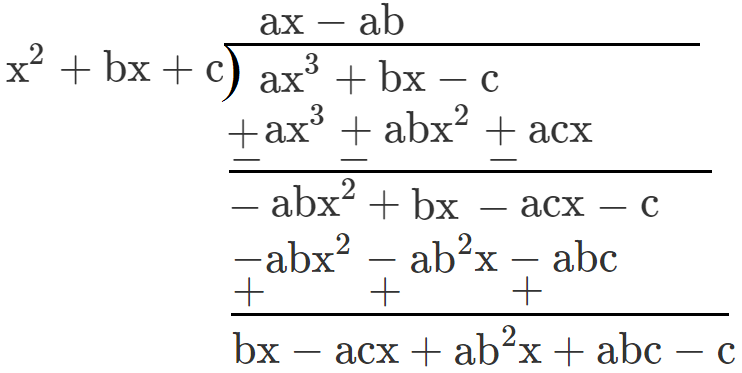
We must have
$bx - acx + ab^2x + abc - c = 0,$ for all $x$
So put $x = 0$ in this equation
$x(b - ac + ab^2) + c(ab - 1) = 0$
$c(ab - 1) = 0$
Since $c \neq 0,$ so
$ab - 1 = 0$
$\Rightarrow ab = 1$
Hence, the correct alternative is $(a)$ View full question & answer→MCQ 811 Mark
If one of the zeros of the cubic polynomial $a x^3+b x^2+c x+d$ is $0,$ then the product of the other two zeros is :
- A
$\frac{-\text{c}}{\text{a}}$
- ✓
$\frac{\text{c}}{\text{a}}$
- C
$0$
- D
$\frac{-\text{b}}{\text{a}}$
AnswerCorrect option: B. $\frac{\text{c}}{\text{a}}$
Let $0,\ \beta,\ \gamma$ be the zeros of the cubic polynomial $a x^3+b x^2+c x+d$.
Now, sum of the products of zeros, taken two at a time is given by
$\Rightarrow0\times\beta+\beta\gamma+\gamma\times0=\frac{\text{c}}{\text{a}}$
$\Rightarrow\beta\gamma=\frac{\text{c}}{\text{a}}$
View full question & answer→MCQ 821 Mark
The zeroes of a polynomial $x^2-7 x+12$ are :
- A
One positive and one negative.
- B
- ✓
- D
Answer$x^2-7 x+12$
$=x^2-4 x-3 x+12=0$
$=x(x-4)-3(x-4)=0$
$=(x-4)(x-3)=0$
$\therefore x-4=0 $ or $ x-3=0$
$\Rightarrow x=4$ or $ x=3$
View full question & answer→MCQ 831 Mark
If $x + 2$ is a factor of $x^2+ ax + 2b$ and $a + b = 4,$ then :
- A
$a = 1, b = 3$
- ✓
$a = 3, b = 1$
- C
$a = −1, b = 5$
- D
$a = 5, b = -1$
AnswerCorrect option: B. $a = 3, b = 1$
Given that $x + 2$ is a factor of $x^2+ ax + 2b$ and $a + b = 4$
$f(x) = x^2+ ax + 2b$
$f(-2) = (-2)^2+ a(-2) + 2b$
$0 = 4 - 2a + 2b$
$-4 = -2a + 2b$
By solving $-4 = -2a + 2b$ and $a + b = 4$ by elimination method we get
Multiply $a + b = 4$ by $2$ we get,
$2a + 2b = 8$.
So $\frac{4}{4}=\text{b}$
$b = 1$
By substituting $b = 1$ in $a + b = 4$ we get
$a + 1 = 4$
$a = 4 - 1$
$a = 3$
Then $a = 3, b = 1$
Hence, the correct choice is $(b)$
View full question & answer→MCQ 841 Mark
The zeros of the polynomial $4\text{x}^2+5\sqrt2\text{x}-3$ are :
- A
$-3\sqrt2,\ \sqrt2$
- B
$-3\sqrt2,\ \frac{\sqrt2}{2}$
- ✓
$\frac{-3\sqrt2}{2},\ \frac{\sqrt2}{4}$
- D
AnswerCorrect option: C. $\frac{-3\sqrt2}{2},\ \frac{\sqrt2}{4}$
$\text{f}(\text{x})=4\text{x}^2+5\sqrt2\text{x}-3$
$=4\text{x}^2+6\sqrt2\text{x}-\sqrt2\text{x}-3$
$=2\sqrt2\text{x}\big(\sqrt2\text{x}+3\big)-1\big(\sqrt2\text{x}+3\big)$
$=\big(2\sqrt2\text{x}-1\big)\big(\sqrt2\text{x}+3\big)$
$\therefore\text{f}(\text{x})=0$
$\Rightarrow\big(2\sqrt2\text{x}-1\big)\big(\sqrt2\text{x}+3\big)=0$
$\Rightarrow2\sqrt2\text{x}-1=0$ or $\sqrt2\text{x}+3=0$
$\Rightarrow\text{x}=\frac{1}{2\sqrt2}$ or $\text{x}=-\frac{3}{\sqrt2}$
$\Rightarrow\text{x}=\frac{\sqrt2}{4}$ or $\text{x}=-\frac{3\sqrt2}{2}$
So, the zeros of given polynomial are $\frac{\sqrt2}{4}$ and $-\frac{3\sqrt2}{2}$
View full question & answer→MCQ 851 Mark
If $\alpha,\ \beta,\ \gamma$ be the zeros of the polynomial $p(x)$ such that $(\alpha+\beta+\gamma)=3,\ (\alpha\beta+\beta\gamma+\gamma\alpha)=-10$ and $\alpha\beta\gamma=-24$ then $p(x) =$ ?
- A
$ x^3+3 x^2-10 x+24 $
- B
$ x^3+3 x^2+10 x-24 $
- ✓
$ x^3-3 x^2-10 x+24$
- D
AnswerCorrect option: C. $ x^3-3 x^2-10 x+24$
A cubic polynomial whose zeros are $\alpha,\ \beta$ and $\gamma$ is given by
$\text{p}(\text{x})=\text{x}^2-(\alpha+\beta+\gamma)\text{x}^2+\alpha\beta+\beta\gamma+\gamma\alpha)\text{x}-\alpha\beta\gamma$
Given, $(\alpha+\beta+\gamma)=3,\ (\alpha\beta+\beta\gamma+\gamma\alpha)=-10$ and $\alpha\beta\gamma=-24$
Thus, $\text{p}(\text{x})=\text{x}^3-\text{3x}^2-\text{10x}+24$
View full question & answer→MCQ 861 Mark
If $\alpha,\ \beta,\ \gamma$ are the zeros of the polynomial $2 x^3+x^2-13 x+6,$ then $\alpha\beta\gamma=?$
- ✓
$-3$
- B
$3$
- C
$\frac{-1}{2}$
- D
$\frac{-13}2{}$
AnswerSince $\alpha,\ \beta,\ \gamma$ are the zeros of $2 x^3+x^2-13 x+6,$
we have $\alpha\beta\gamma=-\frac{\text{d}}{\text{a}}$
$=-\frac{6}{2}=-3$
View full question & answer→MCQ 871 Mark
If one zero of the quadratic polynomial $(k - 1) x^2+ kx + 1$ is $-4,$ then the value of $k$ is :
- A
$\frac{-5}{4}$
- ✓
$\frac{5}{4}$
- C
$\frac{-4}{3}$
- D
$\frac{4}{3}$
AnswerCorrect option: B. $\frac{5}{4}$
Since $-4$ is a zero of $f(x) = (k - 1)x^2+ kx + 1,$
we have $f(-4) = 0$
$\Rightarrow (k - 1)(-4)^2+ k(-4) + 1 = 0$
$\Rightarrow (k - 1)16 - 4k + 1 = 0$
$\Rightarrow 16k - 16 - 4k + 1 = 0$
$\Rightarrow 12k - 15 = 0$
$\Rightarrow 12k = 15$
$\Rightarrow\text{k}=-\frac{15}{12}=\frac{5}{4}$
View full question & answer→MCQ 881 Mark
A real number $k$ is said to be a zero of a polynomial $p(x),$ if $p(k) =$
AnswerA real number $'k\ ’$ is said to be a zero of a polynomial $p(x),$ if $p(k)$ equals to $0$.
if $P(x)$ is a polynomial in $x$ and $k$ is any real number,
then the value of $P(k)$ at $x = k$ is denoted by $P(k)$ is found by replacing $x$ by $k$ in $P(x)$.
e.g., In the polynomial $x^2-3 x+2$,
Replacing $x$ by $1$ gives,
$P(1) = 1 - 3 + 2 = 0$
Similarly, replacing $x$ by $2$ gives,
$P(2) = 4 - 6 + 2 = 0$
For a polynomial $P(x),$ real number $k$ is said to be zero of polynomial $P(x),$ if $P(k) = 0.$
View full question & answer→MCQ 891 Mark
If $\alpha,\beta$ are the zeros of polynomial $f(x)=x^2-p(x+1)-c$, then $(\alpha+1)(\beta+1)=$
- A
$c - 1$
- ✓
$1 - c$
- C
$c$
- D
$1 + c$
AnswerCorrect option: B. $1 - c$
Since $\alpha$ and $\beta$ are the zeros of quadratic polynomial
$\text{f(x)}=\text{x}^2-\text{p(x}+1)-\text{c}$
$=\text{x}^2-\text{px}-\text{p}-\text{c}$
$\alpha+\beta=\frac{-\text{Coefficient of x}}{\text{Coefficient of x}^2}$
$=-\Big(\frac{-\text{p}}{1}\Big)$
$=\text{p}$
$\alpha\times\beta=\frac{\text{Constant term}}{\text{Coefficient of x}^2}$
$=\frac{-\text{p}-\text{c}}{1}$
$=-\text{p}-\text{c}$
We have
$(\alpha+1)(\beta+1)$
$=\alpha\beta+\beta+\alpha+1$
$=\alpha\beta+(\alpha+\beta)+1$
$=-\text{p}-\text{c}+(\text{p})+1$
$=-\text{p}-\text{c}+\text{p}+1$
$=-\text{c}+1$
$=1-\text{c}$
The value of $(\alpha+1)(\beta+1)$ is $1 - c$
Hence, the correct choice is $(b)$
View full question & answer→MCQ 901 Mark
If $\alpha$ and $\beta$ are the zeroes of a quadratic polynomial $x^2-5 x+b$ and $\alpha-\beta = {1}$ then the value of $b$ is :
AnswerHere $\alpha+\beta = \frac{\text{-b}}{\text{a}} = \frac{-(-5)}{1}$
$\alpha+\beta = {5} ... (\text{i)}$
And it is given that $ \alpha-\beta = {1} ...\text{(ii)}$
On solving eq.$(i)$ and eq.$(ii),$ we get
$\alpha+\beta = {5}$
$\alpha-\beta = {1}$
$2\text{a} ={6 } {(\beta }$ is canclled$)$
$\alpha = \frac{6}{2}$
$\alpha =3 $ put the value of $\alpha $ in eq.$(i)$
$\alpha +\beta={5}$
$\Rightarrow{3}+ \beta ={5}$
$\Rightarrow\beta = {5}-{3}$
$\Rightarrow\beta={2}$
$\therefore\alpha \beta = \frac{\text{c}}{\text{a}}$
$\Rightarrow{3}\times{2} =\frac{\text{b}}{1}$
$\Rightarrow\text{b}={6}$
View full question & answer→MCQ 911 Mark
If $\alpha,\beta$ are the zeroes of the polynomial $f(x)=x^2+x+1$, then $\frac{1}{\alpha}+\frac{1}{\beta} = $
AnswerSince $\alpha$ and $\beta$ are the zeroes of the quadratic polynomial $f(x)=x^2+x+1$
$\alpha+\beta = \frac{-\text{Coefficient of }{\text{x}}}{\text{Coefficient of }\text{x}^{2}} = \frac{-1}{1} = {-1}$
$\alpha\times\beta = \frac{\text{Constant term}}{\text{Coefficient of}{\text{x}^{2}}} = \frac{1}{1} = {1}$
Now $\frac{1}{\alpha}+\frac{1}{\beta} = \frac{\beta+\alpha}{\alpha\beta}=\frac{-1}{1} = {-1}$
Thus the value of $\frac{1}{\alpha}+\frac{1}{\beta}$ is $-1$
View full question & answer→MCQ 921 Mark
Choose the correct answer from the given four options in the following questions : If one of the zeroes of a quadratic polynomial of the form $x^2+ax + b$ is the negative of the other, then it :
- ✓
Has no linear term and the constant term is negative.
- B
Has no linear term and the constant term is positive.
- C
Can have a linear term but the constant term is negative.
- D
Can have a linear term but the constant term is positive.
AnswerCorrect option: A. Has no linear term and the constant term is negative.
Let $p(x) = x^2+ ax + b.$
Put $a = 0,$ then, $p(x) = x^2+ b = 0$
$\Rightarrow x^2= -b$
$\Rightarrow\ \text{x}=\pm\sqrt{-\text{b}}$
$[\therefore\ \text{b}<0]$
Hence, if one of the zeroes of quadratic polynomial $p(x)$ is the negative of the other,
then it has no linear term
i.e., $a = 0$ and the constant term is negative
i.e., $b < 0.$
Alternate Answer
Let $f(x) x^2+ ax + b$
and by given condition the zeroes area and $-\alpha$
Sum of the zeroes $=\alpha -\alpha = \text{a}$
$\Rightarrow a = 0$
$f(x) = x^2+ b$, which cannot be linear,
and product of zeroes $=\alpha.(-\alpha)=\text{b}$
$\Rightarrow\ -\alpha^2=\text{b}$
Which is possible when $, b < 0$
Hence, it has no linear tern and the constant term is negative.
View full question & answer→MCQ 931 Mark
If one zero of the quadratic polynomial $x^2+ 3x + k$ is $2,$ then the value of $'k\ ’$ is :
AnswerGiven Polynomial is $p(x) = x^2+ 3x + k$
According to question, $p(x) = 0 \ ($Put $x = 2) p(2) = 0$
$\Rightarrow (2)^2+ 3 \times 2 + k = 0$
$\Rightarrow 4 + 6 + k = 0$
$\Rightarrow k = -10$
View full question & answer→MCQ 941 Mark
The zeroes of the quadratic polynomial $x^2+a x+a, a \neq 0$
AnswerLet $f(x)=x^2+a x+a$
Product of the zeroes of $f(x) = a \Big[\text{Product of zeroes}=\frac{\text{c}}{\text{a}}\text{ when f(x) = ax}^2+\text{bx + c}\Big]$
Since the product of zeroes is positive, so the zeroes must be either both positive or both negative.
Also, sum of the zeroes $ = -a \Big[\text{Sum of zeroes}=-\frac{\text{b}}{\text{a}}\text{when f(x) = ax}^2+\text{bx + c}\Big]$
So, the sum of the zeroes is negative, so the zeroes cannot be both positive.
Hence, the correct answer is option $(b)$
View full question & answer→MCQ 951 Mark
If $\alpha$ and $\beta$ are the zeros of the polynomial $f(x) = x^2+ px + q,$ then a polynomial having $\frac{1}{\alpha}$ and $\frac{1}{\beta}$ and is its zero is :
- A
$ x^2+q x+p $
- B
$ x^2-p x+q $
- ✓
$ q x^2+p x+1 $
- D
$ p x^2+q x+1 $
AnswerCorrect option: C. $ q x^2+p x+1 $
Let $\alpha,\beta$ be the zeros of the polynomial $f(x) = x^2+ px + q.$
Then,
$\alpha+\beta=\frac{-\text{Coefficient of x}}{\text{Coefficient of x}^2}$
$=-\frac{\text{p}}{1}$
$=-\text{p}$
And
$\alpha\beta=\frac{\text{Constant term}}{\text{Coefficient of x}^2}$
$=\frac{\text{q}}{1}$
$=\text{q}$
Let $S$ and $R$ denote respectively the sum and product of the zeros of a polynomial
Whose zeros are $\frac{1}{\alpha}$ and $\frac{1}{\beta}$ then
$\text{S}=\frac{1}{\alpha}+\frac{1}{\beta}$
$=\frac{\alpha+\beta}{\alpha\beta}$
$=\frac{-\text{p}}{\text{q}}$
$\text{R}=\frac{1}{\alpha}\times\frac{1}{\beta}$
$=\frac{1}{\alpha\beta}$
$=\frac{1}{\text{q}}$
Hence, the required polynomial $g(x)$ whose sum and product of zeros are $S$ and $R$ is given by
$\text{x}^2-\text{Sx}+\text{R}=0$
$\text{x}^2+\frac{\text{p}}{\text{q}}\text{x}+\frac{1}{\text{q}}=0$
$\frac{\text{qx}^2+\text{qx}+1}{\text{q}}=0$
$\Rightarrow\ \text{qx}^2+\text{qx}+1$
So $ ,g(x) = q x^2+p x+1 $
Hence, the correct choice is $(c)$
View full question & answer→MCQ 961 Mark
If two of the zeros of the cubic polynomial $a x^3+b x^2+c x+d$ is $0,$ then the third zeros is :
- ✓
$\frac{-\text{b}}{\text{a}}$
- B
$\frac{\text{b}}{\text{a}}$
- C
$\frac{\text{c}}{\text{a}}$
- D
$\frac{-\text{d}}{\text{a}}$
AnswerCorrect option: A. $\frac{-\text{b}}{\text{a}}$
Let $0,\ 0,\ \gamma$ be the zeros of the cubic polynomial $a x^3+b x^2+c x+d$.
Now, sum of zeros $=-\frac{\text{b}}{\text{a}}$
$\Rightarrow0+0+\gamma=-\frac{\text{b}}{\text{a}}$
$\Rightarrow\gamma=-\frac{\text{b}}{\text{a}}$
View full question & answer→MCQ 971 Mark
If one zero of the polynomial $f(x)=\left(k^2+4\right) x^2+13 x+4 k$ is reciprocal of the other, then $k =$
AnswerWe are given $f(x)=\left(k^2+4\right) x^2+13 x+4 k$ then
$\alpha+\beta=\frac{-\text{Coefficient of x}}{\text{Coefficient of x}^2} =\frac{-13}{\text{k}^2+4}$
$\alpha\times\beta=\frac{\text{Constant term}}{\text{Coefficient of x}^2} =\frac{4\text{k}}{\text{k}^2+4}$
one root of the polynomial is reciprocal of the other.
Then, we have $\alpha\times\beta=1$
$\Rightarrow\ \frac{4\text{k}}{\text{k}^2+4}=1$
$\Rightarrow\ \text{k}^2-4\text{k}+4=0$
$\Rightarrow\ (\text{k}-2)^2=0$
$\Rightarrow\ \text{k}=2$
Hence the correct choice is $(a)$
View full question & answer→MCQ 981 Mark
It is given that the difference between the zeroes of $4x^2- 8kx + 9$ is $4$ and $k > 0$. Then, $k =$ ?
- A
$\frac{1}{2}$
- B
$\frac{3}2{}$
- ✓
$\frac{5}{2}$
- D
$\frac{7}{2}$
AnswerCorrect option: C. $\frac{5}{2}$
Let the zeroes of the polynomial be $\alpha$ and $\alpha+4.$
Here, $p(x) = 4x^2- 8kx + 9$
Comparing the given polynomial with $ax^2+ bx + c$, we get :
$a = 4, b = -8k$ and $c = 9$
Now, sum of the roots $=-\frac{\text{b}}{\text{a}}$
$\Rightarrow\alpha+\alpha+4=\frac{-(-8\text{k})}{4}$
$\Rightarrow2\alpha=4=\text{2k}$
$\Rightarrow\alpha+2=\text{k}$
$\Rightarrow\alpha=(\text{k}-2)\dots(\text{i})$
Also, product of the roots, $\alpha\beta=\frac{\text{c}}{\text{a}}$
$\Rightarrow\alpha(\alpha+4)=\frac{9}{4}$
$\Rightarrow(\text{k}-2)(\text{k}-2+4)=\frac{9}{4}$
$\Rightarrow(\text{k}-2)(\text{k}+2)=\frac{9}{2}$
$\Rightarrow\text{k}^2-4=\frac{9}{4}$
$\Rightarrow\text{4k}^2-16=9$
$\Rightarrow\text{4k}^2=25$
$\Rightarrow\text{k}^2=\frac{25}{4}$
$\Rightarrow\text{k}=\frac{5}{2}$
$(\because\text{k}>0)$
View full question & answer→MCQ 991 Mark
If one of the zeroes of the quadratic polynomial $(k - 1) x^2+ kx + 1 is -3$, then the value of $k$ is :
- A
$\frac{2}{3}$
- ✓
$\frac{4}{3}$
- C
$\frac{-4}{3}$
- D
$\frac{-2}{3}$
AnswerCorrect option: B. $\frac{4}{3}$
Zeroes of a polynomial are the values of $x$ at which the polynomial is equal to zero.
As one of the zeros of given polynomial $p(x) = (k - 1) x^2+ kx + 1$ is $-3,$
$p(-3) = 0$
$\Rightarrow (k - 1) (-3)^2+ k(-3) + 1 = 0$
$\Rightarrow (k - 1) (9) -3 k + 1 = 0$
$\Rightarrow 9k - 9 -3k + 1 = 0$
$\Rightarrow 9k -3k - 8 = 0$
$\Rightarrow 6k = 8$
$\Rightarrow\text{k} = \frac{4}{3}$
View full question & answer→MCQ 1001 Mark
If one zero of the quadratic polynomial $x^2+ 3x + k$ is $2,$ then the value of $k$ is :
AnswerLet the given polynomial be $f(x) = x^2+ 3x + k$
Since $2$ is one of the zero of the given plynomial,
so $(x - 2)$ will be a factor of the given polynomial.
Now $, f(2) = 0$
$\Rightarrow 2^2+ 3 \times 2 + k = 0$
$\Rightarrow 4 + 6 + k = 0$
$\Rightarrow k = -10$
Hence, the correct answer is option $(b)$
View full question & answer→