MCQ 11 Mark
What should be subtracted to the polynomial $x^2-16 x+30$, so that $15$ is the zero of the resulting polynomial?
View full question & answer→MCQ 21 Mark
If one of the zeroes of a quadratic polynomial of the form $x^2+a x+b$ is the negative of the other, then it:
- ✓
Has no linear term and constant term is negative.
- B
Has no linear term and the constant term is position.
- C
Can have a linear term but the constant term is negative.
- D
Can have a linear term but the constant term is positive.
AnswerCorrect option: A. Has no linear term and constant term is negative.
Let the quadratic polynomial be $f(x) = x^2 + ax + b$
Now, the zeroes are $\alpha$ and $-\alpha$
So, the sum of the zeroes is zero.
$\therefore\ \alpha+(-\alpha)=\frac{-\text{a}}{1}=-\text{a}$
$\Rightarrow\text{a}=0$
So, the polynomial becomes $f(x) = x^2 + b$, which is not linear
Also, the product of the zeros,
$\alpha\beta=\frac{\text{b}}{1}=\text{b}$
$\Rightarrow\alpha(-\alpha)=\text{b}$
$\Rightarrow\alpha^2=\text{b}$
Thus, the constant term is negative.
Hence, the correct answer is option $(a)$
View full question & answer→MCQ 31 Mark
If $\alpha,\beta$ are the zeros of the polynomial $f(x) = ax^2 + bx + c$, then $\frac{1}{\text{a}^2}+\frac{1}{\beta^2}=$
- A
$\frac{\text{b}^2-2\text{ac}}{\text{a}^2}$
- ✓
$\frac{\text{b}^2-2\text{ac}}{\text{c}^2}$
- C
$\frac{\text{b}^2+2\text{ac}}{\text{a}^2}$
- D
$\frac{\text{b}^2+2\text{ac}}{\text{c}^2}$
AnswerCorrect option: B. $\frac{\text{b}^2-2\text{ac}}{\text{c}^2}$
We have to find the value of $\frac{1}{\alpha^2}+\frac{1}{\beta^2}$
Given $\alpha$ and $\beta$ be the zeros of the polynomial $f(x)=a x^3+b x^2+c$
$\alpha+\beta=\frac{-\text{Coefficient of x}}{\text{Coefficient of x}^2}$
$=\frac{-(\text{b})}{\text{a}}$
$\alpha\cdot\beta=\frac{\text{Constant term}}{\text{Coefficient of x}^2} $
$=\frac{\text{c}}{\text{a}}$
We have
$\frac{1}{\alpha^2}+\frac{1}{\beta^2}=\Big(\frac{1}{\alpha}+\frac{1}{\beta}\Big)^2-\frac{2}{\alpha\beta}$
$\frac{1}{\alpha^2}+\frac{1}{\beta^2}=\Big(\frac{\beta}{\alpha\beta}+\frac{\alpha}{\beta\alpha}\Big)^2-\frac{2}{\alpha\beta}$
$\frac{1}{\alpha^2}+\frac{1}{\beta^2}=\Big(\frac{\alpha+\beta}{\alpha\beta}\Big)^2-\frac{2}{\alpha\beta}$
$\frac{1}{\alpha^2}+\frac{1}{\beta^2}=\bigg(\frac{\frac{-\text{b}}{\text{a}}}{\frac{\text{c}}{\text{a}}}\bigg)^2-\frac{2}{\frac{\text{c}}{\text{a}}}$
$\frac{1}{\alpha^2}+\frac{1}{\beta^2}=\Big(\frac{-\text{b}}{\text{a}}\times\frac{\text{a}}{\text{c}}\Big)^2-\frac{2\text{a}}{\text{c}}$
$\frac{1}{\alpha^2}+\frac{1}{\beta^2}=\Big(\frac{-\text{b}}{\text{c}}\Big)^2-\frac{2\text{a}}{\text{c}}$
$\frac{1}{\alpha^2}+\frac{1}{\beta^2}=\Big(\frac{\text{b}^2}{\text{c}^2}\Big)-\frac{2\text{a}\times\text{c}}{\text{c}\times\text{c}}$
$\frac{1}{\alpha^2}+\frac{1}{\beta^2}=\Big(\frac{\text{b}^2}{\text{c}^2}\Big)-\frac{2\text{ac}}{\text{c}^2}$
$\frac{1}{\alpha^2}+\frac{1}{\beta^2}=\Big(\frac{\text{b}^2-2\text{ac}}{\text{c}^2}\Big)$
Hence, the correct choice is $(b)$
View full question & answer→MCQ 41 Mark
If one of the zeroes of the quadratic polynomial $(k - 1)x^2 + kx + 1$ is $-3$, then the value of $k$ is:
- ✓
$\frac{4}{3}$
- B
$\frac{-4}{3}$
- C
$\frac{2}{3}$
- D
$\frac{-2}{3}$
AnswerCorrect option: A. $\frac{4}{3}$
The given polynomial is $f(x)=(k-1) x^2+k x+1$
Since $-3$ is one of the zeroes of the given polynomial, so $f(-3)=0$.
$(k-1)(-3)^2+k(-3)+1=0$
$\Rightarrow 9(k-1)-3 k+1=0$
$\Rightarrow 9 k-9-3 k+1=0$
$\Rightarrow 6 k-8=0$
$\Rightarrow k=\frac{4}{3}$
Hence, the correct answer is option $(a)$
View full question & answer→MCQ 51 Mark
Given that of the zeroes of the cubic polynomial $a x^3+b x^2+c x+d$ are $0$ , the third zero is:
- ✓
$\frac{-\text{b}}{\text{a}}$
- B
$\frac{\text{b}}{\text{a}}$
- C
$\frac{\text{c}}{\text{a}}$
- D
$\frac{-\text{d}}{\text{a}}$
AnswerCorrect option: A. $\frac{-\text{b}}{\text{a}}$
Let the polynomial be $f(x)=a x^3+b x^2+c x+d$
Suppose the two zeroes of $f(x)$ are $\alpha=0$ and $\beta=0$
We know that,
Sum of the zeros,
$\alpha+\beta+\gamma=\frac{-\text{b}}{\text{a}}$
$\Rightarrow0+0+\gamma=\frac{-\text{b}}{\text{a}}$
$\Rightarrow\gamma=\frac{-\text{b}}{\text{a}}$
Hence, the correct answer is option $(a)$
View full question & answer→MCQ 61 Mark
The zeroes of the quadratic polynomial $x^2+99 x+127$ are:
- A
- ✓
- C
- D
One positive and one negative.
AnswerLet $f(x)=x^2+99 x+127$
Product of the zeroes of $f(x)=127 \times 1=127$ [Product of zeroes $=\frac{c}{a}$ when $f(x)=a x^2+b x+c$ ]
Since the product of zeroes is positive, we can say that it is only possible when both zeroes are positive or both zeroes are negative.
Also, sum of the zeroes $= -99$
$\Big[\text{Sum of zeroes}=-\frac{\text{b}}{\text{a}}\text{ when f(x) = ax}^2+\text{bx + c}\Big]$
The sum being negative implies that both zeroes are positive is not correct.
So, we conclude that both zeroes are negative.
Hence, the correct answer is option $(b).$
View full question & answer→MCQ 71 Mark
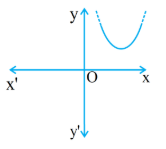
If the diagram in Fig. shows the graph of the polynomial $f(x) = ax^2+ bx + c$, then:
- ✓
$a > 0, b < 0$ and $c > 0$
- B
$a < 0, b < 0$ and $c < 0$
- C
$a < 0, b > 0$ and $c > 0$
- D
$a < 0, b > 0$ and $c < 0$
AnswerCorrect option: A. $a > 0, b < 0$ and $c > 0$
Clearly, $f(x)=a x^2+b x+c$ represent a parabola opening upwards $\mid$
Therefore, $a > 0 y=a x^2+b x+c$ cuts $Y$ axis at $P$ which lies on $O Y$. Putting $x=0$ in $y=a x^2+b x+c$, we get $y=c$. So the coordinates of $P$ is $( 0 , c).$ Clearly, $P$ lies on $OY$. Therefore $c > 0$
View full question & answer→MCQ 81 Mark
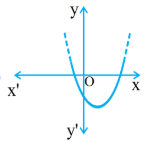
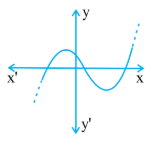
Which of the following is not the graph of a quadratic polynomial?
AnswerFor a quadratic polynomial, $a x^2+b x+c$, the zeros are precisely the $x-$ coordinates of the points where the graph representing $y=a x^2+b x+c$ intersects the $x-$ axis.
The graph has one of the two shapes either open upwards like $∪ ($parabolic shape$)$ or open downwards like $∩ ($parabolic shape$)$ depending on whether $a > 0 $ or $a < 0.$
Three cases are thus possible :
- Graph cuts $x-$ axis at two distinct points $($two zeroes$)$
- Graph cuts the $x-$ axis at exactly one point $($one zero$)$
- The graph is either completely above the $x-$ axis or completely below the $x-$ axis $($no zeroes$)$
- The graph is cutting the $x-$ axis at three distinct points and it is not a parabola opening either upwards or downwards.
So, option $(d)$ does not represent the graph of a quadratic polynomial.
Hence, the correct answer is option $(b)$ View full question & answer→MCQ 91 Mark
If one root of the polynomial $f(x) = 5x^2 + 13x + k$ is reciprocal of the other, then the value of $k$ is:
- A
$0$
- ✓
$5$
- C
$\frac{1}{5}$
- D
$6$
AnswerIf one zero of the polynomial $f(x) = 5x^2 + 13x + k$ is reciprocal of the other.
So $\beta=\frac{1}{\alpha}\Rightarrow\alpha\beta=1$
Now we have
$\alpha\times\beta=\frac{\text{Constant term}}{\text{Coefficient of x}^2}$
$=\frac{\text{k}}{5}$
Since $\alpha\beta=1$
Therefore we have
$\alpha\beta=\frac{\text{k}}{5}$
$1=\frac{\text{k}}{5}$
$\Rightarrow\text{k}=5$
Hence, the correct choice is $(b)$
View full question & answer→MCQ 101 Mark
If $\alpha,\beta$ are the zeros of the polynomial $f(x) = x^2 + x + 1$, then $\frac{1}{\alpha}+\frac{1}{\beta}=$
AnswerSince $\alpha$ and $\beta$ are the zeros of the quadratic polynomial $f(x) = x^2 + x + 1$
$\alpha+\beta=-\frac{\text{coefficient of x}}{\text{coefficient of x}^2}$
$=\frac{-1}{1}=-1$
$\alpha\times\beta=\frac{\text{constant term}}{\text{coefficient of x}^2}$
$=\frac{1}{1}=1$
We have
$=\frac{1}{\alpha}+\frac{1}{\beta}$
$=\frac{\beta+\alpha}{\alpha\beta}$
$=\frac{-1}{1}$
$=-1$
The value of $\frac{1}{\alpha}+\frac{1}{\beta}$ is $-1$
Hence, the correct choice is $ (b).$
View full question & answer→MCQ 111 Mark
If two zeros $x^3+x^2-5 x-5$ are $\sqrt{5}$ and $-\sqrt{5},$ then its third zero is:
AnswerLet $\alpha=\sqrt{5}$ and $\beta=-\sqrt{5}$ be the given zeros and $\gamma$ be the third zero of $x ^3+ x ^2-5 x -5=0$
By using $\alpha+\beta+\gamma=\frac{-\text{Coefficient of x}^2}{\text{Coefficient of x}^3}$
$\alpha+\beta+\gamma=-\frac{+(+1)}{1}$
$\alpha+\beta+\gamma=-1$
By substituting $\alpha=\sqrt{5}$ and $\beta=-\sqrt{5}$ in $\alpha+\beta+\gamma=-1$
$\sqrt{5}-\sqrt{5}+\gamma=-1$
$\gamma=-1$
Hence, the correct choice is (b)
View full question & answer→MCQ 121 Mark
If the product of zeros of the polynomial $f(x) a x^3-6 x^2+11 x-6$ is 4 , then $a=$
- ✓
$\frac{3}{2}$
- B
$-\frac{3}{2}$
- C
$\frac{2}{3} $
- D
$ -\frac{2}{3}$
AnswerCorrect option: A. $\frac{3}{2}$
Since $\alpha$ and $\beta$ are the zeros of quadratic polynomial $f(x)=a x^2-6 x^2+11 x-6$
$\alpha\beta=\frac{-\text{Constant term}}{\text{Coefficient of x}^2}$
So we have
$4=-\Big(\frac{-6}{\text{a}}\Big) $
$4=\frac{6}{\text{a}}$
$4\text{a}=6$
$ \text{a}=\frac{6}{4}$
$ \text{a}=\frac{3\times2}{2\times2}$
$\text{a}=\frac{3}{2}$
The value of $\alpha$ is $\frac{3}{2}$
Hence, the correct alternative is (a)
View full question & answer→MCQ 131 Mark
If the product of two zeros of the polynomial $f(x)=2 x^3+6 x^2-4 x+9$ is $3,$ then its third zero is:
- A
$\frac{3}{2}$
- ✓
$\frac{-3}{2}$
- C
$\frac{9}{2}$
- D
$\frac{-9}{2}$
AnswerCorrect option: B. $\frac{-3}{2}$
Let $\alpha,\beta,\gamma$ be the zeros of polynomial $f(x) = 2x^3 + 6x^2 - 4x + 9$ such that $\alpha\beta=3$
We have,
$\alpha\beta\gamma=\frac{\text{Constant term}}{\text{Coefficient of x}^2}$
$=\frac{-9}{2}$
Putting $\alpha\beta=3\text{ in }\alpha\beta\gamma=\frac{-9}{2},$ we get
$\alpha\beta\gamma=\frac{-9}{2}$
$3\gamma=\frac{-9}{2}$
$\gamma=\frac{-9}{2}\times\frac{1}{3}$
$\gamma=\frac{-3}{2}$
Therefore, the value of third zero is $\frac{-3}{2}$
Hence, the correct alternative is $(b)$
View full question & answer→MCQ 141 Mark
If two zeroes of the polynomial $x^3 + x^2- 9x - 9$ are $3$ and $-3, $ then its third zero is:
AnswerLet $\alpha=3$ and $\beta=-3$ be the given zeros and $\gamma$ be the third zero of the polynomial $x^3 + x^2 - 9x - 9$ then
By using $\alpha+\beta+\gamma=\frac{-\text{Coefficient of x}^2}{\text{Coffiecient of x}^3}$
$\alpha+\beta+\gamma=\frac{-1}{1}$
$\alpha+\beta+\gamma=-1$
Substituting $\alpha=3$ and $\beta=-3$ in $\alpha+\beta+\gamma=-1,$ we get
$3-3+\gamma=-1$
$\gamma=-1$
Hence, the correct choice is $(a)$
View full question & answer→MCQ 151 Mark
If the polynomial $f(x)=a x^3+b x-c$ is divisible by the polynomial $g(x)=x^2+b x+c$, then $a b=$
- ✓
$1$
- B
$\frac{1}{\text{c}}$
- C
$-1$
- D
$-\frac{1}{\text{c}}$
AnswerWe have to find the value of $ab$
Given $f(x)=a x^3+b x-c$ is divisible by the polynomial $g(x)=x^2+b x+c$
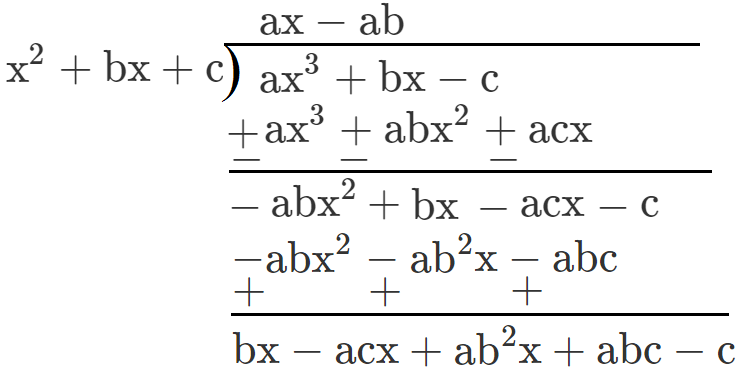
We must have
$b x-a c x+a b^2 x+a b c-c=0$, for all $x$
So put $x=0$ in this equation
$x\left(b-a c+a b^2\right)+c(a b-1)=0$
$c(ab - 1) = 0$
Since $c \neq 0,$ so
$ab - 1 = 0$
$\Rightarrow ab = 1$
Hence, the correct alternative is $(a)$ View full question & answer→MCQ 161 Mark
If $x + 2$ is a factor of $x^2 + ax + 2b$ and $a + b = 4,$ then:
- A
$a = 1, b = 3$
- ✓
$a = 3, b = 1$
- C
$a = −1, b = 5$
- D
$a = 5, b = -1$
AnswerCorrect option: B. $a = 3, b = 1$
Given that $x+2$ is a factor of $x^2+a x+2 b$ and $a+b=4$
$f(x)=x^2+a x+2 b$
$f(-2)=(-2)^2+a(-2)+2 b$
$0=4-2 a+2 b$
$-4=-2 a+2 b$
By solving $-4=-2 a+2 b$ and $a+b=4$ by elimination method we get
Multiply $a + b =4$ by $2$ we get,
$2 a+2 b=8 .$
So $\frac{4}{4}=b$
$b=1$
By substituting $b=1$ in $a+b=4$ we get
$a+1=4$
$a=4-1$
$a=3$
Then $a=3, b=1$
Hence, the correct choice is $(b)$
View full question & answer→MCQ 171 Mark
If $\alpha,\beta$ are the zeros of polynomial $f(x) = x^2 - p (x + 1) - c$, then $(\alpha+1)(\beta+1)=$
- A
$c - 1$
- ✓
$1 - c$
- C
$c$
- D
$1 + c$
AnswerCorrect option: B. $1 - c$
Since $\alpha$ and $\beta$ are the zeros of quadratic polynomial
$\text{f(x)}=\text{x}^2-\text{p(x}+1)-\text{c}$
$=\text{x}^2-\text{px}-\text{p}-\text{c}$
$\alpha+\beta=\frac{-\text{Coefficient of x}}{\text{Coefficient of x}^2}$
$=-\Big(\frac{-\text{p}}{1}\Big)$
$=\text{p}$
$\alpha\times\beta=\frac{\text{Constant term}}{\text{Coefficient of x}^2}$
$=\frac{-\text{p}-\text{c}}{1}$
$=-\text{p}-\text{c}$
We have
$(\alpha+1)(\beta+1)$
$=\alpha\beta+\beta+\alpha+1$
$=\alpha\beta+(\alpha+\beta)+1$
$=-\text{p}-\text{c}+(\text{p})+1$
$=-\text{p}-\text{c}+\text{p}+1$
$=-\text{c}+1$
$=1-\text{c}$
The value of $(\alpha+1)(\beta+1)$ is $1 - c$
Hence, the correct choice is $(b)$
View full question & answer→MCQ 181 Mark
The zeroes of the quadratic polynomial $x^2 + ax + a, a ≠ 0$
AnswerLet $f(x) = x^2 + ax + a$
Product of the zeroes of f(x) = a $\Big[\text{Product of zeroes}=\frac{\text{c}}{\text{a}}\text{ when f(x) = ax}^2+\text{bx + c}\Big]$
Since the product of zeroes is positive, so the zeroes must be either both positive or both negative.
Also, sum of the zeroes = -a $\Big[\text{Sum of zeroes}=-\frac{\text{b}}{\text{a}}\text{when f(x) = ax}^2+\text{bx + c}\Big]$
So, the sum of the zeroes is negative, so the zeroes cannot be both positive.
Hence, the correct answer is option $(b)$
View full question & answer→MCQ 191 Mark
If $\alpha$ and $\beta$ are the zeros of the polynomial $f(x) = x^2 + px + q$, then a polynomial having $\frac{1}{\alpha}$ and $\frac{1}{\beta}$ and is its zero is:
- A
$x^2+q x+p$
- B
$x^2-p x+q$
- ✓
$q x^2+p x+1$
- D
$p x^2+q x+1$
AnswerCorrect option: C. $q x^2+p x+1$
Let $\alpha,\beta$ be the zeros of the polynomial $f(x) = x^2 + px + q.$
Then,
$\alpha+\beta=\frac{-\text{Coefficient of x}}{\text{Coefficient of x}^2}$
$=-\frac{\text{p}}{1}$
$=-\text{p}$
And $\alpha\beta=\frac{\text{Constant term}}{\text{Coefficient of x}^2}$
$=\frac{\text{q}}{1}$
$=\text{q}$
Let $S$ and $R$ denote respectively the sum and product of the zeros of a polynomial
Whose zeros are $\frac{1}{\alpha}$ and $\frac{1}{\beta}$ then
$\text{S}=\frac{1}{\alpha}+\frac{1}{\beta}$
$=\frac{\alpha+\beta}{\alpha\beta}$
$=\frac{-\text{p}}{\text{q}}$
$\text{R}=\frac{1}{\alpha}\times\frac{1}{\beta}$
$=\frac{1}{\alpha\beta}$
$=\frac{1}{\text{q}}$
Hence, the required polynomial $g(x)$ whose sum and product of zeros are $S$ and $R$ is given by
$\text{x}^2-\text{Sx}+\text{R}=0$
$\text{x}^2+\frac{\text{p}}{\text{q}}\text{x}+\frac{1}{\text{q}}=0$
$\frac{\text{qx}^2+\text{qx}+1}{\text{q}}=0$
$\Rightarrow\ \text{qx}^2+\text{qx}+1$
So, $g(x) = qx^2+ Px + 1$
Hence, the correct choice is $(c)$
View full question & answer→MCQ 201 Mark
If one zero of the polynomial $f(x)=\left(k^2+4\right) x^2+13 x+4 k$ is reciprocal of the other, then $k=$
AnswerWe are given $f(x)=\left(k^2+4\right) x^2+13 x+4 k$ then
$\alpha+\beta=\frac{-\text{Coefficient of x}}{\text{Coefficient of x}^2}$
$=\frac{-13}{\text{k}^2+4}$
$\alpha\times\beta=\frac{\text{Constant term}}{\text{Coefficient of x}^2}$
$=\frac{4\text{k}}{\text{k}^2+4}$
one root of the polynomial is reciprocal of the other.
Then, we have
$\alpha\times\beta=1$
$\Rightarrow\ \frac{4\text{k}}{\text{k}^2+4}=1$
$\Rightarrow\ \text{k}^2-4\text{k}+4=0$
$\Rightarrow\ (\text{k}-2)^2=0$
$\Rightarrow\ \text{k}=2$
Hence the correct choice is $(a)$
View full question & answer→MCQ 211 Mark
If one zero of the quadratic polynomial $x^2 + 3x + k$ is $2, $ then the value of $k$ is:
AnswerLet the given polynomial be $f(x)=x^2+3 x+k$
Since $2$ is one of the zero of the given plynomial, so $(x-2)$ will be a factor of the given polynomial.
Now, $f(2)=0$
$\Rightarrow 2^2+3 \times 2+ k =0$
$\Rightarrow 4+6+k=0$
$\Rightarrow k =-10$
Hence, the correct answer is option $(b)$
View full question & answer→MCQ 221 Mark
If the sum of the zeros of the polynomial $f(x)=2 x^3-3 k x^2+4 x-5$ is $6 ,$ then the value of $k$ is:
AnswerLet $\alpha,\beta$ be the zeros of the polynomial $f(x)=2 x^3-3 k x^2+4 x-5$ and we are given that
Then, $\alpha+\beta+\gamma=\frac{-\text{Coefficient of x}}{\text{Coefficient of x}^2}$
It is given that $\alpha+\beta+\gamma=6$
Substituting $\alpha+\beta+\gamma=\frac{3\text{k}}{2},$ we get
$\frac{+3\text{k}}{2}=6+3\text{k}=6\times2+3\text{k}=12$
$\text{k}=\frac{12}{+3}$
$\text{k}=+4$
The value of $k$ is $4$
Hence, the correct alternative is $(b)$
View full question & answer→MCQ 231 Mark
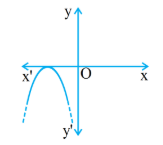
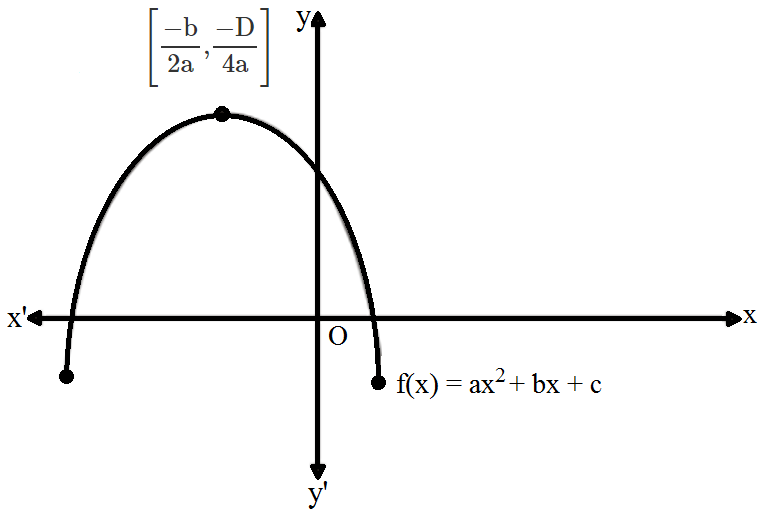
Fig. show the graph of the polynomial $f(x) = ax^2 + bx + c$ for which:
- A
$a < 0, b > 0$ and $c > 0$
- ✓
$a < 0, b < 0$ and $c > 0$
- C
$a < 0, b < 0$ and $c < 0$
- D
$a > 0, b > 0$ and $c < 0$
AnswerCorrect option: B. $a < 0, b < 0$ and $c > 0$
Clearly, $f(x)=a x^2+b x+c$ represent a parabola opening downwards.
Therefore, $a < 0 y=a x ^2+b x+c$ cuts $y-$ axis at $P$ which lies on $O Y$.
Putting $x=0$ in $y=a x^2+b x+c$, we get $y=c$.
So the coordinates $P$ are $(0, c )$. Clearly, $P$ lies on $OY$ .
Therefore $c > 0$
The vertex $\Big(\frac{-\text{b}}{2\text{a}},\frac{-\text{D}}{4\text{a}}\Big)$ of the parabola is in the second quadrant.
Therefore $\frac{-\text{b}}{2\text{a}} < 0,\text{b} < 0$
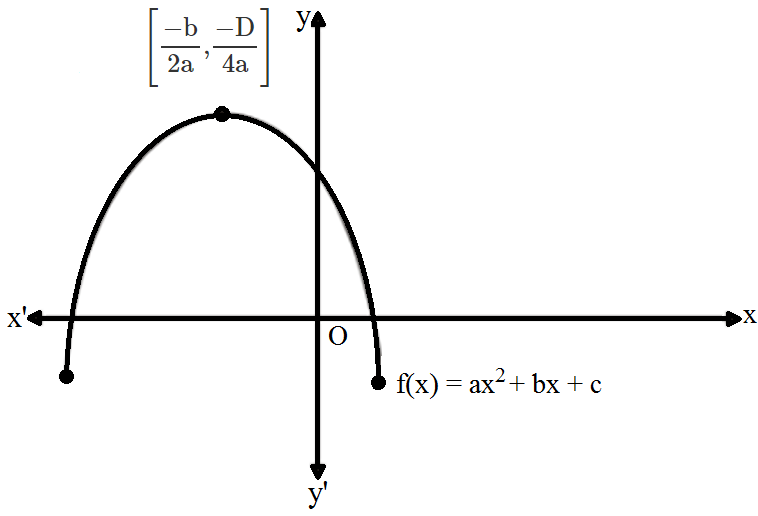
Therefore $a < 0, b < 0,$ and $c > 0$
Hence, the correct choice is $(b)$ View full question & answer→MCQ 241 Mark
Given that one of the zeroes of the cubic polynomial $a x^3+b x^2+c x+d$ is zero, the product of other two zeroes is:
- A
$\frac{-\text{c}}{\text{a}}$
- ✓
$\frac{\text{c}}{\text{a}}$
- C
$0$
- D
$\frac{-\text{b}}{\text{a}}$
AnswerCorrect option: B. $\frac{\text{c}}{\text{a}}$
Let $p(x)=a x^3+b x^2+c x+d$
Now $0$ is the zero of the polynomial.
So, $p(0)=0$
$\Rightarrow a(0)^3+b(0)^2+c(0)+d=0$
$\Rightarrow d=0$
So $, p(x)=a x^3+b x^2+c x=x\left(a x^2+b x+c\right)$
Putting $p ( x )=0$, we get
$x=0 $ or $ a x^2+b x+c=0$
Let $\alpha, \beta$ be the other zeroes of $ax ^2+ bx + c =0$
So, $\alpha \beta=\frac{ c }{ a }$
Hence, the correct answer is option $(b)$
View full question & answer→MCQ 251 Mark
If two of the zeros of the cubic polynomial $ax^3 + bx^2 + cx + d$ are each equal to zero, then the third zero is:
- A
$\frac{-\text{d}}{\text{a}}$
- B
$\frac{\text{c}}{\text{a}}$
- ✓
$\frac{-\text{b}}{\text{a}}$
- D
$\frac{\text{b}}{\text{a}}$
AnswerCorrect option: C. $\frac{-\text{b}}{\text{a}}$
Let $\alpha=0,\beta=0$ and $\gamma$ be the zeros of the polynomial
$f(x)=a x^3+b x^2+c x+d$
Therefore
$\alpha+\beta+\gamma=\frac{-\text{Coefficient of x}^2}{\text{Coefficient of x}^3}$
$=-\Big(\frac{\text{b}}{\text{a}}\Big)$
$\alpha+\beta+\gamma=-\frac{\text{b}}{\text{a}}$
$0+0+\gamma=-\frac{\text{b}}{\text{a}}$
$\gamma=-\frac{\text{b}}{\text{a}}$
The value of $\gamma=-\frac{\text{b}}{\text{a}}$
Hence, the correct choice is $(c)$
View full question & answer→MCQ 261 Mark
The polynomial which when divided by $-x^2+x-1$ gives a quotient $x-2$ and remainder $3 ,$ is:
- A
$x^3-3 x^2+3 x-5$
- B
$-x^3-3 x^2-3 x-5$
- ✓
$-x^3+3 x^2-3 x+5$
- D
$x^3-3 x^2-3 x+5$
AnswerCorrect option: C. $-x^3+3 x^2-3 x+5$
We know that
$f(x)=g(x) q(x)+r(x)$
$=\left(-x^2+x-1\right)(x-2)+3$
$=-x^3+x^2-x+2 x^2-2 x+2+3$
$=-x^3+x^2+2 x^2-x-2 x+2+3$
$=-x^3+3 x^2-3 x+5$
Therefore,
The polynomial which when divided by $-x^2+x-1$ gives a quotient $x-2$ and remainder $3 ,$ is $-x^3+3 x^2-3 x+5$
Hence, the correct choice is $(c)$
View full question & answer→MCQ 271 Mark
If one of the zeroes of the cubic polynomial $x^3+a x^2+b x+c$ is $-1 ,$ then the product of other two zeroes is:
- ✓
$b - a + 1$
- B
$b - a – 1$
- C
$a - b + 1$
- D
$a - b - 1$
AnswerCorrect option: A. $b - a + 1$
Let $p(x)=x^3+a x^2+b x+c$
Now, $-1$ is a zero of the polynomial
So $, p(0)=0$
$\Rightarrow(-1)^3+a(-1)^2+b(-1)+c=0$
$\Rightarrow-1+a-b+c=0$
$\Rightarrow a-b+c=1$
$\Rightarrow c=1-a+b$
Now, if $\alpha, \beta, \gamma$ are the zeroes of the cubic polynomial $ax ^3+ bx ^2+ cx + d$,
then product of zeroes is given by
$\alpha \beta \gamma=-\frac{d}{a}$
So, for the given polynomial, $p(x)=x^3+a x^2+b x+c$
$\alpha \beta(-1)=\frac{-c}{1}=\frac{-(1-a+b)}{1}$
$\Rightarrow \alpha \beta=1-a+b$
Hence, the correct answer is option $(a)$
View full question & answer→MCQ 281 Mark
The number of polynomials having zeroes $-2$ and $5$ is:
- A
$1$
- B
$2$
- C
$3$
- ✓
More than $3$
AnswerCorrect option: D. More than $3$
Polynomials having zeros $-2$ and $5$ will be of the form
$p(x)=a(x+2)^n(x-5)^m$
Here, $n$ and $m$ can take any value from $1, 2, 3, ...$
Thus, the number of polynomials will be more than $3.$
Hence, the correct answer is option $(d)$
View full question & answer→MCQ 291 Mark
The product of the zeros of $x^3+4 x^2+x-6$ is:
AnswerGiven $\alpha,\beta,\gamma$ be the zeros of the polynomial $f(x) = x^3+4 x^2+x-6$
Product of the zeros $=\frac{\text{Constant term}}{\text{Coefficient of x}^3}=\frac{-(-6)}{1}=6$
The value of Product of the zeros is $6.$
Hence, the correct choice is $(c)$
View full question & answer→MCQ 301 Mark
If the zeroes of the quadratic polynomial $x^2+(a+1) x+b$ are $2$ and $-3,$ then
- A
$a = -7,b = -1$
- B
$a = 5, b = -1$
- C
$a = 2, b = -6$
- ✓
$a = 0, b = -6$
AnswerCorrect option: D. $a = 0, b = -6$
The given quadratic equation is $x^2+(a+1) x+b= 0$
Since the zeroes of the given equation are $2$ and $-3$.
So,
$\alpha=2$ and $\beta=-3$
Now,
Sum of zeroes $=-\frac{\text{Coefficient of x}}{\text{Coefficient of x}^2}$
$\Rightarrow2+(-3)=-\frac{(\text{a}+1)}{1}$
$\Rightarrow-1=-\text{a}-1$
$\Rightarrow\text{a}=0$
Product of zeroes $=\frac{\text{Constant of x}}{\text{Coefficient of x}^2}$
$\Rightarrow 2\times(-3)=\frac{\text{b}}{1}$
$\Rightarrow\text{b}=-6$
So, $a = 0$ and $b = -6$
Hence, the correct answer is option $(d)$
View full question & answer→MCQ 311 Mark
If $\alpha, \beta$ are the zeros of the polynomial $f ( x )= x ^2- p ( x +1)- c$ such that $(\alpha+1)(\beta+1)=0$, then $c =$
AnswerSince $\alpha$ and $\beta$ are the zeros of quadratic polynomial
$\text{f(x)}=\text{x}^2-\text{p(x}+1)-\text{c}$
$\text{f(x)}=\text{x}^2-\text{px}-\text{p}-\text{c}$
$\alpha+\beta=\frac{-\text{Coefficient of x}}{\text{Coefficient of x}^2}$
$=-\Big(\frac{-\text{p}}{1}\Big)$
$=\text{p}$
$\alpha\beta=\frac{-\text{Constant term}}{\text{Coefficient of x}^2}$
$=\frac{-\text{p}-\text{c}}{1}$
$=-\text{p}-\text{c}$
We have
$0=(\alpha+1)(\beta+1)$
$0=\alpha\beta+(\alpha+\beta)+1$
$0=-\text{p}-\text{c}+\text{p}+1$
$0=-\text{c}+1$
$\text{c}=1$
Hence, the correct alternative is $(a)$
View full question & answer→MCQ 321 Mark
What should be added to the polynomial $x^2-5 x+4$, so that $3$ is the zero of the resulting polynomial?
AnswerIf $\text{x}=\alpha$ is a zero of a polynomial then $\text{x}-\alpha$ is a factor of $f(x)$
Since $3$ is the zero of the polynomial $f(x) =x^2-5 x+4$,
Therefore $x - 3$ is a factor of $f(x)$
Now, we divide $f(x) = x^2-5 x+4$ by $(x - 3)$ we get
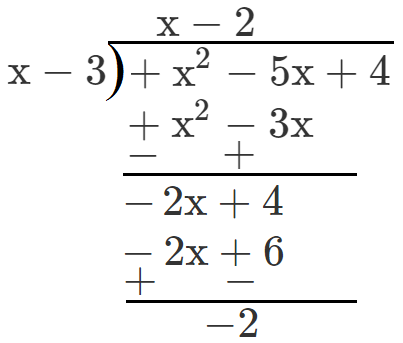
Therefore we should add $2$ to the given polynomial
Hence, the correct choice is $(b)$ View full question & answer→MCQ 331 Mark
A quadratic polynomial, the sum of whose zeroes is $0$ and one zero is $3,$ is:
- ✓
$x^2-9$
- B
$x^2+9$
- C
$x^2+3$
- D
$x^2-3$
AnswerCorrect option: A. $x^2-9$
Since $\alpha$ and $\beta$ are the zeros of the quadratic polynomials such that
$0=\alpha+\beta$
If one of zero is $3$ then
$\alpha+\beta=0$
$3+\beta=0$
$\beta=0-3$
$\beta=-3$
Substituting $\beta=-3$ in $\alpha+\beta=0$ we get
$\alpha-3=0$
$\alpha=3$
Let $S$ and $P$ denote the sum and product of the zeros of the polynomial respectively then
$\text{S}=\alpha+\beta$
$\text{S}=0$
$\text{p}=\alpha\beta$
$\text{p}=3\times-3$
$\text{p}=-9$
Hence, the required polynomials is
$=(\text{x}^2-\text{Sx}+\text{p})$
$=(\text{x}^2-0\text{x}-9)$
$=\text{x}^2-9$
Hence, the correct choice is $(a)$
View full question & answer→MCQ 341 Mark
If $\sqrt{5}$ and $-\sqrt{5}$ are two zeroes of the polynomial $x^3+3 x^2-5 x-15$, then its third zero is:
AnswerLet $\alpha=\sqrt{5}$ and $\beta=-\sqrt{5}$ be the given zeros and $\gamma$ be the third zero of the polynomial $x^3+3 x^2-5 x-15$ Then,
By using $\alpha+\beta+\gamma=\frac{-\text{Coefficient of x}^2}{\text{Coefficient of x}^3}$
$\alpha+\beta+\gamma=\frac{-3}{1}$
$\alpha+\beta+\gamma=-3$
Substituting $\alpha=\sqrt{5}$ and $\beta=-\sqrt{5}$ in $\alpha+\beta+\gamma=-3$
We get
$\sqrt{5}-\sqrt{5}+\gamma=-3$
$\gamma=-3$
Hence, the correct choice is $(b)$
View full question & answer→MCQ 351 Mark
If zeros of the polynomial $f(x)=x^3-3 p x^2+q x-r$ are in $A.P.$, then:
- ✓
$2 p^3=p q-r$
- B
$2 p^3=p q+r$
- C
$p^3=p q-r$
- D
AnswerCorrect option: A. $2 p^3=p q-r$
Let $a-d, a, a+d$ be the zeros of the polynomial $f(x)=x^3-3 p x^2+q x-r$ then
Sum of zeros $=\frac{-\text{Coefficient of x}^2}{\text{Coefficient of x}^3}$
$(\text{a}-\text{d})+\text{a}+(\text{a}+\text{d})=\frac{-(-3\text{p})}{1}$
$\text{a}-\text{d}+\text{a}+\text{a}+\text{d}=3\text{p}$
$3\text{a}=3\text{p}$
$\text{a}=\frac{3}{3}\text{p}$
$\text{a}=\text{p}$
Since $a$ is $a$ zero of the polynomialm $ f(x)$
Therefore,
$f(a) = 0$
$a^3-3 p a^2+q a-r=0$
Substituting $a = p$ we get
$p^3-3 p(p)^2+q \times p-r=0$
$p^3-3 p^3+q p-r=0$
$-2 p^3+q p-r=0$
$q p-r=2 p^3$
Hence, the correct choice is $(a)$
View full question & answer→MCQ 361 Mark
If the polynomial $f(x)=a x^3+b x-c$ is divisible by the polynomial $g(x)=x^2+b x+c$, then $a b=$
- A
$b$
- B
$2b$
- ✓
$2 b^2$
- D
$-2 b$
AnswerCorrect option: C. $2 b^2$
We have to find the value of ab
Given $f(x)=a x^3+b x-c$ is divisible by the polynomial $g(x)=x^2+b x+c$
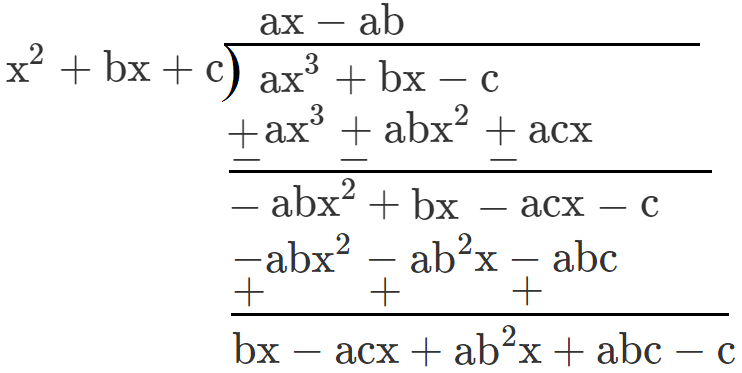
We must have
$x\left(b-a c+a b^2\right)+c(a b-1)=0$
$c(a b-1)=0$
Since $c \neq 0$, so
$a b-1=0$
$\Rightarrow a b=1$
Now in the equation $(1)$ the condition is true for all $x$.
So put $x=1$ and also we have $a b=1$
Therefore we have
$b-a c+a b^2=0$
$b+a b^2-a c=0$
$b(1+a b)-a c=0$
Substituting $a =\frac{1}{b}$ and $ab =1$ we get,
$b(1+1)-\frac{1}{b} \times c=0$
$2 b-\frac{1}{b} \times c=0$
$-\frac{1}{b} \times c=-2 b$
$c=2 b \times \frac{b}{1}$
Hence, the correct alternative is $(c)$ View full question & answer→MCQ 371 Mark
If $f(x)=a x^2+b x+c$ has no real zeros and $a+b+c=0$, then:
- A
$c = 0$
- B
$c > 0$
- ✓
$c < 0$
- D
AnswerCorrect option: C. $c < 0$
If $f(x) = ax^2 + bx + c$ has no real zeros and $a + b + c < 0$ then $c < 0$
Hence, the correct choice is $(c)$
View full question & answer→MCQ 381 Mark
If $\alpha,\beta$ are the zeros of the polynomial $p(x) = 4x^2 + 3x + 7$, then $\frac{1}{\alpha}+\frac{1}{\beta}$ is equal to:
- A
$\frac{7}{3}$
- B
$\frac{-7}{3}$
- C
$\frac{3}{7}$
- ✓
$\frac{-3}{7}$
AnswerCorrect option: D. $\frac{-3}{7}$
Since $\alpha$ and $\beta$ are the zeros of the quadratic polynomial $p(x) = 4x^2 + 3x + 7$
$\alpha+\beta=-\frac{\text{coefficient of x}}{\text{coefficient of x}^2}$
$=\frac{-3}{4}$
$\alpha\beta=\frac{\text{constant term}}{\text{coefficient of x}^2}$
$=\frac{7}{4}$
We have
$=\frac{1}{\alpha}+\frac{1}{\beta}$
$=\frac{\beta+\alpha}{\alpha\beta}$
$=\frac{\frac{-3}{4}}{\frac{7}{4}}$
$=\frac{-3}{4}\times\frac{4}{7}$
$=\frac{-3}{7}$
The value of $\frac{1}{\alpha}+\frac{1}{\beta}$ is $\frac{-3}{7}$
Hence, the correct choice is $(d)$.
View full question & answer→MCQ 391 Mark
If the zeroes of a quadratic polynomial $ax^2 + bc + c, c \neq 0$ are equal, then:
- A
$C$ and $a$ have opposite signs.
- B
$C$ and $b$ have opposite signs.
- ✓
$C$ and $a$ have the same sign.
- D
$C$ and $b$ have the same sign.
AnswerCorrect option: C. $C$ and $a$ have the same sign.
Let the given quadratic polynomial be $f(x) = ax^2 + bc + c, c$
Suppose $\alpha$ and $\beta$ be the zeroes of the given polynomial.
Since $\alpha$ and $\beta$ are equal so they will have the same sign
i.e., either both are positive or both are negative.
So, $\alpha\beta>0$
But $\alpha\beta=\frac{\text{c}}{\text{a}}$
$\therefore\ \frac{\text{c}}{\text{a}}>0,$ which is possible only when both have same sign
Hence, the correct answer is option $(c)$
View full question & answer→MCQ 401 Mark
If $\alpha . \beta$, $\gamma$ are the zeros of the polynomial $f ( x )= ax ^3+ bx + cx + d$, then $\alpha^2+\beta^2+\gamma^2=$
- A
$\frac{\text{b}^2-\text{ac}}{\text{a}^2}$
- B
$\frac{\text{b}^2-2\text{ac}}{\text{a}}$
- C
$\frac{\text{b}^2+2\text{ac}}{\text{b}^2}$
- ✓
$\frac{\text{b}^2-2\text{ac}}{\text{a}^2}$
AnswerCorrect option: D. $\frac{\text{b}^2-2\text{ac}}{\text{a}^2}$
We have to find the value of $\alpha^2+\beta^2+\gamma^2$
Given $\alpha,\beta,\gamma$ be the zeros of the polynomial $f ( x )= ax ^3+ bx + cx + d$
We know that
$\alpha+\beta+\gamma=\frac{\text{Coefficient of x}}{\text{Coefficient of x}^3}$
$=\frac{-\text{b}}{\text{a}}$
$\alpha\beta+\beta\gamma+\gamma\alpha=\frac{-\text{Constant term}}{\text{Coefficient of x}^3} $
$=\frac{\text{c}}{\text{a}}$
Now
$\alpha^2+\beta^2+\gamma^2=(\alpha+\beta+\gamma)^2-2(\alpha\beta+\beta\gamma+\gamma\alpha)$
$\alpha^2+\beta^2+\gamma^2=\Big(\frac{-\text{b}}{\text{a}}\Big)^2-2\Big(\frac{\text{c}}{\text{a}}\Big)$
$\alpha^2+\beta^2+\gamma^2=\frac{\text{b}^2}{\text{a}^2}-\frac{2\text{c}\times\text{a}}{\text{a}\times\text{a}}$
$\alpha^2+\beta^2+\gamma^2=\frac{\text{b}^2}{\text{a}^2}-\frac{2\text{ca}}{\text{a}^2}$
$\alpha^2+\beta^2+\gamma^2=\frac{\text{b}^2-2\text{ac}}{\text{a}^2}$
The value of $\alpha^2+\beta^2+\gamma^2=\frac{\text{b}^2-2\text{ac}}{\text{a}^2}$
Hence, the correct choice is $(d)$
View full question & answer→MCQ 411 Mark
If $\alpha,\beta,\gamma$ are the zeros of the polynomial $f(x)=a x^3+b x^2+c x+d$ then $\frac{1}{\alpha}+\frac{1}{\beta}+\frac{1}{\gamma}=$
- A
$-\frac{\text{b}}{\text{d}}$
- B
$\frac{\text{c}}{\text{d}}$
- ✓
$-\frac{\text{c}}{\text{d}}$
- D
$-\frac{\text{c}}{\text{a}}$
AnswerCorrect option: C. $-\frac{\text{c}}{\text{d}}$
We have to find the value of $\frac{1}{\alpha}+\frac{1}{\beta}+\frac{1}{\gamma}$
Given $\alpha,\beta,\gamma$ be the zeros of the polynomial $f(x)=a x^3+b x^2+c x+d$
We know that
$\alpha\beta+\beta\gamma+\gamma\alpha=\frac{\text{Coefficient of x}}{\text{Coefficient of x}^3}$
$=\frac{\text{c}}{\text{a}}$
$\alpha\beta\gamma=\frac{-\text{Constant term}}{\text{Coefficient of x}^3} $
$=\frac{-\text{d}}{\text{a}}$
So
$\frac{1}{\alpha}+\frac{1}{\beta}+\frac{1}{\gamma}=\frac{\beta\gamma+\alpha\gamma+\alpha\beta}{\alpha\beta\gamma} $
$\frac{1}{\alpha}+\frac{1}{\beta}+\frac{1}{\gamma}=\frac{\frac{\text{c}}{\text{a}}}{-\frac{\text{d}}{\text{a}}}$
$\frac{1}{\alpha}+\frac{1}{\beta}+\frac{1}{\gamma}=\frac{\text{c}}{\text{a}}\times\Big(-\frac{\text{a}}{\text{d}} \Big)$
$\frac{1}{\alpha}+\frac{1}{\beta}+\frac{1}{\gamma}=-\frac{\text{c}}{\text{d}}$
Hence, the correct choice is $(c)$
View full question & answer→MCQ 421 Mark
If $\alpha,\beta,\gamma$ are are the zeros of the polynomial $f(x)=x^3-p x^2+q x-r$, then $\frac{1}{\alpha\beta}+\frac{1}{\beta\gamma}+\frac{1}{\gamma\alpha}=$
- A
$\frac{\text{r}}{\text{p}}$
- B
$\frac{\text{p}}{\text{r}}$
- ✓
$\frac{\text{p}}{-\text{r}}$
- D
$-\frac{\text{r}}{\text{p}}$
AnswerCorrect option: C. $\frac{\text{p}}{-\text{r}}$
We have to find the value of $\frac{1}{\alpha\beta}+\frac{1}{\beta\gamma}+\frac{1}{\gamma\alpha}$
Given $\alpha,\beta,\gamma$ be the zeros of the polynomial $f(x)=x^3-p x^2+q x-r$
$\alpha+\beta+\gamma=\frac{-\text{Coefficient of x}^2}{\text{Coefficient of x}^3}$
$=\frac{-(-\text{p})}{1}$
$=\text{p}$
$\alpha\cdot\beta\cdot\gamma=\frac{\text{Constant term}}{\text{Coefficient of x}^3} $
$=\frac{-\text{r}}{1}$
$=-\text{r}$
Now we calculate the expression
$\frac{1}{\alpha\beta}+\frac{1}{\beta\gamma}+\frac{1}{\gamma\alpha}=\frac{\gamma}{\alpha\beta\gamma}+\frac{\alpha}{\alpha\beta\gamma}+\frac{\beta}{\alpha\beta\gamma}$
$\frac{1}{\alpha\beta}+\frac{1}{\beta\gamma}+\frac{1}{\gamma\alpha}=\frac{\alpha+\gamma+\beta}{\alpha\beta\gamma}$
$\frac{1}{\alpha\beta}+\frac{1}{\beta\gamma}+\frac{1}{\gamma\alpha} = \frac{\text{p}}{-\text{r}}$
Hence, the correct choice is $(c)$
View full question & answer→MCQ 431 Mark
What should be added to the polynomial $x^2-5 x+4$, so that 3 is the zero of the resulting polynomial?
Answer(B) 2
Let the number be $c$. Then, 3 is a zero of the polynomial $x^2-5 x+4+c$.
$
\therefore \quad 9-15+4+c=0 \Rightarrow c-2=0 \Rightarrow c=2
$
ALITER Let $f(x)=x^2-5 x+4$. Then, the remainder when $f(x)$ is divided by 3 is $f(3)$. Thus, if we add $-f(3)$ to $f(x)$ the remainder will be zero and hence 3 will be a zero of the resulting polynomial.
$
\therefore \quad \text { Required number }=-f(3)=-(9-15+4)=2
$
View full question & answer→MCQ 441 Mark
The zeroes of a polynomial $x^2+p x+q$ are twice the zeroes of the polynomial $4 x^2-5 x-6$. The value of $p$ is
- ✓
$-\frac{5}{2}$
- B
$\frac{5}{2}$
- C
- D
AnswerCorrect option: A. $-\frac{5}{2}$
(A) $-\frac{5}{2}$
Let $\alpha, \beta$ be the zeroes of $4 x^2-5 x-6$. Then, $2 \alpha, 2 \beta$ are zeroes of $x^2+p x+q$.
$
\begin{array}{ll}
\therefore & \alpha+\beta=-\frac{-5}{4} \text { and } 2 \alpha+2 \beta=-p \\
\Rightarrow & \alpha+\beta=\frac{5}{4} \text { and } 2(\alpha+\beta)=-p \Rightarrow 2 \times \frac{5}{4}=-p \Rightarrow p=-\frac{5}{2}
\end{array}
$
View full question & answer→MCQ 451 Mark
If the sum of the zeroes of the polynomial $p(x)=2 x^2-k \sqrt{2} x+1$ is $\sqrt{2}$, then the value of $k$ is
- A
$\sqrt{2}$
- ✓
- C
$2 \sqrt{2}$
- D
$1 / 2$
Answer(B) 2
We find that:
Sum of the zeroes $=-\frac{-k \sqrt{2}}{2}=\frac{k}{\sqrt{2}}$
$\Rightarrow \quad \sqrt{2}=\frac{k}{\sqrt{2}} \quad[\because$ Sum of the zeroes $=\sqrt{2}$ (given) $]$
$\Rightarrow \quad k=2$
View full question & answer→MCQ 461 Mark
If $\alpha, \beta$ are the zeros of the polynomial $p(x)=5 x^2+3 x-7$, then $\frac{1}{\alpha}+\frac{1}{\beta}$ is equal to
- A
$-\frac{3}{7}$
- B
$\frac{3}{5}$
- ✓
$\frac{3}{7}$
- D
$-\frac{5}{7}$
AnswerCorrect option: C. $\frac{3}{7}$
View full question & answer→MCQ 471 Mark
If $\alpha$ and $\beta$ are the zeroes of the quadratic polynomial $p(x)=x^2-a x-b$, then the value of $\alpha^2+\beta^2$ is
- A
$a^2-2 b$
- ✓
$a^2+2 b$
- C
$b^2-2 a$
- D
$b^2+2 a$
AnswerCorrect option: B. $a^2+2 b$
(B) $a^2+2 b$
Given that $\alpha$ and $\beta$ are the zeroes of the polynomials $p(x)=x^2-a x-b$.
$
\therefore \quad \alpha+\beta=a \text { and } \alpha \beta=-b
$
Hence, $\alpha^2+\beta^2=(\alpha+\beta)^2-2 \alpha \beta=a^2+2 b$.
View full question & answer→MCQ 481 Mark
The zeroes of the polynomial $p(x)=x^2+4 x+3$ are given by
AnswerCorrect option: D. $-1,-3$
(D) $-1,-3$
We have,
$
p(x)=x^2+4 x+3=(x+1)(x+3)
$
So, the zeroes of $p(x)$ are given by
$
p(x)=0 \Rightarrow(x+1)(x+3)=0 \Rightarrow x+1=0 \text { or, } x+3=0 \Rightarrow x=-1,-3
$
View full question & answer→MCQ 491 Mark
If one zero of the polynomial $6 x^2+37 x-(k-2)$ is reciprocal of the other, then what is the value of $k$ ?
Answer(A) -4
Let $\alpha, \beta$ be the zeroes of polynomial $6 x^2+37 x-(k-2)$ such that
$
\beta=\frac{1}{\alpha} \Rightarrow \alpha \beta=1 \Rightarrow \frac{-(k-2)}{6}=1 \Rightarrow k-2=-6 \Rightarrow k=-4
$
View full question & answer→MCQ 501 Mark
The number of polynomials having -2 and 5 as zeroes is
Answer(D) infinitely many
Quadratic polynomial having -2 and 5 as its zeroes are given by $f(x)=k\left\{x^2-x(-2+5)+(-2) \times 5\right\}$ or $f(x)=k\left(x^2-3 x-10\right)$, where $k$ is any non-zero real number. So, there are infinitely many polynomials.
View full question & answer→