MCQ 511 Mark
If a polynomial $p(x)$ is given by $p(x)=x^2-5 x+6$, then the value of $p(1)+p(4)$ is
View full question & answer→MCQ 521 Mark
If $\alpha, \beta$ are the zeroes of the polynomial $p(x)=4 x^2-3 x-7$, then $\frac{1}{\alpha}+\frac{1}{\beta}$ is equal to
- A
$\frac{7}{3}$
- B
$-\frac{7}{3}$
- C
$\frac{3}{7}$
- ✓
$-\frac{3}{7}$
AnswerCorrect option: D. $-\frac{3}{7}$
View full question & answer→MCQ 531 Mark
Which of the following is a quadratic polynomial having zeroes $-\frac{2}{3}$ and $\frac{2}{3}$ ?
AnswerCorrect option: D. $5\left(9 x^2-4\right)$
View full question & answer→MCQ 541 Mark
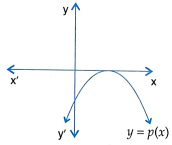
The graph of $y=p(x)$ is given, for a polynomial $p(x)$. The number of zeroes of $p(x)$ from the graph is
View full question & answer→MCQ 551 Mark
If $\alpha$ and $\beta$ are the zeroes of the polynomial $x^2-1$, then the value of $(\alpha+\beta)$ is
View full question & answer→MCQ 561 Mark
If the zeroes of the quadratic polynomial $x^2+(a+1) x+b$ are 2 and -3 , then
- A
$a=-7, b=-1$
- B
$a=5, b=-1$
- C
$a=2, b=-6$
- ✓
$a=0, b=-6$
AnswerCorrect option: D. $a=0, b=-6$
View full question & answer→MCQ 571 Mark
The number of polynomials having zeros -3 and 5 is
MCQ 581 Mark
If $\alpha, \beta$ are the zeros of the polynomial $f(x)=x^2+x-1$, then $\frac{1}{\alpha}+\frac{1}{\beta}=$
View full question & answer→MCQ 591 Mark
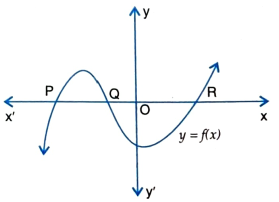
The graph of a polynomial $f(x)$ is shown in Fig. The number of zeroes of $f(x)$ is
Answer(A) 3
We observe that the curve $y=f(x)$ crosses $x$-axis at three distinct points. So, the polynomial $f(x)$ has three zeros.
View full question & answer→MCQ 601 Mark
A quadratic polynomial, the sum of whose zeros is -5 and their product is 6 , is
- ✓
$x^2+5 x+6$
- B
$x^2-5 x+6$
- C
$x^2-5 x-6$
- D
$-x^2+5 x+6$
AnswerCorrect option: A. $x^2+5 x+6$
View full question & answer→MCQ 611 Mark
If one zero of the quadratic polynomial $x^2+3 x+k$ is 2 , then the value of $k$ is
View full question & answer→MCQ 621 Mark
The zeros of the quadratic polynomial $f(x)=x^2+99 x+127$ are
- A
- ✓
- C
one positive and one negative
- D
Answer(B) both negative
Let $\alpha, \beta$ be the zeros of the quadratic polynomial $f(x)=x^2+99 x+127$. Then, $\alpha+\beta=-99$ and $\alpha \beta=127$
Thus, the sum of the zeros is negative and product is positive. Therefore, $\alpha$ and $\beta$ both are negative.
View full question & answer→MCQ 631 Mark
If $\alpha, \beta, \gamma$ are the zeros of the polynomial $f(x)=a x^3-5 x+9$ such that $\alpha^3+\beta^3+\gamma^3=27$, then the value of $a$ is
Answer(D) -1
It is given that $\alpha, \beta, \gamma$ are zeros of $f(x)=a x^3-5 x+9$. Therefore,
$
\alpha+\beta+\gamma=-\frac{\text { Coeff. } x^2}{\text { Coeff. } x^3}=0 \text { and, } \alpha \beta \gamma=-\frac{9}{a}
$
Now, $\quad \alpha+\beta+\gamma=0 \Rightarrow \alpha^3+\beta^3+\gamma^3=3 \alpha \beta \gamma \Rightarrow 27=3 \times-\frac{9}{a} \Rightarrow a=-1$
View full question & answer→MCQ 641 Mark
If $\alpha, \beta$ are the zeros of the polynomial $f(x)=x^2-p(x+1)-c$ such that $(\alpha+1)(\beta+1)=0$, then $c=$
Answer(A) 1
It is given that $\alpha, \beta$ are the zeroes of $f(x)=x^2-p x-(p+c)$.
$\therefore \quad \alpha+\beta=p$ and $\alpha \beta=-(p+c)$
Now, $\quad(\alpha+1)(\beta+1)=0 \Rightarrow \alpha \beta+(\alpha+\beta)+1=0 \Rightarrow-p-c+p+1=0 \Rightarrow c=1$
View full question & answer→MCQ 651 Mark
If the polynomial $f(x)=a x^3+b x-c$ is divisible by the polynomial $g(x)=x^2+b x+c$ and $c \neq 0$, then $a b=$
- A
- B
$\frac{1}{c}$
- C
- D
$-\frac{1}{c}$
View full question & answer→MCQ 661 Mark
Given that one of the zeroes of the cubic polynomial $a x^3+b x^2+c x+d$ is zero, the product of other two zeroes is
- A
$-\frac{c}{a}$
- ✓
$\frac{c}{a}$
- C
$0$
- D
$-\frac{b}{a}$
AnswerCorrect option: B. $\frac{c}{a}$
(B) $\frac{c}{a}$
Let $\alpha, \beta, 0$ be three zeroes of $f(x)=a x^3+b x^2+c x+d$. Then,
$
\alpha \beta+\beta \times 0+0 \times \alpha=\frac{c}{a} \Rightarrow \alpha \beta=\frac{c}{a} \quad\left[\because \alpha \beta+\beta \gamma+\gamma \alpha=(-1)^2 \frac{\text { Coeff.of } x}{\text { Coeff. of } x^3}\right]
$
View full question & answer→MCQ 671 Mark
If one of the zeroes of the cubic polynomial $x^3+a x^2+b x+c$ is -1 , then the product of other two zeroes is
- ✓
$b-a+1$
- B
$b-a-1$
- C
$a-b+1$
- D
$a-b-1$
AnswerCorrect option: A. $b-a+1$
(A) $b-a+1$
Let $\alpha, \beta,-1$ be three zeroes of $f(x)=x^3+a x^2+b x+c$. Then,
$
\text { Product of zeroes }=-\frac{c}{1} \Rightarrow \alpha \beta \times-1=-c \Rightarrow \alpha \beta=c\qquad\ldots(i)
$
It is given that -1 is a zero of $f(x)$. Therefore,
$
f(-1)=0 \Rightarrow-1+a-b+c=0 \Rightarrow c=b-a+1 \Rightarrow \alpha \beta=b-a+1\qquad[Using (i)]
$
View full question & answer→MCQ 681 Mark
If two zeroes of the cubic polynomial $f(x)=a x^3+b x^2+c x+d$ are each equal to zero, then third zero is
- A
$-\frac{d}{a}$
- B
$\frac{c}{a}$
- ✓
$-\frac{b}{a}$
- D
$\frac{b}{a}$
AnswerCorrect option: C. $-\frac{b}{a}$
(C) $-\frac{b}{a}$
Let $\alpha, \beta=0, \gamma=0$ be three zeroes of $f(x)$. Then,
Sum of the zeroes $=-\frac{b}{a} \Rightarrow \alpha+0+0=-\frac{b}{a} \Rightarrow \alpha=-\frac{b}{a}$
Hence, third zero is $-\frac{b}{a}$.
View full question & answer→MCQ 691 Mark
If $\alpha, \beta, \gamma$ are the zeroes of the polynomial $f(x)=x^3-p x^2+q x-r$, then $\frac{1}{\alpha \beta}+\frac{1}{\beta \gamma}+\frac{1}{\gamma \alpha}$ is equal to
- A
$\frac{r}{p}$
- ✓
$\frac{p}{r}$
- C
$-\frac{p}{r}$
- D
$-\frac{r}{p}$
AnswerCorrect option: B. $\frac{p}{r}$
(B) $\frac{p}{r}$
It is given that $\alpha, \beta, \gamma$ are zeroes of $f(x)=x^3-p x^2+q x-r$.
$
\therefore \quad \alpha+\beta+\gamma=p, \alpha \beta+\beta \gamma+\gamma \alpha=q \text { and } \alpha \beta \gamma=r
$
Hence, $\quad \frac{1}{\alpha \beta}+\frac{1}{\beta \gamma}+\frac{1}{\gamma \alpha}=\frac{\alpha+\beta+\gamma}{\alpha \beta \gamma}=\frac{p}{r}$
View full question & answer→MCQ 701 Mark
If $\alpha, \beta, \gamma$ are the zeroes of the polynomial $f(x)=a x^3+b x^2+c x+d$, then $\alpha^2+\beta^2+\gamma^2=$
- A
$\frac{b^2-a c}{a^2}$
- B
$\frac{b^2-2 a c}{a}$
- C
$\frac{b^2+2 a c}{b^2}$
- ✓
$\frac{b^2-2 a c}{a^2}$
AnswerCorrect option: D. $\frac{b^2-2 a c}{a^2}$
(D) $\frac{b^2-2 a c}{a^2}$
It is given that $\alpha, \beta, \gamma$ are the zeroes of $f(x)=a x^3+b x^2+c x+d$. Therefore,
$
\begin{array}{ll}
& \alpha+\beta+\gamma=-\frac{b}{a} \text { and } \alpha \beta+\beta \gamma+\gamma \alpha=\frac{c}{a} \\
\therefore \quad & \alpha^2+\beta^2+\gamma^2=(\alpha+\beta+\gamma)^2-2(\alpha \beta+\beta \gamma+\gamma \alpha) \Rightarrow \alpha^2+\beta^2+\gamma^2=\left(-\frac{b}{a}\right)^2-\frac{2 c}{a}=\frac{b^2-2 a c}{a^2}
\end{array}
$
View full question & answer→MCQ 711 Mark
If two zeros of the polynomial $f(x)=x^3+x^2-5 x-5$ are $\sqrt{5}$ and $-\sqrt{5}$, then its third zero is
Answer(B) -1
Let the third zero of $f(x)$ be $\alpha$. Then,
Sun of the zeroes $=-\frac{\text { Coeff.of } x^2}{\text { Coeff.of } x^3} \Rightarrow \sqrt{5}+(-\sqrt{5})+\alpha=-\frac{1}{1} \Rightarrow \alpha=-1$
View full question & answer→MCQ 721 Mark
If the product of two zeros of the polynomial $f(x)=2 x^3+6 x^2-4 x+9$ is 3 , then its third zero is
- A
$\frac{3}{2}$
- ✓
$-\frac{3}{2}$
- C
$\frac{9}{2}$
- D
$-\frac{9}{2}$
AnswerCorrect option: B. $-\frac{3}{2}$
(B) $-\frac{3}{2}$
Let $\alpha, \beta, \gamma$ be three zeroes of $f(x)=2 x^3+6 x^2-4 x+9$ such that $\alpha \beta=3$. But it is given that
Product of zeroes $=-\frac{9}{2} \Rightarrow \alpha \beta \gamma=-\frac{9}{2} \Rightarrow 3 \gamma=-\frac{9}{2} \Rightarrow \gamma=-\frac{3}{2}$
Hence, the third zero is $-\frac{3}{2}$.
View full question & answer→MCQ 731 Mark
If zeros of the polynomial $f(x)=x^3-3 p x^2+q x-r$ are in A.P., then
- ✓
$2 p^3=p q-r$
- B
$2 p^3=p q+r$
- C
$p^3=p q-r$
- D
AnswerCorrect option: A. $2 p^3=p q-r$
(A) $2 p^3=p q-r$
Let $a-d, a, a+d$ be the zeroes of $f(x)=x^3-3 p x^2+q x-r$. Then,
$
(a-d)+a+(a+d)=3 p \Rightarrow 3 a=3 p \Rightarrow a=p
$
But, $a$ is a zero of $f(x)$. Therefore,
$
f(a)=0 \Rightarrow a^3-3 p a^2+q a-r=0 \Rightarrow p^3-3 p^3+p q-r=0 \Rightarrow 2 p^3=p q-r
$
View full question & answer→MCQ 741 Mark
If $f(x)=a x^2+b x+c$ has no real zeroes and $a+b+c<0$, then
- A
$c=0$
- B
$c>0$
- ✓
$c<0$
- D
c can be positive or negative
Answer(C) $c<0$
If $f(x)=a x^2+b x+c$ has no ral zero, then its graph does not cross $x$-axis. Therefore, either the complete curve is above $x$-axis or it lies below $x$-axis. This means that either $f(x)>0$ or $f(x)<0$ for all values of $x$. It is given that $f(1)=a+b+c<0$. Therefore,
$
f(x)<0 \text { for all values of } x \Rightarrow f(0)<0 \Rightarrow c<0
$
View full question & answer→MCQ 751 Mark
The zeroes of the polynomial $x^2+\frac{1}{6} x-2$ are
- A
$-3,4$
- ✓
$-\frac{3}{2}, \frac{4}{3}$
- C
$-\frac{4}{3}, \frac{3}{2}$
- D
$-\frac{4}{3},-\frac{3}{2}$
AnswerCorrect option: B. $-\frac{3}{2}, \frac{4}{3}$
(B) $-\frac{3}{2}, \frac{4}{3}$
Let $f(x)=x^2+\frac{1}{6} x-2$. Then,
$
f(x)=\frac{1}{6}\left(6 x^2+x-12\right)=\frac{1}{6}\left(6 x^2+9 x-8 x-12\right)=\frac{1}{6}\{3 x(2 x+3)-4(2 x+3)\}=\frac{1}{6}(2 x+3)(3 x-4)
$
Zeroes of $f(x)$ are given by
$
f(x)=0 \Rightarrow \frac{1}{6}(2 x+3)(3 x-4)=0 \Rightarrow 2 x+3=0 \text { or } 3 x-4=0 \Rightarrow x=-\frac{3}{2}, \frac{4}{3}
$
View full question & answer→MCQ 761 Mark
If zeroes of the quadratic polynomial $f(x)=\left(k^2+4\right) x^2+7 x+4 k$ are reciprocal of each other, then the value (s) of $k$ is (are)
Answer(C) 2
Let $\alpha$ and $\frac{1}{\alpha}$ be zeroes of $f(x)$. Then,
$
\alpha \times \frac{1}{\alpha}=\frac{4 k}{k^2+4} \Rightarrow k^2+4=4 k \Rightarrow(k-2)^2=0 \Rightarrow k=2
$
View full question & answer→MCQ 771 Mark
The quadratic polynomial whose zeroes are reciprocal of the zeroes of quadratic polynomial $a x^2+b x+c, a \neq 0, c \neq 0$, are given by
where $k$ is a non-zero real number.
- A
$k\left(c x^2+a x+b\right)$
- ✓
$k\left(c x^2+b x+a\right)$
- C
$k\left(c x^2-b x+a\right)$
- D
$k\left(c x^2+b x-a\right)$
AnswerCorrect option: B. $k\left(c x^2+b x+a\right)$
(B) $k\left(c x^2+b x+a\right)$
Let $\alpha, \beta$ be the zeroes of quadratic polynomial $a x^2+b x+c$. Then,
$
\alpha+\beta=-\frac{b}{a} \text { and } \alpha \beta=\frac{c}{a}
$
Quadratic polynomials having $\frac{1}{\alpha}$ and $\frac{1}{\beta}$ as zeroes are given by
$
\begin{array}{l}
\quad f(x)=\lambda\left\{x^2-x\left(\frac{1}{\alpha}+\frac{1}{\beta}\right)+\frac{1}{\alpha \beta}\right\}, \text { where } \lambda \neq 0 \\
\Rightarrow \quad f(x)=\lambda\left\{x^2-x\left(\frac{\alpha+\beta}{\alpha \beta}\right)+\frac{1}{\alpha \beta}\right\}=\lambda\left\{x^2+\frac{b}{c} x+\frac{a}{c}\right\}=\frac{\lambda}{c}\left(c x^2+b x+a\right)=k\left(c x^2+b x+a\right), \\
\\
\text { where } k=\lambda / c \neq 0
\end{array}
$
REMARK To find a quadratic polynomial having zeroes as the reciprocal of zeros of a given quadratic simply interchange the coefficient of $x^2$ and constant term.
View full question & answer→MCQ 781 Mark
If $(a-2) x^2+3 x-5$ is a quadratic polynomial, then
- A
a can take any real value
- B
a can take any non-zero value
- ✓
$a \neq 2$
- D
$a=2$
AnswerCorrect option: C. $a \neq 2$
(C) $a \neq 2$
If $(a-2) x^2+3 x-5$ is a quadratic polynomial, then $a-2 \neq 0$ i.e. $a \neq 2$.
View full question & answer→MCQ 791 Mark
If $\alpha$ and $\beta$ are the zeros of the polynomial $f(x)=p x^2-2 x+3 p$ and $\alpha+\beta=\alpha \beta$, then the value of $p$ is
- A
$-\frac{2}{3}$
- ✓
$a^2+2 b$
- C
$\frac{1}{3}$
- D
$-\frac{1}{3}$
AnswerCorrect option: B. $a^2+2 b$
(B) $a^2+2 b$
Clearly, $\alpha+\beta=\frac{2}{p}$ and $\alpha \beta=3$. It is given that
$\alpha+\beta=\alpha \beta \Rightarrow \frac{2}{p}=3 \Rightarrow p=\frac{2}{3}$
View full question & answer→MCQ 801 Mark
If the product of the zeroes of the quadratic polynomial $3 x^2+5 x+k$ is $-\frac{2}{3}$, then the value of $k$ is
Answer(B) -2
Let $\alpha, \beta$ be zeroes of $3 x^2+5 x+k$. Then, product of its zeroes is $\frac{k}{3}$.
But, $\quad$ Product of zeroes $=-\frac{2}{3} \Rightarrow \frac{k}{3}=-\frac{2}{3} \Rightarrow k=-2$
View full question & answer→MCQ 811 Mark
The maximum number of zeroes a cubic polynomial can have, is
Answer(D) 3
The graph of a cubical polynomial crosses/cuts $x$-axis at most at three points. So, cubic polynomial can have at most three zeroes.
View full question & answer→MCQ 821 Mark
If one zero of the quadratic polynomial $k x^2+3 x+k$ is 2 , then the value of $k$ is
- A
$\frac{5}{6}$
- B
$-\frac{5}{6}$
- C
$\frac{6}{5}$
- ✓
$-\frac{6}{5}$
AnswerCorrect option: D. $-\frac{6}{5}$
(D) $-\frac{6}{5}$
It is given that 2 is a zero of $f(x)=k x^2+3 x+k$. Therefore,
$
f(2)=0 \Rightarrow k \times 2^2+3 \times 2+k=0 \Rightarrow 5 k+6=0 \Rightarrow k=-\frac{6}{5}
$
View full question & answer→MCQ 831 Mark
Which of the following is a polynomial?
AnswerCorrect option: C. $\sqrt{2} x^3+\sqrt{3} x^2+\sqrt{5} x-3$
(C) $\sqrt{2} x^3+\sqrt{3} x^2+\sqrt{5} x-3$
An expression of the form $a_0 x^n+a_1 x^{n-1}+a_2 x^{n-2}+\ldots+a_{n-1} x+a_n, a_0 \neq 0$ is a polynomial of degree $n$ (a natural number).
Clearly, in expression given in option (a) has a term containing $x^{-1}$. So, it is not a polynomial. Expression in option (b) has a term containing $x^{1 / 2}$, so it is not a polynomial. The expression in option (d) has a term containing $x^{-3}$, so it is not a polynomial. Expression in option (c) satisfies the definition of a polynomial.
View full question & answer→MCQ 841 Mark
If 2 and $\frac{1}{2}$ are zeros of $p x^2+5 x+r$, then
- A
$p=r=2$
- ✓
$p=r=-2$
- C
$p=2, r=-2$
- D
$p=-2, r=2$
AnswerCorrect option: B. $p=r=-2$
View full question & answer→MCQ 851 Mark
If the zeros of the quadratic polynomial $a x^2+b x+c, c \neq 0$ are equal, then
- A
$c$ and $a$ have opposite signs
- B
$c$ and $b$ have opposite signs
- ✓
$c$ and $a$ have the same sign
- D
$c$ and $b$ have the same sign
AnswerCorrect option: C. $c$ and $a$ have the same sign
View full question & answer→MCQ 861 Mark
The zeros of the quadratic polynomial $x^2+a x+a, a \neq 0$,
View full question & answer→MCQ 871 Mark
If $a-b, a$ and $a+b$ are zeroes of the polynomial $x^3-3 x^2+x+1$, then the value of $a+b$ is
- A
$\sqrt{2}-1$
- B
$\sqrt{2}$
- C
$-\sqrt{2}-1$
- ✓
$1 \pm \sqrt{2}$
AnswerCorrect option: D. $1 \pm \sqrt{2}$
View full question & answer→MCQ 881 Mark
If the polynomial $f(x)=2 x^3-k x^2+5 x+9$ is exactly divisible by $x+2$, then $k=$
- A
$\frac{17}{4}$
- ✓
$-\frac{17}{4}$
- C
$-\frac{15}{4}$
- D
$\frac{15}{4}$
AnswerCorrect option: B. $-\frac{17}{4}$
View full question & answer→MCQ 891 Mark
If the sum of two zeroes of the polynomial $x^3-2 x^2+q x-r$ is zero, then
- A
$q=2 r$
- ✓
$r=2 q$
- C
$q=r$
- D
$r=4 q$
AnswerCorrect option: B. $r=2 q$
View full question & answer→MCQ 901 Mark
If $\alpha, \beta, \gamma$ are the zeros of the polynomial $f(x)=a x^3+b x^2+c x+d$, then $\frac{1}{\alpha}+\frac{1}{\beta}+\frac{1}{\gamma}=$
- A
$-\frac{b}{d}$
- B
$\frac{c}{d}$
- ✓
$-\frac{c}{d}$
- D
$-\frac{c}{a}$
AnswerCorrect option: C. $-\frac{c}{d}$
View full question & answer→MCQ 911 Mark
If the zeroes of the polynomial $x^3-12 x^2+44 x+c$ are in A.P., then the value of $c$ is
View full question & answer→MCQ 921 Mark
If $\alpha$ and $\beta$ are the zeroes of the polynomial $x^2-(k+6) x+2(2 k-1)$ such that $\alpha+\beta=\frac{\alpha \beta}{2}$, then the value of $k$ is
View full question & answer→MCQ 931 Mark
If zeros of the polynomial $f(x)=x^3-3 p x^2+q x-r$ are in A.P., then
- ✓
$2 p^3=p q-r$
- B
$2 p^3=p q+r$
- C
$p^3=p q-r$
- D
AnswerCorrect option: A. $2 p^3=p q-r$
View full question & answer→MCQ 941 Mark
If two zeroes of the polynomial $x^3+7 x^2-2 x-14$ are $\sqrt{2}$ and $-\sqrt{2}$, then the third zero is
View full question & answer→MCQ 951 Mark
If $\alpha, \beta$ and $\gamma$ are the zeroes of the polynomial $x^3-x^2-10 x-8$, then $\alpha \beta+\beta \gamma+\gamma \alpha+\alpha \beta \gamma$ is equal to
View full question & answer→MCQ 961 Mark
If $\alpha$ and $\beta$ are the zeroes of the polynomial $a x^2-5 x+c$ and $\alpha+\beta=\alpha \beta=10$, then
- A
$a=5, c=\frac{1}{2}$
- B
$a=1, c=\frac{5}{2}$
- C
$a=\frac{5}{2}, c=1$
- ✓
$a=\frac{1}{2}, c=5$
AnswerCorrect option: D. $a=\frac{1}{2}, c=5$
View full question & answer→MCQ 971 Mark
If two of the zeros of the cubic polynomial $a x^3+b x^2+c x+d$ are each equal to zero, then the third zero is
- A
$\frac{-d}{a}$
- B
$\frac{c}{a}$
- ✓
$\frac{-b}{a}$
- D
$\frac{b}{a}$
AnswerCorrect option: C. $\frac{-b}{a}$
View full question & answer→MCQ 981 Mark
The polynomial which when divided by $-x^2+x-1$ gives a quotient $x-2$ and remainder 3 , is
- A
$x^3-3 x^2+3 x-5$
- B
$-x^3-3 x^2-3 x-5$
- ✓
$-x^3+3 x^2-3 x+5$
- D
$x^3-3 x^2-3 x+5$
AnswerCorrect option: C. $-x^3+3 x^2-3 x+5$
View full question & answer→MCQ 991 Mark
If $x+2$ is a factor of $x^2+a x+2 b$ and $a+b=4$, then
- A
$a=1, b=3$
- ✓
$a=3, b=1$
- C
$a=-1, b=5$
- D
$a=5, b=-1$
AnswerCorrect option: B. $a=3, b=1$
View full question & answer→MCQ 1001 Mark
What should be subtracted to the polynomial $x^2-16 x+30$, so that 15 is the zero of the resulting polynomial?
View full question & answer→