MCQ 1011 MarkWhat should be added to the polynomial $x^2-5 x+4$, so that 3 is the zero of the resulting polynomial?A1✓2C4D5AnswerCorrect option: B. 2B View full question & answer→
MCQ 1021 MarkIf $\alpha$ and $\beta$ are the zeros of the polynomial $x^2-6 x+k$ and $3 \alpha+2 \beta=20$, then the value of $k$ isA-8B16✓-16D8AnswerCorrect option: C. -16C View full question & answer→
MCQ 1031 MarkIf $\alpha, \beta$ are the zeros of polynomial $f(x)=x^2-p(x+1)-c$, then $(\alpha+1)(\beta+1)=$A$c-1$✓$1-c$C$c$D$1+c$AnswerCorrect option: B. $1-c$B View full question & answer→
MCQ 1041 MarkIf $\alpha$ and $\beta$ are the zeros of the polynomial $f(x)=x^2+p x+q$, then a polynomial having $\frac{1}{\alpha}$ and $\frac{1}{\beta}$ is its zeros isA$x^2+q x+p$B$x^2-p x+q$✓$q x^2+p x+1$D$p x^2+q x+1$AnswerCorrect option: C. $q x^2+p x+1$C View full question & answer→
MCQ 1051 MarkIf $\alpha, \beta$ are the zeros of the polynomial $f(x)=a x^2+b x+c$, then $\frac{1}{\alpha^2}+\frac{1}{\beta^2}=$A$\frac{b^2-2 a c}{a^2}$✓$\frac{b^2-2 a c}{c^2}$C$\frac{b^2+2 a c}{a^2}$D$\frac{b^2+2 a c}{c^2}$AnswerCorrect option: B. $\frac{b^2-2 a c}{c^2}$B View full question & answer→
MCQ 1061 MarkThe zeroes of the quadratic polynomial $x^2+99 x+127$ areAboth positive✓both negativeCboth equalDone positive and one negativeAnswerCorrect option: B. both negativeB View full question & answer→
MCQ 1071 MarkIf one of the zeroes of the quadratic polynomial $(k-1) x^2+k x+1$ is -3 , then the value of $k$ is✓$\frac{4}{3}$B$-\frac{4}{3}$C$\frac{2}{3}$D$-\frac{2}{3}$AnswerCorrect option: A. $\frac{4}{3}$A View full question & answer→
MCQ 1081 MarkIf the product of zeros of the polynomial $f(x)=a x^3-6 x^2+11 x-6$ is 4 , then $a=$✓$\frac{3}{2}$B$-\frac{3}{2}$C$\frac{2}{3}$D$-\frac{2}{3}$AnswerCorrect option: A. $\frac{3}{2}$A View full question & answer→
MCQ 1091 MarkIf the sum of the zeros of the polynomial $f(x)=2 x^3-3 k x^2+4 x-5$ is 6 , then the value of $k$ isA2✓4C-2D-4AnswerCorrect option: B. 4B View full question & answer→
MCQ 1101 MarkIf $\sqrt{5}$ and $-\sqrt{5}$, are two zeroes of the polynomial $x^3+3 x^2-5 x-15$, then its third zero isA3✓-3C5D-5AnswerCorrect option: B. -3B View full question & answer→
MCQ 1111 MarkIf two zeroes of the polynomial $x^3+x^2-9 x-9$ are 3 and -3 , then its third zero is✓-1B1C-9D9AnswerCorrect option: A. -1A View full question & answer→
MCQ 1121 MarkThe product of the zeros of $x^3+4 x^2+x-6$ isA-4B4✓6D-6AnswerCorrect option: C. 6C View full question & answer→
MCQ 1131 MarkIf two zeros of $x^3+x^2-5 x-5$ are $\sqrt{5}$ and $-\sqrt{5}$, then its third zero isA1✓-1C2D-2AnswerCorrect option: B. -1B View full question & answer→
MCQ 1141 MarkIf one root of the polynomial $f(x)=5 x^2+13 x+k$ is reciprocal of the other, then the value of $k$ isA$0$✓5C$\frac{1}{6}$D6AnswerCorrect option: B. 5B View full question & answer→
MCQ 1151 MarkIf the product of two zeros of the polynomial $f(x)=2 x^3+6 x^2-4 x+9$ is 3 , then its third zero isA$\frac{3}{2}$✓$-\frac{3}{2}$C$\frac{9}{2}$D$-\frac{9}{2}$AnswerCorrect option: B. $-\frac{3}{2}$B View full question & answer→
MCQ 1161 MarkIf one zero of the polynomial $f(x)=\left(k^2+4\right) x^2+13 x+4 k$ is reciprocal of the other, then $k=$✓2B-2C1D-1AnswerCorrect option: A. 2A View full question & answer→
MCQ 1171 MarkThe product of the zeros of the polynomial $x^3+4 x^2+x-6$ isA-4B4✓6D-6AnswerCorrect option: C. 6C View full question & answer→
MCQ 1181 MarkA quadratic polynomial, the sum of whose zeroes is 0 and one zero is 3 , is✓$x^2-9$B$x^2+9$C$x^2+3$D$x^2-3$AnswerCorrect option: A. $x^2-9$A View full question & answer→
MCQ 1191 MarkIf one of the zeros of a quadratic polynomial of the form $x^2+a x+b$ is the negative of the other, then it✓has no linear term and constant term is negative.Bhas no linear term and the constant term is positive.Ccan have a linear term but the constant term is negative.Dcan have a linear term but the constant term is positive.AnswerCorrect option: A. has no linear term and constant term is negative.A View full question & answer→
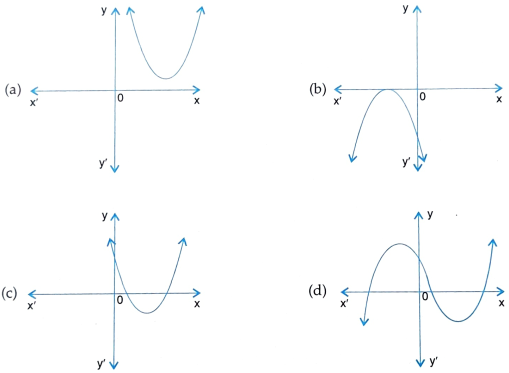
Question 1201 MarkWhich of the following is not the graph of a quadratic polynomial?AnswerD View full question & answer→