Questions

1 Marks Question

🎯

Test yourself on this topic

14 questions · timed · auto-graded

Question 11 Mark
If P(E) = 0.05, what is the probability of not E?
Answer
– 1.5 cannot be the probability of an event because 0$ \leqslant $P(E)$ \leqslant $ 1.

The probability of a sure event is 1 and the probability of an impossible event is 0.
View full question & answer
Question 21 Mark
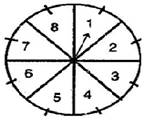
A game of chance consists of spinning an arrow which comes to rest pointing at one of the numbers 1, 2, 3, 4, 5, 6, 7, 8 (see figure) and these are equally likely outcomes. What is the probability that it will point at:

  1. 8?
  2. an odd number?
  3. a number greater than 2?
  4. a number less than 9?
Answer
$Proabibilty\;of\;the\;event=\frac{Number\;of\;favourble\;outcomes}{Total\;number\;of\;possible\;outcomes}$

Probability of head= P(H)=$\frac12$

Probability of tail = P(T)=$\frac12$

i.e. $P\left(H\right)=\frac12=P\left(T\right)=\frac12$
Probability of getting head and tail both are same.
$\therefore$Tossing a coin considered to be fairway.

View full question & answer
Question 31 Mark
A baby is born. It is a boy or a girl. Is this experiment has an equally likely outcome? Explain.
Answer
It is an equally likely event because in the given experiment, a trial is made to answer a true-false question. The answer is either right or wrong only.
View full question & answer
Question 41 Mark
A trial is made to answer a true-false question. The answer is right or wrong. Is this experiment has an equally likely outcome? Explain.
Answer
It is not an equally likely event because the outcome depends upon many factors e.g. quality of player.
View full question & answer
Question 51 Mark
A player attempts to shoot a basketball. She/he shoots or misses the shot. Is this experiment has an equally likely outcome? Explain.
Answer
In the experiment, “A driver attempts to start a car. The car starts or does not start”, it depends on several factors such as fuel, engine condition etc. So we are not justified to assume that each outcome is as likely to occur as the other. Thus, the experiment has not equally likely outcomes.
View full question & answer
Question 61 Mark
The probability of an event is greater than or equal to ________ and less than or equal to ________.
Answer
1
View full question & answer
Question 71 Mark
The sum of the probabilities of all the elementary events of an experiment is ________.
Answer
Sure, Certain
View full question & answer
Question 81 Mark
The probability of an event that is certain to happen is ________. Such an event is called ________.
Answer
0, Impossible
View full question & answer
Question 111 Mark
Find the probability of getting a head when a coin is tossed once. Also find the probability of getting a tail.
Answer
In the experiment of tossing a coin once, the number of possible outcomes is two: Head (H) and Tail (T).

P (head) = $\frac{\text { Number of favourable outcomes } }{\text { Number of all possible outcomes }}=\frac{1}{2}$
P (tail) = $\frac{\text { Number of favourable outcomes }}{\text { Number of all possible outcomes }}=\frac{1}{2}$

View full question & answer
Question 121 Mark
Why is tossing a coin considered to be a fair way of deciding which team should get the ball at the beginning of a football game?
Answer
It is an equally likely event because in the given experiment, “A baby is born, It is a boy or a girl, we know that there are only two possible outcomes – either a boy or a girl.
View full question & answer
Question 131 Mark
If P(A)=0.65, then find the probability of "not A".
Answer
The probability of an event not happening is P(not A) = 1 - P(A) = $ P(\bar{A})=0.35 $
View full question & answer
Question 141 Mark
Find the probability of getting an even number on throwing a dice.
Answer
The probability is the number of favorable outcomes divided by the total number of outcomes: P(even) = $ \frac{3}{6}=\frac{1}{2} $
View full question & answer
1 Marks Question - MATHS STD 10 Questions - Vidyadip