Sample QuestionsProbability questions
One sample from each question group in this chapter. Select any group above to see the full set with answer keys.
In a family of $3$ children, the probability of having at least one boy is :
- ✓
$\frac{7}{8}$
- B
$\frac{1}{8}$
- C
$\frac{5}{8}$
- D
$\frac{3}{4}$
Answer: A.
View full solution →The probability that a number selected at random from the numbers $\{1, 2, 3, ..., 15\}$ is a multiple of $4,$ is
- A
$\frac{4}{15}$
- B
$\frac{2}{15}$
- ✓
$\frac{1}{5}$
- D
$\frac{1}{3}$
Answer: C.
View full solution →The probability that a number selected at random from the numbers $\{1, 2, 3,..., 15\}$ is a multiple of $4,$ is :
- A
$\frac{4}{15}$
- B
$\frac{2}{15}$
- ✓
$\frac{1}{5}$
- D
$\frac{1}{3}$
Answer: C.
View full solution →Cards bearing numbers $\{2, 3, 4, ...., 11\}$ are kept in a bag. A card is drawn at random from the bag. The probability of getting a card with a prime number is :
- ✓
$\frac{1}{2}$
- B
$\frac{2}{5}$
- C
$\frac{3}{10}$
- D
$\frac{5}{9}$
Answer: A.
View full solution →A card is drawn from a well $-$ shuffled deck of $52$ playing cards. The probability that the card will not be an ace is :
- A
$\frac{1}{13}$
- B
$\frac{1}{4}$
- ✓
$\frac{12}{13}$
- D
$\frac{3}{4}$
Answer: C.
View full solution →Directions : In the following questions, a statement of assertion $(A)$ is followed by a statement of reason $(R).$ Mark the correct choice as:
Assertion : If a die is thrown, the probability of getting a number less than $3$ and greater than $2$ is zero.
Reason : Probability of an impossible event is zero.
- ✓
Both assertion $(A)$ and reason $(R)$ are true and reason $(R)$ is the correct explanation of assertion $(A)$.
- B
Both assertion $(A)$ and reason $(R)$ are true but reason $(R)$ is not the correct explanation of assertion $(A)$.
- C
Assertion $(A)$ is true but reason $(R)$ is false.
- D
Assertion $(A)$ is false but reason $(R)$ is true.
Answer: A.
View full solution →Directions : In the following questions, a statement of assertion $(A)$ is followed by a statement of reason $(R).$ Mark the correct choice as :
Assertion : When two coins are tossed simultaneously then the probability of getting no tail is $\frac{1}{4}$
Reason : The probability of getting a head $($i.e., no tail$)$ in one toss of a coin is $\frac{1}{2}$
- A
If both Assertion and Reason are true and Reason is the correct explanation of Assertion.
- ✓
If both Assertion and Reason are true and Reason is not the correct explanation of Assertion.
- C
If Assertion is true but Reason is false.
- D
If Assertion is false but Reason is true.
Answer: B.
View full solution →Directions : In the following questions, a statement of assertion $(A)$ is followed by a statement of reason $(R).$ Mark the correct choice as:
Assertion : The probability of getting a prime number, When a die is throw $n$ once is $\frac{2}{3}$
Reason : Prime numbers on a die are $2, 3, 5.$
- A
If both Assertion and Reason are true and Reason is the correct explanation of Assertion.
- B
If both Assertion and Reason are true and Reason is not the correct explanation of Assertion.
- C
If Assertion is true but Reason is false.
- ✓
If Assertion is false but Reason is true.
Answer: D.
View full solution →Directions : In the following questions, a statement of assertion $(A)$ is followed by a statement of reason $(R).$ Mark the correct choice as:
Assertion : An event is very unlikely to happen.Its probability is $0.0001.$
Reason : If $P(A)$ denote the probability of an event $A,$ then $0\leq\text{P(A)}\leq1$
- A
If both Assertion and Reason are true and Reason is the correct explanation of Assertion.
- ✓
If both Assertion and Reason are true and Reason is not the correct explanation of Assertion.
- C
If Assertion is true but Reason is false.
- D
If Assertion is false but Reason is true.
Answer: B.
View full solution →Directions : In the following questions, a statement of assertion $(A)$ is followed by a statement of reason $(R).$ Mark the correct choice as:
Assertion : When two coins are tossed simultaneously then the probability of getting no tail is $\frac{1}{4}$
Reason : The probability of getting a head $($ie., no $+7$ tail$)$ in one toss of a coin is $\frac{1}{2}$
- ✓
Both Assertion and Reason are true and Reason is the correct explanation of Assertion.
- B
Both Assertion and Reason are true and Reason is not the correct explanation of Assertion.
- C
Assertion is true but Reason is false.
- D
Assertion is false but Reason is true.
Answer: A.
View full solution →The probability of an event that is sure to happen, is _________.
Probability of event E + Probability of event “not E” = _______________
The probability of an event that is certain to happen is _______________. Such an event is called _______________.
The probability of an event is greater than or equal to _______________ and less than or equal to _______________.
The sum of the probabilities of all the elementary events of an experiment is _______________.
If P(E) = 0.05, what is the probability of not E?
A game of chance consists of spinning an arrow which comes to rest pointing at one of the numbers 1, 2, 3, 4, 5, 6, 7, 8 (see figure) and these are equally likely outcomes. What is the probability that it will point at:
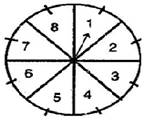
- 8?
- an odd number?
- a number greater than 2?
- a number less than 9?
A baby is born. It is a boy or a girl. Is this experiment has an equally likely outcome? Explain.
A trial is made to answer a true-false question. The answer is right or wrong. Is this experiment has an equally likely outcome? Explain.
A player attempts to shoot a basketball. She/he shoots or misses the shot. Is this experiment has an equally likely outcome? Explain.
A game of chance consists of spinning an arrow which comes to rest pointing at one of the numbers 1, 2, 3, 4, 5, 6, 7, 8 (see figure) and these are equally likely outcomes. What is the probability that it will point at:
- 8?
- an odd number?
- a number greater than 2?
- a number less than 9?
A bag contains lemon flavoured candies only. Malini takes out one candy without looking into the bag. What is the probability that she takes out
- an orange flavoured candy?
- a lemon flavoured candy?
Is the given statement correct or not correct?
If a die is thrown, there are two possible outcomes- an odd number or an even number. Therefore, the probability of getting an odd number is $\frac{1}{2}$.
View full solution →Is the given statement correct or not correct?
If two coins are tossed simultaneously there are three possible outcomes- two heads, two tails or one of each. Therefore, for each of these outcomes, the probability is $\frac{1}{3}$.
View full solution →A die is thrown twice. What is the probability that:
- 5 will not come up either time?
- 5 will come up at least once?
[Hint: Throwing a die twice and throwing two dice simultaneously are treated as the same experiment]
A box contains 5 red marbles, 8 white marbles and 4 green marbles. One marble is taken out of the box at random. What is the probability that the marble taken out will be
- red ?
- white ?
- not green ?
It is given that in a group of 3 students, the probability of 2 students not having the same birthday is 0.992. What is the probability that the 2 students have the same birthday?
Why is tossing a coin considered to be a fair way of deciding which team should get the ball at the beginning of a football game?
A box contains 90 discs which are numbered from 1 to 90. If one disc is drawn at random from the box, find the probability that it bears
- a two-digit number
- a perfect square number
- a number divisible by 5.
A die is thrown once. Find the probability of getting
- a prime number;
- a number lying between 2 and 6
- an odd number.
One card is drawn from a well-shuffled deck of 52 cards. Find the probability of getting
- a king of red colour
- a face card
- a red face card
- the jack of hearts
- a spade
- the queen of diamonds
- Two dice, one blue and one grey, are thrown at the same time.Complete the following table:
| Event: Sum on 2 dice | 2 | 3 | 4 | 5 | 6 | 7 | 8 | 9 | 10 | 11 | 12 |
| Probability | $\frac{1}{{36}}$ | | | | | | $\frac{5}{{36}}$ | | | | $\frac{1}{{36}}$ |
- A student argues that there are 11 possible outcomes 2, 3, 4, 5, 6, 7, 8, 9, 10, 11 and 12. Therefore, each of them has a probability $\frac{1}{11}$. Do you agree with this argument? Justify your answer.
Rahul goes to a fete in Mussoorie. There he saw a game having prizes - wall clocks, power banks, puppets and water bottles. The game consists of a box having cards inside it, bearing the numbers I to 200, one on each card. A person has to select a card at random. Now, the winning of prizes has the following conditions:
- Wall clock- If the number on the selected card is a perfect square.
- Power bank - If the number on the selected card is multiple of 3.
- Puppet - If the number on selected card is divisible by 10.
- Water bottle - If the number on the selected card is a prime number more than 100 but less than 150.
- Better luck next time - If the number on the selected card is a perfect cube.

On the basis of above information, answer the following questions.
- Find the probability of winning a puppet.
- What is the probability of winning a water bottle?
- What is the probability of winning a Power bank?
Or
What is the probability of winning a wall clock?
Two families- Gupta's and Singhal's are lived in a colony. Gupta family has two children while Singhal family has 3 children.

On the basis of the above information, answer the following questions.
- Find the probability that Mr Singhal has exactly 2 girls and 1 boy.
- What is the probability of Gupta having atleast 1 boy?
- What is the probability of Gupta having atleast 1 Girl?
Or
What is the probability of Singhal having no boy?
ln the month of May, the weather forecast department gives the prediction of weather for the month of June. The given table shows the probabilities of forecast of different days:
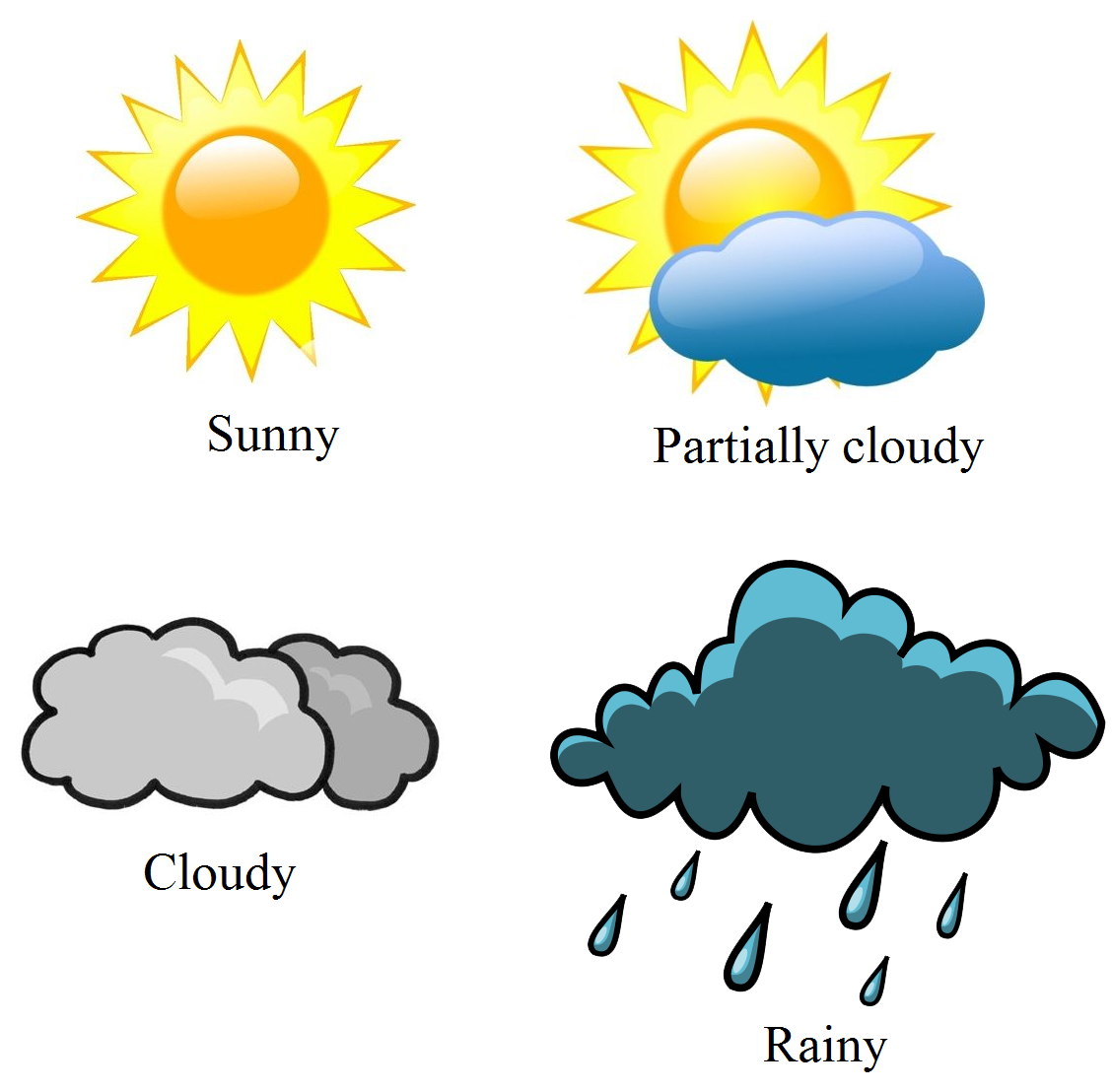
| Days |
Days |
Cloudy |
Partially cloudy |
Rainy |
| Probability |
$\frac{1}{2}$ |
x |
$\frac{1}{5}$ |
y |
lf the forecast is 100% correct for June, then answer the following questions.
- The number of sunny days in June, is?
- If the number of cloudy days in June is 5, then x = ?
- The probability that the day is not rainy will be ?
Or
If the sum of x and y is $\frac{3}{10},$ then the number of rainy days in June will be ?
Four friends are playing with cards. One of them hides all the 2's, S's and Jacks from the deck of 52 cards and then shuffles the remaining cards. Now, he tells to one of his friend to pick a card at random from the remaining cards.
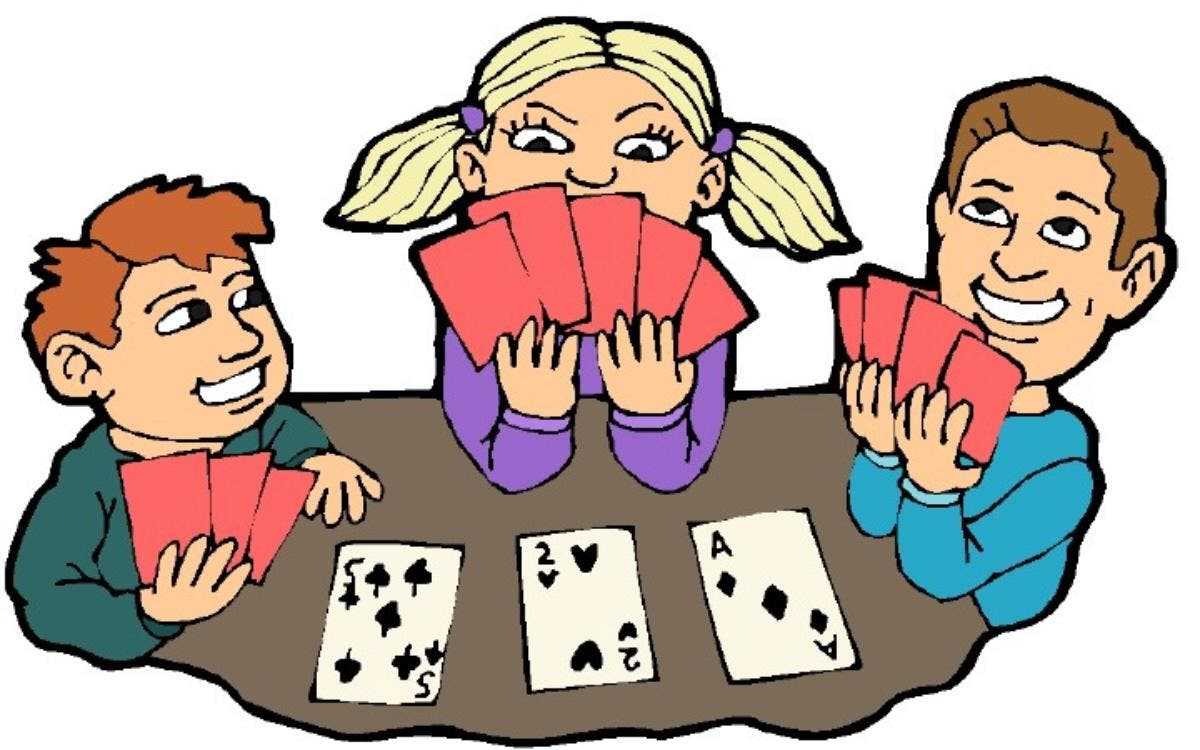
On the basis of above information, answer the following questions.
- What is the probability of getting '6 of spade'?
- What is the probability of getting a black diamond?
- What is the probability of getting a face card?
Or
What is the probability of getting a club?
Rohit wants to distribute chocolates in his class on his birthday. 'The chocolates are of three types: Milk chocolate, White chocolate and Dark chocolate. If the total number of students in the class is 54 and everyone gets a chocolate, then answer the following questions.
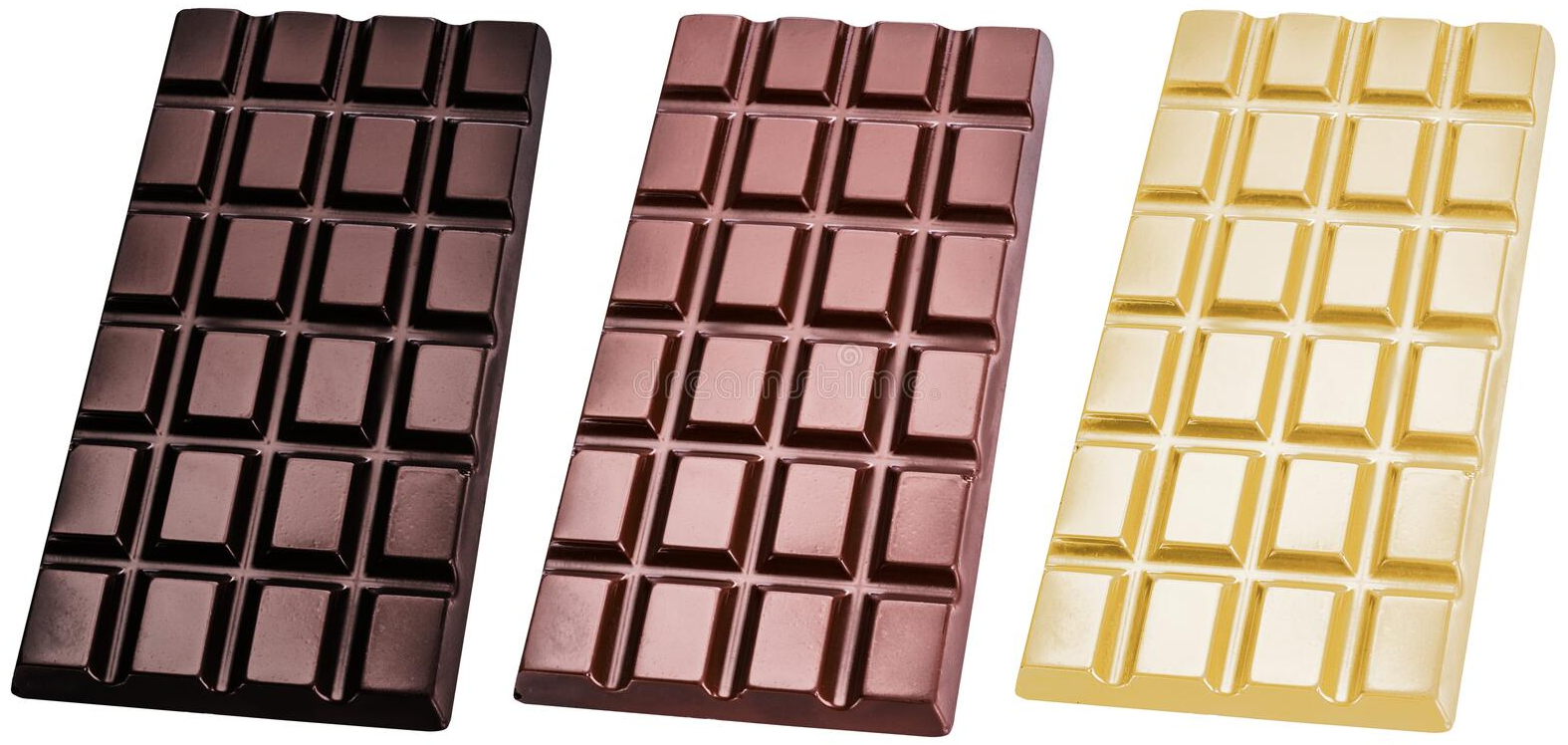
- If the probability of distributing milk chocolates is $\frac{1}{3}$ then the number of milk chocolates Rohit has ?
- If the probability of distributing dark chocolates is $\frac{4}{9}$ If the probability of distributing dark chocolates is.
- If the probability of distributing dark chocolates is.
Or
The probability of distributing both milk and white chocolates is.