Questions · Page 3 of 3

3 Marks Question

Question 1013 Marks
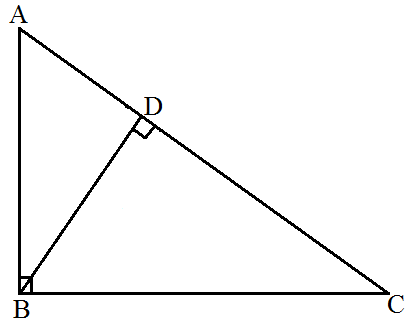
In the given figure, $\angle\text{ABC}=90^\circ$ and $\text{BD} \perp\text{AC.}$ If AB = 5.7cm, BD = 3.8cm and CD = 5.4cm, find BC.
Answer
We have, $\angle\text{ABC}=90^\circ$ and $\text{BD}\perp\text{AC}$
In $\triangle\text{ABC}$ and $\triangle\text{BDC}$
$\angle\text{ABC}=\angle\text{BDC}$ [Each 90°]
$\angle\text{C}=\angle\text{C}$ [Commom]
Then, $\triangle\text{ABC}\sim\triangle\text{BDC}$ [By AA similarity]
$\therefore\frac{\text{AB}}{\text{BD}}=\frac{\text{BC}}{\text{DC}}$ [Corresponding parts of similar $\triangle$ are proportional]
$\Rightarrow\frac{5.7}{3.8}=\frac{\text{BC}}{5.4}$
$\Rightarrow\text{BC}=\frac{5.7}{3.8}\times8.1\text{cm}$
View full question & answer
Question 1023 Marks
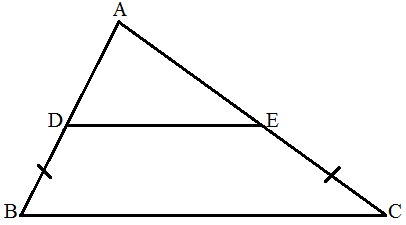
In a $\triangle\text{ABC,D}\ \text{and E}$ are points on the sides AB and AC respectively such that DE || BC.
If $\frac{\text{AD}}{\text{BD}}=\frac{4}{5}$ and EC = 2.5cm, find AE.
Answer
Given: $\frac{\text{AD}}{\text{BD}}=\frac{4}{5}$ and EC = 2.5cm
by thales theorem,
$\frac{\text{AD}}{\text{BD}}=\frac{\text{AE}}{\text{CE}}$
$\Rightarrow\frac{4}{5}=\frac{\text{AE}}{2.5}\ \ (\because\text{CE}=\text{EC})$
$\Rightarrow\text{AE}=\frac{4\times2.5}{5}$
$\Rightarrow\text{AE}=2\text{cm}$
View full question & answer
Question 1033 Marks
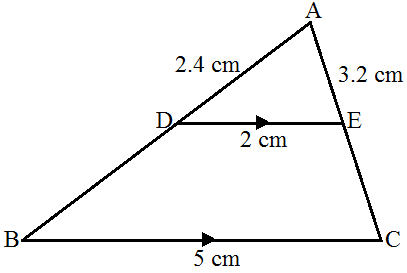
In a $\triangle\text{ABC}$ D and E are points on AB and AC respectively such that DE || BC. If AD = 2.4cm, AE = 3.2cm, DE = 2cm and BC = 5cm, find BD and CE.
Answer
In the $\triangle\text{ABC},$ DE || BC
AD = 2.4cm, AE = 3.2cm, DE = 2cm and BC = 5cm

$\text{In}\ \triangle\text{ABC}$
$\because\text{DE}||\text{BC}$
$\therefore\triangle\text{ADE}\sim\triangle\text{ABC}$
$\Rightarrow\frac{\text{AD}}{\text{AB}}=\frac{\text{AE}}{\text{AC}}=\frac{\text{DE}}{\text{BC}}$
$\Rightarrow\frac{2.4}{\text{AB}}=\frac{3.2}{\text{AC}}=\frac{2}{5}$
Now, $\frac{2.4}{\text{AB}}=\frac{2}{5}\Rightarrow\text{AB}=\frac{2.4\times5}{2}=6\text{cm}$
$\text{DB}=\text{AB}-\text{AD}=6.0-2.4=3.6\text{cm}$
And $\because\frac{3.2}{\text{AC}}=\frac{2}{5}\Rightarrow\text{AC}=\frac{3.5\times5}{2}=8.75\text{cm}$
$\therefore\text{CE}=\text{AC}-\text{AE}=8.0-3.2=4.8\text{cm}=8\text{cm}$
View full question & answer
Question 1043 Marks
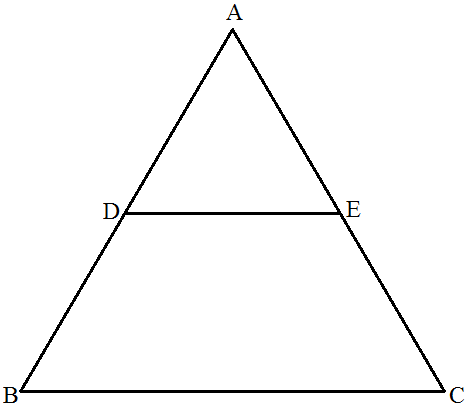
In the given figure, DE || BC
If DE : BC = 3 : 5. Calculate the ratio of the areas of $\triangle\text{ADE}$ and the trapezium BCED.
Answer
DE : BC = 3 : 5 calculate the ratio of the areas of $\triangle\text{ADE}$ and the trapezium BCED
$\because\triangle\text{ADE}\sim\triangle\text{ABC}$
$\therefore\frac{\text{area}\triangle\text{ADE}}{\text{area}\triangle\text{ABC}}=\frac{\text{DE}^2}{\text{BC}^2}=\Big(\frac{3}{5}\Big)^2=\frac{9}{25}$
$\Rightarrow25\text{ area }\triangle\text{ADE}=9\text{ area }\triangle\text{ABC}$
= 9(area $\triangle\text{ADE}$ + area trapezium BCED)
= 9 area $\triangle\text{ABC}$ + 9 area trapezium BCED
25 area $\triangle\text{ADE}$ - 9 area $\triangle\text{ADE}$
= 9 area trapezium BCED
⇒ 16 area $\triangle\text{ADE}$ = 9 area trapezium BCED
$\Rightarrow\frac{\text{area }\triangle\text{ADE}}{\text{area trapezium BCED}}=\frac{9}{16}$
$\therefore$ Ratio = 9 : 16.
View full question & answer
Question 1053 Marks
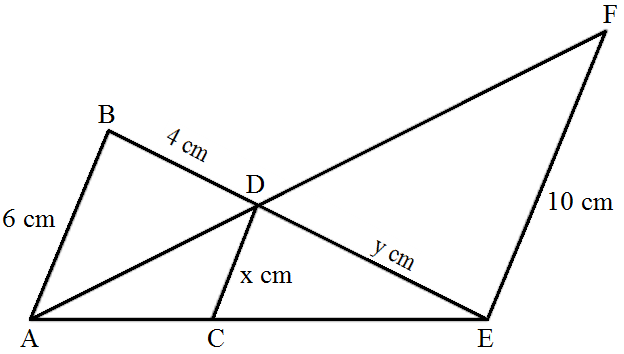
In the given figure, we have AB || CD || EF. If AB = 6cm, CD = x cm, EF = 10cm, BD = 4cm and DE = y cm, Calculate the values of x and y.
Answer
It is given that AB || CD || EF AB = 6cm, CD = x cm and EF = 10cm
We have to calculate the values of x and y. In $\triangle\text{ADB}$ and $\triangle\text{DEF},$ we have $\angle\text{ADB}=\angle\text{EDF}$ (Vertically opposite angles) $\Rightarrow\angle\text{ABD}=\angle\text{DEF}$ (Alternate interior angles) So $\triangle\text{ADB}\sim\triangle\text{DEF}$ $\frac{\text{EF}}{\text{AB}}=\frac{\text{OE}}{\text{OB}}$ $\frac{10\text{cm}}{6\text{cm}}=\frac{\text{y}}{4\text{cm}}$ $6\text{cm}\times\text{y}=40\text{cm}$ $\text{y}=\frac{40\text{cm}}{6\text{cm}}$ $\text{y}=6.67\text{cm}$ Similarly in $\triangle\text{ABE}$ we have $\frac{\text{CD}}{\text{AB}}=\frac{\text{DE}}{\text{DB}}$ $\frac{4}{6.7}\text{cm}=\frac{\text{x}}{6}\text{cm}$ $6.7\text{cm}\times\text{x}=6\text{cm}\times4\text{cm}$ $\text{x}=\frac{24}{6.7}\text{cm}$ $\text{x}=3.78\text{cm}$ Hence x = 3.78cm and y = 6.67cm.
View full question & answer
Question 1063 Marks
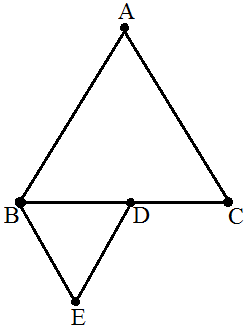
If $\triangle\text{ABC}$ and $\triangle\text{BDE}$ are equilateral triangles, where D is the midpoint of BC, find the ratio of areas of $\triangle\text{ABC}$ and $\triangle\text{BDE}.$
Answer

We have,
$\triangle\text{ABC}$ and $\triangle\text{BDE}$ are equilateral triangles then both triangles are equiangular
$\therefore\triangle\text{ABC}\sim\triangle\text{BDE}$ [By AAA similarity]
By area of similar triangle theorem
$\frac{\text{ar}(\triangle\text{ABC)}}{\text{ar}(\triangle\text{BDE})}=\frac{\text{BC}^2}{\text{BD}^2}$
$=\frac{(2\text{BD})^2}{\text{BD}^2}$ [D is the mid-point of BC]
$=\frac{4(\text{BD})^2}{\text{BD}^2}$
$=\frac{4}{1}$
View full question & answer
Question 1073 Marks
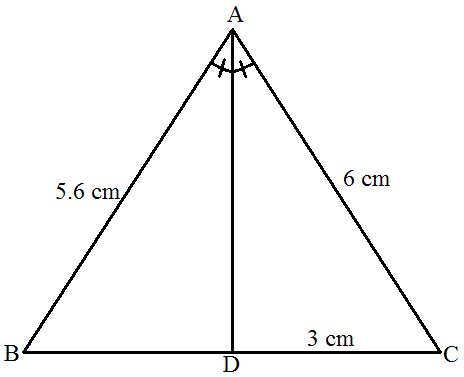
If a $\triangle\text{ABC},$ AD is the bisector of $\angle\text{A},$ Meeting side BC at D.
If AB = 5.6cm, AC = 6cm and DC = 3cm, find BC.
Answer
AB = 5.6cm, AC = 6cm and DC = 3cm

$\because$ AD is the bisector of $\angle\text{A}$
$\therefore\frac{\text{AB}}{\text{AC}}=\frac{\text{BD}}{\text{DC}}$
$\Rightarrow\frac{5.6}{6}=\frac{\text{BD}}{3}$
$\Rightarrow\text{BD}=\frac{3\times5.6}{6}=2.8$
$\therefore$ BC = BD + DC = 2.8 + 3 = 5.8cm.
View full question & answer
Question 1083 Marks
If D and E are points on sides AB and AC respectively of a ∆ABC such that DE || BC and BD = CE. Prove that $\triangle\text{ABC}$ is isosceles.
Answer
Given: In $\triangle\text{ABC},$ D and E are points on the sides AB and AC such that BD = CD

To prove: $\triangle\text{ABC}$ is an isosceles triangle
Proof: By thales theorem
$\frac{\text{AD}}{\text{DB}}=\frac{\text{AE}}{\text{EC}}$
But BD = CE .....(i)
$\therefore\text{AD}=\text{AE}\ ....(\text{ii})$
Adding we get,
AD + BD = AE + CE
$\Rightarrow\text{AB}=\text{AC}$
$\therefore\triangle\text{ABC}$ is an isosceles triangle.
Hence proved.
View full question & answer
Question 1093 Marks
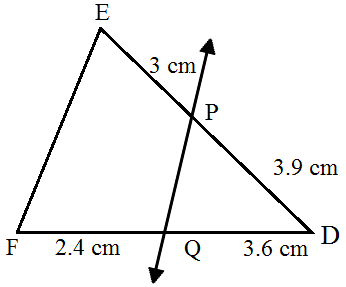
In fig. state if PQ || EF.
Answer
We have,
DP = 3.9cm, PE = 3cm, DQ = 3.6cm and QF = 2.4cm.
Now, $\frac{\text{DP}}{\text{PE}}=\frac{3.9}{3}=\frac{1.3}{1}=\frac{13}{10}$
And, $\frac{\text{DQ}}{\text{QF}}=\frac{3.6}{2.4}=\frac{36}{24}=\frac{3}{2}$
$\Rightarrow\frac{\text{DP}}{\text{PE}}\neq\frac{\text{DQ}}{\text{QF}}$
So, PQ is not parallel to EF.
View full question & answer
Question 1103 Marks
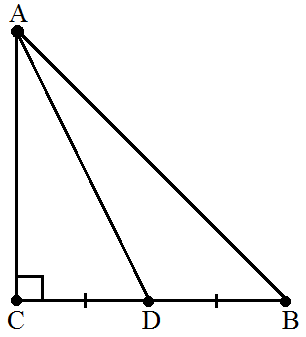
In right-angled triangle $ABC$ is which $\angle\text{C}=90^\circ,$ if $D$ is the mid-point of $BC$, prove that $AB^2 = 4AD^2 - 3AC^2.$
Answer

We have,
$\angle\text{C}=90^\circ$ and D is the mid-point of BC
In $\triangle\text{ACB},$ by pythagoras theorem
$AB^2 = AC^2 + BC^2$
$\Rightarrow AB^2 = AC^2 + (2CD)^2$^ [D is the mid-point of BC]
$AB^2 = AC^2 + 4CD^2$
$\Rightarrow AB^2 = AC^2 + 4(AD^2 - AC^2)$ [In $\triangle\text{ACD},$ by pythagoras theorem]
$\Rightarrow AB^2 = AC^2 + 4AD^2 - 4AC^2$
$\Rightarrow AB^2 = 4AD^2 - 3AC^2$​​​​​​​^
View full question & answer
3 Marks Question - Page 3 - MATHS STD 10 Questions - Vidyadip