Question 512 Marks
Evaluate:
$=\frac{\sin18^\circ}{\cos72^\circ}+\sqrt{3}\ \{\tan10^\circ\tan30^\circ\tan40^\circ\tan50^\circ\tan80^\circ\}$
AnswerWe will use the properties of complementary angles.
$=\frac{\sin18^\circ}{\cos72^\circ}+\sqrt{3}\ (\tan10\tan30\tan40\tan50\tan80)$
$ =\frac{\sin18^\circ}{\sin18^\circ}+\sqrt{3}\ (\cot80\tan30\cot50\tan50\tan80)$
$ =1+\sqrt{3}\Big(\frac{1}{\sqrt{3}}\Big)$
$ =2$
View full question & answer→Question 522 Marks
Prove that:$\sin48^\circ\sec42^\circ+\cos48^\circ\text{cosec }42^\circ=2$
Answer$\text{L.H.S}=\sin48^\circ\sec42^\circ+\cos48^\circ\text{cosec }42^\circ$
$=\sin48\sec(90^\circ-48^\circ)+\cos48^\circ\text{cosec }(90^\circ-48^\circ)$
$=\sin48^\circ\cdot\text{cosec }48^\circ+\cos48^\circ\cdot\sec48^\circ$
$=\sin48^\circ\times\frac{1}{\sin48^\circ}+\cos48^\circ\times\frac{1}{\cos48^\circ}$
$=1+1$
$=2$
$=\text{R.H.S}$
View full question & answer→Question 532 Marks
Evaluate the following:
$\frac{\sin19^\circ}{\cos71^\circ}$
Answer$\Rightarrow\frac{\sin(90^\circ-71^\circ)}{\cos71^\circ}=\frac{\cos71^\circ}{\cos71^\circ}$
$=1$
View full question & answer→Question 542 Marks
If $\theta=30^\circ,$ verify that.
$\cos3\theta=4\cos^3\theta-3\cos\theta$
AnswerGiven:
$\theta=30^\circ\dots(1)$
To verify:
$\cos3\theta=4\cos^3\theta-3\cos\theta\dots(2)$
Now consider left hand side of the expression in equation (2)
Therefore
$\cos3\theta=\cos3\times30$
$=\cos90$
$=0$
Now consider right hand side of the expression to be verified in equation (2)
Therefore,
$4\cos^3\theta-3\cos\theta=4\cos^330-3\cos30$
$=4\bigg(\frac{\sqrt{3}}{2}\bigg)^3-3\times\frac{\sqrt{3}}{2}$
$=\frac{3\sqrt{3}}{2}-\frac{3\sqrt{3}}{2}$
$=0$
Hence it is verified that,
$\cos3\theta=4\cos^3\theta-3\cos\theta$
View full question & answer→Question 552 Marks
State whether the following are true or false. Justify your answer.
cot A is the product of cot and A.
Answercot A is a trigonometric ratio which means cotangent of angle A.
Hence, cot A is the product of cot and A is False.
View full question & answer→Question 562 Marks
In a $\triangle\text{ABC}$ right angled at B, $\angle\text{A}=\angle\text{C.}$ Find the values of.
$\sin\text{A}\cos\text{C}+\cos\text{A}\sin\text{C}$
AnswerIn $\triangle\text{le}\text{ ABC}\ \angle\text{A}+\angle\text{B}+\angle\text{C}=180^\circ$ $\angle\text{A}+90^\circ+\angle\text{A}=180^\circ$ $2\angle\text{A}=90^\circ$ $\angle\text{A}=45^\circ$$\therefore\ \angle\text{A}=45^\circ$
$\sin45^\circ\cos45^ \circ+\cos45^\circ\sin45^\circ$ $\frac{1}{\sqrt{2}}\cdot\frac{1}{\sqrt {2}}+\frac{1}{\sqrt{2}}\cdot\frac{1}{\sqrt {2}}=\frac{1}{2}+\frac{1}{2}=1$
View full question & answer→Question 572 Marks
Prove that:
$\frac{\cos80^\circ}{\sin10^\circ}+\cos59^\circ\text{cosec }31^\circ=2$
Answer$\cos80^\circ=\cos(90^\circ-10^\circ)=\sin10^\circ$
$\cos59^\circ=\cos(90^\circ-31^\circ)=\sin31^\circ$
$\Rightarrow\frac{\sin10^\circ}{\sin10^\circ}+\sin31^\circ\text{cosec }31^\circ$
$=1+1=2$ $[\because\sin\theta\text{ cosec }\theta=1]$
Hence proved.
View full question & answer→Question 582 Marks
Evaluate the following:
$\tan48^\circ\tan23^\circ\tan42^\circ\tan67^\circ$
AnswerWe have to find $\tan48^\circ\tan23^\circ\tan42^\circ\tan67^\circ$
Since $\tan(90^\circ-\theta)=\cot\theta$
So, $\tan48^\circ\tan23^\circ\tan42^\circ\tan67^\circ$ $=\tan(90^\circ-42^\circ)\tan(90^\circ-67^\circ)\tan42^\circ\tan67^\circ$
$=\cot42^\circ\cot67^\circ\tan42^\circ\tan67^\circ$
$=(\tan67^\circ\cot67^\circ)(\tan42^\circ\cot42^\circ)$
$=1\times1$
$=1$
So value of $\tan48^\circ\tan23^\circ\tan42^\circ\tan67^\circ\text{ is }1$
View full question & answer→Question 592 Marks
In a rectangle ABCD, AB = 20cm, $\angle\text{BAC} = 60^\circ,$ calculate side BC and diagonals AC and BD.
AnswerWe have drawn the following figure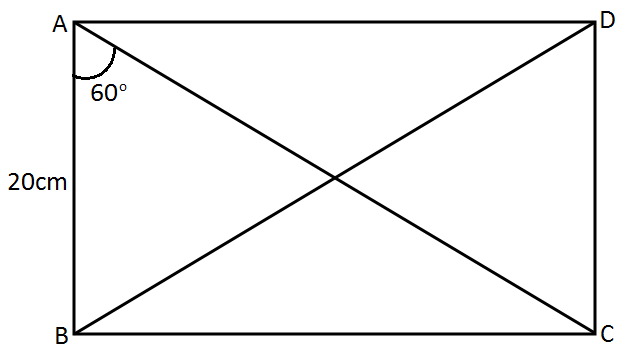
Since ABCD is a rectangle Therefore, $\angle\text{ABC}=\angle\text{BCD}=90^\circ$ Now, consider $\triangle\text{ABC}$ We know that sum of all the angles of any triangle is 180° Therefore, $\angle\text{BAC}+\angle\text{ABC}+\angle\text{ACB}=180^\circ\dots(1)$ Now by substituting the values of known angles $\angle\text{BAC}$ and $\angle\text{ABC}$ in equation (1) We get, $60^\circ+90^\circ+\angle\text{ACB}=180^\circ$ $\Rightarrow150^\circ+\angle\text{ACB}=180^\circ$ $\Rightarrow\angle\text{ACB}=180^\circ-150^\circ$ $\Rightarrow\angle\text{ACB}=30^\circ$ Now in $\triangle\text{ABC}$ We know that, $\cos\text{A}=\cos60^\circ$ $\Rightarrow\frac{\text{AB}}{\text{AC}}=\cos60^\circ$ Now we have, $\cos60^\circ=\frac{1}{2}$ AB = 20cm and Therefore by substituting above values in equation (2) We get, $\cos\text{A}=\cos60^\circ$ $\Rightarrow\frac{20}{\text{AC}}=\frac{1}{2}$ Now by cross multiplying we get, $20\times2=1\times\text{AC}$ $\Rightarrow40=\text{AC}$ $\Rightarrow\text{AC}=40$ Therefore, $\text{AC}=40\text{cm}\ \dots(3)$ Now in $\triangle\text{ABC}$ We know that, $\sin\text{A}=\sin60^\circ$ $\Rightarrow\frac{\text{BC}}{\text{AC}}=\sin60^\circ$ Now we have from equation (3), $\sin60^\circ=\frac{\sqrt{3}}{2}$ AC=40cm and Therefore by substituting above values in equation (4) We get, $\sin\text{A}=\sin60^\circ$ $\Rightarrow\frac{\text{BC}}{40}=\frac{\sqrt{3}}{2}$ Now by cross multiplying we get, $\text{BC}\times2=\sqrt{3}\times40$ $\Rightarrow\text{BC}=\frac{\sqrt{3}\times40}{2}$ $\Rightarrow\text{BC}=20\sqrt{3}\text{m}$ Therefore, $\Rightarrow\text{BC}=20\sqrt{3}\text{m}\ \dots(5)$ Since ABCD is a rectangle Therefore, $\text{AB}=\text{CD}=20\text{cm}\ \dots(6)$ And $\text{BC}=\text{AD}=20\sqrt{3}\text{cm}\ \dots(7)$ Now in $\triangle\text{BCD}$ We know that, $\tan\text{B}=\frac{\text{CD}}{\text{BC}}$ Now by substituting the values of sides from equation (6) and (7) We get, $\Rightarrow\tan\text{B}=\frac{20}{20\sqrt{3}}$ $\Rightarrow\tan\text{B}=\frac{1}{\sqrt{3}}$ Since $\tan30^\circ=\frac{1}{\sqrt{3}}$ Therefore, $\angle\text{B}=30^\circ$ That is in $\triangle\text{BCD}$ $\angle\text{DBC}=30^\circ\ \dots(8)$ NOW in $\triangle\text{BCD}$ We know that, $\cos\text{B}=\frac{BC}{BD}$ From equation (7) and (8) $\Rightarrow\cos30^\circ=\frac{20\sqrt{3}}{\text{BD}}$ Since $\Rightarrow\cos30^\circ=\frac{\sqrt{3}}{2}$ Therefore, $\frac{\sqrt{3}}{2}=\frac{20\sqrt{3}}{\text{BD}}$ Now by cross multiplying we get, $\sqrt{3}\times\text{BD}=20\sqrt{3}\times2$ $\Rightarrow\sqrt{3}\times\text{BD}=40\sqrt{3}$ $\Rightarrow\text{BD}=\frac{40\sqrt{3}}{\sqrt{3}}$ $\Rightarrow\text{BD}=40$ Therefore, $\text{BD}=40\text{cm}\ \dots(9)$ Hence from equation (3), (5) and (9) $\text{AC}=40\text{cm},\ \text{BC}=20\sqrt{3}\text{cm},\ \text{BD}=40\text{cm}$ View full question & answer→Question 602 Marks
Write the maximum and minimum values of $\cos\theta.$
AnswerThe maximum value of $\cos\theta$ is 1 and the minimum value of $\cos\theta$ is -1 because value of $\cos\theta$ lies between -1 and 1.
View full question & answer→Question 612 Marks
If $\sec4\text{A}=\text{cosec(A}-20^\circ),$ where 4A is an acute angles, find the value of A.
AnswerGiven: $\sec4\text{A}=\text{cosec}(\text{A}-20^\circ)$ and 4A is an acute angle
We have to find $ \theta$
Now
$\sec4\text{A}=\text{cosec}(\text{A}-20^\circ)$
$ \sec4\text{A}=\sec\big\{90^\circ-(\text{A}-20^\circ)\big\}$
$ \sec4\text{A}=\sec(90^\circ-\text{A}+20^\circ)$
$ \sec4\text{A}=\sec(110^\circ-\text{A})$
$ 5\text{A}=110^\circ$
$ \text{A}=22^\circ$
Hence the value of A is 22º
View full question & answer→Question 622 Marks
If A + B = 90° and $\tan\text{A}=\frac{3}{4},$ what is cot B?
AnswerWe have,
$\text{A}+\text{B}=90^\circ$
So, $\text{A}=90^\circ-\text{B}$
And, $\tan\text{A}=\frac{3}{4}$
$\Rightarrow\tan\text{A}=\tan(90^\circ-\text{B})$
$\Rightarrow\cot\text{B}=\frac{3}{4}$
View full question & answer→Question 632 Marks
Express the following in terms of trigonometric ratios of angles lying between 0° and 45°.$\text{cosec }54^\circ+\sin72^\circ$
Answer$\text{cosec }54^\circ=\text{cosec }(90^\circ-36^\circ)=\sec36^\circ$
$\sin72^\circ=\sin(90^\circ-18^\circ)=\cos18^\circ$
$\Rightarrow \sec36^\circ+\cos18^\circ$
View full question & answer→Question 642 Marks
State whether the following are true or false. Justify your answer.
$\sin\theta=\frac{4}{3}$ for some angle $\theta.$
Answer$\sin\theta=\frac{4}{3}$ for some angle $\theta$
Given statement is false
Since value of $\sin\theta$ is less than (or) equal to one.
Here value of $\sin\theta$ exceeds one, so given statement is false.
View full question & answer→Question 652 Marks
If $2\theta + 45^\circ$ and $30^\circ-\theta$ are acute angles, find the degree measure of $\theta$ satisfying $\sin (2\theta + 45^\circ) = \cos (30^\circ − \theta).$
AnswerHere $2\theta+45^\circ$ and $30-\theta^\circ$ are acute angles:
We know that $ (90-\theta)=\cos\theta$
$\sin(2\theta+45^\circ)=\sin(90-(30-\theta))$
$ \sin(2\theta+45^\circ)=\sin(90-30+\theta)$
$\sin(2\theta+45^\circ)=\sin(60+\theta)$
On equting sin of angle of we get
$ 2\theta+45=60+\theta$
$2\theta-\theta=60-45$
$\theta=15^\circ$
View full question & answer→Question 662 Marks
Express the following in terms of trigonometric ratios of angles lying between 0° and 45°.$\sin59^\circ+\cos56^\circ$
Answer$\sin59^\circ=\sin(90^\circ-59^\circ)=\cos31^\circ$
$\cos56^\circ=\cos(65^\circ-34^\circ)=\sin34^\circ$
$\Rightarrow\cos31^\circ+\sin34^\circ$
View full question & answer→Question 672 Marks
Evaluate:
$=\frac{3\cos55^\circ}{7\sin35^\circ}-\frac{4(\cos70^\circ\text{cosec}20^\circ)}{7(\tan5^\circ\tan25^\circ\tan45^\circ\tan65^\circ\tan85^\circ)}$
AnswerWe will use the properties of complementary angles. $=\frac{3\cos55^\circ}{7\sin35^\circ}-\frac{4(\cos70^\circ\text{cosec}20^\circ)}{7(\tan5^\circ\tan25^\circ\tan45^\circ\tan65^\circ\tan85^\circ)}$ $ =\frac{3\cos55^\circ}{7\cos55^\circ}-\frac{4(\cos70^\circ\sec70^\circ)}{7(\cot85^\circ\cot65^\circ\tan45^\circ\tan65^\circ\tan85^\circ)}$ $ =\frac{3}{7}-\frac{4}{7}$$=-\frac{1}{7}$
View full question & answer→Question 682 Marks
If $\tan\text{A}=\frac{3}{4}$ and A + B = 90°, then what is the value of cot B?
AnswerGiven that:
$\text{A}+\text{B}=90^\circ$
$\tan\text{A}=\frac{3}{4}$
$\text{A}+\text{B}=90^\circ$
$\Rightarrow\text{B}=90^\circ-\text{A}$
$\Rightarrow\cot\text{B}=\cot(90^\circ-\text{A})$
$\Rightarrow\cot\text{B}=\tan\text{A}$
$\Rightarrow\cot\text{B}=\frac{3}{4}\big[\cot\big(90^\circ-\text{A}\big)=\tan\text{A}\big]$
Hence the value of cot B is $\frac{3}{4}$
View full question & answer→Question 692 Marks
Find the value of x in the following:
$\sqrt{3}\sin\text{x}=\cos\text{x}$
Answer$\sqrt{3}\sin\text{x}=\cos\text{x}$
$\frac{\sin\text{x}}{\cos\text{x}}=\frac{1}{\sqrt{3}}$
$\Rightarrow\tan\text{x}=\frac{1}{\sqrt{3}}$
$\Rightarrow\tan\text{x}=\tan30^\circ$
$\Rightarrow\text{x}=30^\circ$
View full question & answer→Question 702 Marks
Express the following in terms of trigonometric ratios of angles lying between 0° and 45°.
$\sin67^\circ+\cos75^\circ$
Answer$\sin67^\circ=\sin(90^\circ-23^\circ)=\cos23^\circ$
$\cos75^\circ=\cos(90^\circ-15^\circ)=\sin15^\circ$
$=\cos23^\circ+\sin15^\circ$
View full question & answer→Question 712 Marks
State whether the following are true or false. Justify your answer.
The value of tan A is always less than 1.
Answer$\tan\text{A}\angle1$
Value of tan A at 45° i.e., tan 45 = 1
As value of A increases to 90°
Tan A becomes infinite
So, given statement is false.
View full question & answer→Question 722 Marks
Evaluate the following:
$\Big(\frac{\sin27^\circ}{\cos63^\circ}\Big)^2-\Big(\frac{\cos63^\circ}{\sin27^\circ}\Big)^2$
AnswerWe have to find: $\Big(\frac{\sin27^\circ}{\cos63^\circ}\Big)^2-\Big(\frac{\cos63^\circ}{\sin27^\circ}\Big)^2$$$
Since $\sin(90^\circ-\theta)=\cos\theta$ and $\cos(90^\circ-\theta)=\sin\theta$
So, $\Big(\frac{\sin27^\circ}{\cos63^\circ}\Big)^2-\Big(\frac{\cos63^\circ}{\sin27^\circ}\Big)^2=\bigg[\frac{\sin(90^\circ-63^\circ)}{\cos63^\circ}\bigg]^2-\bigg[\frac{\cos(90^\circ-27^\circ)}{\sin27^\circ}\bigg]^2$
$=\Big(\frac{\cos63^\circ}{\cos63^\circ}\Big)^2-\Big(\frac{\sin27^\circ}{\sin27^\circ}\Big)^2$
$= 1 - 1$
$= 0$
So value of $\Big(\frac{\sin27^\circ}{\cos63^\circ}\Big)^2-\Big(\frac{\cos63^\circ}{\sin27^\circ}\Big)^2\text{ is }0$
View full question & answer→Question 732 Marks
If $\sin 3\text{A} = \cos (\text{A} - 26^\circ),$ where 3A is an acute angles, find the value of A.
Answer$\cos\theta=\sin(90^\circ-\theta)$
$\Rightarrow\cos(\text{A}-26)=\sin(90^\circ-(\text{A}-26^\circ))$
$\Rightarrow\sin3\text{A}=\sin(90^\circ-(\text{A}-26))$
Equating anglees on both sides,
$3\text{A}=90^\circ-\text{A}+26^\circ$
$4\text{A}=116^\circ\Rightarrow\text{A}=\frac{116}{4}=29^\circ$
$\therefore\ \text{A}=29^\circ$
View full question & answer→Question 742 Marks
Prove that:$\tan20^\circ\tan35^\circ\tan45^\circ\tan55^\circ\tan70^\circ=1$
Answer$\tan20^\circ=\tan(90^\circ-70^\circ)=\cot70^\circ$
$\tan35^\circ=\tan(90^\circ-55^\circ)=\cot55^\circ$
$\tan45^\circ=1$
$\Rightarrow\cot70^\circ\tan70^\circ\times\cot55^\circ\tan55^\circ\tan45^\circ$
$\Rightarrow1\times1\times1=1$
Hence proved.
View full question & answer→Question 752 Marks
What is the maximum value of $\frac{1}{\text{cosec }\theta}?$
AnswerThe maximum value of $\frac{1}{\text{cosec }\theta}$ is 1 because the maximum value of $\sin\theta$ is 1 that is
$\frac{1}{\text{cosec }\theta}=\sin\theta$
$\frac{1}{\text{cosec }\theta}=1$
View full question & answer→Question 762 Marks
If $\cos\theta=\frac{2}{3},$ find the value of $\frac{\sec\theta-1}{\sec\theta+1}.$
Answer$\cos\theta=\frac{2}{3}\Rightarrow\sec\theta=\frac{3}{2}$
$\therefore\frac{\sec\theta-1}{\sec\theta+1}=\frac{\frac{3}{2}-1}{\frac{3}{2}+1}$
$=\frac{\frac{1}{2}}{\frac{5}{2}}=\frac{1}{2}\times\frac{2}{5}=\frac{1}{5}$
View full question & answer→Question 772 Marks
$\frac{2\sin68} {\cos22}-\frac{2\cot15^\circ}{5\tan75^ \circ}-\frac{3\tan45^\circ\tan20^\circ \tan40^\circ\tan50^\circ\tan70^\circ} {5}$
Answer$\sin68^\circ=\sin(90 -22)=\cos22$
$\cot15^\circ=\cot(90 -75)=\tan75 $
$2\cdot\frac{\cos22} {\cos22}-\frac{2\tan75^\circ}{5\tan75^ \circ}-\frac{3\tan45^\circ\tan20^\circ \tan40^\circ\cot40^\circ\cot20^\circ} {5}\ $
$=2-\frac{2}{5}-\frac {3}{5}=2-1=1$
View full question & answer→Question 782 Marks
Evaluate:
$=\tan35^\circ \tan40 \tan50^\circ \tan55^\circ$
Answer$ \tan35^\circ=\tan(90^\circ-55^\circ)=\cot55^\circ$
$ \tan40^\circ=\tan(90^\circ-50^\circ)=\cot+50^\circ$
$=\cot55^\circ\cdot\cot50^\circ\cdot\tan50^\circ\cdot\tan55^\circ$
$=\cot55^\circ\cdot\tan55^\circ\cdot\cot50^\circ\cdot\tan50^\circ$
$=1$
View full question & answer→Question 792 Marks
Evaluate:
$\text{cosec }(65^\circ+\theta)-\sec(25^\circ-\theta)-\tan(55^\circ-\theta)+\cot(35^\circ+\theta)$
Answer$\text{cosec}(65^\circ+\theta)-\sec(25^\circ-\theta)-\tan(55^\circ-\theta)+\cot(35^\circ+\theta)$
$ = \text{cosec}\big\{90^\circ-(25^\circ-\theta)\big\}-\sec(25^\circ-\theta)-\tan(55^\circ-\theta)+\cot\big\{90^\circ-(55^\circ-\theta)\big\}$
$ =\sec(25^\circ-\theta)-\sec(25^\circ-\theta)-\tan(55^\circ-\theta)+\tan(55^\circ-\theta)$
$= 0$
View full question & answer→