Questions

case /data -based (4 Marks)

🎯

Test yourself on this topic

13 questions · timed · auto-graded

Question 14 Marks
Use the data in Table 12.2 to answer the following–
  1. Which among iron and mercury is a better conductor?
  2. Which matcrial is the best conductor?
Electrical resistivity of some substances at $20^oC$
- Meterial Resistivity ($\Omega$ m)
Conductors Silver $1.60 \times 10^{-8}$
Copper $1.60\times 10^{-8}$
Aluminium $2.63\times 10^{-8}$
Tungsten $5.20 \times 10^{-8}$
Nickel $6.84\times 10^{-8}$
Iron $10.0 \times 10^{-8}$
Chromoium $12.9 \times 10^{-8}$
Mercury $94.0\times 10^{-8}$
Manganese $1.84 \times 10^{-6}$
Constant (alloy of Cu, Mn and Ni) $49 \times 10^{-6}$
Alloys Manganin (alloy of Cu, Mn and Ni) $44 \times 10^{-6}$
Nichrome (alloy of Ni, Cr, MN and Fe) $100 \times 10^{-6}$
Glass $10^{10}-10^{14}$
Insulators Hard rubber $10^{13}-10^{16}$
Ebonite $10^{15}-10^{17}$
Diamond $10^{12}-10^{13}$
Paper (dry) $10^{12}$
Answer
  1. Resistivity of iron $=10.0\times10^{-8}\Omega$
Resistivity of mercury $=94.0\times10^{-8}\Omega$

Resistivity of mercury is more than that of iron. This implies that iron is a better conductor than mercury.
  1. It can be observed from Table 12.2 that the resistivity of silver is the lowest among the listed materials. Hence, it is the best conductor.
View full question & answer
Question 24 Marks
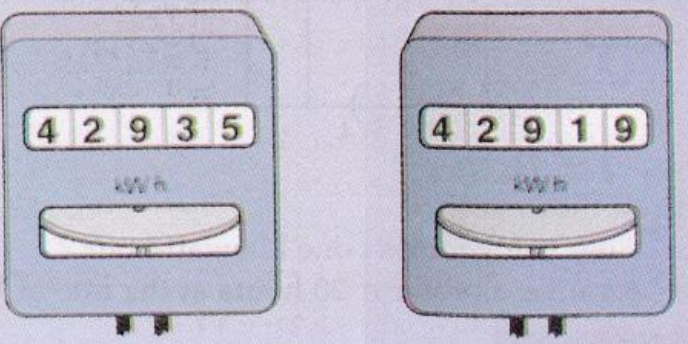
A boy noted the readings on his home’s electricity meter on Sunday at 8AM and again on Monday at 8AM (see figure below).
  1. What was the meter reading on Sunday?
  2. What was the meter reading on Monday?
  3. How many units of electricity have been used?
  4. In how much time these units have been used?
  5. If the rate is Rs. 5 per unit, what is the cost of electricity used during this time?
Answer
  1. 42919
  2. 42935
  3. 42935 - 42919 = 16 units
  4. 24 hours.
  5. Cost of 1 unit = Rs. 5
Cost of 16 units = 16 × 5 = Rs. 80
View full question & answer
Question 34 Marks
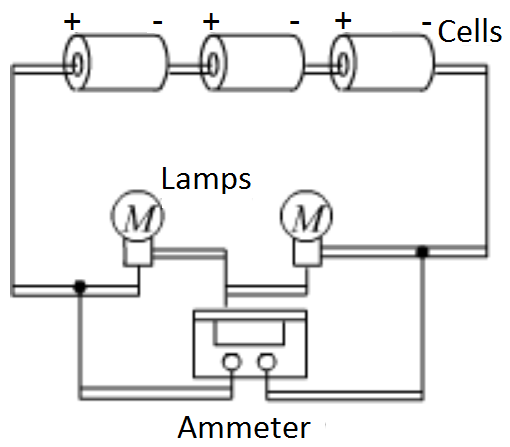
A student made an electric circuit shown here to measure the current through two lamps.
  1. Are the lamps in series or parallel?
  2. The student has made a mistake in this circuit. What is the mistake?
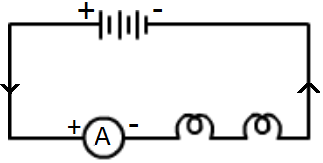
  3. Draw a circuit diagram to show the correct way to connect the circuit. Use the proper circuit symbols in your diagram.
Answer
  1. Lamps are in series.
  2. Student has connected ammeter in parallel with lamps. It should be connected in series.
View full question & answer
Question 44 Marks
Read the following and answer any three questions from (i) to (iv).The rate of flow of charge is called electric current. The SJ unit of electric current is Ampere (A). The direction of flow of current is always opposite to the direction of flow of electrons in the current. The electric potential is defined as the amount of work done in bringing a unit positive test charge from infinity to a point in the electric field. The amount of work done in bringing a unit positive test charge from one point to another point in an electric field is defined as potential difference.
$\text{V}_{\text{AB}}=\text{V}_{\text{B}}-\text{V}_\text{A}=\frac{\text{W}_{\text{BA}}}{\text{q}}$
The SJ unit of potential and potential difference is volt.
  1. The 2C of charge is flowing through a conductor in 100ms, the current in the circuit will?
     
  2. Define electric current? what is the SJ unit of electric current.
     
  3. The potential difference between the two terminals of battery, if 100 joules of work is required to transfer 20 coulombs of charge from one terminal of the battery to other will?
OR
  1. a) Then number of electrons flowing per second in a conductor if I A current is passing through it?
    b) The voltage can be written as.
Answer
  1. (a) 20 A
Explanation:

$\text{q} = 2\text{C}. \text{t} = 100\text{ms} = 0.1\text{s}$

$\text{l}=\frac{\text{q}}{\text{r}}=\frac{\text{2}}{\text{0.1}}=20\text{A}$
  1. (d) All of these.
  2. (b) -5V
Explanation:

$\text{W}= 100 \text{J}, \text{q} = 20\text{C}$

$\text{V}=\frac{\text{W}}{\text{q}}=\frac{\text{100}}{\text{20}}=5\text{V}$
  1. (c) $6.25 × 10^{18}$
Explanation:

$\text{I} = 1 \text{A}, \text{t} = 1 \text{s}$

$\text{q} = \text{It} = 1 \times 1 =1\text{C}$

$\text{n}=\frac{\text{q}}{\text{e}}=\frac{1}{1.6\times10^{-19}}=6.25\times10^{18}$
  1. (c) $\frac{\text{Work done}\times\text{time}}{\text{Current}}$
Explanation:

$\text{V}=\frac{\text{W}}{\text{q}}=\frac{\text{W}}{\text{lt}}$
View full question & answer
Question 54 Marks
Read the following and answer any three questions from (i) to (iv).The electrical energy consumed by an electrical appliance is given by the product of its power rating and the time for which it is used. The SI unit of electrical energy is Joule. Actually, Joule represents a very small quantity of energy, and therefore it is inconvenient to use where a large quantity of energy is involved. So for commercial purposes we use a bigger unit of electrical energy which is called kilowatt-hour. 1 kilowatt-hour is equal to $3.6 × 10^6$ joules of electrical energy.
  1. The energy dissipated by the heater is E. When the time of operating the heater is doubled, the energy dissipated will?
     
  2. The power of a lamp is 60W. The energy consumed in 1 minute will?
     
  3. The electrical refrigerator rated 400W operates 8 hours a day. The cost of electrical energy is ₹ 5 per kWh. Find the cost of running the refrigerator for one day?
    OR
  4. Calculate the energy transformed by a 5A current flowing through a resistor of $2\Omega$ for 30 minutes?
Answer
  1. (a) Doubled
Explanation:

$\text{E}\propto\text{t}$
  1. (c) 3600J
Explanation:

Given: P = 60W, t = 1min

E = 60 × 1 × 60 = 3600J
  1. (b) ₹ 16
Explanation:

Given: $\text{P}=400\Omega, \text{t}=8\text{ hour}$

E = 400 × 8 = 3200Wh = 3.2kWh.

Cost= 3.2 × 5 = ₹ 16
  1. (a) 90kJ
Explanation:

Given: I = 5A,

$\text{R}=2\Omega, \text{t}=30\text{ min}$

$E=I^2 R t=5 \times 5 \times 2 \times 30 \times 60$

E = 90000J = 90kJ
  1. (a) 1 watt hour = 3600J
Explanation:

1 watt hr = 3600J.
View full question & answer
Question 64 Marks
Read the following and answer any three questions from (i) to (iv).The obstruction offered by a conductor in the path of flow of current is called resistance. The SJ unit of resistance is ohm (Q). It has been found that the resistance of a conductor depends on the temperature of the conductor. As the temperature increases, the resistance also increases. But the resistance of alloys like mangnin, Constantin and nichrome is almost unaffected by temperature. The resistance of a conductor also depends on the length of conductor and the area of cross-section of the conductor. More be the length, more will be the resistance, more be the area of cross-section, lesser will be the resistance.
  1. Which is not will desired in material being used for making electrical wires?
     
  2. What is a resistance?
     
  3. Which resistance of alloys will unaffected by temperature?
    OR
  4. A wire of resistance $20\Omega$ is cut into 5 equal pieces. The resistance of each part will be?
Answer
  1. (b) High resistance.
Explanation:

The electrical wire should have low resistance.
  1. ii. (b) $T_A>T_B$
Explanation:

More is the temperature, more will be the resistance. The resistance of A is more, so temperature of A is more.
  1. (c) $R_2=4 R_1$
Explanation:

$\text{R}_1=\text{p}\frac{\text{L}}{\text{A}},\text{R}_2=\text{p}\frac{\text{2L}}{\text{A/ 2}}$
  1. (a) Resistance is higher in sununer.
Explanation:

In summers, temperature is more, so resistance is more.
  1. (a) $4\Omega$
Explanation:

$\text{R'}=\frac{\text{R}}{\text{5}}=\frac{\text{20}}{\text{5}}=4\Omega$
View full question & answer
Question 74 Marks
Read the following and answer any three questions from (i) to (iv).The heating effect of current is obtained by transformation of electrical energy in heat energy. Just as mechanical energy used to overcome friction is covered into heat, in the same way, electrical energy is converted into heat energy when an electric current flows through a resistance wire. The heat produced in a conductor, when a current flows through it is found to depend directly on (a) strength of current (b) resistance of the conductor (c) time for which the current flows. The mathematical expression is given by $\text{H} = \text{I}^2\text{Rt}.$
The electrical fuse, electrical heater, electric iron, electric geyser etc. all are based on the heating effect of current.
  1. What are the properties of heating element?
     
  2. What are the properties of electric fuse?
     
  3. When the current is doubled in a heating device and time is halved, the heat energy produced will be?
    OR
  4. A) A fuse wire melts at 5 A. It is is desired that the fuse wire of same material melt at 10 A. The new radius of the wire will be.

    B) When a current of 0.5A passes through a conductor for 5 min and the resistance of conductor is $10\Omega$ the amount of heat produced will be.
Answer
  1. (b) Low resistance, high melting point.
  2. (c) High resistance, low melting point.
  3. (a) Doubled.
Explanation:

Given: $\text{H} = \text{I}^2\text{Rt}.$

So, $\text{H}'=(21)^2.\frac{\text{R}}{2}\text{t}=\text{2H}$
  1. (b) 2times
Explanation:

Given: I = 5A, resistance = R. Let r be the new radius.

Now, $\text{H} = \text{I}^2\text{Rt}$ (i)

Also, $\text{H'} = \text{I}^2\text{R't}.$(ii)

From (i) and (ii), $5^2\times\text{p}\frac{\text{L}}{\pi\text{r}^2}\text{t}=10^2\times\text{p}\frac{\text{L}}{\pi\text{r'}^2}.\text{t}$

$\frac{25}{\text{r}^2}=\frac{100}{\text{r'}^2}\Rightarrow\frac{\text{r'}}{\text{r}}=\text{2r}$
  1. (c) 750J
Explanation:

Given: $\text{I} = 0.5 \text{A,} \text{R} =10\Omega,\text{t} = 5 \text{ min}$

$\text{H} = \text{I}^2\text{Rt}=0.5\times0.5\times10\times5\times60$

$\text{H} = 750\text{ J}$
View full question & answer
Question 84 Marks
Image

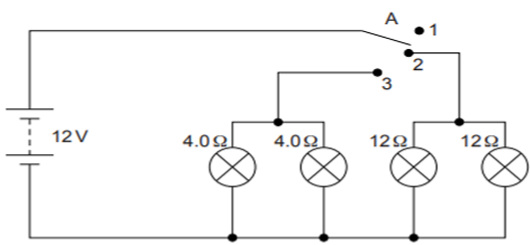
Vinita and Ahmed demonstrated a circuit that operates the two headlights and the two sidelights of a car, in their school exhibition. Based on their demonstrated circuit, answer the following questions.
(i) State what happens when switch $A$ is connected to
a) Position 2
b) Position 3
(ii) Find the potential difference across each lamp when lit.
(iii) Calculate the current
a) in each $12 \Omega$ lamp when lit.
b) In each $4 \Omega$ lamp when lit.
OR
(iv) Show, with calculations, which type of lamp, 4.0 Ω or 12 Ω, has the higher power.
Answer
(i) $12 \Omega$ lamps (only) on.
(a) $4 \Omega$ lamps (only) on
(ii) $12 V$ for both sets of lamps and all of them are in parallel.
(iii) $12 \Omega$ lamps are on when the wire is connected to position 2 .
Voltage across both $12 \Omega$ lamps $=12 V$.
$V = IR \text { (Ohm's law). }$
$I=\frac{V}{R}=\frac{12}{12}=1 A .$
$4 \Omega$ lamps are on when the wire is connected to position 3 .
Voltage across both $4 \Omega$ lamps $=12 V$.
$V = IR ( Ohm \text { 's law })$
$I=\frac{V}{R}=\frac{12}{4}=3 A .$
OR
$P = V ^2 / R$
All lamps are in parallel and hence same $V$ for all lamps.
For $4 \Omega$ lamps $\rightarrow P=\frac{12 \times 12}{4}=36 W$
For $12 \Omega$ lamps $\rightarrow P=\frac{12 \times 12}{12}=12 W$
Hence $4 \Omega$ lamps will have higher power.
View full question & answer
Question 94 Marks
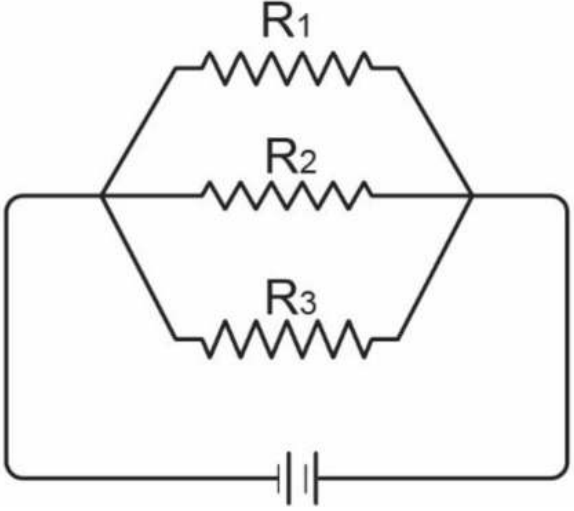
The same resistors are connected in a parallel combination in the circuit.

Image
10. What is the equivalent resistance of the circuit?
A. Less than 1 Ω
B. 1 Ω
C. 2 Ω
D. More than 2 Ω

Answer
10. A. less than 1 Ω
View full question & answer
Question 104 Marks
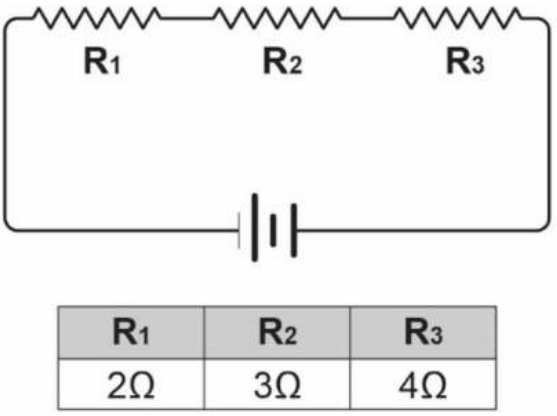
Leena creates an electric circuit with three resistors R1, R2 and R3.

Image
9. What is the equivalent resistance of the circuit?
A. 3 Ω
B. 4 Ω
C. 5 Ω
D. 9 Ω

Answer
9. D. 9 Ω
View full question & answer
Question 114 Marks
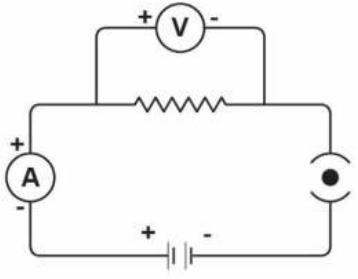
The picture shows an electric circuit.
Image
7. Which of these is true about the circuit?
Circle ‘Yes’ or ‘No’ for correct response.

Is this true for the circuit?

Yes or No

The circuit is open.

Yes/No

The circuit has double batteries.

Yes/No

The circuit has an ammeter and a voltmeter parallel to each other.

Yes/No

8. Will there be any change in the ammeter reading if the length of the wire in the circuit is doubled?
Explain your answer.

Answer
7. No
Yes
No
8. Mentions that the ammeter’s reading will be decreased by one-half.
View full question & answer
Question 124 Marks

Image
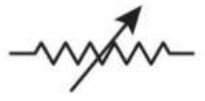
4. What does the symbol mean in an electric circuit?
A. Switch
B. Wire joint
C. Electric bulb
D. Variable resistance
5. A current of 1A lows through an electric bulb for 5 minutes.
What is the amount of electric charge that lows through the bulb?
Show your calculation.
6. Which of these decides the resistance of a wire?
Circle ‘Yes’ or ‘No’ for correct response.

Does this affect the resistance?

Yes or No

Length of the wire

Yes/No

Thickness of the wire

Yes/No

Material of the cover on the wire

Yes/No

Answer
4. D. Distance of the candle from the eyes
5. Time of electric current low, t = 5 min= 300 s
The total amount of electric charge that low within the time, Q = I × t = 1A × 300 s = 300 C
6. Mentions all three responses correctly.
● Yes/Yes/No
View full question & answer
Question 134 Marks
The table shows four different materials and their resistivity.

Material

Resistivity(Ω m)

Material 1

1.62 ×10⁻⁸

Material 2

100 ×10-6

Material 3

6.84 ×10⁻⁸

Material 4

44 ×10-6

1. Which material is the best conductor of electricity?
A. Material 1
B. Material 2
C. Material 3
D. Material 4
2. What is the SI unit of Resistivity?
3. Why is nichrome wire used in many electrical heating devices?
A. It has low resistivity and low melting point.
B. It has high resistivity and low melting point.
C. It has low resistivity and high melting point.
D. It has high resistivity and high melting point.

Answer
1. A. Material 1
2. Mentions ohm-meter (Ω m) as correct response.
3. D. It has high resistivity and high melting point.
View full question & answer
case /data -based (4 Marks) - Science STD 10 Questions - Vidyadip