Questions · Page 2 of 2

[2 Mark Questions]

Question 512 Marks
Will geographical isolation be a major factor in the speciation of a self-pollinating plant species? Why or why not?
Answer
No, because geographical barrier do not allow breeding between such individuals of a population which reproduce sexually. Moreover, asexually reproducing organism pass on the parental DNA to offspring which gives no chance of speciation.
View full question & answer
Question 522 Marks
Describe the phenomenon of homology.
Answer
Homology, in biology, similarity of the structure, physiology, or development of different species of organisms based upon their descent from a common evolutionary ancestor.
According to Darwin, more closely related species have evolved from a common ancestor. The characteristics and fundamentally similar structures suggest the possibility of a common ancestor.
Such a phenomenon of similarity of structures due to common ancestry is known as homology.
View full question & answer
Question 532 Marks
Parent pea plants were crossed for contrasting traits, i.e. round and wrinkled seeds. The progeny obtained in $F_1$ -generation is Rr, RR, Rr and rr. Which of these are dominant and recessive traits?
Answer
Tall plan (RR): dominant trait
Wrinkled seed (rr): recessive trait
From the above given progeny obtained in the $F_1$ generation:
1 RR: dominant
2 Rr: dominant
1 rr: recessive the ratio would be -1 : 2 : 1
View full question & answer
Question 542 Marks
Why are traits acquired during the life-time of an individual not inherited?
Answer
Any change in non-reproductive tissues cannot be passed on to the DNA of the germ cells. Therefore, the traits acquired during life-time on an individual are not inherited.
View full question & answer
Question 552 Marks
What is a monohybrid cross?
Answer
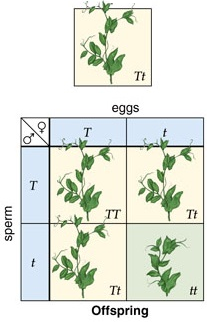
A monohybrid cross is a breeding experiment between P generation (parental generation) organisms that differ in a single given trait. The P generation organisms are homozygous for the given trait. However, each parent possesses different alleles for that particular trait. A Punnett square may be used to predict the possible genetic outcomes of a monohybrid cross based on probability. This type of genetic analysis can also be performed in a dihybrid cross, a genetic cross between parental generations that differ in two traits.
View full question & answer
Question 562 Marks
‘Older fossils are found closer to the surface of deep in the Earth strata?
Answer
Layer of fossils get deeper and deeper with the passing time like dinosaurs fossils were found deeper because they die a long time ago. so, fossils which are recent means not very old are present near the surface of earth because they didn't get time to get deeper. therefore this statement is correct Older fossils are found closer to the surface of deep in the Earth strata.
View full question & answer
Question 572 Marks
Give the contrasting traits of the following characters in pea plant and mention which is dominant and which is recessive:
  1. Yellow seed
  2. Round seed
Answer
  1. Green seed: Yellow is dominant: Green is recessive.
  2. Wrinkled seed: round is dominant: wrinkled is recessive.
View full question & answer
Question 582 Marks
Will geographical isolation be a major factor in the speciation of an organism that reproduces asexually? Give reason for your answer.
Answer
Geographical isolation cannot be a major factor in the speciation of an asexually reproducing organism because it does not require any other organism to carry out reproduction.
View full question & answer
Question 592 Marks
‘Non-living material must have given rise to life’. Describe with an example.
Answer
This can be proved with help of Miller and Urey experiment: They took a mixture of ammonia, hydrogen sulfide and and methane and water and provided it a temp. of just below 100 degree Celsius and exposed it to 25000 V electric sparks to resemble the lightning. After 8-10 days 15% of carbon from methane had been converted into organic compounds of sugars, organic acids etc. These had self-duplicating power. So basically life came from inanimate matter.
View full question & answer
Question 602 Marks
Can the wing of a butterfly and the wing of a bat be considered homologous organs? Why or why not?
Answer
The wing of a butterfly and the wing of a bat are similar in function. They help the butterfly and the bat in flying. Since they perform similar function, they are analogous organs and not homologous.
View full question & answer
Question 612 Marks
Gregor Mendel’s first law of genetics states “Of a pair of contrasted characters", only one can be represented in a gamete by its internal ‘factor’.
Answer
  1. Give the modern name for this ‘factor’.
  2. State where these factors are found in gametes.
View full question & answer
Question 622 Marks
Pure-bred pea plants A are crossed with pure-bred pea plants B. It is found that the plants which look like A do not appear in $F_1$ generation but re-emerge in $F_2$ generation. Which of the plants A and B are:
  1. tall.
  2. dwarf?
Give reason for your answer.
Answer
  1. Pea plants B are the tall ones. It is because these plants carry the trait for tallness, which is dominant.
  2. Pea plants A are dwarfs. It is because these plants carry the trait for dwarfism, which is recessive. A recessive trait remains hidden in $F_1$ generation but reappears in $F_2$ generation.
View full question & answer
Question 632 Marks
What kind of image is formed on a cinema screen?
Answer
A real image can be obtained on the screen. The real image is always inverted. The common example of real image is the image formed on the cinema screen. A virtual image is that image which is formed when the light rays coming from an object do not actually meet, but appear to meet when produced backwards.
View full question & answer
Question 642 Marks
Explain the terms ‘analogous organs’ and ‘homologous organs’ with examples.
Answer
Analogous Organs: Organs which performs similar function but are different in structure and origin.
Example: wings of a bird and wings of an insect.
Homologous Organ: Organs which have different functions but similar structure and origin.
Example: fore arm of frog, lizard, bird and human.
View full question & answer
Question 652 Marks
What do the following symbols used in the topic on heredity represent?
  1. TT
  2. tt
  3. XX
  4. XY
Answer
  1. Tall plant.
  2. Dwarf plant.
  3. Female.
  4. Male.
View full question & answer
Question 662 Marks
In what way are analogous organs evidence for evolution?
Answer
The presence of analogous organs indicates that even the organisms having organs with different structures can adapt to perform similar functions for their survival under hostile environmental conditions. Thus, the presence of analogous organs in different animals provide evidence for evolution by telling us that though they are not derived from common ancestors, they can still evolve to perform similar functions to survive, flourish and keep on evolving in the prevailing environment.
View full question & answer
Question 672 Marks
Give examples of analogous organs.
Answer
Analogous structures are structures, such as organs or parts of a plant or animal, that are very similar in two completely unrelated organisms. They occur when the organisms evolve under similar conditions.
Such as penguins and seals both having flippers because they evolved to swim.
View full question & answer
Question 682 Marks
A man with blood group A marries a woman with blood group O and their daughter has blood group O. Is this information enough to tell you which of the traits-blood group A or O is dominant? Why?
Answer
The give information is not enough to tell us which of the traits - blood group A or O - is dominant. In blood heredity, blood Type A is always dominant and blood Type O is always recessive.
Here, father’s Blood group can be AA (homozygous) or AO (heterozygous) genotypic ally, where as that of mother can be OA or OO. For daughter to be born with blood group O, she must receive O type gene one each from father and mother. For this father must have heterozygous AO blood group and mother must have homozygous blood group OO.
View full question & answer