Questions · Page 2 of 4

M.C.Q

MCQ 511 Mark
The organism having parasitic mode of nutrition is :
  • A
    Penicillium.
  • Plasmodium.
  • C
    Paramecium.
  • D
    Parrot.
Answer
Correct option: B.
Plasmodium.
Plasmodium is a microbial parasite that has a parasitic mode of nutrition.
View full question & answer
MCQ 521 Mark
Internal respiration may be defined as :
  • A
    Breathing in and releasing of oxygen in the tissue.
  • The oxidation of food substances to release energy.
  • C
    The building up $($synthesis$)$ of complex substances.
  • D
    Getting rid of carbon dixode that would accumulate in the tissues.
Answer
Correct option: B.
The oxidation of food substances to release energy.
Internal respiration may be defined as the oxidation of food substances to release energy.
View full question & answer
MCQ 531 Mark
One of the following is not a constituent of blood. This one is :
  • A
    Red blood cells.
  • B
    White blood cells.
  • Sieve plates.
  • D
    Platelets.
Answer
Correct option: C.
Sieve plates.
Sieve plates do not constitute blood. They are a part of phloem.
View full question & answer
MCQ 541 Mark
The breathing and respiration in woody stem of a plant takes place through :
  • A
    Root hair.
  • Lenticels.
  • C
    Closed stomata.
  • D
    Open stomata.
Answer
Correct option: B.
Lenticels.
In woody stems, the bark $($outer covering of the stem$)$ has lenticels for gaseous exchange.
View full question & answer
MCQ 551 Mark
The internal $($cellular$)$ energy reserve in autotrophs is :
  • A
    Glycogen.
  • B
    Protein.
  • Starch.
  • D
    Fatty acid.
Answer
Correct option: C.
Starch.
Autotrophs are the organisms that use light as source of energy, carbon dioxide as chief carbon source and water as electron donor to fix the atmospheric carbon dioxide into organic compounds $($carbohydrates$)$. The main photosynthetic pigment chlorophyll a and accessory pigments chl $b,$ chl $c$ and carotenoids etc trap the Sunlight to carry out the light reactions of photosynthesis. The light reaction of photosynthesis produces $\text{ATP}$ and reducing agents which in turn serve as energy source to drive the second phase of photosynthesis $($dark reactions$)$ during which carbohydrate synthesis takes place.
The carbohydrates which are not immediately consumed by plants are stored as starch $($homopolysaccharide of $D-$ glucose$).$
Glycogen serves as main stored form of carbohydrates in animals.
View full question & answer
MCQ 561 Mark
Which is the first enzyme to mix with food in the digestive tract?
  • A
    Pepsin.
  • B
    Cellulase.
  • Amylase.
  • D
    Trypsin.
Answer
Correct option: C.
Amylase.
Chemical digestion of food starts in the mouth. Digestion of starch by salivary amylase takes place in mouth. Oesophagus serves to push the food into stomach only. $\ce{NO}$ digestion takes place here. Gastric juice of stomach digests the protein part of food. Pancreatic amylase, trypsin and lipase as well as intestinal peptidases and maltase carry out chemical digestion of food in small intestine. The simpler substances formed by chemical digestion are then absorbed small intestinal villi. Large intestine is the organ of water and salts reabsorption from undigested food and elimination of remaining undigested material out of body.
View full question & answer
MCQ 571 Mark
Which of the following organisms is ammonotelic?
  • Birds.
  • B
    Humans.
  • C
    Reptiles.
  • D
    Aquatic animals.
Answer
Correct option: A.
Birds.
An ammonotelic organism excretes nitrogenous waste as soluble ammonia. Most of the aquatic animals including protozoans, crustaceans,
platyhelminths, cnidarians, poriferans, echinoderms, fishes, larvae tadpoles of amphibians are ammonotelic.
View full question & answer
MCQ 581 Mark
Which part of alimentary canal receives bile from the liver?
  • A
    Oesophagus.
  • Small intestine.
  • C
    Stomach.
  • D
    Large intestine.
Answer
Correct option: B.
Small intestine.
Small intestine receives bile from the liver, which is temporarily stored in the gall bladder.
View full question & answer
MCQ 591 Mark
One of the following animals does not use tracheae as the respiratory organs. This animal is :
  • A
    Grasshopper.
  • Prawn.
  • C
    Mosquito.
  • D
    Cockroach.
Answer
Correct option: B.
Prawn.
Prawn is an aquatic animal that respires through gills. Insects such as grasshopper, mosquito and cockroach respire through tracheae.
View full question & answer
MCQ 601 Mark
Which of the following has no muscular walls?
  • A
    Artery.
  • B
    Vein.
  • C
    Arteriole.
  • Capillary.
Answer
Correct option: D.
Capillary.
Capillaries are very narrow tubes about $8$ micrometers in diameter. It has no muscle.
View full question & answer
MCQ 611 Mark
Which of the following has a three $-$ chambered heart?
  • A
    Pigeon.
  • Lizard.
  • C
    Fish.
  • D
    Lion.
Answer
Correct option: B.
Lizard.
Lizard is a reptile and it has a three $-$ chambered heart. Birds $($e.g. Pigeon$)$ and mammals $($e.g. lion$)$ have a four $-$ chambered heart, while Pisces $($e.g. fish$)$ have a two $-$ chambered heart.
View full question & answer
MCQ 621 Mark
Which of the following is the first site for the exachange of inhaled air?
  • A
    Blood capillaries of lungs.
  • Alveoli of lungs.
  • C
    Blood capillaries adjacent to body cells.
  • D
    Left auricle of the heart.
Answer
Correct option: B.
Alveoli of lungs.
Alveolar macrophages are the primary phagocytes of the innate immune system, clearing the air spaces of infectious, toxic, or allergic particles that have evaded the mechanical defenses of the respiratory tract, such as the nasal passages, the glottis, and the mucociliary transport system.
View full question & answer
MCQ 631 Mark
Which of the following is the correct sequence of parts as they occur in the human alimentary canal?
  • A
    Mouth $\rightarrow $ Stomach $\rightarrow $ Small intestine $\rightarrow $ Oesophagus $\rightarrow $ Large intestine.
  • B
    Mouth $\rightarrow $ Oesophagus $\rightarrow $ Stomach $\rightarrow $ Large intestine $\rightarrow $ Small intestine.
  • C
    Mouth $\rightarrow $ Stomach $\rightarrow $ Oesophagus $\rightarrow $ Small intestine $\rightarrow $ Large intestine.
  • Mouth $\rightarrow $ Oesophagus $\rightarrow $ Stomach $\rightarrow $ Small intestine $\rightarrow $ Large intestine.
Answer
Correct option: D.
Mouth $\rightarrow $ Oesophagus $\rightarrow $ Stomach $\rightarrow $ Small intestine $\rightarrow $ Large intestine.
The correct sequence of the parts as they occur in the human alimentary canal is given below.
Mouth $\rightarrow $ Oesophagus $\rightarrow $ Stomach $\rightarrow $ Small intestine $\rightarrow $ Large intestine.
View full question & answer
MCQ 641 Mark
Lack of oxygen in muscles often leads to cramps among cricketers. This results due to :
  • A
    Conversion of pyruvate to ethanol.
  • B
    Conversion of pyruvate to glucose.
  • C
    Non conversion of glucose to pyruvate.
  • Conversion of pyruvate to lactic acid.
Answer
Correct option: D.
Conversion of pyruvate to lactic acid.
Respiration is the sole source of energy in muscles. During intense physical activity, limited oxygen supply do not support the aerobic respiration and muscles carry out lactic acid fermentation of pyruvate to meet the energy demand.
View full question & answer
MCQ 651 Mark
When air is blown from mouth into a test $-$ tube containing lime water, the lime water turns milky due to the presence of :
  • A
    Oxygen.
  • Carbon $-$ dioxide.
  • C
    Nitrogen.
  • D
    Water vapour.
Answer
Correct option: B.
Carbon $-$ dioxide.
Lime water turns milky due to the presence of carbon $-$ dioxide in the exhaled air.
View full question & answer
MCQ 661 Mark
Which of the following is an incorrect statement?
  • A
    Energy is essential for life processes.
  • B
    Organisms grow with time.
  • Movement of molecules does not take place among cells.
  • D
    Organisms must repair and maintain their body.
Answer
Correct option: C.
Movement of molecules does not take place among cells.
Movement of molecules takes place among cells.
View full question & answer
MCQ 671 Mark
If a patient is out on dialysis, he is most likely suffering from a severe ailment of the :
  • A
    Circulatory system.
  • B
    Respiratory system.
  • Excretory system.
  • D
    Digestive system.
Answer
Correct option: C.
Excretory system.
Dialysis is the process of removing wastes using an artificial kidney.
Hence, if a patient is out on dialysis, he is most likely suffering from a severe ailment of excretory system. It is because kidneys are a part of human excretory system and in case of kidney failure, to remove the accumulated wastes from the body, blood is filtered periodically through an artificial kidney.
View full question & answer
MCQ 681 Mark
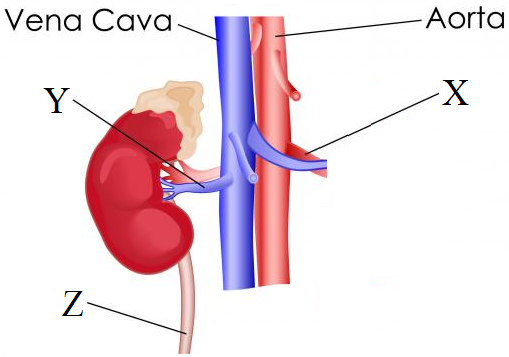
In the figure given below the structures associated with human kidneys are marked $(X,Y$ and $Z)$. The relative concentrations of urea in these structure is.
  • A
    $X$ is sometimes higher than $Y.$
  • B
    $Y$ is always higher than $Z.$
  • $Y$ is always lower than $Z.$
  • D
    $Z$ is sometimes lower than $X.$
Answer
Correct option: C.
$Y$ is always lower than $Z.$
The structures are labeled as :
$X –$ Renal vein
$Y –$ Renal artery
$Z - $ Ureter
The renal artery $(Y)$ carries oxygenated blood to the kidneys from the heart. This blood contains negligible amounts of waste products $($such as urea$).$ On the other hand, the ureters $(Z)$ transport urine from the kidneys to the urinary bladder. The urine contains comparatively high amounts of urea to be excreted out. Thus, the relative concentration of urea in $Y$ is always lower than that in $Z.$
View full question & answer
MCQ 691 Mark
Single circulation i.e., blood flows through the heart only once during one cycle of passage through the body, is exhibited by :
  • A
    Labeo, Chameleon, Salamander.
  • Hippocampus, Exocoetus, Anabas.
  • C
    Hyla, Rana, Draco.
  • D
    Whale, Dolphin, Turtle.
Answer
Correct option: B.
Hippocampus, Exocoetus, Anabas.
The examples and the relation of animal group and heart are as,
Fishes have two chambered heart and exhibit single circulation while three chambered heart of amphibian and reptiles and four chambered heart of birds and mammals exhibit double circulation. In given options $,C$ includes all fishes which makes it correct answer.
View full question & answer
MCQ 701 Mark
The process of carrying food from the leaves to other parts of a plant is called :
  • A
    Transpiration.
  • B
    Transportation.
  • Translocation.
  • D
    Transformation.
Answer
Correct option: C.
Translocation.
The process of carrying food from the leaves to other parts of a plant is called translocation.
View full question & answer
MCQ 711 Mark
Which of the following contributes most to the transport of water from the ground to the leaves of a tall tree?
  • A
    Root pressure.
  • B
    Capillary rise of water in xylem.
  • C
    Breakdown of $\text{ATP}.$
  • Cohesion of water and transpiration pull.
Answer
Correct option: D.
Cohesion of water and transpiration pull.
Transpiration is the loss of water from the plant through evaporation at the leaf surface. It is the main driver of water movement in the xylem. it creates negative pressure $($tension$).$ Water from the roots is pulled up by this tension. The water is held in the stem and leaf by the cohesion of water molecules to each other as well as the adhesion of water to the cell walls of the xylem vessels and tracheids. This is called the cohesion $-$ tension theory of sap ascent
View full question & answer
MCQ 721 Mark
The mechanism of human body which facilitates the exchange of respiratory gases is called.
  • A
    Exhalation.
  • Breathing.
  • C
    Circulation.
  • D
    All of these.
Answer
Correct option: B.
Breathing.
This is movement of air into and out of the lungs. Breathing supplies oxygen to the alveoli, and eliminates carbon dioxide.
The main muscles involved in breathing are the intercostal muscles and the diaphragm.
View full question & answer
MCQ 731 Mark
How does the exchange of gases occur in roots of a plant?
  • A
    Through lenticels.
  • B
    Through root stomata.
  • Through root hairs.
  • D
    None of these.
Answer
Correct option: C.
Through root hairs.
The exchange of gases in roots of a plant takes place by the process of diffusion.
The exchange of gases is mostly done with the help of stomata. Plant breath in through stomata present in their bodies.
View full question & answer
MCQ 741 Mark
Which vein brings clean blood from the lungs into the heart?
  • A
    Renal vein.
  • Pulmonary vein.
  • C
    Vena cava.
  • D
    Hepatic vein.
Answer
Correct option: B.
Pulmonary vein.
Pulmonary vein carries oxygenated blood $($clean blood$)$ from the lungs into the heart.
View full question & answer
MCQ 751 Mark
Which of the following is most appropriate for aerobic respiration?
  • A
    $\text{Glucose}\xrightarrow{\ \text{mitochondria}\ }\text{Pyruvate}\xrightarrow{\ \text{cytoplasm}\ }\text{CO}_2+\text{H}_2\text{O}+\text{Energy}$
  • $\text{Glucose}\xrightarrow{\ \text{cytoplasm}\ }\text{Pyruvate}\xrightarrow{\ \text{mitochondria}\ }\text{CO}_2+\text{H}_2\text{O}+\text{Energy}$
  • C
    $\text{Glucose}\xrightarrow{\ \text{cytoplasm}\ }\text{Pyruvate}+\text{Energy}\xrightarrow{\ \text{mitochondria}\ }\text{CO}_2+\text{H}_2\text{O}$
  • D
    $\text{Glucose}\xrightarrow{\ \text{cytoplasm}\ }\text{Pyruvate}+\text{Energy}\xrightarrow{\ \text{mitochondria}\ }\text{CO}_2+\text{H}_2\text{O}+\text{Energy}$
Answer
Correct option: B.
$\text{Glucose}\xrightarrow{\ \text{cytoplasm}\ }\text{Pyruvate}\xrightarrow{\ \text{mitochondria}\ }\text{CO}_2+\text{H}_2\text{O}+\text{Energy}$
Aerobic respiration is complete breakdown of glucose into carbon dioxide and water with release of large amount of energy. It occurs in three steps, glycolysis, citric acid cycle and $\text{ETC}$. Glycolysis is breakdown of glucose into pyruvate. It is oxygen independent pathway that occurs in cytoplasm. Aerobic respiration takes place in the mitochondria, using the pyruvate produced via glycolysis. It produces large amounts of energy in t he form of $\text{ATP}$ along with carbon dioxide gas and water.
View full question & answer
MCQ 761 Mark
The blood leaving the tissues becomes richer in :
  • Carbon dioxide.
  • B
    Water.
  • C
    Heamoglobin.
  • D
    Oxygen.
Answer
Correct option: A.
Carbon dioxide.
The left ventricle pumps blood into the aorta which in turn branches and delivers oxygenated blood to the major body regions and organs. The oxygen is consumed in cellular respiration and the carbon dioxide produced during respiration enters into blood.
The anterior vena cava collects deoxygenated blood from the head, chest, and arms and enters the right atrium while the inferior vena cava collects blood from the lower body regions. Both venae cavae pass the deoxygenated blood to the right atrium. Thus, blood from tissues is rich in carbon dioxide.
Deoxygenated blood from right atrium enters right ventricle and pulmonary arteries carry deoxygenated blood from right ventricle to lungs for oxygenation.
View full question & answer
MCQ 771 Mark
When air is blown from mouth into a test $-$ tube containing lime water, the lime water turned milky due to the presence of :
  • A
    Oxygen.
  • Carbon dioxide.
  • C
    Nitrogen.
  • D
    Water vapour.
Answer
Correct option: B.
Carbon dioxide.
Carbon dioxide gas turns lime water milky. Since the exhaled air is carbon dioxide rich, when air is blown from mouth into test tube, the lime water turned milky.
View full question & answer
MCQ 781 Mark
Which part of alimentary canal receives bile from the liver?
  • A
    Stomach.
  • Small intestine.
  • C
    Large intestine.
  • D
    Oesophagus.
Answer
Correct option: B.
Small intestine.
Bile is secreted by liver and is stored in gall bladder from where it enters the small intestine via common duct.
View full question & answer
MCQ 791 Mark
The xylem in plants are responsible for :
  • Transport of water
  • B
    Transport of food
  • C
    Transport of amino acids
  • D
    Transport of oxygen.
Answer
Correct option: A.
Transport of water
View full question & answer
MCQ 801 Mark
Blood is pumped from the heart to the entire body by the :
  • A
    Lungs.
  • Ventricles.
  • C
    Atria.
  • D
    Nerves.
Answer
Correct option: B.
Ventricles.
Ventricles pump oxygenated blood from the heart to the entire body.
View full question & answer
MCQ 811 Mark
The substance which is not reabsorbed into the blood capillaries surrounding the tuble of a nephron is mainly :
  • A
    Glucose.
  • B
    Amino acid.
  • Urea.
  • D
    Water.
Answer
Correct option: C.
Urea.
Urea is not reabsorbed into the blood capillaries that surround the tubule of a nephron.
However, glucose, amino acid and water are reabsorbed.
View full question & answer
MCQ 821 Mark
In one of the following organisms, the gaseous exchange during repiration does not take place through cell membrane/ skin. This organism is :
  • Electric eel
  • B
    Leech
  • C
    Earthworm
  • D
    Amoeba.
Answer
Correct option: A.
Electric eel
Electric eel respires through gills. Leech and earthworm respire through their skin.
View full question & answer
MCQ 831 Mark
In autotrophs, water is transported through :
  • A
    Root hair.
  • B
    Phloem.
  • C
    Stomata.
  • Xylem.
Answer
Correct option: D.
Xylem.
Xylem transports water and minerals from the soil via the roots to the rest of the plant body.
View full question & answer
Question 841 Mark
Which substances will be present in the glomerular filterate from the kidneys of a mammal?
Glucose Protein Salts
(a) $\checkmark$ $\checkmark$ $\times$
(b) $\times$ $\checkmark$ $\checkmark$
(c) $\checkmark$ $\times$ $\checkmark$
(d) $\times$ $\times$ $\checkmark$
Key $\checkmark$ = present, $\times$ = absent
Answer
Glucose Protein Salts
(c) $\checkmark$ $\times$ $\checkmark$
Explanation:
Urine also contains many salts and glucose. Red blood cells and sugar are not normally found in urine but may indicate glomerulus injury and diabetes mellitus respectively.
View full question & answer
MCQ 851 Mark
The opening and closing of stomata is regulated by :
  • Turgidity of guard cells.
  • B
    Availability of solar radiations.
  • C
    Biological clock of plants.
  • D
    Concentration of atmospheric $\mathrm{CO}_2$.
Answer
Correct option: A.
Turgidity of guard cells.
Stomatal pores in plants regulate the amount of water and solutes within them by opening and closing their guard cells using osmotic pressure. In order for plants to produce energy and maintain cellular function, their cells undergo the highly intricate process of photosynthesis. Critical in this process is the stoma.
View full question & answer
MCQ 861 Mark
Which blood vessel does not carry any carbon $-$ dioxide?
  • A
    Pulmonary artery.
  • B
    Vena cava.
  • C
    Hepatic vein.
  • Pulmonary vein.
Answer
Correct option: D.
Pulmonary vein.
Pulmonary vein carries the oxygen rich blood from the lungs to the heart.
View full question & answer
MCQ 871 Mark
The kidneys in human beings are a part of the system for :
  • A
    Nutrition
  • B
    Respiration
  • Excretion
  • D
    Transportation.
Answer
Correct option: C.
Excretion
View full question & answer
MCQ 881 Mark
The first enzyme to mix with food in the digestive tract is :
  • A
    Pepsin.
  • B
    Cellulose.
  • Amylase.
  • D
    Trypsin.
Answer
Correct option: C.
Amylase.
The digestion of food begins in the mouth by the action of salivary amylase.
View full question & answer
MCQ 891 Mark
What prevents backflow of blood inside the heart during contraction?
  • Valves in heart.
  • B
    Thick muscular walls of ventricles.
  • C
    Thin walls of atria.
  • D
    Inner lining of the heart.
Answer
Correct option: A.
Valves in heart.
Valves ensure that blood does not flow backwards when the atria or ventricles contract. Semilunar valves, the valves present between ventricles and their attached vessels, serve to prevent the backflow of blood to ventricles from their respective attached vessels. Likewise, atrioventricular $\ce{(AV)}$ valve between atrium and ventricle directs the flow of blood and prevents any backflow into atria.
View full question & answer
MCQ 901 Mark
Which of the following is not produced during anaerobic respiration in unicellular fungus?
  • A
    $\mathrm{C}_2 \mathrm{H}_5 \mathrm{OH}$
  • $\mathrm{H}_2 \mathrm{O}$
  • C
    $\mathrm{CO}_2$
  • D
    $\ce{ATP}.$
Answer
Correct option: B.
$\mathrm{H}_2 \mathrm{O}$
Anaerobic respiration occurs in absence of oxygen. One molecule of glucose breaks down to release two molecules of ethanol, two molecules of carbon $-$ dioxide and two $\ce{ATP}$ molecules.
View full question & answer
MCQ 911 Mark
The filtration units of kidneys are called :
  • A
    Ureter.
  • B
    Urethra.
  • C
    Neurons.
  • Nephrons.
Answer
Correct option: D.
Nephrons.
Due to this, nephron is called the functional unit of Kidney.
View full question & answer
MCQ 921 Mark
The autotrophic mode of nutrition requires :
  • A
    Carbon $-$ dioxide and water.
  • B
    Chlorophy $\ce{ll}.$
  • C
    Sunlight.
  • All of the above.
Answer
Correct option: D.
All of the above.
In autotrophic mode of nutrition, green plants that have chlorophy ll, make food from carbon $-$ dioxide and water in the presence of sunlight.
View full question & answer
MCQ 931 Mark
Choose the correct path of urine in our body :
  • A
    Kidney $\rightarrow $ ureter $\rightarrow $ urethra $\rightarrow $ urinary bladder.
  • B
    Kidney $\rightarrow $ urinary bladder $\rightarrow $ urethra $\rightarrow $ ureter.
  • Kidney $\rightarrow $ ureters $\rightarrow $ urinary bladder $\rightarrow $ urethra.
  • D
    Urinary bladder $\rightarrow $ kidney $\rightarrow $ ureter $\rightarrow $ urethra.
Answer
Correct option: C.
Kidney $\rightarrow $ ureters $\rightarrow $ urinary bladder $\rightarrow $ urethra.
The correct path of urine is kidney $-4$ Ureters $-4$ Urinary bladder Urethra.
Kidneys are the paired organ where urine formation takes place. Small muscular tube, called as ureter, extend from kidneys and carry blood to urinary bladder. The urethra is a small tube that extends from the urinary bladder to an external opening. Hence, option $C$ is the correct sequence.
View full question & answer
MCQ 941 Mark
Which of the following is an incorrect statement?
  • A
    Organisms grow with time.
  • B
    Organisms must repair and maintain their structure.
  • Movement of molecules does not take place among cells.
  • D
    Energy is essential for life processes.
Answer
Correct option: C.
Movement of molecules does not take place among cells.
Movement of molecules is an important aspect of life process and it is necessary that such movements take place among cells.
View full question & answer
MCQ 951 Mark
In human digestive system, bile is secreted by :
  • A
    Pancreas.
  • Liver.
  • C
    Kidneys.
  • D
    Stomach.
Answer
Correct option: B.
Liver.
Liver secretes the greenish yellow liquid called bile.
View full question & answer
MCQ 961 Mark
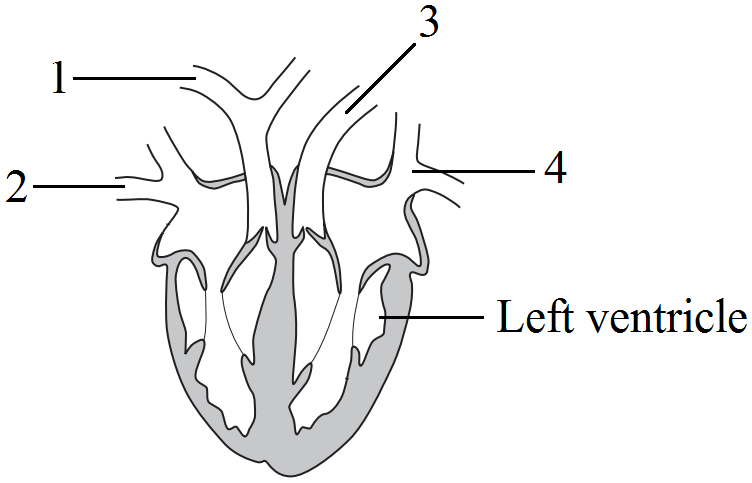
The diagram shows a vertical section through the heart. What are the functions of the numbered blood vessels?
Carries blood to body Carries blood to lungs Carries blood from lungs Carries blood from body
$(a)$ $1$ $2$ $3$ $4$
$(b)$ $1$ $3$ $4$ $2$
$(c)$ $2$ $4$ $3$ $1$
$(d)$ $3$ $1$ $4$ $2$
  • A
    $(a)$
  • B
    $(b)$
  • C
    $(c)$
  • $(d)$
Answer
Correct option: D.
$(d)$
  1. Pulmonary artery.
  2. Vena cava.
  3. Aorta.
  4. Pulmonary vein.
View full question & answer
MCQ 971 Mark
Which one of the following has cytoplasm but no nucleus :
  • A
    Xylem vessel.
  • Sieve, which has tube.
  • C
    Tracheid.
  • D
    Companion cell.
Answer
Correct option: B.
Sieve, which has tube.
Sieve tube, which forms the phloem, are living cells containing cytoplasm but no nucleus.
View full question & answer
MCQ 981 Mark
The breakdown of pyruvate to give carbon dioxide, water and energy takes place in :
  • A
    Cytoplasm
  • Mitochondria
  • C
    Chloroplast
  • D
    Nucleus.
Answer
Correct option: B.
Mitochondria
View full question & answer
MCQ 991 Mark
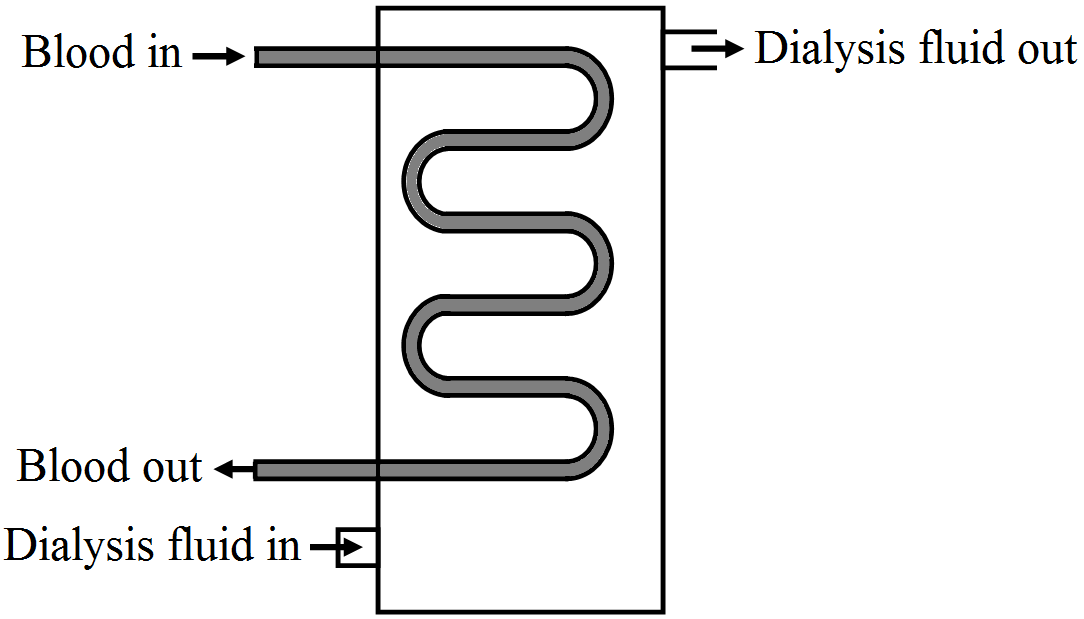
The figure given below is representing the dialysis machine for removing nitrogenous wastes in patient with a kidney failure.

Which substances out of the following in the dialysis fluid should be at a lower concentration than in the blood of patient?
  • A
    Glucose and urea.
  • B
    Glucose and amino acids.
  • Salts and urea.
  • D
    Glucose and salts
Answer
Correct option: C.
Salts and urea.
View full question & answer
MCQ 1001 Mark
Which of the following is are the respiratory organs of the plant?
  • A
    Lenticels.
  • B
    Hydathodes.
  • C
    Stomata.
  • Both $(a)$ and $(c).$
Answer
Correct option: D.
Both $(a)$ and $(c).$
Lenticels and Stomata are the respiratory organs of the plant.
View full question & answer
M.C.Q - Page 2 - Science STD 10 Questions - Vidyadip