Questions · Page 3 of 4

M.C.Q

MCQ 1011 Mark
Lack of oxygen in muscles often leads to cramps in the legs of sprinters. This is due to conversion of pyruvate to :
  • A
    Ethanol.
  • B
    Carbon $-$ dioxide.
  • C
    Acetic acid.
  • Lactic acid.
Answer
Correct option: D.
Lactic acid.
Lack of oxygen in muscles causes accumulation of lactic acid, due to anaerobic respiration.
Accumulation of lactic acid leads to cramps in the legs of sprinters.
View full question & answer
MCQ 1021 Mark
The correct order of steps occurring in nutrition in animals is :
  • A
    Ingestion $\rightarrow $ Absorption $\rightarrow $ Digestion $\rightarrow $ Assimilation $\rightarrow $ Egestion.
  • B
    Ingestion $\rightarrow $ Digestion $\rightarrow $ Assimilation $\rightarrow $ Absorption $\rightarrow $ Egestion.
  • Ingestion $\rightarrow $ Digestion $\rightarrow $ Absorption $\rightarrow $ Assimilation $\rightarrow $ Egestion.
  • D
    Ingestion $\rightarrow $ Assimilation $\rightarrow $ Digestion $\rightarrow $ Absorption $\rightarrow $ Egestion.
Answer
Correct option: C.
Ingestion $\rightarrow $ Digestion $\rightarrow $ Absorption $\rightarrow $ Assimilation $\rightarrow $ Egestion.
The food is ingested through the mouth. It is then digested in the mouth, the stomach and the small intestine.
Then, it is absorbed and assimilated in the small intestine, the reabsorption of water takes place in the large intestine and the undigested waste is egested through the anus.
View full question & answer
MCQ 1031 Mark
The following changes take place in an athlete’s body during a $100m$ race. Which change occurs first?
  • A
    Increased availability of oxygen to muscles.
  • B
    Increased breathing rate.
  • C
    Increased carbon dioxide concentration in the blood.
  • Increased production of carbon dioxide by muscles.
Answer
Correct option: D.
Increased production of carbon dioxide by muscles.
View full question & answer
MCQ 1041 Mark
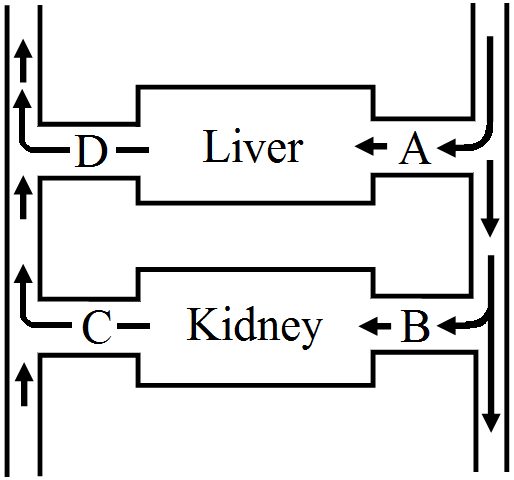
The diagram given below represents the liver, kidney and some associated blood vessels. Identify the vessel from the labelled parts $A - D$ in which the blood will contain the lowest concentration of urea?
  • A
    $A$
  • B
    $B$
  • $C$
  • D
    $D$
Answer
Correct option: C.
$C$
The urea is formed by the urea $-$ cycle in the liver, and not in the kidneys. The blood vessel coming out from the kidney will contain the lowest concentration of urea $($although kidneys contain only a small amount of urea to maintain osmolarity$)$. And the blood vessel coming out from the liver will contain the highest concentration of urea.
View full question & answer
MCQ 1051 Mark
Which cell structure is involved in the process of formation of glucose?
  • A
    Golgi body.
  • Mitochondria.
  • C
    Endoplasmic reticulum.
  • D
    Plastids.
Answer
Correct option: B.
Mitochondria.
Mitochondria is cell structure is involved in the process of formation of glucose.
View full question & answer
MCQ 1061 Mark
Which of the following is known as the energy currency of the cells in biology?
  • A
    $\text{DTP}.$
  • B
    $\text{PDP}.$
  • $\text{ATP}.$
  • D
    $\text{DDT}.$
Answer
Correct option: C.
$\text{ATP}.$
In biology $,\text{ATP}$ is known as the energy currency of a cell. It is a high energy molecule that stores the energy.
View full question & answer
MCQ 1071 Mark
Which one of the following does not have valves?
  • A
    Heart.
  • B
    Arteries.
  • Capillaries.
  • D
    Veins.
Answer
Correct option: C.
Capillaries.
Capillaries do not have valves, while heart, arteries and veins have valves to prevent the back $-$ flow of blood.
View full question & answer
MCQ 1081 Mark
Select the correct statement :
  • Heterotrophs do not synthesise their own food.
  • B
    Heterotrophs utilise solar energy for photosynthesis.
  • C
    Heterotrophs synthesise their own food.
  • D
    Heterotrophs are capable of converting carbon dioxide and water into carbohydrates.
Answer
Correct option: A.
Heterotrophs do not synthesise their own food.
Heterotrophs are the organisms that cannot synthesize their own food and depend on available organic/ inorganic compounds to fulfil their energy requirements.
Examples : All animals.
View full question & answer
MCQ 1091 Mark
Chloroplasts are the site of photosynthesis because.
  • A
    They contain carotenoids.
  • B
    They contain xanthophylls.
  • They contain chlorophyll.
  • D
    They fix atmospheric carbon dioxide.
Answer
Correct option: C.
They contain chlorophyll.
Essentially, the chloroplast is an independent fully functional organelle. Although all the green parts of a plant can carry outphotosynthesis, it mainly occurs in the leaves due to the high abundance of chloroplasts. A chloroplast contains stroma, fluid, and stack of thylakoids called grana.
View full question & answer
MCQ 1101 Mark
What may happen if a young plant is dug up and re $-$ planted in another place?
  • A
    The leaves loss less water.
  • B
    The roots cannot take up mineral salts.
  • C
    The stem cannot transport water.
  • The surface area of the root is reduced.
Answer
Correct option: D.
The surface area of the root is reduced.
View full question & answer
MCQ 1111 Mark
In humans, carbon dioxide that is excreted passes from the blood directly into the :
  • A
    Trachea.
  • B
    Kidneys.
  • Alveoli.
  • D
    Liver.
Answer
Correct option: C.
Alveoli.
Alveoli are an important part of the respiratory system whose function it is to exchange oxygen and carbon dioxide molecules to and from the bloodstream.
View full question & answer
MCQ 1121 Mark
A healthy woman consumes a litre of water at once.
  1. How will be the internal environment of her body affected by this?
  2. A corrective measure to bring the arising condition to normal state is?
Select the correct option for $(i)$ and $(ii)$ from those given below.​​​​​​​
$(i)$ $(ii)$
$(a)$ Plasma becomes diluted Concentration of the urine formed.
$(b)$ Osmotic pressure of the plasma decreases Increase in the volume of urine formed.
$(c)$ The body cells undergoes shrinkage Less water is reabsorbed by the kidneys.
$(d)$ Osomotic pressure of the plasma increases Formation of dilute urine occure.
  • A
    $(a)$
  • B
    $(b)$
  • $(c)$
  • D
    $(d)$
Answer
Correct option: C.
$(c)$
Consuming high amount of water leads to increased water concentration in blood. As a result, osmotic pressure of the plasma decreases because excess water must be eliminated to maintain normal functioning of the body. Decreased osmotic pressure of the plasma tends to push out excess water from the circulatory system.
Consequently, more volume of urine is produced and the person has frequent urination.
View full question & answer
MCQ 1131 Mark
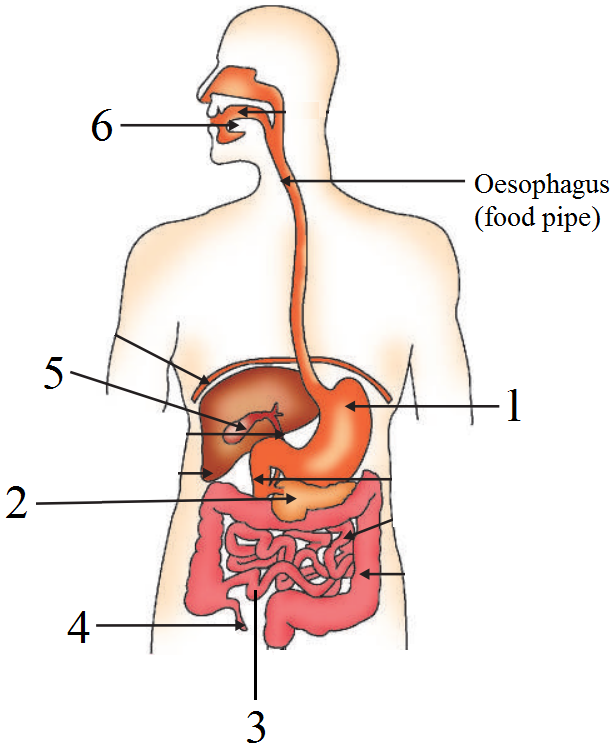
The diagram shows the human gut. Which numbered structures secrete digestive enzymes?
  • A
    $1, 2, 3$ and $4$
  • $1, 2, 3$ and $6$
  • C
    $2, 3, 4$ and $5$
  • D
    $2, 3, 5$ and $6$
Answer
Correct option: B.
$1, 2, 3$ and $6$

Digestive enzymes are secreted by salivary glands $($salivary amylase$),$ stomach $($pepsin$),$ pancreas (amylase, lipase) and small intestine $($trypsin$)$. Liver produces bile juice and it only emulsifies $($breaks down$)$ fats and does not digest them.
View full question & answer
MCQ 1141 Mark
The blood leaving the tissues becomes richer in :
  • Carbon $-$ dioxide.
  • B
    Water.
  • C
    Haemoglobin.
  • D
    Oxygen.
Answer
Correct option: A.
Carbon $-$ dioxide.
The blood leaving the tissues becomes richer in carbon $-$ dioxide,
i.e. it becomes deoxygenated.
View full question & answer
MCQ 1151 Mark
In cockroaches, air enters the body through :
  • A
    Lungs.
  • B
    Gills.
  • Spiracles.
  • D
    Skin.
Answer
Correct option: C.
Spiracles.
In insects $($such as cockroaches, grasshoppers$),$ the tiny holes called spiracles are present on the body. Air enters the body through these holes.
View full question & answer
MCQ 1161 Mark
An organism which does not have loop of Henle will excrete.
  • A
    No urine.
  • Dilute urine.
  • C
    Concentrated urine.
  • D
    No change in urine.
Answer
Correct option: B.
Dilute urine.
A "dilute specimen" is a urine sample that has a higher than average water content.
When a test applicant consumes excessive.
Amounts of fluid, the concentration of urine will subsequently become dilute.
This can be abused by intentionally over $-$ consuming large amounts of water prior to a drug test.
View full question & answer
Question 1171 Mark
Which of the following is correct for the process of anaerobic respiration?
 
Carbon dioxide always produced
A lot of energy released
a.
No
Yes
b.
No
No
c.
Yes
No
d.
Yes
Yes
Answer
b.
No
No
Explanation:
There are two pathways through which anaerobic respiration occurs. In micro - organisms such as yeast and bacteria, the glucose is broken down into ethanol and carbon-dioxide, and releases very little energy. In the other pathway, glucose is broken down into only lactic acid with the release of little energy. This occurs in the muscles during strenuous exercise. Therefore, carbon-dioxide is not always produced during anaerobic respiration.
View full question & answer
MCQ 1181 Mark
Which of the following increases in muscle cells when they are lacking in oxygen?
  • A
    Carbon $-$ dioxide.
  • B
    Lactose.
  • Lactic acid.
  • D
    Uric acid.
Answer
Correct option: C.
Lactic acid.
In the muscle cells that lack oxygen, concentration of lactic acid is increased. This is because, here, anaerobic respiration takes place in which glucose is converted into lactic acid with the release of a small amount of energy.
View full question & answer
MCQ 1191 Mark
The cells in our blood which destroy disease $-$ causing germs, are :
  • A
    Platelets.
  • B
    Skin cells.
  • C
    $\text{RBCs}.$
  • $\text{WBCs}.$
Answer
Correct option: D.
$\text{WBCs}.$
White blood cells or $\text{WBCs}$ destroy the disease causing germs. They are like soldiers that protect the body from various infections.
View full question & answer
MCQ 1201 Mark
In which of the following vertebrate group/groups, heart does not pump oxygenated blood to different parts of the body?
  • A
    Pisces and amphibians.
  • B
    Amphibians and reptiles.
  • C
    Amphibians only.
  • Pisces only.
Answer
Correct option: D.
Pisces only.
In Pisces, the heart does not pump oxygenated blood to different parts of the body. This is because Pisces have two $-$ chambered heart with one auricle and one ventricle.
Since, Both the auricle and ventricle remain undivided, only deoxygenated blood passes through it. The deoxygenated blood then enters the gills for oxygenation from the ventricle.
View full question & answer
MCQ 1211 Mark
What is the correct route for blood flow in a human?
  • A
    Left atrium $\rightarrow $ Left ventricle $\rightarrow $ Lungs $\rightarrow $ Right ventricle $\rightarrow $ Right atrium.
  • B
    Left atrium $\rightarrow $ Left ventricle $\rightarrow $ Right ventricle $\rightarrow $ Right atrium $\rightarrow $ Lungs.
  • C
    Right atrium $\rightarrow $ Right ventricle $\rightarrow $ Left ventricle $\rightarrow $ Left atrium $\rightarrow $ Lungs.
  • Right atrium $\rightarrow $ Right ventricle $\rightarrow $ Lungs $\rightarrow $ Left atrium $\rightarrow $ Left ventricle.
Answer
Correct option: D.
Right atrium $\rightarrow $ Right ventricle $\rightarrow $ Lungs $\rightarrow $ Left atrium $\rightarrow $ Left ventricle.
The deoxygenated blood collected from different body parts is poured into the right auricle. From right auricle it moves to the right ventricle and through the pulmonary artery this is deoxygenated blood is pumped into the lungs where it is oxygenated. Then this oxygenated blood is transported to the left Atrium and then moves to the left ventricle from where it is pumped into the whole body.
View full question & answer
MCQ 1221 Mark
Where are proteins first digested in the alimentary canal?
  • A
    Small intestine.
  • B
    Oesophagus.
  • C
    Mouth.
  • Stomach.
Answer
Correct option: D.
Stomach.
The digestion of proteins begins in the stomach by pepsin.
View full question & answer
MCQ 1231 Mark
The excretory organs in an earthworm are :
  • Nephridia.
  • B
    Nephrons.
  • C
    Raphides.
  • D
    Ureters.
Answer
Correct option: A.
Nephridia.
In earthworm, the main excretory organs are nephridia. It functions like a kidney.
View full question & answer
MCQ 1241 Mark
Most often during a kidney disorder, the colour of urine changes from yellow to others. A patient is secreting dark coloured urine which turns to blue or black later. This is due to the presence of which of the following?
  • A
    Homogentisic acid.
  • B
    Methaemoglobin.
  • Corpoporphyrin.
  • D
    Both A and B
Answer
Correct option: C.
Corpoporphyrin.
Glucose Protein Salts
(c) $\checkmark$ $\times$ $\checkmark$
Explanation:
Urine also contains many salts and glucose. Red blood cells and sugar are not normally found in urine but may indicate glomerulus injury and diabetes mellitus respectively.
View full question & answer
MCQ 1251 Mark
Which of the following is most likely to have a much higher breathing rate?
  • A
    Man.
  • Fish.
  • C
    Dog.
  • D
    Sparrow.
Answer
Correct option: B.
Fish.
Rate of breathing in aquatic animals is much faster than terrestrial animals.
This is because a faster rate of breathing provides more oxygen to the aquatic animals.
View full question & answer
MCQ 1261 Mark
Choose the forms in which most plants absorb nitrogen :
$(I)$ Proteins.
$(II)$ Nitrates and Nitrites.
$(III)$ Urea.
$(IV)$ Atmospheric nitrogen.
  • A
    $(i)$ and $(ii).$
  • $(ii)$ and $(iii).$
  • C
    $(iii)$ and $(iv).$
  • D
    $(i)$ and $(iv).$
Answer
Correct option: B.
$(ii)$ and $(iii).$
Plants cannot take up atmospheric nitrogen and hence option $'iv\ ’$ is incorrect.
Protein is synthesized by plants and hence option $'i\ ’$ is incorrect.
View full question & answer
MCQ 1271 Mark
What prevents the backflow of blood inside the heart during contraction?
  • A
    Thick muscular walls of ventricles.
  • Valves.
  • C
    Thin walls of atria.
  • D
    All of the above.
Answer
Correct option: B.
Valves.
During contraction, valves prevent the back $-$ flow of blood inside the heart.
View full question & answer
MCQ 1281 Mark
The correct sequence of anaerobic reactions in yeast is :
  • A
    $\text{Glucose}\xrightarrow{\ \ \text{cytoplasm}\ \ }\text{Pyruvate}\xrightarrow{\ \text{mitochondria}\ }\text{Ethanol}+\text{Carbondioxide}$
  • B
    $\text{Glucose}\xrightarrow{\ \ \text{cytoplasm}\ \ }\text{Pyruvate}\xrightarrow{\ \text{cytoplasm}\ }\text{Lactic acid}$
  • C
    $\text{Glucose}\xrightarrow{\ \ \text{cytoplasm}\ \ }\text{Pyruvate}\xrightarrow{\ \text{mitochondria}\ }\text{Lactic acid}$
  • $\text{Glucose}\xrightarrow{\ \ \text{cytoplasm}\ \ }\text{Pyruvate}\xrightarrow{\ \text{cytoplasm}\ }\text{Ethanol}+\text{Carbondioxide}$
Answer
Correct option: D.
$\text{Glucose}\xrightarrow{\ \ \text{cytoplasm}\ \ }\text{Pyruvate}\xrightarrow{\ \text{cytoplasm}\ }\text{Ethanol}+\text{Carbondioxide}$
Breakdown of pyruvate; under anaerobic condition; takes place in cytoplasm of yeast. Ethanol and carbon dioxide are produced at the end of this reaction.
View full question & answer
MCQ 1291 Mark
Which is the correct sequence of air passage during inhalation
  • A
    Nostrils $\rightarrow $ Larynx $\rightarrow $ Pharynx $\rightarrow $ Trachea $\rightarrow $ Lungs.
  • B
    Nasal Passage $\rightarrow $ Trachea $\rightarrow $ Pharynx $\rightarrow $ Larynx $\rightarrow $ Alveoli.
  • C
    Larynx $\rightarrow $ Nostril $\rightarrow $ Pharynx $\rightarrow $ Lungs.
  • Nostrils $\rightarrow $ Pharynx $\rightarrow $ Larynx $\rightarrow $ Trachea $\rightarrow $ Alveoli.
Answer
Correct option: D.
Nostrils $\rightarrow $ Pharynx $\rightarrow $ Larynx $\rightarrow $ Trachea $\rightarrow $ Alveoli.
The air enters through nostrils, passes to pharynx, larynx, trachea and then to alveoli. As soon as the air is inhaled the diaphragm and inter coastal muscles contract meanwhile, there is also the expansion of thoracic muscles which creates enough space for the air to enter into the lungs. The process is opposite in the case of exhalation.
View full question & answer
MCQ 1301 Mark
The opening and closing of the stomatal pores depends upon :
  • A
    Oxygen.
  • Water in guard cells.
  • C
    Temperature.
  • D
    Concentration of $\mathrm{CO}_2$ in stomata.
Answer
Correct option: B.
Water in guard cells.
When guard cells have water, stomatal pores open and when water moves out of the guard cells, these pores close.
View full question & answer
MCQ 1311 Mark
Two of the following organisms have a holozoic mode of nutrition. These organisms are :
  • A
    Paramecium and Plasmodium.
  • B
    Plasmodium and Parakeet.
  • Parakeet and Paramecium.
  • D
    Paramecium and Parasite.
Answer
Correct option: C.
Parakeet and Paramecium.
Parakeet and Paramecium feed on solid food.
Therefore, they have holozoic mode of nutrition.
 
View full question & answer
MCQ 1321 Mark
Which of the following equations is the summary of photosynthesis?
  • A
    $6 \mathrm{CO}_2+12 \mathrm{H}_2 \mathrm{O} \rightarrow $$\mathrm{C}_6 \mathrm{H}_{12} \mathrm{O}_6+6 \mathrm{O}_2+6 \mathrm{H}_2 \mathrm{O}$
     
  • B
    $6 \mathrm{CO}_2+\mathrm{H}_2 \mathrm{O}+\text { Sunlight } \rightarrow \mathrm{C}_6 \mathrm{H}_{12} \mathrm{O}_6+\mathrm{O}_2+6 \mathrm{H}_2 \mathrm{O}$
  • $6 \mathrm{CO}_2+12 \mathrm{H}_2 \mathrm{O}+\text { Chlorophyll }+ \text { Sunlight } \rightarrow$$ \mathrm{C}_6 \mathrm{H}_{12} \mathrm{O}_6+6 \mathrm{O}_2+6 \mathrm{H}_2 \mathrm{O}$
  • D
    $6 \mathrm{CO}_2+12 \mathrm{H}_2 \mathrm{O}+\text { Chlorophyll }+ \text { Sunlight } \rightarrow$$ \mathrm{C}_6 \mathrm{H}_{12} \mathrm{O}_6+6 \mathrm{CO}_2+6 \mathrm{H}_2 \mathrm{O}$
Answer
Correct option: C.
$6 \mathrm{CO}_2+12 \mathrm{H}_2 \mathrm{O}+\text { Chlorophyll }+ \text { Sunlight } \rightarrow$$ \mathrm{C}_6 \mathrm{H}_{12} \mathrm{O}_6+6 \mathrm{O}_2+6 \mathrm{H}_2 \mathrm{O}$
Option $'a\ ’$ shows correct reaction. But option $'c\ ’$ shows correct reaction as well as other important factors of reaction. Option $'b\ ’$ is not a balanced equation. Option $'d\ ’$ shows carbon dioxide among the products; which is wrong.
View full question & answer
MCQ 1331 Mark
One of the following organism does not depend on simple diffusion of gases for breathing and respiration. This organism is:
  • A
    Amoeba.
  • Prawn.
  • C
    Planaria.
  • D
    Bryophyllum.
Answer
Correct option: B.
Prawn.
Prawn is an aquatic animal that respires through gills. The gills extract oxygen dissolved in water and take away carbon-dioxide from the body.
 
View full question & answer
MCQ 1341 Mark
Bile juice is stored in which organ of human body?
  • A
    Kidney.
  • Gall bladder.
  • C
    Pancreas.
  • D
    Liver.
Answer
Correct option: B.
Gall bladder.
Bile or gall is a dark green to yellowish brown fluid, produced by the liver of most vertebrates, that aids the digestion of lipids in the small intestine. In humans, bile is produced continuously by the liver $($liver bile$),$ and stored and concentrated in the gallbladder.
View full question & answer
MCQ 1351 Mark
Which of the following statement $(s)$ is $($are$)$ true about heart?
  1. Left atrium receives oxygenated blood from different parts of body while right atrium receives deoxygenated blood from lungs.
  2. Left ventricle pumps oxygenated blood to different body parts while right ventricle pumps deoxygenated blood to lungs.
  3. Left atrium transfers oxygenated blood to right ventricle which sends it to different body parts.
  4. Right atrium receives deoxygenated blood from different parts of the body while left ventricle pumps oxygenated blood to different parts of the body.
  • A
    $(i).$
  • B
    $(ii).$
  • $(ii)$ and $(iv).$
  • D
    $(i)$ and $(iii).$
Answer
Correct option: C.
$(ii)$ and $(iv).$
The left ventricle pumps blood into the aorta which in turn delivers it to the major body regions and organs which makes statement $(iii)$ incorrect. The anterior vena cava collects deoxygenated blood from the head, chest, and arms and enters the right atrium while the inferior vena cava collects blood from the lower body regions. Both venae cavae pass the deoxygenated blood to the right atrium which makes statement $(i)$ incorrect. Blood from right atrium enters right ventricle and pulmonary arteries carry deoxygenated blood from right ventricle to lungs for oxygenation; this makes statements $(ii)$ and $(iv)$ correct.
View full question & answer
MCQ 1361 Mark
Which of the following equations is the summary of photosynthesis?
  • A
    $6 \mathrm{CO}_2+12 \mathrm{H}_2 \mathrm{O} \rightarrow \mathrm{C}_6 \mathrm{H}_{12} \mathrm{O}_6+6 \mathrm{O}_2+6 \mathrm{H}_2 \mathrm{O}$

     
  • B
    $6 \mathrm{CO}_2+\mathrm{H}_2 \mathrm{O}+\text { Sunlight } \rightarrow \mathrm{C}_6 \mathrm{H}_{12} \mathrm{O}_6+\mathrm{O}_2+6 \mathrm{H}_2 \mathrm{O}$
  • $6 \mathrm{CO}_2+12 \mathrm{H}_2 \mathrm{O}+\text { Chlorophyll }+ $$\text { Sunlight } \rightarrow \mathrm{C}_6 \mathrm{H}_{12} \mathrm{O}_6+6 \mathrm{O}_2+6 \mathrm{H}_2 \mathrm{O}$
  • D
    $6 \mathrm{CO}_2+12 \mathrm{H}_2 \mathrm{O}+\text { Chlorophyll }+ $$\text { Sunlight } \rightarrow \mathrm{C}_6 \mathrm{H}_{12} \mathrm{O}_6+6 \mathrm{CO}_2+6 \mathrm{H}_2 \mathrm{O}$
Answer
Correct option: C.
$6 \mathrm{CO}_2+12 \mathrm{H}_2 \mathrm{O}+\text { Chlorophyll }+ $$\text { Sunlight } \rightarrow \mathrm{C}_6 \mathrm{H}_{12} \mathrm{O}_6+6 \mathrm{O}_2+6 \mathrm{H}_2 \mathrm{O}$
When combined together glucose and excess gasses e.g. oxygen are made. A good explanation for why the equation is that way is the equation:
$6 \mathrm{CO}_2+12 \mathrm{H}_2 \mathrm{O}\ +$ Chlorophyll $+$ Sunlight $\rightarrow \mathrm{C}_6 \mathrm{H}_{12} \mathrm{O}_6+6 \mathrm{O}_2+6 \mathrm{H}_2 \mathrm{O}$
View full question & answer
MCQ 1371 Mark
Which of the following helps in the upward movement of water and dissolved minerals from the roots to the leaves through the stem?
  • A
    Transportation.
  • B
    Translocation.
  • C
    Tropic movement.
  • Transpiration.
Answer
Correct option: D.
Transpiration.
Transpiration is the loss of water through the stomata of leaves and other aerial parts of the plants in the form of water vapour. It provides a transpirational pull, which is responsible for the upward movement of water and dissolved minerals from the roots to the leaves through the stem.
 
View full question & answer
MCQ 1381 Mark
A blood vessel which carries blood back to the heart is :
  • A
    Artery.
  • Vein.
  • C
    Capillary.
  • D
    Platelet.
Answer
Correct option: B.
Vein.
Veins carry carbon $-$ dioxide rich blood from the various tissues of the body to the heart.
View full question & answer
MCQ 1391 Mark
Which is the correct sequence of parts in human alimentary canal?
  • A
    Mouth $\rightarrow $ stomach $\rightarrow $ small intestine $\rightarrow $ oesophagus $\rightarrow $ large intestine.
  • B
    Mouth $\rightarrow $ oesophagus $\rightarrow $ stomach $\rightarrow $ large intestine $\rightarrow $ small intestine.
  • C
    Mouth $\rightarrow $ stomach $\rightarrow $ oesophagus $\rightarrow $ small intestine $\rightarrow $ large intestine.
  • Mouth $\rightarrow $ oesophagus $\rightarrow $ stomach $\rightarrow $ small intestine $\rightarrow $ large intestine.
Answer
Correct option: D.
Mouth $\rightarrow $ oesophagus $\rightarrow $ stomach $\rightarrow $ small intestine $\rightarrow $ large intestine.
Human alimentary canal consists of organs of digestion which are namely, in sequence, mouth, oesophagus, stomach, small intestine, large intestine and anus.
View full question & answer
MCQ 1401 Mark
What prevents backflow of blood inside the heart during contraction?
  • Valves in heart.
  • B
    Thick muscular walls of ventricles.
  • C
    Thin walls of atria.
  • D
    All of the above.
Answer
Correct option: A.
Valves in heart.
Walls of heart facilitate the pumping action only and have no role in preventing backflow of blood.
View full question & answer
MCQ 1411 Mark
Which process occurring in human body does not involve energy from respiration?
  • A
    Contraction of heart muscle.
  • B
    Diffusion of oxygen from the alveoli into the blood.
  • Digestion of bread.
  • D
    Maintaining a constant body temperature.
Answer
Correct option: C.
Digestion of bread.
View full question & answer
MCQ 1421 Mark
During respiration exchange of gases take place in :
  • A
    Trachea and larynx.
  • Alveoli of lungs.
  • C
    Alveoli and throat.
  • D
    Throat and larynx.
Answer
Correct option: B.
Alveoli of lungs.
Trachea and larynx just serve as passage for air. Exchange of gases takes place in alveoli; where oxygen diffuses into blood and carbon dioxide comes out of blood.
View full question & answer
MCQ 1431 Mark
The wave of expansion of an artery when blood is forced into it is called :
  • A
    Flow.
  • B
    Heart beat.
  • Pulse.
  • D
    Ticking.
Answer
Correct option: C.
Pulse.
Pulse is the expansion of the artery each time the blood is forced into it.
 
View full question & answer
MCQ 1441 Mark
Which of the following is not a purpose of transpiration?
  • A
    Supplies water for photosynthesis.
  • Helps in translocation of sugar in plants.
  • C
    Cools leaf surface.
  • D
    Transport minerals from the soil to all the parts of the plant.
Answer
Correct option: B.
Helps in translocation of sugar in plants.
The process of movement of water in the plants through xylem and its evaporation through leaves or stem is known as transpiration. Transpiration supplies water for photosynthesis, cools the leaves surface through evaporation, and the transpirational pull helps in transportation of minerals from the roots to the leaves. But it never helps in the translocation of sugars. Translocation is the process of movement of food from the leaves to the different parts of the plant through phloem.
View full question & answer
MCQ 1451 Mark
The two organisms which breathe only through their moist skin are :
  • A
    Fish and frog.
  • B
    Frog and earthworm.
  • Leech and earthworm.
  • D
    Fish and earthworm.
Answer
Correct option: C.
Leech and earthworm.
Leech and earthworm breathe only through their moist skin. Fish breathe through gills, while frogs breathe through lungs and skin.
View full question & answer
MCQ 1461 Mark
A few drops of iodine solution were added to rice water. The solution turned blue-black in colour. This indicates that rice water contains :
  • A
    Complex proteins.
  • B
    Simple proteins.
  • C
    Fats.
  • Starch.
Answer
Correct option: D.
Starch.
Starch makes a dark blue complex with iodine. This is the most often used test to check the presence of starch in something.
View full question & answer
MCQ 1471 Mark
Right atrium receives blood from.
  • A
    Pulmonary aorta.
  • B
    Pulmonary veins.
  • C
    Inferior vena cava.
  • Superior and inferior vena cava.
Answer
Correct option: D.
Superior and inferior vena cava.
The inferior vena cava is a vein. It carries deoxygenated blood from the lower half of the body to the right atrium of the heart. The corresponding vein that carries deoxygenated blood from the upper half of the body is the superior vena cava.
View full question & answer
MCQ 1481 Mark
The portion of the human respiratory tract called sound box is :
  • larynx.
  • B
    trachea.
  • C
    bronchi.
  • D
    pharynx.
Answer
Correct option: A.
larynx.
Briefly, the vocal folds are folds of tissue located in the larynx $($voicebox$)$ that have three important functions : To protect the airway from choking on material in the throat. To regulate the flow of air into our lungs. The production of sounds used for speech.
View full question & answer
MCQ 1491 Mark
Oxygen liberated during photosynthesis comes from :
  • Water.
  • B
    Chlorophyll.
  • C
    Carbon dioxide.
  • D
    Glucose.
Answer
Correct option: A.
Water.
Splitting of water molecule, results in liberation of oxygen and hydrogen.
Hydrogen is utilized for reduction of carbon dioxide so that carbohydrate can be made.
View full question & answer
MCQ 1501 Mark
The liquid waste product of plants formed due to oxidation of various essential oils is :
  • A
    Gums.
  • B
    Latex.
  • Resins.
  • D
    Tannin.
Answer
Correct option: C.
Resins.
The hard transparent resins, such as the copals, dammars, mastic, and sandarac, are principally used for varnishes and adhesives, while the softer odoriferous oleo $-$ resins $($frankincense, elemi, turpentine, copaiba$)$ and gum resins.
View full question & answer
M.C.Q - Page 3 - Science STD 10 Questions - Vidyadip