Questions

[5 marks Questions]

🎯

Test yourself on this topic

13 questions · timed · auto-graded

Question 15 Marks
What are the merits of the modern periodic table of elements?
Answer
Merits of modern periodic table:
  1. The modern periodic table is based on the atomic numbers of elements which is the most fundamental property of elements.
  2. It helps us to understand why elements in a group show similar properties but elements in different groups show different properties.
  3. It explains the reasons for the periodicity in properties of elements.
  4. It tells us why the properties of elements are repeated after 2, 8, 18 and 32 elements.
View full question & answer
Question 25 Marks
Can the following groups of elements be classified as Dobereiner's triads?
  1. Na, Si, Cl.
  2. Be, Mg, Ca.
Give reason for your answer.

(Atomic masses: Be 9; Na 23; Mg 24; Si 28; Cl 35. 5; Ca 40)
Answer
  1. No. This is because the elements Na, Si and Cl do not have similar properties even though the atomic mass of middle element Si is almost equal to the average atomic mass of first element Na and third element Cl.
  2. Yes. This is because the elements Be, Mg and Ca have similar properties and the atomic mass of middle element Mg is almost equal to the average atomic mass of first element Be and third element Ca.
View full question & answer
Question 35 Marks
The following diagram shows a part of the periodic table in which the elements are arranged according to their atomic numbers.
(The letters given here are not the chemical symbols of the elements):
a
3
b
4
 
c
5
d
6
e
7
f
8
g
9
h
10
i
11
j
12
 
k
13
l
14
m
15
n
16
o
17
p
18
  1. Which element has a bigger atom, a or f?
  2. Which element has a higher valency, k or o?
  3. Which element is more metallic, i or k?
  4. Which element is more non-metallic, d or g?
  5. Select a letter which represents a metal of valency 2.
  6. Select a letter which represents a non-metal of valency 2.
Answer
  1. A (size decreases from left to right in a period).
  2. K (valency of k = 3; valency of o = 1).
  3. I (metallic character decreases from left to right in a period).
  4. G (non - metallic character increases from left to right in a period).
  5. B (or j).
  6. F (or n).
View full question & answer
Question 45 Marks
Mendeleev predicted the existence of certain elements not known at that time and named two of them as eka - aluminium, and eka - silicon.
  1. Name the element which has taken the place of (i) eka - aluminium, and (ii) eka - silicon.
  2. Mention the period/ periods of these elements in the modern periodic table.
  3. Write the group/ groups of these elements in the modern periodic table.
  4. Classify these elements as metals, non - metals or metalloids.
  5. How many valence electrons are present in the atoms of each of these elements?​​​​​​
Answer
  1.  
  1. Gallium.
  2. Germanium.
b. $4^{\text {th }}$ period.
c. Gallium: $13^{\text {th }}$ group; Germanium: $14^{\text {th }}$ group.
d. Gallium: Metal; Germanium: Metalloid.
e. Gallium: 3; Germanium: 4.
View full question & answer
Question 55 Marks
A part of the early classification of elements has been given below:
$\text{H}\ \ \ \ \ \ \ \text{Li} \ \ \ \ \ \ \ \text{Be} \ \ \ \ \ \ \ \ \ \text{B}\ \ \ \ \ \ \ \text{C}\ \ \ \ \ \ \ \text{N}\ \ \ \ \ \ \ \text{O}\\\text{F}\ \ \ \ \ \ \ \text{Na}\ \ \ \ \ \ \text{Mg}\ \ \ \ \ \ \ \text{Al}\ \ \ \ \ \ \text{Si}\ \ \ \ \ \ \ \text{P}\ \ \ \ \ \ \ \ \text{S}$
  1. Which law of classification of element is illustrated by the above arrangement of elements?
  2. Name the scientist who proposed such a classification of elements.
  3. Why is such a classification of elements compared with a characteristics of musical scale?
  4. State one limitation of this classification of elements.
Answer
  1. Newlands' law of octaves is illustrated by the above arrangement of elements.
  2. John Newlands is the scientist who proposed this classification of elements.
  3. This classification is compared with a characteristic of the musical scale because the repetition of the properties of elements is just like the repetition of the eighth note in an octave of music.
  1. Limitation:
Newlands' law of octaves could only be applied up to the element calcium.
View full question & answer
Question 65 Marks
How do the following change on going from left to right in a period of the periodic table?
  1. Chemical reactivity of elements.
  2. Nature of oxides of elements Give examples in support of your answer.
Answer
  1. On moving from left to right in a period, the chemical reactivity of elements first decreases and then increases.
Example: In the 3rd period of elements, sodium is a very reactive element, magnesium is less reactive whereas aluminium is still less reactive. Silicon is the least reactive in the third period. Now, phosphorus is quite reactive, sulphur is still more reactive whereas chlorine is very reactive.
  1. On moving from left to right in a period, the basic nature of oxides decreases and the acidic nature of oxides increases.
Example: In the 3rd period of the periodic table, sodium oxide is highly basic in nature and magnesium oxide is comparatively less basic. The aluminium and silicon oxides are amphoteric in nature. Phosphorus oxides are acidic, sulphur oxides are more acidic whereas chlorine oxides are highly acidic in nature.
View full question & answer
Question 75 Marks
What are the advantages of the periodic table?
Answer
Advantages of the periodic table:
  1. It has made the study of chemistry systematic and easy.
  2. It is easier to remember the properties of an element if its position in the periodic table is known.
  3. The type of compounds formed by an element can be predicted by knowing its position in the periodic table.
  4. It is used as a teaching aid in chemistry in schools and colleges.
View full question & answer
Question 85 Marks
Write the names and symbols of two very reactive metals belonging to group 1 of the periodic table. Explain by drawing electronic structure, how either one of the two metals reacts with a halogen. With which name is the bond formed between these elements known and what is the class of the compound so formed known? State any four physical properties of such compounds.
Answer
Sodium (Na) and Potassium (K); Sodium (Na) is a metal. So, sodium readily reacts with a halogen like chlorine (Cl) to form an ionic chloride called sodium chloride. This is illustrated below:
$2\text{Na (s)}+\text{Cl}_2\text{ (g)}\ \ \ \rightarrow\ \ \ 2\text{NaCl (s)}\\^\text{Sodium}\ \ \ \ \ \ \ \ \ ^\text{Chloride}\ \ \ \ \ \ \ \ \ \ \ ^\text{Sodium}\ ^\text{Chloride}\\^\text{(A metal)}\ \ \ \ \ \ \ \ \ \ \ \ \ \ \ \ \ \ \ \ \ \ \ \ \ \ \ \ \ \ \ ^\text{(Ionic chloride)}$
Ionic bond; Ionic compounds. Physical properties of ionic compounds:
  1. Ionic comp ounds are usually hard, brittle.
  2. They conduct electricity when molten or dissolved.
  3. They have high melting and boiling points.
  4. Most are soluble in polar solvents such as water.
View full question & answer
Question 95 Marks
A non - metal X which is the largest constituent of air combines with hydrogen when heated in the presence of iron as catalyst to form a gas Y. When gas Y is treated with sulphuric acid, it forms a compound Z which is used as a chemical fertiliser.
  1. What are X, Y and Z?
  2. To which group of periodic table does X belong?
  3. Name the period of periodic table in which X is placed.
  4. Which element is placed just before X in the period?
  5. Which element is placed just after X in the period?
Answer
a. X is nitrogen gas, $N ; Y$ is ammonia gas, NH and Z is ammonium sulphate, $\left( NH _4\right)_2 SO _4$.
b. $15^{\text {th }}$ group.
c. $2^{\text {nd }}$ period.
d. Carbon, C.
e. Oxygen, O.
View full question & answer
Question 105 Marks
An element X belongs to group 2 and another element Y belongs to group 15 of the periodic table:
  1. What is the number of valence electrons in X?
  2. What is the valency of X?
  3. What is the number of valence electrons in Y?
  4. What is the valency of Y? Explain how you have arrived at your answers.
Answer
  1. 2.
For groups 1 and 2, the number of valence electrons is equal to the group number.
  1. 2.
Valency is determined by the number of valence electrons present in the atom of the element.
  1. 5.
For groups 13 to 18, the number of valence electrons is equal to (group no. – 10).
  1. 3.
The number of electrons lost or gained by one atom of an element to achieve the nearest inert gas configuration, gives us the valency.
View full question & answer
Question 115 Marks
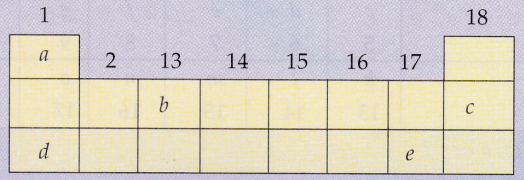
The following diagram shows a part of the periodic table containing first three periods in which five elements have been represented by the letters a, b, c, d and e (which are not their chemical symbols):
  1. Select the letter which represents an alkali metal.
  2. Select the letter which represents a noble gas.
  3. Select the letter which represents a halogen.
  4. What type of bond is formed between a and e?
  5. What type of bond is formed between d and e?
Answer
  1. d.
  2. c.
  3. e.
  4. Covalent bond.
  5. Ionic bond.
View full question & answer
Question 125 Marks
Atoms of eight elements A, B, C, D, E, F, G and H have the same number of electron shells but different number of electrons in their outermost shells. It was found that elements A and G combine to form an ionic compound. This ionic compound is added in a small amount to almost all vegetables and dishes during cooking. Oxides of elements A and B are basic in nature while those of elements E and F are acidic. The oxide of element D is, however, almost neutral. Based on the above information, answer the following questions:
  1. To which group or period of the periodic table do these elements belong?
  2. What would be the nature of compound formed by a combination of elements B and F?
  3. Which two of these elements could definitely be metals?
  4. Which one of the eight elements is most likely to be found in gaseous state at room temperature?
  5. If the number of electrons in the outermost shell of elements C and G be 3 and 7 respectively, write the formula of the compound formed by the combination of C and G.
Answer
  1. $3^{\text {rd }}$ period.
  2. Ionic compound.
  3. A and B.
  4. H.
  5. CG3.
View full question & answer
Question 135 Marks
Which element has:
  1. Two shells, both of which are completely filled with electrons?
  2. The electronic configuration 2, 8, 2?
  3. A total of three shells, with four electrons in its valence shell?
  4. A total of two shells, with three electrons in its valence shell?
  5. Twice as many electrons in its second shell as its first shell?
Answer
  1. Neon (2, 8).
  2. Magnesium.
  3. Silicon (2, 8, 4).
  4. Boron (2, 3).
  5. Carbon (2, 4).
View full question & answer
[5 marks Questions] - Science STD 10 Questions - Vidyadip