Questions

5 Marks Questions

Take a timed test

35 questions · self-marked practice — reveal the answer and mark yourself.

Question 15 Marks
What would happen if HCl were not secreted in the stomach?
Answer
HCl is secreted by parietal or oxyntic cells of gastric glands. It serves the following functions:
  1. It activates the pepsinogen and prorennin into their active form pepsin and rennin.
  2. It provides the acidic pH (pH 1.8) optimal for pepsin.
  3. It kills the harmful bacteria present in the food.
  4. It stops the action of saliva on food. Pepsin and rennin are the principle proteolytic enzymes of stomach. If these enzymes are not activated by HCl then digestion of protein will not take place in stomach, and also the harmful bacteria can cause various diseases.
View full question & answer
Question 25 Marks
Explain the term thecodont and diphyodont.
Answer
The codont is a type of dentition in which the teeth are embedded in the deep sockets of the jaw bone. Ankylosis is absent and the roots are cylindrical. Examples include living crocodilians and mammals. Diphyodont is a type of dentition in which two successive sets of teeth are developed during the lifetime of the organism. The first set of teeth is deciduous and the other set is permanent. The deciduous set of teeth is replaced by the permanent adult teeth. This type of dentition can be seen in humans.
View full question & answer
Question 35 Marks
Match column I with column II
 
Column I
 
Column II
a.
Bilirubin and biliverdin
i.
Parotid
b.
Hydrolysis of starch
ii.
Bile
c.
Digestion of fat
iii.
Lipases
d.
Salivary gland
iv
Amylases
Answer
 
Column I
 
Column II
a.
Bilirubin and biliverdin
ii.
Bile
b.
Hydrolysis of starch
iv.
Amylases
c.
Digestion of fat
iii.
Lipases
d.
Salivary gland
i.
Parotid
View full question & answer
Question 45 Marks
Describe the process of digestion of protein in stomach.
Answer
The gastric glands of the stomach secrete gastric juice that contains HCl and proenzymes – pepsinogen and prorennin. The proenzyme pepsinogen, on exposure to HCl gets converted into the active enzyme pepsin, the proteolytic enzyme of stomach. The pepsin converts proteins into proteoses and peptones (peptides). Prorennin is found in gastric juice of infants and is activated by pepsin into active rennin. It helps in digestion of milk protein casein.$\text{pepsinogen}\xrightarrow[]{\text{HCL}}\text{Pepsin}$
$\text{proteins}\xrightarrow[]{\text{pepsin}}\text{proteoses and peptones}$
$\text{prorennin}\xrightarrow[]{\text{HCL}}\text{Rennin}$
$\text{Casein(Milk protein)}\xrightarrow[]{\text{Rennin}}\text{paracasein}\\+\text{Ca}\ \ \ \ \ \ \ \ \ \ \ \ \ \ \ \ \ \ \ \ \ \ \ \ \ \ \ \ \ \ \ \ \ \ \ \ \ \ \ \ \ \ \ \text{(curd})$
$\text{calcium paracasein}\xrightarrow[]{\text{pepsin}}\text{peptnes}$
View full question & answer
Question 55 Marks
Name different types of teeth and their number in an adult human.
Answer
There are four different types of teeth in an adult human. They are as follows:
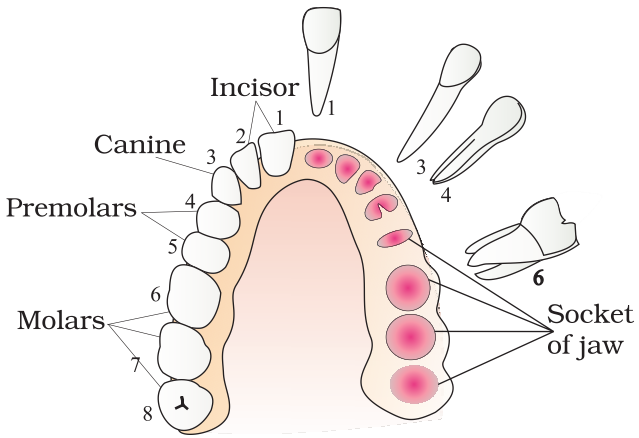
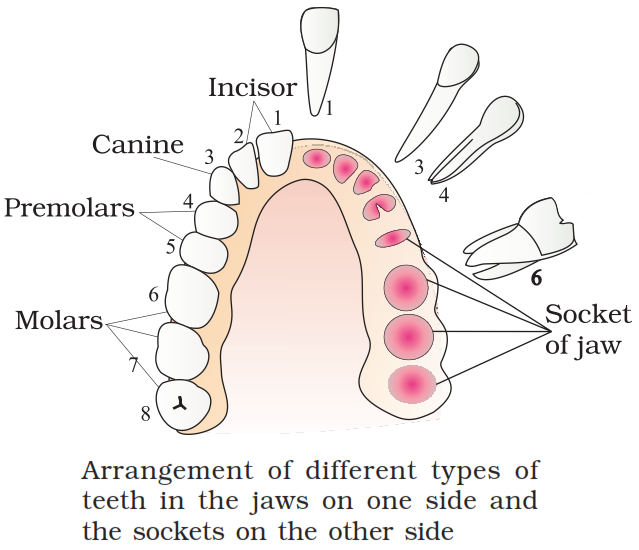
  1. Incisors: The eight teeth in the front are incisors. There are four incisors each in the upper jaw and the lower jaw. They are meant for cutting.
  2. Canines: The pointy teeth on either side of the incisors are canines. They are four in number, two each placed in the upper jaw and the lower jaw. They are meant for tearing.
  3. Premolars: They are present next to the canines. They are eight in number, four each placed in the upper jaw and the lower jaw. They are meant for grinding.
  4. Molars: They are present at the end of the jaw, next to the premolars. There are twelve molars, six each placed in the upper jaw and the lower jaw.
Hence, the dental formula in humans is $\frac{2123}{2123}\times2=32$ This means each half of the upper jaw and the lower jaw has 2 incisors, 1 canine, 2 premolars, and 3 molars. Hence, an adult human has 32 permanent teeth.
View full question & answer
Question 65 Marks
How are polysaccharides and disaccharides digested?
Answer
Digestion of carbohydrates takes place in the mouth and the small intestine. The enzymes carbohydrases act on carbohydrates. As the food enters the mouth, it gets mixed with saliva and breaks down starch into maltose, isomaltose and limit dextrins. The digestion of carbohydrates does not take place in the stomach. In the small intestine, the food gets mixed with pancreatic juice and intestinal juice. Pancreatic juice contains pancreatic amylase which digests polysaccharides into disaccharides.$\text{polysaccharides}\xrightarrow[]{\text{Anylase}}\text{Disaccharides} $
Intestinal juice also contains a variety of enzymes which digest the disaccharides into glucose, fructose and galactose.
View full question & answer
Question 75 Marks
What are the functions of liver?
Answer
The functions of liver are:
  1. The liver secretes bile juice which helps in the digestion of fats.
  2. It secretes an anticoagulant called heparin which prevent clotting of blood inside blood vessels.
  3. It produces a protein, angiotensinogen, which helps the kidneys in maintaining body fluid osmoregulation.
  4. It is an important place of lymph formation.
  5. It produces red blood cells in the embryo.
  6. It also helps in breakdown of insulin and other hormones, haemogloin, some toxic substances and conversion of ammonia into urea takes place in liver.
View full question & answer
Question 85 Marks
Suraj was getting weak and pale day by day. His biology teacher noticed this and called his father to discuss about the condition of Suraj. After talking to his teacher, his father got worried and took him to the doctor. The doctor diagnosed that he is suffering from jaundice and put him on proper medication. His father asked the doctor about the cause of the disease and precautions to be taken. Doctor explained him that it is due to increase in the level of bilirubin in the blood. Doctor also adviced to avoid fatty food substances and uncovered food.
  1. To which part of the digestive system, jaundice is related to?
  2. What major roles does liver play in our body?
  3. Which pigments are involved in jaundice?
  4. What values are reflected from Suraj's father's character?
Answer
  1. Liver.
  2. It helps in digestion of fats, regulation of blood sugar, formation of red blood corpuscles, deamination, blood clotting, etc.
  3. Bile pigments (bilirubin, biliverdin).
  4. Suraj's father is a responsible person. He cares for his son's health. So, he took initiative and took him to a good doctor.
View full question & answer
Question 95 Marks
How are the activities of gastro-intestinal tract regulated?
Answer
The activities of the gastro-intestinal tract are under both neural and hormonal control. The gastro-intestinal tract is innervated by intrinsic nerves as well as by extrinsic nerves. The sight, smell and/ or the presence of food in the oral cavity can stimulate the secretion of saliva. Neural signals stimulate the gastric and intestinal secretions. The muscular activities of different parts of the alimentary canal can also be moderated by neural mechanisms, both local and through CNS. Hormonal. Control of the secretion of digestive juices is carried out by the local hormones produced by the gastric and intestinal mucosa such as gastrin, cholecystokinin and secretin etc.
View full question & answer
Question 105 Marks
Give a description of liver.
Answer
Liver is the largest gland of the body weighing about 1.2 to 1.5 kg in an adult human. It is situated in the abdominal cavity, just below the diaphragm and has two lobes. The hepatic lobules are the structural and functional units of liver containing hepatic cells arranged in the form of cords. Each lobule is covered by a thin connective tissue sheath called the Glisson's capsule. The bile secreted by the hepatic cells passes through the hepatic ducts and is stored and concentrated in a thin muscular sac called the gall bladder. The duct of gall bladder (cystic duct) along with the hepatic duct from the liver forms the common bile duct. The bile duct and the pancreatic duct open together into the duodenum as the common hepato-pancreatic duct which is guarded by a sphincter called the sphincter of Oddi.
View full question & answer
Question 115 Marks
Explain the action of different enzymes in succus entericus.
Answer
$\text{Dipeptides}\xrightarrow{\text{Dipeptidases}}\text{Amino acides}$ $\text{Maltose}\xrightarrow{\text{Maltase}}\text{Glucose}+\text{Glucose}$ $\text{Lactose}\xrightarrow{\text{Lactase}}\text{Glucose}+\text{Galactose}$ $\text{Sucrose}\xrightarrow{\text{Surcase}}\text{Glucose}+\text{Fructose}$ $\text{Nucleotides}\xrightarrow{\text{Nucleotidase}}\text{Nucleotides}\xrightarrow{\text{Nucleosidase}}\text{Sugar}+\text{Bases}$ $\text{Di and monoglycerides}\xrightarrow{\text{Lipase}}\text{Fatty acides}+\text{Glycerol}$
View full question & answer
Question 125 Marks
Correct the statement given below by choosing the right option shown in the bracket against them.
  1. Absorption of amino acids and glycerol takes place in the (small intestine/ large intestine).
  2. The faeces in the rectum initiate a reflex causing an urge for its removal (neural/ hormonal).
  3. Skin and eyes turn yellow in infection (liver/ stomach).
  4. Rennin is a proteolytic enzyme found in gastric juice in (infants/ adults).
  5. Pancreatic juice and bile are released through (intestine pancreatic/ hepato-pancreatic duct)
Answer
  1. Absorption of amino acids and glycerol takes place in the small intestine.
  2. The faeces in the rectum initiate a neural reflex causing an urge for its removal.
  3. Skin and eyes turn yellow in infection of liver.
  4. Rennin is a proteolytic enzyme found in gastric juice in infants.
  5. Pancreatic juice and bile are released through hepatopancreatic duct.
View full question & answer
Question 135 Marks
Describe the role played in the digestion and assimilation of food by the:
  1. pancreas.
  2. liver.
Answer
  1. The pancreas secretes digestive enzymes into the duodenum. Pancreatic amylase digests starch to maltose, trypsin digests proteins to polypeptide and pancreatic lipase digests fats to fatty acids and glycerol.
  2. The liver produces bile, which is stored in the gall bladder. Bile is released into the duodenum for the emulsification of fats. This increases the surface area for digestion by enzyme lipase.
Amino acids and glucose are taken first into the liver by the hepatic portal vein. They are required by the body and transported out of the liver by the hepatic vein. Amino acids are used for growth and repair of worn out parts of the body and production of enzymes and hormones and glucose is utilised during cellular respiration to produce energy. In the liver, excess amino acids are deaminated, their amino groups are removed and converted to urea for excretion and glycogen for storage.
View full question & answer
Question 145 Marks
How are the activities of gastrointestinal tract regulated?
Answer
The activities of the gastrointestinal tract are under neural and hormonal control for proper coordination of different parts:
  1. The sight, smell and/ or the presence of food in the
    oral cavity can stimulate the secretion of saliva.
  2. Similarly, gastric and intestinal secretions are also
    stimulated by neural signals.
  3. The muscular activities of different parts of the
    alimentary canal can also be moderated by neural
    mechanisms (both local and through CNS).
  4. Hormonal control of the secretion of digestive juices
    is carried out by local hormones produced by the
    gastric and intestinal mucosa.
View full question & answer
Question 155 Marks
Explain absorption of food in the small intestine.
Answer
The breakdown of bio-macromolecules mentioned above occurs in the duodenum region of the small intestine. The simple substances thus formed are absorbed in the jejunum and ileum regions of the small intestine. The undigested and unabsorbed substances are passed on to the large intestine. No significant digestive activity occurs in the large intestine.The functions of large intestine are:
  1. Absorption of some water, minerals and certain drugs:
  2. Secretion of mucus which helps in adhering the waste fundigested) particles together and lubricating it for an easy passage.
Transport of water depends upon the osmotic gradient. Active transport occurs against the concentration gradient and hence requires energy. Various nutrients like amino acids, monosacharides like glucose, electrolytes like Na' are absorbed into the blood by this mechanism. Fatty acids and glycerol being insoluble, cannot be absorbed into the blood. They are first incorporated into small droplets called micelles which move into the intestinal mucosa. They are re-formed into very small protein coated fat globules called the chylomicrons which are transported into the lymph vessels (lacteals) in the villi. These lymph vessels ultimately release the absorbed substances into the blood stream.
View full question & answer
Question 165 Marks
Discuss mechanisms of absorption.
Answer
Mechanisms of absorption: Absorption is the process by which the end products of digestion pass through the intestinal mucosa into the blood or lymph. It is carried out by passive, active or facilitated transport mechanisms. Small amounts of monosaccharide’s like glucose, amino acids and some electrolytes like chloride ions are generally absorbed by simple diffusion. The passage of these substances into the blood depends upon the concentration gradients. However, some substances like glucose and amino acids are absorbed with the help of carrier proteins. This mechanism is called the facilitated transport. Transport of water depends upon the osmotic gradient. Active transport occurs against the concentration gradient and hence requires energy. Various nutrients like amino acids, monosaccharide’s like glucose, electrolytes like Na+ are absorbed into the blood by this mechanism.
View full question & answer
Question 175 Marks
Distinguish between:
  1. Peptic and oxyntic cells
  2. Lipases and peptidases
  3. Villi and microvilli
  4. Sucrose and maltose
  5. Extracellular and intracellular digestion.
Answer
  1. Peptic cells are glandular cells that are usually basal in location. These produce enzymes, while oxyntic cells are large, deep seated cells that secrete HCI.
  2. Lipases are the type of enzymes found in digestive tract, which breaks fats into di and monoglycerides. Peptidases breaks proteins into their respective peptides.
  3. Villi are the foldings of mucosa layer, whereas microvilli are the tiny finger-like projection present on the cells in mucosa layer. Both of them are meant to increase the area of absorption in small intestine.
  4. Both enzymes are used in digestive tract to convert carbohydrate into its smaller units. Sucrase is the enzyme, which converts sucrose into glucose and fructose, while maltase enzyme converts maltose into glucose in small intestine.
  5. Extracellular digestion is the type of digestion (breaking down of macromolecules) which takes place outside the cell, while intracellular digestion is the type of digestion that takes place inside the cell.
View full question & answer
Question 185 Marks
Describe the histology of human alimentary canal.
Answer
  • Serosa is the outermost layer and consists of a thin mesothelium and some connective tissues
  • Inner to serosa is the layer called muscularis, which is composed of smooth muscles arranged as an inner layer of circular muscles and an outer layer of longitudinal muscles.
  • Submucosa is the third layer, formed of soft/ loose connective tissue and this layer is supplied with nerves, blood vessels and lymph vessels; Brunner's glands are present in the submucosal layer of duodenum.
  • Mucosa is the innermost layer of the wall of the alimentary canal that lines the lumen of the alimentary canal.
  • This layer forms irregular folds called rugae in the stomach and finger-like projections, called villi in the small intestine.
  • The cells lining the villi bear microvilli giving a brush-border appearance to the villi.
  • Villi are supplied with a network of capillaries and a large lymph vessel, called lacteal.
  • Mucosa has goblet cells in the stomach and crypts of Leiberkuhn in between the bases of villi in the intestine.
View full question & answer
Question 195 Marks
Describe the enzymatic action on fats in the duodenum.
Answer
Fat is largely digested in the small intestine (duodenum). Bile secreted by liver is released into duodenum which breaks down fat droplets into small micelles by the process, known as emulsification. This increases lipase action, on fats. Pancreatic juice and intestinal juice contain lipase. The pancreatic lipase converts triglycerides, first into diglycerides and then into monoglycerides, releasing a fatty acid at each step. The intestinal lipase converts remaining fats into monoglycerides and fatty acids. Finally all fats are converted into fatty acids, glycerol and monoglycerides. $\text{Fat(Triglyceride)}\xrightarrow{\text{Bile}}\text{Emulsified fat}$ $\text{Emulsified}\xrightarrow[\text{Lipase}]{\text{Pancreatic}}\text{Fatty + Diglyceride}\\ \ \ \ \ \ \ {\text{Fat}}\ \ \ \ \ \ \ \ \ \ \ \ \ \ \ \ \ \ \ \ \ \ \ \ \ {\text{acid}}$$\text{Diglyceride}\xrightarrow[\text{Lipase}]{\text{Pancreatic}}\text{Fatty + Monoglyceride}\\ \ \ \ \ \ \ \ \ \ \ \ \ \ \ \ \ \ \ \ \ \ \ \ \ \ \ \ \ \ \ \ \ \ \ \ \ \ \ {\text{acid}}$
$\text{Monoglyceride}\xrightarrow[\text{Lipase}]{\text{Pancreatic}}\text{Fatty + Glycerol}\\ \ \ \ \ \ \ \ \ \ \ \ \ \ \ \ \ \ \ \ \ \ \ \ \ \ \ \ \ \ \ \ \ \ \ \ \ \ \ \ \ \ \ \ \ {\text{acid}}$
View full question & answer
Question 205 Marks
Fill in the blanks A-F in the different columns of the table given below.
Enzyme Site of Action Substrate Product of Action
Salivary amylase Mouth and stomach A Maltose
B Stomach Proteins Proteoses and peptones
Trypsin C Proteins peptones and propteoses Dipeptides
Lipase Small intestine Fats D
E Small intestine Nucleic acid Nucleotides and nucleosides
Lactase Small intestine F Glucose and galactose
Answer
Enzyme Site of Action Substrate Product of Action
Salivary amylase Mouth and stomach Starch Maltose
Pepsin Stomach Proteins Proteoses and peptones
Trypsin Duodenum Proteins peptones and propteoses Dipeptides
Lipase Small intestine Fats Fatty acid + Glycerol
Nucleascs Small intestine Nucleic acid Nucleotides and nucleosides
Lactase Small intestine Lacto Glucose and galactose
View full question & answer
Question 215 Marks
Sakshi's biology teacher was explaining about the digestion in human beings and the enzymes responsible for digestion. During that time, Sakshi was busy completing work of some other subject. So, she did not understand the topic completely. Sakshi reached home asked her elder sister (a biology graduation student) about the role of HCI in our digestive system as she had heard it in her biology class. She also asked her sister that it was surprising because she had only studied about HCI in chemistry that it is a strong acid to be used in industries and labs, then how is it useful in our body in protein digestion. Her sister clarified her doubts about the difference between the types of HCI used in labs and produced in our body:
  1. What is the role of HCI in protein digestion?
  2. How the milk protein gets digested in stomach of infants?
  3. Name the organ that produces HCI in human body.
  4. What value you get from Sakshi's nature as a biology student?
Answer
  1. HCI activates pepsinogen into active pepsin. HCI provides the acidic medium needed for the functioning of enzymes in gastric juice.
  2. In infants, rennin catalyses the breakdown of milk protein.
  3. Stomach has parietal cells that secretes HC1 in human stomach.
  4. Sakshi is responsible towards her studies, wants to learn new things, has ability to manage the situation.
View full question & answer
Question 225 Marks
Differentiate between Kwashiorkar and marasmus, the two forms of PEM.
Answer
Differences:
S.No.
Kwashiorkar
Marasmus
1.
It is produced by deficiency of proteins and is not accompanied by deficiency of food calories.
It is produced by a simultaneous deficiency of proteins and total food calories.
2.
It occurs in children of more than one year of age.
It is found in infants of less than a year of age.
3.
Extensive oedema and swelling of body parts are seen.
Oedema or swelling of body parts is not seen.
4.
Some fat is left under the skin and skin does not become wrinkled.
No fat is left under the skin and the skin becomes dry and wrinkled.
View full question & answer
Question 235 Marks
Explain different enzyme's action in the succus entericus.
Answer
$\text{Dipeptides}\ \xrightarrow{\text{Dipeptidases}}\text{Amino Acids}$ $\text{Maltose}\xrightarrow{\text{Maltase}\ \ }\text{Glucose}+\text{Glucose}$ $\text{Lactose}\ \xrightarrow{\text{Lactase}\ \ }\ \text{Glucose}+\text{Galactose}$ $\text{Sucrose}\ \xrightarrow{\text{Sucrase}\ \ }\text{Glucose}+\text{Fructose}$ $\text{Nucleotides}\ \xrightarrow{\text{Nucleotidase}\ \ }\text{Nucleosides}\ \xrightarrow{\text{Nucleosidase}\ }\text{Sugars}+\text{Bases}$ $\text{Di-and Monoglycerides}\xrightarrow{\ \text{Lypase}\ }\text{Fatty Acids}+\text{Glycerol}$
View full question & answer
Question 245 Marks
List the organs of human alimentary canal and name the major digestive glands with their location.
Answer
Human digestive system consists of two main parts : alimentary canal and digestive glands. The organs of human alimentary canal are mouth, pharynx, oesophagus, stomach, small intestine, large intestine, rectum and anus. Major digestive glands with their location are as follows:
Digestive glands
Location
Salivary glands.
In buccopharyngeal cavity (near the ears beneath tongue and at angle of lower jaw).
Gastric glands.
In the epithelium of stomach.
Liver.
In the abdominal cavity, just below the diaphragm.
Pancreas
Between the limbs of the 'U' shaped duodenum.
View full question & answer
Question 255 Marks
How is food digested in the stomach?
Answer
  • The stomach stores the food for 4-5 hours. The food mixes thoroughly with the acidic gastric juice of the stomach by the churning movements of its muscular wall and is called the chyme. The proenzyme pepsinogen, on exposure to hydrochloric acid gets converted into the active enzyme pepsin, the proteolytic enzyme of the stomach. Pepsin converts proteins into proteoses and peptones (peptides).
  • The mucus and bicarbonates present in the gastric juice play an important role in lubrication and protection of the mucosal epithelium from excoriation by the highly concentrated hydrochloric acid.
  • HCI provides the acidic pH (pH 1.8) optimal for pepsins. Rennin is a proteolytic enzyme found in gastric juice of infants which helps in the digestion of milk proteins. Small amounts of lipases are also secreted by gastric glands.
View full question & answer
Question 265 Marks
As a result of intestinal disease, parts of the alimentary-canal are sometimes surgically removed. Discuss the effect of this removal on lifestyle and digestive function.
  1. Stomach.
  2. Colon.
Answer
  1. Removal of stomach, which is the main organ for digestion of protein, leads to a change in the patient's diet. It is the stomach where proteins are first broken down into polypeptides by pepsin in gastric juice before they can be acted up on by pancreatic enzymes and intestinal enzymes. The patient must lower down the in take of protein in his diet. Animal meat especially red meat, which is rich in proteins must be avoided.
  2. Removal of the colon, which is responsible for absorption of water from undigested food, results in loss of water (dehydration) in patient. The patient needs to drink plenty of fluids to replace water loss. In most cases, where the whole colon is removed, a surgical procedure is done to attach the small intestine to the rectum to allow for recta elimination of liquid stools. A small pouch is created in the lower abdomen to collect the stool. The patient has to learn to regulate his bowel movements.
View full question & answer
Question 275 Marks
What would happen if the liver does not secrete bile?
Answer
If the liver would stop secreting the bile, following may happen:
  1. The fats in our diet would not be digested, it is because bile helps in emulsifying fats and breaks it down for the body to absorb.
  2. The liver makes bile from cholesterol. Thus, higher levels of cholesterol in the body may occur.
  3. Bilirubin is made from our dead red blood cells and is a type of a pigment, that also acts as a part of the bile. Hence, if the liver does not secrete bile, the bilirubin would stay in blood instead of being converted by the liver into a soluble form and flows with the bile.
  4. This may make our skin, white of the eyes more yellow in colour (jaundice), darken our urine and the stools would be whiter in colour.
View full question & answer
Question 285 Marks
A person had roti and dal for his lunch. Trace the changes in those during its passage through the alimentary canal.
Answer
The roti and dal are rich sources of carbohydrate and protein respectively. The digestion of carbohydrates and proteins takes place in the following way:
  1. Digestion of carbohydrates: Digestion of carbohydrates occurs in mouth and small intestines.
  1. Digestion in Mouth: It begins in mouth. Mouth contains salivary glands that secrete saliva that contains enzymes like salivary amylase, lysozyme and electrolytes. Salivary amylase basically helps in carbohydrate (starch) digestion up to 30%. It converts starch into maltose.
$\text{Starch}\xrightarrow[\text{pH6.8}]{\text{Salivary amylase}}\text{Maltose}$
  1. Digestion in Small intestines: The digestion of food takes place in duodenum, which is the first part of small intestine. The small intestine receives digestive juices from liver (bile juice) and pancreas (pancreatic juice). Small intestine itself also secretes digestive juices. Three of the major enzymes present in the pancreatic juice are−trypsin, amylase and lipase.
The amylase converts remaining starch into disaccharides.
After being partially digested, the food moves to the second part of small intestine where it is acted upon by enzymes such as maltase, sucrase, and lactase. These enzymes convert maltose/ lactose and sucrose into glucose/galactose and fructose.
$\text{Maltose/Lactose/Sucrose}\xrightarrow{\text{Maltase/Lactase/Sucrase}}\text{Glucose + Glucose/ Galactose/ Fructose}$
  1. Digestion of proteins: The digestion of proteins begins in the stomach and is completed in the small intestine.
  1. Digestion in stomach: digestive juice secreted in the gastric glands present on the stomach walls is called gastric juice. The food that enters the stomach becomes acidic on mixing with this gastric juice.
The main components of gastric juice are hydrochloric acid, pepsinogen, mucus, and rennin. Hydrochloric acid dissolves the bits of food and creates an acidic medium so that pepsinogen is converted into pepsin. Pepsin is a protein- digesting enzyme. It is secreted in its inactive form called pepsinogen, which then gets activated by hydrochloric acid. The activated pepsin then converts proteins into proteases and peptides.
$\text{Proteins}\xrightarrow{\text{Pepsin}}\text{Proteases + Peptides}$
  1. Digestion in small intestines: The proteins, proteoses and peptides (partially hydrolysed proteins) on reaching the small intestines are acted upon by the proteolytic enzymes of pancreatic juice.
$\begin{matrix} \text{Proteins}\\\text{Peptones} \\ \text{Proteoses} \end{matrix}\Bigg]\xrightarrow[\text{Carboxypeptidase}]{\text{Typsin/ Chymotrypsin}}\text{dipeptides}$
The enzymes of the intestinal juice like dipeptidases now act upon the dipeptides and converts them into absorbable form i.e amino acids.
$\text{Dipeptides}\xrightarrow{\text{Dipeptidase}}\text{amino acids}$
View full question & answer
Question 295 Marks
Describe the digestive role of chymotrypsin. Which two other digestive enzymes of the same category are secreted by its source gland?
Answer
The enzyme trypsin (present in the pancreatic juice) activates the inactive enzyme chymotrypsinogen into chymotrypsin.$\text{Chymotrypsinogen}\xrightarrow[]{\text{trypsin}}\text{Chymotrypsin}\\\text{(Inactive)} \ \ \ \ \ \ \ \ \ \ \ \ \ \ \ \ \ \ \ \ \ \ \ \ \text({Active)} $
The activated chymotrypsin plays an important role in the further breakdown of the partially-hydrolysed proteins. $\text{Proteins}\xrightarrow[]{\text{chymotrypsin}}\text{Peptides} $ The other digestive enzymes of the same category are trypsinogen and carboxypeptidase. These are secreted by the same source-gland, pancreas. Trypsinogen is present in an inactive form in the pancreatic juice. The enzyme enterokinase – secreted by the intestinal mucosa – activates trypsinogen into trypsin. $\text{Trypsinogen }\xrightarrow[]{\text{Enterokinase}}\text{Trypsin + Inactive peptide} $ The activated trypsin then further hydrolyses the remaining trypsinogen and activates other pancreatic enzymes such as chymotrypsinogen and carboxypeptidase. Trypsin also helps in breaking down proteins into peptides. $\text{Proteins}\xrightarrow[]{\text{Trypsin}}\text{ peptide} $ Carboxypeptidases act on the carboxyl end of the peptide chain and help in releasing the last amino acids. $\text{peptides}\xrightarrow[]{\text{carboxypeptidase}}\text{ Small peptide chain + Amino acids} $
View full question & answer
Question 305 Marks
Discuss the role of hepato–pancreatic complex in digestion of carbohydrate, protein and fat components of food.
Answer
The hepato-pancreatic complex is common duct for pancreatic duct and bile duct, which opens into duodenum. It is guarded by a sphincter called the sphincter of Oddi. Pancreatic juice contains enzymes for digestion of starch, proteins and fats. Bile helps in emulsification of fats only. Starch digesting enzyme of pancreatic juice, called pancreatic amylase converts starch into maltose, isomaltose and a-dextrins. Three proenzymes present in pancreatic juice; trypsinogen, chymotrypsinogen and procarboxypeptidase are concerned with protein digestion. $\text{Trypsinogen}\xrightarrow{\text{Enterokinase}}\text{Trypsin}$ $\text{Proteins}\xrightarrow{\text{Trypsin}}\text{Peptides}$ Bile provide alkaline medium required for various reactions Bile salts break down fats into small fat droplets, by process called emulsification. Bile increases lipase action on fats. Pancreatic lipase is the principal enzyme for digestion of fats. It converts emulsified fats (triglycerides) into diglycerides and then into monoglycerides and release a fatty acid at each step. $\text{Fat (Triglyceride)}\xrightarrow{\text{Bile}}\text{Emulsified fat}$ $\text{Emulsified}\xrightarrow[\text{Lipase}]{\text{Pancreatic}}\text{Fatty + Diglycerider}\\ \ \ \ \ \ {\text{fat}}\ \ \ \ \ \ \ \ \ \ \ \ \ \ \ \ \ \ \ \ \ \ \ \ \ \ \ {\text{acid}}$ $\text{Diglyceride}\xrightarrow[\text{Lipase}]{\text{Pancreatic}}\text{fatty + Monoglyceride}\\ \ \ \ \ \ \ \ \ \ \ \ \ \ \ \ \ \ \ \ \ \ \ \ \ \ \ \ \ \ \ \ \ \ \ \ \ \ {\text{acid}}$ $\text{Monoglyceride}\xrightarrow[\text{Lipase}]{\text{Pancreatic}}\text{Fatty + Glycerol}\\ \ \ \ \ \ \ \ \ \ \ \ \ \ \ \ \ \ \ \ \ \ \ \ \ \ \ \ \ \ \ \ \ \ \ \ \ \ \ \ \ \ \ \ \ {\text{acid}}$
View full question & answer
Question 315 Marks
Discuss the main steps in the digestion of proteins as the food passes through different parts of the alimentary canal.
Answer
Proteins of ingested food are broken down into amino acids by proteases (peptidases). Proteases are secreted in inactive forms called proenzymes which are converted into active forms at site of their action. Protein digestion starts in the stomach and is completed in the small intestine. Saliva contains no protease.
Digestion of proteins in stomach : Chief cells of gastric gland secrete pepsinogen and prorennin, which act as follows:
$\text{pepsinogen }\xrightarrow[]{\text{HCL}}\text{pepsin}$ $\text{proteins}\xrightarrow[]{\text{pepsin}}$ $\text{Casein(Milk protein)}\xrightarrow[\text{paracasein+whey protein}]{\text{Renin}}$ $\text{paracasein}+\text{calcium}\rightarrow\text{calcium paracaseinate}$ $\text{calcium paracaseinate}\xrightarrow[]{\text{pepsin}}\text{peptones}$ Digestion of proteins in small intestine: In small intestine, peptones and proteoses are acted upon by enzymes of pancreatic juice and intestinal juice.
Pancreatic juice contains 3 inactive proteases; trypsinogen, chymotrypsinogen and pro-carboxypeptidase. Their action is as follows: $\text{Teysinogen}\xrightarrow[]{\text{Enterokinase of intestinal juice}}\text{Trypsin}$ $\text{peptones+proteoses}\xrightarrow[]{\text{Trypsin}}\text{large peptides}$ $\text{chymotrypsinogen}\xrightarrow[]{\text{Trypsin}}\text{chymotrypsin}$ $\text{peptones+proteoses}\xrightarrow[]{\text{chymotrypsin}}\text{large peptides}$ $\text{procarboxypeptidase}\xrightarrow[]{\text{Trypsin}}\text{carboxypeptidase}$ $\text{Large peptides}\xrightarrow[]{\text{carboxypeptidase}}\text{Dipeptides + Amino acids}$ Intestinal juice contains two digestive pro-teases; aminopeptidases and dipeptidases and a nondigestive enterokinase (enteropep- tidase). $\text{Large peptides}\xrightarrow[]{\text{Aminopeptidase}}\text{Dipeptides + Amino acids}$ $\text{Dipeptides}\xrightarrow[]{\text{Dipeptidase}}\text{Amino acids}$ Amino acids are the end products of protein digestion which are absorbed by intestinal cells.
View full question & answer
Question 325 Marks
State the role of pancreatic juice in digestion of proteins.
Answer
Pancreatic juice contains a variety of inactive enzymes such as trypsinogen, chymotrypsinogen, and carboxypeptidases. These enzymes play an important role in the digestion of proteins. Physiology of protein-digestion The enzyme enterokinase is secreted by the intestinal mucosa. It activates trypsinogen into trypsin. $\text{Trypsinogen}\xrightarrow[]{\text{Entrokinase}}\text{Trypsin + Inactive peptide}$ Trypsin then activates the other enzymes of pancreatic juice such as chymotrypsinogen and carboxypeptidase. Chymotrypsinogen is a milk-coagulating enzyme that converts proteins into peptides. $\text{Chymotrypsinogen}\xrightarrow[]{\text{Trypsin}}\text{Chymotrypsin}\\\text{(Inactive)}\ \ \ \ \ \ \ \ \ \ \ \ \ \ \ \ \ \ \ \ \ \ \ \ \ \ \ \ \ \ \ \ (\text{Active})$ $\text{Proteins}\xrightarrow[]{\text{Chymotrypsin}}\text{Peptides}$ Carboxypeptidase acts on the carboxyl end of the peptide chain and helps release the last amino acids. Hence, it helps in the digestion of proteins. $\text{Peptides}\xrightarrow[]{\text{Carboxypeptidase}}\text{Smaller peptide chain + Amino acids}$ Thus, in short, we can say that the partially-hydrolysed proteins present in the chyme are acted upon by various proteolytic enzymes of the pancreatic juice for their complete digestion. Proteins, peptones Dipeptides and proteases.
View full question & answer
Question 335 Marks
Explain the process of digestion in the buccal cavity with a note on the arrangement of teeth.
Answer
The process of digestion in the buccal cavity: The buccal cavity performs two major functions, mastication of food and facilitation of swallowing. The teeth and the tongue with the help of saliva masticate and mix up the food thoroughly. Mucus in saliva helps in lubricating and adhering the masticated food particles into a bolus. The bolus is then conveyed into the pharynx and then into the oesophagus by swallowing or deglutition. The bolus further passes down through the oesophagus by successive waves of muscular contractions called peristalsis. The gastro-oesophageal sphincter controls the passage of food into the stomach. The saliva secreted into the oral cavity contains electrolytes and enzymes, salivary amylase and lysozyme. The chemical process of digestion is initiated in the oral cavity by the hydrolytic action of the carbohydrate splitting enzyme, the salivary amylase. About% of starch is hydrolysed here by this enzyme (optimum pH 6.8) into a disaccharide-maltose. Lysozyme present in saliva acts as an antibacterial agent that prevents infections.
View full question & answer
Question 345 Marks
What are the various enzymatic types of glandular secretions in our gut helping digestion of food? What is the nature of end products obtained after complete digestion of food?
Answer
In the buccal cavity, saliva secreted by the salivary glands contains salivary amylase that acts as follows: $\text{Starch}\xrightarrow[\text{pH6.8}]{\text{Salivary amylase}}\text{Maltose}$ Gastric juice of the stomach contains proenzyme pepsinogen, which on exposure to hydrochloric acid gets converted into active enzyme, pepsin. Pepsin is a proteolytic enzyme that converts proteins into proteoses and peptones. Rennin is a proteolytic enzyme found in the gastric juice of infants which helps in the digestion of milk proteins. Small amounts of lipases are also secreted by gastric glands.$\text{Pepsinogen}\xrightarrow{\text{HCL}}\text{Pepsin}$
$\text{Proteins}\xrightarrow{\text{Pepsin}}\text{Proteases + Peptones}$
$\text{Casein}\xrightarrow{\text{Rennin}}\text{Paracasein}$
Bile, pancreatic juice and intestinal juice (succus erttericus) are the secretions released into the small intestine. Pancreatic juice and bile are released through hepato-pancreatic duct into duodenum. Pancreas secretes pancreatic juice that contains inactive enzymes like trypsinogen, chymotrypsinogen, procarboxypeptidases and enzymes like amylases, lipases and nuclease. An enzyme, enterokinase, secreted by the intestinal mucosa converts trypsinogen into active trypsin, which in turn activates the other enzymes in the pancreatic juice. The food reaching the small intestine is acted upon by the enzymes of pancreatic juice as follows: $\begin{matrix} \text{Proteins}\\\text{Peptones} \\ \text{Proteoses} \end{matrix}\Bigg]\xrightarrow[\text{Carboxypeptidase}]{\text{Typsin / Chymotrypsin}}\text{dipeptides}$ $\text{Polysaccharides}\xrightarrow{\text{Amylase}}\text{Disaccharides}\\ \ \ \ \ {\text{(starch)}} \ \ \ \ \ \ \ \ \ \ \ \ \ \ \ \ \ \ \ \ \ \ \ \ \ \ \ {\text{(maltose)}}$ $\text{Fat}\xrightarrow{\text{Lipase}}\text{Diglycerides}\rightarrow\text{Monoglycerides}$ $\text{Nucleric acid}\xrightarrow{\text{Nucleases}}\\ \ \ \ \ \ \ \ \ \ \ \ \ \ \ \ \ \ \ \ \ \ \ \ \ {\text{Nucleotides}}\rightarrow\text{Nucleosides}$ Bile secreted by liver does not contain any enzyme. It only helps in emulsification of fats and activation of lipases. In the duodenum of the small intestine, the enzymes of the succus entericus act on the end products of the above reactions to form the respective simple absorbable form. $\text{Dipeptides}\xrightarrow{\text{Dipeptidases}}\text{Amino acids}$ $\text{Maltose}\xrightarrow{\text{Maltase}}\text{Glucose + Glucose}$ $\text{Lactose}\xrightarrow{\text{Lactose}}\text{Glucose + Galactose}$ $\text{Sucrose}\xrightarrow{\text{Sucrase}}\text{Glucose + Fructose}$ $\text{Nucleotides}\xrightarrow{\text{Nucleotidases}}\text{Nucleosides}\\ \ \ \ \ \ \ \ \ \ \ \ \ \ \ \ \ \ \ \ \ \ \ \ \ \xrightarrow{\text{Nucleotidases}}\text{Sugars + Bases}$ $\text{Diglycerides + Monoglycerides}\xrightarrow{\text{Lipases}}\\ \ \ \ \ \ \ \ \ \ \ \ \ \ \ \ \ \ \ \ \ \ \ \ \ \ \ \ \ \ \ \ \ \ \ \ \ \ \ \ \ \ \ \ {\text{Fatty acids + Glycerol}}$ The end products of the carbohydrate digestion are glucose, protein digestion are amino acids, fat digestion are fatty acids and glycerol and nucleic acid digestion are sugars and bases.
View full question & answer
Question 355 Marks
How does butter in your food get digested and absorbed in the body?
Answer
Digestion of fats: Butter is a fat product and gets digested in the small intestine. The bile juice secreted by the liver contains bile salts that break down large fat globules into smaller globules, so as to increase their surface area for the action of lipase. This process is referred to as emulsification of fats. After this, the pancreatic lipase present in the pancreatic juice and the intestinal lipase present in the intestinal juice hydrolyse the fat molecules into triglycerides, diglycerides, monoglycerides, and ultimately into glycerol. $\text{Fats}\xrightarrow[\text{lipase}]{\text{pancreatic}}\text{Triglycerides + Diglycerides} $ $\text{Diglycerides and monoglycerides }\xrightarrow[]{\text{Lipase}}\text{Fatty acids + Glycerol} $ Absorption of fats: Fat absorption is an active process. During fat digestion, fats are hydrolysed into fatty acids and glycerol. However, since these are water insoluble, they cannot be directly absorbed by the blood. Hence, they are first incorporated into small droplets called micelles and then transported into the villi of the intestinal mucosa. They are then reformed into small microscopic particles called chylomicrons, which are small, protein-coated fat globules. These chylomicrons are transported to the lymph vessels in the villi. From the lymph vessels, the absorbed food is finally released into the blood stream and from the blood stream, to each and every cell of the body.
View full question & answer