Questions

5 Marks Questions

Take a timed test

23 questions · self-marked practice — reveal the answer and mark yourself.

Question 15 Marks
How do the various leaf modifications help plants?
Answer
The main function of the leaves is to carry out the process of photosynthesis. However, in a few plants, leaves are modified to perform different functions.
  1. Tendrils: The leaves of a pea plant are modified into tendrils that help the plant in climbing.
  2. Spines: The leaves in cactus are modified into sharp spines that act as an organ of defense.
  3. Phyllode: The leaves of some Australian acacia are short-lived and soon replaced by flattened, green structures called phyllodes that arise from the petiole of the leaves. The petioles in these plants synthesize food.
  4. Pitcher: The leaves of the pitcher plant are modified into pitcher-like structures, which contain digestive juices and help in trapping and digesting insects.

View full question & answer
Question 25 Marks
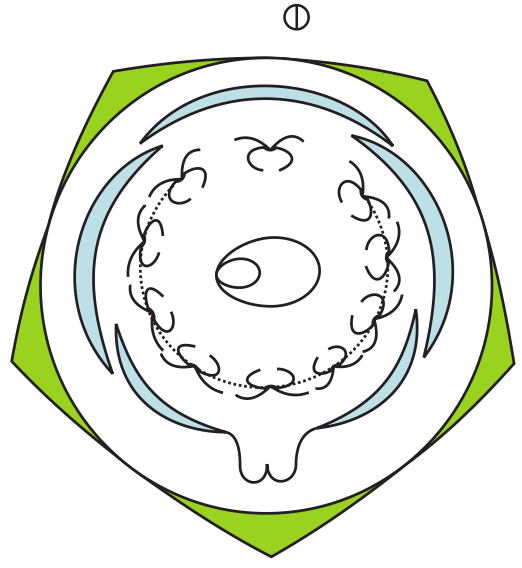
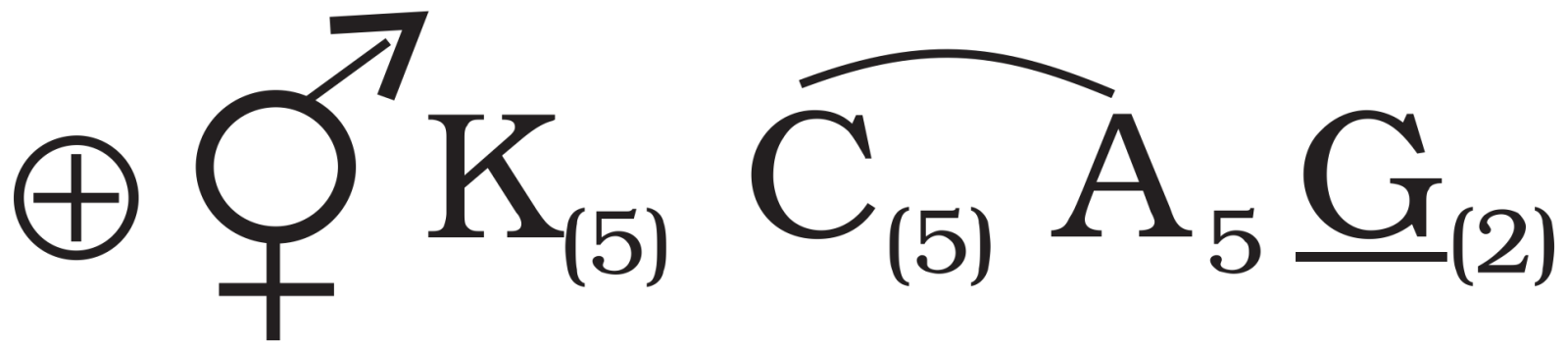
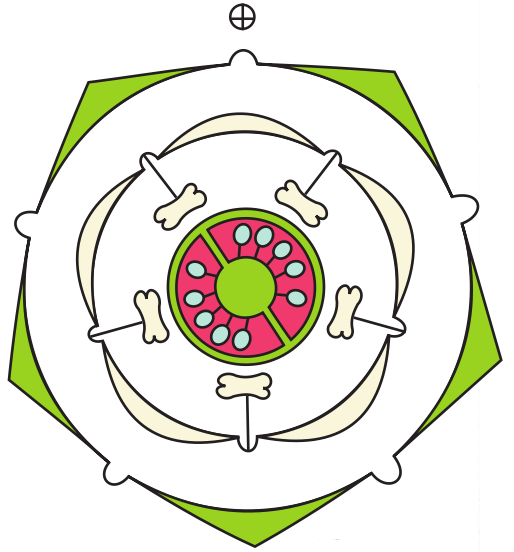
Take one flower each of the families Fabaceae and Solanaceae and write its semi-technical description. Also draw their floral diagram after studying them.
Answer
Family Fabaceae (Pea): Fabaceae (earlier called Papilionaceae) is a sub-family of the Leguminoseae family. Vegetative features:
  • Habit: Pinnately compound, alternately arranged with leaf tendrils with the pulvinus present at the leaf base along folacious stipules.
  • Root: Tap root system with root nodules.
Floral features:
  • Inflorescence: Racemose, generally axial than terminal.
  • Flower: Zygomorphic and bisexual flowers are found.
  • Calyx: It contains five sepals which are gamosepalous while aestivation is imbricate.
  • Corolla: It contains five petals (polypetalous) with vexillary aestivation.
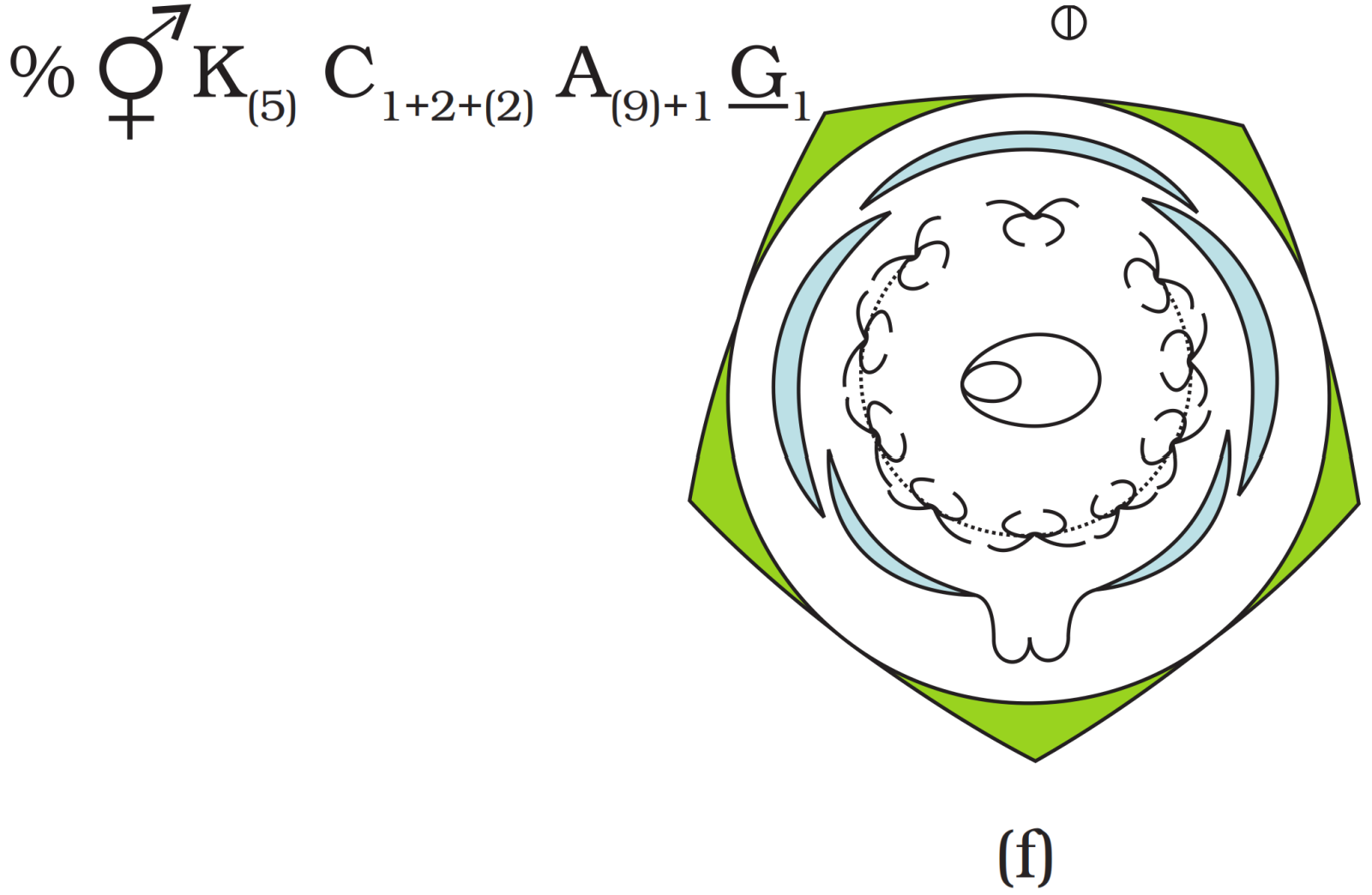
  • Androecium: It consists of ten anthers that are diadelphous with dithecous anthers.
  • Gynoecium: Monocarpellary superior ovary which is unilocular with marginal placentation.
  • Fruit: Legume pod with non-endospermic seeds.
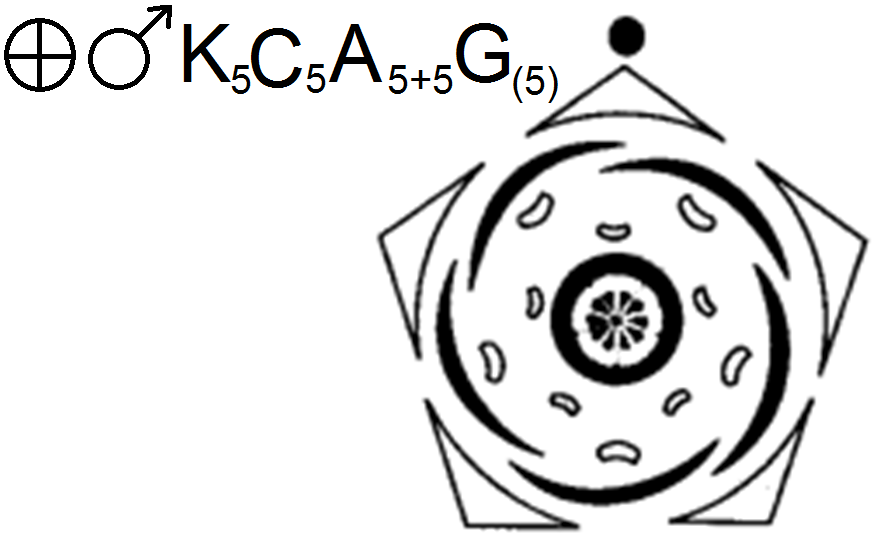
  • Floral formula:
  • Economic importance: Peas are used as vegetables for making various culinary preparations.

Flowers of Solanum nigrum:
Family Solanaceae.

Vegetative features:
  • Habit: Erect, herbaceous plant.
  • Leaves: Simple, exstipulate leaves with reticulate venation.
  • Stem: Erect stem with numerous branches.
Floral features:
  • Inflorescence: Solitary and axillary.
  • Flowers: Actinomorphic, bisexual flowers.
  • Calyx: Calyx is composed of five sepals that are united and persistent. Aestivation is valvate.
  • Corolla: Corolla consists of five united petals with valvate aestivation.
  • Androecium: It consists of five epipetalous stamens.
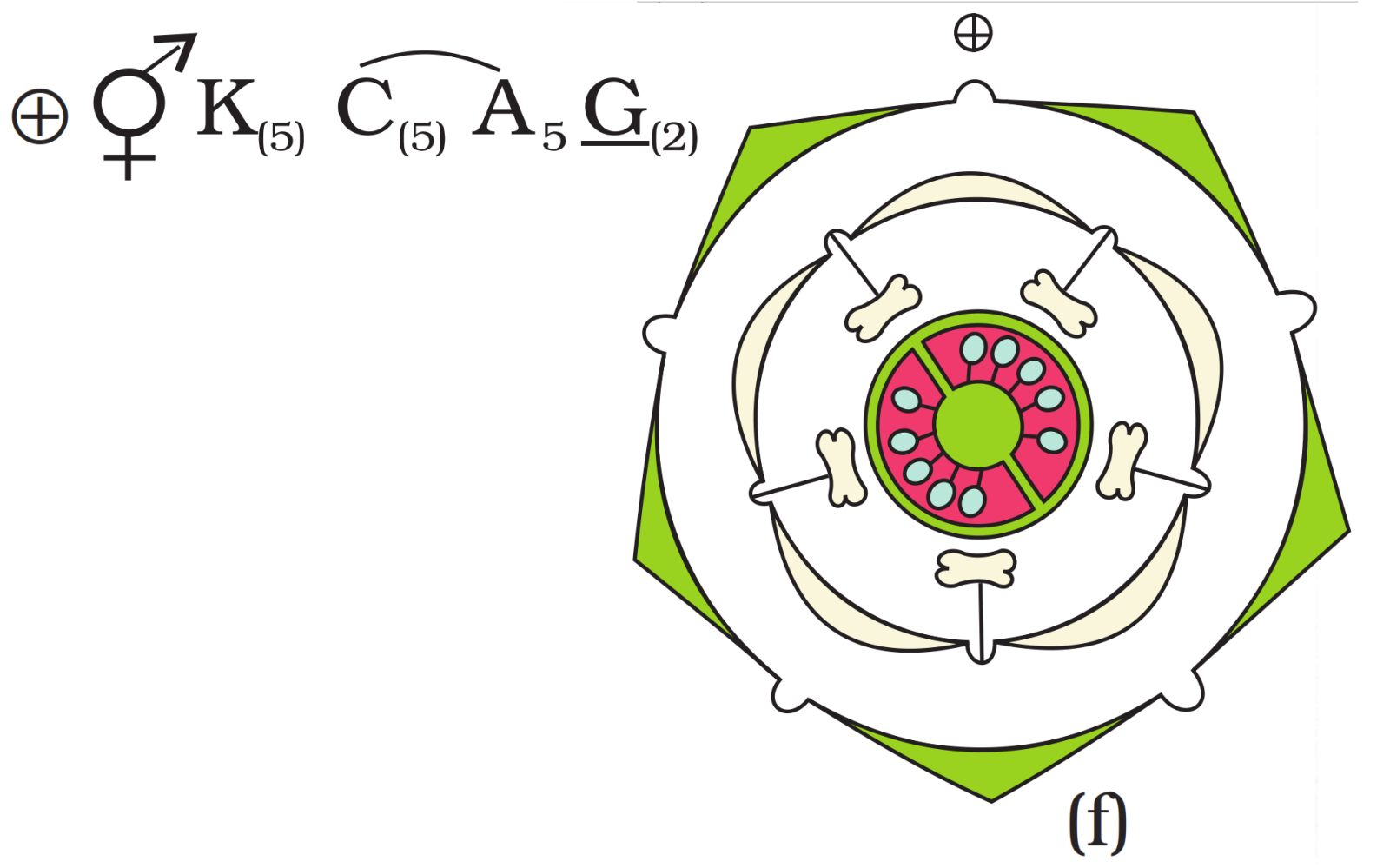
  • Gynoecium: It consists of bicarpellary syncarpous superior ovary with axile placentation.
  • Fruits: Berry.
  • Seeds: Numerous, endospermous.
  • Floral formula:
  • Economic importance: Used for medicinal purposes.
​​​​​​​
View full question & answer
Question 35 Marks
Describe the arrangement of floral members in relation to their insertion on thalamus.
Answer
In a typical flower, the floral members like calyx, corolla, androecium and gynoecium are arranged over the thalamus! Based on the position of calyx, corolla and androecium in respect to ovary on thalamus, the flowers are described as hypogynous, perigynous and epigenous ones. In the hypogynous flower the gynoecium occupies the highest position while the other parts are situated below it. The ovary in such flowers is said to be superior, e.g., mustard, china rose and brinjal. If gynoecium is situated in the centre and other parts of the flower are located on the rim of the thalamus almost at the same level, it is called perigynous. The ovary here is said to be half inferior or sub superior, e.g., plum, rose, peach. In epigynous flowers, the margin of thalamus grows upward enclosing the ovary completely and gets fused with it; the other parts of flower arise above the ovary. Hence, the ovary is said to be inferior as in flowers of guava and cucumber, and the ray florets of sunflower.
View full question & answer
Question 45 Marks
Describe the various types of placentations found in flowering plants.
Answer
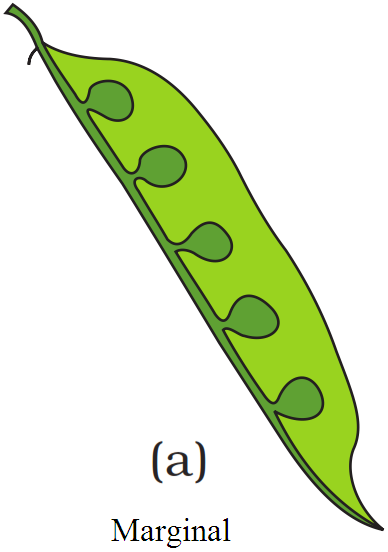
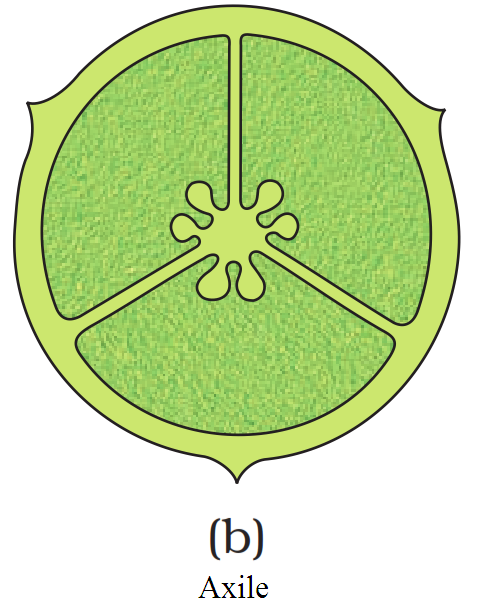
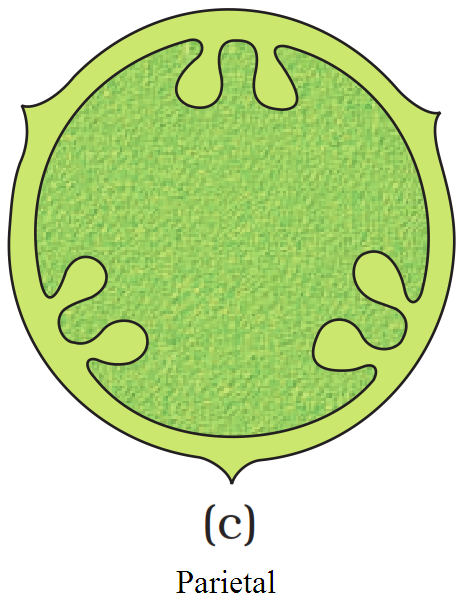
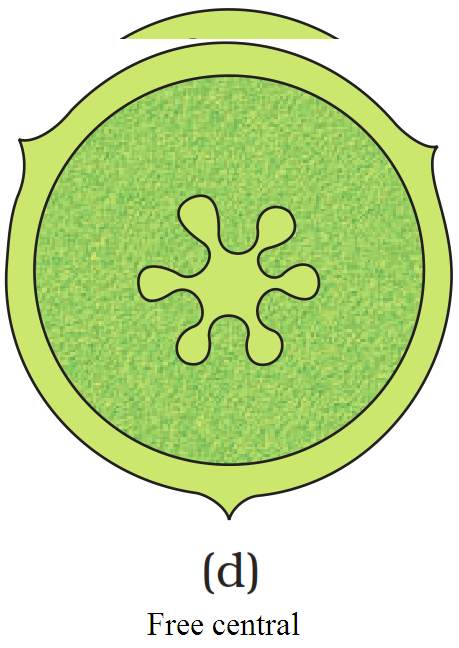
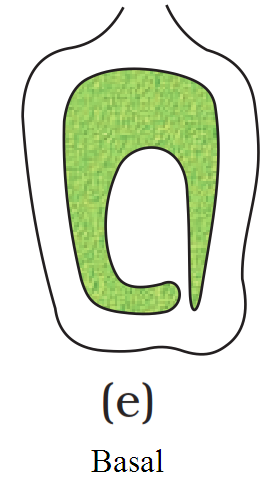
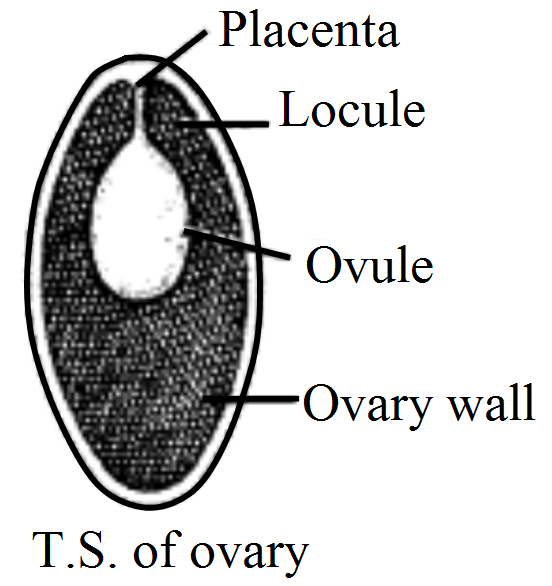
Placenta is a parenchymatous cushion present inside the ovary where ovules are borne. The number, position, arrangement or distribution of placentae inside an ovary is called placentation. The placentations are of different types namely, marginal, axile, parietal, basal and free central.
  1. Marginal placentation: The placenta forms a ridge along the ventral suture of the ovary and the ovules are borne on this ridge forming two rows, e.g., pea.
  2. Axile placentation: When the placenta is axial and the ovules are attached to it in a multilocular ovary, the placentation is said to be axile, e.g., china rose, tomato and lemon.
  3. Parietal placentation: The ovules develop on the inner wall of the ovary or on peripheral part. Ovary is one-chambered but it becomes two-chambered due to the formation of the false septum, e.g., mustard and Argemone
  4. Free central placentation: When the ovules are borne on central axis and septa are absent, as in Dianthus and primrose the placentation is called free central.
  5. Basal placentation: The placenta develops at the base of ovary and a single ovule is attached to it, as in sunflower, marigold.
View full question & answer
Question 55 Marks
What is meant by modification of root? What type of modification of root is found in the:
  1. Banyan tree.
  2. Turnip.
  3. Mangrove trees.
Answer
Primarily, there are two types of root systems found in plants, namely the tap root system and fibrous root system. e-main function of the roots is to absorb water and minerals from the soil. However, roots are also modified to perform various other functions. The roots of some plants act as storage sites for food some provide support to massive plant structures, while others absorb oxygen from the atmosphere. Roots and its modifications in various plants:
  1. Banyan tree: The banyan tree (Ficus benghalensis) has massive pillar-like adventitious roots arising from the aerial part of the stem. These roots grow towards the ground and provide support to the tree. Such roots are called prop roots.
  2. Turnip: The roots of turnip (Brassica rape) help in the storage of food. Similar food-storing roots are found in radishes, carrots, and sweet potatoes.
  3. Mangrove tree: The roots of mangrove plants grow vertically upwards from the soil for the absorption of oxygen from the atmosphere as the soil is poorly aerated. These types of roots are called pneumatophores.
View full question & answer
Question 65 Marks
What is a flower? Describe the parts of a typical angiosperm flower.
Answer
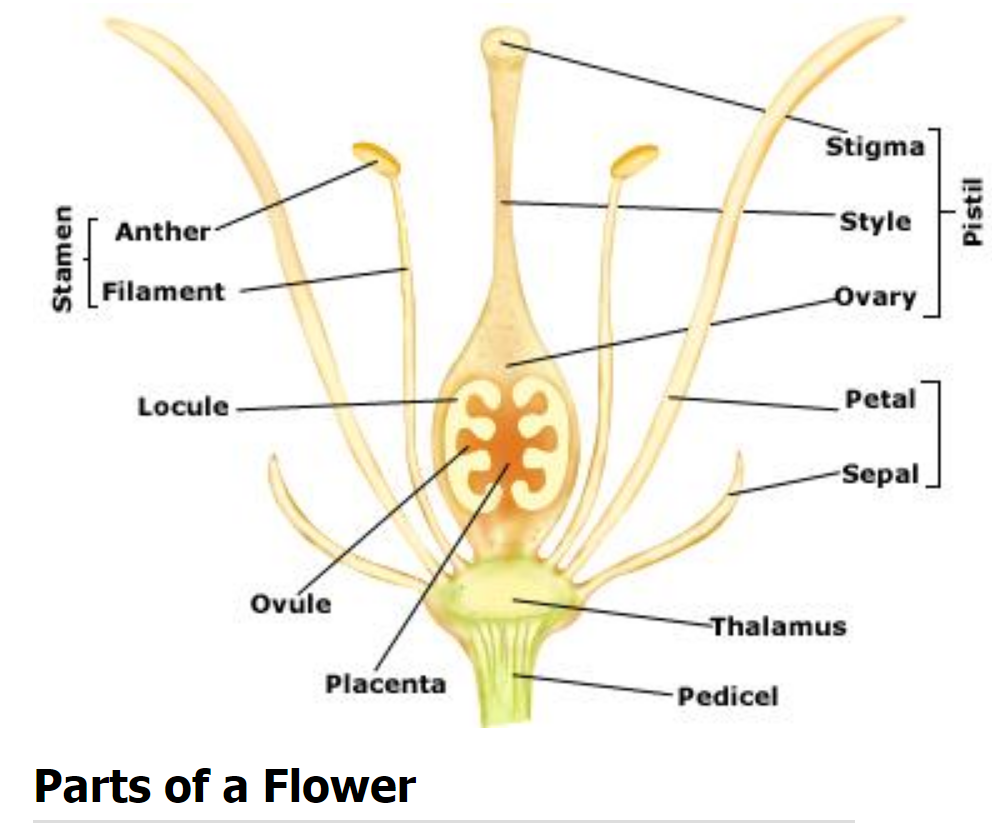
A flower can be defined as the reproductive unit of any flowering plant (angiosperms). Flowers carry out sexual reproduction in angiosperms. A typical flower is a modified stem with a condensed axis. A flower has four different parts i.e., the calyx, corolla, androecium, and gynoecium. Androecium and gynoecium represent the male and female reproductive organs of a flower (respectively). Bisexual flowers are those which contain both androecium and gynoecium, while unisexual flowers contain either gynoecium or androecium. The corolla and the calyx are generally distinct, but may sometimes be fused (called perianth). A flower that contains all four floral parts is called a complete flower.Parts of flowers:
  1. The calyx forms the outermost whorl of a flower, which contains sepals. They are green, leaf–like structures that cover and protect the flowers during the bud stage. When the sepals of a flower are free, they are called polysepalous, while fused sepals of a flower are called gamosepalous.
  2. The corolla of a flower is a layer that lies inside the calyx. It contains beautifully coloured petals, which help in attracting insects for pollination. When the petals are free, they are called polypetalous, while fused petals are called gamopetalous.
  3. The androecium or the stamen is the male reproductive part of a flower. It consists of two parts, the filament and the bilobed anther. The bilobed anther is the site for meiosis and the generation of pollen grains.
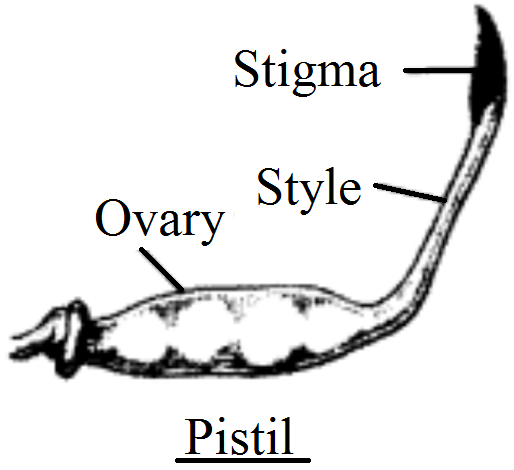
  4. Gynoecium represents the female reproductive part of a flower. It consists of an ovary. The ovary is connected by a long tube (called style) to the stigma. The ovary bears numerous ovules attached to the placenta.
View full question & answer
Question 75 Marks
Describe modifications of stem with suitable examples.
Answer
Modifications of Stem:
  1. Modification for food storage: The underground stems of potato, ginger, turmeric, zamikand, Colocasia, etc. are modified for food storage. Such modifications are the tools of perenation to tide over unfavourable conditions.
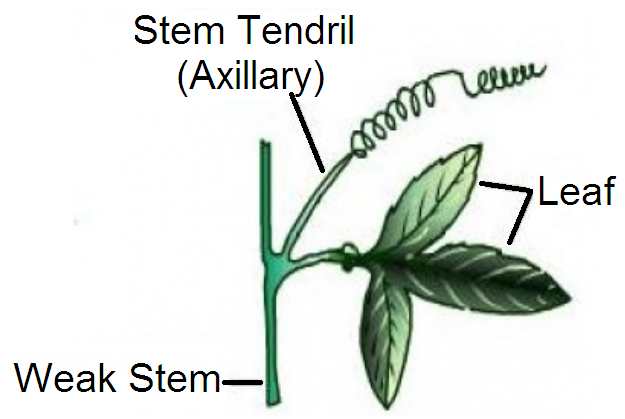
  2. Modifications for climbing: In some plants, stem tendrils develop form axillary buds. These are slender and spirally coiled structures. A tendril helps the plant to climb to a support, e.g. cucumber, pumpkin, grapevine, etc.
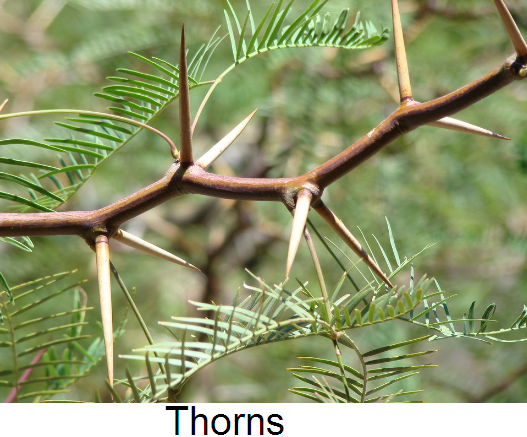
  3. Modification for defence: In some plants, the axillary buds are modified into woody, straight and pointed thorns. Such thorns protect the plant from browsing animals, e.g. Citrus, Bougainvillea.
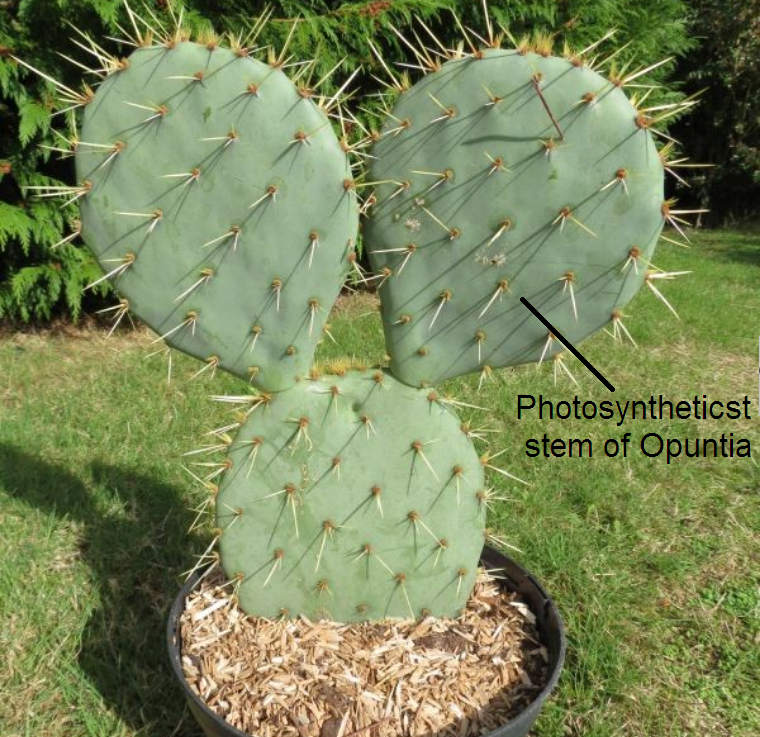
  4. Modification for photosynthesis: In some plants of arid regions, the stems are modified into flattened or fleshy cylindrical structures. The flattened structure can be seen in Opuntia and the cylindrical structure can be seen in euphorbia. Such structures contain chlorophyll and photosynthesis happens in them.
  5. Modification for vegetative propagation: Stems are modified for vegetative propagation in many plants, e.g. grass, berry, dahlia, etc.
View full question & answer
Question 85 Marks
Sonali, a 7 years old girl was roaming in the garden, when she saw a butterfly hovering over a flower. She was attracted to the flower and plucked it. On coming back home, she showed it to her brother (a biology graduate student) who scolded her for her action. He explained the importance of flowers for the plants and insects like butterflies honeybees, etc. Sonali realised her mistake and immediately promised not to repeat įt.
  1. What is the importance of flower?
  2. How are insects attracted to flowers?
  3. Name the different parts of a flower.
  4. What values are displayed by Sonali?
Answer
  1. Flower contains androecium and gynoecium for the reproduction.
  2. Insects are attracted to the flowers by their colour and fragrance.
  3. Calyx, corolla, androecium and gynoecium are different parts of a flower.
  4. Realisation of mistake, love towards nature and never repeatation of mistake are the values displayed by Sonali.
View full question & answer
Question 95 Marks
What is a tissue? Describe different types of simple tissues in plants.
Answer
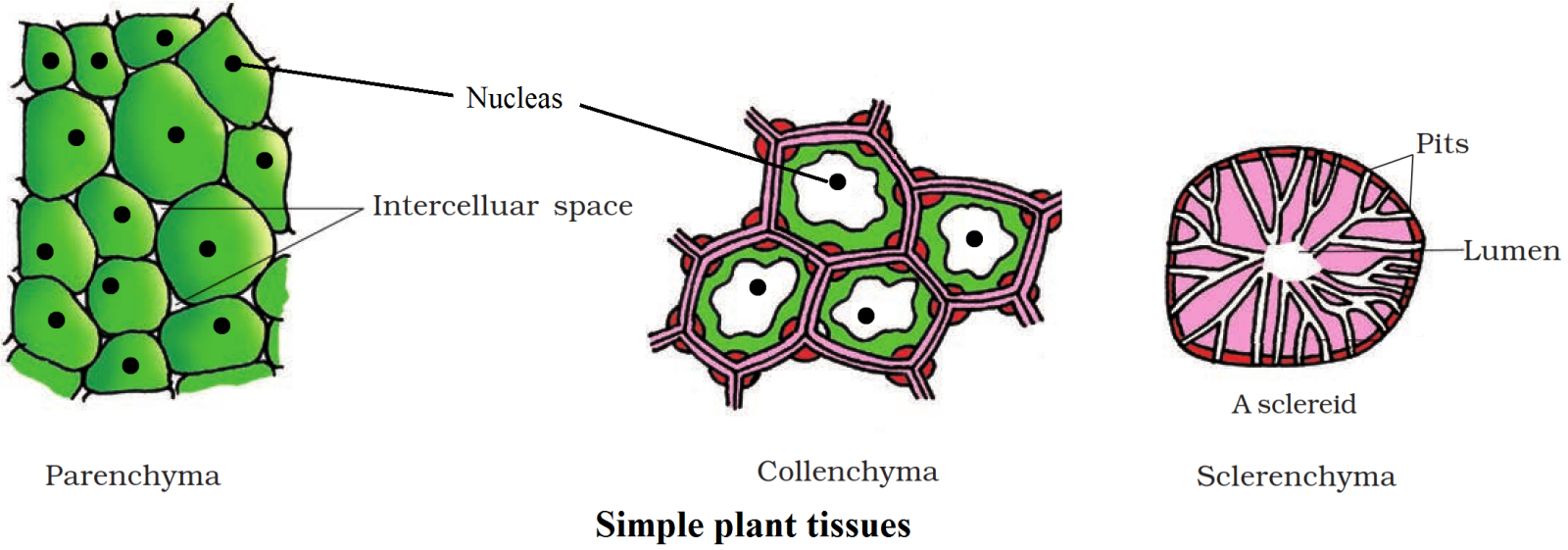
A tissue is a group of cells having a common origin and usually performing a common function. Simple Tissues: A simple tissue is made of only one type of cells. Simple tissues are of following types:
  1. Parenchyma: Parenchyma forms the major component within organs. The cells of the parenchyma are generally isodiametric. They may be spherical, oval, round, polygonal or elongated in shape. Their walls are thin and made up of cellulose. They may either be closely packed or have small intercellular spaces.
  • Function: The parenchyma performs various functions like photosynthesis, storage, secretion.
  1. Collenchyma: The collenchyma occurs in layers below the epidermis in dicotyledonous plants. It is found either as a homogeneous layer or in patches. It consists of cells which are much thickened at the corners due to a deposition of cellulose, hemicellulose and pectin. Collenchymatous cells may be oval, spherical or polygonal and often contain chloroplasts. These cells assimilate food when they contain chloroplasts. Intercellular spaces are absent.
  • Function: They provide mechanical support to the growing parts of the plant such as young stem and petiole of a leaf.
  1. Sclerenchyma: Sclerenchyma consists of long, narrow cells with thick and lignified cell walls having a few or numerous pits. They are usually dead and without protoplasts. On the basis of variation in form, structure, origin and development, sclerenchyma may be either fibres or sclereids. The fibres are thick-walled, elongated and pointed cells, generally occuring in groups, in various parts of the plant. The sclereids are spherical, oval or cylindrical, highly thickened dead cells with very narrow cavities (lumen). These are commonly found in the fruit walls of nuts; pulp of fruits like guava, pear and sapota; seed coats of legumes and leaves of tea.
  • Function: Sclerenchyma provides mechanical support to organs.
View full question & answer
Question 105 Marks
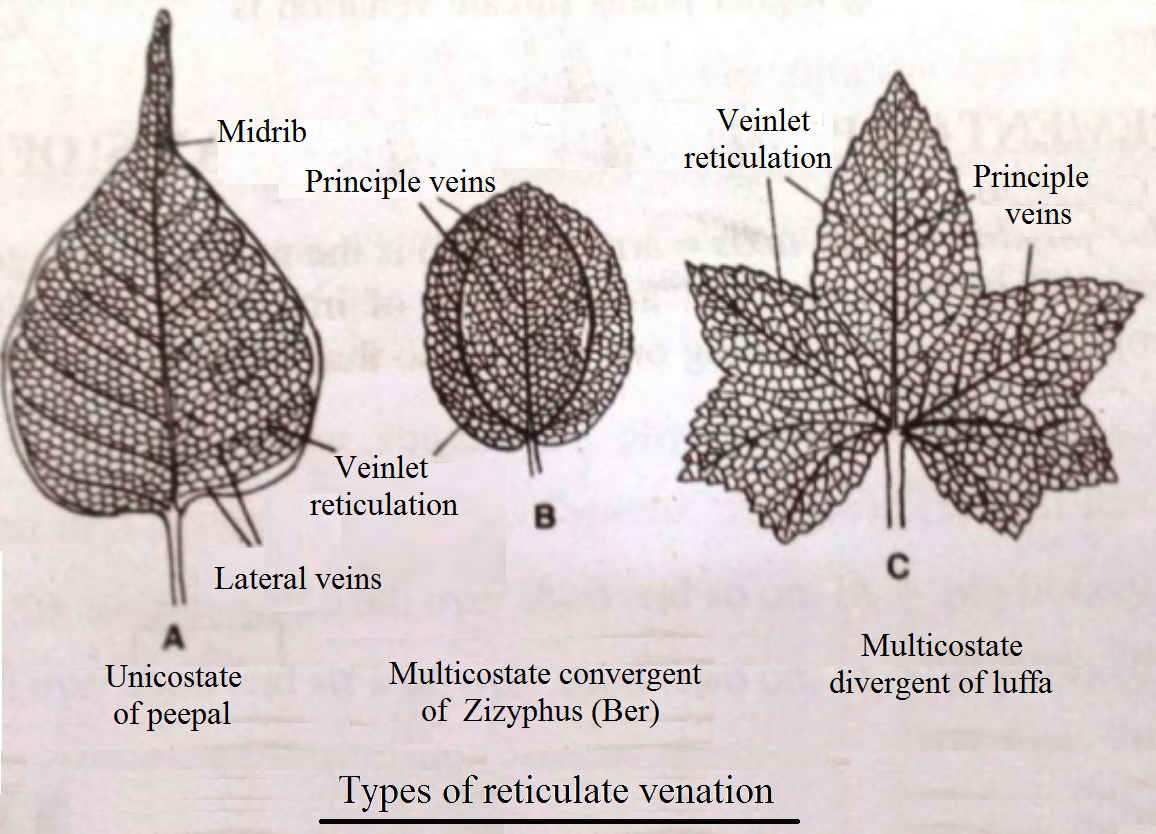
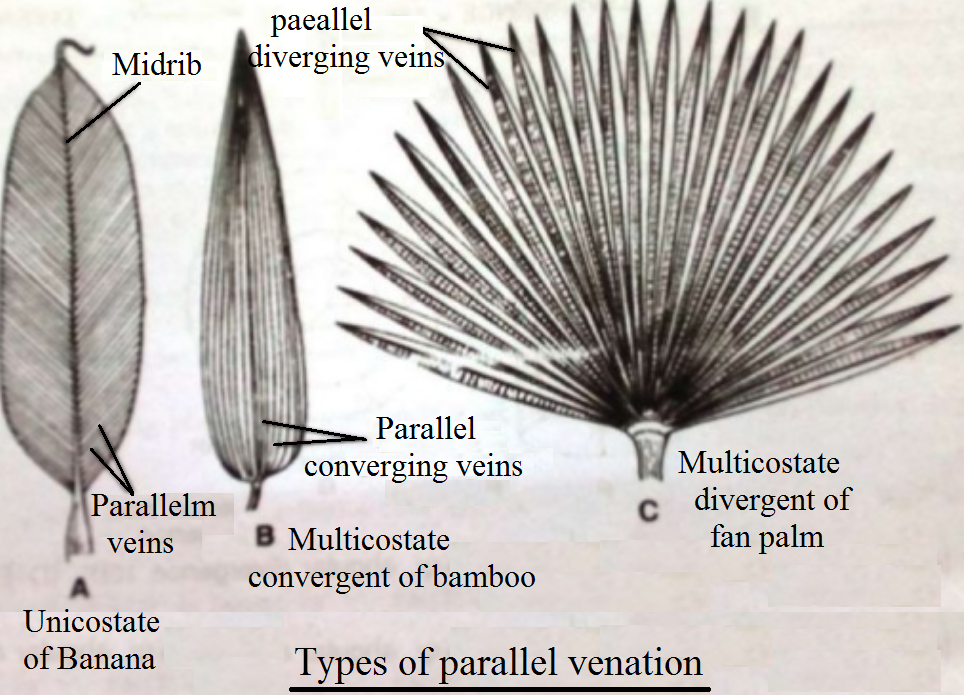
Draw diagrams of a typical monocot and dicot leaves to show their venation pattern.
Answer
Labelled diagrams of monocot leaves showing parallel venation are as follows:
View full question & answer
Question 115 Marks
The essential functions of roots are anchorage and absorption of water and minerals in the terrestrial plant. What functions are associated with the roots of aquatic plants. How are roots of aquatic plants and terrestrial plants different?
Answer
The root system in hydrophytes is feebly developed and root, root hairs and cap arq absent. In some floating plants such as Utricularia, Ceratophyllum, etc., no roots are developed, and in submerged plants such as Vallisneria, Hydrilla etc., water dissolved mineral salts and gases are absorbed by their whole surface. In plants like Pistia, Eichhornia, Lemna, etc., no root cap develops, but root pocket is formed instead. An aquatic plant is, in reality, submerged in or floating up on a nutrient solution. In hydrophytes the root system is functioning chiefly as holdfast or anchors, and a large part of the absorption takes place through the leaves and stems.
View full question & answer
Question 125 Marks
A typical angiosperm flower consists of four floral parts. Give the names of the floral parts and their arrangements sequentially.
Answer
The four floral parts of typical angiosperm flower are Calyx It is the outermost whorl of the flower and members are called calyx or sepals. These are usually green and are protective in function (in bud stage). Corolla It is composed of petals, usually bright coloured to attract insects for pollination. AndroeciumIt is composed of stamens, the male reproductive organ. Each stamen hasstalk or filament and anther (containing pollen sac and pollen grains). Gynoecium It is the female reproductive part and made up of one or more carpels. Each carpel has stigma, style and ovary.
View full question & answer
Question 135 Marks
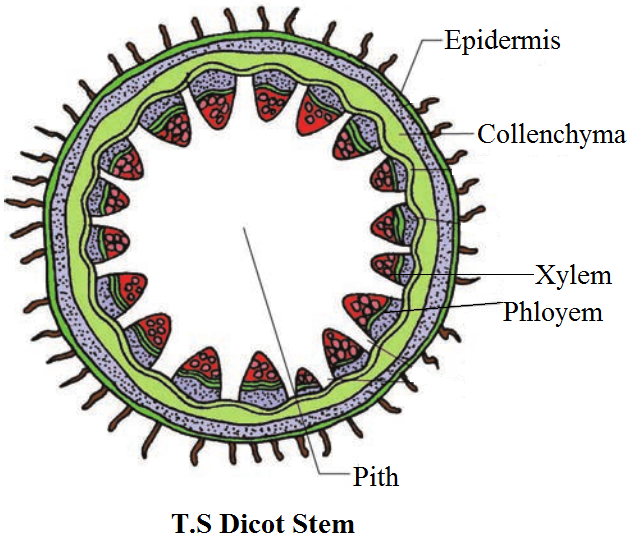
With suitable diagram explain the structure of dicot stem. Write main differences between dicot and monocot stems.
Answer
Dicotyledonous Stem:
  • Epidermis: The transverse section of a typical young dicotyledonous stem shows that the epidermis is the outermost protective layer of the stem. Covered with a thin layer of cuticle, it may bear trichomes and a few stomata.
  • Cortex: The cells arranged in multiple layers between epidermis and pericycle constitute the cortex. It consists of three sub-zones. The outer hypodermis, consists of a few layers of collenchymatous cells just below the epidermis, which provide mechanical strength to the young stem. Cortical layers below hypodermis consist of rounded thin walled parenchymatous cells with conspicuous intercellular spaces. The innermost layer of the cortex is called the endodermis. The cells of the endodermis are rich in starch grains and the layer is also referred to as the starch sheath. Pericycle is present on the inner side of the endodermis and above the phloem in the form of semi-lunar patches of sclerenchyma. In between the vascular bundles there are a few layers of radially placed parenchymatous cells, which constitute medullary rays.
  • Vascular Bundles: A large number of vascular bundles are arranged in a ring; the 'ring' arrangement of vascular bundles is a characteristic of dicot stem. Each vascular bundle is conjoint, open, and with endarch protoxylem. A large number of rounded, parenchymatous cells with large intercellular spaces which occupy the central portion of the stem constitute the pith.
Differences between dicot and monocot stems:
S.No.
Dicot Stem
Monocot Stem
i.
Vascular bundles are arranged in a ring.
Vascular bundles are scattered.
ii.
Secondary growth takes place.
Secondary growth does not happen.
iii.
Wood is formed.
Wood is not formed.
View full question & answer
Question 145 Marks
The arrangements of ovules within the ovary is known as placentation. What does the term placenta refer to? Name and draw various types of placentations in the flower as seen in T.S. or V.S.
Answer
Placenta is a flattened, cushion like tissue on which one or more ovules are attached. The various types of placenta ion seen in the flowers are described in the following table:
Type of Placentation
Description with example
Diagram
Marginal
There is a single placenta which develops along the junction of two fused margins, e.g., pea.
Axile
Mutlicarpellary, syncarpous gynoecium inward growth of carpel's margin forms a multicarpellary condition that contains an axis in the centre. Placenta arises from central axis bearing ovules. e. g., Solanum, China rose.
Parietal
The number of placenta corresponds to number of fusing carpels. Sometimes the ovules bearing placenta grow inward to form false septa and thus ovary becomes bilocular(e.g., mustard) and trilocular e.g., Cucurbit.
Free central
The ovary is unilocular and ovules are borne on the central-axis and not connected to the ovary wall by septum, e.g., Dianthus, Silensa.
Basal
The ovary is unilocular and the single ovule is borne at the base of the ovary attached by a single placenta, e.g., sunflower, wheat.
View full question & answer
Question 155 Marks
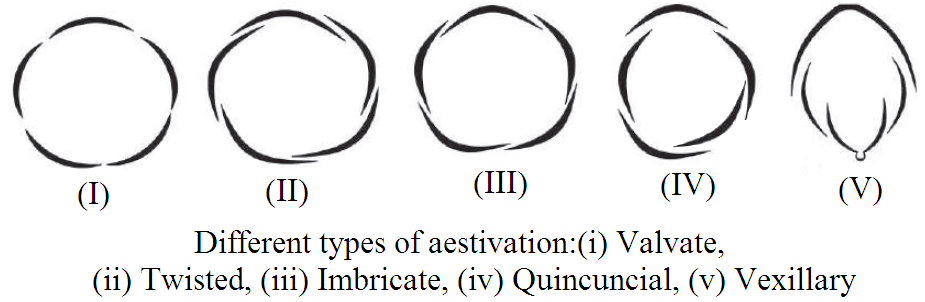
The mode of arrangements of sepals or petals in a floral bud is known as aestivation. Draw the various types of aestivation possible for a typical pentamerous flower.
Answer
The various types of aestivation possible for a typical pentamerous flower are as follows:
  1. Valvate aestivation: In valvate aestivation, the margins of petals just touch each other without any overlapping, e.g., Brassica.
  2. Twisted aestivation: In twisted or contorted type, one margin of each petal overlaps the margin of an adjacent petal and the other margin being overlapped by margin of another adjacent petal, e.g., China rose.
  3. Imbricate aestivation: Imbricate is aestivation of five parts, where one is exterior, one is interior and rest three are having one margin exterior’ and other interior.
  4. Quincuncial aestivation: Quincuncial is aestivation of five parts, where two are exterior, two interior and the fifth is having one margin exterior and the other interior.
  5. Vexillary aestivation: Vexillary aestivation when the standard petal is large and overlaps the two wing petals which in turn overlap the keel petals. It is technically known as vexillary aestivation. E.g. pea, bean, Irtdigofera, Tephrosia, etc.
View full question & answer
Question 165 Marks
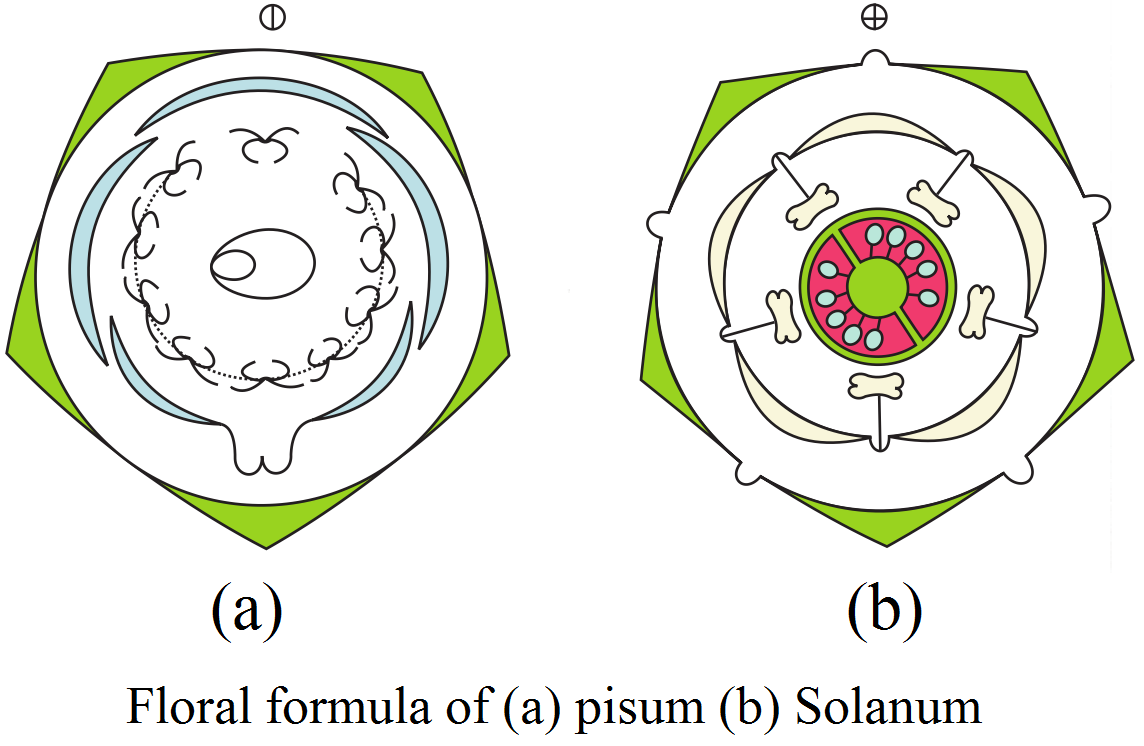
Take one flower each of the families-Fabaceae and Solanaceae and write its floral formulae. Also draw their floral diagram after studying them.
Answer
Pisum sativum (pea) flower of family-Fabaceae. Solanum tuberosum (potato) flower of family-Solanaceae.

View full question & answer
Question 175 Marks
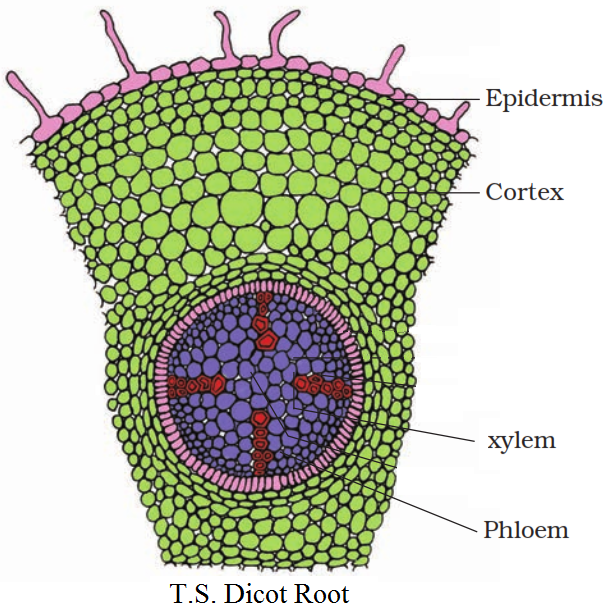
With suitable diagrams explain the structures of dicot and monocot root.
Answer
Dicotyledonous Root:
  • Epidermis: The outermost layer is epidermis. Many of the epidermal cells protrude in the form of unicellular root hairs.
  • Cortex: The cortex consists of several layers of thin-walled parenchyma cells with intercellular spaces.
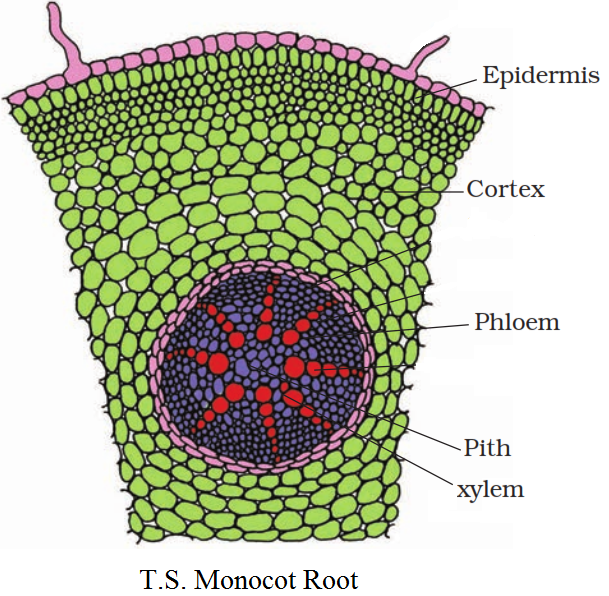
  • Endodermis: The innermost layer of the cortex is called endodermis. It comprises a single layer of barrel-shaped cells without any intercellular spaces. The tangential as well as radial walls of the endodermal cells have a deposition of water be impermeable, waxy material suberin in the form of caspariun strips. Next to endodermis lies a few layers of thick-walled parenchyomatous cells referred to as pericycle. Initiation of lateral roots and vascular cambium during the secondary growth takes place in these cells. The pith is small or inconspicuous. The parenchymatous cells which lie between the xylem and the phloem are called conjuctive tissue. There are usually two to four xylem and phloem patches. Later, a cambium ring develops between the xylem and phloem. All tissues on the innerside of the endodermis such as pericycle, vascular bundles and pith consuute the stele.
  • Monocotyledonous Root: The anatomy of the monocot root is similar to the dicot root in many respects. It has epidermis, cortex, endodermis, pericycle, vascular bundles and pith. As compared to the dicot root which have fewer xylem bundles, there are usually more than six (polyarch) xylem bundles in the monocot root. Pith is large and well developed. Monocotyledonous roots do not undergo any secondary growth.
View full question & answer
Question 185 Marks
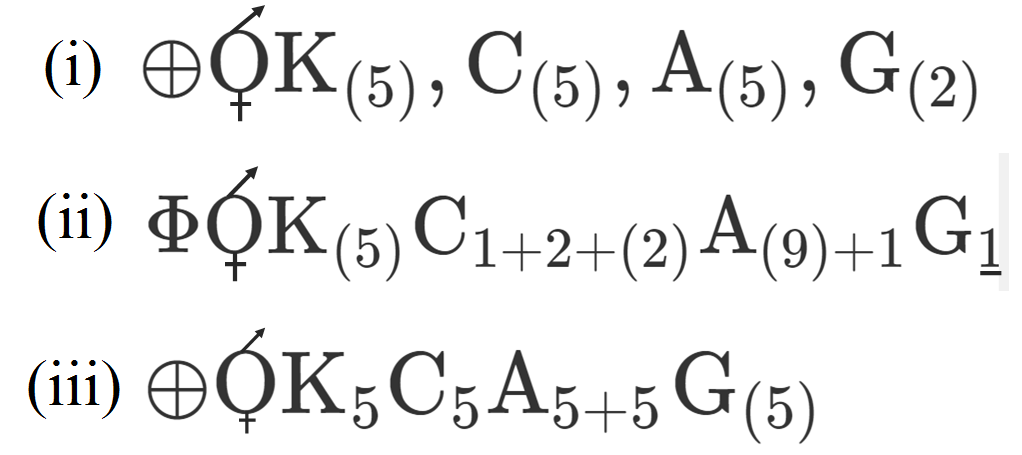
Given below are floral formulae of some plants. Draw floral diagrams from these formulae.
Answer
Floral diagram for floral formula, i. ii. iii.
View full question & answer
Question 195 Marks
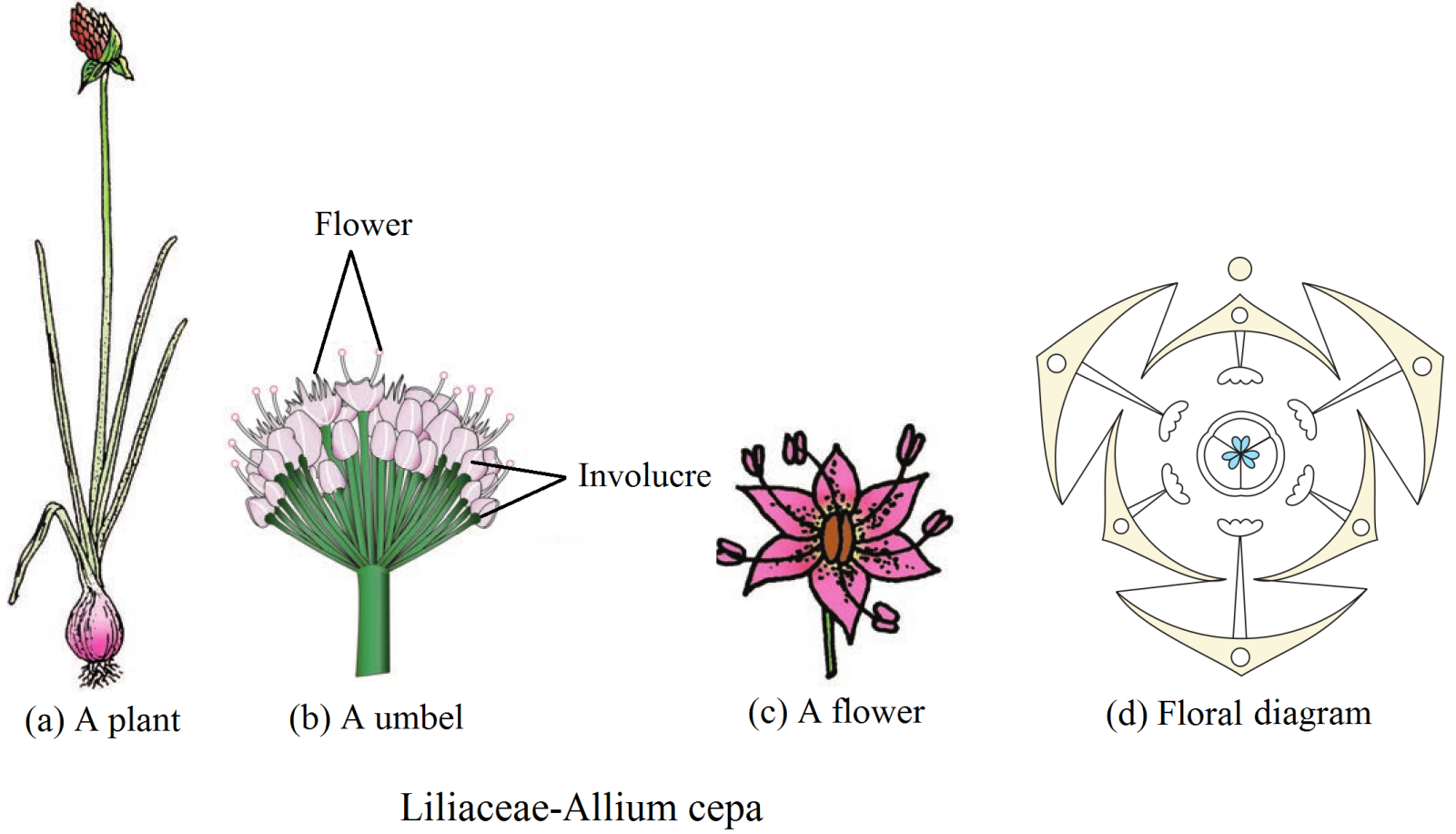
Draw the floral diagram of Liliaceae and write its floral formula. Write two major differences between the flowers of this family and those of Solanaceae.
Answer

S. No
Liliaceae Flowers
Solanaceae Flowers
(i)
Flowers are trimerous.
Flowers are pentameous.
(ii)
Perianth is present in two whorls.
Calyx and corolla are present.
(iiii)
Stamens are opposite to the tepals and free.
Stamens alternate with petals and epipetalous
(iv)
Ovary is tricarpellary, syncarpous with axile placentation.
Ovary is bicarpellary syncarpous with swollen axile placentation.
(v)
Flowers are bracteate.
Flowers are generally ebracteate.
View full question & answer
Question 205 Marks
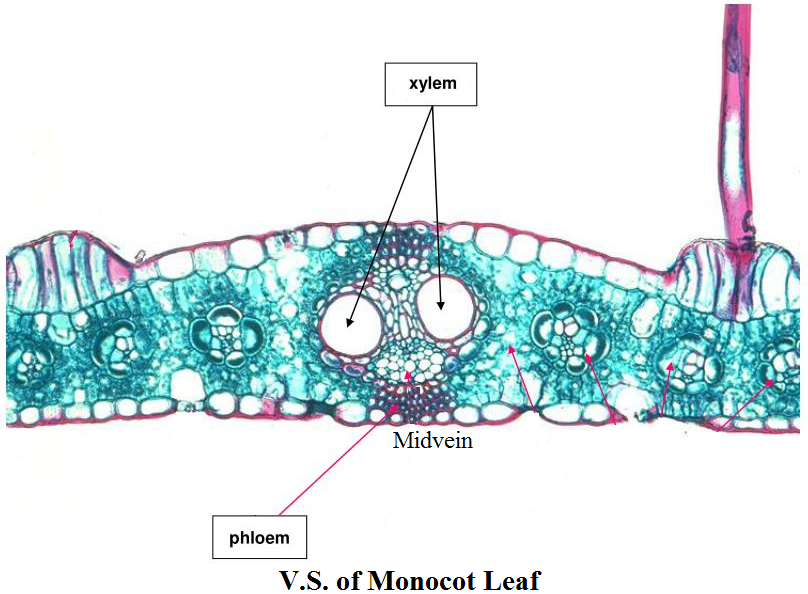
Describe the structure of an isobilateral leaf. Differentiate between a moncot and dicot leaf.
Answer
Isobilateral (Monocotyledonous) Leaf: Structure:
  • Epidermis is composed of single layer of cells.
  • Stomata are present on both surfaces of leaf.
  • Mesophyll is not differentiaited into palisade and spongy parenchyma.
  • In grasses, certain adaxial epidermal cells along the veins modify themselves into large, empty, colourless cells. These are called bulliform cells. When the bulliform cells in the leaves have absorbed water and are turgid, the leaf surface is exposed. When they are flaccid due to water stress, they make the leaves curl inwards to minimise water loss.
  • The parallel venation in monocot leaves is reflected in the near similar sizes of vascular bundles (except in main veins) as seen in vertical sections of the leaves.
Differences between Dicot and Monocot Leaf:
S.No.
Dicot Leaf
Monocot Leaf
i.
Stomata on ventral surface.
Stomata on both surfaces.
ii.
Mesophyll differentiated in Pallisade and spongy parenchyma.
Mesophyll is not differentiated.
iii.
Bulliform cells absent.
Bulliform cells present.
iv.
Vascular bundles are of different sizes.
Vascular bundles are of similar sizes (except in main veins)
View full question & answer
Question 215 Marks
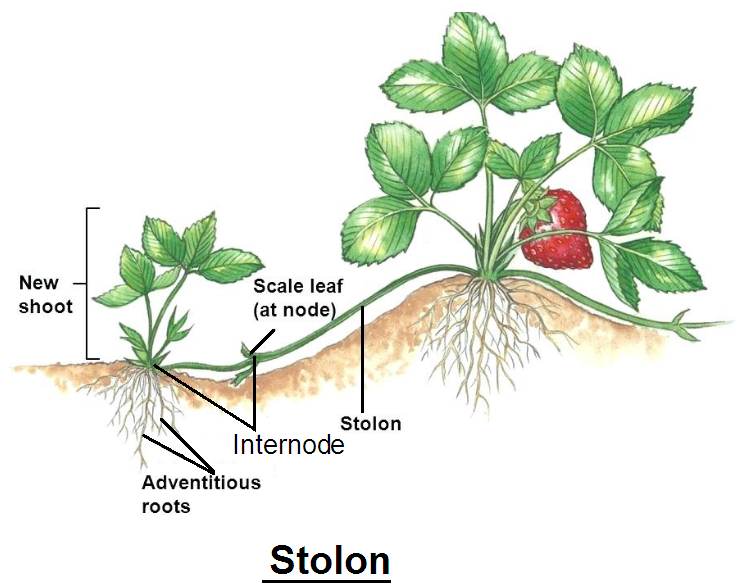
Stolon, offset and rhizome are different forms of stem modifications. How can these modified forms of stem be distinguished from each other?
Answer
Stem modifications. Stem gets modified in different forms like stolen, offset and rhizomes. These can be distinguished from each other in the following manner:
Stolon
Offset
Rhizome
The stem is a creeper. It is a long distance runner with longer and thicker internodes. Horizontal branches arise from the internodes, e.g., strawberry.
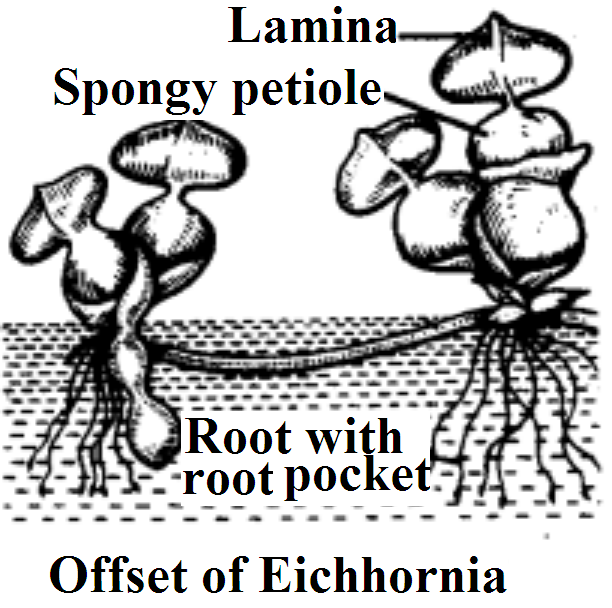
It is like small a runes of one internode long, but inter nodes are shorter and thicker branches arise all around the main stem usually found in rosette plants on water or ground surface, e.g., Eichhornia, Pistia.
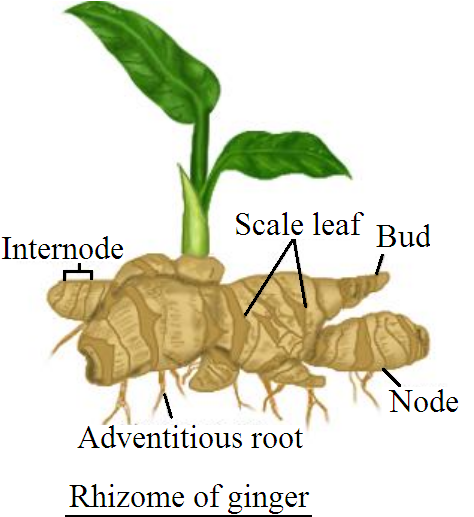
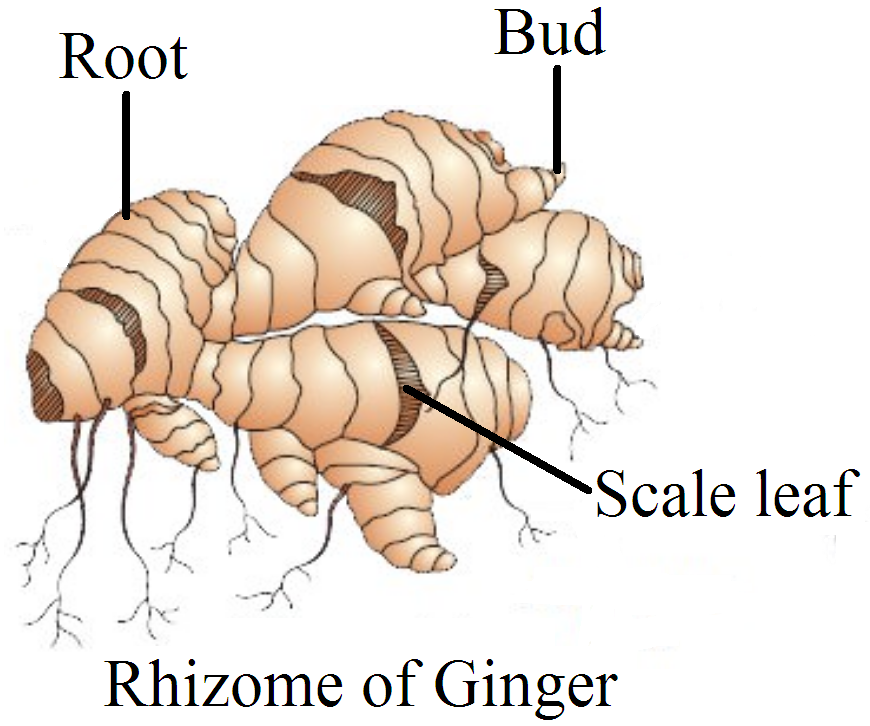
These are stem which bear nodes and internodes, scaly leaves, axillary buds and roots arising from nodes e.g.,Ginger, banana, turmeric. They are modified to store food in plants.
View full question & answer
Question 225 Marks
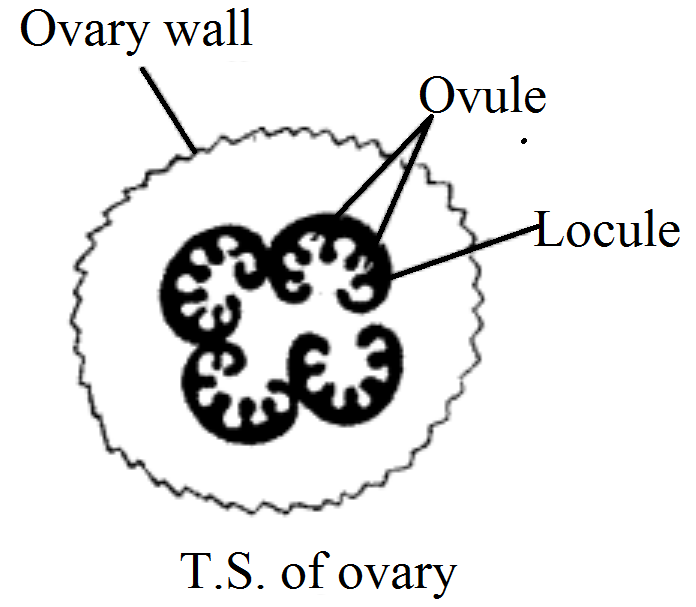
Distinguish between families Fabaceae, Solanaceae, Liliaceae on the basis of gynoecium characteristics (with figures). Also write economic importance of any one of the above family.
Answer
In the Family Fabaceae, gynoecium is monocarpellary, with unilocular superior ovary. Ovary has marginal placentation, and many ovules are arranged in two alternate rows. Style is bent, and stigma is simple or capitates. In Family Solanaceae, gynoecium is bicarpellary, syncarpous, ovary is superior, carpels are placed obliquely, generally bilocular, placentation is axile. Ovules are many in each locule, placentae are swollen. A nectariferous disc or lobe may be present, stigma is capitate or lobed. In Family Liliaceae gynoecium is tricarpellary, syncarpous. Ovary is superior, trilocular with two to many ovules in each locule. Placentation is axile, rarely parietal, styles are united or separate, stigma is free or fused and trilobed. Economic importance of Family Fabaceae is as follows:
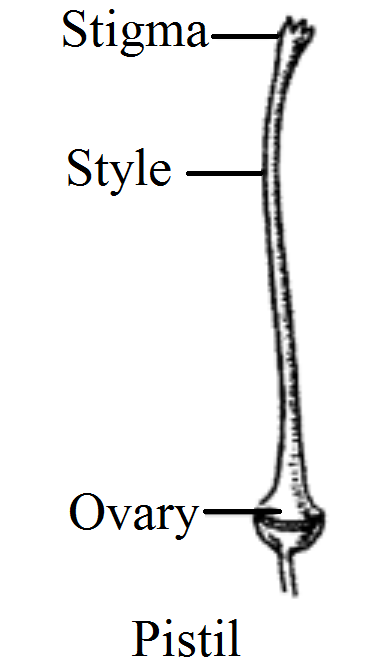
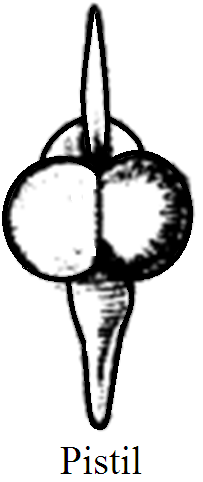
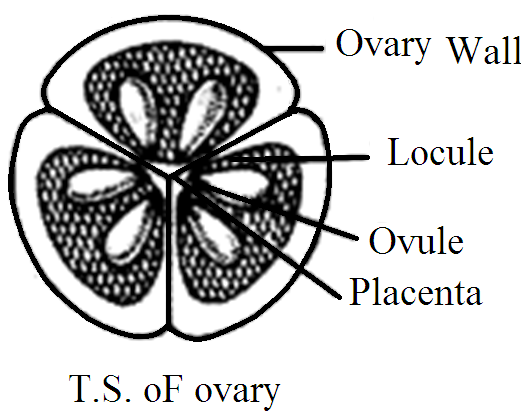
  1. Food: A number of legumes or pulses are obtained from Fabaceae. E.g., Pisum sativum (pea), Cicer arietinum (gram), Lens culinaris (Masur), Phaseolus mungo (urd), Phaseolus aureus (mung) Cajanus cajan (arhar), Glycine max (soybean), etc.
  2. Fodder: Medicago sativa (Alfalfa), Medicago denticulata (toothed, bur clover), Trifolium alexandrium (Egyptian clover), etc’are common herbs used as fodder.
  3. Oils: They are extracted from seeds of Arachis hypogaea (groundnut or peanut) and Glycine max (soybean).
  4. Soil fertility: Nodule bearing papilionaceous plants increase nitrogen content of the soil. E.g., Crotolaria, Sesbania, Cyamopsis.
  5. Fibres: Obtained from the stems of Crotolaria juncea (sunn hemp) and Sesbania species, used in making cordage, sacks, nets, tissue paper, etc.
  6. Dyes: Indigo is obtained from the leaves of Indigofera tinctoria.
  7. Gum: Cyamopsis tetragonoloba yields guar gum which is employed in pharmaceuticals, textiles, paper, plastics and photography.
  8. Meditines: The roots of Glycyrrhiza glabra (malatthi) are used as demulcent, expectorant and in treating gastric ulcers. Fresh leaf juice of Abrus precatorius (Jeweller’s weights, ratti) is useful in treating leucoderma. Juice of flowers of Sesbania grandiflora improves eye sight.
  9. Timber: Dalbergia sissoo (Shisham) and Dalbergia latifolia (Indian rosewood) provide wood for making furniture.
  10. Ornamentals: Lathyrus odoratus, Clitoria ternatea, Lupinus. Erythrena indica are ornamental plants.
View full question & answer
Question 235 Marks
Describe various stem modifications associated with food storage, climbing and protection.
Answer
The stem may be modified for:
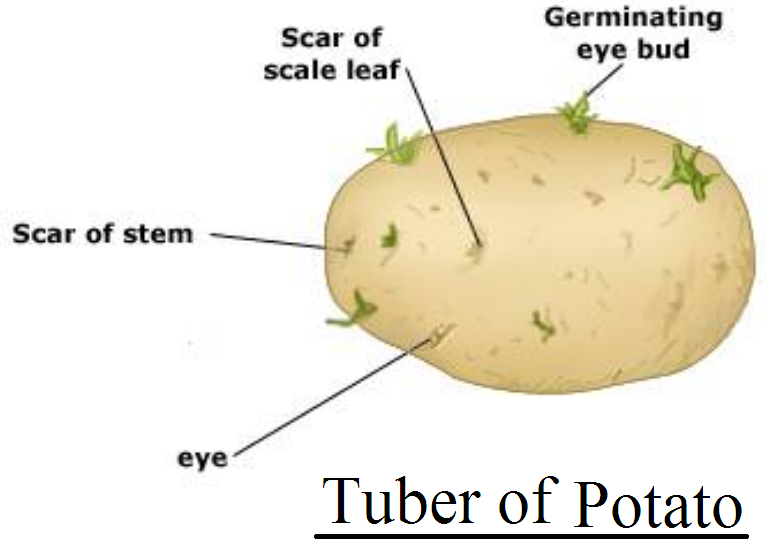
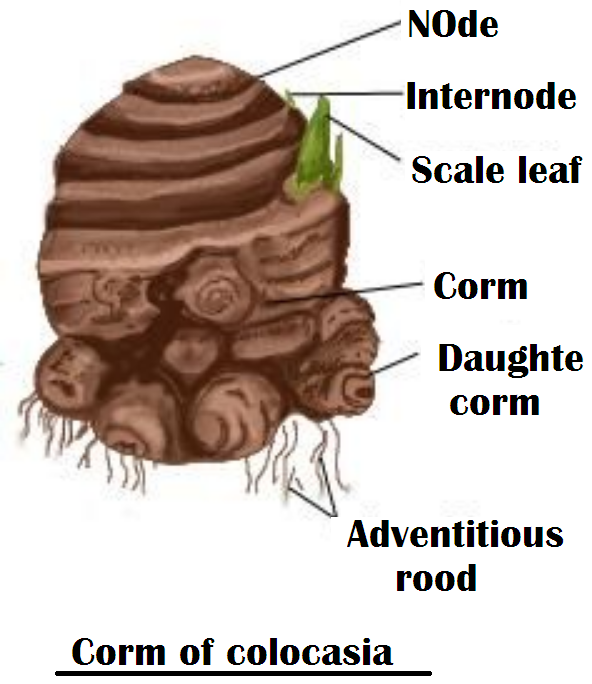
  1. Storage: Underground stems of plants like potato are modified into tubers which perform the function of storing food. Stem of plants like ginger are modified into rhizome while the stem of colocasia are modified into corm. All these stem modification perform the function of storing food.
  1. Support: Stem of the plants like gravevine and pumpkin are modified into tendrils. These tendrils are slender and spirally coil that help the plant to climb and provide support.
  2. Protection: Stem of plants like Citrus and Bougainvillea are modified into thorns which protect the plants from the browsing animals.
​​​​​​​
  1. Photosynthesis: Plants like Opuntia have modified stems which are flattened, fleshy and contain chlorophyll that carries out photosynthesis.
​​​​​​​
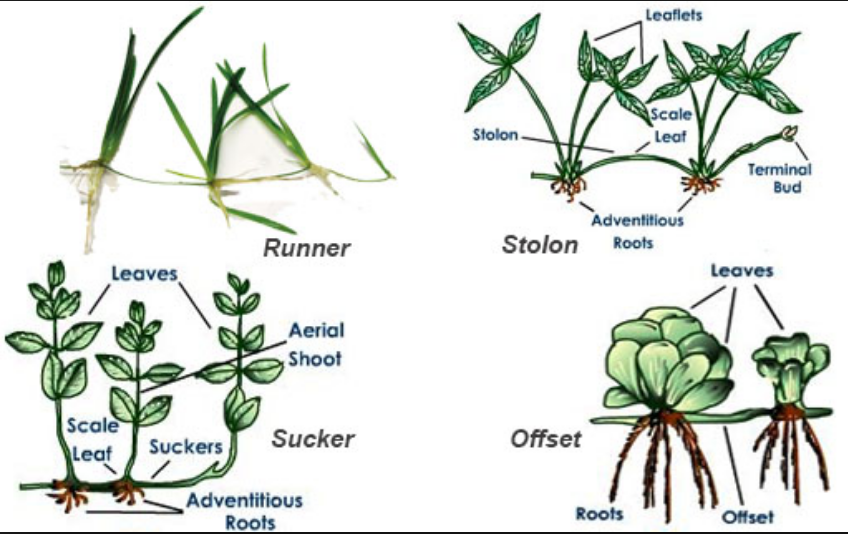
  1. Spread: Stem of plants like strawberry is modified into a Stolon that spreads to new niches. Plants like Pistia possess stem which is modified into Offset, which has a lateral branch with short internodes and each node bearing a tuft of rosette leaves. Runner is the stem modification in plants like oxalis in which lateral branch and runs along the surface of the soil. It develops distinct nodes and internodes. At each node, the runner produces roots below and leaves above. In plants like chrysanthemum the stem is modified into a sucker which has a lateral branch arising close to the ground level, traveling underground for some distance, turning up at its end and producing a new plant.
​​​​​​​
  1. Vegetative propagation: The short lateral stem called the offset in some aquatic plants (such as Eichhornia) bears leaves and tufts of roots at the node and gives rise to new plants.
View full question & answer