Question 1515 Marks
If $\sin\text{x}+\sin\cos\text{x}=\text{m},$ then prove that $\sin^6\text{x}+\cos^6\text{x}=\frac{4-3(\text{m}^2-1)^2}{4},$ where $\text{m}^2\leq2$
AnswerTo show: $\sin^6\text{x}+\cos^6\text{x}=\frac{4-3(\text{m}^2-1)^2}{4},$ $\text{ where m}^2\leq2$
Since, $\sin\text{x}+\cos\text{x}=\text{m}\cdots(\text{i})$
$\Rightarrow(\sin\text{x}+\cos\text{x})^2=\text{m}^2$
$\Rightarrow\sin^2\text{x}+\cos^2\text{x}+2\sin\text{x}\cos\text{x}=\text{m}^2$
$\Rightarrow1+2\sin\text{x}\cos\text{x}=\text{m}^2$ $(\because\sin^2\text{x}+\cos^2\text{x}=1)$
$\Rightarrow2\sin\text{x}\cos\text{x}=\text{m}^2-1$
$\Rightarrow\sin\text{x}\cos\text{x}=\frac{\text{m}^2-1}{2}\cdots(\text{ii})$
$\therefore\text{L.H.S}=\sin^6\text{x}+\cos^2\text{x}$
$=(\sin^2\text{x})^3+(\cos^3\text{x})^3$
$=(\sin^2\text{x}+\cos^2\text{x})(\sin^2\text{x})^2+(\cos^2\text{x})^2-\sin^2\text{x}\cos^2\text{x}$
$=1.((\sin^2\text{x})^2+(\cos^2\text{x})^2\\\ \ \ +2\sin^2\text{x}\cos^2\text{x}-2\sin^2\text{x}\cos^2\text{x}-\sin^2\text{x}\cos^2\text{x})$ $(\text{adding and subtracting }2\sin^2\text{x}\cos^2\text{x})$
$=(\sin^2\text{x}+\cos^2\text{x})^2-3\sin^2\text{x}\cos^2\text{x}$
$=1-3\sin^2\text{x}\cos^2\text{x}$
$=1-3(\sin\text{x}\cos\text{x})^2$
$=1-3\frac{(\text{m}^2-1)^2}{4}$ $\text{(from (ii))}$
$=\frac{4-3(\text{m}^2-1)^2}{4}, \text{ where m}^2\leq2$
$=\text{R.H.S}$
$\text{Proved}$
View full question & answer→Question 1525 Marks
Sketch the graphs of the following functions:
$\text{f(x)}=2\text{cosec }\pi\text{x}$
Answer$\text{f(x)}=2\text{cosec }\pi\text{x}$
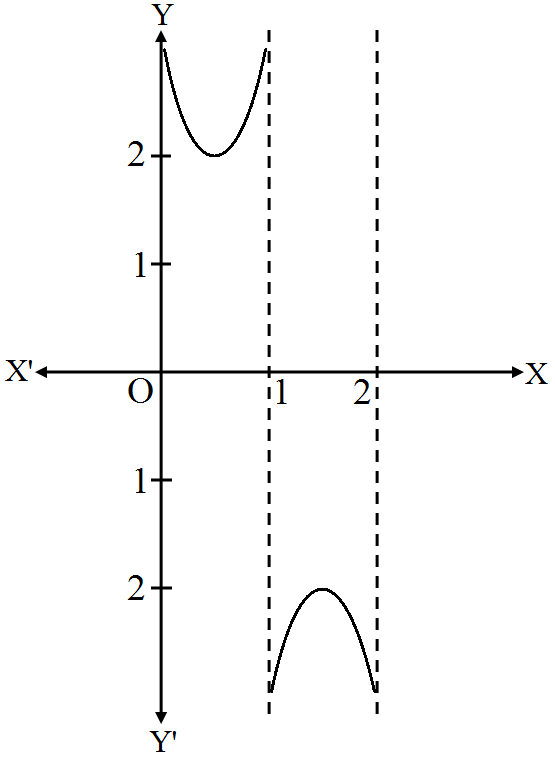
View full question & answer→Question 1535 Marks
In a $\triangle\text{ABC},$ if $\cos\text{C}=\frac{\sin\text{A}}{2\sin\text{B}},$ prove that the triangle is isosceles.
AnswerLet $\frac{\sin\text{A}}{\text{a}}=\frac{\sin\text{B}}{\text{b}}=\frac{\sin\text{C}}{\text{c}}=\text{k}.$ Then, $\sin\text{A = ka},\sin\text{B = kb},\sin\text{C}=\text{kc}$
Now, $\cos\text{C}=\frac{\sin\text{A}}{2\sin\text{B}}$
$2\sin\text{B}\cos\text{C}=\sin\text{A}$
$2\Big(\frac{\text{a}^2+\text{b}^2-\text{c}^2}{2\text{ab}}\Big)\text{kb = ka}$
$\text{a}^2+\text{b}^2-\text{c}^2=\text{a}^2$
$\text{b}^2=\text{c}^2$
$\text{b = c}$
$\triangle\text{ABC}$ is isosceles.
View full question & answer→Question 1545 Marks
The angle of a quadrilateral are in A.P. and the greatest angle is 120°. Express the angles in radians.
AnswerLet the angle in degrees be a - 3d, a - d, a + 3d
Then,
Sum of the angle = 360°
⇒ 4a = 360°
a = 90°
Also,
Greatest angle = 120°
⇒ a + 3d = 120°
⇒ 3d = 30°
⇒ d = 10°
Hence, angle in degrees
60°, 80°, 100°, 120° and in redians,
We know that,
$1^{\circ}=\Big(\frac{\pi}{180}\Big)^{\text{c}}$
$\therefore 60\times\frac{\pi}{180}=\frac{\pi}{3},80\times\frac{\pi}{180}$
$=\frac{4\pi}{9}$
$100\times\frac{\pi}{180}=\frac{5\pi}{9},120\times\frac{\pi}{180}$
$=\frac{2\pi}{3}$
$\therefore \frac{\pi}{3},\frac{4\pi}{9},\frac{5\pi}{9},\frac{2\pi}{3}$
View full question & answer→Question 1555 Marks
$\text{If} \ \cos\text{A}+\sin\text{B}=\text{m}$ and $\sin\text{A}+\cos\text{B}=\text{n},$ prove that $2\sin\text{(A}+\text{B)}=\text{m}^2+\text{n}^2-2. $
AnswerWe have,
$\cos\text{A}+\sin\text{B}=\text{m}\ \text{and}\ \sin\text{A}+\cos\text{B}=\text{n}$
$=\text{m}^2+\text{n}^2-2$
$=(\cos\text{A}+\sin\text{B})^2+(\sin\text{A}+\cos\text{B)}^2-2$
$ =\cos^2\text{A}+\sin^2\text{B}+2\cos\text{A}\sin\text{B}+\sin^2\text{A}\cos^2\text{B}+2\sin\text{A}\cos\text{B}-2$
$ =(\sin^2\text{A}+\cos^2\text{A})+(\sin^2\text{B}+\cos^2\text{B})\\\ +2\cos\text{A}\sin\text{B}+\sin^2\text{A}\cos \text{B}+2\sin\text{A}\cos\text{B}-2 $
$=1+1+2\cos\text{A}\sin\text{B}+2\sin\text{A}\cos\text{B}-2$
$=2+2(\sin\text{A}\cos\text{B}+\cos\text{A}\sin\text{B)}-2$
$=2(\sin\text{A}\cos\text{B}+\cos\text{A}\sin\text{B)}$
$ =2\sin\text{(A}+\text{B)}$$\big[\because\sin\text{(A}+\text{B)}=\sin\text{A}\cos\text{B}+\cos\text{A}\sin\text{B}\big]$
$\therefore2\sin\text{(A}+\text{B)}=\text{m}^2+\text{n}^2-2 $
Hence proved.
View full question & answer→Question 1565 Marks
Show thet:
$3(\sin\text{x}-\cos\text{x})+6(\sin\text{x}+\cos)^2+4(\sin^6\text{x}+\cos^6\text{x})=13$
Answer$\text{LHS}=3(\sin\text{x}-\cos\text{x})+6(\sin\text{x}+\cos)^2+4(\sin^6\text{x}+\cos^6\text{x})$
$=3[\sin^4\text{x}-4\sin^3\text{x}\cos\text{x}+6\sin^2\text{x}\cos^2\text{x}-4\sin\text{x}\cos^3\text{x}+\cos^4\text{x}]$
$+6[\sin^2\text{x}+2\sin\text{x}\cos\text{x}+\cos^2\text{x}]+4(\sin^6\text{x}+\cos^6\text{x})$
$\big[\because(\text{a}-\text{b})^4=\text{a}^4-4\text{a}^3\text{b}+6\text{a}^2\text{b}^2-4\text{ab}^3+\text{b}^4$ by binomial expainsion$\big]$
$=3\big[\sin^4\text{x}+\cos^4\text{x}-4\sin\text{x}\cos\text{x}(\sin^2\text{x}+\cos^2\text{x})+6\sin^2\text{x}\cos^2\text{x}\big]$
$+6[1+2\sin\text{x}\cos\text{x}]+4\big[(\cos^2\text{x}+\sin^2\text{x})(\cos^4\text{x}-\cos^2\text{x}+\sin^4\text{x})\big]$
$\big[\because\text{a}^3+\text{b}^3=(\text{a+b})(\text{a}^2-\text{ab+b}^2)$
$=7[\sin^4\text{x}+\cos^4\text{x}]+18\sin^2\text{x}\cos^4\text{x}-4\sin^2\text{x}\cos^2\text{x}+6$
$=7[\sin^4\text{x}+\cos^4\text{x}2\sin^2\cos^2]+6$
$=7[\sin^2\text{x}+\cos^2\text{x}+2\sin^2\text{x}\cos^2\text{x}]+6$
$=7+6$
$=13=\text{RHS}$
View full question & answer→Question 1575 Marks
Prove that:
$\frac{\sin\text{A}+\sin\text3{A}}{\cos\text{A}-\cos3\text{A}}=\cot\text{A}$
AnswerWe have,
$\text{LHS}=\frac{\sin\text{A}+\sin3\text{A}}{\cos\text{A}-\cos3\text{A}}$
$=\ \frac{2\sin\Big(\frac{\text{A}+3\text{A}}{2}\Big)\cos\Big(\frac{\text{A}-3\text{A}}{2}}{-2\sin\Big(\frac{\text{A}+3\text{A}}{2}\Big)\sin\Big(\frac{\text{A}-3\text{A}}{2}\Big)}$
$=\ \frac{-\sin2\text{A}\times\cos(-\text{A})}{\sin2\text{A}\sin(-\text{A})}$
$=\ \frac{-\cos(-\text{A})}{\sin(-\text{A})}$
$=\ \frac{-\cos\text{A}}{-\sin\text{A}}$ $[\because\ \cos(-\theta)=\cos\theta\text{ and }\sin(-\theta)=-\sin\theta]$
$=\ \frac{\cos\text{A}}{\sin\text{A}}$
$=\ \cot\text{A}$
$=\ \text{RHS}$
$\therefore\ \frac{\sin\text{A}+\sin3\text{A}}{\cos\text{A}-\cos3\text{A}}=\cot\text{A}.$ Hence proved.
View full question & answer→Question 1585 Marks
Prove that:
$\frac{1}{\sin\text{(x}-\text{b})\sin\text{(x}-\text{b)}}=\frac{\cot\text{(x}-\text{a)}+\tan\text{(x}-\text{b)}}{\cos\text{(a}-\text{b)}}$
Answer$\text{L.H.S}=\frac{1}{\sin\text{(x}-\text{a)}\cos\text{(x}-\text{b)}}$
$=\frac{1}{\cos\text{(a}-\text{b)}}\Big[\frac{\sin\text{(a}-\text{b)}}{\sin\text{(x}-\text{b})\cos\text{(x}-\text{b)}}\Big]$
$=\frac{1}{\cos\text{(a}-\text{b)}}\Big[\frac{\cos\text{(x}-\text{b)-}(\text{x}-\text{b)}}{\sin\text{(x}-\text{a})\cos\text{(x}-\text{b)}}\Big]$
$=\frac{1}{\cos\text{(a}-\text{b)}}\Big[\frac{\cos\text{(x}-\text{b)cos}(\text{x}-\text{a)}+\sin\text{(x}-\text{b})\sin\text{(x}-\text{a)}}{\sin\text{(x}-\text{a})\sin\text{(x}-\text{b)}}\Big]$
$=\frac{1}{\cos\text{(a}-\text{b})}\Big[\frac{\cos\text{(x}-\text{b)}\cos\text{(x}-\text{a)}}{\sin\text{(x}-\text{b)}\cos\text{(x}-\text{b})}+\frac{\sin\text{(x}-\text{b)}\sin\text{(x}-\text{a)}}{\sin\text{(x}-\text{b)}\cos\text{(x}-\text{b})}\Big]$
$=\frac{\cot\text{(a}-\text{b)}+\tan\text{(x}-\text{b)}}{\cos\text{(a}-\text{b)}}$
$=\frac{1}{\sin\text{(a}-\text{b})}\Big[\cot\text{(x}-\text{b)}-\cot\text{(x}-\text{b)}\Big]$
$=\frac{\cot\text{(x}-\text{a)-}\cot\text{(x}-\text{b)}}{\sin\text{(a}-\text{b)}}$
$=\text{R.H.S}$
$\therefore\ \text{L.H.S}=\text{R.H.S}$
Hence proved.
View full question & answer→Question 1595 Marks
If $\sin\alpha=\frac{4}{5}$ and $\cos\beta=\frac{5}{13},$ prove that $\cos\frac{\alpha-\beta}{2}=\frac{8}{\sqrt{65}}$
AnswerWe have,
$\sin\alpha=\frac{4}{5}\ \&\cos\beta=\frac{4}{5}\Rightarrow\cos\alpha=\frac{3}{5}\ \&\cos\alpha=\frac{3}{5}\ \&\sin\beta=\frac{12}{13}$
$\therefore\cos(\alpha-\beta)=\cos\alpha\cos\beta+\sin\alpha.\sin\beta$
$=\frac{3}{5}.\frac{5}{13}+\frac{4}{5}.\frac{12}{13}$
$=\frac{15}{65}+\frac{48}{65}=\frac{63}{65}$
Now,
$\cos\Big(\frac{\alpha-\beta}{2}\Big)=\sqrt{\frac{1+\cos(\alpha-\beta)}{2}}$
$=\sqrt{\frac{1+\frac{63}{65}}{2}}$
$=\sqrt{\frac{128}{65\times2}}=\sqrt{\frac{64}{65}}$
$=\pm\frac{8}{\sqrt{65}}$
$\therefore\cos\Big(\frac{\alpha-\beta}{2}\Big)=\frac{8}{\sqrt{65}}$
View full question & answer→Question 1605 Marks
In a $\triangle\text{ABC},$ prove that
$\sin^3\text{A}\cos(\text{B}-\text{C})+\sin^2\text{B}\cos(\text{C}-\text{A})+\sin^3\text{C}\cos(\text{A}-\text{B})\\=3\sin\text{A}\sin\text{B}\sin\text{C}$
AnswerLet $\frac{\text{a}}{\sin\text{A}}=\frac{\text{b}}{\sin\text{B}}=\frac{\text{c}}{\sin\text{C}}=\text{k}...(1)$
$\text{LHS}=\sin^3\text{A}\cos(\text{B}-\text{C})+\sin^3\text{B}\cos(\text{C}-\text{A})+\sin^3\text{C}\cos(\text{A}-\text{B})$
$=\sin^2\text{A}\{\sin\text{A}\cos(\text{B}-\text{C})\}+\sin^2\text{B}\{\sin\text{B}\cos(\text{C}-\text{A})\}\\ \ \ \ \ \ \ \ +\sin^2\text{A}\{\sin\text{A}\cos(\text{A}-\text{B})\}$
$=\frac{\text{a}^2}{\text{k}^2}\{\sin\text{A}\cos(\text{B}-\text{C})\}+\frac{\text{b}^2}{\text{k}^2}\{\sin\text{B}\cos(\text{C}-\text{A})\}+\frac{\text{c}^2}{\text{k}^2}\{\sin\text{A}\cos(\text{A}-\text{B})\}$
$=\frac{1}{2\text{k}^2}\big[\text{a}^2\{2\sin\text{A}\cos(\text{B}-\text{C})\}+\text{b}^2\{2\sin\text{B}\cos(\text{C}-\text{A})\}\\ \ \ \ \ \ \ \ \ \ +\text{c}^2\{2\sin\text{A}\cos(\text{A}-\text{B})\}\big]$
$=\frac{1}{2\text{k}^2}\big[\text{a}^2\{2\sin(\pi-(\text{B + C}))\cos(\text{B} - \text{C})\}+\text{b}^2\{2\sin(\pi-(\text{A + C}))\cos(\text{C}-\text{A})\}\\ \ \ \ \ \ \ \ \ \ +\text{c}^2\{2\sin(\pi-(\text{B + C}))\cos(\text{A}-\text{B})\}\big]$
$=\frac{1}{2\text{k}^2}\big[\text{a}^2\{2\sin(\text{B + C})\cos(\text{B}-\text{C})\}+\text{b}^2\{2\sin(\text{C + A})\cos(\text{C}-\text{A})\}\\ \ \ \ \ \ \ \ \ \ \ +\text{c}^2\{2\sin(\text{A + B})\cos(\text{A}-\text{B})\}\big]$
$=\frac{1}{2\text{k}^2}\big[\text{a}^2\{\sin2\text{B}+\sin2\text{C}\}+\text{b}^2\{\sin2\text{C}+\sin2\text{A}\}+\text{c}^2\{\sin2\text{A}+\sin2\text{B}\}\big]$
$=\frac{1}{2\text{k}^2}\big[2\text{a}^2\{\sin\text{B}\cos\text{B}+\sin\text{C}\cos\text{C}\}+2\text{b}^2\{\sin\text{C}\cos\text{C}+\sin\text{A}\cos\text{A}\}\\ \ \ \ \ \ \ \ \ \ +2\text{c}^2\{\sin\text{A}\cos\text{A}+\sin\text{B}\cos\text{B}\}\big]$
$=\frac{1}{2\text{k}^3}\big[2\text{a}^2\{\text{k}\sin\text{B}\cos\text{B}+\text{k}\sin\text{C}\cos\text{C}\}+2\text{b}^2\{\text{k}\sin\text{C}\cos\text{C}+\text{k}\sin\text{A}\cos\text{A}\}\\ \ \ \ \ \ \ \ \ \ +2\text{c}^2\{\text{k}\sin\text{A}\cos\text{A}+\text{k}\sin\text{B}\cos\text{B}\}\big]$
$=\frac{1}{\text{k}^3}\big[\text{a}^2\{\text{b}\cos\text{B + c}\cos\text{C}\}+2\text{b}^2\{\text{c}\cos\text{C + a}\cos\text{A}\}\\ \ \ \ \ \ \ \ +2\text{c}^2\{\text{a}\cos\text{A + a}\cos\text{B}\}\big]$
$=\frac{1}{\text{k}^3}\big[\text{ab(a}\cos\text{B + b}\cos\text{A})+\text{bc(b}\cos\text{C + c}\cos\text{B})+\text{ac(a}\cos\text{ C + c}\cos\text{A})\big]$
$=\frac{1}{\text{k}^3}(\text{abc + bca + acb})$
$=3\text{abc}\times\frac{1}{\text{k}^3}$
$=3\sin\text{A}\sin\text{B}\sin\text{C}\times\frac{1}{\text{k}^3}\times\text{k}^3$
$=3\sin\text{A}\sin\text{B}\sin\text{C}$
$=\text{RHS}$
Hence proved.
View full question & answer→Question 1615 Marks
Prove that: $\frac{\sin\text{(A-B)}}{\sin\text{A}\sin\text{B}}+\frac{\sin\text{(B-C)}}{\sin\text{B}\sin\text{C}}+\frac{\sin\text{(C-A)}}{\sin\text{C}\sin\text{A}}=0$
AnswerWe have,
$\text{L.H.S }\frac{\sin\text{(A-B)}}{\sin\text{A}\sin\text{B}}+\frac{\sin\text{(B-C)}}{\sin\text{B}\sin\text{C}}+\frac{\sin\text{(C-A)}}{\sin\text{C}\sin\text{A}}$
$=\frac{\sin\text{A}\cos\text{B}-\cos\text{A}\sin\text{B}}{\sin\text{A}\sin\text{B}}+\frac{\sin\text{B}\cos\text{C}-\cos\text{B}\sin\text{C}}{\sin\text{B}\sin\text{C}}\\\ \ +\frac{\sin\text{C}\cos\text{A}-\cos\text{C}\sin\text{A}}{\sin\text{C}\sin\text{A}}$
$=\frac{\sin\text{A}\cos\text{B}}{\sin\text{A}\sin\text{B}}-\frac{\cos\text{A}\sin\text{A}}{\sin\text{A}\sin\text{B}}+\frac{\sin\text{B}\cos\text{C}}{\sin\text{B}\sin\text{C}}\\\ \ -\frac{\cos\text{B}\sin\text{C}}{\sin\text{B}\sin\text{C}}+\frac{\sin\text{C}\cos\text{A}}{\sin\text{C}\sin\text{A}}-\frac{\cos\text{C}\sin\text{A}}{\sin\text{C}\sin\text{A}}$
$=\frac{\cos\text{B}}{\sin\text{B}}-\frac{\cos\text{A}}{\sin\text{A}}+\frac{\cos\text{C}}{\sin\text{C}}-\frac{\cos\text{B}}{\sin\text{B}}+\frac{\cos\text{A}}{\sin\text{A}}-\frac{\cos\text{C}}{\sin\text{C}}$ $\Big[\because\cot\theta=\frac{\cos\theta}{\sin\theta}\Big]$
$=\cot\text{B}-\cot\text{A}+\cot\text{C}-\cot\text{B}+\cot\text{A}-\cot\text{C}$
$=0$
$=\text{R.H.S}$
$\therefore\ \text{L.H.S}=\text{R.H.S}$
Hence proved.
View full question & answer→Question 1625 Marks
If $\tan\text{x}=\frac{\text{b}}{\text{a}},$ then find the value of $\sqrt{\frac{\text{a}+\text{b}}{\text{a}-\text{b}}}+\sqrt{\frac{\text{a}-\text{b}}{\text{a}+\text{b}}}$
AnswerGiven that: $\tan\text{x}=\frac{\text{b}}{\text{a}}$
$\sqrt{\frac{\text{a}+\text{b}}{\text{a}-\text{b}}}+\sqrt{\frac{\text{a}-\text{b}}{\text{a}+\text{b}}}=\sqrt{\frac{\text{a}+\text{b}}{\text{a}-\text{b}}}+\sqrt{\frac{\text{a}-\text{b}}{\text{a}+\text{b}}}$
$\frac{\text{a + b + a}-\text{b}}{\sqrt{(\text{a}-\text{b})(\text{a + b})}}=\frac{2\text{a}}{\sqrt{\text{a}^2-\text{b}^2}}=\frac{2\text{a}}{\text{a}\sqrt{1-\frac{\text{b}^2}{\text{a}^2}}}$ $\Big[\because\tan\text{x}=\frac{\text{b}}{\text{a}}\Big]$
$=\frac{2}{1-\tan^2\text{x}}$
$=\frac{2}{\sqrt{1-\frac{\sin^2\text{x}}{\cos^2\text{x}}}}=\frac{2}{\frac{\sqrt{\cos^2\text{x}-\sin^2\text{x}}}{\cos\text{x}}}$
$=\frac{2\cos\text{x}}{\sqrt{\cos2\text{x}}}$ $[\because\cos^2\text{x}-\sin^2\text{x}=\cos2\text{x}]$
Hence, $\sqrt{\frac{\text{a}+\text{b}}{\text{a}-\text{b}}}+\sqrt{\frac{\text{a}-\text{b}}{\text{a}+\text{b}}}=\frac{2\cos\text{x}}{\sqrt{\cos2\text{x}}}$
View full question & answer→Question 1635 Marks
Prove that:
$\sin\frac{\text{x}}{2}\sin\frac{7\text{x}}{2}+\sin\frac{3\text{x}}{2}\sin\frac{11\text{x}}{2}=\sin2\text{x}\sin5\text{x}.$
AnswerWe have,
$\text{LHS}=\sin\frac{\text{x}}{2}\sin\frac{7\text{x}}{2}+\sin\frac{3\text{x}}{2}\sin\frac{11\text{x}}{2}$
$=\ \frac{1}{2}\Big[2\sin\frac{7\text{x}}{2}\sin\frac{\text{x}}{2}+2\sin\frac{110}{2}\sin\frac{3\text{x}}{2}\Big]$
$=\ \frac{1}{2}\Big[\cos\Big(\frac{7\text{x}}{2}-\frac{\text{x}}{2}\Big)-\cos\Big(\frac{7\text{x}}{2}+\frac{\text{x}}{2}\Big)+\cos\Big(\frac{110}{2}-\frac{3\text{x}}{2}\Big)-\cos\Big(\frac{110}{2}+\frac{3\text{x}}{2}\Big)\Big]$
$=\ \frac{1}{2}\Big[\cos\frac{60}{2}-\cos\frac{80}{2}+\cos\frac{80}{2}-\cos\frac{140}{2}\Big]$
$=\ \frac{1}{2}[\cos3\text{x}-\cos4\text{x}+\cos4\text{x}-\cos7\text{x}]$
$=\ \frac{1}{2}[\cos3\text{x}-\cos7\text{x}]$
$=\ \frac{-1}{2}[\cos7\text{x}-\cos3\text{x}]$
$=\ \frac{-1}{2}\Big[-2\sin\Big(\frac{7\text{x}+3\text{x}}{2}\Big)\sin\Big(\frac{7\text{x}-3\text{x}}{2}\Big)\Big]$
$=\ \sin\frac{10\text{x}}{2}\sin\frac{4\text{x}}{2}$
$=\ \sin5\text{x}\sin2\text{x}$
$=\ \sin2\text{x}\sin5\text{x}$
$=\ \text{RHS}$
$\therefore\ \sin\frac{\text{x}}{2}\sin\frac{7\text{x}}{2}+\sin\frac{3\text{x}}{2}\sin\frac{110}{2}=\sin2\text{x}\sin5\text{x}.$
Hence proved.
View full question & answer→Question 1645 Marks
Prove the following identities:
$\text{cosec}\text{ x}(\sec\text{x}−1)−\cot\text{x}(1−\cos\text{x})=\tan\text{x}−\sin\text{x}$
Answer$\text{L.H.S}=\text{cosec }\text{x}\big(\sec\text{x}-1\big)-\cot\big(1-\cos\text{x}\big)$
$=\frac{1}{\sin\text{x}}\Big(\frac{1}{\cos\text{x}}-1\Big)-\frac{\cos\text{x}}{\sin\text{x}}\big(1-\cos\text{x}\big)$$ \Big[\because\text{cosec }\text{x}=\frac{1}{\sin\text{x}},\sec\text{x}=\frac{1}{\cos\text{x}}\cot\text{x}=\frac{\cos\text{x}}{\sin\text{x}}\Big]$
$=\frac{\big(1-\cos\text{x}\big)}{\sin\text{x}\cos\text{x}}-\frac{\cos\text{x}\big(1-\cos\text{x}\big)}{\sin\text{x}}$
$=\frac{\big(1-\cos\text{x}\big)-\cos^{2}\text{x}\big(1-\cos\text{x}\big)}{\sin\text{x}\cos\text{x}}$
$=\frac{\big(1-\cos\text{x}\big)\big(1-\cos^{2}\text{x}\big)}{\sin\text{x}\cos\text{x}}$
$=\frac{\big(1-\cos\text{x}\big)\sin^{2}\text{x}}{\sin\text{x}\cos\text{x}}$
$=\big(1-\cos\text{x}\big)\frac{\sin\text{x}}{\cos\text{x}}$
$=\frac{\sin\text{x}}{\cos\text{x}}-\sin\text{x}$
$=\tan\text{x}-\sin\text{x}$ $\big(\because1-\cos^{2}\text{x}=\sin^{2}\text{x}\big)$
$=\text{R.H.S} $
$\text{proved}$
View full question & answer→Question 1655 Marks
If $\sin\alpha+\sin\beta=\text{a}$ and $\cos\alpha+\cos\beta=\text{b},$ show that
$\cos(\alpha+\beta)=\frac{\text{b}^2-\text{a}^2}{\text{b}^2+\text{a}^2}$
Answer$\text{a}^2+\text{b}^2=(\sin\alpha+\sin\beta)^2+(\cos\alpha+\cos\beta)^2$
$=\sin^2\alpha+\sin^2\beta+\cos^2\alpha+\cos^2\beta+2\sin\alpha\sin\beta+2\cos\alpha\cos\beta$
$=2+2\cos(\alpha+\beta)$
$\Rightarrow\text{b}^2+\text{a}^2=(\cos\alpha+\cos\beta)^2-(\sin\alpha+\sin\beta)^2$
$\Rightarrow\text{b}^2+\text{a}^2=\cos^2\alpha+\cos^2\beta-\sin^2\alpha+\sin^2\beta+2\cos\alpha\cos\beta-2\sin\alpha\sin\beta$
$\Rightarrow\text{b}^2+\text{a}^2=\Big(\cos^2\alpha+\sin^2\beta\Big)+\Big(\cos^2\beta-\sin^2\alpha\Big)-2\cos(\alpha+\beta)$
$\Rightarrow\text{b}^2+\text{a}^2=2\cos(\alpha+\beta)+\cos(\alpha-\beta)+2\cos(\alpha-\beta)$
$\Rightarrow\text{b}^2+\text{a}^2=\cos(\alpha+\beta)(2+2\cos(\alpha-\beta) )$
$\Rightarrow\text{b}^2+\text{a}^2=\cos(\alpha+\beta)(\text{a}^2+\text{b}^2 )$
$\frac{\text{b}^2-\text{a}^2}{\text{b}^2+\text{a}^2}=\cos(\alpha+\beta)$
View full question & answer→Question 1665 Marks
If $\cos(\alpha+\beta)=\frac{4}{5}$ and $\sin(\alpha-\beta)=\frac{5}{13},$ where $\alpha$ lie between 0 and $\frac{\pi}{4},$ find the value of $\tan2\alpha$
$[$Hint: Express $\tan2\alpha$ as $\tan(\alpha+\beta+\alpha-\beta)]$
AnswerWe have $\cos(\alpha+\beta)=\frac{4}{5}$ and $\sin(\alpha-\beta)=\frac{5}{13}$ $\Rightarrow\tan(\alpha+\beta)=\pm\frac{3}{4}$and $\tan(\alpha-\beta)=\pm\frac{5}{12}$
Since $\alpha\in\Big(0,\frac{\pi}{2}\Big),2\alpha\in(0,\pi),$ for which $\tan2\alpha>0$
Now, $\tan2\alpha=\tan[(\alpha+\beta)+(\alpha-\beta)]$ $=\frac{\tan(\alpha+\beta)+\tan(\alpha-\beta)}{1-\tan(\alpha+\beta).\tan(\alpha-\beta)}=\frac{\frac{3}{4}+\frac{5}{12}}{1-\frac{3}{4}.\frac{5}{12}}=\frac{36+20}{48-15}=\frac{56}{33}$ As other values of $\tan(\alpha+\beta)$ and $\tan(\alpha-\beta)$ gives negative value of $\tan2\alpha$
View full question & answer→Question 1675 Marks
If $\sin(\theta+\alpha)=\text{a}$ and $\sin(\theta+\beta)=\text{b},$ then prove that $\cos2(\alpha-\beta)-4\text{ab}\cos(\alpha-\beta)=1-2\text{a}^2-2\text{b}^2$
[Hint: Express $\cos(\alpha-\beta)=\cos((\theta+\alpha)-(\theta+\beta))$]
AnswerWe have $\sin(\theta+\alpha)=\text{a}...(\text{i})$
$\sin(\theta+\beta)=\text{b}...(\text{ii})$
$\therefore\cos(\theta+\alpha)=\sqrt{1-\text{a}^2}$ and $\cos(\theta+\beta)=\sqrt{1-\text{b}^2}$
$\therefore\cos(\alpha-\beta)=\cos[(\theta+\alpha)-(\theta+\beta)]$
$=\cos(\theta+\beta)\cos(\theta+\alpha)+\sin(\theta+\alpha)\sin(\theta+\beta)$
$=\sqrt{1-\text{a}^2}\sqrt{1-\text{b}^2}+\text{ab}=\text{a b}+\sqrt{1-\text{a}^2-\text{b}^2+\text{a}^2\text{b}^2}$
$\Rightarrow\cos2(\alpha-\beta)-4\text{ab}\cos(\alpha-\beta)$
$=2\cos^2(\alpha-\beta)-1-4\text{ab}\cos(\alpha-\beta)$
$=2\cos(\alpha-\beta)[\cos(\alpha-\beta)-2\text{ab}]-1$
$=2\big(\text{ab}+\sqrt{1-\text{a}^2-\text{b}^2+\text{a}^2\text{b}^2}\big)\\\big(\text{ab}+\sqrt{1-\text{a}^2-\text{b}^2+\text{a}^2\text{b}^2}-2\text{ab}\big)-1$
$=2\big[\big(\sqrt{1-\text{a}^2-\text{b}^2+\text{a}^2\text{b}^2+\text{ab}}\big)\\\big(\sqrt{1-\text{a}^2-\text{b}^2+\text{a}^2\text{b}^2}-\text{ab}\big)\big]-1$
$=2[1-\text{a}^2-\text{b}^2+\text{a}^2\text{b}^2-\text{a}^2\text{b}^2]-1\\=2-2\text{a}^2-2\text{b}^2-1=1-2\text{a}^2-2\text{b}^2$
View full question & answer→Question 1685 Marks
Prove that:
$\frac{\sin3\text{A}\cos4\text{A}-\sin\text{A}\cos2\text{A}}{\sin4\text{A}\sin\text{A}+\cos6\text{A}\cos\text{A}}=\tan2\text{A}$
AnswerWe have,
$\text{LHS}=\frac{\sin3\text{A}\cos4\text{A}-\sin\text{A}\cos2\text{A}}{\sin4\text{A}\sin\text{A}+\cos6\text{A}\cos\text{A}}$
$=\ \frac{2(\sin3\text{A}\cos4\text{A}-\sin\text{A}\cos2\text{A})}{2(\sin4\text{A}\sin\text{A}+\cos6\text{A}\cos\text{A})}$
$=\ \frac{2\sin3\text{A}\cos4\text{A}-2\sin\text{A}\cos2\text{A}}{2\sin4\text{A}\sin\text{A}+2\cos6\text{A}\cos\text{A}}$
$=\ \frac{\sin(4\text{A}+3\text{A})-\sin(4\text{A}-3\text{A})-[\sin(2\text{A}+\text{A})-\sin(2\text{A}-\text{A})]}{\cos(4\text{A}-\text{A})-\cos(4\text{A}+\text{A})+\cos(6\text{A}+\text{A})+\cos(6\text{A}-\text{A})}$
$=\ \frac{\sin(7\text{A})-\sin(\text{A})-\sin(3\text{A})+\sin(\text{A})}{\cos(3\text{A})-\cos(5\text{A})+\cos(7\text{A})+\cos(5\text{A})}$
$=\ \frac{\sin(7\text{A})-\sin(3\text{A})}{\cos(3\text{A})+\cos(7\text{A})}$
$=\ \frac{2\sin\Big(\frac{7\text{A}-3\text{A}}{2}\Big)\cos\Big(\frac{7\text{A}+3\text{A}}{2}\Big)}{2\cos\Big(\frac{7\text{A}+3\text{A}}{2}\Big)\cos\Big(\frac{7\text{A}-3\text{A}}{2}\Big)}$
$=\ \frac{\sin2\text{A}}{\cos2\text{A}}$
$=\ \tan2\text{A}$
$=\ \text{RHS}$
$\therefore\ \frac{\sin3\text{A}\cos4\text{A}-\sin\text{A}\cos2\text{A}}{\sin4\text{A}\sin\text{A}+\cos6\text{A}\cos\text{A}}=\tan2\text{A}$ Hence proved.
View full question & answer→Question 1695 Marks
$\text{a}(\cos\text{C}-\cos\text{B})=2(\text{b}-\text{c})\cos^2\frac{\text{A}}{2}.$
AnswerLet $\text{a = k}\sin\text{A}$
$\text{a}(\cos\text{C}-\cos\text{B})=2(\text{b}-\text{c})\cos^2\frac{\text{A}}{2}$
$\text{LHS}=\text{a}(\cos\text{C}-\cos\text{B})$
$=\text{a}2.\sin\frac{\text{C + B}}{2}.\sin\frac{\text{B}-\text{C}}{2}$
$=2\text{k}\sin\text{A}\sin\frac{\pi-\text{A}}{2}.\sin\frac{\text{B}-\text{C}}{2}$
$=2\text{k}2\sin\frac{\text{A}}{2}.\cos\frac{\text{A}}{2}.\cos\frac{\text{A}}{2}.\sin\frac{\text{B}-\text{C}}{2}$
$=2\text{k}\cos^2\frac{\text{A}}{2}\Big(2\sin\frac{\text{B}-\text{C}}{2}.\sin\frac{\text{A}}{2}\Big)$
$=2\text{k}\cos^2\frac{\text{A}}{2}\Big(2\sin\frac{\text{B}-\text{C}}{2}.\sin\frac{\pi-(\text{B + C})}{2}\Big)$
$=2\text{k}\cos^2\frac{\text{A}}{2}\Big(2\sin\frac{\text{B}-\text{C}}{2}.\cos\frac{\text{B + C}}{2}\Big)$
$=2\text{k}\cos^2\frac{\text{A}}{2}(\sin\text{B}-\sin\text{C})$
$=2\cos^2\frac{\text{A}}{2}(\text{k}\sin\text{B}-\text{k}\sin\text{C})$
$=2\cos^2\frac{A}{2}(\text{b}-\text{c})=\text{RHS}$
View full question & answer→Question 1705 Marks
Prove that:
$\text{If}\cos\text{A}+\cos\text{B}=\frac{1}{2}\text{ and }\sin\text{A}+\sin\text{B}=\frac{1}{4},$ prove that $\tan\Big(\frac{\text{A+B}}{2}\Big)=\frac{1}{2}.$
AnswerWe have,
$\text{LHS}=\cos\text{A}+\cos\text{B}=\frac{1}{2}$
$\text{and},\ \sin\text{A}+\sin\text{B}=\frac{1}{4}$
Now,
$\frac{\sin\text{A}+\sin\text{B}}{\cos\text{A}+\cos\text{B}}=\frac{\frac{1}{4}}{\frac{1}{2}}$ [On dividing]
$\Rightarrow\ \frac{2\sin\Big(\frac{\text{A}+\text{B}}{2}\Big)\cos\Big(\frac{\text{A}-\text{B}}{2}\Big)}{2\cos\Big(\frac{\text{A}+\text{B}}{2}\Big)\cos\Big(\frac{\text{A}-\text{B}}{2}\Big)}=\frac{1}{2}$
$\Rightarrow\ \frac{\sin\Big(\frac{\text{A}+\text{B}}{2}\Big)}{\cos\Big(\frac{\text{A}+\text{B}}{2}\Big)}=\frac{1}{2}$
$\Rightarrow\ \tan\Big(\frac{\text{A}+\text{B}}{2}\Big)=\frac{1}{2}$
$\Rightarrow\ \text{RHS}$
Hence proved.
View full question & answer→Question 1715 Marks
Prove that: $\frac{\sin\text{(A-B)}}{\cos\text{A}\cos\text{B}}+\frac{\sin\text{(B-C)}}{\cos\text{B}\cos\text{C}}+\frac{\sin\text{(C-A)}}{\cos\text{C}\cos\text{A}}=0$
Answer$\text{L.H.S}=\frac{\sin\text{(A-B)}}{\cos\text{A}\cos\text{B}}+\frac{\sin\text{(B-C)}}{\cos\text{B}\cos\text{C}}+\frac{\sin\text{(C-A)}}{\cos\text{C}\cos\text{A}}=0$
$=\frac{\sin\text{A}\cos\text{B}-\cos\text{A}\sin\text{B}}{\cos\text{A}\cos\text{B}}+\frac{\sin\text{B}\cos\text{C}-\cos\text{B}\sin\text{C}}{\cos\text{B}\cos\text{C}}\\\ \ +\frac{\sin\text{C}\cos\text{A}-\cos\text{C}\sin\text{A}}{\cos\text{C}\cos\text{A}}$
$=\frac{\sin\text{A}\cos\text{B}}{\cos\text{A}\cos\text{B}}-\frac{\cos\text{A}\sin\text{A}}{\cos\text{A}\cos\text{B}}+\frac{\sin\text{B}\cos\text{C}}{\cos\text{B}\cos\text{C}}\\\ \ -\frac{\cos\text{B}\sin\text{C}}{\cos\text{B}\cos\text{C}}+\frac{\sin\text{C}\cos\text{A}}{\cos\text{C}\cos\text{A}}-\frac{\cos\text{C}\sin\text{A}}{\cos\text{C}\cos\text{A}}$
$$$=\tan\text{A}-\tan\text{B}+\tan\text{B}-\tan\text{C}+\tan\text{C}-\tan\text{A}$
$=0$
$=\text{R.H.S}$
$\therefore\ \text{L.H.S}=\text{R.H.S}$
Hence proved.
View full question & answer→Question 1725 Marks
Solve the following equations:
$\tan\text{x}+\tan2\text{x}+\tan3\text{x}=0$
Answer$\tan\text{x}+\tan2\text{x}+\frac{(\tan\text{x}+\tan2\text{x})}{1-\tan\text{x}.\tan2\text{x}}=0$
$[\tan\text{x}+\tan2\text{x}]\Big[1+\frac{1}{1-\tan\text{x}.\tan2\text{x}}\Big]=0$
$\tan\text{x}+\tan2\text{x}(2-\tan\text{x}.\tan2\text{x})=0$
$\tan\text{x}=\tan(-2\text{x})$ or $\tan\text{x}.\tan2\text{x}=0$
$\text{x}=\text{n}\pi-2\text{x}$ or $\tan\text{x}.\frac{2\tan\text{x}}{1-\tan^{2}\text{x}}=2$
$3\text{x}=\text{n}\pi$ or $\frac{2\tan^{2}\text{x}}{1-\tan^{2}\text{x}}=2$
$3\text{x}=\text{n}\pi$ or $2\tan^{2}\text{x}=2-2\tan^{2}\text{x}$
$3\text{x}=\text{n}\pi$ or $4\tan^{2}\text{x}=2$
$\text{x}=\frac{\text{n}\pi}{3}$ or $\tan^{2}\text{x}=\frac{1}{2}$
$\text{x}=\frac{\text{n}\pi}{3}$ or $\text{x}=\text{m}\pi\pm\tan^{-1}(\frac{1}{\sqrt{2}}),\text{n,m}\in\text{Z}$
View full question & answer→Question 1735 Marks
Prove that:
$\frac{\cos4\text{A}+\cos3\text{A}+\cos2\text{A}}{\sin4\text{A}+\sin3\text{A}+\sin2\text{A}}=\cot3\text{A}$
AnswerWe have,
$\text{LHS}=\frac{\cos4\text{A}+\cos3\text{A}+\cos2\text{A}}{\sin4\text{A}+\sin2\text{A}+\sin2\text{A}}$
$=\ \frac{(\cos4\text{A}+\cos2\text{A})+\cos3\text{A}}{(\sin4\text{A}+\sin2\text{A})+\sin3\text{A}}$
$=\ \frac{2\cos\Big(\frac{4\text{A}+2\text{A}}{2}\Big)\cos\Big(\frac{4\text{A}-2\text{A}}{2}\Big)+\cos3\text{A}}{2\sin\Big(\frac{4\text{A}+2\text{A}}{2}\Big)\cos\Big(\frac{4\text{A}-2\text{A}}{2}\Big)+\sin3\text{A}}$
$=\ \frac{2\cos3\text{A}\cos\text{A}+\cos3\text{A}}{2\sin3\text{A}\cos\text{A}+\sin3\text{A}}$
$=\ \frac{\cos3\text{A}(2\cos\text{A}+1)}{\sin3\text{A}(2\cos2\text{A}+1)}$
$=\ \frac{\cos3\text{A}}{\sin\text{A}}$
$=\ \cot3\text{A}$
$=\ \text{RHS}$
$\therefore\ \frac{\cos4\text{A}+\cos3\text{A}+\cos2\text{A}}{\sin4\text{A}+\sin3\text{A}+\sin2\text{A}}=\cot3\text{A}$ Hence proved.
View full question & answer→Question 1745 Marks
Prove that:
$\sin20^\circ\sin40^\circ\sin80^\circ=\frac{\sqrt3}{8}$
Answer$\text{LHS}=\sin20^\circ\sin40^\circ\sin80^\circ$
$=\ \frac{1}{2}(2\sin20^\circ\sin40^\circ)\sin80^\circ$
$=\ \frac{1}{2}[\cos(40^\circ-20^\circ)-\cos(40^\circ+20^\circ)]\sin80^\circ$$[\because2\sin\text{A}\sin\text{B}=\cos(\text{A}-\text{B})-\cos(\text{A+B})$
$=\ \frac{1}{2}[\cos20^\circ-\cos60^\circ]\sin80^\circ$
$=\ \frac{1}{2}\Big[\cos20^\circ-\frac{1}{2}\Big]\sin80^\circ$
$=\ \frac{1}{2}[\cos20^\circ\sin80^\circ]-\frac{1}{4}\sin80^\circ$
$=\ \frac{1}{4}[2\cos20^\circ\sin80^\circ-\sin80^\circ]$
$=\ \frac{1}{4}[\sin(80^\circ+20^\circ)+\sin(80^\circ-20^\circ)-\sin80^\circ]$$[\because2\sin\text{A}\cos\text{B}=\sin(\text{A+B})+\sin(\text{A}-\text{B})$
$=\ \frac{1}{4}[\sin100^\circ+\sin60^\circ-\sin80^\circ]$
$=\ \frac{1}{4}\Big[\sin(180^\circ-80^\circ)+\frac{\sqrt3}{2}-\sin80^\circ\Big]$
$=\ \frac{1}{4}\Big[\sin80^\circ+\frac{\sqrt3}{2}-\sin80^\circ\Big]$
$= \frac{\sqrt3}{8}=\ \text{RHS}$
View full question & answer→Question 1755 Marks
$\frac{\cos^2\text{B}-\cos^2\text{C}}{\text{b + c}}+\frac{\cos^2\text{C}-\cos^2\text{A}}{\text{c + a}}+\frac{\cos^2\text{A}-\cos^2\text{B}}{\text{a + b}}=0$
Answer$\frac{\cos^2\text{B}-\cos^2\text{C}}{\text{b + c}}+\frac{\cos^2\text{C}-\cos^2\text{A}}{\text{c + a}}+\frac{\cos^2\text{A}-\cos^2\text{B}}{\text{a + b}}=0$
$\text{LHS}=\frac{\cos^2\text{B}-\cos^2\text{C}}{\text{b + c}}+\frac{\cos^2\text{C}-\cos^2\text{A}}{\text{c + a}}+\frac{\cos^2\text{A}-\cos^2\text{B}}{\text{a + b}}$
$=\frac{\cos^2\text{B}-\cos^2\text{C}}{\text{b + c}}+\frac{\cos^2\text{C}-\cos^2\text{A}}{\text{c + a}}+\frac{\cos^2\text{A}-\cos^2\text{B}}{\text{a + b}}$
$=\frac{1-\sin^2\text{B}-1+\sin^2\text{C}}{\text{b + c}}+\frac{1-\sin^2\text{C}-1+\sin^2\text{A}}{\text{c + a}}+\frac{1-\sin^2\text{A}-1+\sin^2\text{B}}{\text{a +b}}$
$=\frac{\sin^2\text{C}-\sin^2\text{B}}{\text{b + c}}+\frac{\sin^2\text{A}-\sin^2\text{C}}{\text{c + a}}+\frac{\sin^2\text{B}-\sin^2\text{A}}{\text{a + b}}$
$=\frac{\text{k}^2\text{c}^2-\text{k}^2\text{b}^2}{\text{b + c}}+\frac{\text{k}^2\text{a}^2-\text{k}^2\text{c}^2}{\text{c + a}}+\frac{\text{k}^2\text{b}^2-\text{k}^2\text{a}^2}{\text{a + b}}$
$=\text{k}^2\Big(\frac{\text{c}^2-\text{b}^2}{\text{b + c}}+\frac{\text{a}^2-\text{c}^2}{\text{c + a}}+\frac{\text{b}^2-\text{a}^2}{\text{a + b}}\Big)$
$=\text{k}^2(\text{c}-\text{b + a}-\text{c + b}-\text{a})$ $[\text{Using }\text{b}^2 -\text{a}^2 = (\text{b}-\text{a})(\text{b + a})]$
$=0=\text{RHS}$
Hence Proved
View full question & answer→Question 1765 Marks
The number of sides of two regular polygons are as 5 : 4 and the difference between their angles is 9°. Find the number of sides of the polygons.
AnswerLet the number of sides in the first polygon be the number of sides in the second polygon.We know that each angle of regular polygon is $\Big(\frac{2\text{n}-4}{\text{n}}\Big)$ right angles.
Now,
According to the quation,
$\frac{\text{n}}{\text{m}}=\frac{5}{4}$
$\Rightarrow \frac{5\text{m}}{4}=\text{n}\ ...(\text{i})$
Also,
$\Big(\frac{2\text{n}-4}{\text{n}}\Big)\times90^{\circ}-\Big(\frac{2\text{m}-4}{\text{m}}\Big)\times90^{\circ}=9^{\circ}$
$\Rightarrow \frac{(2\text{n}-4)\text{m}-(2\text{m}-4)\text{n}}{\text{mn}}=\Big(\frac{1}{10}\Big)^{\circ}\ ...(\text{ii})$
From (i) and (ii),
$\frac{\big(2\times\frac{5}{4}\text{m}-4\big)\text{m}-\big(2\text{m}-4\big)\frac{5}{4}\text{m}}{\frac{5}{4}\text{m}^{2}}=\frac{1}{10}$
$\Rightarrow \frac{(10\text{m}-16)-(10\text{m}-20)}{5\text{m}}=\frac{1}{10}$
$\Rightarrow \frac{4}{\text{m}}=\frac{1}{2}$
$\Rightarrow \text{m}=8$
View full question & answer→Question 1775 Marks
$\frac{\text{c}}{\text{a}+\text{b}}=\frac{1-\tan\big(\frac{\text{A}}{2}\big)\tan\big(\frac{\text{B}}{2}\big)}{1+\tan\big(\frac{\text{A}}{2}\big)\tan\big(\frac{\text{B}}{2}\big)}$
Answer$\frac{\text{c}}{\text{a}+\text{b}}=\frac{1-\tan\big(\frac{\text{A}}{2}\big)\tan\big(\frac{\text{B}}{2}\big)}{1+\tan\big(\frac{\text{A}}{2}\big)\tan\big(\frac{\text{B}}{2}\big)}$
$\text{LHS}=\frac{\text{c}}{\text{a}+\text{b}}$
$=\frac{\text{k}\sin\text{C}}{\text{k}\sin\text{A}+\text{k}\sin\text{B}}$
$=\frac{2\sin\frac{\text{C}}{2}\cos\frac{\text{C}}{2}}{2\sin\big(\frac{\text{A +B}}{2}\big).\cos\big(\frac{\text{A}-\text{B}}{2}\big)}$
$=\frac{\sin\frac{\text{C}}{2}\cos\frac{\text{C}}{2}}{\sin\big(\frac{\pi-\text{C}}{2}\big).\cos\big(\frac{\text{A}-\text{B}}{2}\big)}$
$=\frac{\sin\big(\frac{\pi-\text{(A + B})}{2}\big)\cos\frac{\text{C}}{2}}{\cos\big(\frac{\text{C}}{2}\big).\cos\big(\frac{\text{A}-\text{B}}{2}\big)}$
$=\frac{\cos\big(\frac{\text{A + B}}{2}\big)}{\cos\big(\frac{\text{A}-\text{B}}{2}\big)}$
$=\frac{\cos\frac{\text{A}}{2}.\cos\frac{\text{B}}{2}-\sin\frac{\text{A}}{2}\sin\frac{\text{B}}{2}}{\cos\frac{\text{A}}{2}.\cos\frac{\text{B}}{2}+\sin\frac{\text{A}}{2}.\sin\frac{\text{B}}2{}}$
$=\frac{1-\tan\frac{\text{A}}{2}\tan\frac{\text{B}}2{}}{1+\tan\frac{\text{A}}{2}.\tan\frac{\text{B}}{2}}=\text{RHS}$ $\Big[$Dividing both Numberator and Denomiator by $\cos\big(\frac{\text{A}}{2}\big).\cos\big(\frac{\text{B}}{2}\big)\Big]$
View full question & answer→Question 1785 Marks
Prove the following identities: $\frac{\sin^3+\cos^3\text{x}}{\sin\text{x}+\cos\text{x}}+\frac{\sin^3\text{x}-\cos^3\text{x}}{\sin\text{x}-\cos\text{x}}=2$
Answer$\text{L.H.S}=\frac{\sin^{3}\text{x}+\cos^{3}\text{x}}{\sin\text{x}+\cos\text{x}}+\frac{\sin^{3}\text{x}-\cos^{3}\text{x}}{\sin\text{x}-\cos\text{x}}$
$=\frac{\big(\sin\text{x}+\cos\text{x}\big)\big(\sin^{2}\text{x}+\cos^{2}\text{x}-\sin\text{x}\cos\text{x}\big)}{\big(\sin\text{x}+\cos\text{x}\big)}\\\ \ +\frac{\big(\sin\text{x}-\cos\text{x}\big)\big(\sin^{2}\text{x}+\cos^{2}\text{x}+\sin\text{x}\cos\text{x}\big)}{\big(\sin\text{x}-\cos\text{x}\big)}$ $\left(\begin{array}{c}\text{using }\text{a}^{3}+\text{b}^{3}=\big(\text{a+b}\big)\big(\text{a}^{2}+\text{b}^{2}-\text{ab}\big)\\\text{ and }\text{ a}^{3}-\text{b}^{3}=\big(\text{a - b}\big)\big(\text{a}^{2}+\text{b}^{2}+\text{ab}\big)\end{array}\right)$
$=\big(1-\sin\text{x}\cos\text{x}\big)+\big(1+\sin\text{x}\cos\text{x}\big)$ $\big(\because \sin^{2}\text{x}+\cos^{2}\text{x}=1\big)$
$=2$
$=\text{R.H.S}$
View full question & answer→Question 1795 Marks
Prove that:
$\sin5\text{x}=5\sin\text{x}-20\sin^3\text{x}+16\sin^5\text{x}$
Answer$\text{LHS}=\sin5\text{x}=\sin(3\text{x}+2\text{x})$
$=\sin3\text{x}\cos2\text{x}+\cos3\text{x}.\sin2\text{x}$
$=(3\sin\text{x}-4\sin^3\text{x})(1-2\sin^3\text{x})\\+(s\cos^3\text{x}=3\cos\text{x})2\sin\text{x}\cos\text{x}.$
$=3\sin\text{x}-4\sin^3\text{x}-6\sin^3\text{x}\\+8\sin^5\text{x}(8\cos^4\text{x}-6\cos^2\text{x})\sin\text{x}$
$=3\sin\text{x}-10\sin^3\text{x}+8\sin^5\text{x}\\+8\sin\text{x}\big((1-\sin^2\text{x})^2-6\sin\text{x}(1-\sin^2\text{x})\big)$
$=13\sin\text{x}-10\sin^3\text{x}+8\sin^5\text{x}+8\sin\text{x}\\-16\sin^3\text{x}8\sin^5\text{x}-6\sin\text{x}+6\sin^3\text{x}$
$=5\sin\text{x}-20\sin^3\text{x}+16\sin^5\text{x}=\text{RHS}$
View full question & answer→Question 1805 Marks
Solve the following equations:
$\sin\text{x}+\cos\text{x}=\sqrt{2}$
AnswerWe have,
$\sin\text{x}+\cos\text{x}=\sqrt{2}$
$\Rightarrow\frac{1}{\sqrt{2}}\sin\text{x}+\frac{1}{\sqrt{2}}\cos\text{x}=1$
$\Rightarrow\sin\frac{\pi}{4}\sin\text{x}+\cos\frac{\pi}{4}\cos\text{x}=1$$\Big[\because\cos\frac{\pi}{4}=\sin\frac{\pi}{4}=\frac{1}{\sqrt{3}}\Big]$
$\Rightarrow\cos\Big(\text{x}-\frac{\pi}{4}\Big)=\cos0^\circ$
$\Rightarrow\text{x}-\frac{\pi}{4}=2\text{n}\pi,\text{n}\in\text{z}$
$\Rightarrow\text{x}=2\text{n}\pi+\frac{\pi}{4},\text{n}\in\text{z}$
$\therefore\text{x}=(8\text{n}+1)\frac{\pi}{4},\text{n}\in\text{z}$
View full question & answer→Question 1815 Marks
The angles of a triangle are in A.P. such that the greatest is 5 times the least. Find the angles in radians.
AnswerLet A, B & C are the angles of triangle ABC
According to the quation,
Also,
A, B & C are in A.P.
Let A = a - d, B = a & C = a + d
So, A + B + C = 180°
⇒ a - d + a + a + d = 180°
⇒ 3a = 180°
⇒ a = 60° ...(i)
Also,
Greatest angle in 5 times the least
a + d = 5(a - d)
⇒ 4a = 6d
$\Rightarrow \frac{2}{3}\text{a}$
$\Rightarrow \text{d}=\frac{2}{3}\times60=40^{\circ}\ ...(\text{ii})$
$\therefore 1^{\circ}=\Big(\frac{\pi}{180^{\circ}}\Big)\ \text{radians}$
$\text{A}=20\times\frac{\pi}{180}=\frac{\pi}{9}$
$\text{B}=60\times\frac{\pi}{180}=\frac{\pi}{3}$
$\text{C}=100\times\frac{\pi}{180}=\frac{5\pi}{3}$
Thus,
$\text{A}=\frac{\pi}{9},\text{B}=\frac{\pi}{3},\text{C}=\frac{5\pi}{9}$
View full question & answer→Question 1825 Marks
Reduce each of the following expressions to the sine and cosin of a single expression:
$24\cos\text{x}+7\sin\text{x}$
AnswerLet $\text{f(x)}=24\cos\text{x}+7\sin\text{x}$
Dividing and multiplying by $\sqrt{24^2+7^2},$ i.e. by 25, We get:
$\text{f(x)}=25\Big(\frac{24}{25}\cos\text{x}+\frac{7}{25}\sin\text{x}\Big)$
$\Rightarrow\text{f(x)}=25\Big(\sin\alpha\cos\text{x}+\cos\alpha\sin\text{x}\Big),$ $\text{where}\sin\alpha=\frac{24}{25}\text{ and}\cos\alpha=\frac{7}{25}$
$\Rightarrow\text{f(x)}=25\sin\Big(\alpha+\text{x}\Big), \text{where}\tan\alpha=\frac{24}{7}.$
Again,
$\text{f(x)}=25\Big(\frac{24}{25}\cos\text{x}+\frac{7}{25}\sin\text{x}\Big)$
$\Rightarrow\text{f(x)}=25\Big(\cos\alpha\cos\text{x}+\sin\alpha\sin\text{x}\Big),$ $\text{where}\cos\alpha=\frac{24}{25}\text{ and}\sin\alpha=\frac{7}{25}.$
$\Rightarrow\text{f(x)}=25\cos\Big(\alpha-\text{x}\Big), \text{where}\tan\alpha=\frac{24}{7}.$
View full question & answer→Question 1835 Marks
If $\cos\text{x}=\frac{\cos\alpha+\cos\beta}{1+\cos\alpha\cos\beta}$ prove that $\tan\frac{\text{x}}{2}=\pm\tan\frac{\alpha}{2}\tan\frac{\beta}{2}$
AnswerWe have,
$\cos\theta=\frac{\cos\alpha+\cos\beta}{1+\cos\alpha.\cos\beta}$
Now,
$\cos\theta=\frac{1-\tan^2\frac{\theta}{2}}{1+\tan^2\frac{\theta}{2}}$
$=\frac{1-\tan^2\frac{\theta}{2}}{1+\tan^2\frac{\theta}{2}}=\frac{\cos\alpha+\cos\beta}{1+\cos\alpha\cos\beta}$
By componende and dividendo, we get
$\frac{\big(1-\tan^2\frac{\theta}{2}\big)+\big(1+\tan^2\frac{\theta}{2}\big)}{\big(1+\tan^2\frac{\theta}{2}\big)-\big(1-\tan^2\frac{\theta}{2}\big)}=\frac{1+\cos\alpha\cos\beta+\cos\alpha\cos\beta}{-(1+\cos\alpha\cos\beta-\cos\alpha\cos\beta)}$
$\frac{2}{2\tan^2\frac{\theta}{2}}=\frac{(1+\cos\alpha)(1+\cos\beta)}{(1-\cos\alpha)(1-\cos\alpha)}$
$\tan^2\frac{\theta}{2}=\frac{(1-\cos\alpha)(1-\cos\beta)}{(1+\cos\alpha)(1+\cos\alpha)}$
$=\frac{2\sin^2\frac{\alpha}{2}.1\sin^2\frac{\beta}{2}}{2\cos^2\frac{\alpha}{2}.1\cos^2\frac{\beta}{2}}$
$\tan\frac{\theta}{2}=\pm\tan\frac{\alpha}{2}.\tan\frac{\beta}{2}$
View full question & answer→Question 1845 Marks
Prove that:$\cos^2\text{A}+\cos^2\text{B}-2\cos\text{A}\cos\text{B}\cos\text{(A}-\text{B)}=\sin^2\text{(A}+\text{B)} $
Answer$\text{R.H.S}=\cos^2\text{A}+\cos^2\text{B}-2\cos\text{A}\cos\text{B}\cos\text{(A}+\text{B)}$
$=\cos^2\text{A}+(\text{1}-\sin^2\text{B})-2\cos\text{A}\cos\text{B}\cos(\text{A}+\text{B})$
$=\Big[\cos^2\text{A}-\sin^2\text{B}\Big]-2\cos\text{A}\cos\text{B}\cos\text{(A}+\text{B)}+1$
$=\Big[\cos\text{(A}+\text{B)}\cos\text{(A}-\text{B)}\Big]-2\cos\text{A}\cos\text{B}+\cos\text{(A}+\text{B}) +1$
$=\cos\text{(A}+\text{B)}\Big[\cos(\text{A}-\text{B)}-2\cos\text{A}\cos\text{B}\Big] +1$
$=\cos\text{(A}+\text{B)}\Big[\cos\text{A}\cos\text{B}+\sin\text{A}\sin\text{B}-2\cos\text{A}\cos\text{B}\Big]+1$
$=\cos\text{(A}+\text{B)}\Big[-\cos\text{A}\cos\text{B}+\sin\text{A}\sin\text{B}\Big]+1$
$=\cos\text{(A}+\text{B)}\Big[\cos\text{A}\cos\text{B}-\sin\text{A}\sin\text{B}\Big]+1$
$ =\cos^2\text{(A}+\text{B)}+1$
$=1-\cos^2\text{(A}+\text{B)}$ $\Big[\sin^2\theta=1-\cos^2\theta\Big]$
$=\sin^2\text{(A}+\text{B)}$
$=\text{R.H.S}$
$\therefore \text{L.H.S}=\text{R.H.S}$
Hence proved.
View full question & answer→Question 1855 Marks
If $\cos\text{x}=-\frac{3}{5}$ and x lies in the IIIrd quadrant, find the values of $\cos\frac{\text{x}}{2},\sin\frac{\text{x}}{2},\sin2\text{x}.$
Answer$\text{since}\cos\text{x}=-\frac{3}{5}=\frac{\text{b}}{\text{h}}$
$\Rightarrow\text{b}=3,\text{h}=5$
$\Rightarrow\text{p}=4$
Now, x loes on third quad.
$\therefore\sin2\text{x}=2\sin\text{x}.\cos\text{x}$
$=2\Big(\frac{-4}{5}\Big).\Big(\frac{-3}{5}\Big)=\frac{24}{25}$
$\because\pi<\text{x}<\frac{3\pi}{2}\Rightarrow\frac{\pi}{2}<\frac{\text{x}}{2}<\frac{3\pi}{4}$
Which means $\frac{\text{x}}{2}$ lies in secound quadrant
so, $\cos\frac{\text{x}}{2}=\sqrt{\frac{1+\cos\text{x}}{2}}$ $[\because1+\cos2\theta=2\cos^2\theta]$
$=\sqrt{\frac{1-\frac{3}{5}}{2}}=\frac{-1}{\sqrt{5}}$ (-ve sigh because od second quad. where cos D is -ve)
Also,
$\sin\frac{\text{x}}{2}=\frac{\sin\text{x}}{1\cos\frac{\text{x}}{2}}$ $[\because\sin2\text{A}=2\sin\text{A}\cos\text{A}]$
$=\Bigg(\frac{\frac{-4}{5}}{2\Big(\frac{-1}{\sqrt{5}}\Big)}\Bigg)$
$=\frac{2}{\sqrt{5}}$
View full question & answer→Question 1865 Marks
In $\triangle\text{ABC}$ prove that, it $\theta$ be any angle, then $\text{b}\cos\theta=\text{c}\cos(\text{A}-\theta)+\text{a}\cos(\text{C}+\theta).$
Answer$\text{b}\cos\theta=\text{c}\cos(\text{A}-\theta)+\text{a}\cos(\text{C}+\theta)$
Let $\text{a}\sin\text{C = c}\sin\text{A}$ [Using sine rule]
$\text{RHS}=\text{c}\cos(\text{A}-\theta)+\text{a}\cos(\text{C}+\theta)$
$=\text{c}\cos\text{A}\cos\theta+\text{c}\sin\text{A}\cos\theta+\text{a}\cos\text{C}.\cos\theta-\text{a}\sin\text{C}\sin\theta$
$=\text{k}\sin\text{C}\cos\text{A}\cos\theta+\text{k}\sin\text{C}\sin\text{A}\cos\theta+\text{k}\sin\text{A}\cos\text{C}.\cos\theta\\-\text{k}\sin\text{A}\sin\text{C}\sin\theta$
$=\text{k}\sin\text{C}\cos\text{A}.\cos\theta+\text{k}\sin\text{A}\cos\text{C}.\cos\theta$
$=\text{k}\cos\theta(\sin\text{C}\cos\text{A}+\sin\text{A}\cos\text{C})$
$=\text{k}\cos\theta\sin(\text{C + A})$
$=\text{k}\cos\theta\sin(\pi-\text{B})$
$=\text{k}\cos\theta\sin\text{B}$
$=\text{k}\sin\text{B}.\cos\theta=\text{b}\cos\theta=\text{LHS}$
View full question & answer→Question 1875 Marks
Prove that:
$\cos20^\circ\cos100^\circ+\cos100^\circ\cos140^\circ-\cos140^\circ\cos200^\circ=-\frac{3}{4}$
AnswerWe have,
$\text{LHS}=\cos20^\circ\cos100^\circ+\cos100^\circ\cos140^\circ-\cos140^\circ\cos200^\circ$
$=\ \frac{1}{2}[2\cos100^\circ\cos20^\circ+2\cos140^\circ\cos100^\circ-2\cos200^\circ\cos140^\circ]$
$=\ \frac{1}{2}\big[\cos(100^\circ+20^\circ)+\cos(100^\circ-20^\circ)+\cos(140^\circ+100^\circ)\\ \ \ \ \ \ \ \ \ +\cos(140^\circ-100^\circ) -(\cos(200^\circ+140^\circ)+\cos(200^\circ-140^\circ))\big]$
$=\ \frac{1}{2}\big[\cos120^\circ+\cos80^\circ+\cos240^\circ+\cos40^\circ-\cos340^\circ-\cos60^\circ\big]$
$=\ \frac{1}{2}\Big[\cos(90^\circ+30^\circ)+\cos80^\circ+\cos40^\circ-\cos(180^\circ60^\circ)-\cos(360^\circ-20^\circ)-\frac{1}{2}\Big]$
$=\ \frac{1}{2}\Big[-\sin30^\circ+2\cos\Big(\frac{80^\circ+40^\circ}{2}\Big)\cos\Big(\frac{80^\circ-40^\circ}{2}\Big)-\cos60^\circ-\cos20^\circ-\frac{1}{2}\Big]$
$=\ \frac{1}{2}\Big[-\frac{1}{2}+2\cos60^\circ\cos20^\circ-\frac{1}{2}-\cos20^\circ-\frac{1}{2}$
$=\ \frac{1}{2}\Big[-\frac{3}{2}+2\times\frac{1}{2}\times\cos20^\circ-\cos20^\circ\Big]$
$=\ \frac{1}{2}\Big[-\frac{3}{2}+\cos20^\circ-\cos20^\circ\Big]$
$=\ \frac{1}{2}\Big[-\frac{3}{2}+0\Big]$
$=\ -\frac{3}{4}$
$=\ \text{RHS}$
$\therefore\ \cos20^\circ\cos100^\circ+\cos100^\circ\cos140^\circ-\cos140^\circ\cos200^\circ=-\frac{3}{4}.$
Hence proved.
View full question & answer→Question 1885 Marks
If the sides a, b, c of a $\triangle\text{ABC}$ are in H.P., prove that $\sin^2\frac{\text{A}}{2},\sin^2\frac{\text{B}}{2},\sin^2\frac{\text{C}}{2}$ are in H.P.
AnswerIf the sides a, b, c of a $\triangle\text{ABC}$ are in H.P.
$\therefore\frac{1}{\text{a}},\frac{1}{\text{b}}$ and $\frac{1}{\text{c}}$ are in AP
$\therefore\frac{1}{\text{b}}-\frac{1}{\text{a}}=\frac{1}{\text{c}}-\frac{1}{\text{b}}$
$\Rightarrow\frac{\text{a}-\text{b}}{\text{ba}}=\frac{\text{b}-\text{c}}{\text{ca}}$
$\Rightarrow\frac{\sin\text{A}-\sin\text{B}}{\sin\text{B}\sin\text{A}}=\frac{\sin\text{B}-\sin\text{C}}{\sin\text{C}\sin\text{B}}$ ...[Using sine rule]
$\Rightarrow\frac{2\sin\frac{\text{A}-\text{B}}{2}\cos\frac{\text{A + B}}{2}}{\sin\text{A}}=\frac{2\sin\frac{\text{B}-\text{C}}{2}\cos\frac{\text{B + C}}{2}}{\sin\text{C}}$
But $\text{A + B + C = } \pi$
$\text{A + B}=\pi-\text{C}$
$\cos\frac{\text{A + B}}{2}=\cos\Big(\frac{\pi}{2}-\frac{\text{C}}{2}\Big)=\sin\frac{\text{C}}{2}$
$\sin^2\frac{\text{C}}{2}\cos\frac{\text{C}}{2}\sin\frac{\text{A}-\text{B}}{2}=\sin\frac{\text{B}-\text{C}}{2}\cos\frac{\text{A}}{2}\sin^2\frac{\text{A}}{2}$
$\sin^2\frac{\text{C}}{2}\sin\frac{\text{A + B}}{2}\sin\frac{\text{A}-\text{B}}{2}=\sin\frac{\text{B}-\text{C}}{2}\cos\frac{\text{B + C}}{2}\sin^2\frac{\text{A}}{2}$
$\sin^2\frac{\text{C}}{2}\Big[\sin^2\frac{\text{A}}{2}-\sin^2\frac{\text{B}}{2}\Big]=\sin^2\frac{\text{A}}{2}\Big[\sin^2\frac{\text{B}}{2}-\sin^2\frac{\text{C}}{2}\Big]$
$\sin^2\frac{\text{C}}{2}\sin^2\frac{\text{A}}{2}-\sin^2\frac{\text{C}}{2}\sin^2\frac{\text{B}}{2}=\sin^2\frac{\text{A}}{2}\sin^2\frac{\text{B}}{2}-\sin^2\frac{\text{A}}{2}\sin^2\frac{\text{C}}{2}$
$\frac{1}{\sin^2\frac{\text{B}}{2}}-\frac{1}{\sin^2\frac{\text{A}}{2}}=\frac{1}{\sin^2\frac{\text{C}}{2}}-\frac{1}{\sin^2\frac{\text{B}}{2}}$
Hence $\frac{1}{\sin^2\frac{\text{A}}{2}},\frac{1}{\sin\frac{\text{B}}{2}},\frac{1}{\sin^2\frac{\text{C}}{2}}$ are in A.P.
$\therefore\sin^2\frac{\text{A}}{2},\sin^2\frac{\text{B}}{2},\sin^2\frac{\text{C}}{2}$ are in H.P.
View full question & answer→Question 1895 Marks
Solve the following equations:
$\sin\text{x}\ \tan\text{x}-1\tan\text{x}-\sin\text{x}$
Answer$\sin\text{x}\ \tan\text{x}-1=\tan\text{x}-\sin\text{x}$
$=\sin\text{x}\ \text{tan}\text{x}-\tan\text{x}+\sin\text{x}-1=0$
$\Rightarrow\tan\text{x}(\sin\text{x}-1)+1(\sin\text{x})-1=0$
$\Rightarrow(\tan\text{x}+1)(\sin\text{x}-1)=0$
$\Rightarrow(\tan\text{x}+1)=0$ or $(\sin\text{x}-1)=0$
$\Rightarrow\tan\text{x}=-1$ or $\sin\text{x}=1$
$\Rightarrow\tan\text{x}=\tan\frac{3\pi}{4}$ or $\sin\text{x}=\sin\frac{\pi}{2}$
$\Rightarrow\text{x}=\text{n}\pi+\frac{3\pi}{4}$ or $\text{x}=\text{n}\pi+(-1)^\text{n}\frac{\pi}{2},\ \text{n}\in\text{Z}$
View full question & answer→Question 1905 Marks
If $ \tan\text{A}+\tan\text{B}=\text{a}$ and $\cot\text{A}+\cot\text{B}=\text{b},$ prove that $\cot\text{(A}+\text{B)}=\frac{1}{\text{a}}-\frac{1}{\text{b}}.$
AnswerWe have,
$\tan\text{A}+\tan\text{B}=\text{a}$ $\text{and}\ \cot\text{A}+\cot\text{B}=\text{b}$
$\cot\text{A}+\cot\text{B}=\text{b}$
$\Rightarrow\frac{1}{\tan\text{A}}+\frac{1}{\tan\text{B}}=\text{b}$ $\Big[\because\cot\theta=\frac{1}{\tan\theta}\Big]$
$\Rightarrow\frac{\tan\text{B}+\tan\text{A}}{\tan\text{A}\tan\text{B}}=\text{b}$ $\big[\because\tan\text{A}+\tan\text{B}=\text{a}\big]$
$\Rightarrow\frac{\text{a}}{\tan\text{A}\tan\text{B}}=\text{b}$
$\Rightarrow\frac{\text{a}}{\text{b}}=\tan\text{A}\tan\text{B}$
$\because\cot\text{(A}+\text{B)}=\frac{1}{\tan\text{(A}+\text{B)}}$
$=\frac{\frac{1}{\tan\text{A}+\tan\text{B}}}{1-\tan\text{A}\tan\text{B}}$
$=\frac{1-\tan\text{A}\tan\text{B}}{\tan\text{A} +\tan\text{B}}$
$=\frac{1-\frac{\text{a}}{\text{b}}}{\text{a}}$
$=\frac{\text{b}-\text{a}}{\text{ab}}$ $\big[\because\tan\text{A}+\tan\text{B}=\frac{\text{a}}{\text{b}}\big]$
$=\frac{\text{b}}{\text{ab}}-\frac{\text{a}}{\text{ab}}$
$=\frac{\text{1}}{\text{a}}-\frac{\text{1}}{\text{b}}$
$\therefore\cot\text{(A}+\text{B)}=\frac{1}{\text{a}}-\frac{1}{\text{b}}$
Hence proved.
View full question & answer→Question 1915 Marks
In a $\triangle\text{ABC,}$ if $\sin^2\text{A}+\sin^2\text{B}=\sin^2\text{C},$ show that the triangle is right angled.
AnswerLet $\sin\text{A = ak},\sin\text{B = bk},\sin\text{C = ck}$
$\sin^2\text{A}+\sin^2\text{B}=\sin^2\text{C}$
$\Rightarrow{\text{k}}^2\text{a}^2+\text{k}^2\text{b}^2=\text{k}^2\text{c}^2$ [Using sine rule]
$\Rightarrow\text{a}^2+\text{b}^2=\text{c}^2$
Since the triangle satisfies the pythagoras theorem, therefore it is right angled.
View full question & answer→Question 1925 Marks
If $\sin\alpha\sin\beta-\cos\alpha\cos\beta+1=0$ prove that $1+\cot\alpha\tan\beta$
AnswerWe have,
$\sin\alpha\sin\beta-\cos\alpha\cos\beta+1=0$
$\Rightarrow-(\cos\alpha\cos\beta-\sin\alpha\sin\beta)=-1$
$\Rightarrow-\cos(\alpha+\beta)=1\ ...(1)$
$\therefore\sin(\alpha+\beta)=\sqrt{1-\cos^2(\alpha+\beta)}$
$=\sqrt{1-1^2}=0$
$\Rightarrow\sin(\alpha+\beta)=0\ ...(2)$
Now,
$1+\cot\alpha\tan\beta=1+\frac{\cos\alpha}{\sin\alpha}\times\frac{\sin\beta}{\cos\beta}$
$=\frac{\sin\alpha\times\cos\beta+\cos\alpha\times\sin\beta}{\sin\alpha\times\cos\beta}$
$=\frac{\sin(\alpha+\beta)}{\sin\alpha\times\cos\beta}=\frac{0}{\sin\alpha\times\cos\beta}$ [Using equation (2)]
$\therefore1+\cot\alpha\tan\beta=0$
Hence proved.
View full question & answer→Question 1935 Marks
Solve the following equations:
$3\sin2\text{x}-5 \sin\text{x}\cos \text{x} + 8 \cos2\text{x = 2}$
Answer$3\sin^2\text{x}-5\sin\text{x}\cos\text{x}+8\cos^2\text{x}=2$
$\Rightarrow3\sin^2\text{x}-5\sin\text{x}\cos\text{x}+3\cos^\text{x}2+5\cos^2\text{x}-2=0$
$\Rightarrow3(\sin^2\text{x}\cos^2\text{x})-5\sin\text{x}\cos\text{x}+5\cos^2\text{x}-2=0$
$\Rightarrow3-5\sin\text{x}\cos\text{x}+5\cos^2\text{x}-2=0$
$\Rightarrow5\cos^2\text{x}-5\sin\text{x}\cos\text{x}+1=0$
$\Rightarrow5(1-\sin^2\text{x})-5\sin\text{x}\cos\text{x}+1=0$
$\Rightarrow5-5\sin^2\text{x}-5\sin\text{x}\cos\text{x}+1=0$
$\Rightarrow5\sin^2\text{x}+5\sin\text{x}\cos\text{x}-6=0$
Dividing by $\cos^2\text{x},\ $ we get
$\Rightarrow5\tan^2\text{x}+5\tan\text{x}-6\sec^2\text{x}=0$
$\Rightarrow5\tan^2\text{x}+5\tan\text{x}-6-6\tan^2\text{x}=0$
$\Rightarrow-\tan^2\text{x}+5\tan\text{x}-6=0$
$\Rightarrow\tan^2\text{x}-5\tan\text{x}+6=0$
$\Rightarrow\tan^2\text{x}-3\tan\text{x}-2\tan\text{x}+6=0$
$\Rightarrow(\tan\text{x}-3)=0$ or $\tan\text{x}=2$
$\Rightarrow\text{x}=\text{n}\pi+\tan^{-1}3$ or $\text{x}=\text{n}\pi+\tan6{-1}2,\ \text{n}\in\text{Z}$
View full question & answer→Question 1945 Marks
If $\tan\theta+\sin\theta=\text{m}$ and $\tan\theta-\sin\theta=\text{n},$ then prove that $\text{m}^2-\text{n}^2=4\sin\theta\tan\theta$
AnswerGiven that: $\tan\theta+\sin\theta=\text{m}$ and $\tan\theta-\sin\theta=\text{n}$
$\text{L.H.S.}=\text{m}^2-\text{n}^2=(\text{m + n})(\text{m}-\text{n})$
$=[(\tan\theta+\sin\theta)+(\tan\theta-\sin\theta)].[(\tan\theta+\sin\theta)-(\tan\theta-\sin\theta)]$
$=(\tan\theta+\sin\theta+\tan\theta-\sin\theta).(\tan\theta+\sin\theta-\tan\theta+\sin\theta)$
$=2\tan\theta.2\sin\theta=4\sin\theta\tan\theta=\text{R.H.S.}$
$\text{L.H.S. = R.H.S.}$ Hence proved.
View full question & answer→Question 1955 Marks
$\sin5\text{x}=5\cos^4\text{x}\sin\text{x}-10\cos^2\text{x}\sin^3\text{x}+\sin^5\text{x}$
Answer$\text{LHS}=\sin5\text{x}$
$=\sin\text{x}(3\text{x}+2\text{x})$
$=\sin3\text{x}\times\cos2\text{x}+\cos3\text{x}\times\sin2\text{x}$
$=(3\sin\text{x}-4\sin^3\text{x})(2\cos^2-1)\\+(4\cos^32\cos^2-3\cos\text{x})\times2\sin\text{x}\cos\text{x}$
$=-3\sin\text{x}-4\sin^3\text{x}+6\sin\text{x}\cos^2\text{x}\\-8\sin^3\text{x}\cos^2\text{x}+8\sin\text{x}\cos^4\text{x}-6\sin\text{x}\cos^2\text{x}$
$=8\sin\text{x}\cos^4\text{x}-8\sin^3\text{x}\cos^2\text{x}-3\sin\text{x}+4\sin^3\text{x}$
$=5\sin\text{x}\cos^4\text{x}-10\sin^3\text{x}\cos^2\text{x}-3\sin\text{x}\\+3\sin\text{x}\cos^4\text{x}+4\sin^3\text{x}+2\sin^3\text{x}\cos^2\text{x}$
$=5\sin\text{x}\cos^4\text{x}-10\sin^3\text{x}\cos^2\text{x}\\-3\sin\text{x}(1-\cos^4\text{x})+2\sin^3\text{x}(2+\cos^2\text{x})$
$=5\sin\text{x}\cos^4\text{x}-10\sin^3\text{x}\cos^2\text{x}\\-3\sin\text{x}(1-\cos^2\text{x})(1+\cos^2\text{x})+2\sin^3\text{x}(2+\cos^2\text{x})$
$=5\sin\text{x}\cos^4\text{x}-10\sin^3\text{x}\cos^2\text{x}\\-3\sin^3\text{x}(1+\cos^2\text{x})+2\sin^3\text{x}(2+\cos^2\text{x})$
$=5\sin\text{x}\cos^4\text{x}-10\sin^3\text{x}\cos^2\text{x}\\-3\sin^3\text{x}[3(1+\cos^2\text{x})-2(2+\cos^2\text{x})]$
$=5\sin\text{x}\cos^4\text{x}-10\sin^3\text{x}\cos^2\text{x}\\-3\sin^3\text{x}[3+3\cos^2\text{x}-4-2\cos^2\text{x}]$
$=5\sin\text{x}\cos^4\text{x}-10\sin^3\text{x}\cos^2\text{x}-3\sin^3\text{x}[\cos^2\text{x-1}]$
$=5\sin\text{x}\cos^4\text{x}-10\sin^3\text{x}\cos^2\text{x}-3\sin^3\text{x}\times(-\sin^2\text{x})$
$=5\sin\text{x}\cos^4\text{x}-10\sin^3\text{x}\cos^2\text{x}+\sin^5\text{x}$
$=5\cos^4\text{x}\sin\text{x}-10\cos^2\text{x}\sin^3\text{x}+\sin^5\text{x}$
$=\text{RHS}$
View full question & answer→Question 1965 Marks
Prove that:
$\cos(\text{A+B+C})+\cos(\text{A}-\text{B+C})+\cos(\text{A+B}-\text{C})\\+\cos(-\text{A+B+C})=4\cos\text{A}\cos\text{B}\cos\text{C}$
AnswerWe have,
$\text{LHS}=\cos(\text{A+B+C})+\cos(\text{A}-\text{B}+\text{C})\\ \ \ \ \ +\cos(\text{A+B}-\text{C})+\cos(-\text{A+B+C})$
$=\ [\cos(\text{A+B+C})+\cos(\text{A}-\text{B+C})]\\ \ \ \ \ +[\cos(\text{A+B}-\text{C})+\cos(-\text{A+B+C})$
$=\ 2\cos\Big\{\frac{\text{A+B+C+A}-\text{B}+\text{C}}{2}\Big\}\cos\Big\{\frac{\text{A+B+C}-\text{A+B}-\text{C}}{2}\Big\}\\ \ \ \ +2\begin{Bmatrix}\cos\Big\{\frac{\text{A+B}-\text{C}-\text{A+B+C}}{2}\Big\} \\\cos\Big\{\frac{\text{A+B}-\text{C}+\text{A}-\text{B}-\text{C}}{2}\Big\} \end{Bmatrix}$
$=\ 2\cos\Big(\frac{2\text{A}+2\text{C}}{2}\Big)\cos\Big(\frac{2\text{B}}{2}\Big)+2\cos\Big(\frac{2\text{B}}{2}\Big)\cos\Big\{\frac{2\text{A}-2\text{C}}{2}\Big\}$
$=\ 2\cos(\text{A+B})\cos(\text{B})+2\cos(\text{B})\cos(\text{A}-\text{C})$
$=\ 2\cos(\text{B})[\cos(\text{A+C})+\cos(\text{A}-\text{C})]$
$=\ 2\cos\text{B}\Big[2\cos\Big(\frac{\text{A+C+A}-\text{C}}{2}\Big)\cos\Big(\frac{\text{A+C}-\text{A+C}}{2}\Big)\Big]$
$=\ 2\cos(\text{B})[2\cos\text{A}\cos\text{C}]$
$=\ 4\cos\text{A}\cos\text{B}\cos{C}.$
$=\ \text{RHS}$
View full question & answer→Question 1975 Marks
Reduce each of the following expressions to the sine and cosin of a single expression:
$\cos\text{x}-\sin\text{x}$
AnswerLet $\text{f(x)}=\cos\text{x}-\sin\text{x}$
Dividing and multiplying by $\sqrt{1^2+1^2},$ i.e. by $\sqrt{2},$ we get:
$\text{f(x)}=\sqrt{2}\Big(\frac{1}{\sqrt{2}}\cos\text{x}-\frac{1}{\sqrt{2}}\sin\text{x}\Big)$
$\Rightarrow\text{f(x)}=\sqrt{2}(\cos45^\circ\cos\text{x}-\sin45^\circ\sin\text{x})$
$\Rightarrow\text{f(x)}=\sqrt{2}\cos\Big(\frac{\pi}{4}+\text{x}\Big)$
Again,
$\text{f(x)}=\sqrt{2}\Big(\frac{1}{\sqrt{2}}\cos\text{x}-\frac{1}{\sqrt{2}}\sin\text{x}\Big)$
$\Rightarrow\text{f(x)}=\sqrt{2}\Big(\sin45^\circ\cos\text{x}-\cos45^\circ\sin\text{x}\Big)$
$\Rightarrow\text{f(x)}=\sqrt{2}\sin\Big(\frac\pi4-\text{x}\Big)$
View full question & answer→Question 1985 Marks
A person observes the angle of elevation of the peak of a hill from a station to be $\alpha.$ He walks c metres along a slope inclined at an angle $\beta$ and finds the angle of elevation of the peak of the hill to be $\gamma.$ Show that the height of the peak above the ground is $\frac{\text{c}\sin\alpha\sin(\gamma-\beta)}{(\sin\gamma-\alpha)}.$
AnswerSuppose, AB is a peak whose height above the ground is t + x.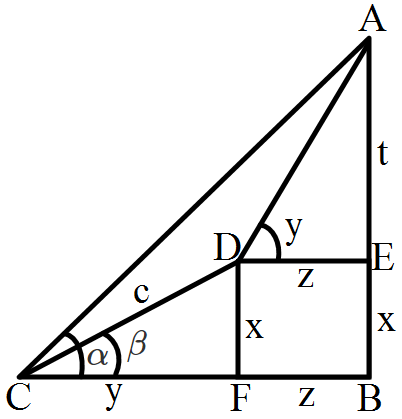
In $\triangle\text{DFC},$ $\sin\beta=\frac{\text{x}}{\text{c}}$ $\Rightarrow\text{x}=\text{c}\sin\beta$ and $\tan\beta=\frac{\text{x}}{\text{y}}$ $\Rightarrow\text{y}=\frac{\text{x}}{\tan\beta}=\frac{\text{c}\sin\beta}{\sin\beta}\times\cos\beta=\text{c}\cos\beta...(1)$ In $\triangle\text{ADE},$ $\tan\gamma=\frac{\text{t}}{\text{z}}$ $\Rightarrow\text{z}=\text{t}\cot\gamma...(2)$ In $\triangle\text{ABC},$ $\tan\text{a}=\frac{\text{t + x}}{\text{y + z}}$ $\Rightarrow\text{t + x}=(\text{c}\cos\beta\tan\alpha+\text{t}\cot\gamma)\tan\text{a}$ (from (1) and (2)) $\Rightarrow\text{t}-\text{t}\cot\gamma\tan\text{a = c}\cos\beta\tan\text{a}-\text{c}\sin\beta$ $(\because\text{x = c}\sin\beta)$ $\Rightarrow\text{t}\Big(1-\frac{\sin\alpha\cos\gamma}{\cos\alpha\sin\gamma}\Big)=\text{c}\Big(\frac{\cos\beta\sin\alpha-\cos\alpha\sin\beta}{\cos\alpha}\Big)$ $\Rightarrow\text{t}\Big(\frac{\sin\gamma\cos\alpha-\sin\alpha\cos\gamma}{\cos\alpha\sin\gamma}\Big)=\text{c}\frac{\sin(\alpha-\beta)}{\cos\alpha}$ $\Rightarrow\text{t}\frac{\sin(\gamma-\beta)}{\cos\alpha\sin\gamma}=\text{c}\frac{\sin(\alpha-\beta)}{\cos\alpha}$ $\Rightarrow\text{t = c}\frac{\sin\gamma\sin(\alpha-\beta)}{\sin(\gamma-\beta)}...(3)$ Now, $\text{AB = t + x = c}\frac{\sin\gamma\sin(\alpha-\beta)}{\sin(\gamma-\beta)}+\text{c}\sin\beta$ (using (3)) $=\text{c}\Big(\frac{\sin\gamma\sin(\alpha-\beta)}{\sin(\gamma-\beta)}+\sin\beta\Big)$ $=\text{c}\Big[\frac{\sin\gamma\sin(\alpha-\beta)+\sin(\gamma-\beta)}{\sin(\gamma-\beta)}\Big]$ $=\text{c}\Big[\frac{\sin\gamma\sin\alpha\cos\beta-\sin\beta\sin\gamma\cos\alpha+\sin\beta\sin\gamma\cos\alpha-\sin\beta\cos\gamma\sin\alpha}{\sin(\gamma-\beta)}\Big]$ $=\text{c}\Big[\frac{\sin\gamma\sin\alpha\cos\beta-\sin\beta\cos\gamma\sin\alpha}{\sin(\gamma-\beta)}\Big]$ $=\text{c}\Big[\frac{\sin\alpha\sin(\gamma-\beta)}{\sin(\gamma-\beta)}\Big]$ $=\frac{\text{c}\sin\alpha\sin(\gamma-\beta)}{\sin(\gamma-\beta)}$ Hence proved. View full question & answer→Question 1995 Marks
Show that $\sin100^\circ-\sin10^\circ$ is positive.
AnswerWe have, $\sin100^\circ-\sin10^\circ$
$=\sqrt{2}\Big(\frac{1}{\sqrt{2}}\times100^\circ-\frac{1}{\sqrt{2}}\times\cos100^\circ\Big)$ $\big[$Multiplying and dividing by $\sqrt{1^2+1^2}$ i.e., by $\sqrt{2}\big]$
$=\sqrt{2}(\cos45^\circ\times\sin100^\circ-\sin45^\circ\times\cos100^\circ)$
$=\sqrt{2}(\sin100^\circ\times\cos45^\circ-\cos100^\circ\times\sin45^\circ)$
$=\sqrt{2}(\sin(100^\circ-45^\circ))$
$=\sqrt{2}\sin55^\circ,$ which is positive real number. $[\because\sin\theta$ is positive in first quadrant$]$
View full question & answer→Question 2005 Marks
prove that:
$\sin(\text{B}-\text{C})\cos(\text{A}-\text{D})+\sin(\text{C}-\text{A})\cos(\text{B}-\text{D})+\sin(\text{A}-\text{B})\cos(\text{C}-\text{D})=0$
AnswerWe have,
$\text{LHS}=\sin(\text{B}-\text{C})\cos(\text{A}-\text{D})+\sin(\text{C}-\text{A})\cos(\text{B}-\text{D})+\sin(\text{A}-\text{B})\cos(\text{C}-\text{D})$
$=\ \frac{1}{2}[2\sin(\text{B}-\text{C})\cos(\text{A}-\text{D})+\sin(\text{C}-\text{A})\cos(\text{B}-\text{D})+2\sin(\text{A}-\text{B})\cos(\text{C}-\text{D})]$
$=\ \frac{1}{2}[\sin(\text{B}-\text{C}+\text{A}-\text{D})+\sin(\text{B}-\text{C}-\text{A+D})+\sin(\text{C}-\text{A}+\text{B}-\text{D})\\ \ \ \ \ +\sin(\text{C}-\text{A}-\text{B}+\text{D})+\sin(\text{A}-\text{B+C}-\text{D})+\sin(\text{A}-\text{B}-\text{C+D})]$
$=\ \frac{1}{2}[\sin(\text{A+B}-\text{C}-\text{D})+\sin(\text{B+D}-\text{C}-\text{A})+\sin(\text{B+C}-\text{A}-\text{D})\\ \ \ \ \ +\sin(\text{C+D}-\text{A}-\text{B})+\sin(\text{A+C}-\text{B}-\text{D})+\sin(\text{A+D}-\text{B}-\text{C})]$
$=\ \frac{1}{2}[\sin(\text{A+B}-\text{C}-\text{D})-\sin(\text{A+C}-\text{B}-\text{D})-\sin(\text{A+D}-\text{B}-\text{C})\\ \ \ \ \ -\sin(\text{A+B}-\text{C}-\text{D})+\sin(\text{A+C}-\text{B}-\text{D})+\sin(\text{A+D}-\text{B}-\text{C})]$
$=\ \frac{1}{2}[0]$
$=\ 0$
$=\ \text{RHS}$
$\sin(\text{B}-\text{C})\cos(\text{A}-\text{D})+\sin(\text{C}-\text{A})\cos(\text{B}-\text{D})+\sin(\text{A}-\text{B})\cos(\text{C}-\text{D})=0$
Hence proved.
View full question & answer→