Question 1015 Marks
Prove that:
$\sin20^\circ\sin40^\circ\sin60^\circ\sin80^\circ=\frac{3}{16}$
Answer$\text{LHS}=\sin20^\circ\sin40^\circ\sin60^\circ\sin80^\circ$
$\sin20^\circ\sin40^\circ\sin80^\circ\times\frac{\sqrt3}{2}$$\Big[\because\ \sin60^\circ=\frac{\sqrt3}{2}\Big]$
$=\ \frac{\sqrt3}{2}\times\frac{1}{2}(2\sin20^\circ\sin40^\circ)\sin80^\circ$
$=\ \frac{\sqrt3}{4}[\cos(40^\circ-20^\circ)-\cos(40^\circ+20^\circ)]\sin80^\circ$
$=\ \frac{\sqrt3}{4}[\cos20^\circ-\cos60^\circ]\sin80^\circ$
$=\ \frac{\sqrt3}{4}\Big[\cos20^\circ\sin80^\circ-\frac{1}{2}\sin80^\circ\Big]$
$=\ \frac{\sqrt3}{8}[2\cos20^\circ\sin80^\circ-\sin80^\circ]$
$=\ \frac{\sqrt3}{8}[\sin(80^\circ+20^\circ)+\sin(80^\circ-20^\circ)-\sin80^\circ]$
$=\ \frac{\sqrt3}{8}[\sin100^\circ+\sin60^\circ-\sin80^\circ]$
$=\ \frac{\sqrt3}{8}[\sin80^\circ+\sin60^\circ-\sin80^\circ]$
$=\ \frac{\sqrt3}{8}\times\sin60^\circ=\frac{\sqrt3}{8}\times\frac{\sqrt3}{2}$
$=\ \frac{3}{16}=\text{RHS}$
View full question & answer→Question 1025 Marks
Prove that:
$\cos40^\circ\cos80^\circ\cos160=-\frac{1}{8}$
Answer$\cos40^\circ\cos80^\circ\cos160^\circ=-\frac{1}{8}$
$\text{LHS}=\cos40^\circ\cos80^\circ\cos160^\circ$
$=\ \cos80^\circ\cos40^\circ\cos160^\circ$
Multiplying and dividing by 2
$=\ \frac{1}{2}(\cos80^\circ\times(2\cos40^\circ\cos160^\circ))$
$2\cos\text{A}\cos\text{B}=\cos(\text{A+B})+\cos(\text{A}-\text{B})$
$=\ \frac{1}{2}(\cos80^\circ(\cos(40^\circ+160^\circ)+\cos(40^\circ-160^\circ)))$
$=\ \frac{1}{2}(\cos80^\circ(\cos200+\cos(-120)))$
$=\ \frac{1}{2}(\cos80^\circ(\cos180^\circ+20^\circ)+\cos(180^\circ-60^\circ))$
$=\ \frac{1}{2}\cos80^\circ(\cos20^\circ+\cos60^\circ)$
$=\ \frac{1}{2}\cos80^\circ\cos20^\circ+\frac{1}{2}\cos80^\circ+60^\circ$
$=\ -\frac{1}{2}(2\cos80^\circ\cos20^\circ)+\frac{1}{2}\cos80^\circ\cos60^\circ$
$=\ -\frac{1}{4}[2\cos80^\circ\cos20^\circ+\cos80^\circ]$
$=\ -\frac{1}{4}[\cos(80^\circ+20^\circ)+\cos(80^\circ-20^\circ)+\cos80^\circ]$
$=\ -\frac{1}{4}[\cos100^\circ+\cos60^\circ+\cos80^\circ]$
$=\ -\frac{1}{4}[\cos(180^\circ-80^\circ)+\cos60^\circ+\cos80^\circ]$
$=\ -\frac{1}{4}[-\cos80^\circ+\cos60^\circ+\cos80^\circ]$
$=\ -\frac{1}{4}\cos60^\circ$
$=\ -\frac{1}{4}\times\frac{1}{2}$
$=\ -\frac{1}{8}\ \text{RHS}$
View full question & answer→Question 1035 Marks
Prove the following identities:
$\frac{2\sin\text{x}\cos\text{x}-\cos\text{x}}{1-\sin\text{x}+\sin^2\text{x}-\cos^2\text{x}}=\cot\text{x}$
Answer$\text{L.H.S}=\frac{2\sin\text{x}\cos\text{x}-\cos\text{x}}{1-\sin+\sin^2\cos^2\text{x}}$
$=\frac{\cos\text{x}(2\sin\text{x}-1)}{1-\cos^2\text{x}+\sin^2\text{x}-\sin\text{x}}$
$=\frac{\cos\text{x}(2\sin\text{x}-1)}{\sin^2\text{x}+\sin^2\text{x}-\sin\text{x}}$ $(\because1-\cos^2\text{x}=\sin^2\text{x})$
$=\frac{\cos\text{x}(2\sin\text{x}-1)}{2\sin^2\text{x}-\sin\text{x}}$
$=\frac{\cos\text{x}(2\sin\text{x}-1)}{\sin\text{x}(2\sin\text{x}-1)}$
$=\frac{\cos\text{x}}{\sin\text{x}}$
$=\cot\text{x}$
$=\text{R.H.S}$
$\text{Proved}$
View full question & answer→Question 1045 Marks
Prove the following identities: $\frac{(1+\cot\text{x}+\tan\text{x})(\sin\text{x}+\cos\text{x})}{\sec^3\text{x}-\text{cosec}^3\text{ x}}=\sin^2\text{x}\cos^2\text{x}$
Answer$\text{L.H.S}=\frac{(1+\cot\text{x}+\tan\text{x})(\sin\text{x}+\cos\text{x})}{\sec^3\text{x}-\text{cosec}^3\text{ x}}$
$=\frac{\Big(1+\frac{\cos\text{x}}{\sin\text{x}}+\frac{\sin\text{x}}{\cos\text{x}}\Big)}{\Big(\frac{1}{\cos^3\text{x}}-\frac{1}{\sin^3\text{x}}\Big)}$ $\left(\begin{array}{c}\because\cot\text{x}=\frac{\cos\text{x}}{\sin\text{x}},\tan\text{x}=\frac{\sin\text{x}}{\cos\text{x}}\\ \sec\text{x}=\frac{1}{\cos\text{x}},\text{cosec }\text{x}=\frac{1}{\sin\text{x}}\end{array}\right)$
$=\Bigg(\frac{1+\frac{\cos^2\text{x}+\sin^2\text{x}}{\sin\text{x}\cos\text{x}}}{\frac{\sin^3\text{x}-\cos^3\text{x}}{\cos^3\text{x}\sin^3\text{x}}}\Bigg)(\sin\text{x}-\cos\text{x})$
$=\frac{(\sin\text{x}\cos\text{x}+1)\sin^3\text{x}\cos^3\text{x}}{\sin\text{x}\cos\text{x}.(\sin^3\text{x}-\cos^3\text{x})}\cdot(\sin\text{x}-\cos\text{x})$ $(\because\sin^2\text{x}+\cos^2\text{x}=1)$
$=\frac{(1+\sin\text{x}\cos\text{x})\sin^2\text{x}\cos^2\text{x}.(\sin\text{x}-\cos\text{x})}{(\sin\text{x}-\cos\text{x})(\sin^3\text{x}+\cos^2\text{x}+\sin\text{x}\cos\text{x})}$ $(\because\text{a}^3-\text{b}^3=(\text{a-b})(\text{a}^2+\text{b}^2+\text{ab})$
$=\frac{(1+\sin\text{x}\cos\text{x}).\sin^2\text{x}\cos^2\text{x}}{1+\sin\text{x}\cos\text{x}}$
$=\sin^2\text{x}\cos^2\text{x}$
$=\text{R.H.S}$
$\text{Proved}$
View full question & answer→Question 1055 Marks
Prove the following identities:
$\cos\text{x}(\tan\text{x}+2)(2\tan\text{x}+1)=2\sec\text{x}+5\sin\text{x}$
Answer$\text{L.H.S}=\cos\text{x}(\tan\text{x}+2)(2\tan\text{x}+1)$
$=\cos\text{x}\Big(\frac{\sin\text{x}}{\cos\text{x}}+2\Big)\Big(\frac{2\sin\text{x}}{\cos\text{x}}=1\Big)\Big(\because\tan\text{x}=\frac{\sin\text{x}}{\cos\text{x}}\Big)$
$=\cos\frac{(\sin\text{x}+2\cos\text{x})(2\sin\text{x}+\cos\text{x})}{\cos\text{x}.\cos\text{x}}$
$=\frac{(2\sin^2\text{x}+\sin\text{x}\cos\text{x}+4\sin\text{x}\cos\text{x}+2\cos^2\text{x})}{\cos\text{x}}$
$=\frac{2(\sin^2\text{x}+\cos^2\text{x})+5\sin\text{x}\cos\text{x}}{\cos\text{x}}$
$=\frac{2+5\sin\text{x}\cos\text{x}}{\cos\text{x}}$ $(\because\sin^2\text{x}+\cos^2\text{x})=1$
$=\frac{2}{\cos\text{x}}+\frac{5\sin\text{x}\cos\text{x}}{\cos\text{x}}$
$=2\sec\text{x}+5\sin\text{x}$
$=\text{R.H.S}$
$\text{Proved}$
View full question & answer→Question 1065 Marks
Find the general solutions of the following equations:
$\sin3\text{x}+\cos2\text{x}=0$
Answer$\cos(2\text{x})=-\sin(3\text{x})$$=-\cos(\frac{\pi}{2}-3\text{x})$
$=\cos(\frac{\pi}{2}+3\text{x})$
$\Rightarrow2\text{n}\pi+2\text{x}=\frac{\pi}{2}+3\text{x}$
$\text{x}=(4\text{m}-1)\frac{\pi}{2},\text{m}\in\text{z}$
or
$\Rightarrow2\text{n}\pi-2\text{x}=\frac{\pi}{2}+3\text{x}$
$\text{x}=(4\text{n}-1)\frac{\pi}{10},\text{n}\in\text{z}$
View full question & answer→Question 1075 Marks
Solve the following equations:
$\sin\text{x}+\sin2\text{x}+\sin3=0$
AnswerWe have,
$\sin\text{x}+\sin2\text{x}+\sin3=0$
$\Rightarrow\sin2\text{x}+2\sin2\text{x}.\cos\text{x}=0$
$\Rightarrow\sin2\text{x}+(1+2\cos\text{x})=0$
$\Rightarrow\text{Either}$
$\sin2\text{x}=0$ or $1+2\cos\text{x}=0$
$\Rightarrow2\text{x}=\text{n}\pi,\text{n}\in\text{z}$ or $\cos\text{x}=-\frac{1}{2}=\cos\Big(\pi-\frac{\pi}{3}\Big)$
$\Rightarrow\text{x}=\frac{\text{n}\pi}{2},\text{n}\in\text{z}$ or $\text{x}=2\text{m}\pi\pm\frac{2\pi}{3},\text{m}\in\text{z}$
Thus,
$\text{x}=\frac{\text{n}\pi}{2},\text{n}\in\text{z}$ or $\text{x}=2\text{m}\pi\pm\frac{2\pi}{3},\text{m}\in\text{z} $
View full question & answer→Question 1085 Marks
If $\tan\theta=\frac{\sin\alpha-\cos\alpha}{\sin\alpha+\cos\alpha},$ then show that $\sin\alpha+\cos\alpha=\sqrt{2}\cos\theta.$
[Hint: Express $\tan\theta=\tan(\alpha-\frac{\pi}{4})\theta=\alpha-\frac{\pi}{4}$ ]
AnswerGiven that: $\tan\theta=\frac{\sin\alpha-\cos\alpha}{\sin\alpha+\cos\alpha}$
$\Rightarrow\tan\theta=\frac{\frac{\sin\alpha-\cos\alpha}{\cos\alpha}}{\frac{\sin\alpha+\cos\alpha}{\cos\alpha}}$
$\Rightarrow\tan\theta=\frac{\tan\alpha-1}{\tan\alpha+1}=\frac{\tan\alpha-\tan\frac{\pi}{4}}{1+\tan\frac{\pi}{4}\tan\alpha}$$[\tan(\text{A}-\text{B})=\frac{\tan\text{A}-\tan\text{B}}{1+\tan\text{A}\tan\text{B}}]$
$\Rightarrow\tan\theta=\tan\Big(\alpha-\frac{\pi}{4}\Big)$
$\therefore\theta=\alpha-\frac{\pi}{4}$
$\Rightarrow\cos\theta=\cos\Big(\alpha-\frac{\pi}{4}\Big)$
$\Rightarrow\cos\theta=\cos\alpha\cos\frac{\pi}{4}+\sin\alpha\sin\frac{\pi}{4}$
$[\cos(\text{A}-\text{B})=\cos\text{A}\cdot\cos\text{B}+\sin\text{A}\cdot\sin\text{B}]$
$\Rightarrow\cos\theta=\cos\alpha\cdot\frac{1}{\sqrt2}+\sin\alpha\cdot\frac{1}{\sqrt2}$
$\Rightarrow\sqrt2\cos\theta=\cos\alpha+\sin\alpha$
$\Rightarrow\sin\alpha+\cos\alpha=\sqrt2\cos\theta.$ Hence proved.
View full question & answer→Question 1095 Marks
Solve the following equations:
$\cos\text{x}\cos2\text{x}\cos3\text{x}=\frac{1}{4}$
AnswerWe have,
$\cos\text{x}\cos2\text{x}\cos3\text{x}=\frac{1}{4}$
View full question & answer→Question 1105 Marks
Prove that:
$\frac{1}{\sin\text{(x}-\text{b})\sin\text{(x}-\text{b)}}=\frac{\cot\text{(x}-\text{b)}-\cot\text{(x}-\text{b)}}{\sin\text{(a}-\text{b)}}$
Answer$\text{L.H.S}\ \frac{1}{\sin\text{(x}-\text{a)}\sin\text{(x}-\text{b)}}$
$=\frac{1}{\sin\text{(a}-\text{b)}}\Big[\frac{\sin\text{(a}-\text{b)}}{\sin\text{(x}-\text{b})\sin\text{(x}-\text{b)}}\Big]$
$=\frac{1}{\sin\text{(a}-\text{b)}}\Big[\frac{\sin\text{(x}-\text{b)-}(\text{x}-\text{b)}}{\sin\text{(x}-\text{a})\sin\text{(x}-\text{b)}}\Big]$
$=\frac{1}{\sin\text{(a}-\text{b)}}\Big[\frac{\sin\text{(x}-\text{b)}\cos(\text{x}-\text{a})-\cos(\text{x}-\text{b})\sin(\text{x}-\text{a)}}{\sin\text{(x}-\text{a})\sin\text{(x}-\text{b)}}\Big]$
$=\frac{1}{\sin\text{(a}-\text{b)}}\Big[\frac{\sin(\text{x}-\text{b)}\cos(\text{x}-\text{a})}{\sin\text{(x}-\text{a)}\sin(\text{x}-\text{b})}-\frac{\sin(\text{x}-\text{b)}\cos(\text{x}-\text{a})}{\sin\text{(x}-\text{a)}\sin(\text{x}-\text{b})}\Big]$
$=\frac{1}{\sin\text{(a}-\text{b)}}\Big[\cot(\text {x}-\text{a}-\cot(\text{x}-\text{b})\Big]$
$=\frac{\cot(\text{x}-\text{a})-\cot(\text{x}-\text{b})}{\sin(\text{a}-\text{b})}$
$=\text{R.H.S}$
$\therefore\ \text{L.H.S}=\text{R.H.S}$
Hence proved.
View full question & answer→Question 1115 Marks
$\frac{\sqrt{\sin\text{A}}-\sqrt{\sin\text{B}}}{\sqrt{\sin\text{A}}+\sqrt{\sin\text{B}}}=\frac{\text{a + b}-2\sqrt{\text{ab}}}{\text{a}-\text{b}}$
Answer$\frac{\sqrt{\sin\text{A}}-\sqrt{\sin\text{B}}}{\sqrt{\sin\text{A}}+\sqrt{\sin\text{B}}}=\frac{\text{a + b}-2\sqrt{\text{ab}}}{\text{a}-\text{b}}$
$\text{RHS}=\frac{\text{a + b}-2\sqrt{\text{ab}}}{\text{a}-\text{b}}$
$=\frac{(\sqrt{\text{a}})^2+(\sqrt{\text{b}})^2-2\sqrt{\text{ab}}}{(\sqrt{\text{a}})^2-(\sqrt{\text{b}})^2}$
$=\frac{(\sqrt{\text{a}}-\sqrt{\text{b}})^2}{(\sqrt{a})^2-(\sqrt{\text{b}})^2}$
$=\frac{(\sqrt{\text{a}}-\sqrt{\text{b}})}{(\sqrt{\text{a}}+\sqrt{\text{b}})}$
$=\frac{\big(\sqrt{\text{k}\sin\text{A}}-\sqrt{\text{k}\sin\text{B}}\big)}{\big(\sqrt{\text{k}\sin\text{A}}+\sqrt{\text{k}\sin\text{B}}\big)}$
$=\frac{\big(\sqrt{\sin\text{A}}-\sqrt{\sin\text{B}}\big)}{\big(\sqrt{\sin\text{A}}+\sqrt{\sin\text{B}}\big)}=\text{LHS}$ [taking k common and cancelling them]
Hence proved
View full question & answer→Question 1125 Marks
Sketch the graphs of the following functions:
$\text{f(x)}=\text{cosec}^2\text{x}$
Answer$\text{f(x)}=\text{cosec}^2\text{x}$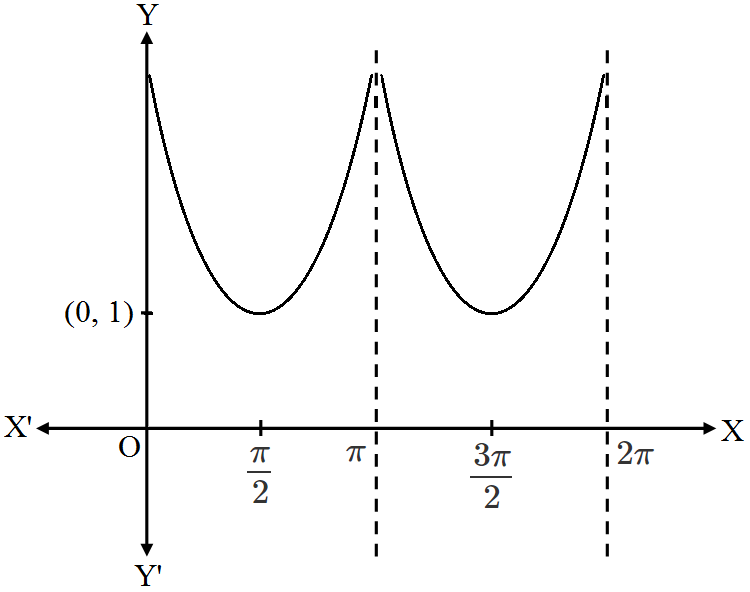
View full question & answer→Question 1135 Marks
If $\sec(\text{x}+\alpha)+\sec(\text{x}-\alpha)=2\sec\text{x},$ prove that $\cos\text{x}-\pm\sqrt{2}\cos\frac{\alpha}{2}$
AnswerWe have,
$\sec(\theta+\alpha)+\sec(\theta-\alpha)=2\sec\theta.$
$\Rightarrow\frac{1}{\cos^2\theta.\cos^2\alpha-\sin^\theta\sin^2\alpha}+\frac{1}{\cos\theta.\cos\alpha-\sin\theta\sin\alpha}=\frac{2}{\cos\theta}$
$\Rightarrow\frac{2\cos\theta\cos\alpha}{\cos^2\cos^2\alpha-\sin^2\sin^2\alpha}=\frac{2}{\cos\theta}$
$\Rightarrow\frac{2\cos\theta\cos\alpha}{\cos^2\theta\cos^2\alpha-(\cos^2\alpha+\sin^2\alpha)}=\frac{1}{\cos\theta}$
$\Rightarrow\cos^2\theta\cos\alpha=\cos^2\theta(\cos^2\alpha+\sin^2\alpha)-\sin^2\alpha$
$\Rightarrow\cos^2\theta(1-\cos\alpha)=\sin^2\alpha$
$\Rightarrow\cos^2\theta=\frac{\sin^2\alpha}{2\sin^2\frac{\alpha}{2}}$
$=\frac{1\sin^2\frac{\alpha}{2}.\cos^2\frac{\alpha}{2}}{2\sin^2\frac{\alpha}{2}}$
$\Rightarrow\cos\theta=\pm\sqrt{2}\cos\frac{\alpha}{2}$
View full question & answer→Question 1145 Marks
Sketch the graphs of the following functions:
$\text{f(x)}=\tan^2\text{x}$
Answer$\text{f(x)}=\tan^2\text{x}$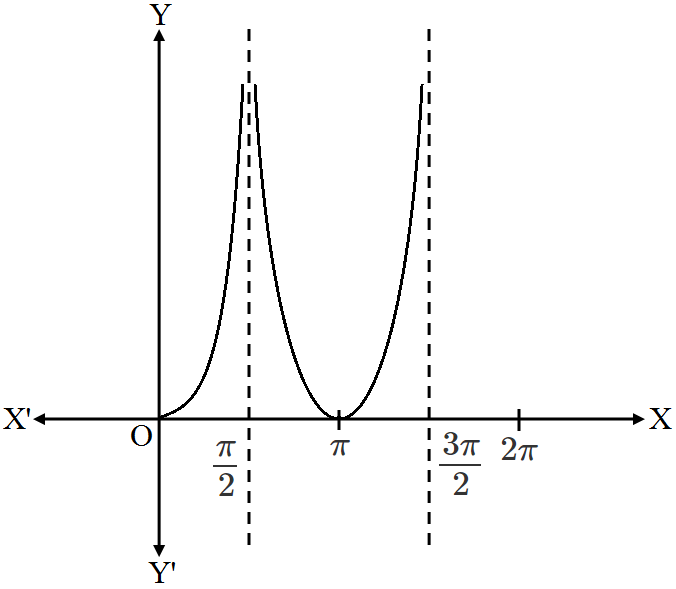
View full question & answer→Question 1155 Marks
Prove that:
$\sin3\text{A}+\sin2\text{A}-\sin\text{A}=4\sin\text{A}\cos\frac{\text{A}}{2}\cos\frac{3\text{A}}{2}$
AnswerWe have,
$\text{LHS}=\sin3\text{A}+\sin2\text{A}-\sin\text{A}$
$=\ \sin3\text{A}-\sin\text{A}+\sin2\text{A}$
$=\ 2\sin\Big(\frac{3\text{A}-\text{A}}{2}\Big)\cos\Big(\frac{3\text{A}+\text{A}}{2}\Big)+\sin2\text{A}$
$=\ 2\sin\text{A}\cos2\text{A}+\sin2\text{A}$
$=\ 2\sin\text{A}\cos2\text{A}+2\sin\text{A}\cos\text{A}$
$=\ 2\sin\text{A}[\cos2\text{A}+\cos\text{A}]$
$=\ 2\sin\text{A}\Big[2\cos\Big(\frac{2\text{A}+\text{A}}{2}\Big)\cos\Big(\frac{2\text{A}-\text{A}}{2}\Big)\Big]$
$=\ 4\sin\text{A}\cos\frac{3\text{A}}{2}\cos\frac{\text{A}}{2}$
$=\ 4\sin\text{A}\cos\frac{\text{A}}{2}\cos\frac{3\text{A}}{2}$
$=\ \text{RHS}$
$\therefore\ \sin3\text{A}+\sin2\text{A}-\sin\text{A}=4\sin\text{A}\cos\frac{\text{A}}{2}\cos\frac{3\text{A}}{2}.$
Hence proved.
View full question & answer→Question 1165 Marks
Prove that:
$\frac{\sin\text{A}+2\sin3\text{A}+\sin5\text{A}}{\sin3\text{A}+2\sin5\text{A}+\sin7\text{A}}=\frac{\sin3\text{A}}{\sin5\text{A}}$
AnswerWe have,$\text{LHS}=\frac{\sin\text{A}+2\sin3\text{A}+\sin5\text{A}}{\sin3\text{A}+2\sin5\text{A}+\sin7\text{A}}$
$=\ \frac{\sin5\text{A}+\sin\text{A}+2\sin3\text{A}}{\sin7\text{A}+\sin3\text{A}+2\sin5\text{A}}$
$=\ \frac{2\sin\Big(\frac{5\text{A}+\text{A}}{2}\Big)\cos\Big(\frac{5\text{A}-\text{A}}{2}\Big)+2\sin3\text{A}}{2\sin\Big(\frac{7\text{A}+3\text{A}}{2}\Big)\cos\Big(\frac{7\text{A}-3\text{A}}{2}\Big)+2\sin5\text{A}}$
$=\ \frac{2\sin3\text{A}\cos2\text{A}+2\sin3\text{A}}{2\sin5\text{A}\cos2\text{A}+2\sin5\text{A}}$
$=\ \frac{2\sin3\text{A}(\cos2\text{A}+1)}{2\sin5\text{A}(\cos2\text{A}+1)}$
$=\ \frac{\sin3\text{A}}{\sin5\text{A}}$
$=\ \text{RHS}$
$\frac{\sin\text{A}+2\sin3\text{A}+\sin5\text{A}}{\sin3\text{A}+2\sin5\text{A}+\sin7\text{A}}=\frac{\sin3\text{A}}{\sin5\text{A}}$ Hence proved.
View full question & answer→Question 1175 Marks
Prove that:
$\cos\frac{\pi}{15}\cos\frac{2\pi}{15}\cos\frac{4\pi}{15}\cos\frac{7\pi}{15}=\frac{1}{16}$
Answer$\text{LHS}=\cos\frac{\pi}{15}\cos\frac{2\pi}{15}\cos\frac{4\pi}{15}\cos\frac{7\pi}{15}$
$=\frac{2\sin\frac{\pi}{15}.\cos\frac{\pi}{15}}{2\sin\frac{\pi}{15}}.\cos\frac{2\pi}{15}\cos\frac{4\pi}{15}\cos\frac{7\pi}{15}$ $\Big[$ Divide and multiply by $2\sin\frac{\pi}{15}\Big]$
$=\frac{2\sin\frac{\pi}{15}.\cos\frac{\pi}{15}}{2\sin\frac{\pi}{15}}.\cos\frac{2\pi}{15}\cos\frac{4\pi}{15}\cos\frac{7\pi}{15}$
$=\frac{2\sin\frac{4\pi}{15}}{2.4\sin\frac{\pi}{15}}.\cos\frac{4\pi}{15}\cos\frac{7\pi}{15}$
$=\frac{2\sin\frac{8\pi}{15}}{2.8\sin\frac{\pi}{15}}.\cos\frac{7\pi}{15}$
$=\frac{\sin\big(\frac{8\pi}{15}+\frac{7\pi}{15}\big)+\sin\big(\frac{8\pi}{15}-\frac{7\pi}{15}\big)}{16\sin\frac{\pi}{15}}$
$=\frac{\sin\pi+\sin\frac{\pi}{15}}{16\sin\frac{\pi}{15}}$
$=\frac{\sin\frac{\pi}{15}}{16\sin\frac{\pi}{15}}[\because\sin\pi=0]$
$=\frac{1}{16}$
$=\text{RHS}$
View full question & answer→Question 1185 Marks
If $\cos(\theta+\phi)=\text{m}\cos(\theta-\phi),$ then prove that $\tan \theta=\frac{1-\text{m}}{1+\text{m}}\cot\phi.$
[Hint: Express $\frac{\cos(\theta+\phi)}{\cos(\theta-\phi)}=\frac{\text{m}}{1}$ and apply Componendo and Dividendo]
AnswerGiven that: $\cos(\theta+\phi)=\text{m}\cos(\theta-\phi)$
$\Rightarrow\frac{\cos(\theta+\phi)}{\cos(\theta-\phi)}=\frac{\text{m}}{1}$
Using componendo and dividend rule, we get
$\frac{\cos(\theta+\phi)+\cos(\theta-\phi)}{\cos(\theta+\phi)-\cos(\theta-\phi)}=\frac{\text{m}+1}{\text{m}-1}$
$\Big[\cos\text{C}-\cos\text{D}=-2\sin\Big(\frac{\text{C+D}}{2}\Big)\sin\Big(\frac{\text{C}-\text{D}}{2}\Big)\Big]$
$\Big[\cos\text{C}+\cos\text{D}=2\cos\Big(\frac{\text{C+D}}{2}\Big)\cos\Big(\frac{\text{C}-\text{D}}{2}\Big)\Big]$
$\Rightarrow\frac{2\cos\Big(\frac{\theta+\phi+\theta-\phi}{2}\Big).\cos\Big(\frac{\theta+\phi-\theta+\phi}{2}\Big)}{-2\sin\Big(\frac{\theta+\phi+\theta-\phi}{2}\Big).\sin\Big(\frac{\theta+\phi-\theta+\phi}{2}\Big)}=\frac{\text{m}+1}{\text{m}-1}$
$\Rightarrow\frac{\cos\theta\cos\phi}{-\sin\theta\sin\phi}=\frac{\text{m}+1}{\text{m}-1}\Rightarrow-\cot\theta.\cot\phi=\frac{\text{m}+1}{\text{m}-1}$
$\Rightarrow\frac{-\cot\phi}{\tan\theta}=\frac{\text{m}+1}{\text{m}-1}=-\frac{1+\text{m}}{1-\text{m}}$
$\Rightarrow\tan\theta(1+\text{m})=(1-\text{m})\cot\phi$
$\Rightarrow\tan\theta=\frac{1-\text{m}}{1+\text{m}}\cot\phi.$ Hence proved.
View full question & answer→Question 1195 Marks
Solve the following equations:
$\sin\text{x}+\sin2\text{x}+\sin3\text{x}+\sin4\text{x}=0$
AnswerGiven, $\sin\text{x}+\sin2\text{x}+\sin3\text{x}+\sin4\text{x}=0$$(\sin4\text{x}+\sin2\text{x})+(\sin3\text{x}+\sin\text{x})=0$
Using, $(\sin\text{A}+\sin\text{B})\text{Formula}\Rightarrow$
$2\sin\Big[\frac{(4\text{x}+2\text{x})}{2}\Big]\cos\Big[\frac{4\text{x}-2\text{x}}{2}\Big]+2\sin\Big[\frac{( 3\text{x}+\text{x})}{2}\Big]\cos\Big[\frac{( 3\text{x}-\text{x})}{2}\Big]=0$
$2\sin3\text{x}\cos\text{x}+2\sin2\text{x}\cos\text{x}=0$
$2\cos\text{x}(\sin3\text{x}+\sin2\text{x})=0$
$2\cos\text{x}(2\sin)\Big[\frac{(3\text{x}+2\text{x})}{2}\Big]\cos\Big[\frac{(3\text{x}-2\text{x})}{2}\Big]=0$
$4\cos\text{x}\sin\frac{5\text{x}}{2}\cos\frac{\text{x}}{2}=0$
$\cos\text{x}=0;\sin\frac{5\text{x}}{2}=0;\cos\frac{\text{x}}{2}=0$
$\text{x}=\frac{(2\text{n}+1)\pi}{2};\frac{5\text{x}}{2}=\text{m}\pi;\frac{\text{x}}{2}=\frac{(2\text{x}+1)\pi}{2}$
$\text{x}=\frac{(2\text{n}+1)\pi}{2};\text{x}=\frac{2\text{m}\pi}{5};\text{x}=(2\text{x}+1)\pi,\text{m},\text{r},\text{n}\in\text{Z}$
View full question & answer→Question 1205 Marks
$\text{If}\ \text{y}\sin\phi=\text{x}\sin(2\theta+\phi),$ prove that $(\text{x+y})\cot(\theta+\phi)=(\text{y}-\text{x})\cot\theta$
AnswerWe have,
$\text{y}\sin\phi=\text{x}\sin(2\theta+\phi)$
$\Rightarrow\ \frac{\sin\phi}{\sin(2\theta+\phi)}=\frac{\text{x}}{\text{y}}...(\text{i})$
Now,
$\frac{\sin\phi}{\sin(2\theta+\phi)}=\frac{\text{x}}{\text{y}}$
$\Rightarrow\ \frac{\sin\phi}{\sin(2\theta+\phi)}+1=\frac{\text{x}}{\text{y}}+1$
$\Rightarrow\ \frac{\sin\phi+\sin(2\theta+\phi)}{\sin(2\theta+\phi)}=\frac{\text{x+y}}{\text{y}}...(\text{ii})$
Again,
$\frac{\sin\phi}{\sin(2\theta+\phi)}=\frac{\text{x}}{\text{y}}$ [By equation (i)]
$\Rightarrow\ \frac{\sin\phi}{\sin(2\theta+\phi)}-1=\frac{\text{x}}{\text{y}}-1$
$\Rightarrow\ \frac{\sin\phi-\sin(2\theta+\phi)}{\sin(2\theta+\phi)}=\frac{\text{x}-\text{y}}{\text{y}}...(\text{iii})$
Dividing equation (ii) by equation (iii), we get
$\frac{\sin\phi+\sin(2\theta+\phi)}{\sin\phi-\sin(2\theta+\phi)}=\frac{\text{x+y}}{\text{x}-\text{y}}$
$\Rightarrow\ \frac{2\sin\big(\frac{\phi+2\theta+\phi}{2}\big)\cos\big(\frac{\phi-2\theta-\phi}{2}\big)}{2\sin\big(\frac{\phi-2\theta-\phi}{2}\big)\cos\big(\frac{\phi+2\theta+\phi}{2}\big)}=\frac{\text{x+y}}{\text{x}-\text{y}}$
$\Rightarrow\ \frac{\sin(\theta+\phi)\cos(\theta-\phi)}{\sin(-\theta)\cos(\theta+\phi)}=\frac{\text{x+y}}{\text{x}-\text{y}}$
$\Rightarrow\ \frac{\sin(\theta+\phi)\cos(\theta)}{\cos(\theta+\phi)[-\sin(\theta)]}=\frac{\text{x+y}}{\text{x}-\text{y}}$
$\Rightarrow\ \frac{-\cot(\theta)}{\cot(\theta+\phi)}=\frac{\text{x+y}}{\text{x}-\text{y}}$
$\Rightarrow\ -(\text{x}-\text{y})\cot\theta=(\text{x+y})\cot(\theta+\phi)$
$\Rightarrow\ (\text{y}-\text{x})\cot\theta=(\text{x+y})\cot(\theta+\phi)$
$\Rightarrow\ (\text{x}+\text{y})\cot(\theta+\phi)=(\text{y}-\text{x})\cot\theta$ Hence proved.
View full question & answer→Question 1215 Marks
Find the general solution of the equation $(\sqrt{3}-1)\cos\theta+(\sqrt{3}+1)\sin\theta=2$
[Hint: Put $\sqrt{3}-1=\text{r}\sin\alpha,\sqrt{3}+1=\text{r}\cos\alpha$ which gives $\tan\alpha=\tan\Big(\frac{\pi}{4}-\frac{\pi}{6}\Big)\alpha=\frac{\pi}{12}$]
Answer$(\sqrt{3}-1)\cos\theta+(\sqrt{3}+1)\sin\theta=2...(\text{i})$
Put $\sqrt{3}-1=\text{r}\sin\alpha$ and $\sqrt{3}+1=\text{r}\cos\alpha$
$\therefore\text{r}^2=(\sqrt{3}-1)^2+(\sqrt{3}+1)^2\Rightarrow\text{r}^2=8\Rightarrow\text{r}=2\sqrt{2}$
Also, $\tan\alpha=\frac{\sqrt{3}-1}{\sqrt{3}+1}=2-\sqrt{3}\Rightarrow\alpha=\frac{\pi}{12}$
From eq. (i), we have
$\text{r}\sin\alpha\cos\theta+\text{r}\cos\alpha\sin\theta=2\Rightarrow\text{r}\sin(\theta+\alpha)=2$
$\Rightarrow\sin(\theta+\alpha)=\frac{1}{\sqrt{2}}\Rightarrow\sin(\theta+\alpha)=\sin\frac{\pi}{4}$
$\Rightarrow\theta+\alpha=\text{n}\pi+(-1)^{\text{n}}\frac{\pi}{4},\text{n}\in\text{Z}$
$\Rightarrow\theta=\text{n}\pi+(-1)^{\text{n}}\frac{\pi}{4}-\frac{\pi}{12},\text{n}\in\text{Z}$
View full question & answer→Question 1225 Marks
Solve the following equations:
$2\sin^{2}\text{x}=3\cos\text{x},0\leq\text{x}\leq2\pi$
Answer$2\sin^{2}\text{x}=3\cos\text{x}$$\Rightarrow2(1-\cos^{2}\text{x})=3\cos\text{x}$
$\Rightarrow2\cos^{2}\text{x}+3\cos\text{x}-2=0$
$\Rightarrow(2\cos\text{x}-1)(\cos\text{x}+2)=0$
$\Rightarrow\cos\text{x}=\frac{1}{2}$ or $\cos\text{x}=-2$
But, $\cos\text{x}=-2$ is not possible. $(-1\leq\cos\text{x}\leq1)$
$\therefore\cos\text{x}=\frac{1}{2}=\cos\frac{\pi}{3}$
$\Rightarrow\text{x}=2\text{n}\pi\pm\frac{\pi}{3},\text{n}\in\text{z}$
Putting n=0 and n=1, We get
$\text{x}=\frac{\pi}{3},\frac{5\text{x}}{3}$ $(0\leq\text{x}\leq2\pi)$
View full question & answer→Question 1235 Marks
Sketch the graphs of the following curves on the same scale and the same axes:
$\text{y}=\cos2\text{x}$ and $\text{y}=\cos2\Big(\text{x}-\frac{\pi}{4}\Big)$
AnswerFirst, we draw the graph of $\text{y}=\cos2\text{x}.$ Let us now draw the graph of $\text{y}=\cos2\Big(\text{x}-\frac{\pi}{4}\Big).$ $\text{y}=\cos2\Big(\text{x}-\frac{\pi}{4}\Big)$ $\Rightarrow\text{y}-0=\cos2\Big(\text{x}-\frac{\pi}{4}\Big)...(\text{i})$ On shifting the origin at $\Big(\frac{\pi}{4},0\Big),$ we get: $\text{x = X}+\frac{\pi}{4}$ and $\text{y = Y}+0$ On subsitituting the values in (i), we get: $\text{Y}=\cos2\text{X}$ Then, we draw the graph of $\text{Y}=\cos2\text{X}$ and shift it by $\frac{\pi}{4}$ to the right. Then, we will obtain the following graph: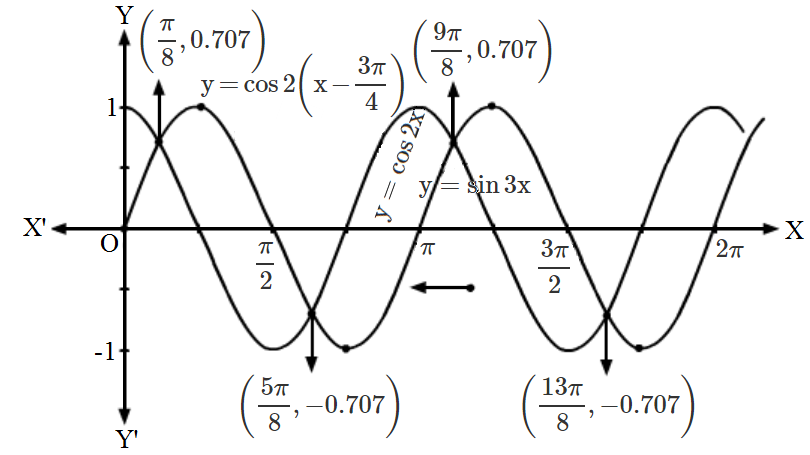
View full question & answer→Question 1245 Marks
If $\cos\theta+\tan\theta=2\text{cosec}\theta,$ then find the general value of $\theta.$
AnswerGiven that: $\cot\theta+\tan\theta=2\text{cosec}\theta$
$ \Rightarrow\frac{\cos\theta}{\sin\theta}+\frac{\sin\theta}{\cos\theta}=\frac{2}{\sin\theta}.$
$\Rightarrow\frac{\cos^2\theta+\sin^2\theta}{\sin\theta\cos\theta}=\frac{2}{\sin\theta}$
$\Rightarrow\frac{1}{\sin\theta\cos\theta}=\frac{2}{\sin\theta}$
$\Rightarrow2\sin\theta\cos\theta=\sin\theta $
$\Rightarrow2\sin\theta\cos\theta-\sin\theta=0$
$\Rightarrow\sin\theta(2\cos\theta-1)=0$
$\Rightarrow\sin\theta=0$ Or $2\cos\theta-1=0$ Or $\cos\theta=\frac{1}{2}$
Now $\sin\theta=0\Rightarrow\theta=\text{n}\pi,\text{n}\in\text{z}$
$\cos\theta=\frac{1}{2}\Rightarrow\cos\theta=\cos\frac{\pi}{3}$
$\therefore\theta=2\text{n}\pi\pm\frac{\pi}{3}$
Hence ,the general values of $\theta$ is $2\text{n}\pi\pm\frac{\pi}{3}$ and $\text{n}\pi,\text{n}\in\text{z}$
View full question & answer→Question 1255 Marks
Find the value of the expression
$3[\sin^4\Big(\frac{3\pi}{2}-\alpha\Big)+\sin^4(3\pi+\alpha)]-2[\sin^6\Big(\frac{\pi}{2}+\alpha\Big)+\sin^6(5\pi-\alpha)]$
Answer$3[\sin^4\Big(\frac{3\pi}{2}-\alpha\Big)+\sin^4(3\pi+\alpha)]-2[\sin^6\Big(\frac{\pi}{2}+\alpha\Big)+\sin^6(5\pi-\alpha)]$$=3[\cos^4\alpha+\sin^4\alpha]-2[\cos^6\alpha+\sin^6\alpha]$
$=3[(\cos^2\alpha+\sin^2\alpha)^2-2\cos^2\alpha.\sin^2\alpha]-2[(\cos^2\alpha+\sin^2\alpha)^3]\\-3\cos^2\alpha.\sin^2\alpha(\cos^2\alpha+\sin^2\alpha)$
$=3[1-2\cos^2\alpha.\sin^2\alpha]-2[1-3\cos^2\alpha.\sin^2\alpha]=3-2=1$
View full question & answer→Question 1265 Marks
Sketch the graphs of the following functions:
$\text{f(x)}=2\sec\pi\text{x}$
Answer$\text{f(x)}=2\sec\pi\text{x}$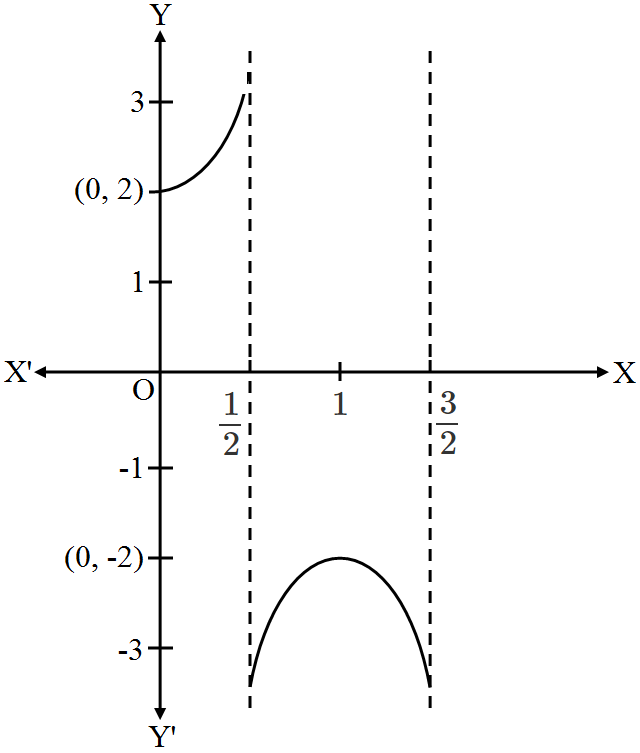
View full question & answer→Question 1275 Marks
Prove the following identities:
$(1+\tan\alpha\tan\beta)^2+(\tan\alpha-\tan\beta)^2=\sec^2\alpha\sec^2\beta$
Answer$\text{L.H.S}=(1+\tan\alpha\tan\beta)^2+(\tan\alpha-\tan\beta)^2$
$=1(\tan\alpha+\tan\beta)^2+2.1\tan\alpha\tan\beta\\\ \ +(\tan\alpha)^2+(\tan\beta)^2-1\tan\alpha.\tan\beta$ $(\text{Using(a+b)}^2=\text{a}^2+\text{b}^2+2\text{ab and (a-b)}^2=\text{a}^2+\text{b}^2-2\text{ab})$
$=1+\tan^2\alpha+\tan^2\beta+2\tan\alpha\tan\beta+\tan^2\alpha+\tan^2\beta-2\tan\alpha\tan\beta$
$=1+\tan^2\alpha+\tan^2\alpha+\tan^2\beta+\tan^2\beta$
$=\sec^2\alpha+\tan^2\beta(1+\tan^2\alpha)$$(\because1+\tan^2\alpha=\sec^2\alpha)$
$=\sec^2\alpha+\tan^2\beta.\sec^2\alpha$
$=\sec^2\alpha(1+\tan^2\beta)$
$=\sec^2\alpha.\sec^2\beta$ $(\because1+\tan^2\beta=\sec^2\beta)$
$=\text{R.H.S}$
$\text{Proved}$
View full question & answer→Question 1285 Marks
Solve the following equations:
$\sqrt{3}\cos\text{x}+\sin\text{x}=1$
AnswerWe have, $\sqrt{3}\cos\text{x}+\sin\text{x}=1$ Divide both side by 2, we get $\frac{\sqrt{3}}{2}\cos\text{x}+\frac{1}{2}\sin\text{x}=\frac{1}{2}$ $\Rightarrow\cos\frac{\pi}{6}\cos\text{x}+\sin\frac{\pi}{6}\sin\text{x}=\frac{1}{2}$ $\Big[\because\sin\frac{\pi}{6}=\frac{1}{2},\cos\frac{\pi}{6}=\frac{\sqrt{3}}{2}\Big]$ $\Rightarrow\cos\Big(\text{x}-\frac{\pi}{6}\Big)=\cos\frac{\pi}{3}$ $\Rightarrow\text{x}=\frac{\pi}{6}=2\text{n}\pm\frac{\pi}{3},\text{n}\in\text{z}$ $\Rightarrow\text{x}=2\text{n}\pi\pm\frac{\pi}{3}+\frac{\pi}{6},\text{n}\in\text{z}$$\Rightarrow\text{x}=(4\text{n}+1)\frac{\pi}{2}$ or $(12\text{m}-1)\frac{\pi}{6},\text{n},\text{m}\in\text{z}$
View full question & answer→Question 1295 Marks
If $\frac{2\sin\alpha}{1+\cos\alpha+\sin\alpha}=\text{y},$ then prove that $\frac{1-\cos\alpha+\sin\alpha}{1+\sin\alpha}$ is also equal to y.
$\Big[\text{Hint: Express }\frac{1-\cos\alpha+\sin\alpha}{1+\sin\alpha}=\frac{1-\cos\alpha+\sin\alpha}{1+\sin\alpha}.\frac{1+\cos\alpha+\sin\alpha}{1+\cos\alpha+\sin\alpha}\Big]$
AnswerWe have, $\frac{2\sin\alpha}{1\cos\alpha+\sin\alpha}=\text{y}$
Now, $\frac{1-\cos\alpha+\sin\alpha}{1+\sin\alpha}=\frac{(1-\cos\alpha+\sin\alpha)}{(1+\sin\alpha)}.\frac{(1+\cos\alpha+\sin\alpha)}{(1+\cos\alpha+\sin\alpha)}$
$=\frac{(1+\sin\alpha)^2-\cos^2\alpha}{(1+\sin\alpha)(1+\sin\alpha+\cos\alpha)}$
$=\frac{1+\sin^2\alpha+2\sin\alpha-1+\sin^2\alpha}{(1+\sin\alpha)(1+\sin\alpha+\cos\alpha)}$
$=\frac{2\sin\alpha(1+\sin\alpha)}{(1+\sin\alpha)(1+\sin\alpha+\cos\alpha)}$
$=\frac{2\sin\alpha}{1+\sin\alpha+\cos\alpha}=\text{y}$
View full question & answer→Question 1305 Marks
Prove that:
$\frac{\sin\text{A}+\sin3\text{A}+\sin5\text{A}}{\cos\text{A}+\cos3\text{A}+\cos5\text{A}}=\tan3\text{A}$
AnswerWe have,
$\text{LHS}=\frac{\sin\text{A}+\sin3\text{A}+\sin5\text{A}}{\cos\text{A}+\cos3\text{A}+\cos5\text{A}}$
$=\ \frac{(\sin5\text{A}+\sin\text{A})+\sin3\text{A}}{(\cos5\text{A}+\cos\text{A})+\cos3\text{A}}$
$=\ \frac{2\sin\Big(\frac{5\text{A}+\text{A}}{2}\Big)\cos\Big(\frac{5\text{A}-\text{A}}{2}\Big)+\sin3\text{A}}{2\cos\Big(\frac{5\text{A}+\text{A}}{2}\Big)\cos\Big(\frac{5\text{A}-\text{A}}{2}\Big)+\cos3\text{A}}$
$=\ \frac{2\sin3\text{A}\cos2\text{A}+\sin3\text{A}}{2\cos3\text{A}+\cos2\text{A}+\cos3\text{A}}$
$=\ \frac{\sin3\text{A}(2\cos2\text{A}+1)}{\cos3\text{A}(2\cos\text{A}+1)}$
$=\ \frac{\sin3\text{A}}{\cos3\text{A}}$
$=\ \tan3\text{A}$
$=\ \text{RHS}$
$\therefore\ \frac{\sin\text{A}+\sin3\text{A}+\sin5\text{A}}{\cos\text{A}+\cos3\text{A}+\cos5\text{A}}=\tan3\text{A}$ Hence proved.
View full question & answer→Question 1315 Marks
$\frac{\text{a}^2\sin(\text{B}-\text{C})}{\sin\text{A}}+\frac{\text{b}^2\sin(\text{C}-\text{A})}{\sin\text{B}}+\frac{\text{c}^2\sin(\text{A}-\text{B})}{\sin\text{C}}=0$
Answer$\frac{\text{a}^2\sin(\text{B}-\text{C})}{\sin\text{A}}+\frac{\text{b}^2\sin(\text{C}-\text{A})}{\sin\text{B}}+\frac{\text{c}^2\sin(\text{A}-\text{B})}{\sin\text{C}}=0$
$\frac{\text{a}}{\sin\text{A}}=\frac{\text{b}}{\text{b}\sin\text{C}}=\frac{\text{c}}{\sin\text{C}}=\text{k}$
$\text{LHS}=\frac{\text{a}^2\sin(\text{B}-\text{C})}{\sin\text{A}}+\frac{\text{b}^2\sin(\text{C}-\text{A})}{\sin\text{B}}+\frac{\text{c}^2\sin(\text{A}-\text{B})}{\sin\text{C}}$
$=\text{ak}\sin(\text{B}-\text{C})+\text{bk}\sin(\text{C}-\text{A})+\text{ck}\sin(\text{A}-\text{B})$
$=\sin\text{A}\sin(\text{B}-\text{C})+\sin\text{B}\sin(\text{C}-\text{A})+\sin(\text{A}-\text{B})$
$=\sin(\pi-(\text{B + C}))\sin(\text{B}-\text{C})+\sin(\pi-(\text{C + A}))\\\sin(\text{C}-\text{A})+\sin(\pi-(\text{A + B}))\sin(\text{A}-\text{B})$
$=\sin(\text{B + C})\sin(\text{B}-\text{C})+\sin(\text{C + A})\\\sin(\text{C} - \text{A})+\sin(\text{A + B})\sin(\text{A}-\text{B})$
$=\sin^2\text{B}-\sin^2\text{C}+\sin^2\text{C}-\sin^2\text{A}+\sin^2\text{A}-\sin^2\text{B}=0=\text{RHS}$
View full question & answer→Question 1325 Marks
Prove the following identities:
$(\sec\text{x}\sec\text{x}+\tan\text{x}\tan\text{y})^2-(\sec\text{x}\tan\text{y}+\tan\text{x}\sec\text{y})^2=1$
Answer$\text{L.H.S}=\big(\sec\text{x}\sec\text{x}+\tan\text{x}\tan\text{y}\big)^{2}-\big(\sec\text{x}\tan\text{y}+\tan\text{x}\sec\text{y}\big)^{2}$
$=\big(\sec\text{x}\sec\text{y}\big)^{2}+\big(\tan\text{x}\tan\text{y}\big)^{2}+2\sec\text{x}\sec\text{y}\tan\text{x}\tan\text{y}\\\ \ \ -\Big(\big(\sec\text{x}\tan\text{y}\big)^{2}+\big(\tan\text{x}\sec\text{y}\big)^{2}+2\sec\text{x}\tan\text{y}\tan\text{x}\sec\text{y}\Big)$ $\big[\text{using}\big(\text{a+b}\big)^{2}=\text{a}^{2}+\text{b}^{2}+2\text{ab}\big]$
$=\sec^{2}\text{x}\sec^{2}\text{y}+\tan^{2}\text{x}\tan^{2}\text{y}+2\sec\text{x}\sec\text{y}\tan{\text{x}}\tan{\text{y}}\\\ \ \ -\sec^{2}\text{x}\tan^{2}\text{y}-\tan^{2}\text{x}\sec^{2}\text{y}-2\sec\text{x}\sec\text{y}\tan\text{x}\tan\text{y}$ $\big[\text{using}\big(\text{ab}\big)^{2}=\text{a}^{2}\text{b}^{2}\big]$
$=\sec^{2}\text{x}\sec^{2}\text{y}-\sec^{2}\text{x}\tan^{2}\text{y}+\tan^{2}\text{x}\tan^{2}{\text{y}}-\tan^{2}\text{x}\sec^{2}\text{y}$
$=\sec^{2}\text{x}\big(\sec^{2}\text{y}-\tan^{2}\text{y}\big)+\tan^{2}\text{x}\big(\tan^{2}\text{y}-\sec^{2}\text{y}\big)$
$= \sec^{2}\text{x}1-\tan^{2}\text{x}1$ $\bigg[\because\sec^{2}\theta=1+\tan^{2}\theta\Rightarrow\sec^{2}\theta-\tan^{2}\theta=1\bigg]$
$=1+\tan^{2}\text{x}-\tan^{2}\text{x}$
$=1$
$=\text{R.H.S}$
$\text{Proved}$
View full question & answer→Question 1335 Marks
$\sin^3\text{x}+\sin^3\big(\frac{2\pi}{3}+\text{x}\big)+\sin^3\big(\frac{4\pi}{3}+\text{x}\big)=-\frac{3}{4}\sin3\text{x}$
Answer$\text{LHS}=\sin^3\text{x}+\sin^3\Big(\frac{2\pi}{3}+\text{x}\Big)+\sin^3\Big(\frac{4\pi}{3}+\text{x}\Big)$
$\Big\{$ We know that $\sin^3\text{x}=\frac{3\sin\text{x}-\sin3\text{x}}{4}\Big\}$
$=\Big(\frac{3\sin\text{x}-\sin3\text{x}}{4}\Big)+\Bigg\{\frac{3\sin\big(\frac{2\pi}{4}+\text{x}\big)-\sin3\big(\frac{2\pi}{3}+\text{x}\big)}{4}\Bigg\}\\+\Bigg\{\frac{3\sin\big(\frac{4\pi}{3}+\text{x}\big)-\sin3\big(\frac{4\pi}{3}+\text{x}\big)}{4}\Bigg\}$
$=\Big[\frac{3\sin\text{x}-\sin3\text{x}}{4}\Big]+\Bigg[\frac{3\sin\big[\pi\big(\frac{2\pi}{3}+\text{x}\big)\big]-\sin(2\pi+3\text{x})}{4}\Bigg]\\+\Bigg[\frac{3\sin\big[\pi\big(\frac{\pi}{3}+\text{x}\big)\big]-\sin(4\pi+3\text{x})}{4}\Bigg]$
$=\frac{1}{4}\Big\{[3\sin\text{x}-\sin3\text{x}]+\Big[3\sin\Big(\frac{\pi}{3}-\text{x}\Big)-\sin3\text{x}\Big]\\-\Big[3\sin\Big(\frac{\pi}{3}+\text{x}\Big)+\sin3\text{x}\Big]\Big\}$
$=\frac{1}{4}\Big[3\sin\text{x}-\sin3\text{x}+3\sin\Big(\frac{\pi}{3}-\text{x}\Big)-3\sin\Big(\frac{\pi}{3}+\text{x}\Big)-\sin3\text{x}\sin3\text{x}\Big]$
$=\frac{1}{4}\Big[3\sin\text{x}-3\sin3\text{x}+3\Big(\sin\Big(\frac{\pi}{3}-\text{x}\Big)-\sin\Big(\frac{\pi}{3}+\text{x}\Big)\Big)\Big]$
$=\frac{1}{4}\Bigg[3\sin\text{x}-3\sin3\text{x}+3\Bigg\{2\cos\frac{\frac{\pi}{3}-\text{x}+\frac{\pi}{3}+\text{x}}{2}\sin\frac{\frac{\pi}{3}-\text{x}\frac{\pi}{3}-\text{x}}{2}\Bigg\}\Bigg]$
$=\frac{1}{4}\Big[3\sin\text{x}-3\sin2\text{x}+6\cos\frac{\pi}{3}\sin(-\text{x})\Big]$
$\frac{1}{4}[3\sin\text{x}-3\sin3\text{x}-3\sin\text{x}]$
$=-\frac{3}{4}\sin3\text{x}$
$=\text{RHS}$
$\text{LHS}=\text{RHS}$
View full question & answer→Question 1345 Marks
Sketch the graphs of the following curves on the same scale and the same axes:
$\text{y}=\cos^2\text{x}$ and $\text{y}=\cos\text{x}$
AnswerFirst, we draw the graph of $\text{y}=\cos^2\text{x}.$ Let us now draw the graph of $\text{y}=\cos\text{x}.$ Then, we will obtain the following graph: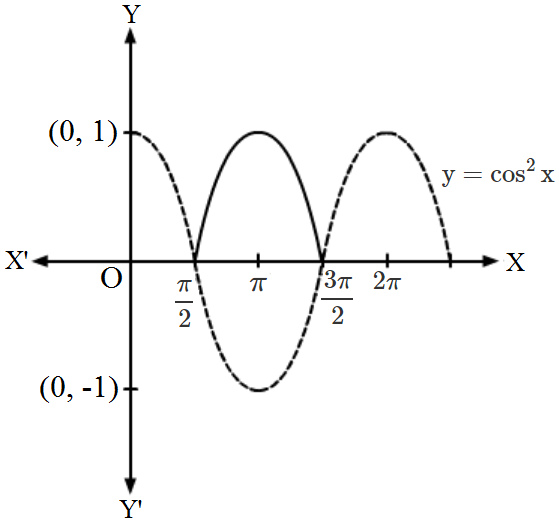
View full question & answer→Question 1355 Marks
$\text{a}\cos\text{A + b}\cos\text{B + c}\cos\text{C}=2\text{b}\sin\text{A}\sin\text{C}=2\text{c}\sin\text{A}\sin\text{B}$
AnswerLet $\frac{\text{a}}{\sin\text{A}}=\frac{\text{b}}{\sin\text{B}}=\frac{\text{c}}{\sin\text{C}}=\text{k }...(1)$
Consider the LHS of the equation $\text{a}\cos\text{A}+\text{b}\cos\text{B}+\text{c}\cos\text{C}.$
$\text{a}\cos\text{A}+\text{b}\cos\text{B}+\text{c}\cos\text{C}$
$=\text{k}(\sin\text{A}\cos\text{A}+\sin\text{B}\cos\text{B}+\sin\text{C}\cos\text{C})$
$=\frac{\text{k}}{2}(2\sin\text{A}\cos\text{A}+2\sin\text{A}\cos\text{A}+2\sin\text{C}\cos\text{C})$
$=\frac{\text{k}}{2}(\sin2\text{A}+\sin2\text{B}+\sin2\text{C})$
$=\frac{\text{k}}{2}[2\sin(\text{A + B})\cos(\text{A}-\text{B})+2\sin\text{C}\cos\text{C}]$
$=\frac{\text{k}}{2}[2\sin(\pi - \text{C})\cos(\text{A}-\text{B})+2\sin\text{C}\cos\text{C}]$
$=\frac{\text{k}}{2}[2\sin\text{C}\cos(\text{A}-\text{B})+2\sin\text{C}\cos\text{C}]$
$=\frac{2\text{k}\sin\text{C}}{2}[\cos(\text{A}-\text{B})+\cos\text{C}]$
$=\text{k}\sin\text{C}[\cos(\text{A}-\text{B})+\cos\{\pi-(\text{A + B})\}]$
$=\text{k}\sin\text{C}[\cos(\text{A}-\text{B})-\cos(\text{A + B})]$
$=\text{k}\sin\text{C}[2\sin\text{A}\sin\text{B}]$
$=2\text{k}\sin\text{A}\sin\text{B}\sin\text{C }...(1)$
Now,
on putting $\text{k}\sin\text{C = C}$ in equation (1), we get:
$2\text{c}\sin\text{A}\sin\text{B}$
and on putting $\text{k}\sin\text{B = b}$ in equation (1), we get:
$2\text{b}\sin\text{A}\sin\text{C}$
So, from (1), we have
$\text{a}\cos\text{A + b}\cos\text{B + c}\cos\text{C}=2\text{b}\sin\text{A}\sin\text{C}=2\text{c}\sin\text{A}\sin\text{B}.$
Hence proved.
View full question & answer→Question 1365 Marks
If $\sin\text{x}+\cos\text{x}=0$ and x lies in the fourth quadrant, find $\sin \text{x } $and $\cos\text{x}.$
AnswerWe have:$\sin\text{x} +\cos\text{x} = 0$
$\Rightarrow \sin \text{x} = - \cos\text{x}$
$\Rightarrow \frac{\sin\text{x}}{\cos\text{x}} = -1$$\Rightarrow \tan\text{x} = - 1$
Now, x is in the fourth quadrant. In the fourth quadrant, $\cos\text{x}$ and $\sec\text{x}$ are positive and all the other four T - ratios are$\therefore\ =\sqrt{ 1+\tan^2\text{x}} = \sqrt{1+(-1)^2}=\sqrt2$
$\cos\text{x} = \frac{1}{\sec\text{x}}=\frac{1}{\sqrt2}$
And, $\sin\text{x}= -\sqrt{1-\cos^2\text{x}} = \sqrt{1-\Big(\frac{1}{\sqrt2}\Big)^2} =\frac{-1}{\sqrt2}$$\therefore\sin\text{x}= \frac{-1}{\sqrt2}$ and $\cos\text{x}= \frac{1}{\sqrt2}$
View full question & answer→Question 1375 Marks
If $2\tan\frac{\alpha}{2}=\tan\frac{\beta}{2},$ prove that $\cos\alpha=\frac{3+5\cos\beta}{5+3\cos\beta}$
AnswerWe have,
$2\tan\frac{\alpha}{2}=\tan\frac{\beta}{2}$
$\Rightarrow\frac{\tan\frac{\alpha}{2}}{\tan\frac{\beta}{2}}=\frac{1}{2}$
Let $\tan\frac {\alpha}{2}=\text{k}$ and $\tan\frac{\beta}{2}=2\text{k}$
Then,
$\cos\alpha=\frac{1-\tan^2\frac{\alpha}{2}}{1+\tan^2\frac{\alpha}{2}}=\frac{1-\text{k}^2}{1+\text{k}^2}\ .....(\text{A})$
Also,
$\frac{3+5\cos\beta}{5+3\cos\beta}=\frac{3+5\Bigg(\frac{1-\tan^2\frac{\beta}{2}}{1+\tan^2\frac{\beta}{2}}\Bigg)}{5+3\Bigg(\frac{1-\tan^2\frac{\beta}{2}}{1+\tan^2\frac{\beta}{2}}\Bigg)}$
$=\frac{3+5\Big(\frac{1-4\text{k}^2}{1+4\text{k}^2}\Big)}{5+3\Big(\frac{1-4\text{k}^2}{1+4\text{k}^2}\Big)}$
$=\frac{8-8\text{k}^2}{8+8\text{k}^2}=\frac{1-\text{k}^2}{1+\text{k}^2}\ .....(\text{B})$
From(A) & (B)
$\cos\alpha=\frac{3+5\cos\beta}{5+3\cos\beta}$
View full question & answer→Question 1385 Marks
If $\text{m}\sin\theta=\text{n}\sin(\theta+2\alpha),$ then prove that $\tan(\theta+\alpha)\cot\alpha=\frac{\text{m}+\text{n}}{\text{m}-\text{n}}$[Hint: Express $\frac{\sin(\theta+2\alpha)}{\sin\theta}=\frac{\text{m}}{\text{n}}$ and apply componendo and dividendo]
AnswerGiven that: $\text{m}\sin\theta=\text{n}\sin(\theta+2\alpha)$
$\Rightarrow\frac{\sin(\theta+2\alpha)}{\sin\theta}=\frac{\text{m}}{\text{n}}$
Using componendo and dividendo rule we get
$\Rightarrow\frac{\sin(\theta+2\alpha)+\sin\theta}{\sin(\theta+2\alpha)-\sin\theta}=\frac{\text{m}+\text{n}}{\text{m}-\text{n}}$
$\Rightarrow\frac{2\cos\big(\frac{\theta+2\alpha+\theta}{2}\big).\cos\big(\frac{\theta+2\alpha-\theta}{2}\big)}{2\sin\big(\frac{\theta+2\alpha+\theta}{2}\big).\sin\big(\frac{\theta+2\alpha-\theta}{2}\big)}=\frac{\text{m}+\text{n}}{\text{m}-\text{n}}$
$\begin{bmatrix}\because\sin\text{A}+\sin\text{B}=2\sin\frac{\text{A + B}}{2}.\cos\frac{\text{A}-\text{B}}{2}\\\sin\text{A}-\sin\text{B}=2\cos\frac{\text{A + B}}{2}.\sin\frac{\text{A}-\text{B}}{2}\end{bmatrix}$
$\Rightarrow\frac{\sin(\theta+\alpha).\cos\alpha}{\cos(\theta+\alpha).\sin\alpha}=\frac{\text{m}+\text{n}}{\text{m}-\text{n}}$
$\Rightarrow\tan(\theta+\alpha).\cot\alpha=\frac{\text{m}+\text{n}}{\text{m}-\text{n}}$ Hence proved.
View full question & answer→Question 1395 Marks
Solve the following equation:
$\sin^{2}\text{x}-\cos\text{x}=\frac{1}{4}$
AnswerWe have,
$\sin^{2}\text{x}-\cos\text{x}=\frac{1}{4}$
$\Rightarrow1-\cos^{2}\text{x}-\cos\text{x}=\frac{1}{4}$ $[\because\sin^{2}\text{x}=1-\cos^{2}\text{x}]$
$\Rightarrow\cos^{2}\text{x}+\cos\text{x}-\frac{3}{4}=0$
$\Rightarrow4\cos^{2}\text{x}+4\cos\text{x}-3=0$
$\Rightarrow4\cos^{2}\text{x}+6\cos\text{x}+2\cos\text{x}-3=0$ [factorize it]
$\Rightarrow2\cos\text{x}(2\cos\text{x}+3)-1(\cos\text{x}+3)=0$
$\Rightarrow(2\cos\text{x}-1)(2\cos\text{x}+3)=0$
$\Rightarrow\text{ Either}$
$2\cos\text{x}-1=0$ or $2\cos\text{x}+3=0$
$\Rightarrow\cos\text{x}=\frac{1}{2}$ or $\cos\text{x}=-\frac{3}{2}$ [This is not possible as $-1<\cos\text{x}<1$]
$\Rightarrow\cos\text{x}=\cos\frac{\pi}{3}$
$\Rightarrow\text{x}=2\text{n}\pi\pm\frac{\pi}{3},\text{n}\in\text{z}$
View full question & answer→Question 1405 Marks
If $2\tan\alpha=3\tan\beta,$ prove that $\tan(\alpha-\beta)=\frac{\sin2\beta}{5-\cos2\beta}$
AnswerWe have,
$2\tan\alpha=3\tan\beta$
$\Rightarrow\frac{\tan\alpha}{\tan\beta}=\frac{3}{2}$
Let $\tan\alpha=3\text{k}$ and $\tan\beta=2\text{k}$
Also,
$\frac{\sin2\beta}{5-\cos2\beta}=\frac{\frac{2\tan\beta}{1+\tan^2\beta}}{5-\Big(\frac{1-\tan^\beta}{1+\tan^2\beta}\Big)}$
$=\frac{\frac{2.2\text{k}}{1+4\text{k}^2}}{5-\Big(\frac{1-4\text{k}^2}{1+4\text{k}^2}\Big)}$
$=\frac{4\text{k}}{5+20\text{k}^2-1+4\text{k}^2}$
$=\frac{4\text{k}}{4+24\text{K}^2}=\frac{\text{K}}{1+6\text{k}^2}\ ...\text{(B)}$
From (A) & (B)
$\tan(\alpha-\beta)=\frac{\sin2\beta}{5-\cos2\beta}$
View full question & answer→Question 1415 Marks
$\text{a}\sin\frac{\text{A}}{2}\sin\Big(\frac{\text{B}-\text{C}}{2}\Big)+\text{b}\sin\frac{\text{B}}{2}\sin\Big(\frac{\text{C}-\text{A}}{2}\Big)+\text{c}\sin\frac{\text{C}}{2}\sin\Big(\frac{\text{A}-\text{B}}{2}\Big)=0.$
Answer$\text{LHS}=\text{a}\sin\frac{\text{A}}{2}\sin\Big(\frac{\text{B}-\text{C}}{2}\Big)+\text{b}\sin\frac{\text{B}}{2}\sin\Big(\frac{\text{C}-\text{A}}{2}\Big)\\+\text{c}\sin\frac{\text{C}}{2}\sin\Big(\frac{\text{A}-\text{B}}{2}\Big)$
We know $\text{a}\sin\text{B = b}\sin\text{A,c}\sin\text{B = b}\sin\text{C},\\\text{a}\sin\text{C}=\text{c}\sin\text{B}$
$\text{a}\sin\frac{\text{A}}{2}\sin\Big(\frac{\text{B}-\text{C}}{2}\Big)+\text{b}\sin\frac{\text{B}}{2}\sin\Big(\frac{\text{C}-\text{A}}{2}\Big)\\+\text{c}\sin\frac{\text{C}}{2}\sin\Big(\frac{\text{A}-\text{B}}{2}\Big)=0$
$=\text{a}\sin\Big(\frac{\pi-(\text{B + C})}{2}\Big)\sin\Big(\frac{\text{B}-\text{C}}{2}\Big)+\text{b}\sin\Big(\frac{\pi-(\text{C + A})}{2}\Big)\sin\Big(\frac{\text{C}-\text{A}}{2}\Big)\\+\text{c}\sin\Big(\frac{\pi-(\text{A + B})}{2}\Big)\sin\Big(\frac{\text{A}-\text{B}}{2}\Big)$
$=\text{a}\cos\Big(\frac{\text{B + C}}{2}\Big)\sin\Big(\frac{\text{B}-\text{C}}{2}\Big)+\text{b}\cos\Big(\frac{\text{C + A}}{2}\Big)\sin\Big(\frac{\text{C}-\text{A}}{2}\Big)\\+\text{c}\cos\Big(\frac{\text{A + B}}{2}\Big)\sin\Big(\frac{\text{A}-\text{B}}{2}\Big)$
$=\text{a}(\sin\text{B}-\sin\text{C})+\text{b}(\sin\text{C}-\sin\text{A})+\text{c}(\sin\text{A}-\sin\text{B})$
$=\text{a}\sin\text{B}-\text{a}\sin\text{C}+\text{b}\sin\text{C}-\text{b}\sin\text{A + c}\sin\text{A}-\text{c}\sin\text{B}$
$=\text{b}\sin\text{A}-\text{a}\sin\text{C + b}\sin\text{C}-\text{b}\sin\text{A + a}\sin\text{C}-\text{b}\sin\text{C}$
$=0 =\text{RHS}$
View full question & answer→Question 1425 Marks
$\text{If}\ \sin2\text{A}=\lambda\sin2\text{B},$ prove that:
$\frac{\tan(\text{A+B})}{\tan(\text{A}-\text{B})}=\frac{\lambda+1}{\lambda-1}$
AnswerWe have,
$\sin2\text{A}=\lambda\sin2\text{B}$
$\Rightarrow\ \lambda=\frac{\sin2\text{A}}{\sin2\text{B}}$
Now,
$\frac{\lambda+1}{\lambda-1}=\frac{\frac{\sin2\text{A}}{\sin2\text{B}}+1}{\frac{\sin2\text{A}}{\sin2\text{B}}-1}$
$=\ \frac{\frac{\sin2\text{A}+\sin2\text{B}}{\sin2\text{B}}}{\frac{\sin2\text{A}-\sin2\text{B}}{\sin2\text{B}}}$
$=\ \frac{\sin2\text{A}+\sin2\text{B}}{\sin2\text{A}-\sin2\text{B}}$
$=\ \frac{2\sin\Big(\frac{2\text{A}+2\text{B}}{2}\Big)\cos\Big(\frac{2\text{A}-2\text{B}}{2}\Big)}{2\sin\Big(\frac{2\text{A}-2\text{B}}{2}\Big)\cos\Big(\frac{2\text{A}+2\text{B}}{2}\Big)}$
$=\ \frac{\sin(\text{A+B})\cos(\text{A}-\text{B})}{\sin(\text{A}-\text{B})\cos(\text{A+B})}$
$=\ \frac{\sin(\text{A+B})\cos(\text{A}-\text{B})}{\cos(\text{A}+\text{B})\sin(\text{A}-\text{B})}$
$=\ \frac{\tan(\text{A+B})}{\tan(\text{A}-\text{B})}$
$\therefore\ \frac{\lambda+1}{\lambda-1}=\frac{\tan(\text{A+B})}{\tan(\text{A}-\text{B})}$
$\Rightarrow\ \frac{\tan(\text{A+B})}{\tan(\text{A}-\text{B})}=\frac{\lambda+1}{\lambda-1}$ Hence proved.
View full question & answer→Question 1435 Marks
Prove that:
$\frac{\cos3\text{A}+2\cos5\text{A}+\cos7\text{A}}{\cos\text{A}+2\cos3\text{A}+\cos5\text{A}}=\frac{\cos5\text{A}}{\cos3\text{A}}$
AnswerWe have,
$\text{LHS}=\frac{\cos3\text{A}+2\cos5\text{A}+\cos7\text{A}}{2\cos\text{A}+2\cos3\text{A}+\cos5\text{A}}$
$=\ \frac{(\cos7\text{A}+\cos3\text{A})+2\cos5\text{A}}{(\cos5\text{A}+\cos\text{A})+2\cos3\text{A}}$
$=\ \frac{2\cos\Big(\frac{7\text{A}+3\text{A}}{2}\Big)\cos\Big(\frac{7\text{A}-3\text{A}}{2}\Big)+2\cos5\text{A}}{2\cos\Big(\frac{5\text{A}+\text{A}}{2}\Big)\cos\Big(\frac{5\text{A}-\text{A}}{2}\Big)+\cos3\text{A}}$
$=\ \frac{2\cos5\text{A}\cos2\text{A}+2\cos5\text{A}}{2\cos3\text{A}\cos2\text{A}+2\cos3\text{A}}$
$=\ \frac{2\cos5\text{A}(\cos2\text{A}+1)}{2\cos3\text{A}(\cos2\text{A}+1)}$
$=\ \frac{\cos5\text{A}}{\cos3\text{A}}$
$=\ \tan3\text{A}$
$=\ \text{RHS}$
$\therefore\ \frac{\cos3\text{A}+2\sin5\text{A}+\cos7\text{A}}{\cos\text{A}+2\cos3\text{A}+\cos5\text{A}}=\frac{\cos5\text{A}}{\cos3\text{A}}$ Hence proved.
View full question & answer→Question 1445 Marks
Sketch the graphs of the following trigonometric functions:
$\phi\text{(x)}=2\cos\Big(\text{x}-\frac{\pi}{6}\Big)$
Answer$\phi\text{(x)}=2\cos\Big(\text{x}-\frac{\pi}{6}\Big)$ $\text{y}=2\cos\Big(\text{x}-\frac{\pi}{6}\Big)$ $\Rightarrow\text{y}-0=2\cos\Big(\text{x}-\frac{\pi}{6}\Big)...(\text{i})$ On shifting the origin at $\Big(\frac{\pi}{6},0\Big),$ we get: $\text{x = X}+\frac{\pi}{6}$ and $\text{y = Y}+0$ On subsitituting the values in (i), we get: $\text{Y}=2\cos\text{X}$ Then, we draw the graph of $\text{Y}=\cos\text{X}$ and shift it by $\frac{\pi}{6}$ to the right. Then, we obtain the following graph: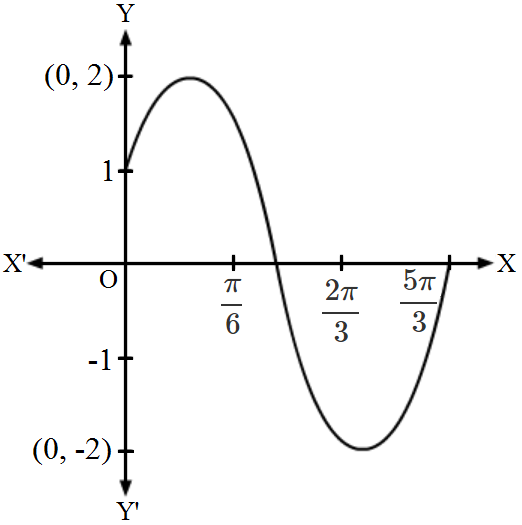
View full question & answer→Question 1455 Marks
Prove the following identities:
$\frac{\tan^3\text{x}}{1+\tan^2\text{x}}+\frac{\cot^3\text{x}}{1+\cot^2\text{x}}=\frac{1-2\sin^2\text{x}\cos^2\text{x}}{\sin\text{x}\cos\text{x}}$
Answer$\text{L.H.S}=\frac{\tan^{3}\text{x}}{1+\tan^{2}\text{x}}+\frac{\cot^{3}\text{x}}{1+\cot^{2}\text{x}}$
$=\frac{\sin^{3}\text{x}}{\cos^{3}\text{x}\bigg(1+\frac{\sin^{2}\text{x}}{\cos^{2}\text{x}}\bigg)}+\frac{\cos^{3}\text{x}}{\sin^{3}\text{x}\bigg(1+\frac{\cos^{2}\text{x}}{\sin^{2}\text{x}}\bigg)}$$$ $\Big(\because\tan\text{x}=\frac{\sin\text{x}}{\cos\text{x}}\text{ and }\cot\text{x}=\frac{\cos\text{x}}{\sin\text{x}}\Big)$
$=\frac{\sin^{3}\text{x}\cos^{2}\text{x}}{\cos^{3}\text{x}\big(\cos^{2}\text{x}+\sin^{2}\text{x}\big)}+\frac{\cos^{3}\text{x}\sin^{2}\text{x}}{\sin^{3}\text{x}\big(\sin^{2}\text{x}+\cos^{2}\text{x}\big)}$$$
$=\frac{\sin{3}\text{ x}}{\cos\text{x}}+\frac{\cos^{3}\theta}{\sin\text{x}}$ $\big(\because\cos^{2}\text{x}+\sin^{2}\text{x}=1\big)$
$=\frac{\sin^{4}\text{x}+\cos^{4}\text{x}}{\sin\text{x}\cos\text{x}}$
$=\frac{\big(\sin^{2}\text{x}\big)^{2}+\big(\cos^{2}\text{x}\big)^{2}+2\sin^{2}\text{x}\cos^{2}\text{x}-2\sin^{2}\text{x}\cos^{2}\text{x}}{\sin\text{x}\cos\text{x}}$ $\big(\text{adding and subtracting }2\sin^{2}\text{x}\cos^{2}\text{x}\big)$
$=\frac{\big(\sin^{2}\text{x}+\cos^{2}\text{x}\big)^{2}-2\sin^{2}\text{x}\cos^{2}\text{x}}{\sin\text{x}\cos\text{x}}$
$=\frac{1^{2}-2\sin^{2}\text{x}\cos^{2}\text{x}}{\sin\text{x}\cos\text{x}}$ $\big(\because\sin^{2}\text{x}+\cos^{2}\text{x}=1\big)$
$=\frac{1-2\sin^{2}\text{x}\cos^{2}\text{x}}{\sin\text{x}\cos\text{x}}$
$=\text{R.H.S}$
$\text{Proved}$
View full question & answer→Question 1465 Marks
Prove that:
$\cos3\text{A}+\cos5\text{A}+\cos7\text{A}+\cos15\text{A}=4\cos4\text{A}\cos5\text{A}\cos6\text{A}$
AnswerWe have,
$\text{LHS}=\cos3\text{A}+\cos5\text{A}+\cos7\text{A}+\cos15\text{A}$
$=\ [\cos5\text{A}+\cos3\text{A}]+[\cos15\text{A}+\cos7\text{A}]$
$=\ \Big[2\cos\frac{5\text{A}+3\text{A}}{2}\cos\frac{5\text{A}-3\text{A}}{2}\Big]+\Big[2\cos\frac{15\text{A}+7\text{A}}{2}\cos\frac{15\text{A}-7\text{A}}{2}\Big]$
$=\ 2\cos4\text{A}\cos\text{A}+2\cos11\text{A}\cos4\text{A}$
$=\ 2\cos4\text{A}[\cos\text{A}+\cos11\text{A}]$
$=\ 2\cos4\text{A}[\cos11\text{A}+\cos\text{A}]$
$=\ 2\cos4\text{A}\Big[2\cos\frac{(11\text{A}+\text{A)}}{2}\cos\frac{(11\text{A}-\text{A})}{2}\Big]$
$=\ 4\cos\text{A}[\cos6\text{A}\cos5\text{A}]$
$=\ 4\cos4\text{A}\cos5\text{A}\cos6\text{A}$
$=\ \text{RHS}$
$\therefore\ \cos3\text{A}+\cos5\text{A}+\cos7\text{A}+\cos15\text{A}=4\cos4\text{A}\cos5\text{A}\cos6\text{A}$
Hence proved.
View full question & answer→Question 1475 Marks
If $\sin\alpha+\sin\beta=\text{a}$ and $\cos\alpha+\cos\beta=\text{b}$ prove that
$\sin(\alpha+\beta)=\frac{2\text{ab}}{\text{a}^2+\text{b}^2}$
Answerwe have,
$\sin\alpha+\sin\beta=\text{a}\ \&\ \cos\alpha+\cos\beta=\text{b}\ .....(\text{A})$
squaring and adding, we get
$\sin^2\alpha+\sin^2\beta+2\sin\alpha\sin\beta+\cos^2\alpha+\cos^2\beta+2\cos\alpha\cos\beta=\text{a}^2+\text{b}^2$
$\Rightarrow1+1+2(\sin\alpha\sin\beta+\cos\alpha\cos\beta)=\text{a}^2+\text{b}^2$
$\Rightarrow2(\sin\alpha\sin\beta+\cos\alpha\cos\beta)=\text{a}^2+\text{b}^2-2$
$\therefore2\cos(\alpha+\beta)=\text{a}^2+\text{b}^2-2$
Thus,
$\cos(\alpha-\beta)=\frac{\text{a}^2+\text{b}^2-2}{2}$
Again,
$\sin\alpha+\sin\beta=\text{a}\Rightarrow2\sin\frac{\alpha+\beta}{2}.\cos\frac{\alpha-\beta}{2}=\text{a}$
$\cos\alpha+\cos\beta=\text{b}\Rightarrow2\cos\frac{\alpha+\beta}{2}.\cos\frac{\alpha-\beta}{2}=\text{b}$
$\Rightarrow\tan\frac{\alpha+\beta}{2}=\frac{\text{a}}{\text{b}}\ .....\text{(B)}$
Now,
$\sin(\alpha+\beta)=\frac{1\tan\frac{\alpha+\beta}{2}}{1}+\tan^2\Big(\frac{\alpha+\beta}{2}\Big)$
thus,
$\sin(\alpha+\beta)=\frac{2\text{ab}}{\text{a}^2+\text{b}^2}$
View full question & answer→Question 1485 Marks
Sketch the graphs of the following functions:
$\text{f(x)}=\tan2\text{x}$
Answer$\text{f(x)}=\tan2\text{x}$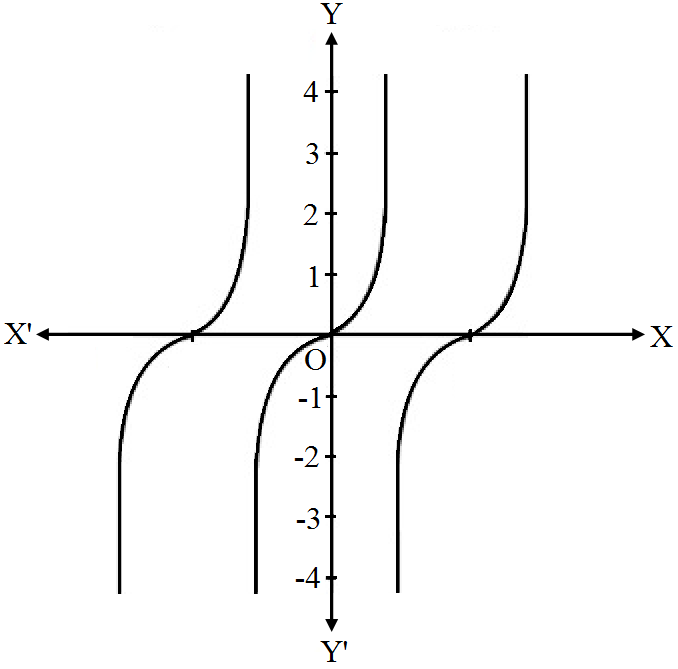
View full question & answer→Question 1495 Marks
Prove that:
$\cos^32\text{x}+3\cos2\text{x}=4(\cos^6\text{x}-\sin^6\text{x})$
Answer$\cos^32\text{x}+3\cos2\text{x}=4(\cos^6\text{x}-\sin^6\text{x})$
$\text{RHS}=4\Big[(\cos^2\theta)^3-(\sin^2\theta)^3\Big]$
$=4(\cos^2\theta-\sin^2\theta)\Big[\cos^4\theta+\sin^4\theta+\sin^2\theta+\cos^2\theta\Big]$
$=4\cos^2\theta\Big[(\cos^2\theta-\sin^2\theta)+2\sin^2\theta+\sin^2\theta+\sin^2\theta+\cos^2\theta\Big]$
$=4\cos^2\theta[\cos^22\theta+3\sin^2\theta\cos^2\theta]$
$=4\cos^2\theta\Big[\cos^22\theta+3\Big(\frac{1-\cos^2\theta}{2}\Big)\Big(\frac{1+\cos^2\theta}{2}\Big)\Big]$
$=4\cos^2\theta\Big(\cos^22\theta+\frac{3}{4}(1-\cos^22\theta)\Big)$
$=\cos^2\theta\big[4\cos^22\theta+3-3\cos^22\theta\big]$
$=\cos^2\theta[\cos^22\theta+3]$
$=\cos^32\theta+3\cos^2\theta\ \text{LHS}$
$\text{LHS=RHS}$
View full question & answer→Question 1505 Marks
If $\sin\text{x}=\frac{12}{13}$ and x lies in the second quadrant, find the value of $\sec\text{x}+\tan\text{x}.$
AnswerWe have: $\sin\text{x}=\frac{12}{13}$ and x lie in the second quadrant.In the second quadrant, $\sin\text{x}$ and $\text{cosec}\text{ x}$ are positive and all the other four T ratios.$\therefore\cos\text{x}=-\sqrt{1-\sin^2\text{x}}\\$
$=-\sqrt{1-\Big(\frac{12}{13}\Big)^2}$
$=\frac{-5}{13}$
$\tan\text{x}=\frac{\sin\text{x}}{\cos\text{x}}$
$=\frac{\frac{12}{13}}{\frac{-5}{13}}$ $=\frac{-12}{5}$ And, $\sec\text{x}=\frac{1}{\cos\text{x}}$$=\frac{1}{\frac{-5}{13}}$
$=\frac{-13}{5}$
$\therefore\sec\text{x}+\tan\text{x}=\frac{-13}{5}+\frac{-12}{5}$
$ = - 5$
View full question & answer→