Questions

3 Marks Question

Take a timed test

15 questions · self-marked practice — reveal the answer and mark yourself.

Question 13 Marks
How many time constants will elapse before the power delivered by a battery drops to half of its maximum value in an RC circuit?
Answer
Power $=\text{CV}^2=\text{Q}\times\text{V}$ Now, $\frac{\text{QV}}{2}=\text{QV}\times\text{e}^{\frac{-\text{t}}{\text{RC}}}$$\Rightarrow\frac{1}{2}=\text{e}^{\frac{-\text{t}}{\text{RC}}}$
$\Rightarrow\frac{\text{t}}{\text{RC}}=-\text{In}\ 0.5$
$\Rightarrow-(-0.69)=0.69.$
View full question & answer
Question 23 Marks
A capacitance C charged to a potential difference V is discharged by connecting its plates through a resistance R. Find the heat dissipated in one time constant after the connections are made. Do this by calculating $\int\text{i}^2\text{R}$ dt and also by finding the decrease in the energy stored in the capacitor.
Answer
Energy stored at a part time in discharging $=\frac{1}{2}\text{CV}^2\Big(\text{e}^{\frac{-\text{t}}{\text{RC}}}\Big)^2$ Heat dissipated at any time = (Energy stored at t = 0) - (Energy stored at time t)$=\frac{1}{2}\text{CV}^2-\frac{1}{2}\text{CV}^2\big(-\text{e}^{-1}\big)^2$ $=\frac{1}{2}\text{CV}^2\big(1-\text{e}^2\big)$
View full question & answer
Question 33 Marks
How many time constants will elapse before the current in a charging RC circuit drops to half of its initial value? Answer the same question for a discharging RC circuit.
Answer
$\frac{\text{Q}}{2}=\text{Q}\Big(1-\text{e}^{\frac{-\text{t}}{\text{CR}}}\Big)$$\Rightarrow\frac{1}{2}=\Big(1-\text{e}^{\frac{-\text{t}}{\text{CR}}}\Big)$
$\Rightarrow\text{e}^{\frac{-\text{t}}{\text{CR}}}=\frac{1}{2}$
$\Rightarrow\frac{\text{t}}{\text{RC}}=\log2\Rightarrow\text{n}=0.69.$
View full question & answer
Question 43 Marks
A capacitor of capacitance $10\mu\text{F}$ is connected across a battery of emf 6.0V through a resistance of $20\text{k}\Omega$ for 4.0s. The battery is then replaced by a thick wire. What will be the charge on the capacitor 4.0s after the battery is disconnected?
Answer
$\text{C} = 100\mu\text{F, emf} = 6\text{V}, \text{ R} = 20 \text{K}\Omega, \text{t} = 4 \text{S}.$Charging: $\text{Q}=\text{CV}\Big(1-\text{e}^{\frac{-\text{t}}{\text{RC}}}\Big)\ \bigg[\frac{-\text{t}}{\text{RC}}=\frac{4}{2\times10^4\times10^{-4}}\bigg]$
$=6\times10^{-4}\big(1-\text{e}^{-2}\big)=5.187\times10^{-4}\text{C}=\text{Q}$
Discharging: $\text{q}=\text{Q}\Big(\text{e}^{\frac{-\text{t}}{\text{RC}}}\Big)=5.184\times10^{-4}\times\text{e}^{-2}$
$=0.7\times10^{-4}\text{C}=70\mu\text{c}.$
View full question & answer
Question 53 Marks
What length of a copper wire of cross-sectional area $0.01mm^2$ will be needed to prepare a resistance of $1\text{k}\Omega?$ Resistivity of copper $=1.7\times10^{-8}\Omega\text{-m}.$
Answer
$\text{f}_\text{cu}=1.7\times10^{-8}\Omega\text{-m}$$\text{A}=0.01\text{mm}^2=0.01\times10^{-6}\text{m}^2$
$\text{R}=1\text{K}\Omega=10^3\Omega$
$\text{R}=\frac{\text{f}\ell}{\text{a}}$
$\Rightarrow10^3=\frac{1.7\times10^{-8}\times\ell}{10^{-6}}$
$\Rightarrow\ell=\frac{10^3}{1.7}=0.58\times10^3\text{m}=0.6\text{km}.$
View full question & answer
Question 63 Marks
An ideal battery sends a current of 5A in a resistor. When another resistor of value $10\Omega$ is connected in parallel, the current through the battery is increased to 6A. Find the resistance of the first resistor.
Answer
$\text{R}_1=\text{R},\text{i}_1=5\text{A}$$\text{R}_2=\frac{10\text{R}}{10+\text{R}},\text{i}_2=6\text{A}$
Since potential constant,
$\text{i}_1\text{R}_1=\text{i}_2\text{R}_2$
$\Rightarrow5\times\text{R}=\frac{6\times10^\text{R}}{10+\text{R}}$
$\Rightarrow(10+\text{R})5=60$
$\Rightarrow5\text{R}=10\Rightarrow\text{R}=2\Omega.$
View full question & answer
Question 73 Marks
A parallel-plate capacitor with plate area $20cm^2$ and plate separation 1.0mm is connected to a battery. The resistance of the circuit is $10\text{k}\Omega.$ Find the time constant of the circuit.
Answer
$\text{A}=20\text{cm}^2=20\times10^{-4}\text{m}^2$$\text{d}=1\text{mm}=1\times10^{-3}\text{m};\text{R}=10\text{K}\Omega$
$\text{C}=\frac{\text{E}_0\text{A}}{\text{d}}=\frac{8.85\times10^{-12}\times20\times10^{-4}}{1\times10^{-3}}$
$=\frac{8.85\times10^{-12}\times2\times10^{-3}}{10^{-3}}=17.7\times10^{-2}\text{Farad}.$
Time constant $=\text{CR}=17.7\times10^{-2}\times10\times10^3$
$=17.7\times10^{-8}=0.177\times10^{-6}\text{s}=0.18\mu\text{s}.$
View full question & answer
Question 83 Marks
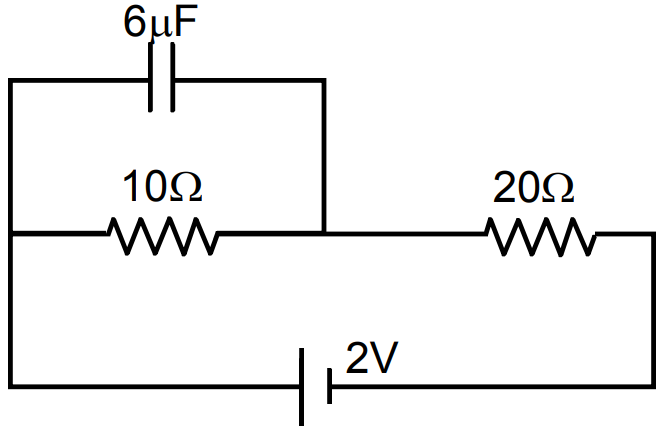
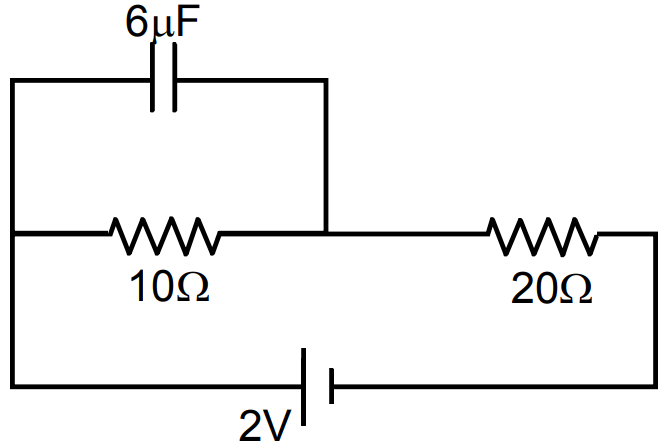
Find the charge on the capacitor shown in figure.
Answer
In steady stage condition no current flows through the capacitor. $\text{R}_\text{eff}=10+20=30\Omega$
$\text{i}=\frac{2}{30}=\frac{1}{15}\text{A}$
Voltage drop across $10\Omega$ resistor = i × R$=\frac{1}{15}\times10=\frac{10}{15}=\frac{2}{3}\text{V}$
Charge stored on the capacitor (Q) = CV$=6\times10^{-6}\times\frac{2}{3}=4\times10^{-6}\text{C}=4\mu\text{C}.$
View full question & answer
Question 93 Marks
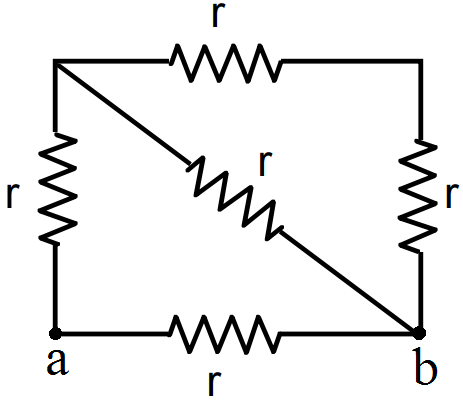
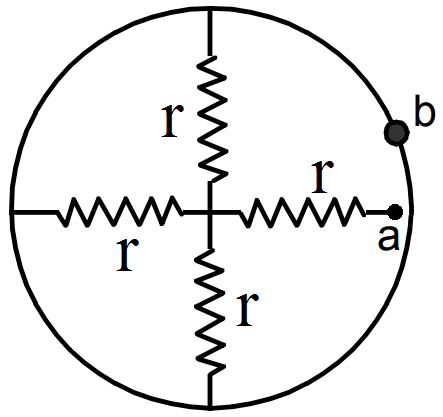
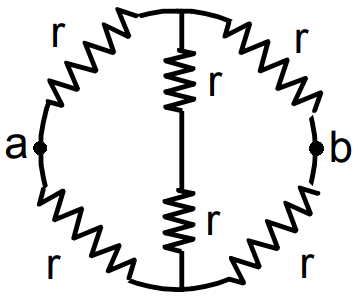
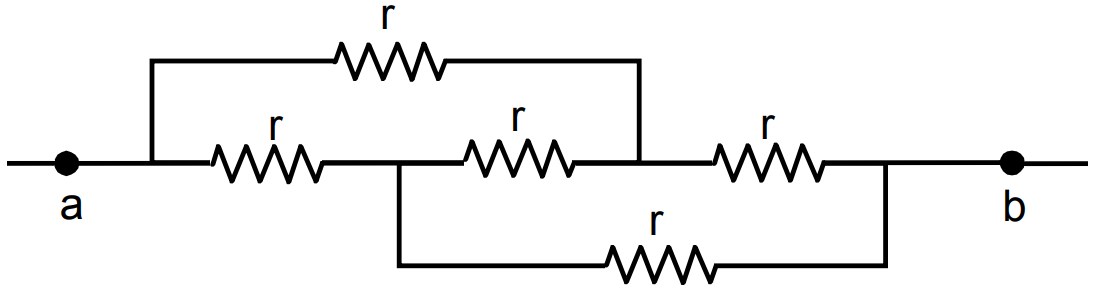
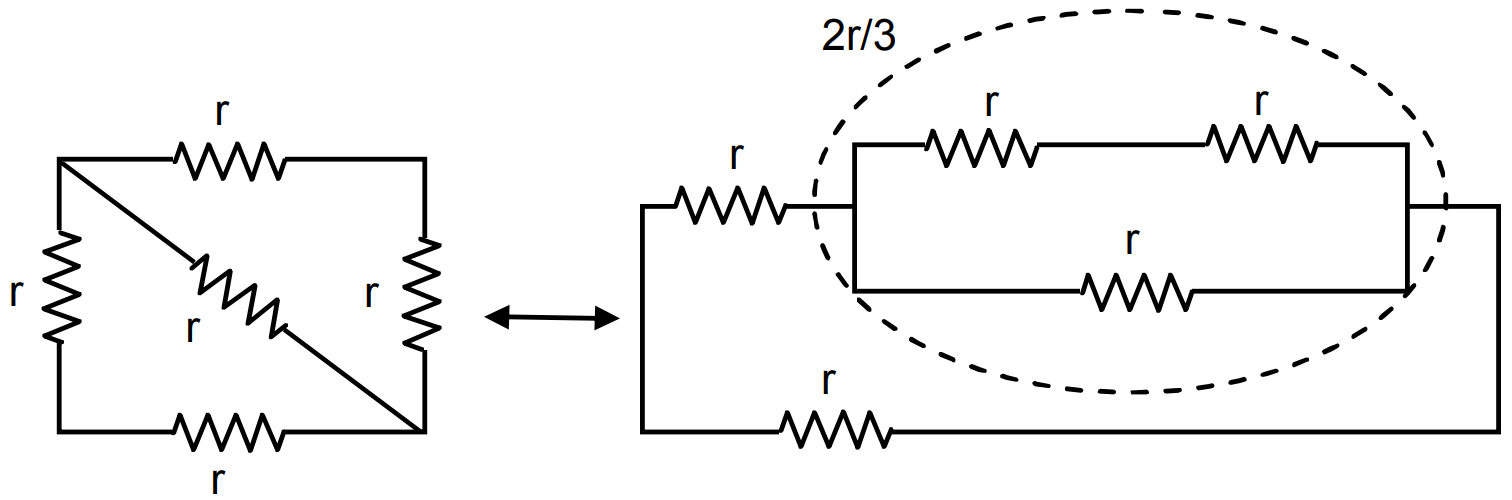
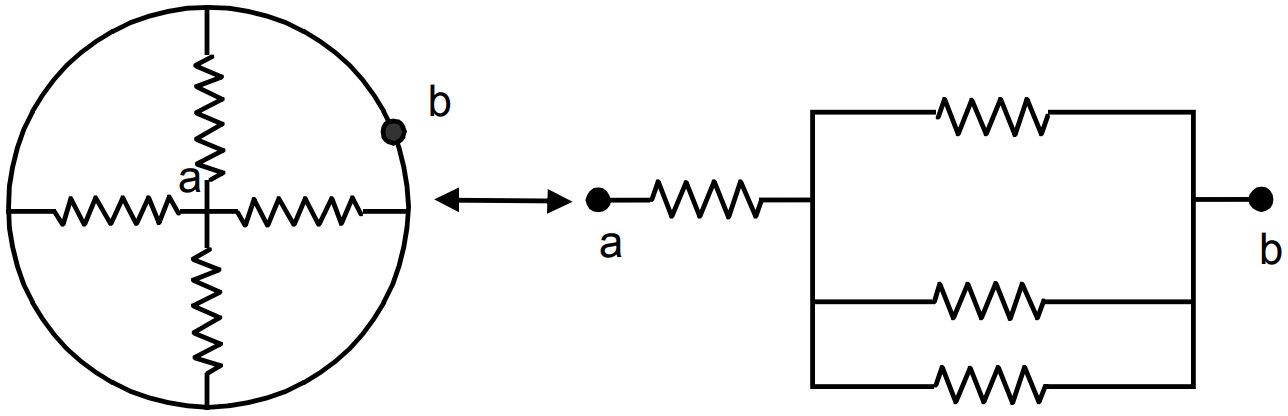
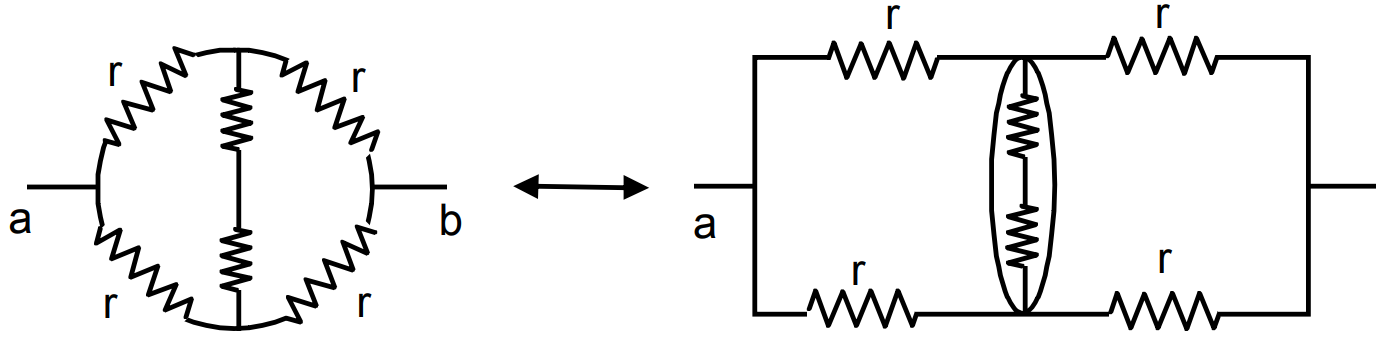
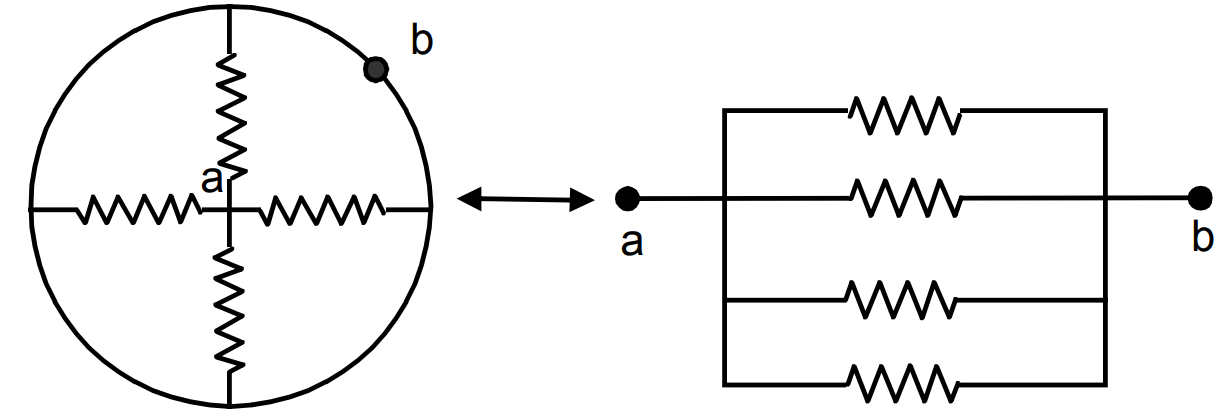
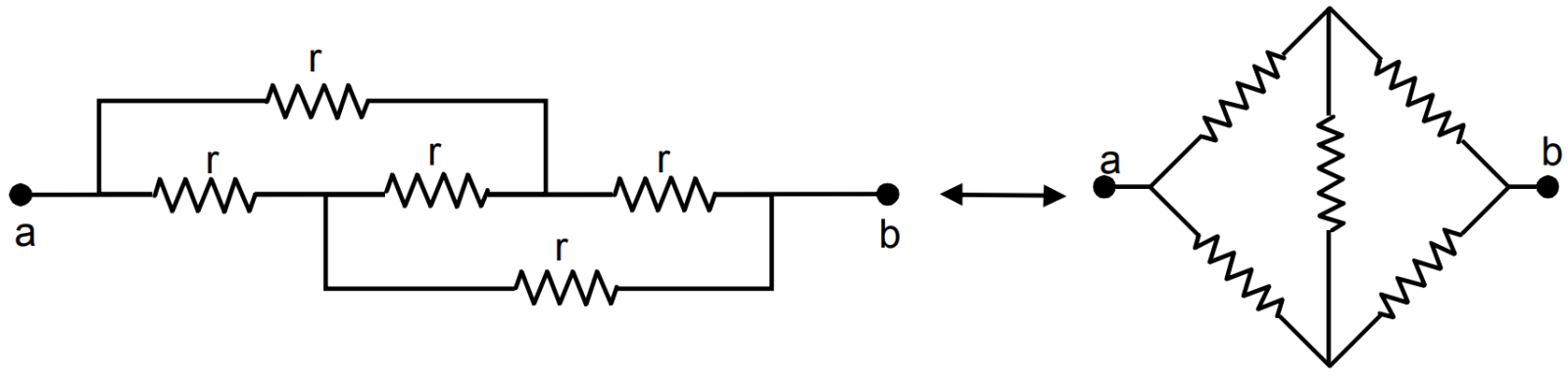
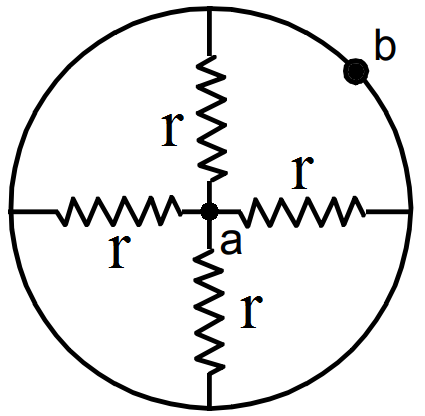
Find the equivalent resistances of the networks shown in the figure. between the points $a$ and $b.$
  1.  
  1.  
  1.  
  1.  
  1.  
Answer
$\text{R}_\text{eff}=\frac{\Big(\frac{2\text{r}}{3}+\text{r}\Big)\text{r}}{\Big(\frac{2\text{r}}{3}+\text{r}+\text{r}\Big)}=\frac{5\text{r}}{8}$

$\text{R}_\text{eff}=\frac{\text{r}}{3}+\text{r}=\frac{4\text{r}}{3}$

$\text{R}_\text{eff}=\frac{2\text{r}}{2}=\text{r}$

$\text{R}_\text{eff}=\frac{\text{r}}{4}$

$\text{R}_\text{eff}=\text{r}$
View full question & answer
Question 103 Marks
A wire of length 1m and radius 0.1mm has a resistance of $100\Omega.$ Find the resistivity of the material.
Answer
$\ell=1\text{m},\text{r}=0.1\text{mm}=0.1\times10^{-3}\text{m}$$\text{R}=100\Omega,\text{f}=?$
$\Rightarrow\text{R}=\frac{\text{f}\ell}{\text{a}}$
$\Rightarrow\text{f}=\frac{\text{Ra}}{\ell}=\frac{100\times3.14\times0.1\times0.1\times10^{-6}}{1}$
$=3.14\times10^{-6}=\pi\times10^{-6}\Omega\text{-m}.$
View full question & answer
Question 113 Marks
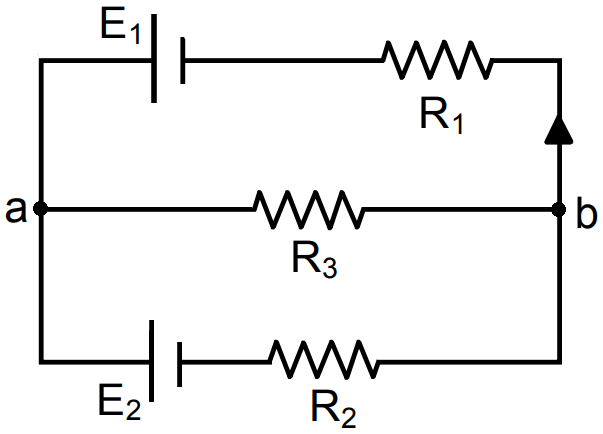
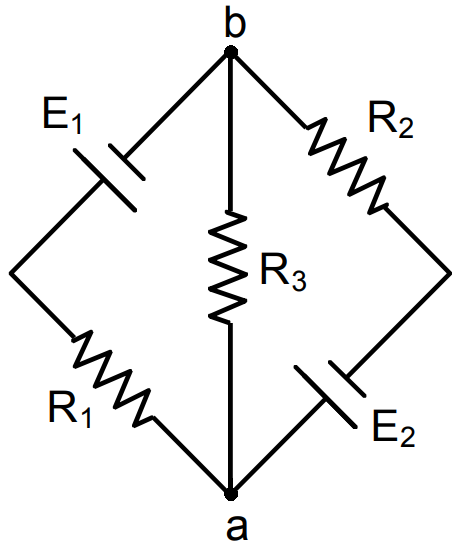
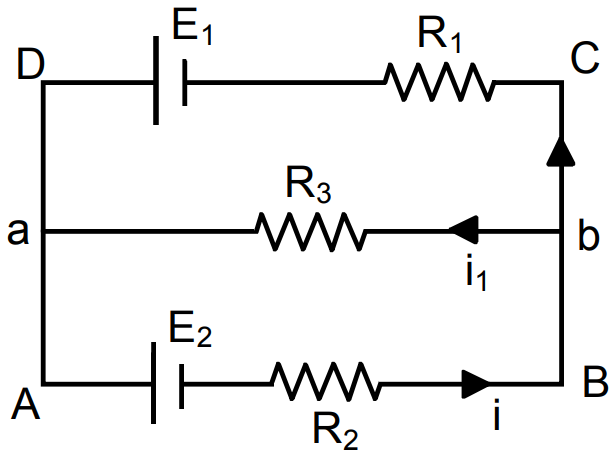
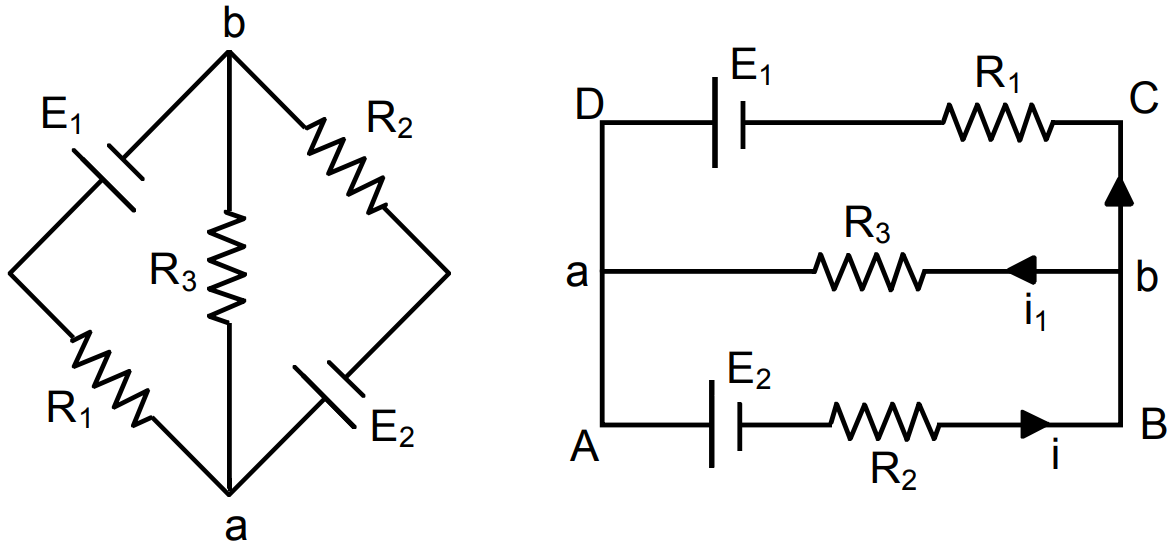
Find the potential difference $V_a - V_b$ in the circuits shown in figure.

Answer
  1. In circuit, $\text{AB ba A}$

$\text{E}_2+\text{iR}_2+\text{i}_1\text{R}_3=0$
In circuit, $\text{i}_1\text{R}_3+\text{E}_1-(\text{i}-\text{i}_1)\text{R}_1=0$
$\Rightarrow\text{i}_1\text{R}_3+\text{E}_1-\text{iR}_1+\text{i}_1\text{R}_1=0$
$[\text{iR}_2+\text{i}_1\text{R}_3\ \ \ \ \ \ \ \ \ \ \ \ \ \ \ \ \ \ \ \ \ \ =-\text{E}_2]\text{R}_1\\ [\text{iR}_2-\text{i}_1(\text{R}_1+\text{R}_3)\ \ \ \ \ \ \ \ \ =\text{E}_1]\text{R}_2\\\underline{\ \ \ \ \ \ \ \ \ \ \ \ \ \ \ \ \ \ \ \ \ \ \ \ \ \ \ \ \ \ \ \ \ \ \ \ \ \ \ \ \ \ \ \ \ \ \ \ \ \ \ \ \ \ \ \ \ }\\\text{iR}_2\text{R}_1+\text{i}_1\text{R}_3\text{R}_1\ \ \ \ \ \ \ \ \ \ \ \ \ =-\text{E}_2\text{R}_1\\\text{iR}_2\text{R}_1-\text{i}_1\text{R}_2(\text{R}_1+\text{R}_3)=\ \ \ \text{E}_1\text{R}_2\\\underline{ \ \ \ \ \ \ \ \ \ \ \ \ \ \ \ \ \ \ \ \ \ \ \ \ \ \ \ \ \ \ \ \ \ \ \ \ \ \ \ \ \ \ \ \ \ \ \ \ \ \ \ \ \ \ \ \ \ }$
$\text{iR}_3\text{R}_1+\text{i}_1\text{R}_2\text{R}_1+\text{i}_1\text{R}_2\text{R}_3=\text{E}_1\text{R}_2-\text{E}_1\text{R}_1$
$\Rightarrow\text{i}_1(\text{R}_3\text{R}_1+\text{R}_2\text{R}_1+\text{R}_2\text{R}_3)=\text{E}_1\text{R}_2-\text{E}_2\text{R}_1$
$\Rightarrow\text{i}_1=\frac{\text{E}_1\text{R}_2-\text{E}_2\text{R}_1}{\text{R}_3\text{R}_1+\text{R}_2\text{R}_1+\text{R}_2\text{R}_3}$
$\Rightarrow\frac{\text{E}_1\text{R}_2\text{R}_3-\text{E}_2\text{R}_1\text{R}_3}{\text{R}_3\text{R}_1+\text{R}_2\text{R}_1+\text{R}_2\text{R}_3}=\Bigg(\frac{\frac{\text{E}_1}{\text{R}_1}-\frac{\text{E}_2}{\text{R}_2}}{\frac{1}{\text{R}_2}+\frac{1}{\text{R}_1}+\frac{1}{\text{R}_3}}\Bigg)$
  1. $\therefore$ Same as $a$
View full question & answer
Question 123 Marks
The current through a wire depends on time as $\text{i}=\text{i}_0+\alpha\text{t},$
Where $\text{i}_0=10\text{A}$ and $\alpha=4\text{A/ s}.$ Find the charge that crosses through a section of the wire in 10 seconds.
Answer
$\text{i}=\text{i}_0+\alpha\text{t},\ \text{t}=10\text{sec},$ $\text{i}_0=10\text{A},\alpha=4\text{A}/\text{ sec}$$\text{q}=\int\limits^\text{t}_0\text{idt}=\int\limits^\text{t}_0(\text{i}_0+\alpha\text{t})\text{dt}=\int\limits^\text{t}_0\text{i}_0\text{dt}+\int\limits^\text{t}_0\alpha\text{tdt}$
$=\text{i}_0\text{t}+\alpha\frac{\text{t}^2}{2}=10\times10+4\times\frac{10\times10}{2}$
$=100+200=300\text{C}.$
View full question & answer
Question 133 Marks
How many time constants will elapse before the charge on a capacitors falls to 0.1% of its maximum value in a discharging RC circuit?
Answer
$\text{q}=\text{Qe}^{\frac{-\text{t}}{\text{RC}}}$$\text{q}=0.1\%\text{ Q}$
$\text{RC}\Rightarrow\text{Time constant}$
$=1\times10^{-3}\text{Q}$
So, $1\times10^{-3}\text{Q}=\text{Q}\times\text{e}^{\frac{-\text{t}}{\text{RC}}}$
$\Rightarrow\text{e}^{\frac{-\text{t}}{\text{RC}}}=\text{In}\ 10^{-3}$
$\Rightarrow\frac{\text{t}}{\text{RC}}=-(-6.9)=6.9$
View full question & answer
Question 143 Marks
The potential difference between the terminals of a battery of emf 6.0V and internal resistance $1\Omega$ drops to 5.8V when connected across an external resistor. Find the resistance of the external resistor.
Answer
$\text{E}=6\text{V},\text{r}=1\Omega,\text{V}=5.8\text{V},\text{R}=?$$\text{l}=\frac{\text{E}}{\text{R}+\text{r}}=\frac{6}{\text{R}+1},\text{V}=\text{E}-\text{lr}$
$\Rightarrow5.8=6-\frac{6}{\text{R}+1}\times1\Rightarrow\frac{6}{\text{R}+1}=0.2$
$\Rightarrow\text{R}+1=30\Rightarrow\text{R}=29\Omega.$
View full question & answer
Question 153 Marks
A uniform wire of resistance $100\Omega$ is melted and recast as a wire of length is double that of the original. What would be the resistance of the wire?
Answer
$\ell'=2\ell$Volume of the wire remains constant.
$\text{A}\ell=\text{A}'\ell'$
$\Rightarrow\text{A}\ell=\text{A}'\times2\ell$
$\Rightarrow\text{A}'=\frac{\text{A}}{2}$
f = Specific resistance
$\text{R}=\frac{\text{f}\ell}{\text{A}};\text{R}'=\frac{\text{f}\ell'}{\text{A}'}$
$100\Omega=\frac{\text{f}2\ell}{\text{A}/2}=\frac{4\text{f}\ell}{\text{A}}=4\text{R}$
$\Rightarrow4\times100\Omega=400\Omega$
View full question & answer