Questions

M.C.Q (1 Marks)

Take a timed test

25 questions · auto-graded multiple-choice test.

MCQ 11 Mark
A current passes through a wire of non$-$uniform cross$-$section. Which of the following quantities are independent of the cross$-$section?
  1. The charge crossing in a given time interval.
  2. Drift speed.
  3. Current density.
  4. Free$-$electron density.
  • A
    Only $a$
  • B
    $a$ and $b$
  • $a$ and $d$
  • D
    None of these
Answer
Correct option: C.
$a$ and $d$
$\text{v}_\text{f}=\Big(\frac{\text{e}}{\text{qm}}\Big)\tau$
$\text{E}=\frac{\text{i}}{\text{A ne}}$
$\text{j}=\frac{\text{i}}{\text{A}}$
$Vd \rightarrow$ drift speed
$j \rightarrow$ current density
$i \rightarrow$ current
$A \rightarrow$ cross$-$section area.
View full question & answer
MCQ 21 Mark
A resistor of resistance $R$ is connected to an ideal battery. If the value of $R$ is decreased, the power dissipated in the resistor will:
  • A
    Increase.
  • Decrease.
  • C
    Remain unchanged.
  • D
    None of these
Answer
Correct option: B.
Decrease.
Power $=\frac{\text{V}^2}{\text{R}},\text{R}\downarrow\text{thanpower}\uparrow$
Because Power $\propto\frac{1}{\text{R}}.$
View full question & answer
MCQ 31 Mark
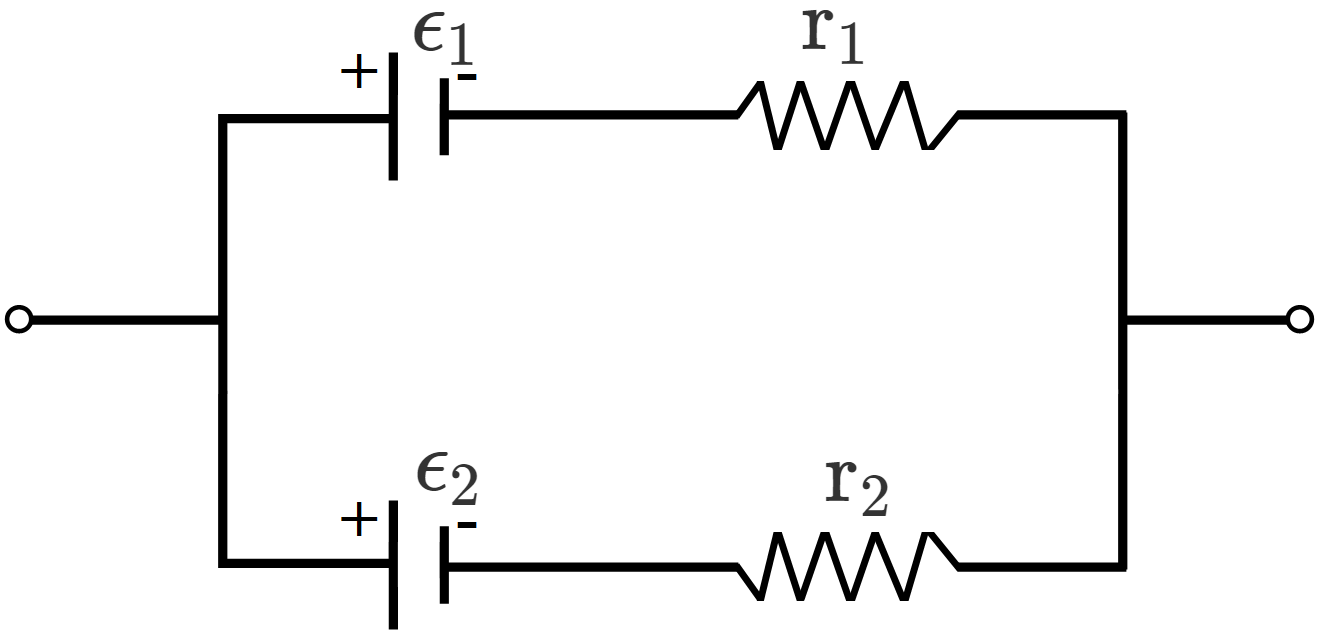
Two non$-$ideal batteries are connected in parallel. Consider the following statements:
$A.$ The equivalent emf is smaller than either of the two emfs.
$B.$ The equivalent internal resistance is smaller than either of the two internal resistances.
  • A
    Both $A$ and $B$ are correct.
  • B
    $A$ is correct but $B$ is wrong.
  • $B$ is correct but $A$ is wrong.
  • D
    Both $A$ and $B$ are wrong.
Answer
Correct option: C.
$B$ is correct but $A$ is wrong.
Equivalent emf $\in_0=\frac{\in_1\text{r}_1+\in_2\text{r}_2}{\text{r}_1+\text{r}_2}$

Equivalent resistance $=\text{r}_0=\frac{\text{r}_1\text{r}_2}{\text{r}_1+\text{r}_2}$
$\phi$ The equivalent $\text{emf}$ is smaller than either of the two emfs.
$\phi$ The equivalent internal resistance is smaller than either of the two internal resistances.
View full question & answer
MCQ 41 Mark
Identify the correct options:
  1. An ammeter should have small resistance.
  2. An ammeter should have large resistance.
  3. A voltmeter should have small resistance.
  4. A voltmeter should have large resistance.
  • A
    Only $A$
  • B
    $A$ and $B$
  • $A$ and $D$
  • D
    All of the  above
Answer
Correct option: C.
$A$ and $D$
$Þ$ An ammeter should have small resistane. To measure the accurate reading of current in the circuit by Ammeter.
$þ$ A voltmeter should have large resistance. To measure the accurate reading of voltage across voltmeter.
View full question & answer
MCQ 51 Mark
Two resistors $A$ and $B$ have resistances $R_A$ and $R_B$, respectively, and $R_A$
  • A
    $\rho _\text{A}>\rho _\text{B}$
  • B
    $\rho _\text{A}=\rho _\text{B}$
  • C
    $\rho _\text{A}<\rho _\text{B}$
  • The information is not sufficient to find the relation between $\rho _\text{A}$ and $\rho _\text{B}.$
Answer
Correct option: D.
The information is not sufficient to find the relation between $\rho _\text{A}$ and $\rho _\text{B}.$
$\text{R}=\frac{\rho \ell}{\text{A}}$
Resistance is depend on Material, length $\&$ Area.
So $RA < RB$ is information is not sufficient to ding.
The relation between $\rho_\text{A}$ and $\rho_\text{B}.$
View full question & answer
MCQ 61 Mark
Two non$-$ideal batteries are connected in series. Consider the following statements:
$A.$ The equivalent $\text{emf}$ is larger than either of the two emfs.
$B.$ The equivalent internal resistance is smaller than either of the two internal resistances.
  • A
    Each of $A$ and $B$ are correct.
  • $A$ is correct but $B$ is wrong.
  • C
    $B$ is correct but $A$ is wrong.
  • D
    Each $A$ and $B$ are wrong.
Answer
Correct option: B.
$A$ is correct but $B$ is wrong.

Equivalent emf $=\hat{\text{I}}_1+\hat{\text{I}}_2$
$\text{R}_\text{eq}=\text{r}_1+\text{r}_2$
Equivalent emf $=\hat{\text{I}}_1+\hat{\text{I}}_2\Big\{\hat{\text{I}}_1>\hat{\text{I}}_2\Big\}$
$\text{R}_\text{eq}=\text{r}_1+\text{r}_2$

$\phi$ The equivalent emf is larger than either of the two $\text{emfs.}$
$\phi$ The equivalent internal resistance is smaller than either of the two internal resistances.
View full question & answer
MCQ 71 Mark
As the temperature of a metallic resistor is increased, the product of its resistivity and conductivity:
  • A
    Increases.
  • B
    Decreases.
  • C
    Remains constant.
  • May increase or decrease.
Answer
Correct option: D.
May increase or decrease.
The product of resistivity and conductivity is independent of temperature. As the temperature of a metallic resistor is increased, the resistivity increases and conductivity decreases. Hence, both the conductivity and resistivity of the metallic resistor nullify the effect of the change in temperature.
View full question & answer
MCQ 81 Mark
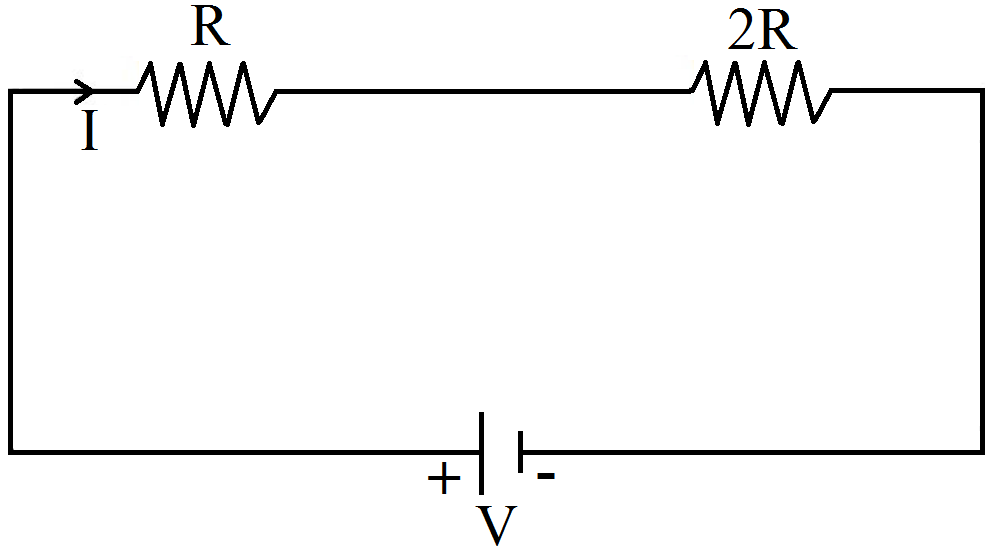
Two resistors $R$ and $2R$ are connected in series in an electric circuit. The thermal energy developed in $R$ and $2R$ are in the ratio:
  • $1 : 2.$
  • B
    $2 : 1.$
  • C
    $1 : 4.$
  • D
    $4 : 1.$
Answer
Correct option: A.
$1 : 2.$
Thermal Energy developed $= 1^2 \mathrm{Rt} ($Because in series, current is same$)$

$\frac{\text{Thermal Energy developedin "R"}}{\text{Thermal Energy developedin "2R"}}=\frac{\text{I}^2\text{Rt}}{\text{I}^2(2\text{R})\text{t}}=\frac{1}{2}$
View full question & answer
MCQ 91 Mark
When no current is passed through a conductor:
  1. The free electrons do not move.
  2. The average speed of a free electron over a large period of time is zero.
  3. The average velocity of a free electron over a large period of time is zero.
  4. The average of the velocities of all the free electrons at an instant is zero.
  • A
    Only $A$
  • B
    $A$ and $B$
  • C
    $B$ and $C$
  • $C$ and $D$
Answer
Correct option: D.
$C$ and $D$
No current is passed through a conductor means. That the average velocity of a free elecron over a large period of time is zero or the average of the velocity of all the free electrons at an instant is zero.
View full question & answer
MCQ 101 Mark
The product of resistivity and conductivity of a cylindrical conductor depends on:
  • A
    Temperature.
  • B
    Material.
  • C
    Area of cross section.
  • None of these.
Answer
Correct option: D.
None of these.
Conductivity $\sigma=\frac{1}{\rho }$ Where r is resistivily.
Product of conductity and resistivity = 1.
View full question & answer
MCQ 111 Mark
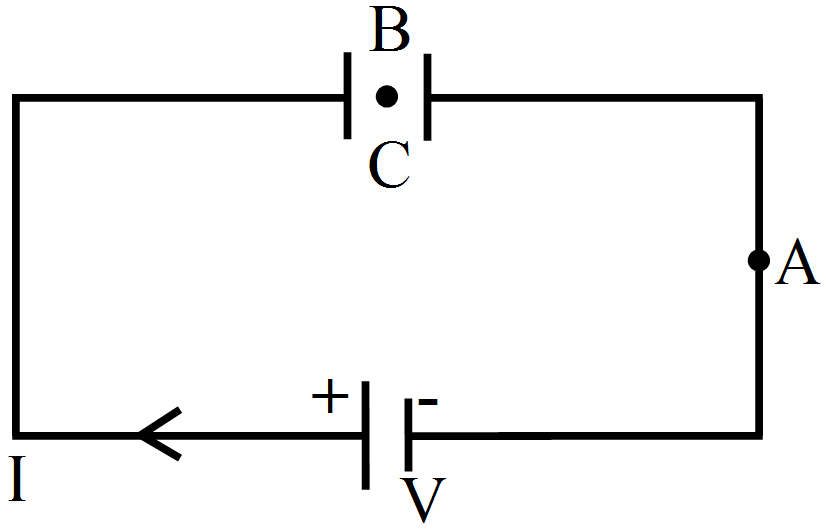
A capacitor with no dielectric is connected to a battery at $t = 0.$ Consider a point $A$ in the connecting wires and a point $B$ in between the plates.
  1. There is no current through $A.$
  2. There is no current through $B.$
  3. There is a current through $A$ as long as the charging is not complete.
  4. There is a current through $B$ as long as the charging is not complete.
  • A
    Only $A$
  • B
    $A$ and $B$
  • $B$ and $C$
  • D
    All of the above
Answer
Correct option: C.
$B$ and $C$

$Þ$ There is no current through $B.$
$Þ$ There is a current through $A$ as long as the charging is not complete.
View full question & answer
MCQ 121 Mark
In an electric circuit containing a battery, the charge (assumed positive) inside the battery:
  • A
    Always goes from the positive terminal to the negative terminal.
  • May go from the positive terminal to the negative terminal.
  • C
    Always goes from the negative terminal to the positive terminal
  • D
    Does not move.
Answer
Correct option: B.
May go from the positive terminal to the negative terminal.
The charge (Positive) inside the bottery my go from the positive terminal to the negative terminal.
View full question & answer
MCQ 131 Mark
A metallic resistor is connected across a battery. If the number of collisions of the free electrons with the lattice is somehow decreased in the resistor $($for example, by cooling it$)$, the current will:
  • Increase.
  • B
    Decrease.
  • C
    Remain constant.
  • D
    Become zero.
Answer
Correct option: A.
Increase.
If the number of collisions of the free electrons with the lattice is decreased, then the drift velocity of the electrons increases.
Current $i$ is directly proportional to the drift velocity '$V_d$' and is given by the following relation:
$\text{i}=\text{neAV}_\text{d}.$
View full question & answer
MCQ 141 Mark
Consider the following two statements:
$A.$ Kirchhoff's junction law follows from conservation of charge.
$B.$ Kirchhoff's loop law follows from conservative nature of electric field.
  • Both $A$ and $B$ are correct.
  • B
    $A$ is correct but $B$ is wrong.
  • C
    $B$ is correct but $A$ is wrong.
  • D
    Both $A$ and $B$ are wrong.
Answer
Correct option: A.
Both $A$ and $B$ are correct.
$\phi$ Kirchhoff's Junction Law follows from conservation of charge.
$\phi$ Kirchhoff's loop law fallows from conservation nature of electric field.
View full question & answer
MCQ 151 Mark
The net resistance of a voltmeter should be large to ensure that:
  • A
    It does not get overheated.
  • B
    It does not draw excessive current.
  • C
    It can measure large potential differences.
  • It does not appreciably change the potential difference to be measured.
Answer
Correct option: D.
It does not appreciably change the potential difference to be measured.
The net resistance of a voltmeter should be large to ensure that it does not appreciably change the potential difference to be measured.
View full question & answer
MCQ 161 Mark
Which of the following quantities do not change when a resistor connected to a battery is heated due to the current?
  • A
    Drift speed.
  • B
    Resistivity.
  • C
    Resistance.
  • Number of free electrons.
Answer
Correct option: D.
Number of free electrons.
When a resistor connected to a battery is heated due to the current that causes drift speed, resistivity & resistance may e change But number of free electrons remains same.
View full question & answer
MCQ 171 Mark
As the temperature of a conductor increases, its resistivity and conductivity change. The ratio of resistivity to conductivity:
  • Increases.
  • B
    Decreases.
  • C
    Remains constant.
  • D
    May increase or decrease, depending on the actual temperature.
Answer
Correct option: A.
Increases.
Temperature of a cunductor increases that causes resistivity (r) is increases & due conductivity (s) is decrease.
$\therefore\sigma=\frac{1}{\rho}$
$\Rightarrow\text{ratio of}\frac{\text{resistivity}}{\text{conductivity}}=\frac{\rho}{\sigma}=\rho^2$ is increase.
View full question & answer
MCQ 181 Mark
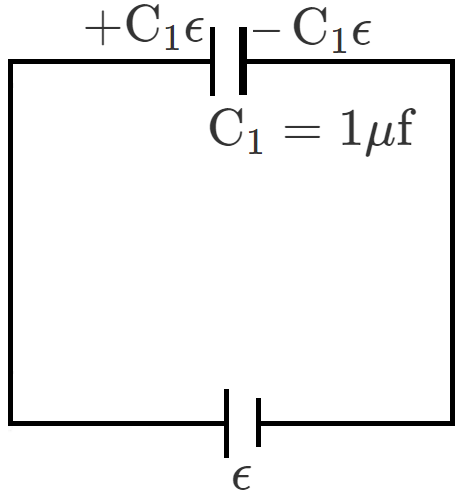
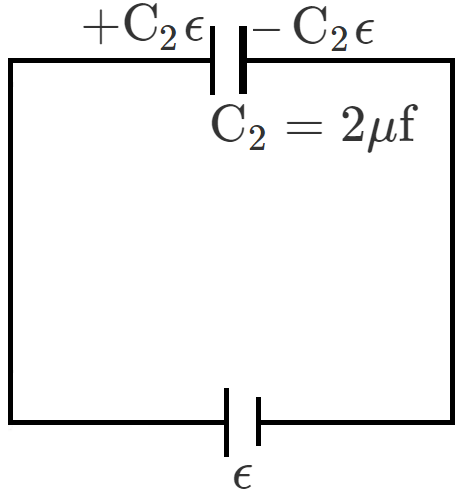
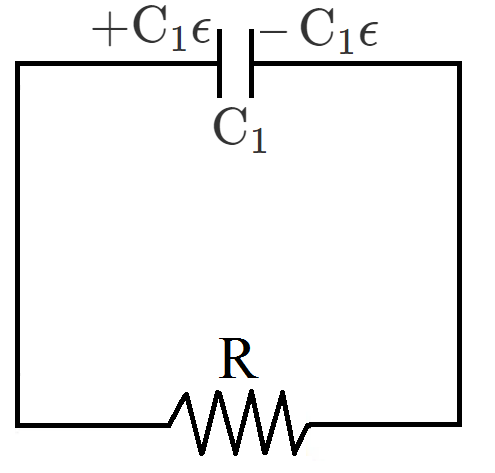
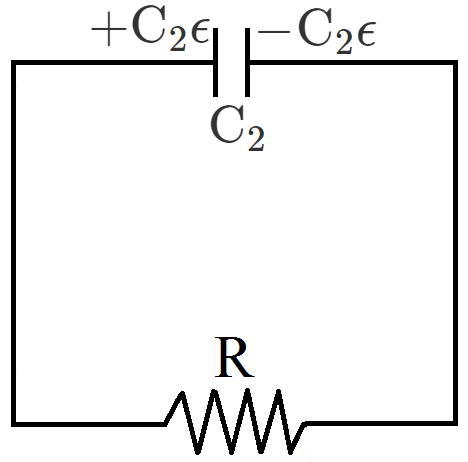
A capacitor $C _1$ of capacitance $1 \mu F$ and a capacitor $C _2$ of capacitance $2 \mu F$ are separately charged by a common battery for a long time. The two capacitors are then separately discharged through equal resistors. Both the discharge circuits are connected at $t =0$.
  • A
    The current in each of the two discharging circuits is zero at $t = 0.$
  • B
    The currents in the two discharging circuits at $t = 0$ are equal but not zero.
  • C
    $C_1$ loses $50\%$ of its initial charge sooner than $C_2 $ loses $50\%$ of its initial charge.
  • Both $B$ and $D$
Answer
Correct option: D.
Both $B$ and $D$

Charging $Þ$


Discharging $þ$


$\text{Q}=\text{C}_1\in\text{e}^{\frac{-\text{t}}{\text{Rc}_1}}$
$\text{Q}=\text{C}_2\in\text{e}^{\frac{-\text{t}}{\text{Rc}_2}}$
$\text{i}_1=\frac{\text{dQ}}{\text{dt}}=\frac{-\text{C}_1\in}{\text{RC}_1}\text{e}^\frac{-\text{t}}{\text{RC}_1}$
$\text{i}_1=\frac{\text{dQ}}{\text{dt}}=\frac{-\in}{\text{R}}\text{e}^\frac{-\text{t}}{\text{RC}_2}$
$\text{i}_1=\frac{-\in}{\text{R}}\text{e}^\frac{-\text{t}}{\text{RC}_1}$
at $\text{t}=0$
at $\text{t}=0$
$\text{i}_1=\frac{-\in}{\text{R}}$
$\text{i}_2=\frac{-\in}{\text{R}}$

View full question & answer
MCQ 191 Mark
Consider a capacitor$-$charging circuit. Let $Q_1$ be the charge given to the capacitor in a time interval of $10 ms$ and $Q_2$ be the charge given in the next time interval of $10 ms$ . Let $10 mC$ charge be deposited in time interval $\mathrm{t}_1$ and another $10 mC$ charge be deposited in the next time interval $\mathrm{t}_2$.
  • A
    $Q_1>Q_2, t_1>t_2$
  • $Q_1>Q_2, t_1$
  • C
    $Q_1t_2$
  • D
    $\mathrm{Q}_1<\mathrm{Q}_2, \mathrm{t}_1<\mathrm{t}_2$
Answer
Correct option: B.
$Q_1>Q_2, t_1$
Condition for charging capacitor$-$
$\text{Q}=\text{Q}_0\Big(1-\text{e}^\frac{-\text{t}}{\text{Rc}}\Big)$
$\text{Q}=\text{Q}_0\Big(1-\text{e}^\frac{-10\text{m}}{\text{Rc}}\Big)\ ...(1)$
$\text{Q}_1=\text{Q}_2=\text{Q}_0\Big(1-\text{e}^\frac{{-(10\text{m}+10\text{m})}}{\text{Rc}}\Big)$
$\text{Q}_1=\text{Q}_2=\text{Q}_0\Big(1-\text{e}^\frac{{-20\text{m}}}{\text{Rc}}\Big)\ ...(2)$
From eq. $(1)$ and $(2)$ we get$-$
$\text{Q}_1>\text{Q}_2$
Given
$\text{Q}=\text{Q}_0\Big(1-\text{e}^\frac{-\text{t}}{\text{Rc}}\Big)$
$10\text{mc}=\text{Q}_0\Big(1-\text{e}^{\frac{-\text{t}}{\text{Rc}}}\Big)\ ...(3)$
$10\mu\text{c}+10\mu\text{c}=\text{Q}_0\Big(1-\text{e}^{\frac{-(\text{t}_1+\text{t}_2)}{\text{Rc}}}\Big)\rightarrow$
$20\mu\text{c}=\text{Q}_0\Big(1-\text{e}^{\frac{-(\text{t}_1+\text{t}_2)}{\text{Rc}}}\Big)\ ...(4)$
From eq. $(3)$ and $(4)$ we get,
$\text{t}_2>\text{t}_1$
View full question & answer
MCQ 201 Mark
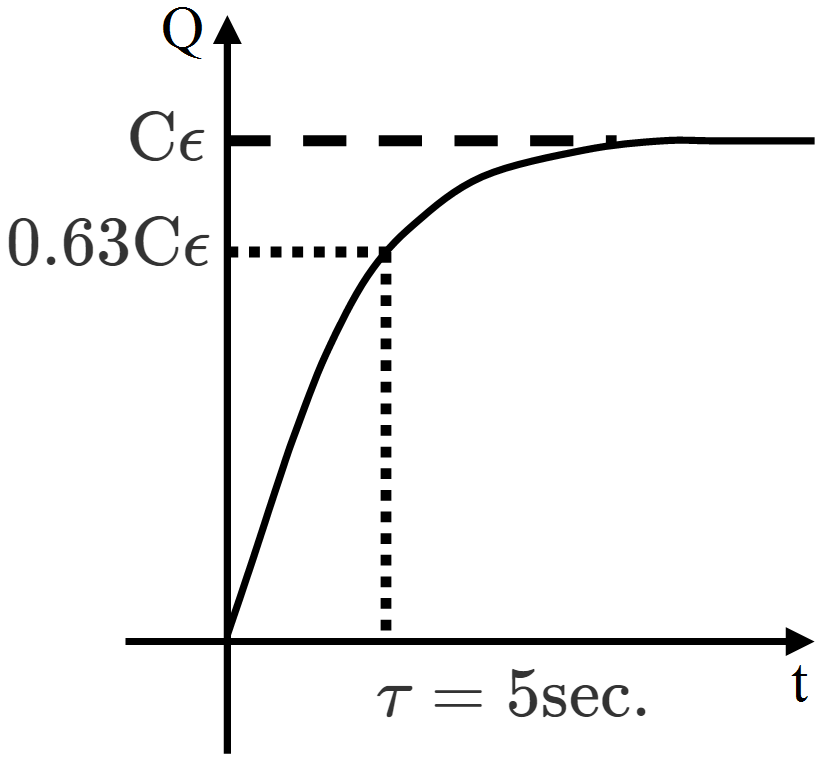
A capacitor of capacitance $500\mu\text{F}$ is connected to a battery through a $10\text{k}\Omega$ resistor. The charge stored in the capacitor in the first $5s$ is larger than the charge stored in the next:
  • $5s$
  • B
    $50s$
  • C
    $500s$
  • D
    All of the above
Answer
Correct option: A.
$5s$
$\text{Q}=\text{CE}\Big(1-\text{e}^{\frac{-\text{t}}{\text{Rc}}}\Big)$
$\text{C}-500\times10^{-6}\text{F}$
$\text{R}=10^4\text{W}$
$\text{t}=\text{Rc}=10^4\times500\times10^{-6}=5$
$\text{t}=5\text{sec}$
$\text{Q}=\text{C}\in\Big(1-\text{e}^{-\text{t}}\Big)=\text{C}\in\Big(1-\frac{1}{\text{e}}\Big)=0.63\text{c}\in$
Thus, $63\%$ of the maximum charge is deposited in one time constant.

With the help of the figure we can say that the capacitor in the first $5s$ is larger than the charge stored in the next any second.
$\Rightarrow$ at $\text{t}=\infty$
$\text{Q}=\text{Q}_0\Big(1-\text{e}^{-\infty}\Big)=\text{Q}_0=\text{C}\in$
$\therefore\text{t}_\infty-\text{t}_5=\text{C}\in-63=37$
after $t = 5\sec.$, maximum charge is deposited is only $37\%.$
View full question & answer
MCQ 211 Mark
A uniform wire of resistance $50\Omega$ is cut into 5 equal parts. These parts are now connected in parallel. The equivalent resistance of the combination is:
  • $2\Omega$
  • B
    $10\Omega$
  • C
    $250\Omega$
  • D
    $6250\Omega$
Answer
Correct option: A.
$2\Omega$
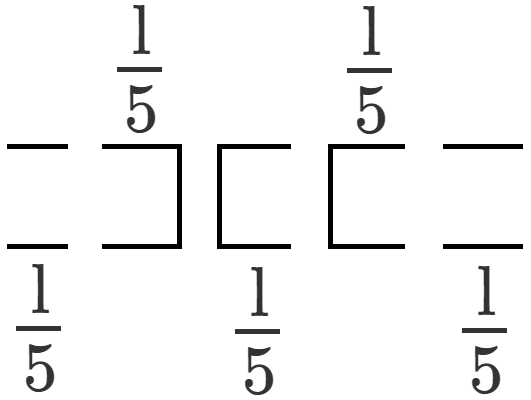
$\text{R}=\frac{\rho}{\text{A}}=50$


resistance of '5' equal parts are same.
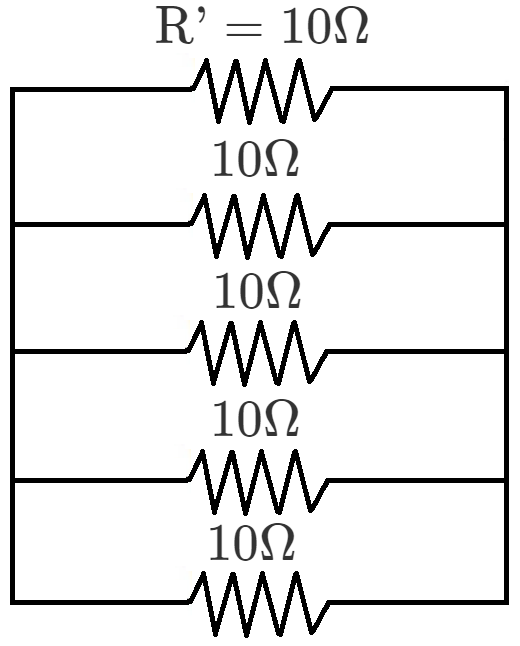
$\text{R}'=\frac{\frac{\rho}{5}}{\text{A}}=\frac{50}{5}=10\Omega$
All '5' equal parts connect in parallel,

$\frac{1}{\text{R}_\text{eq}}=\frac{1}{10}+\frac{1}{10}+\frac{1}{10}+\frac{1}{10}+\frac{1}{10}=\frac{5}{10}$
$\text{R}_\text{eq}=2\Omega$
View full question & answer
MCQ 221 Mark
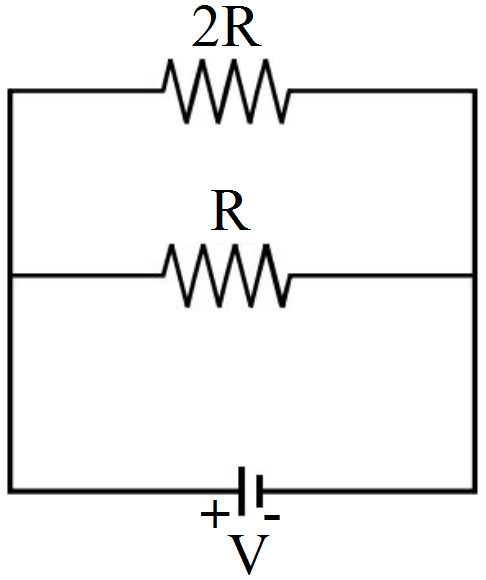
Two resistances R and 2R are connected in parallel in an electric circuit. The thermal energy developed in R and 2R are in the ratio:
  • A
    1 : 2
  • 2 : 1
  • C
    1 : 4
  • D
    4 : 1
Answer
Correct option: B.
2 : 1
Thermal Energy developed $=\frac{\text{v}_2}{\text{R}}\text{t}$ (Because in Parallel, voltage is same)


$\frac{\text{Thermal Energy developedin "R"}}{\text{Thermal Energy developedin "2R"}}=\frac{\frac{\text{v}^2}{\text{R}}\text{t}}{\frac{\text{v}^2}{2\text{R}}\text{t}}=2:1$
View full question & answer
MCQ 231 Mark
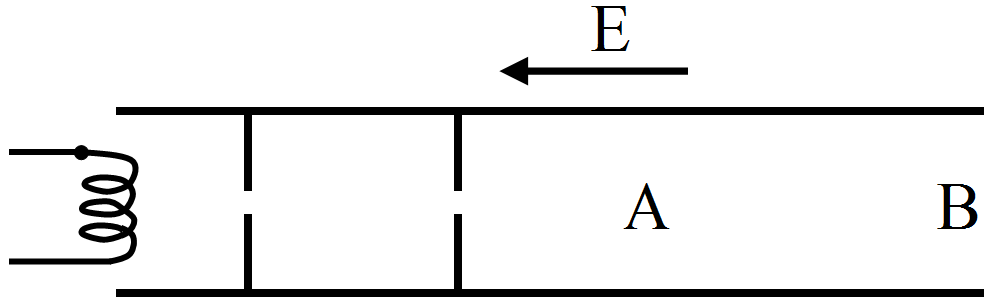
Electrons are emitted by a hot filament and are accelerated by an electric field, as shown in the figure. The two stops at the left ensure that the electron beam has a uniform cross-section.
  • The speed of the electrons is more at B than at A.
  • B
    The electric current is from left to right.
  • C
    The magnitude of the current is larger at B than at A.
  • D
    The current density is more at B than at A.
Answer
Correct option: A.
The speed of the electrons is more at B than at A.
Electric field goes higher potential to Lower potential. The drift velocity of the electron at higher potentail is greater than the lower potential.
So the speed of the electron is more at B that at A.
View full question & answer
MCQ 241 Mark
A current passes through a resistor. Let $\mathrm{K}_1$ and $\mathrm{K}_2$ represent the average kinetic energy of the conduction electrons and the metal ions, respectively:
  • A
    $\mathrm{K}_2<\mathrm{K}_2$
  • B
    $\mathrm{K}_1=\mathrm{K}_2$
  • $\mathrm{K}_1>\mathrm{K}_2$
  • D
    Any of these three may occur.
Answer
Correct option: C.
$\mathrm{K}_1>\mathrm{K}_2$
$vd$ drift velocity $=\frac{1}{2}\Big(\frac{\text{eE}}{\text{m}}\Big)\text{t}$
$\text{K.E}.=\frac{1}{2}\text{mv}^2_\text{d}=\frac{1}{2}\text{m}\Big(\frac{1}{4}\frac{\text{e}^2\text{E}^2\text{t}^2}{\text{m}^2}\Big)$
$\text{K.E}.=\frac{1}{8}\frac{\text{e}^2\text{E}^2\text{t}^2}{\text{m}}$
$\text{p}=\text{K.E}.\propto\frac{1}{\text{m}}$
Mass of electron $<$ mass of metalions.
$K.E.$ of electron $> K.E.$ of metalions.
View full question & answer
MCQ 251 Mark
The net resistance of an ammeter should be small to ensure that:
  • A
    It does not get overheated.
  • B
    It does not draw excessive current.
  • C
    It can measure large currents.
  • It does not appreciably change the current to be measured.
Answer
Correct option: D.
It does not appreciably change the current to be measured.
The net resistance of an ammeter should be small to ensure that it does not oppreciably change the current to be measured.
View full question & answer