Questions

2 Marks Questions

Take a timed test

15 questions · self-marked practice — reveal the answer and mark yourself.
Question 22 Marks
A 1cm object is placed perpendicular to the principal axis of a convex mirror of focal length 7.5cm. Find its distance from the mirror if the image formed is 0.6cm in size.
Answer
$\text{m}=-\frac{\text{v}}{\text{u}}=0.6$ and $\text{f}=7.5\text{cm}=\frac{15}{2}\text{cm}$From mirror equation,
$\Rightarrow\frac{1}{\text{v}}+\frac{1}{\text{u}}=\frac{1}{\text{f}}$
$\Rightarrow\frac{1}{0.6\text{u}}-\frac{1}{\text{u}}=\frac{1}{\text{f}}$
$\Rightarrow \frac{5}{3\text{u}}-\frac{1}{\text{u}}=\frac{5}{15}$
$\Rightarrow\text{u}=5\text{cm}$
View full question & answer
Question 32 Marks
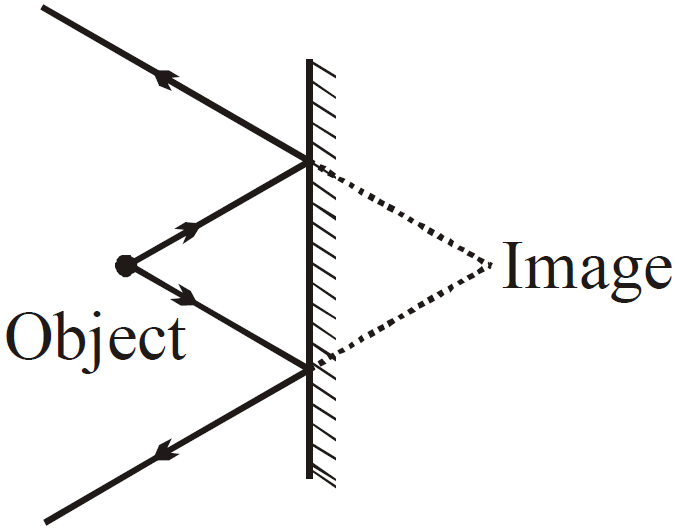
Can a virtual image be photographed by a camera?
Answer

Yes, when you stand in front of plane mirror image is virtual and can be photographed.
View full question & answer
Question 42 Marks
An optical fibre $(\mu=1.72)$ is surrounded by a glass coating $(\mu=1.50).$ Find the critical angle for total internal/ reflection at the fibre-glass interface.
Answer
For calculation of critical angle,$\frac{\sin\text{i}}{\sin\text{r}}=\frac{\mu_2}{\mu_1}$
$\Rightarrow\frac{\sin\theta_\text{C}}{\sin90^\circ}=\frac{15}{1.72}$
$=\frac{75}{86}$
$\Rightarrow\theta_\text{C}=\sin^{-1}\Big(\frac{75}{86}\Big)$
View full question & answer
Question 52 Marks
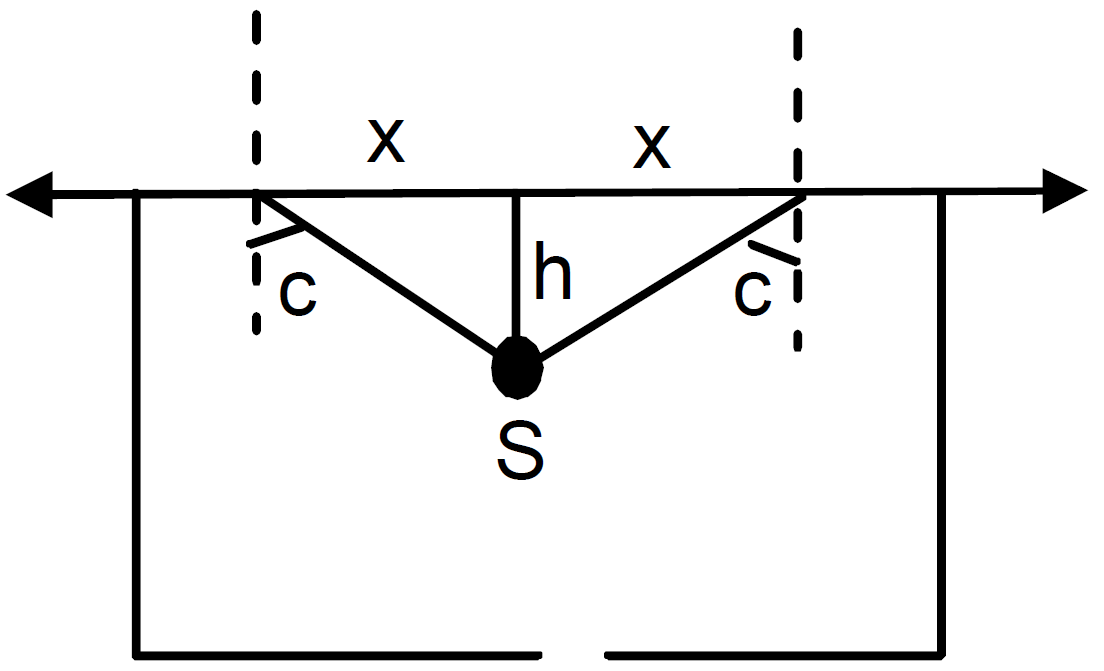
A point source is placed at a depth h below the surface of water $($refractive index $= \mu ).$
  1. Show that light escapes through a circular area on the water surface with its centre directly above the point source.
  2. Find the angle subtended by a radius of the area on the source.
Answer
  1. Let, $x =$ radius of the circular area
$\frac{\text{x}}{\text{h}}=\tan\theta_\text{C} ($where $C$ is the critical angle$)$
$\Rightarrow\frac{\text{x}}{\text{h}}=\frac{\sin\theta_\text{C}}{\sqrt{1-\sin^2\theta_\text{C}}}=\frac{\frac{1}{\mu}}{\sqrt{1-\frac{1}{\mu^2}}} \ \Big(\because \ \sin\theta_\text{C}=\frac{1}{\mu}\Big)$
$\Rightarrow\frac{\text{x}}{\text{h}}=\frac{1}{\sqrt{\mu^2-1}}$ or $\text{x}=\frac{\text{h}}{\sqrt{\mu^2-1}}$
So, light escapes through a circular area on the water surface directly above the point source.
  1. Angle subtained by a radius of the area on the source, $\theta_\text{C}=\sin^{-1}\Big(\frac{1}{\mu}\Big)$
View full question & answer
Question 62 Marks
Light falls from glass $(\mu=1.5)$ to air. Find the angle of incidence for which the angle of deviation is 90°.
Answer
Since, $\mu=1.5,$ Critial angle $=\sin^{-1}\Big(\frac{1}{\mu}\Big)=\sin^{-1}\Big(\frac{1}{1.5}\Big)=41.8^{\circ}$
We know, the maximum attainable deviation in refraction is (90° - 41.8°) = 47.2°
So, in this case, total internal reflection must have taken place.
In reflection,
Deviation = 180° - 2i = 90°
⇒ 2i = 90° ⇒ i = 45°.
View full question & answer
Question 72 Marks
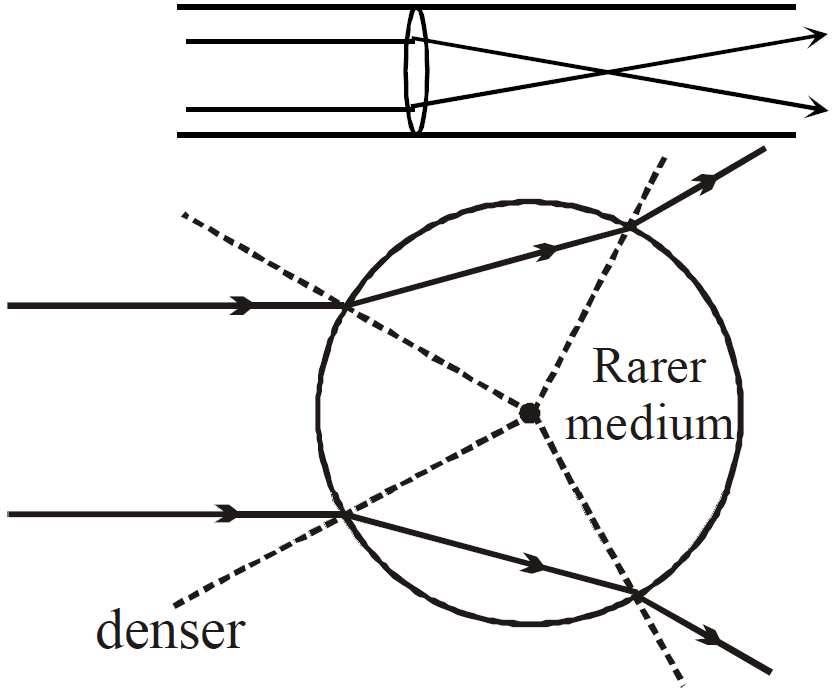
A single lens is mounted in a tube. A parallel beam enters the tube and emerges out of the tube as a divergent beam. Can you say with certainty that there is a diverging lens in the tube?
Answer
No,
View full question & answer
Question 92 Marks
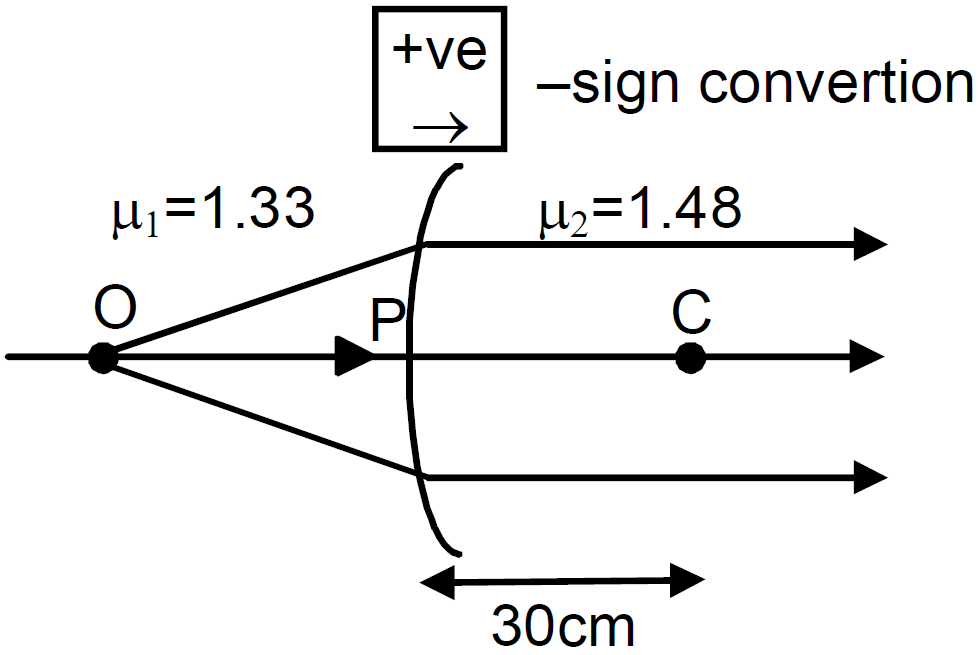
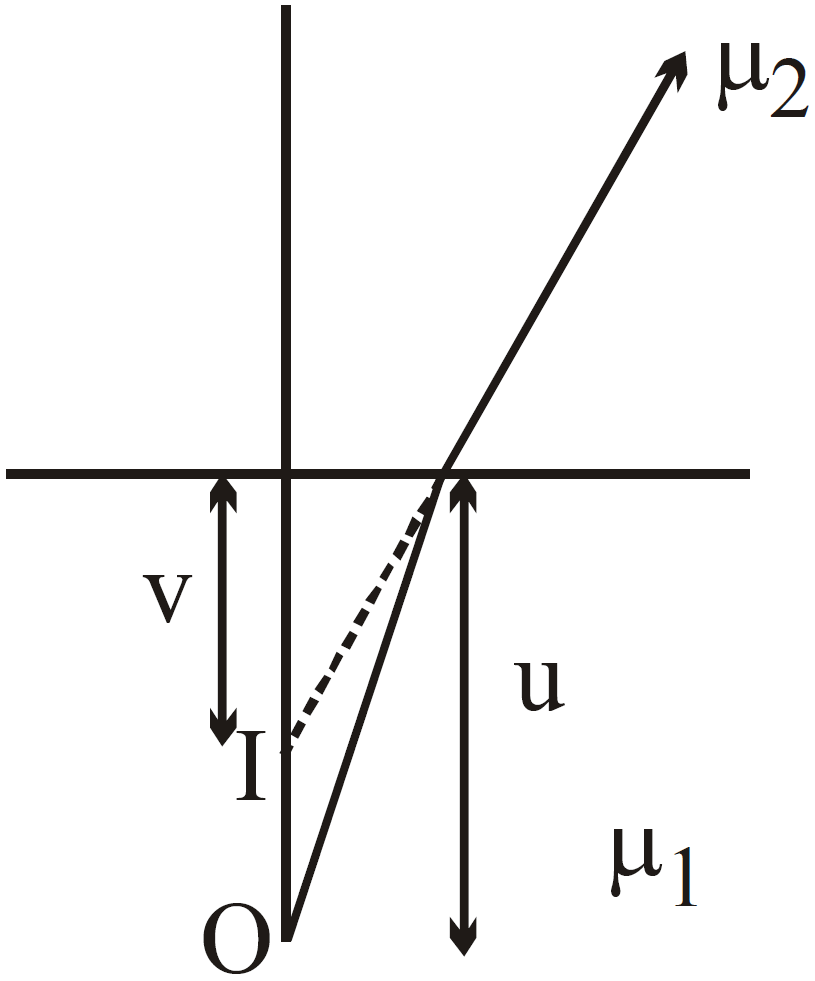
A spherical surface of radius 30cm separates two transparent media A and B with refractive indices 1.33 and 1.48 respectively. The medium A is on the convex side of the surface. Where should a point object be placed in medium A so that the paraxial rays become parallel after refraction at the surface?
Answer
Since, paraxial rays become parallel after refraction i.e. image is formed at $\infty.$$\text{v}=\infty, \ \mu_1=1.33, \ \text{u}=?, \ \mu_2=1.48, \ \text{R}=30\text{cm}$
$\frac{\mu_2}{\text{v}}-\frac{\mu_1}{\text{u}}=\frac{\mu_2-\mu_1}{\text{R}}$
$\Rightarrow\frac{1.48}{\infty}-\frac{1.33}{\text{u}}=\frac{1.48-1.33}{30}\Rightarrow-\frac{1.33}{\text{u}}-\frac{0.15}{30}$
$\Rightarrow\text{u}=-266.0\text{cm}$
$\therefore$ Object should be placed at a distance of 266cm from surface (convex) on side A.
View full question & answer
Question 102 Marks
Find the maximum angle of refraction when a light ray is refracted from glass $(\mu=1.50)$ to air.
Answer
From the definition of critical angle, if refracted angle is more than 90°, then reflection occurs, which is known as total internal reflection.
So, maximum angle of refraction is 90°.
View full question & answer
Question 112 Marks
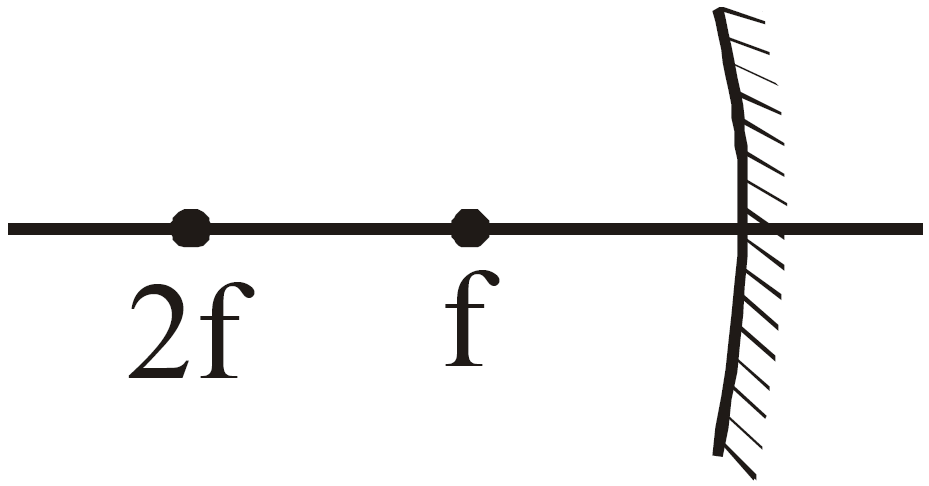
If an object far away from a convex mirror moves towards the mirror, the image also moves. Does it move faster, slower or at the same speed as compared to the object?
Answer
Slower $\text{V}_{\text{img}}=\text{m}^2\text{v}_0$ [m < 1 as far away]

It objects moves from infinity to 2f as distance moved by object is more in same time hence velocity of object is more.
View full question & answer
Question 122 Marks
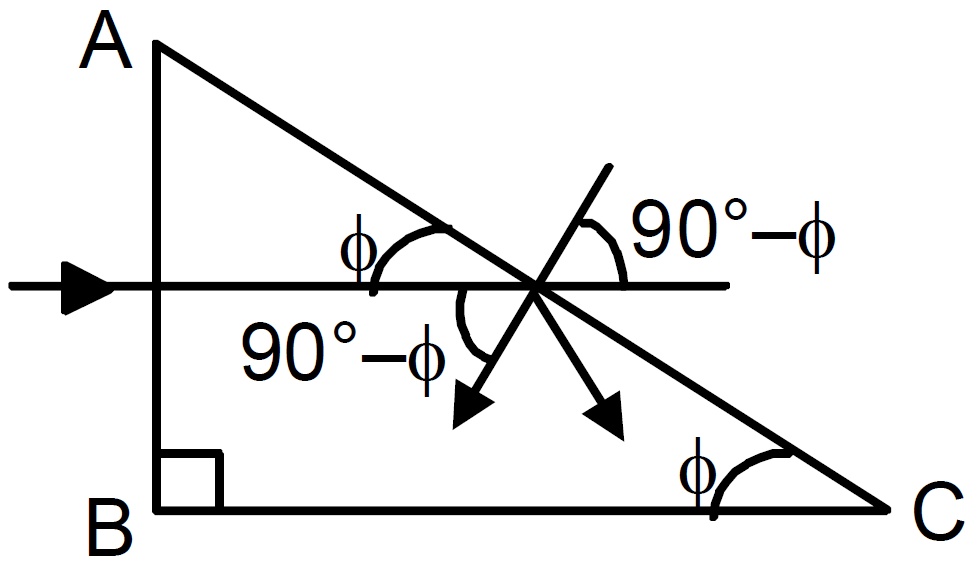
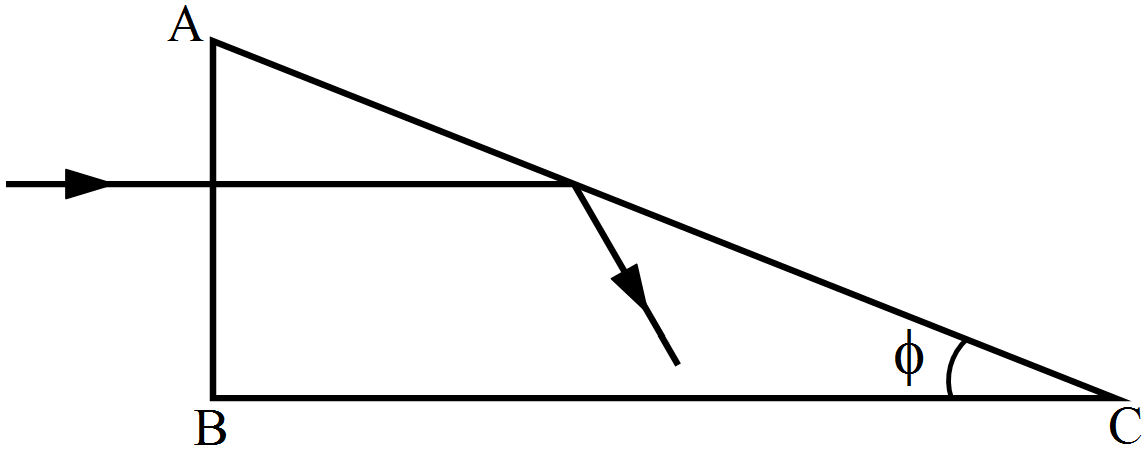
A light ray is incident normally on the face AB of a right-angled prism ABC $(\mu=1.50)$ as shown in figure. What is the largest angle $\phi$ for which the light ray is totally reflected at the surface AC?
Answer
Let $\theta_\text{c}$ be the critical angle for the glass$\frac{\sin\theta_{\text{c}}}{\sin90^{\circ}}=\frac{1}{\text{x}}\Rightarrow\sin\theta_{\text{c}}=\frac{1}{1.5}=\frac{2}{3}\Rightarrow\theta_{\text{c}}=\sin^{-1}\Big(\frac{2}{3}\Big)$
From figure, for total internal reflection, $90^{\circ}-\phi>\theta_{\text{c}}$$\Rightarrow\phi<90^{\circ}-\theta_{\text{c}}\Rightarrow\phi<\cos^{-1}\Big(\frac{2}{3}\Big)$
So, the largest angle for which light is totally reflected at the surface is $\cos^{-1}\Big(\frac{2}{3}\Big).$
View full question & answer
Question 132 Marks
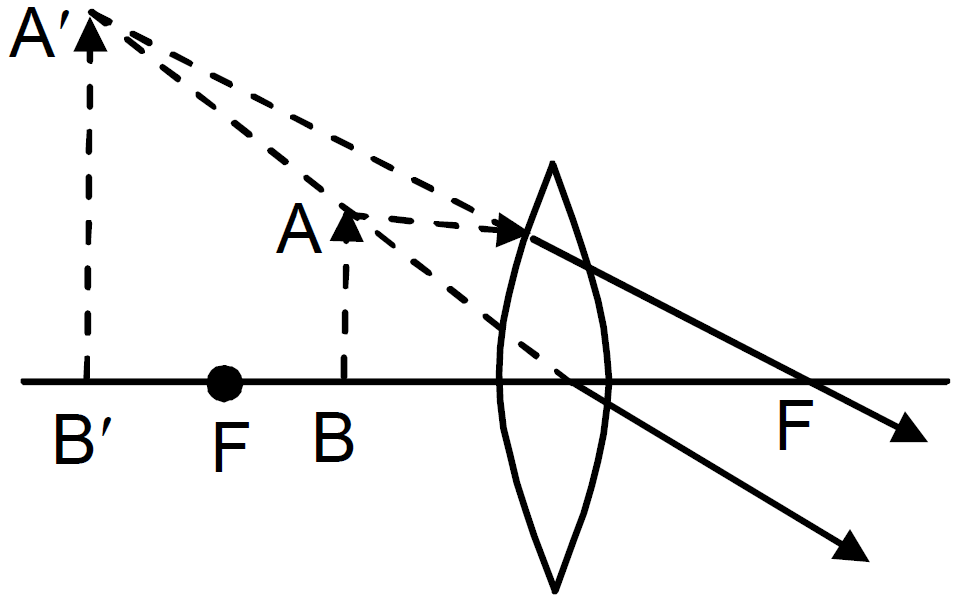
An extended object is placed at a distance of $5.0\ cm$ from a convex lens of focal length $8.0\ cm$.
  1. Draw the ray diagram $($to the scale$)$ to locate the image and from this, measure the distance of the image from the lens.
  2. Find the position of the image from the lens formula and see how close the drawing is to the correct result.
Answer
  1.  
​​​​​​
  1. Given, $u = -5\ cm, f = 8\ cm$
  2. So, $\Rightarrow\frac{1}{\text{v}}-\frac{1}{\text{u}}=\frac{1}{\text{f}}​​$
    $\Rightarrow\frac{1}{8}-\frac{1}{5}=\frac{-3}{40}$
    $\Rightarrow\text{v}=-13.3\ \text{cm} ($virtual image$)$.
View full question & answer
Question 142 Marks
The equation of refraction at a spherical surface is $\frac{\mu_2}{\text{v}}-\frac{\mu_1}{\text{u}}-=\frac{\mu_2-\mu_1}{\text{R}}.$ Taking $\text{R}=\infty,$ show that this equation leads to the equation $\frac{\text{Real depth}}{\text{Apparent depth}}=\frac{\mu_2}{\mu_1}$ for refraction at a plane surface.
Answer
$\frac{\mu_2}{\text{v}}-\frac{\mu_1}{\text{u}}-=\frac{\mu_2-\mu_1}{\infty}$$\frac{\mu_2}{\text{v}}=\frac{\mu_1}{\text{u}}$
$\Rightarrow\frac{\mu_2}{\mu_1}=\frac{\text{v}}{\text{u}}.$
View full question & answer
Question 152 Marks
Light is incident from glass $(\mu=1.5)$ to air. Sketch the variation of the angle of deviation $\delta$ with the angle of incident i for 0 < i < 90°.
View full question & answer