Question 12 Marks
Shows plot of $\frac{\text{PV}}{\text{T}}$ versus P for $1.00 \times 10^{-3} \mathrm{~kg}$ of oxygen gas at two different temperatures. What does the dotted plot signify?
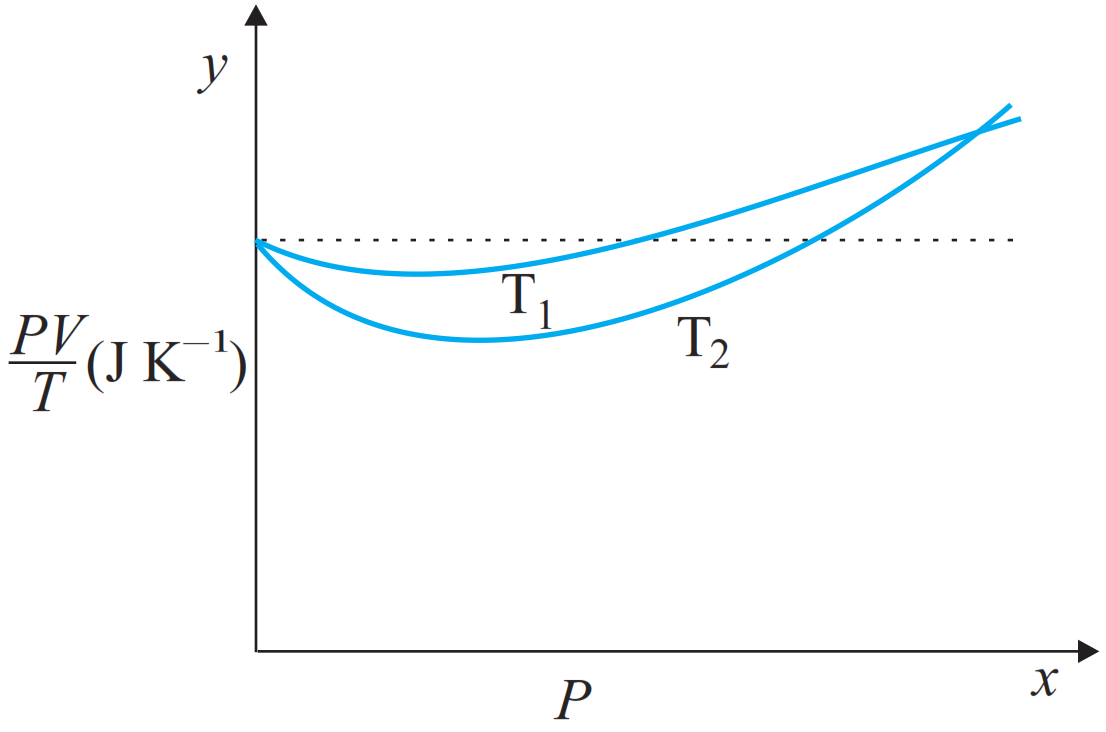
AnswerThe dotted plot in the graph signifies the ideal behaviour of the gas, i.e., the ratio $\frac{\text{PV}}{\text{T}}$ is equal. $\mu\text{R}(\mu$ is the number of moles and R is the universal gas constant) is a constant quality. It is not dependent on the pressure of the gas.
View full question & answer→Question 22 Marks
Shows plot of $\frac{P V}{T}$ versus $P$ for $1.00 \times 10^{-3} \mathrm{~kg}$ of oxygen gas at two different temperatures: Which is true, $T_1>T_2$ or $T_1$ $<T_2$ ?
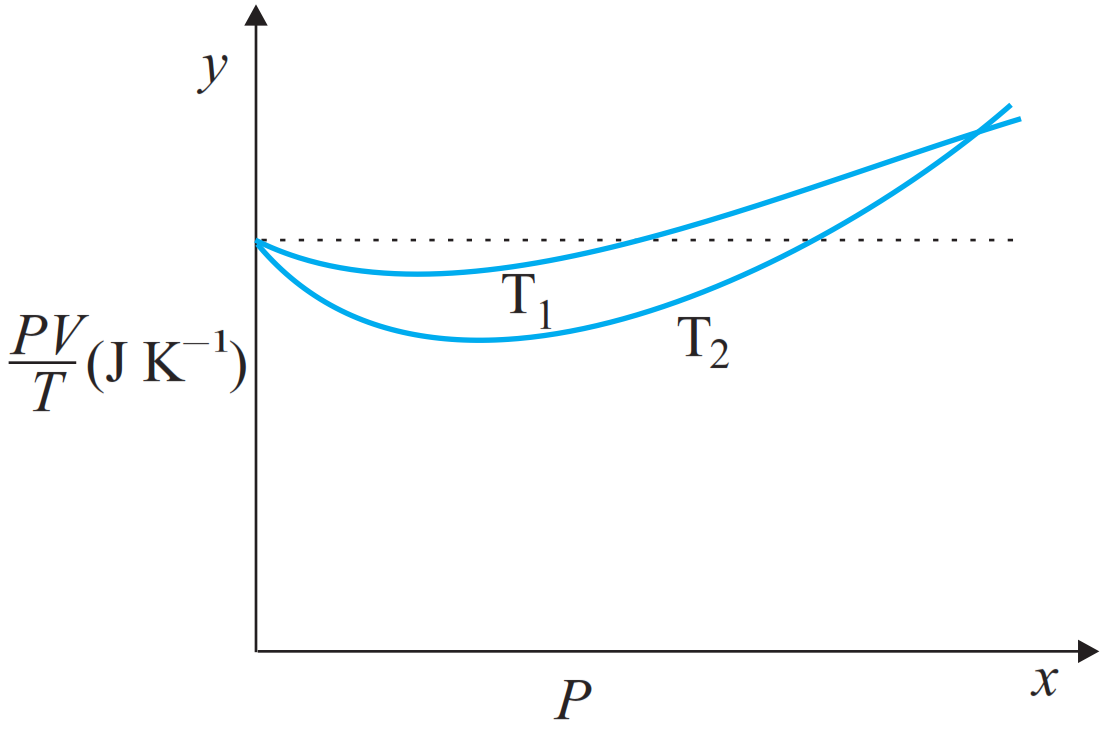
AnswerThe dotted plot in the given graph represents an ideal gas. The curve of the gas at temperature $T_1$ is closer to the dotted plot than the curve of the gas at temperature $T_2$. A real gas approaches the behaviour of an ideal gas when its temperature increases. Therefore, $T_1> T_2$ is true for the given plot.
View full question & answer→Question 32 Marks
Explain, why it is not possible to increase the temperature of a gas while keeping its volume and pressure constant?
AnswerAccording to kinetic theory of gases,$\text{P}=\frac{1}{3}\rho\text{C}^2=\frac{1}{3}\frac{\text{M}}{\text{V}}\text{C}^2=\frac{1}{3}\frac{\text{M}}{\text{V}}\text{KT}$ ($\because C^2$ = KT. when K is constanst)
$\therefore\text{T}\propto\text{PV}$
Now as T is directly proportional to the product of P and V. If P and V are constant, then T is also constant.
View full question & answer→Question 42 Marks
Why gases at high pressure and low temperature show large deviation from ideal gas behavior?
AnswerWhen temperature is low and pressure is high, the intermolecular forces become appreciable. Moreover, the volume occupied by the molecules would not be negligibly small as compared to the volume of the gas. Thus, the behavior of real gases at high pressure and low temperature deviates largely from the behavior of ideal gases.
View full question & answer→Question 52 Marks
Is a slow process always isothermal? ls a quick process always adiabatic?
AnswerAs PV directly proportional to constant in isothermal process. Thus volume varies slowly w.r.t pressure. As in adiabatic process the volume decreases as PV directly proportional to constant. So, isothermal process is slow process and adiabatic process is fast process.
View full question & answer→Question 62 Marks
The weather report reads, "Temperature 20°C : Relative humidity 100%". What is the dew point?
AnswerTemp is 20° Relative humidity = 100% So the air is saturated at 20°C Dew point is the temperature at which SVP is equal to present vapour pressure, So 20°C is the dew point.
View full question & answer→Question 72 Marks
The root-mean square (rms) speed of oxygen molecule ($O_2$) at a certain temperature T is v. If temperature is doubled and oxygen gas dissociates into atomic oxygen, what is the speed of atomic oxygen?
AnswerLet C and C’ be the root mean square velocity of oxygen gas molecule and atomic oxygen at temperature T and T' respectively. Therefore$\text{C}=\sqrt{\frac{3\text{RT}}{\text{M}}}=\text{v}$ and $\text{C}'=\sqrt{\frac{3\text{R}(2\text{T})}{\text{M}/2}}=2\sqrt{\frac{3\text{RT}}{\text{M}}}=2\text{v}$
Hence the velocity of atomic oxygen will become double.
View full question & answer→Question 82 Marks
A barometer correctly reads the atmospheric pressure as 76cm of mercury. Water droplets are slowly introduced into the barometer tube by a dropper. The height of the mercury column first decreases and then becomes constant. lf the saturation vapour pressure at the atmospheric temperature is 0.80cm of mercury, find the height of the mercury column when it reaches its minimum value.
AnswerPressure is minimum when the vapour present inside are at saturation vapour pressure. 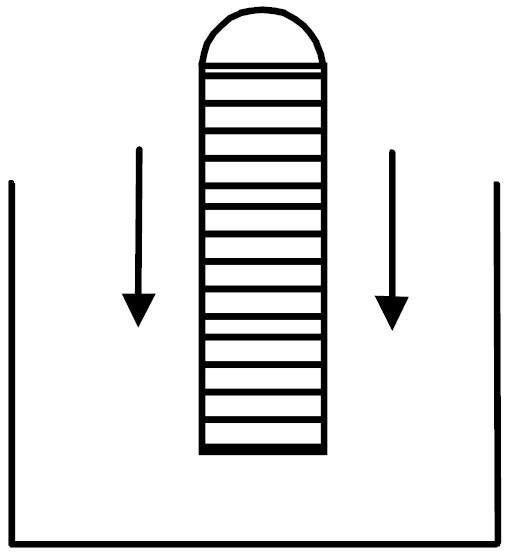 As this is the max. pressure which the vapours can exert. Hence the normal level of mercury drops down by 0.80cm$\therefore$ The height of the Hg column = 76 - 0.80cm = 75.2cm of Hg. [$\because$ Given SVP at atmospheric temp = 0.80cm of Hg]
 View full question & answer→Question 92 Marks
A gas is contained in a closed vessel. How pressure due to the gas will be affected if force of attraction between the molecules disappear suddenly?
AnswerAs force of attraction between molecules disappears, then molecules will hit the wall with more speeds, hence, rate of change of momentum will increase. As we know $\text{F}=\frac{\Delta\text{p}}{\Delta\text{t}},$ Where F is average force on the wall due to molecules.$\Delta\text{p}$ is change in momentum and $\Delta\text{t}$ is the time duration Due to increase in $\Delta\text{p},$ force F will also increase, hence pressure, $\text{p}=\frac{\text{F}}{\text{A}}$ will increase. Here, A is area of one wall.
View full question & answer→Question 102 Marks
The temperature and the dew point in an open room are 20°C and 10°C. If the room temperature drops to 15°C, what will be the new dew point?
AnswerTemp = 20°C Dew point = 10°C The place is saturated at 10°C Even if the temp drop dew point remains unaffected. The air has V.P. which is the saturation VP at 10°C. It (SVP) does not change on temp.
View full question & answer→Question 112 Marks
A tank used for filling helium balloons has a volume of $0.6 \mathrm{~m}^3$ and contains $2.0$ mol of helium gas at $20.0^{\circ} \mathrm{C}$. Assuming that the helium behaves like an ideal gas.
i. What is the total translational kinetic energy of the molecules of the gas?
ii. What is the average kinetic energy per molecule?
Answer
- We know that $(KE)$ trans $=\frac{3}{2}\text{nRT}$
Given, $\text{n}=2$ mol, $T=273+20=293\text{K}$
$\Rightarrow(\text{KE})_{\text{trans}}=\frac{3}{2}(2)(8.31)(293)=7.3\times10^3\text{J}$
- Average $KE$ per molecule
$=\frac{1}{2}\text{mv}^{-2}_{\text{rms}}=\frac{3}{2}\text{Kt}$
$=\frac{3}{2}(1.38)\times10^{-23}(293)$
$=6.07\times10^{-21}\text{J}$ View full question & answer→Question 122 Marks
At room temperature, diatomic gas molecule has five degrees of freedom, at high temperature. It has seven degrees of freedom, explain?
AnswerAt low temperature, diatomic gas has three translational and two rotational degrees of freedom, so total number of degrees of freedom is 5. But at high temperature, gas molecule starts to vibrate which give two additional degrees of freedom i.e. 7.
View full question & answer→Question 132 Marks
During an experiment, an ideal gas is found to obey an additional law $pV^2$ = constant. The gas is initially at a temperature T and volume V. Find the temperature when it expands to a volume 2V.
Answer$PV^2$ = constant$\Rightarrow\text{P}_1\text{V}_1^2=\text{P}_2\text{V}_2^2$
$\Rightarrow\frac{\text{nRT}_1}{\text{V}_1}\times\text{V}_1^2=\frac{\text{nRT}_2}{\text{V}_2}\times\text{V}_2^2$
$\Rightarrow\text{T}_1\text{V}_1=\text{T}_2\text{V}_2=\text{TV}=\text{T}_1\times2\text{V}$
$\Rightarrow\text{T}_2=\frac{\text{T}}{2}$
View full question & answer→Question 142 Marks
A barometer tube is 80cm long (above the mercury reservoir). It reads 76cm on a particular day. A small amount of water is introduced in the tube and the reading drops to 75.4cm. Find the relative humidity in the space above the mercury column if the saturation vapour pressure at the room temperature is 1.0cm.
AnswerAtm–Pressure = 76cm of Hg When water is introduced the water vapour exerts some pressure which counter acts the atm pressure. The pressure drops to 75.4cm Pressure of Vapour = (76 - 75.4)cm = 0.6cm R. Humidity $=\frac{\text{VP}}{\text{SVP}}=\frac{0.6}{1}=0.6=60\%$
View full question & answer→Question 152 Marks
Can a process on an ideal gas be both adiabatic and isothermal?
AnswerNo, In a system either temperature varies or it heat varies. In case of ideal gas Internal energy is function of temperature only thus for isothermal process change in internal energy is zero. Now, since process is adiabatic thus heat exchange is zero. therefore, work done is also zero.
View full question & answer→Question 162 Marks
Equal masses of monoatomic and diatomic gases are supplied heat at the same temperature, pressure and volume. If same amount of heat is supplied to both the gases, which of them will undergo greater temperature rise?
AnswerFor monoatomic gas, temperature rise will be greater because monoatomic gas possesses only translational degree of freedom whereas diatomic gas translation, rotation and vibrational (at higher temperature), so temperature rise for diatomic gases is lower.
View full question & answer→Question 172 Marks
Calculate the number of atoms in $39.4g$ gold. Molar mass of gold is $197g ~mole^{–1}$.
Answer$197gm$ gold has number of atoms $= 6.023 \times 10^{23}$
$1gm$ gold will have number of gold atoms $=\frac{6.023\times10^{23}}{197}$
$39.4gm$ gold has number of Au atoms $=\frac{39.4\times6.023\times10^{23}}{197} = 1.2 \times 10^{23}$ atoms
View full question & answer→Question 182 Marks
A diatomic gas is heated in a vessel to a temperature of 10000K. If each molecule possess an average energy $E_1$. After sometime, a few molecule escape into the atmosphere at 300 K. Due to which, their energy changes to $E_2$. Calculate the ratio of $\frac{\text{E}_1}{\text{E}_2}.$
AnswerNumber of degrees of freedom of diatomic gas at 10000K = 7 Number of degrees of freedom of diatomic gas at 300K = 5$\therefore\frac{\text{E}_1}{\text{E}_2}=\frac{\big(\frac{7}{2}\big)\text{k}_{\text{B}}\text{T}_1}{\big(\frac{5}{2}\big)\text{k}_{\text{B}}\text{T}_2}$
$=\frac{7}{5}\times\frac{\text{T}_1}{\text{T}_1}=\frac{7}5{}\times\frac{10000}{300}=\frac{140}{3}$
View full question & answer→Question 192 Marks
A gas is filled in a cylinder fitted with a piston at a definite temperature and pressure. Why the pressure of the gas decreases when the piston is pulled out?
AnswerWhen the piston is pulled out, the volume of the gas increases. Now, lesser number of molecules collide against the wall per unit time. Moreover, the collisions take place over a large area. Due to both these reasons, the pressure decreases.
View full question & answer→Question 202 Marks
Find the average magnitude of linear momentum of a helium molecule in a sample of helium gas at $0^{\circ} \mathrm{C}$. Mass of a helium molecule $=6.64 \times 10^{-27} \mathrm{~kg}$ nd Boltzmann constant $=1.38 \times 10^{-23} \mathrm{JK}^{-1}$.
Answer$\text{M}=4\times10^{-3}\text{Kg}$$\text{V}_\text{avg}=\sqrt{\frac{8\text{RT}}{\pi\text{M}}}=\sqrt{\frac{8\times8.3\times273}{3.14\times4\times10^{-3}}}=1201.35$
Momentum $=\text{M}\times\text{V}_\text{avg}=6.64\times10^{-27}\times1201.35\\=7.97\times10^{-24}\approx8\times10^{-24}\text{Kg-m/s}.$
View full question & answer→Question 212 Marks
Show that the internal energy of the air (treated as an ideal gas) contained in a room remains constant as the temperature changes between day and night. Assume that the atmospheric pressure around remains constant and the air in the room maintains this pressure by communicating with the surrounding through the windows, doors, etc.
AnswerInternal energy = nRT Now, PV = nRT$\text{nT}=\frac{\text{PV}}{\text{R}}$ Here P & V constant
⇒ nT is constant$\therefore$ Internal energy = R × Constant = Constant.
View full question & answer→Question 222 Marks
Find the temperature at which root mean square velocity of a gas is half of its value at 0°C, while pressure remaining constant.
AnswerSince velocity is directly proportional to the square root of absolute temperature, we have,$\text{v}_{\text{rms}}\propto\sqrt{273+0}$ and $\frac{\text{v}_{\text{rms}}}{2}\propto\sqrt{273+\text{t}}$
By dividing, we get,$2=\sqrt{\frac{273}{273+\text{t}}}$
Squaring both sides, we get,$4=\frac{273}{273+\text{t}}$
$\Rightarrow\text{t}=\frac{273}{4}-273=-204.75^{\circ}\text{C}$
View full question & answer→Question 232 Marks
A sample of 0.177 g of an ideal gas occupies $1000 \mathrm{~cm}^3$ at STP. Calculate the rms speed of the gas molecules.
Answer$\text{V}_\text{rms}=\sqrt{\frac{3\text{P}}{\text{f}}},\ \ \text{P}=10^5\text{Pa}=1\text{ atm},\ \text{f}=\frac{1.77\times10^{-4}}{10^{-3}}$$=\sqrt{\frac{3\times10^5\times10^{-3}}{1.77\times10^{-4}}}=1301.8\approx1302\text{m/s}.$
View full question & answer→Question 242 Marks
The volume of a given mass of a gas at 27°C, 1 atm is 100cc. What will be its volume at 327°C?
AnswerBy gas equation of ideal gas $P_1 = 1atm, P_2 = 1atm, V_1 = 100cc, V_2 = ? T_1 = 273 + 27 = 300K T_2 = 327 + 273 =600K$
$\therefore\frac{\text{P}_1\text{V}_1}{\text{T}_1}=\frac{\text{P}_2\text{V}_2}{\text{T}_2}$
$\frac{1\times100}{300}=\frac{1\times\text{V}_2}{600}$
$\Rightarrow\text{V}_2=\frac{100\times600}{300}=200\text{cc}$
Units of $(P_1P_2)$ and $(V_1V_2)$ must be same separatery but unit of T must be in only on Kelvin scale.
View full question & answer→Question 252 Marks
What is basic law followed by equipartition of energy?
AnswerThe law of equipartition of energy for any dynamical system in thermal equilibrium, the total energy is distributed equally amongst all the degrees of freedom. The energy associated with each molecule per degree of freedom is $\frac{1}{2}\text{k}_{\text{B}}\text{T},$ where $\text{k}_\text{B}$ is Boltzmann's constant and T is temperature of the system.
View full question & answer→Question 262 Marks
Calculate the temperature at which r.m.s. velocity of gas molecules become double than its value at 27°C, pressure of the gas remaining the same.
AnswerAs P is constant and $\text{v}_{\text{rms}}\propto\sqrt{\text{T}},$ we have$\therefore\frac{2\text{v}}{\text{v}}=\sqrt{\frac{\text{T}'}{27+273}}$
$\Rightarrow\text{T}'=1200\text{K or }927^\circ\text{C}$
View full question & answer→Question 272 Marks
Pure water vapour is trapped in a vessel of volume $10cm^3$. The relative humidity is 40%. The vapour is compressed slowly and isothermally. Find the volume of the vapour at which it will start condensing.
Answer$\text{RH}=\frac{\text{VP}}{\text{SVP}}$The point where the vapour starts condensing, VP = SVP
$\text { We know } P_1 V_1=P_2 V_2$
$R_H S V P \times 10=S V P \times V_2$
$\Rightarrow V_2=10 R_H$
$\Rightarrow 10 \times 0.4=4 \mathrm{~cm}^3$
View full question & answer→Question 282 Marks
Can two states of an ideal gas be connected by an isothermal process as well as an adiabatic process?
AnswerYes, we can connect two process one after another as it is explained in cannot cycle. First we let gas expand as isothermal process then insulate it and make it adiabatic process.
View full question & answer→Question 292 Marks
Although velocity of air molecules is very fast but fragnance of a perfume spreads at a much slower rate, explain?
AnswerThis is because scent vapour molecules do not travel uninterrupted, they undergo a number of collisions and trace a zig-zag path, due to which their effective displacement per unit time is small, so spreading is at a much slower rate.
View full question & answer→Question 302 Marks
Calculate the number of degrees of freedom in $15cm^3$ of nitrogen at NTP.
AnswerNumber of nitrogen molecules in $22400cm^3$ of gas at $NTP = 6.023 \times 10^{23}$
$\therefore$ Number of nitrogen molecules in $15cm^3$ of gas at NTP
$=\frac{6.023\times10^{23}\times15}{22400}=4.03\times10^{20}$
Number of degrees of freedom of nitrogen (diatomic) molecule at 273K = 5
$\therefore$ Total degrees of freedom of $15cm^3$ of gas
= $4.03 \times 10^{20} \times 2.015 \times 10^{21}$
View full question & answer→Question 312 Marks
A glass contains some water at room temperature 20°C. Refrigerated water is added to it slowly. When the temperature of the glass reaches 10°C, small droplets condense on the outer surface. Calculate the relative humidity in the room. The boiling point of water at a pressure of 17.5mm of mercury is 20°C and at 8.9mm of mercury it is 10°c.
AnswerGiven, SVP at the dew point = 8.9mm SVP at room temp = 17.5mm Dew point = 10°C as at this temp. the condensation starts Room temp = 20°C$\text{RH}=\frac{\text{SVP at dew point}}{\text{SVP at room temp}}=\frac{8.9}{17.5}=0.508\approx51\%$
View full question & answer→Question 322 Marks
State the number of degrees of freedom possessed by a monoatomic molecule in space. Also give the expression for total energy possessed by it at a given temperature. Hence give the total energy of the atom at 300K.
AnswerA monoatomic gas has three degrees of freedom. Energy associated with each molecule per degree of freedom $=\frac{1}{2}\text{KT}$ Total energy of one monoatomic moleculs at 300K.$=\frac{3}{2}\times1.38\times10^{23}\times300$
$=\frac{3}{2}\times207\times10^{23}\text{J}=621\times10^{23}\text{J}$
View full question & answer→Question 332 Marks
While gas from a cooking gas cylinder is used, the pressure does not fall appreciably till the last few minutes. Why?
AnswerBecause the gas inside cylinder is in liquid form it converts in to gas and occupies rest of the cylinder when the liquid gas is finished there is no more liquid to convert into gas thus in last few minutes the pressure inside cylinder reduces noticeably.
View full question & answer→Question 342 Marks
Calculate the r.m.s velocity of oxygen molecule at 27°C. Given that atomic weight of oxygen is 16.
Answer$\text{c}=\sqrt{3\frac{\text{RT}}{\text{M}}}$$=\sqrt{\frac{3\times1.98\times300}{16}}=10.55\text{m/s}$
View full question & answer→Question 352 Marks
$50 \mathrm{~m}^3$ of saturated vapour is cooled down from $30^{\circ} \mathrm{C}$ to $20^{\circ} \mathrm{C}$. Find the mass of the water condensed. The absolute humidity of saturated water vapour is $30 \mathrm{gm}^{-3}$ at $30^{\circ} \mathrm{C}$ and $16 \mathrm{gm}^{-3}$ at $20^{\circ} \mathrm{C}$.
Answer$50 \mathrm{~cm}^3$ of saturated vapour is cooled $30^{\circ}$ to $20^{\circ}$. The absolute humidity of saturated $\mathrm{H}_2 \mathrm{O}$ vapour $30 \mathrm{~g} / \mathrm{m}^3$ Absolute humidity is the mass of water vapour present in a given volume at $30^{\circ} \mathrm{C}$, it contains $30 \mathrm{~g} / \mathrm{m} 3$ at $50 \mathrm{~m}^3$ it contains $30 \times$ $50=1500 \mathrm{~g}$ at $20^{\circ} \mathrm{C}$ it contains $16 \times 50=800 \mathrm{~g}$ Water condense $=1500-800=700 \mathrm{~g}$.
View full question & answer→Question 362 Marks
Find the number of molecules in $1cm^3$ of an ideal gas at $0^\circC$ and at a pressure of $10^{-5}$ mm of mercury.
Answer$\text{V}=1\text{cm}^3,\text{T}=0^\circ\text{C},\text{P}=10^{-5}\text{mm of Hg}$$\text{n}=\frac{\text{PV}}{\text{RT}}=\frac{\text{fgh}\times\text{V}}{\text{RT}}=\frac{1.36\times980\times10^{-6}\times1}{8.31\times273}=5.874\times10^{-13}$
No. of moluclues $=\text{No}\times\text{n}=6.023\times10^{23}\times5.874\times10^{-13}$ $=3.538\times10^{11}$
View full question & answer→Question 372 Marks
When pressure increases by 1%, what is the percentage decrease in the volume of a gas, if Boyle's law is obeyed?
AnswerWe know PV = constant If P is increased by 1%, then volume will decrease. $\therefore$ (P + 0.01P)(V - dV) = PV -PdV + 0.01PV - 0.01PdV = 0 -PdV(1 + 0.01) = -0.01PV$\therefore\frac{\text{dV}}{\text{V}}=\frac{0.01}{1.01}$
% variation in volume = 0.98
View full question & answer→Question 382 Marks
Estimate the number of collisions per second suffered by a molecule in a sample of hydrogen at STP. The mean free path (average distance covered by a molecule between successive collisions) $=1.38 \times 10^{-5} \mathrm{~cm}$.
Answer$\text{V}_\text{mean}=\sqrt{\frac{8\text{RT}}{\pi\text{M}}}=\sqrt{\frac{8\times8.3\times273}{3.14\times2\times10^{-3}}}=1698.96$Total Dist = 1698.96m
No. of Collisions $=\frac{1698.96}{1.38\times10^{-7}}=1.23\times10^{10}$
View full question & answer→Question 392 Marks
Using figure. of the text, find the boiling point of methyl alcohol at 1atm (760mm of mercury) and at 0.5atm.
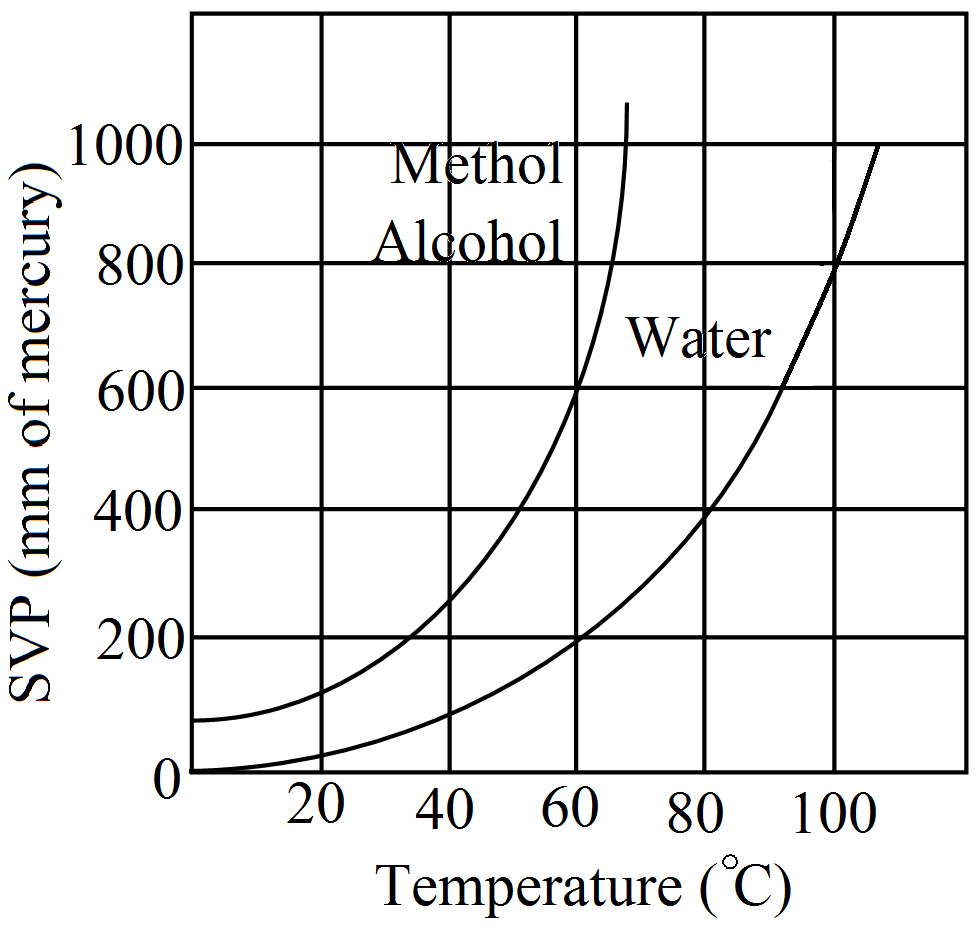
AnswerFrom fig. we draw $\perp\text{r},$ from Y axis to meet the graphs.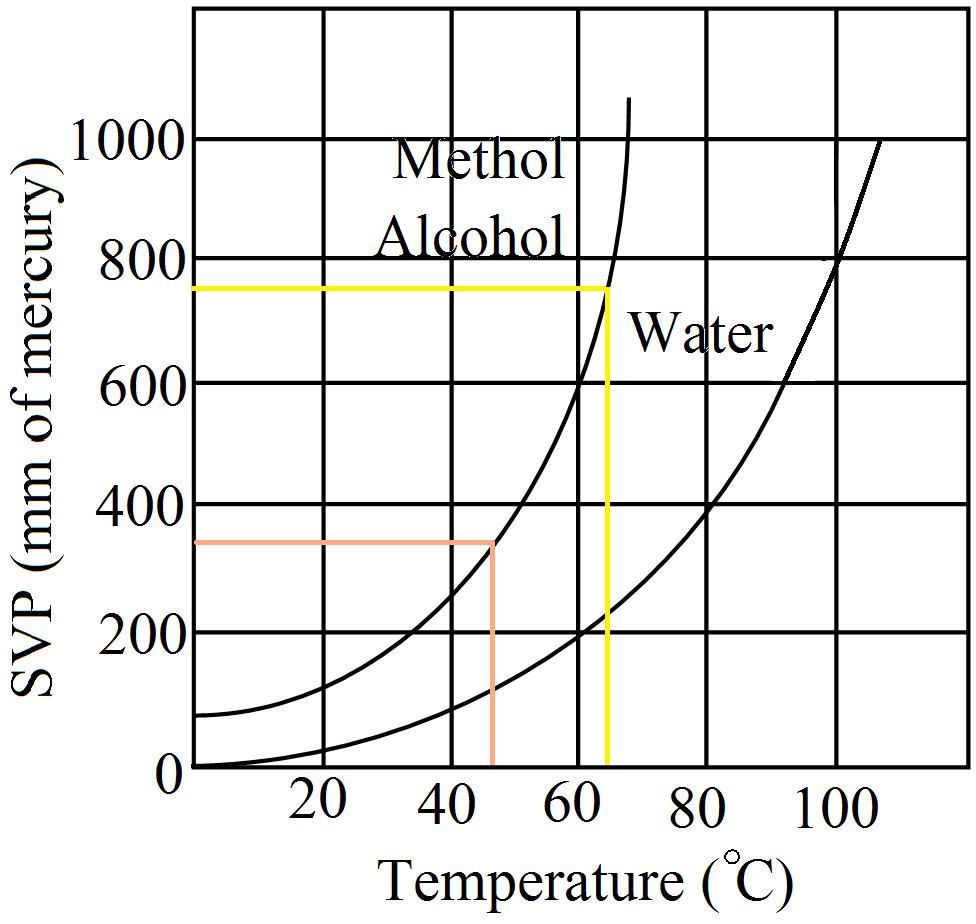
Hence we find the temp. to be approximately 65°C & 45°C View full question & answer→Question 402 Marks
What is mean free path of a gas molecule? On which factors does the mean free path depend?
AnswerMean free path $(\lambda)$ of a gas molecule is defined as the average distance travelled by a molecule between two successive collisions. It is represented by $\lambda.$
$\therefore$ Mean free path $(\lambda) =$ Mean velocity $\times$ Average time between successive collisions $\lambda=\frac{1}{\sqrt{2}\text{n}\pi\text{d}^2}$
Factors on which mean free path depends are:
- Number of molecules per unit volume of the gas $(n).$
- Diameter of the molecule $(d).$
View full question & answer→Question 412 Marks
The mean speed of the molecules of a hydrogen sample equals the mean speed of the molecules of a helium sample. Calculate the ratio of the temperature of the hydrogen sample to the temperature of the helium sample.
Answer$\text{V}_\text{avg}=\sqrt{\frac{8\text{RT}}{\pi\text{M}}}=\frac{8\times8.3\times300}{3.14\times0.032}$Now, $\frac{8\text{RT}_1}{\pi\times2}=\frac{8\text{RT}_2}{\pi\times4}$
$\frac{\text{T}_1}{\text{T}_2}=\frac{1}{2}$
View full question & answer→Question 422 Marks
Calculate the mass of $1cm^3$ of oxygen kept at STP.
Answer$\text{n}=\frac{\text{PV}}{\text{RT}}=\frac{1\times1\times10^{-3}}{0.082\times273}=\frac{10^{-3}}{22.4}$mass $=\frac{(10^{-3}\times32)}{22.4}\text{g}=1.428\times10^{-3}\text{g}=1.428\text{mg}$
View full question & answer→Question 432 Marks
Three vessels of equal capacity have gases at the same temperature and pressure. The first vessel contains neon (mono-atomic), the second contains chlorine (diatomic) and third contains polyatomic gas. Do the vessels contains equal number of molecules? Is the root mean square speed of molecules same in the three cases?
AnswerYes, according to the Avogadro's hypothesis, number in each case is same. No, rms speed of molecules is not same in three cases.$\text{v}_{\text{rms}}\propto\frac{1}{\sqrt{\text{m}}}$
$\therefore\text{v}_{\text{rms}}$ of neon with minimum mass is maximum.
View full question & answer→Question 442 Marks
State the law of equipartition of energy and using this find the relation for the total internal energy of a mole of monoatomic gases.
AnswerLaw of equipartition of energy: For any dynamical system in thermal equilibrium, the total energy is distributed equally amongst all degrees of freedom and the energy associated with each molecule per degree of freedom is $\frac{1}{2}\text{K}_{\text{B}}\text{T},$ is Boltzmann constant and T is temperature of the system. For monoatomic gas there are only three degrees of freedom. For a gas in thermal equilibrium at temperature T, the average value of translational energy of molecule is $(\text{E}_{\text{t}})=\Big(\frac{1}{2}\text{mv}^2_{\text{x}}\Big)+\Big(\frac{1}{2}\text{mv}^2_{\text{y}}\Big)+\Big(\frac{1}{2}\text{mv}^{2}_{\text{z}}\Big)$ Therefore energy associated with monoatomic molecule is $\frac{3}{2}\text{K}_{\text{B}}\text{T}.$
View full question & answer→Question 452 Marks
Find the number of molecules of an ideal gas in a volume of $1.000cm^3a$ at STP.
Answer$\text{n}=\frac{\text{PV}}{\text{RT}}=\frac{1\times1\times10^{-3}}{0.082\times273}=\frac{10^{-3}}{22.4}=\frac{1}{22400}$No of molecules $=6.023\times10^{23}\times\frac{1}{22400}=2.688\times10^{19}$
View full question & answer→Question 462 Marks
Calculate the ratio of the mean free paths of the molecules of two gases having molecular diameters 1 A and 2 A. The gases may be considered under identical conditions of temperature, pressure and volume.
AnswerMean free path$\lambda=\frac{1}{\sqrt{2}\pi\text{d}^2\text{n}}$
N = number of molecules per unit volume, d = diameter of moleculeas the condition for both gases are identiacal so n will be constant.
Or $\lambda\alpha\frac{1}{\text{d}^2}$
Or $\frac{\lambda_1}{\lambda_2}=\frac{\text{d}_2^2}{\text{d}_1^2}=\frac{(2)^2}{(1)^2}$
$\lambda_1:\lambda_2=4:1$
View full question & answer→Question 472 Marks
Calculate the mean free path of a molecule of a gas at a room temperature and one atmospheric pressure. The radius of the gas molecules (avg) is $2 \times 10^{-10}m$?
AnswerGiven, $T = 27^\circ C = 273 + 27 = 300K, P = 1atm = 1.01 \times 10^5N/M^2 d = 2 \times 2 \times 10^{-10}m = 4 \times 10^{-10}m$
$\because\text{Mean free path},\lambda=\frac{\text{k}_{\text{B}}\text{T}}{\sqrt{2}\pi\text{d}^2\text{p}}$
$=\frac{1.38\times10^{-23}\times300}{1.414\times3.14(4\times10^{-10})^21.013\times10^5}=5.75\times10^{-8}\text{m}$
View full question & answer→Question 482 Marks
Show that the slope of p-V diagram is greater for an adiabatic process as compared to an isothermal process.
AnswerAs in isothermal PV is directly proportional to 1. In adiabatic process, PV is directly proportional to 1. As in adiabatic process pressure varies the volume varies as its powers w.r.t pressure so it decreases with more slope.
View full question & answer→Question 492 Marks
Explain why cooking is faster in a pressure cooker.
AnswerAs in pressure cooker liquid is changed in to vapors and they increase pressure inside cooker as we know pressure is directly proportional to temperature thus temperature increases along with pressure thus food is cooked faster.
View full question & answer→Question 502 Marks
Shows plot of $\frac{\text{PV}}{\text{T}}$ versus P for $1.00 \times 10^{-3}kg$ of oxygen gas at two different temperatures. What does the dotted plot signify?
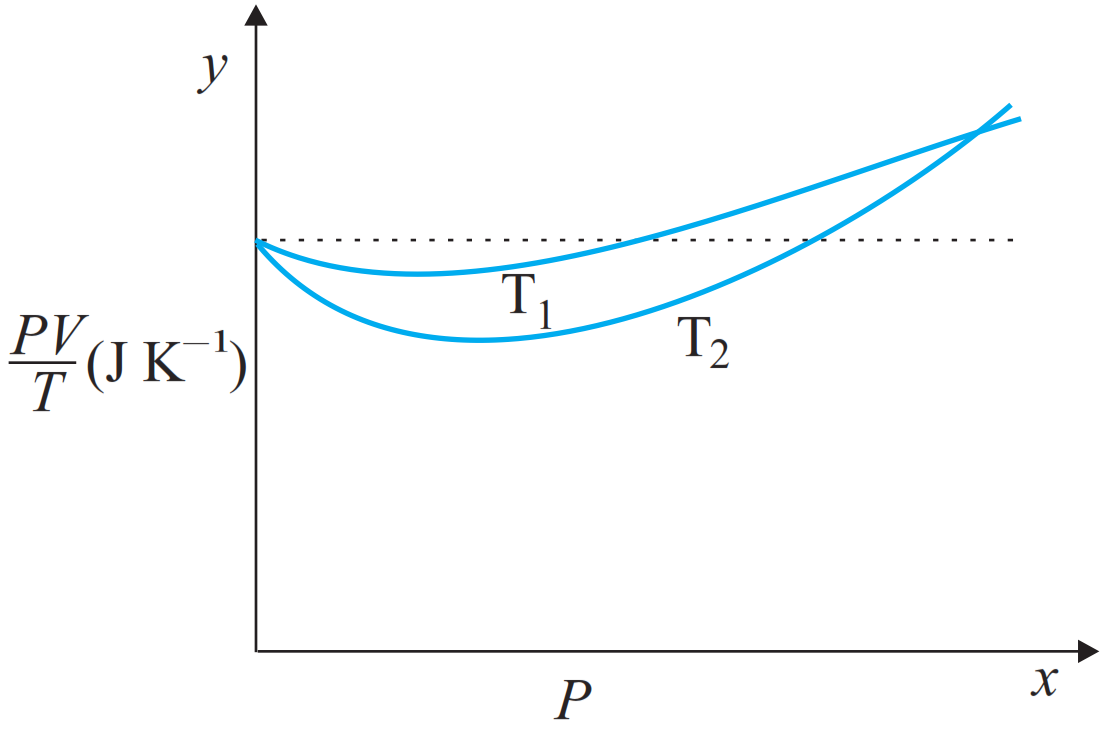
AnswerThe dotted plot in the graph signifies the ideal behaviour of the gas, i.e., the ratio $\frac{\text{PV}}{\text{T}}$ is equal. $\mu\text{R}(\mu$ is the number of moles and R is the universal gas constant) is a constant quality. It is not dependent on the pressure of the gas.
View full question & answer→Question 512 Marks
Explain the phenomenon of evaporation on the basis of kinetic theory.
AnswerAccording to kinetic theory, molecules of a liquid are in a state of continuous random motion. The molecules near the surface of liquid may have enough K.E. so as to overcome the intermolecular attraction of other molecules on the surface and hence manage to escape. Such molecules would move around freely in the space above the liquid. This is the phenomenon of evaporation which may occur at all temperatures.
View full question & answer→Question 522 Marks
Find the ratio of the mean speed of hydrogen molecules to the mean speed of nitrogen molecules in a sample contammg a mixture of the two gases.
Answer$\text{V}_\text{avg}=\sqrt{\frac{8\text{RT}}{\pi\text{M}}}$$\frac{\text{V}_\text{avg}\text{H}_2}{\text{V}_\text{avg}\text{N}_2}=\sqrt{\frac{8\text{RT}}{\pi\times2}}=\sqrt{\frac{\pi\times28}{8\text{RT}}}=\sqrt{\frac{28}{2}}=\sqrt{14}=3.74$
View full question & answer→Question 532 Marks
Shows plot of $\frac{P V}{T}$ versus $P$ for $1.00 \times 10^{-3} \mathrm{~kg}$ of oxygen gas at two different temperatures: Which is true, $T_1>T_2$ or $T_1<T_2$ ?
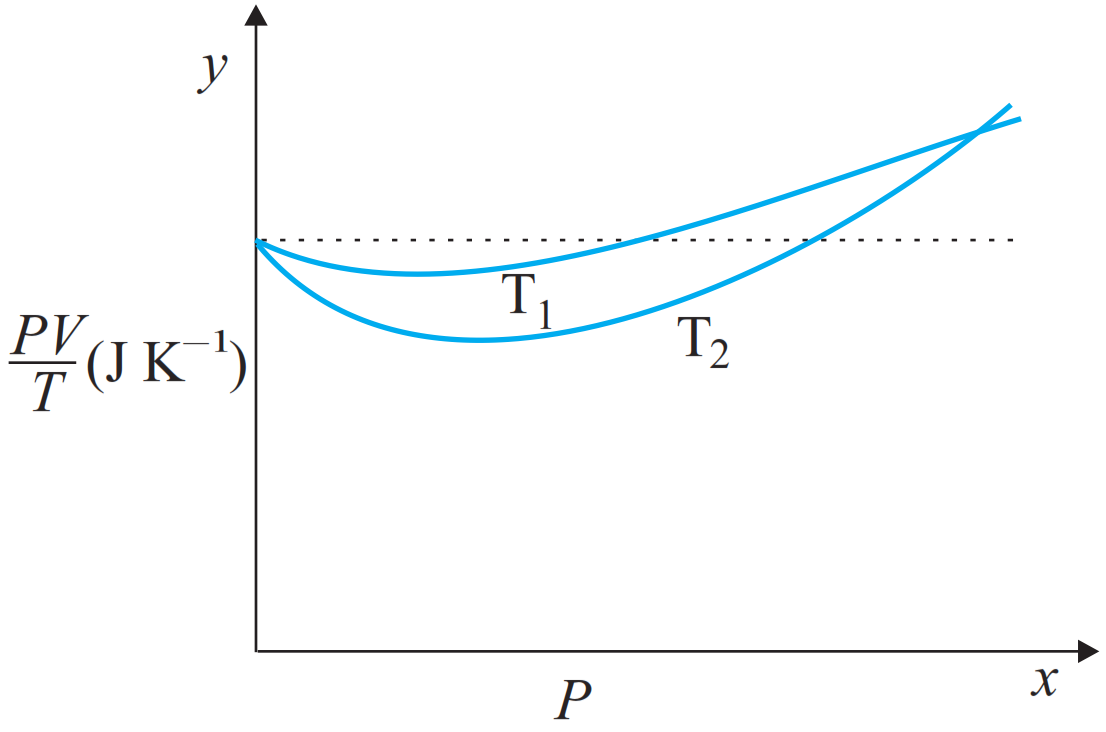
AnswerThe dotted plot in the given graph represents an ideal gas. The curve of the gas at temperature $T_1$ is closer to the dotted plot than the curve of the gas at temperature $T_2$. A real gas approaches the behaviour of an ideal gas when its temperature increases. Therefore, $\mathrm{T}_1>\mathrm{T}_2$ is true for the given plot.
View full question & answer→Question 542 Marks
Figure. shows a cylindrical tube of cross-sectional area A fitted with two frictionless pistons. The pistons are connected to each other by a metallic wire. Initially, the temperature of the gas is $T_0$ and its pressure is P, which equals the atmospheric pressure. (a) What is the tension in the wire? (b) What will be the tension if the temperature is increased to $2T_0$?

Answer$\frac{\text{P}_1\text{V}_1}{\text{T}_1}=\frac{\text{P}_2\text{V}_2}{\text{T}_2}$$\Rightarrow\frac{\text{P}_0\text{V}}{\text{T}_0}=\frac{\text{P}'\text{V}}{2\text{T}_0}\Rightarrow\text{P}'=2\text{P}_0$
Net pressure = $P_0$ outwards
$\therefore$ Tension in wire = $P_0A$
Where A is area of tube.
View full question & answer→Question 552 Marks
Calculate the molecular K.E. of 1 gram of Helium (Molecular weight 4) at $127^\circ C$. Given $R = 8.31J mol^{-1} K^{-1}$.
AnswerT = 127 + 273 = 400K Average K.E. per mole of Helium $=\frac{3}{2}\text{RT}$ Average K.E. of I gram of Helium$=\frac{3}{2}\frac{\text{RT}}{\text{M}}=\frac{3\times8.31\times400}{2\times4}$
$=1246.5\text{J}$
View full question & answer→Question 562 Marks
The ratio of specific heat capacity at constant pressure to the specific heat capacity at constant volume of a diatomic gas decreases with increase in temperature. Explain, why.
AnswerWe know $\gamma=\frac{\text{C}_\text{p}}{\text{C}_{\text{v}}}=1+\frac{2}{\text{f}},$ where f is the degree of freedom of a diatomic gas. The degree of freedom of a diatomic gas increases with the increase in temperature, so γ decreases with increase in temperature.
View full question & answer→Question 572 Marks
Estimate the fraction of molecular volume to the actual volume occupied by oxygen gas at STP. Given the radius of oxygen molecule as $3\mathring{\text{A}}.$
AnswerRadius of oxygen $=3\mathring{\text{A}}=3\times10^{-10}\text{m}$ Volume of each oxygen molecule $=\frac{4}{3}\pi\text{r}^3$$=\frac{4}{3}\times3.14\times27\times10^{-30}$
Molar volume at STP $=2.24\times10^4\text{m}^3,$$\frac{\text{Molecular volume}}{\text{Volume of gas}}=\frac{6.023\times10^{23}\times\frac{4}{3}\pi\text{r}^3}{2.24\times10^4}$
$=\frac{680.8\times10^{-7}}{2.24\times10^4}$
$=304\times10^{-11}$
View full question & answer→Question 582 Marks
A cylinder of fixed capacity 44.8 litres contains helium gas at standard temperature and pressure. What is the amount of heat needed to raise the temperature of the gas in the cylinder by $15.0^{\circ} C ?\left(R=8.31 J mol ^{-1} K ^{-1}\right)$.
AnswerUsing the gas law $P V=\mu R T$, you can easily show that $1 mol$ of any $($ ideal $)$ gas at standard temperature $(273 K )$ and pressure $\left(1 atm =1.01 \times 10^5 Pa \right)$ occupies a volume of $22.4$ litres. This universal volume is called molar volume. Thus the cylinder in this example contains $2 mol$ of helium. Further, since helium is monatomic, its predicted $($ and observed $)$ molar specific heat at constant volume, $C_V=(3 / 2) R$, and molar specific heat at constant pressure, $C_p=(3 / 2) R+R=(5 / 2) R$. Since the volume of the cylinder is fixed, the heat required is determined by $C_V$. Therefore,
Heat required $=$ no. of moles $\times$ molar specific heat rise in temperature
$=2 \times 1.5 R \times 15.0=45 R$
$=45 \times 8.31=374 J .$
View full question & answer→